Category: Taxes

  • From Asteroids to 3-Day Weekends

    I’ve had some thoughts on how our civilization should already be having 3-day weekends at the least, in perpetuity. Usually these thoughts are output from a brain lubricated by adult beverages, and are spouted to others likely lubed, who assure me that I make complete sense. Sober reflection on these ideas has not been easy, putting them in some kind of logical order nearly impossible. A stream of consciousness is my best option, as usual…

    I often wonder why, as time has slugged along, with all the labor saving technology and increased division of labor, we went from single income households to dual, rather than to the lone-breadwinner-of-yore’s having to work less hours while maintaining his/her/their/its standard of living? How do we convert our technological advances into the laid back, gold backed, paradise of a Galt’s Gulch, sans the holographic projection head in the sand BS?

    Given, we have better standards of living and more stuff now than “back in the day” – cell phones, video games, computers, jet skis, etc. – and most everything is now generally safer and better and thus more expensive relatively. Is that solely what’s taking up my extra money, money that could be converted to leisure time? Of course not.

    There’s insurance, that oft mandated fave of crony capitalists, to use as a tool to transfer wealth to the unproductive. We all know the obvious fixes for that mess.

    There are the insane levels of gubmint spending, most of which go to unnecessary bureaucracy. It’d probably be cheaper just to put all those leeches on welfare rather than making shit up for them to do. Or just eliminate the jobs. Either way, if I had only to pay 10% in income taxes rather than 30%, I’d be freed from 2.7 months of slave labor each year! That should at least allow me to work 4 days per week as opposed to 5. 3 day weekends achieved!!!

    And I imagine the end of scarcity economics, especially with the upcoming mining of asteroids. As the prices of things decrease, will we just consume more, buy even more stuff to utilize our disposable income? Will gubmint reg’s increase and the cost of things go right back up with them? Will the gubmint tax/enslave us more, knowing the productive can afford it when the prices of goods are falling? Will we keep the productive peeps working the status quo 40+ hours a week while the headcount of welfare recipients rises as less and less labor is needed to keep civilization running?

    Most likely, the answer would be a combination of all, as the various ambitious incompetents hustle to jack their pie.

    In this context, I could see a Universal Basic Income as an interim step to spreading out the leisure that should come from the end of scarcity economics and from ever increasing productivity, until the prices of life deflate and a new economy is normalized. This however, assumes our society would recognize that a new economic situation was evolving into existence; and that *leisure time, rather than wealth, should be distributed.*
    (Not to say that anything *should* be distributed, as in forced, but getting from hither to thither, from our current situation to Libertarian paradise, naturally wouldn’t happen instantaneously.)

    As I see it now, my increased productivity – due to whatever factors – doesn’t result in my having to work less hours. The nonproductive, via gubmint sanctioned/administered theft, are taking it and converting it into leisure time for themselves. I want it back!!!
  • Illinois- Why We’re Well and Truly Fucked

    In thermodynamics, we have three laws, which can be popularly and accurately summed up as follows:

    First Law: You can’t win, the best you can do is break even.

    Second Law: You can only break even at absolute zero.

    Third Law: You can’t reach absolute zero.

    And that sums up Illinois’s finances. I spent a day reading through some wonderful and depressing information at the Illinois Policy Institute’s website (www.illinoispolicy.org) and would suggest you do the same, even if you aren’t stuck here like I am: it’s a cautionary tale. I’m just going to toss out a few illustrative highlights I’ve dug up there, which will (I hope) inspire people to look further. And it gave me some good rocks to throw (metaphorically) at our Assembly candidates.

    Illinois’s woes are legendary, numerous, and well-documented. I’m simply going to list a few highlighted facts, which lead to the unfortunate and inevitable conclusion: we’re spiraling down the toilet and there’s no way to stop it. The root causes are baked in and, as a practical matter, immutable.

    As you’d expect from a state known as The Cradle of Graft, there’s an amazing amount of money lost to corruption. I found story after story showing hundreds of millions of dollars wasted in useless projects, subsidies, payoffs, kickbacks, legal expenses for police abuse, you name it. But all of that doesn’t even make page one of the Pareto chart.

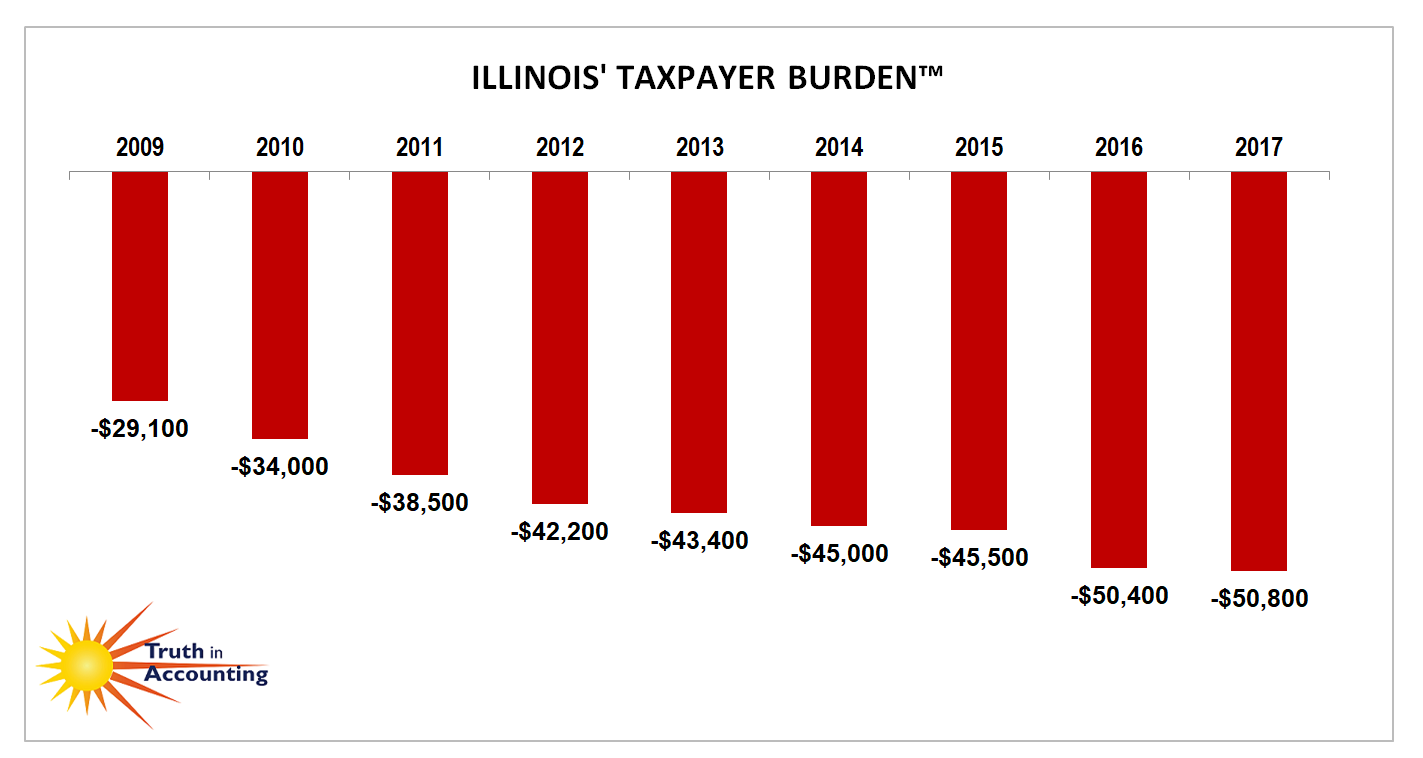
    Illinois’s debt is over $200 billion, with state assets of about $20 billion, and this doesn’t even count local debt, which adds another $100 billion onto the flaming pile. This breaks down to over $50,000 for each and every taxpayer in the state. So you can see that the Three Stooges of How We’re Going to Fix Things beloved of politicians giving speeches (“Waste, Fraud, and Abuse”) are down in the noise; $100 million dollars doesn’t scratch the surface. The tax increases that have been proposed (which will somehow magically not drive people and businesses out of the state at a faster rate than they’re already exiting) aren’t even close to enough to cover this debt.

    Well, how about cutting spending? Let’s look at that a bit, starting with what we’re spending the money on.

    Far and away the biggest cause cause is well-known: public employee pensions and health insurance benefits costs. How bad is it?

    Here’s a delightful graphic which just looks at one typical municipal issue, cops.

    Though there’s variation from county to county, the pattern remains the same.

    How about fire?

    So again, the pattern is clear. If we cut every single penny of cops and fire protection spending, closed every police stations and fire house, and could somehow get around the unions and fire every worker, we would STILL be vastly underwater. There’s nothing unique here; there’s similar charts for teachers, nurses, clerical, administrative, and every other type of state leech employee classification.

    The debt, pension and health insurance costs for retired state workers represent over $185 billion, or about 85% of the Illinois debt. It cannot be stressed enough: this is for people who are no longer working. You could fire EVERYBODY currently employed, cut every goddam program (good or bad), shutter every building, and barely dent the issue. These deals were put in place by the generations of family politicians who have run the state and municipal governments, the Daleys, the Madigans, the Stevensons, the Simons, the Jacobs… all enriching themselves and their hangers-on, while pulling hundreds of millions from the fabulously corrupt unions to indebt all the rest of us.

    So since we can’t tax our way out, we can’t reduce spending enough to make a difference, I guess there’s only one thing left to do: cut the pensions. Oh wait…

    Membership in any pension or retirement system of the State, any unit of local government or school district, or any agency or instrumentality thereof, shall be an enforceable contractual relationship, the benefits of which shall not be diminished or impaired.

    The above is Article 13 Section 5 of the Illinois Constitution. That’s right, it’s in the fucking constitution that we can’t touch the vast bulk of where the money is pouring out. If you want to cut even a dime of the vast sums of money being spent on people who aren’t working , you have to amend the constitution. To do that, there must be an affirmative vote of 2/3 of the House of Representatives and the Senate AND then be approved by a majority of voters on a special election ballot, most of whom do not pay the bulk of taxes. This is de facto a nearly impossible hurdle.

    So we can’t win, we can’t break even, and we can’t get to absolute zero debt. The politicians running who pretend to have ways to fix things and to help taxpayers and property owners are lying scumbags. We are all fucked. Like so many others, I’m doing everything I can to get the hell out of here.

    I will not miss this place.


  • What Are Rights? A CPRM Framework

    This is the first in a series to discuss my Constitutional Property Rights Minarchist philosophy. I will take a look at each element individually before putting it all together. I figured I would start off with the nature of rights because that takes two of the CPRM parts off the table at once. This is because all rights are derived from property rights, which I aim to show through this thesis.

    So, what exactly is a right? Is a property right different than a human right? Is the right to keep and bear arms different than the right to free speech? Where do rights come from anyway? I bet they were just made up by some old dead white guy, so they don’t matter. Most of what I’m about to say is probably old hat to most of the readers, but I decided to lay it all out just to make sure before I get to the big picture.

    One note on rights off the bat (I like to reference pop culture) my favorite quote on rights actually comes from the band Powerman 5000 in their song ‘Free‘.

    It’s not something you can hold
    It’s not something you own
    It’s not something you can buy or steal
    You’ve got it when you’re alone”

    A right is something you have regardless of where or when are born. To hit on the points above, it is a human right. Just by being human these are the rights you posses (why they’re limited to humans will be addressed later on). Well, if it doesn’t matter where or when you are born, then that means certain things can’t be rights. A person born where there is no water can not have a right to it, otherwise that ruins the whole idea that it is inherent in being human, unless you wish to posit people born in a desert are not human, but that would be awfully racist of you. For shame. I think you need counseling to deal with your racism. But you aren’t important, the idea is. So I digress. What other things can a human be born without that some call rights? Well the big one today is healthcare. But that is an even more resource intensive thing than water, I mean we could all spare some water, but there are only a limited few to provide healthcare. That would mean that to provide healthcare to masses would be to compel certain people to provide it. Another thing, which is written into the South African Constitution, is housing. Well, if you have a right to housing, that is also something someone else must be compelled to provide. I keep coming back to that word, don’t I. Compelled. It sounds so innocent. But what does that really mean? Let’s check Dictionary.com

    com·pel

    kəmˈpel/

    verb

    past tense: compelled; past participle: compelled

    1.force or oblige (someone) to do something.

    “a sense of duty compelled Harry to answer her questions”

    synonyms: force, pressure, press, push, urge; More
      • bring about (something) by the use of force or pressure.

        “they may compel a witness’s attendance at court by issue of a summons”

      • literary

        drive forcibly.

        “by heav’n’s high will compell’d from shore to shore”

    Oh, gosh that sounds violent. By use of force?

    No, we’ll just make a law about it.

    How will that law be enforced?

    Well by a tax, or a program.

    And if people don’t comply?

    Well, they’ll get taken to court and fined or put in jail!

    And if they don’t show up to court?

    They’ll show up.

    But if they don’t?

    Well, the cops will make them.

    How will they do that?

    Listen man, people do what cops say.

    And if they don’t?

    Then the cops make them.

    How?

    They just do.

    Is it the fact the cops ask nicely or the fact that they have guns?

    You’re killing my buzz man, leave me alone!

    So to go back to the beginning. Yes it is the old ‘private island’ thought experiment, but with a small change. It’s not an Island, but any place on earth where the first humans were the first intelligent beings to move to (that intelligent beings bit will come back on my promise of why they are human rights). Ug shows up with his sharp stick and his loin cloth in lower Mongolia. When he gets there what does he own? Well, of course he owns his own body, he is a slave to no man, and ownership of everything else extends from his self ownership. And that sharp stick, he found it and chewed it for miles to sharpen it. The loin cloth, well he stole that, so that’s a bit more complicated on the ownership front. So he arrives in lower Mongolia and there is nothing there. There is like this one pissed off falcon circling overhead and Ug saw some wild dogs a hundred miles ago. But that’s it. So Ug decides he’s tired of roaming sits his ass down and says ‘shit, fuck this Ug build himself house!’ There aren’t many trees around, but Ug finds enough to build a frame for a rough stone age yurt. He then hunts enough animals and tans enough leather to to finish his new domicile. Ug found some wild grains and harvested the seeds, carefully planting them and tending to his new garden. Then a wild goat shows up, he grabs it and builds a nice pen. The goat provides him with milk to make up for the absence of an accessible source of water. Months pass and Ug has made a nice little home for himself. Then that asshole Ur shows up.

    You goat be mine. You house be mine!

    No me house mine!

    No, me Ur be mine!

    No, me Ug be mine!

    After a tense stalemate. Ur makes an offer to Ug.

    Me know how make fire!

    Me know how milk goat!

    Me want milk!

    Me want fire!

    Me give you fire for milk!

    Me give you milk for fire!

    Me take your house!

    Me give you place to build house, if you give me hard rock!

    Me give you hard rock, if you build me house!

    And that is the right to contract. Ug created things that were not there when he arrived, and owned those as well as himself. Ur owned a rock which Ug wanted, so they traded. I know this is all farcical, but these are the underpinning ideas. You own your own body. You own the fruits of your labor, which you may trade for payment (today we call this going to work). But you know who doesn’t have any rights? Animals. You know why? It’s not because I’m racist against animals, believe me I have lots of animal friends. No, it’s because animals don’t understand rights. That is an important concept. To you this whole diatribe while slanted and farcical, is something you can understand. If I tell you this is mine and that is yours, that is a concept a human can grasp by the age of three. If you try telling that to a 100 year old tortoise it will still just eat your lettuce and shit on your floor. Tortoises are assholes.


  • The Problem with Aggregation, Part 1 of an.. Aggregation

    I am not a number!  I am a free man!” So begins one of the filler songs on one of the top 5 metal albums of all time.  But I come here today not to extol the virtues Bruce Dickinson or to ruminate on the fact that galloping bass-lines are best bass lines.

    No, today I’m here for something much more interesting – Math!

    Let’s take a look at second grade arithmetic.  Here’s a refresher on the equivalence properties of equality:

    • The Reflexive Property tells us that an A is (equal to) an A.  Oh, now I’m sad again.
    • The Symmetric Property tells us that if A is equal to B, then B is equal to A.
    • The Transitive Property tells us that if A equals B, and B equals C, then A equals C.

    Pretty straight forward, and if you want to do arithmetic or algebra, these are the rules that let you do it.  But there are a lot of assumptions built into. For example, you can expand the Transitive Property of Equality to generate the Transitive Property of Inequalities, such that if A is less than B and B is less than C, A is less than C.

    And that is useful and intuitive too.  You can do some nice arithmetic and algebra with that too.  But like both my graduate-level math classes and my collected works of HP Lovecraft reminded us, there is more to this universe than nice reasonable Euclidean space.

    Take football.  If Directional State beat Poly A&M last week, and Poly A&M beats Costal U this week, stands to reason Costal U has no hope against Directional State next week, right?  After all, if DS > P A&M and P A&M > CU, so we know DS > CU. Just stands to reason, Transitive Property and wot not. All us learned gentlemen can see this.

    And a any sports fan knows… That’s not the way it works.  CU beats DS in, what, 35% of the games under this scenario?

    It’s almost like you can’t apply the Transitive Property to a model when in reality it doesn’t apply. You can’t just apply theoretical rules, you have to look at the real universe and see if they apply before you can incorporate them into your model.

    So let’s move to another domain and see if all the rules of basic arithmetic apply.  A man, a woman, and their kid are going backpacking. Weight is the limiting factor, they can walk until any one of them is worn out.  In a universe that is perfectly fair, but stupid, they all would carry the same load. In the real world, the kid would carry a day of food, a day of water, and emergency supplies.  The woman would carry a bit more, and the man would carry the most. They then hike farther than in the stupid and fair world. Thus, the transitive property holds true in this model.

    Here’s my first assertion for this series of articles: Assuming arithmetical property where they don’t actually exist in humanity is the root of most evil these days.

    One place that it shows up* is in macroeconomics.  Specifically, I’m thinking of the study of optimal tax policy.  This is the study of how to structure taxes to maximize utility.  Assuming arguendo that taxes will be a thing, how do you structure them so that the most good / least bad is done by them.  There’s a lot of math, behavior economics, etc that goes into these analysis.  And there are some beautiful curves telling you how to structure a tax policy.

    And they are always wrong.

    No galloping bass-lines here. Move along.

    They all boil down to how much can I rob Peter to pay Paul.  If a tax structure results in Peter having -3 happy points and Paul getting +5 happy points, that’s a net of +2 happy points.  So that’s a winner right? (I’m going to call “happy points” by their common made up name, utils.)

    No.  There is no +2 utils floating around as the product of aggregation.  There isn’t Peter+0 and Paul+2.  There is only Peter-3 and Paul+5. This leaves a pissed off Peter and a Paul who is going to get trained in the fine art of rent seeking.  Take it too far, and the Peters revolt. Take it too far the other way, and Paul becomes a parasite on society. Keep it right in the middle, and you can divide and conquer Peter and Paul for their votes.

    Why does aggregation work for the backpackers and not for the taxpayers?  Distance. Emotional distance, to be precise.

    The backpackers are a family, but that was just an excuse to use a kid in the example.  They could be a group of friends out for vacation, or a firm out to find gold in them thar hills.  Human nature says that those we care about are those closest to us. Its

    Adam Smith was probably into galloping bass-lines too, but we’ll never know.

    normal for you to care about yourself.  Adam Smith has a great example about a man in Europe facing the loss of his finger and hearing about an earthquake in China.  Which one does he care about more?  The finger, even though he would know that that’s nothing compared to hundreds of deaths.  It sounds cruel and heartless, but that’s just utopian thinking. In the real world, we all can identify with this idea. The closer you are to someone else, the more you care about them.

    You might even care enough to take on their burden to make their life easier.  In the real world, a parent would pay -3 utils to see their kid get +5 utils. The transitive property works because there is an emotional bond there.

    But there are 300 million people in America.  Any random American can only have a personal relationship with maybe a few dozen of them.  Any system that assumes the aggregation utils among all Americans is going to be a cock up.

    So ok, there’s one mathematical model with this flaw.  Hardly the root of all evil. Well, step out of the math and into the real world.  Race. Class. Religion. Political Party. These are all aggregation techniques. On rare occasions they are useful mental shortcuts.  In most cases, they just erase the individual in your mind and replace them with a cardboard cutout called up from your own mental Hollywood. All cops are violent. All Southerners are racists.  All progressives are stupid. All intellectuals are out of touch and dangerous.

    These are common errors in thinking.  And they are the root of all major humanitarian disasters of the last century.  Except it was all blacks being violent, let’s roll out the drug war. All reactionaries are racists, let’s roll them off to the gulag.  All low-income female workers are stupid, let’s sterilize them. All intellectuals are a danger, let’s hunt them down.  The pattern repeats itself, and as we’ve seen, this pattern is dangerous.  Any pattern that could lead to genocide, mass sterilization, or the drug war should be cut off before it can get anywhere near this scale of disaster.

    So I hope here to have laid out a case that aggregation doesn’t apply on the large scale.  But for individuals, they can have it apply to themselves and their small circle.  This error is complex, but it reaches into some of the worst events in living memory. In the next article, I’ll discuss how a person could harness this insight to make themselves a better person.  And in a twist that I’m sure would make all of you Jordan Peterson fans with clean rooms interested, this technique doesn’t require any change from anyone but yourself.

  • Jeffery David Sachs Is a Sanctimonious Prick

    O, what a marvel it appeared to me,
    ⁠When I beheld three faces on his head!
    ⁠The one in front, and that vermilion was;
    Two were the others, that were joined with this
    ⁠Above the middle part of either shoulder,
    ⁠And they were joined together at the crest;
    And the right-hand one seemed ‘twixt white and yellow;
    ⁠The left was such to look upon as those
    ⁠Who come from where the Nile falls valley-ward.
    Underneath each came forth two mighty wings,
    ⁠Such as befitting were so great a bird;
    ⁠Sails of the sea I never saw so large.
    No feathers had they, but as of a bat
    ⁠Their fashion was; and he was waving them,
    ⁠So that three winds proceeded forth therefrom.
    Thereby Cocytus wholly was congealed.
    ⁠With six eyes did he weep, and down three chins
    ⁠Trickled the tear-drops and the bloody drivel.
    At every mouth he with his teeth was crunching
    ⁠A sinner, in the manner of a brake,
    ⁠So that he three of them tormented thus.
    To him in front the biting was as naught
    ⁠Unto the clawing, for sometimes the spine
    ⁠Utterly stripped of all the skin remained. ⁠

    The Divine Comedy, Canto 34, lines 37-60 (Alighieri, trans. Longfellow, 1867)

    Today, in an op-ed penned for CNN, Jeffery Sachs reminded all and sundry that he is an vile, unrepentant prick. As the avatar of the demoness Abyzou made manifest in flesh, Sachs used his op-ed as an opportunity to weave the textual fabric of self-righteousness to clothe the emaciated and decrepit form of his morality. Having donned the cloak of sanctimony, Sachs proceeded to list the ways in which he would use armed violence to redistribute the wealth of Bezos, Zuckerberg, Page, Brin, and Gates to satisfy his own prerogatives.

    Sachs, in all his munificence, states that he would first give these robber barons of the Silicone Age the opportunity to “voluntarily” donate 1% (and who among us could argue with a mere one percent?) of their net worth per annum, but admits that “when they don’t, governments should put on a 1% net worth levy to fund the basic health and education needs of the world’s poorest people.” Not content to employ the legal monopoly of violence held by government to strong-arm Elon Musk into giving up his rocketships, (and by “strong-arm” I mean “asphyxiate for not paying taxes” all Eric Garner-style) Sachs concluded his jeremiad with the dire prediction that the Neanderthal-browed, proletarian mob, having been whipped into frenzy by the populist murmurings of Donald Trump, will storm the campuses of SpaceX and Blue Origin looking for blood:

    The mega-rich expect the adulation of the masses and often get it. Yet the forbearance of society for the antics of the mega-rich will soon wear thin. Too many people are suffering, too many lower-skilled workers are losing their jobs and earnings, too much wealth is being frivolously squandered, and too much power over our lives is being asserted by big tech and other corporate giants.

    Donald Trump channeled the rising unhappiness into his electoral victory, but his trade wars and tax cuts for the rich only widen the divide. Real answers depend on redirecting the mega-wealth towards those in urgent need.

    Nevertheless, like a mafioso “convincing” a shop owner to contribute to his protection racket, Sachs offers us a way out, “[f]or those who don’t do so voluntarily, governments should put a levy on mega-wealth.” Let us be mindful, however, that when we pay indulgences to the Church of Sachs, what constitutes “mega-wealth” would be, of course, determined by its high priest: Jeffery David Sachs, the Quetelet Professor of Sustainable Development at Columbia University’s School of International and Public Affairs and Professor of Health Policy and Management at Columbia’s School of Public Health. Oh, what burden must rest upon his wrinkled brow! How fortunate are we to be living in an age where we can hear, from his honeyed lips, the pronouncements of our philosopher-king, Sachs! Indeed, have no fear! For once we have achieved Sachsian utopia, he assures us that “there will be enough time and wealth to reach for the stars.”


    In the ancient mythology of Mediterranean and Mesopotamian cultures, envy was thought to manifest as harm to the person envied through the “evil eye.” Indeed, the Latin word for envy, “invidia” originates from the verb “invideo“(i.e., in+video); literally meaning “to look into/against”, but having the connotations of “being envious of,” being prejudiced against,” or “wishing harm upon.” To combat the baneful influence of the invidious evil eye, people in these cultures wore protective amulets. (And many still do!) One of the most common and powerful amulets against the evil eye was known in Latin as a fascinus.

    Pictured: An example of a fascinus.

    While our cultural mores may have fallen so far that we may scratch our heads over the import of a flying phallus creature, our ancestors knew that this is a perfect example of sympathetic magic, that is ‘like produces, or wards off, like’. And what better way to combat giant pricks like Jeffery Sachs than with a giant prick?

    Having read this article, you may, perchance, wish to purchase a fascinus. If so, you may start here. And if you have less propriety than I do, you may wish to use this as your shipping address.

    And, if you found this article fascinating, there’s a reason for that.

    Pictured: Glibertarians.com Founder Action Figures (L to R – OMWC, Swiss Servator, jesse.in.mb). Available at the Glibertarians.com Gift Shop: Collect them all!
  • Funding Libertopia – a gedankenexperiment

    Introduction

    For those of you of an AnCap mindset, this article is probably not of much benefit. But for those of us that think a minarchy is necessary (and sufficient), the discussion of how to fund a micro-state is of more interest.
    Also, yes, this will be, in large part, a discussion of the Single Land Tax (SLT.) This is not the article on the SLT that I promised a year ago, but this is the one you are going to get. At least for now.

    Recent discussions of the SLT have got me thinking in different ways and led me to what I needed to do. it’s the answer to almost every problem: DO THE MATH

    The Auction

    I. Let us start with the premise of this thought experiment. A group of libertarians discovers a previous unfound island or planet or whatever. Either way, whether on sea or through space, I am pretty sure the ship is named Der Sausagefest. This land is entirely undeveloped. Their established minarchy will never spend any money it does not already have in its coffers. The land needs to be divided in a just manner. So they decide: We will divide the land into parcels and auction off the parcels. However, the auction won’t be for the price of land, the bidding will be the amount of land tax you (or any future owners) are committing to pay on the parcel each year going forward for all eternity. The land itself will be free, and come with complete property rights, except for being encumbered with the tax.

    There shall be one exception to the eternal nature of the tax: if the owner wishes to, he may forfeit the property back to the state for re-auctioning. He may decide the tax is too damn high and try to “buy” It back at a lower tax. Or he may just decide he doesn’t want it. Whatever.

    The libertopian state will have a fixed income based on the initial auction. As it is sensible, the currency will be something like gold that is stable over the long term and so inflation won’t be a problem.

    II. Why an auction for the tax amount instead of selling the land? Technically, they are the same thing. The price you would pay is equal to the present value of the future cash flows of the property. And the same for the tax stream, the amount you are willing to bid is a stream with the same present value. But I can think of 3 reasons that the tax is better than an upfront cost:

    1. I don’t trust any state, even libertopia, with a large sum of money. Better to give them an annual income than a lump sum.

    2. While the state could turn around and invest the money, generating the same income stream as the tax, that involves the state choosing investments. We have seen how well that kind of thing works with CalPERS, for example. We don’t want the state choosing winners or losers or getting some PC thing going and divesting from the hookers and blow industries.

    3. This one is a little weird, and if you want to discount it, so be it. But the make-up of the initial libertopians may be diverse. Some will be flush with cash, others may be poor. While the poor could get a mortgage to pay the initial cost, that adds a level of risk that would lead to lower bidding by them. I find the stream payment to be more equitable.

    I see the obvious argument against the tax vs initial purchase price idea. The former is effectively an eternal mortgage, while the latter is over and done with. But as they are mathematically equivalent, I don’t see that as an actual issue. As I said in the introduction, we have to do the math.

    Application to Real Life

    I. None, probably. But I was thinking about it for two reasons. First, the recent discussion in which UCS and RCDean questioned the reality of imputed value. The fact that someone will pay for undeveloped land shows that imputed value or economic rents or whatever is a real thing. Even in my scenario, people would bid a positive amount for the plots, which implies that the imputed value is, in fact, a real thing that they do value.

    The second, and possibly more important, reason was that I have been thinking about what a land tax would due to the resale price of unimproved land. I came up with an answer but didn’t really like it. Hence, I had to do the math. And this gedankenexperiment was the result of that. A properly valued land value tax that was exactly at the value of the economic rents (no more and no less) would reduce the resale price of unimproved land to zero.

    That isn’t actually a real life situation though, as “unimproved” land is all but non-existent. Think about an empty lot in a neighborhood. Is it unimproved? Does it have a road bordering it? That is an improvement that increases the value of the land. So is a functioning court system. And deeds that can be trusted. And national defense. While they aren’t DIRECT improvements to the land, they all increase the value of the land. Being secure in your ownership is an improvement.

    In fact, it might even be a flaw in my gedankenexperiment. The landing of the spaceship Sausagefest may have improved the land. But it’s a small enough improvement that I stand behind the results.

    II. So how do we get from here to there? We really can’t. Without a tyranny, we can’t take all the land and auction it off. The land has improvements anyway. It would take a series of nukes to unimprove the land. The good thing about the auction was it valued the land tax properly. If we implemented one, it wouldn’t be done that way. A rate would be set, valuations would be calculated, and a crappy fiat money system would be used that wouldn’t allow anything like a stable pricing system. Humans would be involved and they screw everything up. Plus, people did pay for their land, and some of them oppose the idea of having to pay rent on it forever, too. Even if it did mean getting rid of every other form of taxation. Like any change in the tax system, there would be winners and losers (even if overall taxation was cut to a level that we won big overall), which is why it is so hard to make a change.
    The Georgist Single Land Tax is a utopian fantasy. And I still favor it over the current system or any other anyone has proposed.

  • Tax Relief, Hollywood Edition

    Thanks to an unusually eclectic set of parents, I was raised on classic cinema- my father always said that he knew he had acculturated me correctly because I was the only kid my age who knew who Spring Byington was. Of all the great movies we watched, I always favored Frank Capra’s. The themes were all different, but had a certain commonality of the Little Guy rising despite the entrenched forces of corruption. His vision of America is one that I came to adopt, a place where opportunity was there for those willing to grab it, a vision informed by his own experiences as a penniless immigrant who rose to the top of Hollywood through sheer effort and skill.

    Fortunately, SP shares my taste for old movies, and when we were poking around Amazon a few nights ago, she came across the wonderful You Can’t Take It With You, which she hadn’t seen in… let’s say a long time. It featured a very typical Capra cast: a young Jimmy Stewart, the always hot Jean Arthur, crusty and foreboding Edward Arnold, flighty and dance-y Ann Miller (15 years old, playing a 20-something), avuncular Lionel Barrymore, and of course, a dotty Spring Byington. Fun extra feature: a very young Dub Taylor playing the xylophone. Another bonus: if you want to see where Michael Richards got the Kramer character from, look at Mischa Auer’s Kolenkhov.

    In any case, one memorable scene had us high-fiveing in delight, something that reflected our own beliefs (and those of many of you) perfectly. And it even had Charles Lane, a Jew from Milwaukee who made a great career of always playing the same WASP-y character. So, with no further ado, the perfect Frank Capra analysis of taxes, as explicated by Barrymore and Lane. Have a fun April 15 (yes, yes, I know, the 17th this year)!

    Taxation Is Theft, and Fuck Off, Slaver!

  • Escapability of Taxes

    Needz Moar Guns and IRS jackets

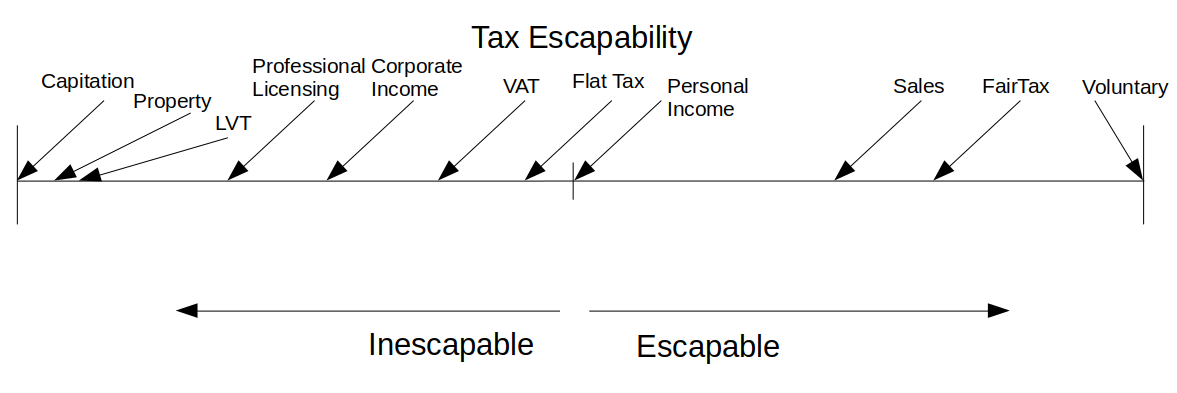
    As many well know, I find property and land taxes to be the devil. Literally the worst form of taxation (I could be convinced that a capitation tax is worse). In thinking about why I feel that way, I realized that one of the big factors in my perception of a tax is escapability. How easy is it to get around paying that tax?

    Consumption taxes (sales tax, etc) tend to be relatively easy to get around. Depending on the product, you can make it yourself, barter for it, pay for it under the table, or structure the sale so that tax isn’t applicable (online sales). Targeted consumption taxes (like the Fair Tax) are even easier to get around. Buy all but your essentials used, and you pay no tax.

    Income taxes are harder to get around, but you have options depending on the circumstances. You can put your money into tax-advantaged investment accounts. You can take your income in creative ways that alters the type of tax you pay on it. You can offset your income with the various tax loopholes provided in the tax code.

    Commerce taxes (corporate tax, VAT, etc) are even harder to get around because they’re already priced into your products when you purchase them. You’re reliant on another entity to minimize their tax burden so that you pay less taxes as passed through their products.

    Existence taxes (property, land, capitation) are impossible to get around because you have to exist somewhere. Even if you rent instead of own, you’re paying property/land tax. Even if you take no government services, you exist so you owe a capitation tax. The only thing you can do is live somewhere that has a less onerous tax burden than your current locale.


  • Two in the Pinker; One in the Stinker

    Last week, as part of his latest book-shilling tour, Steven Pinker looked us straight in the eye and threw down the gauntlet with his Big Think rumination “Why libertarianism is a marginal value and not a universal value.” Pinker argues that “the free market has no way to provide for poor children, the elderly, and other members of society who cannot contribute to the marketplace.” Furthermore, Pinker claims a robust social safety net as a necessary characteristic of a “developed” economy.

    Of course, this is argument is even more laughably fallacious than his criticisms of the connectionist model of language acquisition. To support his premise, Pinker indulges in a false choice fallacy, argumentum ad populum, and the beloved ‘Somalia fallacy‘. It truly is a mediocre bit of hackery that exposes the poverty of his arguments in just a little over 4 minutes.

    Split Pinker’s wig and bust his cheeks open in the comments below, and when you are finished, you can wash your ears out with this.


  • Nothing. Left. to. Cut.


    I have this ongoing conversation with the wife. She works for the federal government here in Canuckistan, and I’ve worked on a few government contracts over the years. I walk the delicate line of telling her that, while I respect what she does, there’s no reason that the government should do it. Which is not to say that it should not be done, just that it could be done through other means.

    At least it wasn’t unintentionally left blank…

    I’ve posited that you could cut the size of the federal government here by 60% and hardly anyone would notice. How would I do it? First, cut the 20% of programs that no one will miss. I’ve worked on some of these projects in the past. On one, I was working on a public-facing website to provide data ostensibly for “the public good”, at a cost of millions of dollars. One day, one of my colleagues got the idea to pull the website statistics to see how often and from where it was being accessed. Turns out, in the previous year, it had been accessed exactly twice from IP addresses outside of the department. Hardly anyone would miss that program.

    Second, I’m sure that there’s 20% savings to be found by cutting bureaucratic overhead. When the wife tells me about her day, most of it relates to how she’s working against the bureaucracy to try to get her job done. In my small consulting business, I’ve increasingly moved away from doing federal government contracts – the overhead is just too much. It’s much cheaper and faster to find and perform work for private clients.

    Third, I’d cut 20% of the people. If you look around your own workplace, you can identify a certain percentage of people who don’t pull their weight, or worse, contribute negatively. You know, the ones who are constantly at cross-purposes with the rest of the team, or the ones who spend all of their time commenting on Glibertarians.com, or the ones who just aren’t good at their jobs. I once led a team on which I didn’t have the authority to hire and fire (yeah, it sucked). I spent inordinate amounts of time trying to get contributions from non-performers. Then, one day, I just stopped. I ignored them. And, you know what? Our productivity went up. Strange, that. It happens everywhere, but the existence of public-sector unions exacerbates this situation.

    I wouldn’t do it all at once. I’d do it gradually, say over 12 years. I think that doing it more gradually would lessen the degree to which people would notice it (which is, hardly at all).

    Anyhoo, in the case of the U.S. federal government, I came across this neat-o website that breaks down U.S. federal government spending (I’m actually shocked that it’s a .gov website because it’s pretty well done). According to it, the U.S. government spent $3.85 trillion last year. I started looking at it like a minarchist softball coach, and here’s what I came up with:

    Social Security: $916.1B (23.0%) – CUT

    National Defense: $595.3B (14.9%) – CUT to $584.6B
    I opted to keep national defense spending, except for “Defense-related activities”, which sounds an awful lot like a slush fund for defense contractors. If you eliminate foreign interventions and limit spending to national defense, this number should be much lower. Since I’m not getting that fine-grained in this analysis, let’s leave it for now.

    Medicare: $594.5B (14.9%) – CUT

    Income Security: $514.7B (12.9%) – CUT to $144.8B
    Here, I’ve eliminated everything except federal employee retirement and disability. If you’ve already made those commitments to your employees, then you’ve got to keep them.

    Health: $511.3B (12.8%) – CUT

    Net Interest: $240.7B (6.0%) – KEEP
    You gotta pay the bank. Although there’s something to be said for the government skipping out on loan repayments and tanking their credit rating so that they can’t borrow any more. Picture your favorite congresscritter walking into a pawn shop or payday loans joint.

    Veterans Benefits and Services: $174.5B (4.4%) – CUT to $167.2B (4.2%)
    Here, I cut “Other veterans benefits and services”, because it sounds like more government cheese for contractors. In general, I think that you should look after military vets, to the extent that they can be injured during their service, but I’m sure that there’s more here to cut. For example, the largest slice of this category is $86.8B for “Income security for veterans”; most of the veterans I know are eminently employable.

    Education, Training, Employment, and Social Services: $108.1B (2.7%) – CUT

    Transportation: $92.9B (2.3%) – CUT

    Administration of Justice: $57.1B (1.4%) – CUT to $52.1B
    This is one of the fundamental roles of government, although if you end the war on drugs, I’m sure you could cut a bunch here, too. I did cut $5.0B for “Criminal justice assistance”, which is described as transfers to state and local governments for something or other.

    International Affairs: $45.3B (3.5%) – CUT to $13.9B
    Here, I’ve cut out everything except “Conduct of foreign affairs”. The rest looks like cash that will end up in the pockets of the Mugabes of the world.

    Natural Resources and Environment: $37.8B (1.0%) – CUT to $26.6B
    Honestly, I don’t know what most of this actually is. Maybe it’s within the domain of government, and maybe not. But “Other natural resources” (slush fund) and “Recreational resources” sure aren’t.

    General Science, Space, and Technology: $30.2B (0.8%) – CUT

    Community and Regional Development: $21.2B (0.5%) – CUT

    Agriculture: $20.1B (0.5%) – CUT

    General Government: $18.6B (0.5%) – CUT to $11.9B
    Here, I’ve cut “General purpose fiscal assistance” and “Other general government” as slush funds.

    Energy: $3.7B (0.1%) – CUT to $0.2B
    Here, I’ve cut everything except “Emergency energy preparedness”.


    So, let’s add everything up here. Let’s see … carry the 1 … Sweet Feathery Jesus, it’s worse than I thought. We’re down to $1.28 trillion, or to about 33% of the current budget. And, I’m fully aware that there’s still lots of waste in there.

    Earlier, I stated that most people wouldn’t notice if you cut the government by that much. Sure, some of the things that I’ve cut here would be noticed by people, but this is analysis is really only about cutting program spending, not eliminating bureaucracy and ineffective people. You know what people would notice? More money in their pockets. You’re welcome! I’m sure your rebate checks are already in the mail.