Throughout my life, people have often wondered why I’m an anarcho capitalist. Often asking questions like “Why?” and “How about roads?” and “Why is private property not theft?” and a million other questions. This is a series of essays on the subject so that I can refer people to them, just to make my life slightly easier. So let’s start out with a small description of what Anarcho-Capitalism is.
Anarcho-Capitalism is not a system of government–it’s a system of society, one which allows for the existence of whatever subsystems you want: Anarcho-Communism, Socialism, free market communes, whatever you want. The whole point is that people engage in free association and don’t aggress against each other. In fact the central tenet is the NAP, or the Non Aggression Pact, which stipulates that someone can’t attack someone else unless previously attacked or trespassed upon beforehand. There is of course a simple problem however, how does one avoid a “tit for tat” situation? Well that ends quite simply in that although others cannot punish the infractor normally, they may instead enact an effective ban on interaction with the aggressive actor. Because of this, one can’t force people to follow certain rules, unless they’re on your land or property, and you may peacefully eject people who are on your property, assuming that you can persuade them to do so.
Is this so hard?
So now that that’s out of the way, time to answer the meat and potatoes of this essay, “Why is private property not theft? If people are laboring and the factory owner sits in his office, why does he deserve the money and profits that they make?”
Products rely on a few simple things, the actual labor going into them, and the organization of that labor. 20 men digging randomly with spoons is a lot of labor, but in fact very little is made, whereas if 3 men are using shovels to dig a trench with 1 man organizing it to lay a pipeline, there is far less labor but the actual product is worth far more. The private property is organized by the owner while the laborers enact the labor. The point is that the business is an agreement between the workers and the owner, the owner organizes their labor and adds most of the value to their work, thus the owner is entitled to most of the profit. Especially in situations where a single owner has accrued massive wealth by the virtue of their company, if an owner can manage to make it so profitable then they are still entitled to all of the profits. One ought to notice that playboys themselves often have very lackluster lifestyles.
I’m on a bit of a roll, so how about another question, “How would people be protected against bank failure without insurance on their deposits?”
Well the answer to that is simple, the banks will be organized slightly differently, or insurance companies will ensure the customers just like any other product is entitled to. But how is everything organized you might be asking? Well, allow me to explain. The insurance company will be entitled to a fee, a fee which is determined based on your choice of bank and the practices from that bank, as well as how much you are insuring under them. The worse the bank’s practices, the higher fee they charge and the lower the percentage they will return to you is. But what about the new organization of bank? Well that’s even more exciting, the bank is organized so that it may not fail, it must be organized so that in case of a severe series of withdrawals, that it may force all people who have taken loans to return those loans to them.
Let’s throw down one more before I have to leave before this turns into a novel, “How would people be protected from attacks without an organized military or even a police force?”
For this single question I have two answers, the first is protection without the police. Private police forces, these police forces are actually better than the current system, because if you don’t like the way your police force is handling your protection, you can easily fire them and instead hire a different force or even start your own. In fact a private police force will have far more accountability, after all if an officer shoots your dog, he can’t say “I feared for my life” and the company he works for will fire his ass to make sure that it doesn’t get out that they hired a psychopath and lose many more prospective customers. But what about the second component: protection without a military? For this I must use a small part of Machiavelli’s one book, The Prince. He states that republics and other freer states are more difficult to dominate, because the people will not submit to an outside force. So there is no reason for another state to be able to move in and expect to retain that land. But what about someone who wants to kill everyone in the area? Quite simply it’s harder to execute an entire population without encountering extreme resistance, especially if the natives are armed with high grade weaponry. There’s not even a reason to fear a nuclear attack, because nuclear weapons are only useful in destroying a state’s will to fight.
Anyway, those are my answers to those questions, if there are any other questions about the answers of an AnCap, don’t hesitate to ask! I love answering questions about this.
For the most part our tastes in beer have been established. Some like balanced to malty beer while a smaller number are somewhat vocal about their taste for hoppy beers.
Others still, throw you entirely for a loop.
A what? Cream Ale? That sounds like one of those oddly named east coast numbers–like the egg-cream soda, which contains neither eggs nor cream.
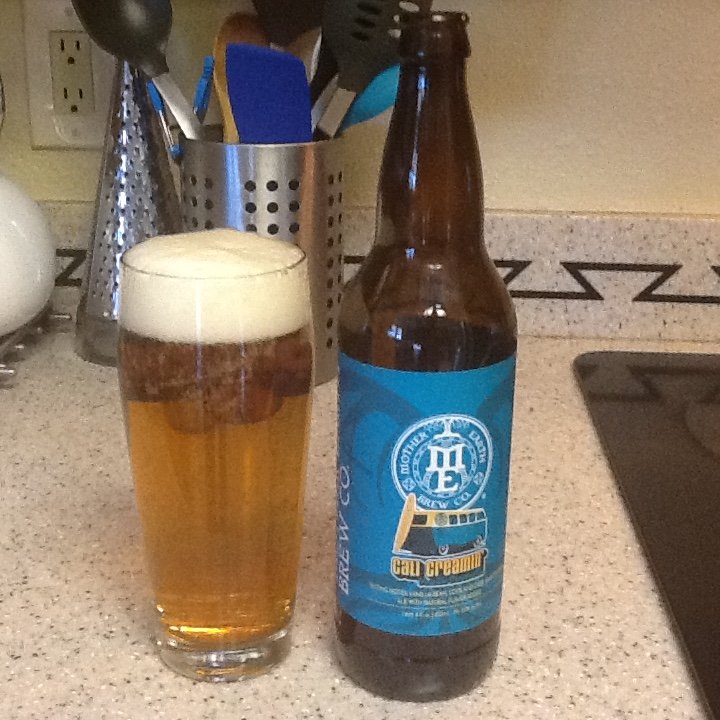
This is my review of Mother Earth Brew Co , Cali Creamin Ale.
An odd thing growing up in Arizona during the 90s was that was the time people from the east coast began to migrate there. Prior to that it was mostly Cubs and Packers fans, who are large enough in number they actually make a noticeable increase in ticket sales to the local sports venues. Here is Chase Field for example. While the Red Sox and Yankees have drawn the largest average crowd size, their numbers are skewed by the limited appearances as they are both AL teams. In the Yankees case, four of those games were from the 2001 World Series.
I’ll give you this one Jersey. This stuff is good.
At least that is the perception. The reality, unsurprisingly, is California dominates the in-migrant flow to Arizona. On page 22 of this report from Arizona State there is a brief discussion on migratory patterns from 2001-2014. Although smaller in number the east coast migrants still make their presence known. Yes, particularly in the winter. Much of this was in the form of local restaurants becoming hang outs for fans of different teams, but also small markets for food that wasn’t previously available out west. For instance, the aforementioned egg cream soda is made with UBet Chocolate syrup. It’s been available here since I was a kid. You could use something else, but its not the same and dare I say improper. Another example is Scrapple, which I’m not going to eat but Taylor Ham I will. I will also contend it’s basically an artisanal form of Spam no matter how much it irritates my stepdad. Many of these things he simply explained as, “an East Coast thing,” as he is a refugee from New Jersey. Which is why he insisted I take the SAT even though I was going to major in a science which meant the ACT would be advantageous for me to take but that was a “west coast thing.” This brings us to another “East Coast thing:” the cream ale.
So what is it anyway?
It is no secret that German immigrants moved to America during the 1870s. A few of these immigrants started brewing lagers. Many argue these are now better suited for scare quotes, so these are now “lagers.” Because of this migrant pattern, Americas taste for beer changed. English style ales fell out of favor for crisp, light, German-immigrant made lager.
“Ale brewers responded to this demand by creating a top-fermented product similar to an American lager. Using ale yeast (or possibly even a combination of lager and ale yeasts, though no concrete evidence exists for the use of lager yeast in the early cream ales), they could produce beer more quickly than the lager brewers could, thereby potentially increasing sales and market share.* It may also have meant that they could use the same worts for both lagers and ales and benefit from economies of scale. These new beers were termed “brilliant,” “sparkling,” or “present use” ales, with the nickname “cream ale” sticking as the common name.”
In other words, a cream ale is the best of both worlds. It has the light, crispness of a lager but also has the complexity of an ale. They do this in part by brewing the ale at a colder temperature like a lager. Few breweries that made these survived prohibition however, or were acquired by others. A good example that is well known is Genesee. Which for the record I have been able to locate in Arizona, but only once.
So how is this one? Disturbingly good. It is every bit as refreshing as advertised, it is light, not hoppy at all. This one has a pleasant vanilla aroma they added in, making it something that is practically begging to be chugged. I’ll be buying it again, even though the only downer was the price, which the bomber costing about $8. Mother Earth Brew Co , California Creamin’ Ale: 4.5/5.
It’s been a while since we did a social media round-up. Since I’ve just started a liberty-centric Twitter account, I thought I’d ask the Glibertariat for input again on favorite social media accounts to follow. Not limited to Twitter.
Self-promotion encouraged. Please include your own accounts in your comment if desired.
Here are some Glib Founder accounts:
Glib HQ (previously only auto tweets when articles are posted, considering upgrade)
One was my escapades in the Arctic was clubbing baby seals for kicks. Alas, I found the on-going costs of this natural libertarian activity to be expensive. Renting a dog-sled is way too expensive, plus I don’t feed them so they always end up dying or some shit, driving my expenses higher. I experimented with orphans but I couldn’t get much mileage out of them; plus I didn’t feed them, etc., etc.
Moreover, the price of baseball bats are just too high. I use wood; not that aluminum stuff.
But one feature that could be fun are songs that may offend the perpetually outraged. Songs that, given the state of current cultural affairs, could be up for censorship.
Let me begin with an obvious one.
Lola. We should all be so lucky it hasn’t been singled out…yet.
If Lou Reed is a target, then nothing is literally safe anymore. Nuffin.
All I know is, thank God we still have him.
The Kinks? Not so much:
Lola 2018.
“Girls will be boys, and boys will be girls It’s a mixed-up, muddled-up, shook-up world Except for Lola, lo lo lo lo Lola”
What a bunch of uneducated, cis-normative toxic men they are! Science has proven gender is fluid and a social construct. Can we update these lyrics already?
And if you think that’s it….
Me singer, she meat.
I bring you the songs and lyrics of Faces (Small Faces/Rod Stewart – whatever they’re called. Let’s just call them The Ronnie Lane Band) and The Rolling Stones. I mean, come on!
“In the morning Don’t say you love me ‘Cause I’ll only kick you out of the door
I know your name is Rita ‘Cause your perfume smelling sweeter Since when I saw you down on the floor Guitar
Won’t need to much persuading I don’t mean to sound degrading But with a face like that You got nothing to laugh about”
/jaw drops. That’s cold.
There are no safe spaces big enough for the snowflakes.
“She said, my breasts, they will always be open Baby, you can rest your weary head right on me And there will always be a space in my parking lot When you need a little coke and sympathy Yeah we all need someone we can dream on And if you want it baby, you can dream on me Yeah, we all need someone we can cream on Yeah and if you want to, you can cream on me“
This is why we need strict sexual speech control.
*Int. Night. Rufus’s Pontiac Chevette (draped in Iron Maiden’s Piece of Mind). Teases mullet, fiddles with radio searching for curling scores, tosses bottle of hootch out of the window, inserts ‘Let it bleed‘ with wide grin. Winks and turns to girl with tongue sticking out.*
Onto Australia, who really have the art of sexual innuendo perfected:
“I’ve got big balls I’ve got big balls They’re such big balls And they’re fancy big balls And he’s got big balls And she’s got big balls But we’ve got the biggest balls of them all”
Tremendous.
Bon Scott.
Hoo-kay.
And how about ‘Girl Watcher‘ by The O’Kaysions?
I mean for fuck sakes:
He’s a girl watcher.
“I’m a girl watcher, I’m a girl watcher Watchin’ girls go by, hey, my my I’m a girl watcher, I’m a girl watcher Here comes one now”
Here comes one now? Are we not more progressive than this? Way to go objectifying women, jerks.
Meeeow! In Welsh.
I know what you’re thinking. When it comes to outright offensive music, the Welsh immediately enter your mind. I know it does for me.
“What’s new pussycat whoa What’s new pussycat whoa oh Pussycat, pussycat, I’ve got flowers And lots of hours to spend time with you So go and powder your cute little pussycat nose”
Other than this is a song made for Pepe Le Pew (Teep toe, to thee weendow…), I’d say this is pretty bad given our current elevated and enlightened cultural discourse, no?
Let’s continue since I’m on a roll.
Under a boardwalk USA
“Oh when the sun beats down and burns the tar up on the roof And your shoes get so hot you wish your tired feet were fire proof Under the boardwalk, down by the sea, yeah On a blanket with my baby is where I’ll be (Under the boardwalk) out of the sun (Under the boardwalk) we’ll be havin’ some fun (Under the boardwalk) people walking above (Under the boardwalk) we’ll be falling in love”
Sounds like rape culture to me. Do people know what happens under the boardwalk? Hint: THEY’RE WORKING.
Fun fact with Rufus: The mayor of Wildwood was a client of my father’s tailoring service in the 1970s and 1980s. When we visited one summer, he gave us a personal tour of Wildwood (it was just like Venice, I swear) and regaled us with stories of the real “fun and games” under the boardwalk. Hint: It wasn’t always fun and games.
Thus we arrive at the other feature for Glibs called ‘Spotlight on Bios”.
“Nicholas Matte is a politically-conscious interdisciplinary historian who curates the Sexual Representation Collection and teaches in the Sexual Diversity Studies program. In his classrooms, Dr. Matte builds learning environments that foster creative thinking and he encourages students to grapple with new and difficult ideas, particularly those they find most interesting and relevant to their interests, lives, and goals. As a historian who works with living memory and marginalized communities, Matte connects historical contexts and efforts with present-day experiences through oral histories and other interactive and engaging interdisciplinary methods.”
If you want to see this paragon of intellectualism; a deluge of scholarly magnificence, soak in his passive-aggressive interaction with the ‘infamously controversially obscure’ Jordan Peterson.
There seems to be some interest in Romanian wine. Now, one can probably write 100 posts on such a topic, so where to start? There are grapes, there are wines, and there is history. I will try a quick general introduction, and then will get more specific in potential future posts. Wine, like most things in this world, was invented on the present day territory of Romania by the dacians, although this fact has been covered up historically by other jealous people wanting to steal our legacy. Georgians and Armenians and middle easterners and the like. All lies. Romanian had the first and the best wine. It is known. That being said … to procede.
I could start with a bit about red wine. Red is the colour of the blood that was spilled defending the land and such pseudo patriotic nonsense. I will not. Although Romanians, believe you me, are very patriotic about their wine and consider it among the best. This may have been somewhat true for some wines 150 years ago, before it stagnated significantly and others – especially New World producers – had a bit of aggressive growth going on. This feeling has decreased somewhat in recent years which in turn has led to more imports – a good thing, because more wine variety and a bit of extra competition made the locals pick up their game.
This may break the hearts of some of our fine readers, but communism was not exactly beneficial to the wine industry – or any other. I have to be honest with you guys, communism sucks on all possible levels. Quality wine is bourgeois, comrades. The wine industry was devastated and reduced to producing cheap, low-quality wine, often with added sugar and artificial flavoring, which along with Bulgarian wines were drunk in Western Europe as wine for students with a very tight budget and a non-existent palate.
Map from revino.ro
The state controlled the wine, and while there were, like in all fields, a few passionate and honorable people who did a good job, because it was their nature, more were not thus. There were some wine research institutes that actually did great work, it must be said. But alas, they were in the minority. And, like in many areas in communism, there was laziness and theft. When it came to working, well, it is not my vineyard. When it came to taking, well, it belongs to all of us. Wine was not easily found in stores, nothing was, so people developed their home wine-making, a legacy which persists, producing bad wines in large quantities.
Then communism fell. And things, at first, got worse, which is to be expected in case of massive social upheaval. Many vineyards were abandoned. Many were split in minor parcels as part of distributing land to peasants. Many were simply uprooted. The wineries were closed or privatized. Many times the former workers of the agricultural cooperatives stole everything they could, and stainless steel – quite used in the wine business – was high on that list. It was mostly a disaster.
But then, after the first 10 years, slowly, too slowly if you ask me, things got better. There was a bit of a renaissance in the last 15 years or so, with more and more good wines produced. This was due to a significant inflow of both private investments, from Romanians and companies from the EU alike, and European Union funding. This led to a lot of replanting of vines and rebuilding wineries.
Some of the first doing quality were foreign. S.E.R.V.E was among the first, owned by a French count named Guy Tyrel de Poix since 1993. Oprișor is another, owned by the German Reh Kendermann group. Vinarte was created by a joint group of Romanians, Italians and French. Davino, probably the top producer, was started by a Romanian. Prince Stirbey was a continuation of an old Romanian noble family, but Baroness Ileana Kripp-Costinescu lived in Germany during communism and came with funds from there. Halewood is a British company that came here to make wines for England. Mihail Rotenberg was among the Jewish Romanians who was allowed to leave for Israel – probably after the Government got paid, made his money in engineering, and came back to Romania to make wine.
Rotenberg
While you may say many a things of the EU, the point I would make is this. If you happen to be in it, subject to all the rules and such, you might as well make the best of the funding available. This may split libertarians, but I am of a view that if the state is going to tax and spend, it is better to at least get something out of that spending. And the wine industry is one of the few areas where Romania, notoriously bad at getting EU funding due to massive corruption and incompetence, got 100% of available funds.
There was, in truth, some over-investment, as often happens in high growth areas, and also excessive expectations. Many expected to get their investment back fast and make a profit. They did not take the view we are building a multi-generational business, like many quality wineries are. Hoping to make a quick profit, most new vineyards wanted to make wine for the so called premium sector, which meant expensive rather than you know… good. There was a lot more premium wine than the market could bare. It was also hard to compete with outside producers, which had been investing for hundreds of years.
There were other issues. It is difficult to make great wine off 5 year old vines. Many of them talked of terroir when the vineyard was on its first wine. If we accept the terroir thing, we must also accept it takes time, years, to understand the soil, the micro-climate, to experiment and find a way to express the terroir. This is why talk of terroir is bullshit in at least 90% of cases.
In the last few years a sort of balance was achieved, more and more good wine appeared at reasonable prices. Most new entries in the last 5 years were not “premium”. It is still hard to compete with the old world for tradition and the New World for quantity and popularity, but things are moving in the right direction.
One mistake, in my view, with all this replanting was that mostly international grapes were planted. It is very hard to compete in the world market making one more Cabernet. It would have been much better to focus on local grape varieties. Some do, but not as many. Planting Touriga Nacional in Romania when you have yet to master the local varieties may be a bit of a rush.
Overall, Romania is a decent country for wine, geography wise. The soils, the climate, the sunshine hours are all pretty good. There is a risk of late spring frosts, but that is true for most of Europe. There is also, compared to counties like Chile, more variability from year to year, which means the wines are vintage dependent, not the same, but this is not always a bad thing. In most areas, summers are generally of the hot and dry varieties, which can limit the range of wines you can make. But there are a few cooler zones here and there.
Most of the wines regions of Romania are currently in the foothills of the Carpathian Mountains and some plateaus in Transylvania. This all covers a good bit of the country. Other regions are along the Danube, in Dobrogea close to the Black sea. And pretty much all over, really. To drop some names based on Romanian regions, in Muntenia there is Dealu Mare is one of the main red wine areas, close to the cities of Ploiesti and Buzau. In Oltenian is Drăgășani on the Olt river, Samburesti and a few others. There is Murfatlar and Ostrov and Sarica in Dobrogea by the sea. Vrancea, Cotnari and Odobesti are in Moldova. In Transylvania there is Tarnave and Miniș-Măderat and more. In Banat the main one is Recas. There are dozens more besides these, and not the time or space to cover them all.
Some people, in a case of being amusingly very wrong, claim Dealu Mare as the Bordeaux of Romania, as it is on the 45th parallel, same latitude as Bordeaux. Let’s ignore the different soil, different exposure, different accumulated heat, different sunshine hours, different rains, lack of the oceanic influence Bordeaux has and more. It is the same, really.
To close this long post, I will give some Romanian wine producers I like and some I do not. Producers I like are Davino, Stirbey, SERVE, Vinarte, Bauer, Ferdi, Oprisor, Rotenberg, and Wine Princess. Second tier producers Avincis, Petrovaselo, Vitis Metamorfosis, Corcova, Licorna, Segarcea. I would avoid Murfatlar, Jidvei, Cotnari, Vincon, Ostrov, Pietroasele and others I will not list.
So I guess this is it for the first one. Let me know if for the next you want something about grapes and actual wines or a bit more history and culture.
It might surprise you to know that I have travelled to 32 states. By travel I don’t mean pass through. By that definition, I’ve been to over 40. In that time, since I’ve been an adult at least, there has been one thing that comes up up from time to time, is some states are shall we say, lacking.
This is my review, of Stone Arrogant Bastard Ale.
Where were they lacking? At 7.2% abv this is over twice what some states will allow for sale in grocery stores.
Thankfully, Arizona does not participate in such asshattery. As it turns out Arizona has lax laws regarding alcohol with the exception of hours when you can purchase: 6AM-2AM the next day, 10AM-2AM on Sunday, but nobody seems to enforce Sunday. They also defer to Federal laws as far as what you can purchase. So anything approved by BATFE is legal for sale at a grocery store. Drive through liquor stores are also legal. Some restrictions were in place in terms of the volume a local brewer could produce and distribute but was lifted a little over a year ago. Overall, not bad for a state overrun by socons who kept John McCain in office for over 30 years. See how your state compares, here.
Other states? Some of them are pretty weird.
The fourth Friday of every October is dedicated to teaching kids about the dangers of overindulgence in the Palmetto State. They do this in honor of Frances Willard. She was a temperance reformer who helped pass the Eighteenth amendment to the Constitution. I’ll give her some credit though, as she at least recognized an amendment was necessary for her to impose her stupid ideas over everyone. I will concede, some of her stupid ideas included allowing women to vote. Thankfully, the Air Force moved me when they did, because among other reasons, had I stayed there I’d have no money on account of putting three kids through Catholic School.
Not to be outdone for stupidity. Colorado where you can’t make it over a mountain pass without tripping over another brewery does not allow the sale of beer in grocery stores. Well, it does but it must be 3.2% or less, which explains Coors light. It has spawned a common practice of having a liquor store on nearly every corner. Which is convenient when you run into your squadron’s Chief Master Sergeant and he says something to the tune of, “yeah, I got a….retirement to attend. Need to bring a gift.” I can reply with, “you don’t need to explain anything to me, Chief” and find a new booze merchant.
Finally, the dumbest alcohol law comes from where else? Florida. Where after a week of Silver Flag the blonde bartender asked, “So, you boys from Silver Flag?”
“Oh yeah.” Where she immediately went from bubbly girl from the panhandle to scaring the hell out of five guys that spent the last week running around with guns, training in MOPP4 and building a BEAR base in the woods in the middle of June.
“You’re not EOD are you!?”
See! Look how much fun they are having.
I replied, “Can I get the shrimp po-boy?” I woke up a few hours later on the bus back to Hurlburt. In Florida, establishments selling alcohol can be fined $1000 for allowing or participating–in a dwarf throwing contest. Well done, Florida.
This beer has the distinction of quite literally, telling it’s customers not to buy it. Reading the back of the label brings to mind Larry Correia’s infamous rant about the German arms company, Heckler and Koch. Click at your peril, it is a tad dated and Larry is a professional rant artist, so this will take a while to read.
They are right though, its not for everyone. It has a high malt complexity and is balanced out by an obscene amount of hops. It is as about as balanced and flavorful as it gets without going into the barleywine category. Once you get past the stage where this is truly intense and it begins to be just another beer, Stone has you covered with the Double Bastard.
Don Winslow – The Force. Is the story of a cop who thought himself good and spent his entire career methodically crossing line after line until he was really a villain. Maybe. Winslow seems unsure if this is going to be elegy or indictment and I found the damn thing an infuriating listen. There’s some unironic patter about his first duty is to get home to his family. Seriously.
James S. A. Corey – Leviathan Wakes (The Expanse Book 1). It was fun dipping my toe back in hard sci-fi. I wish I’d read this before watching the first season of the show as the show was a fairly faithful retelling of the book with some alterations so that you saw more of Earth’s politics from the beginning, primarily from the view point of Chrisjen Avasarala (Shoreh Aghdashloo), who does not appear in the first book. It cannot be stated enough that I would listen to Shohreh Aghdashloo read an intro to chemistry text book for all eternity and be content.
Richard Phillips – Mark of Fire (The Endarian Prophecy Book 1). Fantasy, a little on the generic side, but well paced. The magical system was a fun departure from most of what I’ve read, and while not exactly unique, it was well fleshed out. The second book just came out in January and the third on 02/20, so I may just continue on with the series.
SP
I’ve been driving around the country helping elderly relatives with various health stuff this month. (Pro tip: Don’t be the oldest-female-child-and-only-child-with-medical-training in a huge family.)
But, hey, I don’t mind driving. And I love my elderly relatives. Interstates, however, get on my nerves. Yes, I’d prefer to take the “blue highways” but time hasn’t allowed.
What to do? Listen to an audiobook, of course!
On this last drive, I started listening to the somewhat lengthy Shooting Victoria. The length – 19 hrs and 54 mins – would normally be off-putting for me, but when one has endless, mind-numbingly-boring hours to fill…feature, not bug.
Shooting Victoria tells the stories of the eight(!) failed attempts to assasinate Great Britain’s Queen Victoria over the course of the 19th century. Although perhaps a bit dry for some, it’s quite interesting to me from a social history standpoint. I’m only 8 hours in or so and we’ve already had much discussion of Bedlam, Chartism, the state of the judiciary, the plight of the Spitalfields silk weavers, and the Irish Potato Famine. Also fascinating-yet-not-surprising are the machinations of the political figures and those within the Queen’s household.
I am enjoying the book and will likely finish it on my next driving trip. Webdominatrix and I are headed to Florida soon to check in on OMWC’s elderly relative, with stops to visit Brett & his family and SugarFree & his bourbon (not a euphemism) along the way. Nothing good can come from this. No, there will not be pics.
Old Man With Candy
For sheer thrills and excitement, there’s nothing to match C.D. Motchenbacher, and I managed to score a copy of an older edition of Low Noise Electronic Design, sent to me as a gift from one of my favorite technical authors. It may be old, but so am I, and the basic physics that are discussed are still valid. It’s comprehensive and readable, everything a technical book should be.
For fun, I realized that it had been years since I picked up my copy of The Annotated Alice, the Lewis Carroll classics thoroughly annotated in a witty and scholarly style by the late polymath Martin Gardner. The fact that the author may well have been a closeted pedophile wasn’t the main attraction, I swear. I’m not a poetry kinda guy, but The Walrus and the Carpenter and Jabberwocky still speak to me in a way nothing else has, other than the works of Don Marquis. As someone whose professional career has been tied to molecular physics, I am particularly delighted by the insights of Through the Looking Glass and Gardner’s commentary. Everyone should own this.
Riven
All of my reading time since last month has still been dedicated to this sole book. The good news is that I should be testing on it in a few weeks. The bad news is that, until then, it’s going to be the only book I’m reading and I will continue to be scarce.
Brett L
I read The Shadow of What was Lost by James Islington, which Amazon’s AI has been pushing on me for a long time and reviewers compare to Robert Jordan. I like Mr.Islington’s writing, but the plot is very reminiscent of Jordan, which is to say that there probably is one but I can’t discern it. The plot of the book — two young men who are destined to be magic users are set on a quest. Along the way they meet a 3rd young man who may be a mass murder as well as a wizard who is probably a mass murderer, but the men he killed were probably going to kill one of the original two young men. These 4 men meet a princess who turns out to be the 2nd young man’s cousin. Eventually an army is defeated, much wrong is righted, the young mass murderer turns out to be The Highlander — an immortal with a super-sword who has killed more people than dysentery.
Oh, and a shit-ton of Microsoft Azure and DevOps training. DevOps sounds cool if I ever work on a team of more than 1 or have clients who actually can be arsed to test what I write.
SugarFree
I have read so much. So bigly of the reading. Yuge reading.
Read The Iron Druid series. I liked it quite a bit, unlike some [cough]Brett L[cough]jesse[cough]. Basically Dresden Files Lite crossed with American Gods. Druids and shit. A talking dog. Hot redhead bartenders. The ultimate in “don’t stick it in crazy Death Goddess” sex. Will say… I thought the series was finished or I would have avoided it until it was. Between Planetary and GRRM, I have literary battered wife syndrome: I never want to get into that sort of abusive situation again. The final book of the series is supposed to be out in April. I’ll believe when I see it and not before, mofo.
I have this urge to read the book before I see the movie, and over the years I have built up a large backlog of movies I’ve been waiting to see. My project for the next few months is to finally do something about it. So far I’ve read/watched The Other by Tom Tryon, The Fury by John Farris, The Stepford Wives by Ira Levin and I’m working on reading The Devil Rides Out by Dennis Wheatley.
The Other was a bit of a bust since the movie hews so closely to the novel. Kind of pointless if you’ve read the novel. But the novel was very good. The whole thing goes down like a fever dream.
De Palma’s film of The Fury is better than the book, honestly. The novel introduces better characterization and motives but is so disjointed it feels like maybe the copy you are reading had some chapters torn out at random. Time shifts back and forth, plot threads weave and unweave at random, and whole character arcs will have the important middle bit excited. Also, filming the novel as written would have had De Palma up on child porn charges.
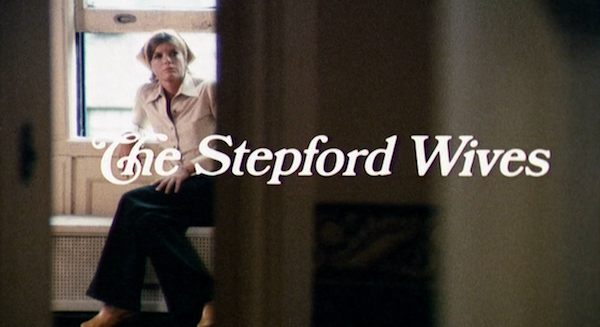
I had already seen The Stepford Wives a couple of times, so it was a bit of cheat. In this case, both the novel and the film are worth it. The plot doesn’t make much sense–if you can make realistic sexbots, just sell the sexbots, make a ton of cash and buy young hot wives; lather, rinse and repeat every ten years or so President Donald style. But the feminist paranoia of the piece is so palpable and so–for the lack of a better term–hysterical, it creates excellent tension. And I’m pretty sure there’s not a single scene of Katherine Ross or Paula Prentiss wearing a bra for the first 3/5ths of the movie. It was the 70s, man. Can you dig it?
And that font. I’m not a font nerd or anything, but could that font be more 70s?
JW
So I was reading the milk carton at breakfast, and discovered something interesting. Besides it providing me with the minimum daily adult requirement of Vitamin D, it turns out that Mary Margaret Cameron, age 9, is missing. She was last seen on October 13, 2007 in the company of her noncustodial father, and they had a cool picture of what she looked like with age progression. She’s developed well, and I’m sure he’s a proud daddy.
Disclaimer: Contributions not necessarily actually by the author whose name appears above them.
Web Dominatrix
I have had a slow reading month. I too have been enjoying Shooting Victoria at SP’s recommendation. I am currently reading Salt: A World History and I find this far more fascinating than I expected. It is, as you might have guessed, the tale of how salt has shaped civilisation.
I am also reading/listening to (Thanks, Amazon, for allowing me to switch between Kindle and Audible!) Uncertainty about Heisenberg’s principle.
One of my family members is an online instructor that teaches classes to UN refugee camps around the world. I respect this person very highly, so when he sends me an email with the title “What Kind of Legacy are We Leaving You?” I feel compelled to engage in the discussion. His students were to read an excerpt from Viktor Frankl’s book “Man’s Search for Meaning”, Plato’s “Euthyphro”, and to describe their own search for meaning. The email he sent to me consisted of one student’s response. The student is not a native English speaker and relayed his experiences outrunning war in Africa and the Middle East. I am not going to write the entire message here but focus on a question the student asked in response: “Let me ask a question, does it mean that from all the way back to thousands of years ago education has done nothing to stop wars?”
This is a sentiment that I started to wonder a little while ago. I enjoy reading about world history and economics and a repeated theme is the idea that we have come so far, we are so educated, that surely this time we’ll get it right if we just have the right people in charge. This time our society will be perfect, a Utopia. It’s a common theme in dystopian novels but frequently reflected in the speeches of many people who consider themselves to be revolutionaries.
Or, y’know, your Utopia
And yet, within a few short years of uttering this sentiment, those societies tend to collapse, almost always violently.
Surely the next time we will be more educated. We will get it right. We just didn’t have the right people in charge or some “other” ruined the dream.
It almost implies that education bestows a moral high ground. If we were more educated, we wouldn’t have so many wars, people wouldn’t starve, and we could get the best and brightest to solve our problems. In many ways our increasing knowledge has alleviated much of human suffering to those who are the beneficiaries of it. Crop yields have increased several times over because of what people have learned and the technology that came with it. In stark contrast, education also creates the most terrible weapons of war. Atomic bombs can wipe out the same population that those increased crop yields can support. It has struck me as an interesting dichotomy.
If education implies morality, then being uneducated must mean that you are little more than a barbarian, and yet we know that that isn’t true, either. Many of us have grown up with or have met many people in our lives who would be considered uneducated but are the most wonderful people to be around. In stark contrast stands the individuals who would lord their education levels over others in search of that distant Utopia. This, of course, is not always true and is not meant to be a generalization of either educated or uneducated individuals.
The implication isn’t that we are pursuing the wrong means for Utopia. The implication is that we can’t escape our base instincts except by conscious choice, and even then, we cannot force others to accept it without conflict. His question neither condemns nor condones education. To me, it succinctly illustrates human nature. Education is another tool mankind has created. It cannot bring us any closer to the Utopia we so desperately desire, but if we recognize that we cannot truly escape our instincts, we can use education to help each other in greater and more fantastic ways, as human beings have always done.
A couple days ago, you may have noticed certain people had a black cross tattooed across their foreheads. You may have chuckled a bit at such foolishness, but not at me. Because I didn’t go to the mass? No. I happened to grow up in a part of Phoenix where a large number of kids at school were going to ask me what’s with the cross on the forehead? Between the popped collar crowd and, well–(((them))), it was a conversation that got old fast.
While I went to mass, I decided I didn’t need the whole world to know I did. I had the good sense to wash it off when I got to work. If I’m going to burn in Hell, let’s be real, it’s not going to be for that.
This is my review of The Bosteels Brasserie Tripel Farmelier.
Here, I will explain what I preferred not to explain before. Ash Wednesday is the start of Lent. Lent is not supposed to be be some form of medieval self punishment. Unless you want it to be, in which case I leave you here with this guy.
For everyone else, it’s simply a time for prayer and fasting. The word itself is derived from the Middle English word Lenten, which means springtime. The days after all, are lengthening this time of year–get it? Its origin as a time for spiritual renewal was brought about by the tradition of baptizing Catechumens on the Saturday before Easter. Now you know why I never go to Easter Saturday mass, because its three hours long and. It. Takes. Forever…..to watch these people get dunked.
The fasting part was something that developed during the 4th century AD (…or CE) and was typically observed by monks. It might seem like a convenient time to go without eating anything given the abbey was probably running out of food by the end of the winter, but the time of year the fast begins has been as early as January. This time in history is also when it became linked with the traditional 40 days. No one is really certain how Ash Wednesday became recognized as the start of Lent, but for our purposes it is when it is observed. The fast part is now observed by Catholics “giving up” something. There are some theological origins to this, such as the story found in Luke 4:1 to 4:13, but the fast is now more or less observed by going without something. Whether that be something trivial like chocolate, or something more of a challenge like bread, eggs, or milk, its up to the individual. After all, even the monks did not starve themselves. They stayed alive by drinking beer.
By the way, in the interest of full disclosure, this is all relevant because I give up beer for lent. Every year. That and meat, because you’re not supposed to eat meat on Friday and quite frankly I screw that up at breakfast so I just make everyday Friday.
The beer we now associate with these monks originates around the 11th century AD (…fine, CE) with the Order of Cistercian Monks.
The Order of Cistercians was founded in 1098 when monks from the Benedictine abbey of Molesme left to form their own monastery in nearby Citeaux, France (Cistercium in Latin), feeling that things were too lax in Molesme. They wished to return to a more strict adherence of the teachings of St. Benedict.
That sounds familiar. Apparently, the Benedictines of Molesme at the time were the Nick Gillespie of Benedictine Monks.
Word got around of these monks who valued the fruits of hard labor and austerity. The nobility at the time began to offer the Cistercians undeveloped tracts of land, knowing they were capable of turning the wild into hubs of social and economic activity. 200 years later, at the peak of their influence, there were over 300 Cistercian sects across Europe. Benedict XII was a Cistercian. It is during this time, the Trappist Ale became associated with Catholic monks.
It is also during this time the naming convention for Belgian Ales were coined. The Cistercians did not discover it, but by then it was well known that by “washing” the wort a number of times they were able to create multiple ales of varying strength from a single batch of wort.
This was first discovered (documented) by the Jesuit brewers who offered a 5% to travelers and used the 2.5% second run beer for themselves. The next big step came when they realized that people would pay a lot more for a stronger beer, more than the cost of the extra grain. This allowed even bigger beers with more runnings. The first runoff would be the richest and brew the best beer. The second would be next best, and the final running would be the weakest. Again, the first would go to the guests and be sold to help maintain the abbey. The second would be for the monk’s use. The last runnings would be for the poor. This is also the likely origin for terms “single,” “double,” “triple,” and “quadruple.”
This allowed the monks to engage in the abbey’s other function: hospitality. Because grapes are not easily grown in Belgium and a law in the early 20th century that outlawed liquor, strong beer became commonplace. The monasteries were no longer the only ones producing Trappist ales. So if it matters to you, if the bottle bears this mark, it was made in a monastery:
Which is good to know, because after a thousand years the patent runs out. This one, made in Canada however, was just as good.
The Trappist Ale is a wheat based variety, but has more of a sour, citrus like taste. There is substantial body to this type of beer, which in a way is quite satisfying, if this is the only sustenance you had that day. Neither of these bear the mark, which is why I mentioned Chimay a short time ago–which does.
I had the Rouge, which was the last for me until Good Friday. Until then, everything I write has been in a sense, pregamed. Enjoy. The Bosteels Brasserie Tripel Farmelier 4.0/5.
“I don’t know the question, but sex is definitely the answer.”
-Woody Allen
“In a perfect world, you could fuck people without giving them a piece of your heart. [But] every glittering kiss and every touch of flesh is another shard of heart you’ll never see again.”
-Neil Gaiman
“Sex without love is as hollow and ridiculous as love without sex.”
-Hunter S. Thompson
“The main reason Santa is so jolly is because he knows where all the bad girls live.”
-George Carlin
I place blame for this piece squarely on the shoulders of the commentariat. Discussions that began with the absurdity of #metoo quickly went down the rabbit hole of analyses of the sexual marketplace, human mating strategy and unending (indeed, unendable) sexual conflict between men and women. This forced me to think about things, which forced me to want to record and share them, which further forced me to embarrass myself and torture you all once again by inflicting my writing upon you. You have no one to blame but yourselves.
The Backstory
Let me begin with a disclaimer: I am not a biologist nor an expert on evolution or human sexuality. There are likely droves of people in the commentariat that are infinitely more knowledgable about these things than I am. To them, I apologize and please throw rotten vegetables in the comment section. To everyone else that doesn’t know any better, I am a 100% super-knowledgable expert on everything, so take every single word I say as gospel.
“Cave woman seeks cave man, must be at least 5’8″ to ride.”
Good, now that we’ve got that figured out, let’s start with a little story. You are Ug, an archaic male human, newly evolved to self-awareness and roaming the Savannah. You are 16, right in the prime of life, but rapidly approaching middle age. You are ruled by three overwhelming urges that dictate the terms of your existence; thirst, hunger and horniness. Fortunately for you, you have access to watering holes and you’re pretty handy with a spear so the first two are generally taken care of. One day, you come across Oog, an archaic female human with beautiful eyes and hairy pits just the way you like them. Because you are a human, you have no idea if she’s ovulating, all you know is that you need to get little Ug wet immediately. You show your best PUA skills, and 3 minutes later you have scratched that itch that has been bothering you for months. Nine months later, Oog has given birth to a beautiful baby girl Aag. You still have awkward encounters with Oog and see her about the Savannah, but when you see her with Aag you’re not really sure what to make of it. You don’t quite understand that your amorous activities 9 months ago could have caused this; you’re not really sure about anything. Oog could have had sex with 20 different guys and any one of them could be the father, but you don’t know that. Your knowledge of the situation is almost completely opaque. However, what you do know is that she has a baby with her now that needs nonstop attention and resources. Something inside you, another thing you don’t quite understand, is driving you to try and help her take care of this thing. So, against your better judgement, you start sharing your food and water with her and the baby and life goes on, a vision of domestic bliss, complete with a white picket fence around the cave.
The catch is that, Ug may not realize it, but he cannot possibly be sure that he is, in fact, the father of Aag. This is one of the two reasons that he doesn’t pull an alpha lion and kill Aag; the other one being “love” aka: a cascade of hormones (vasopressin, oxytocin, estradiol among others) that create a pair bond and make him want to take care of Oog and Aag and make more babies. So, rather than running back out on the Savannah and chasing some hot new strange, he embraces monogamy, otherwise known as making the best out of a bad situation.
Big Dicks and Horny Chicks
Our bodies and behaviors are museums dedicated to the millennia of evolution that have shaped the human race. Some adaptations are legacies from the larger course of mammalian evolution, internal fertilization, placental fetal nourishment and the eponymous mammary glands providing nourishment post-birth. There are, however, a number of adaptations that are unique (or nearly unique) to humans that must have evolved relatively quickly and can only be explained by sexual selection (physiologic changes brought about by mate preference pressure rather than environmental pressure). Human males have unusually large penises for primates, both as a percentage of body size and in absolute terms. They also lack an os penis or penis bone. The vast majority of mammals have a bone that will actually move into the penis during arousal to create an erection. Human males rely on hydraulic pressure from blood to get the job done. This also means that human penises are a bit more pliable during sex, getting to those hard to reach places. It’s an open question why these adaptations to the human penis happened, but it’s a safe bet that women chose men with these characteristics and had more babies with them. More pleasure? Consequence of bipedal locomotion? Not sure.
For the ladies there are two big ones. The first is my personal favorite; permanently engorged breasts. Biologists are reasonably certain that these are a consequence of humans’ preference for face-to-face sex and evolved as a visual stimulus analogous to the buttock that most male mammals would see while getting their freak on. Preference for large ones could be an indicator of age as bigguns tend to droop as a woman ages. The other adaptation is really important; concealed ovulation combined with year-round sexual availability. This means that humans have no mating season and women are DTF any time. It also means that a lack of being “in heat” ensures that neither partner knows if a particular copulation likely resulted in offspring being produced. This element of paternal uncertainty is essential to the way human relationships developed over time.
Whycome No Pics?
In case you need examples of how this all works (we’re all socially maladjusted failures around here, so it’s entirely possible), I have a pop-up book I can lend you. Before we completely lose the script here, I want to say that the previous story and examples of biological oddity that we humans have are simply to demonstrate that competing sexual strategy has always existed between men and women. This is expressed in our biology and it is certainly expressed in our behavior (what this tome will eventually come around to focusing on). Every animal has such an imbalance to some extent; it’s unavoidable.
Speaking strictly for humans, the cost of reproduction for women always has been higher. She is the one who is saddled with 9 months of pregnancy, followed by the necessity to care for an utterly helpless infant for years. This task, while not impossible to do alone, is light-years easier with Dad involved to procure resources and provide protection. Therefore, it’s in her best interest to be more restrictive when selecting a mate. Compounding her need to be choosy is the fact that she has a limited number of eggs and therefore a limited reproductive lifetime. She doesn’t want to waste scarce and precious resource on the wrong guy. Men, on the other hand, produce zillions of sperm from puberty until death and they’re all raring to be deposited in the nearest vagina, the more the better. Men, intrinsically, have a very low cost of reproduction. No pregnancy, an endless supply of sperm, why not go nuts? That is certainly one strategy that evolved (the “cad”). Fuck as many women as possible, banking on the fact that at least a few of the babies will survive after you love ‘em and leave ‘em. The other strategy (the “dad”), will stick around and help care for the baby, giving it a better chance of survival. The rub with this strategy is that dad only has an incentive to stick around if he’s reasonably certain that the baby carries his genetic material. Otherwise, he’s squandering his time, resources and opportunity cost taking care of someone else’s kid. On the flip side, mom is putting all her eggs (so to speak) in this guy’s basket, so she wants a guy with as many resources as possible. Resources often come along with strength and status, so women want those qualities.
From these few simple rules evolved basically all the pomp and circumstance surrounding human mating behavior. You see, the rules of the game are hardwired into us from thousands of generations. Despite progs’ desire to create the New Soviet Man, you can’t handwave away these realities and any changes to them will necessarily have to happen over a long period of time. Social engineering is a miserable failure when it comes to sex (and, well, pretty much everything else too, but that’s another article).
Modern Sex Pre-1960
Now we reach the crux of this piece, a survey of modern human sexual behavior as a consequence of these biological realities. Before people start throwing autistic fits, I’m fully aware that there are a multitude of other arrangements, lifestyles and aberrations to these rules (see: Sade, Marquis de); however, I’m working in averages here and looking at the most prevalent mating styles. I’m also not going to touch ancient societies with things like sacred prostitution, matriarchal societies (which, BTW, have never really been conclusively proven to have existed), “walking marriages” etc. Basically, I’m going to deal with post-Enlightenment, Western sexual relationships because that happens to be the world we inhabit.
Everyone had so many kids…
Humans are often cited as being unusual in the mammalian world for our penchant for monogamy. Many social critics claim that this is an oppressive social norm forced on women (always specifically women) by the patriarchy to enslave them into becoming breeding cattle. I argue that this is utterly wrong and human monogamy is a direct consequence of concealed ovulation, paternal uncertainty and the complete uselessness of human children for the first 5 years (at least) of life. All of these factors put humans at the extreme end of the K-side in r/K selection (go look it up, I don’t have the energy to go down that rabbit hole). Yes, it doesn’t change the fact that men still have those zillions of sperm raring to be ejaculated in new and interesting places; it also doesn’t change the fact that women want a man with as much wealth, status and resources as possible, but as I said before, monogamy is a compromise on the part of both parties making the best out of a bad situation. Many men still would occasionally satisfy their deep-seated biological urges with low-risk third parties (like prostitutes) in which the chances of yet another woman making demands on his scant resources were minimal. Likewise, women tolerated this because it was a low probability of him leaving her holding the bag. For their part, women would encourage (read: nag) men to improve themselves and their social station to try and make more money or gain more influence. The perfect picture of domestic bliss.
Monogamy is an odd institution because it’s simultaneously natural and unnatural. As I’ve said in previous essays, humans are like onions; we have layers of conflicting desires built one on top of another from the various parts of our ancient evolutionary brains. Our reptilian, mammalian, neo-cortical and spiritual sides are all locked in a battle royale. On one hand, it’s natural for a man to want to stick it in every hole he can find, but on the flip side, it’s natural to want to care for your offspring to ensure their chances of survival. For women, on one hand, it’s natural to want to find the man with the most possible resources (the king or chief), but in that case, you’re most likely going to be competing with several different women for his attention. Therefore, it’s also natural to want to find a decent guy with decent resources who won’t run away and you have all to yourself.
The major rub here is that sex, love and reproduction were all inextricably linked. It was very, very unlikely that you have one without the others coming along for the ride. Our very hormones themselves alter after the birth of a child (for men and women) making it much more likely that mom and dad will stick around and care for that helpless little blob. These are things that are hard-wired into us. You’re not going to change it, at least not with current technology. However, that playbook; the one that got us from the Savannah all the way to airplanes, interchangeable parts, the polio vaccine and indoor plumbing got completely torched with one invention.
The Pill
Those of you who read my previous piece will already know that I consider this to be the most Earth-shattering, life altering invention ever in human history. First approved by the FDA in 1960, this little pack of hormones made possible things that humanity never before dreamed of. Sex, love and reproduction, arguably the most formative phenomena of human evolution, were no longer linked. The world envisioned in Stranger in a Strange Land (published one year after the Pill was approved) was not speculative; it really was possible for people to live in group marriages and sex communes without the messiness of children entering the picture.
And that’s exactly what people did. With gusto. Like a college kid going on a bender at his 21st birthday, the drought was over. No longer would the chains of biology enslave us and repress us. No longer would we have to choose between plodding bourgeois monogamy and family or celibacy. No longer would women have to be so circumspect about who they took to bed. No longer would men have to think twice about having a one-night stand with that hot girl he doesn’t really like that much but has a great rack. As long as she’s on the Pill, all bets are off; no harm, no foul. Everyone gets their various rocks off, then walks away as if nothing ever happened. As easy as playing a game of Gin-Rummy but more fun.
“Intentional communities” (I really hate that term) like Sandstone (counting The Joy of Sex author Alex Comfort and Sammy Davis Jr. as members) and Kerista sprung up practically overnight. The Summer of Love and Woodstock firmly established that consequence-free casual sex and promiscuity were here to stay. The swinging 70s moved it from young free thinkers into the suburbs and the bourgeois community at large. Key parties and swinging became part of the cultural lexicon. Ordinary people began to question what radicals and academics had been questioning for decades; are the expectations of matrimony, nuclear family, monogamy and fidelity a scam? Why do we voluntarily subordinate our urges to outdated social structures? Why do we put a higher value on responsibility and commitment (which can certainly be a drag sometimes) than we do on pleasure, fulfillment and liberation? And the clarion call that still resonates to this day “IT’S NOT NATURAL!”
As stated above, this is true. It’s also not true. It’s also irrelevant. The human situation is one that is much more complex than any 60s sexual radical could conceive of. The millions of years of evolution leading us to this point has, again, created many contradictory urges within us. The onion-like human psyche is far more complicated than than a philosophy of “if it feels good, do it” can contain. But, easy pleasure is a siren song that is very hard to resist. One immediate social consequence of this revolution was a drastic increase in divorce. No doubt, this was a life saver to many people in lousy marriages, but to others it was the first inklings of the “broken homes” and “mixed families” that are ubiquitous today. The mainstreaming of so-called “alternative lifestyles” (another term I hate) would probably have continued apace except for one unfortunate complication.
AIDS
To middle and late Gen-Xers like myself, I have never known a sexual world that did not have the specter of these four letters hanging over it. Previously, STDs were a mild inconvenience. Picked up the clap at the sex party last weekend? Just go get your shot and you’re good for the party next weekend. Even permanent diseases like herpes were NBD; just rub some cream on it and wait for the acute outbreak to go away.
But what a way to go…
Now, however, there was a badass new kid on the block and he wasn’t taking shit from anyone. No vaccine. No cure. Bringing about a horrible, painful, slow and humiliating death. It definitely changed the landscape of relationships and sex toward the more conservative. It’s an interesting coincidence that it just happened to occur during the Reagan Revolution and the New Moral Majority. Since anal sex was and is a much easier way to contract the disease, and since, on average, gay men tend to have more lifetime sex partners than straights and lesbians, AIDS first exploded among male gays. This was not only devastating to the community at large, but adding insult to injury, Social Conservatives used it to take potshots at gays calling AIDS “gay cancer” and “divine retribution” for their “deviant lifestyle”.
People like myself who came of age at this time were relentlessly bombarded with PSAs about how sex will kill you and, if you decide to be an idiot and have sex in spite of our warnings, don’t even *think* about not using a condom; you might as well just give a .357 a blowjob. It’s telling about the overwhelming strength of uncontrolled human sexuality that it took the threat of death to reign it in. Monogamy, sexual restraint and conventional family, never completely abandoned in the first place, came screaming back to overturn the sexual revolution for one brief moment, because the perceived alternative was Russian Roulette. This image was not helped by the fact that many prominent individuals known for their promiscuity contracted and/or died of HIV (Magic Johnson, Eazy-E, Liberace, Freddy Mercury and, more recently, Charlie Sheen).
However, time marches on and human ingenuity is a wonderful thing. New drugs and treatments started cranking out and, while initially very expensive, have become more or less available to anyone that has contracted the disease. Magic Johnson has been living with the virus for decades and seems as healthy as ever. HIV/AIDS was no longer an automatic death sentence; if, in fact, it was ever as big of a threat as it was portrayed in the first place. Some conspiracy-minded libertines maintain that the AIDS scare was trumped up as worse than it actually was to try and purposely counteract the promiscuous tendencies of the previous two decades. Regardless, it had the intended effect until the mid-late 90s when all of a sudden it just didn’t seem like that big of a deal anymore. Sleep around, but use a condom; it would definitely suck to catch it, but if you did it’s not automatically the end. You take drugs for life and, in some cases, the virus won’t even be detectable in your blood. You can even have HIV-negative children using advanced reproductive technologies. The beast of human sexuality was not completely unshackled as it was in the 60s and 70s, but it was let out of the cage and given a long leash.
Tinder, Hook-Ups and #metoo
So here we sit. The sexual revolution mostly back in full swing, so-called “alternative lifestyles” are very much en vogue again. To be fair, people were swinging, making “arrangements” with their spouses and creating sexual sub-cultures all throughout the AIDS scare, but it was definitely more underground and seen as dangerous and shameful. Now, these choices are out in the open big time and sometimes portrayed by the intelligentsia as superior to plodding, bourgeois monogamy; a middle ground between the new ground rules of non-child-bearing recreational sex and the continuing desire for stability and family. Perhaps it’s true. I suppose time will tell.
Sexuality among adolescents and young adults went through a secondary revolution of its own. It’s completely ridiculous to think that teenagers and students weren’t constantly having sex for centuries before the current era. However, many times these unions would involve quite a bit of emotional seriousness due to the looming specter of pregnancy. People married young and typically stayed married. The new rules of sex, intersecting with technology, made having sex more similar to ordering a pizza than a complicated dance of courtship and emotions. In many ways, the sexual revolution had reached its ultimate goal; totally unfettered, (mostly) consequence-free sex on demand. Just swipe right and you’re off to the races. For large swaths of young people, intercourse had become akin to a handshake.
As stated, and the theme of this plodding piece of mental excrement, is that human nature is never so simple and it’s not easily altered. You see, going along with the Savannah Principle (the idea that our brains haven’t changed much since the days of Oog and Ug), doubts, fears and general despair and dysphoria began to creep in to this arrangement. In spite of what the sexual revolutionaries had been saying for decades, intercourse is *not* a handshake, and even barring the physical consequences of pregnancy and disease there are emotional consequences of sex.
Recapping from earlier, on the Savannah, Oog and Ug have intrinsically competitive sexual strategies. This can be traced back to the fact that Oog has to carry the baby, then birth it and take care of it. This all comes at the a huge economic and physical cost; all to produce one lousy human. Ug, while his urges to impregnate as many women as possible are very strong, he also must protect his genetic legacy. Human babies are so useless for such a long time that there is a much higher probability that they will survive if they have two parents looking after them. Compound this with the fact that women have a much higher reproductive economic value; finite number of eggs and only able to carry one baby at a time vs. men’s zillions of sperm and ability to impregnate a theoretically arbitrary number of women; and further compound it with concealed ovulation and parental uncertainty, we have quite a complex social situation. Nature has concocted a cocktail of wonderful things to overcome this complexity; female orgasm, penis size, oxytocin, vasopressin, sexual jealousy among other things combine to bond mates together with strong emotions.
As if things weren’t already complicated enough, men and women are both hypergamous; ie: they want to “marry up”. This means very different things to men and women. Women’s reproductive value is derived from beauty and youth, so men want to find young, beautiful women with whom to mate. Men’s reproductive value is derived from strength and capability at procuring resources for mom and baby, so, in the old cliche, women prefer a big wallet to a big dick. I don’t pretend to have all the answers to these complexities. There are entire philosophies inquiring on the nature of love. Love, lust and sex have probably motivated the creation of more art than anything else in history (with the possible exception of religion). In drastic understatement, human familial relationships are very complicated. It’s no wonder there would eventually be a backlash against the often simple-minded form that they take today.
#MeToo
At first started by women coming out to claim that they had been victims of rape/assault and were too ashamed to say anything until now, it has now morphed into a sinister condemnation of male sexuality. Acting like a tactless boor is enough to get you #metoo’ed and potentially put your family and livelihood in jeopardy. Again, at the risk of over-simplifying, this can all be traced back to women giving up their leverage in the sexual marketplace. The ingrained biological behaviors from the Savannah cannot be forgotten or dismissed so easily. To put it bluntly, pussy used to be scarce and expensive, now it’s plentiful and cheap. The supply and demand have been drastically altered from the way things were for essentially all of human history up until 50 years ago (less than the blink of an eye in the grand scheme of things). Men behave like boors and expect easy sex because those are the new rules of the game. Men have always wanted easy sex, but the possibility/likelihood of pregnancy incentivized women to keep pussy scarce and expensive; after all, they had a much higher cost associated with sex. This was their leverage, and it was the most powerful leverage known to humanity. Women have always had the upper hand in sexual relationships because of this, in spite of what pop culture and half-baked feminist theories argue. Women certainly got a raw deal when it came to political freedom and, in some cases, arranged marriage. I do not trivialize the treatment women sometimes got as second-class citizens. These were strategies concocted by male-dominated institutions to try and wrestle some control back from the omnipotent vagina. But, it is always in vain because pussy is the ultimate trump card. Men want it. Women have it. And women ultimately decide who gets it, in spite of social constructs designed to contravene that power.
#Metoo, in my opinion, is a reaction by women who find they don’t especially like the results of the revolution. They feel cheated that they no longer have that leverage, even though their Savannah brain is telling them they should. They feel used and cheap and, in many cases, through no fault of their own, they are. To try and win back some of the control they lost through biology, they now are, consciously or unconsciously, using the apparatus of the State and public shaming to try and reel in male sexual fervor. I’ve always thought it self-evident that male and female sexuality are different, but complementary. Men are the engine and women are the transmission. Men are filled with drive and energy and power; a walking hard-on looking for a hole. Women channel that energy from unfocused sexual excess into a sublimation of productivity, art, engineering, etc. Thus things have been since G-d said, “Let there be light”. Now, the transmission has lost its ability to direct the power of the engine; running out of control, the engine tears apart millennia of tradition, family structure and personal motivation. Both sexes perhaps should be more careful what they wish for.
The ultimate purpose of this tome is not to answer any questions, provide predictions or suggest how things can be “fixed”. There *is* nothing to fix. Things are what they are now. The toothpaste is not going back in the tube. Who knows what the future holds? Perhaps some new, even more badass STD will (likely temporarily) push people back to their old ways of sexual restraint. Perhaps the swingers and polyamorists are right that monogamy no longer has a purpose and will be phased out, paving the way for group marriages or some other such arrangement. Due to the hard wiring in our brains, I doubt this is something that would happen on a large scale anytime soon, however. More likely, we’re going to continue escalating the sex war to some kind of breaking point. What comes after that is anyone’s guess. We are indeed cursed to live in interesting times.




 It’s been available here since I was a kid. You could use something else, but its not the same and dare I say improper. Another example is Scrapple, which I’m not going to eat but Taylor Ham I will. I will also contend it’s basically an artisanal form of Spam no matter how much it irritates my stepdad. Many of these things he simply explained as, “an East Coast thing,” as he is a refugee from New Jersey. Which is why he insisted I take the SAT even though I was going to major in a science which meant the ACT would be advantageous for me to take but that was a “west coast thing.” This brings us to another “East Coast thing:” the cream ale.


 Most of the wines regions of Romania are currently in the foothills of the Carpathian Mountains and some plateaus in Transylvania. This all covers a good bit of the country. Other regions are along the Danube, in Dobrogea close to the Black sea. And pretty much all over, really. To drop some names based on Romanian regions, in Muntenia there is Dealu Mare is one of the main red wine areas, close to the cities of Ploiesti and Buzau. In Oltenian is Drăgășani on the Olt river, Samburesti and a few others. There is Murfatlar and Ostrov and Sarica in Dobrogea by the sea. Vrancea, Cotnari and Odobesti are in Moldova. In Transylvania there is Tarnave and Miniș-Măderat and more. In Banat the main one is Recas. There are dozens more besides these, and not the time or space to cover them all.
 Where were they lacking? At 7.2% abv this is over twice what some states will allow for sale in grocery stores.
 They are right though, its not for everyone. It has a high malt complexity and is balanced out by an obscene amount of hops. It is as about as balanced and flavorful as it gets without going into the barleywine category. Once you get past the stage where this is truly intense and it begins to be just another beer, Stone has you covered with the




 And that’s exactly what people did. With gusto. Like a college kid going on a bender at his 21st birthday, the drought was over. No longer would the chains of biology enslave us and repress us. No longer would we have to choose between plodding bourgeois monogamy and family or celibacy. No longer would women have to be so circumspect about who they took to bed. No longer would men have to think twice about having a one-night stand with that hot girl he doesn’t really like that much but has a great rack. As long as she’s on the Pill, all bets are off; no harm, no foul. Everyone gets their various rocks off, then walks away as if nothing ever happened. As easy as playing a game of Gin-Rummy but more fun.
