Category: Food & Drink

  • The Fat Tuesday Special

    Explain this shit, Reali.

    A couple days ago, you may have noticed certain people had a black cross tattooed across their foreheads. You may have chuckled a bit at such foolishness, but not at me.  Because I didn’t go to the mass? No. I happened to grow up in a part of Phoenix where a large number of kids at school were going to ask me what’s with the cross on the forehead? Between the popped collar crowd and, well–(((them))), it was a conversation that got old fast.

    While I went to mass, I decided I didn’t need the whole world to know I did. I had the good sense to wash it off when I got to work. If I’m going to burn in Hell, let’s be real, it’s not going to be for that.

    This is my review of The Bosteels Brasserie Tripel Farmelier.

    Here, I will explain what I preferred not to explain before. Ash Wednesday is the start of Lent. Lent is not supposed to be be some form of medieval self punishment. Unless you want it to be, in which case I leave you here with this guy.

    For everyone else, it’s simply a time for prayer and fasting. The word itself is derived from the Middle English word Lenten, which means springtime. The days after all, are lengthening this time of year–get it? Its origin as a time for spiritual renewal was brought about by the tradition of baptizing Catechumens on the Saturday before Easter. Now you know why I never go to Easter Saturday mass, because its three hours long and. It. Takes. Forever…..to watch these people get dunked.

    The fasting part was something that developed during the 4th century AD (…or CE) and was typically observed by monks. It might seem like a convenient time to go without eating anything given the abbey was probably running out of food by the end of the winter, but the time of year the fast begins has been as early as January. This time in history is also when it became linked with the traditional 40 days. No one is really certain how Ash Wednesday became recognized as the start of Lent, but for our purposes it is when it is observed. The fast part is now observed by Catholics “giving up” something. There are some theological origins to this, such as the story found in Luke 4:1 to 4:13, but the fast is now more or less observed by going without something. Whether that be something trivial like chocolate, or something more of a challenge like bread, eggs, or milk, its up to the individual. After all, even the monks did not starve themselves.  They stayed alive by drinking beer.

    By the way, in the interest of full disclosure, this is all relevant because I give up beer for lent. Every year. That and meat, because you’re not supposed to eat meat on Friday and quite frankly I screw that up at breakfast so I just make everyday Friday.

    The beer we now associate with these monks originates around the 11th century AD (…fine, CE) with the Order of Cistercian Monks.

    The Order of Cistercians was founded in 1098 when monks from the Benedictine abbey of Molesme left to form their own monastery in nearby Citeaux, France (Cistercium in Latin), feeling that things were too lax in Molesme. They wished to return to a more strict adherence of the teachings of St. Benedict.

    That sounds familiar. Apparently, the Benedictines of Molesme at the time were the Nick Gillespie of Benedictine Monks.

    Word got around of these monks who valued the fruits of hard labor and austerity. The nobility at the time began to offer the Cistercians undeveloped tracts of land, knowing they were capable of turning the wild into hubs of social and economic activity. 200 years later, at the peak of their influence, there were over 300 Cistercian sects across Europe. Benedict XII was a Cistercian. It is during this time, the Trappist Ale became associated with Catholic monks.

    It is also during this time the naming convention for Belgian Ales were coined. The Cistercians did not discover it, but by then it was well known that by “washing” the wort a number of times they were able to create multiple ales of varying strength from a single batch of wort.

    This was first discovered (documented) by the Jesuit brewers who offered a 5% to travelers and used the 2.5% second run beer for themselves. The next big step came when they realized that people would pay a lot more for a stronger beer, more than the cost of the extra grain. This allowed even bigger beers with more runnings. The first runoff would be the richest and brew the best beer. The second would be next best, and the final running would be the weakest. Again, the first would go to the guests and be sold to help maintain the abbey. The second would be for the monk’s use. The last runnings would be for the poor. This is also the likely origin for terms “single,” “double,” “triple,” and “quadruple.”

    This allowed the monks to engage in the abbey’s other function: hospitality. Because grapes are not easily grown in Belgium and a law in the early 20th century that outlawed liquor, strong beer became commonplace. The monasteries were no longer the only ones producing Trappist ales. So if it matters to you, if the bottle bears this mark, it was made in a monastery:

    Which is good to know, because after a thousand years the patent runs out. This one, made in Canada however, was just as good.

    The Trappist Ale is a wheat based variety, but has more of a sour, citrus like taste. There is substantial body to this type of beer, which in a way is quite satisfying, if this is the only sustenance you had that day. Neither of these bear the mark, which is why I mentioned Chimay a short time ago–which does.

    I had the Rouge, which was the last for me until Good Friday. Until then, everything I write has been in a sense, pregamed. Enjoy. The Bosteels Brasserie Tripel Farmelier 4.0/5.
  • UnCivil Cooks – Phaildelphia Cheese Steak

    UnCivil Cooks – Phaildelphia Cheese Steak

    I’ve heard a rumor that there was something sportsball related that happened in Philadelphia. I think the Phillies won Fifa or something. So to celebrate, I’ll be bastardizing their one claim to culinary fame – tossing beef, cheese and aromatic veggies on a roll. I’m just not in the mood for bread, so the first change will be to replace the roll with an absurdist substitution. Okay, maybe not as absurd as I could have, but we’re going with portabello mushrooms. Since mushroom caps don’t fold too well, they’ll be more in the role of trenchers for the goop.

    Being within the limits of the culinary talents of the residents of Philadelphia, it is a fairly straightforward process. We need to start by greasing a cooking surface. You could use butter, but I decided to go a different way. While collecting ingredients, I spotted salt pork on the grocery shelf. I figured I could use it in much the same was as bacon. I did make one oversight, I didn’t realize they sold salt pork with the skin still attached. This is mainly an inconvenience that made cubing it a bit more of a hassle than it otherwise would have been. I should have got bacon, it’d be easier. But, once chopped up, I tossed it into the pan and started rendering out the pork fat.

    Not the prettiest pig.

    This part is simple, don’t let the pork stick to the pan, and keep it on medium heat until it lets the lard out. Once it does that and you have a nice, sizzling puddle of grease, it’s time to add the onions. Sliced or diced, doesn’t matter, we’re not being faithful to the original, but we need the onions browned or even caramelized for flavor. Even though you can probably guess what onions in a pan look like, I still took a picture anyway.

    Aromatic veggies.

    I’m too impatient to wait for the onions to caramelize, so I got out the shaved beef. They claim it’s shaved steak, but the consistency is more like that of a brisket. Doesn’t matter, it’s a brick of beef that has been frozen and fed through a deli slicer. I start piling this in with the onions.

    The beef joins the piggy party.

    Now, beef this thin cooks really fast, I mean it was less than half a minute between the time I put it in and this next picture.

    Some people would call this ‘done’

    So I needed to prep my trenchers, and I realized I had far too much beef for the amount of mushroom I had. So I needed plates. When I think of sportsball, I think of food slopped onto cheapass paper plates, so I dropped the ugly mushroom tops onto some of the cheapest I had at my disposal while the beef finished cooking. It was a suitably cheapass looking sight.

    It looks so sad.

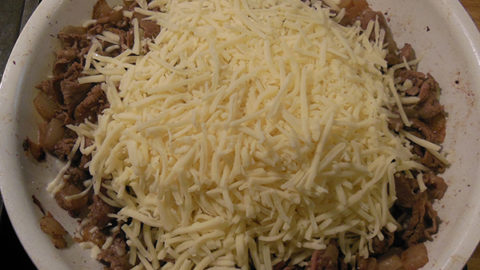
    Now the key thing with the choice of cheese is how easily it melts. Since everything else is completely cooked at this point (except the mushrooms, which won’t be cooked at all), we want something that melts readily. I went with Monterrey Jack, because it will melt if you look at it harshly. I just heaped it on there…

    Most things can be improved with cheese.

    And stirred it in. Before you know it, we get the goop we’re looking for.

    Ready to plate.

    We scoop the goop onto our fungal trenchers and… we get something that looks like a Philly street after a sportsball game…

    “Splat”

    Perhaps I should go and look for inspiration somewhere with a better culinary track record.

  • It works every time.

    Every once in a while, I draw inspiration from the audience.  None of you have steered me wrong.

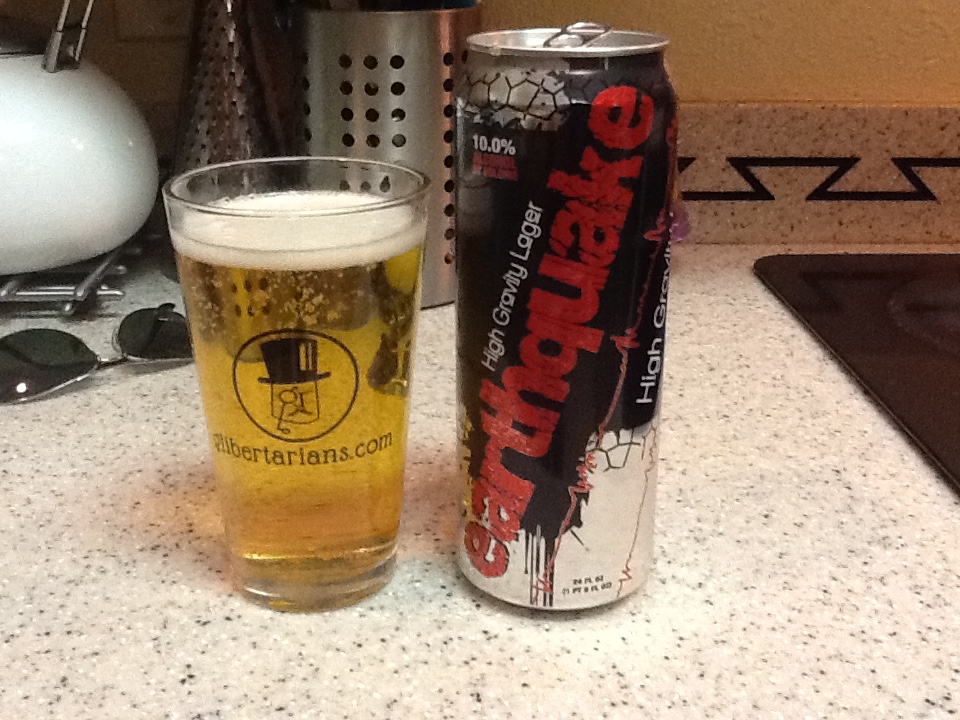
    This is my review of Earthquake High Gravity Lager…

    Okay.  One of you did.  I’m not about to start pointing fingers, because its more fun for me to wait until the end.

    A primer on Malt Liquor:  Brooklyn, the 1970’s

    This is a dream, man.  A man’s dream.  A man named Don Vultaggio  At the time he had nothing but a VW, an underserved market, and a dream.

    “Vultaggio began delivering malt liquor. This was a dangerous job — so dangerous, in fact, that the breweries’ own truck drivers refused to do it, which is the opening Vultaggio wanted to exploit. He braved stickups and shoot-outs. He hauled cheaper product from upstate wholesalers back into the city, because gas was 30 cents a gallon, and the hassle paid well.”

    Relax, this gets better.

    “One little fly-by-night distribution operation became a $2 billion beverage empire that now makes everything from malt liquor and flavored malt beverages, to beer, to — wait for it — AriZona Iced Tea.”

    True story.  Arizona Ice Tea is not a product of Arizona.  Actual people from Arizona, that is, the 10-20% of the population that are actually from here, are fully aware it is made in New York.  Like that terrible salsa from San Antonio, and their sales pitch– New York City!

    You probably know where this is going.

    “Ultimately, marketers failed to convince the white bourgeois that malt liquor was the new drink of the white bourgeois. But they did convince someone, albeit unintentionally. The word bubbled up the supply chain, from corner store, to distributor, to brewer, and finally to marketing departments: malt liquor is selling well in black neighborhoods. No one knew exactly why. It wasn’t cheaper than regular beer (that would come in the late ’80s, when Schlitz, then the market leader, undercut the competition and triggered the whole category’s slide from premium to bottom shelf). And the messaging was still white as all hell — in fact, a marketing study from the era suggests that malt liquor’s upper-class packaging may have been a contributing factor to its appeal to black customers, though this is no easy thing to corroborate.”

    Alas, I could continue to give you excerpts of this article.  I am not going to do that.  Am I that lazy? Yes.  This article though should be of interest to anyone that values capitslism.  After all, it never matters who you sell it to.  It matters that you sold it.

    “malt liquor’s fortunes have been entangled with America’s sorest social bugbears, from race, to class, to poverty, to whether or not capitalism ought to give a shit about any of those things.”

    In spite of the halfhearted attempt to SJW, this article is actually pretty good.  Read the whole thing.

    So how is Eathquake?  It pretty bad.  I’m not about to indulge myself in its flat body.  Its bitter sweet taste and its nose that reminds me of the bathroom in the gas station.  There is no redeeming quality about it.  It’s made with enzymes that break down the malt to allow the industrial grade yeast to process the sugar as a monosaccharide.  This is depression, and squalor in a can.  If it were possible to take being a New York Jets fan, distill it, bottle it, distribute it, market it and ultimately sell it–I imagine it would taste like this.  Ultimately, everyone will need a drink from time to time, and at least this one it honest enough that all we will know is that it will do its job–and nothing else.  Earthquake Malt Liquor 1.5/5.

    This is your fault. I blame you.


    Hat Tip: This sick, twisted man.
  • Romanian Food – A Short Primer – Part One

    Romanians have the peculiar habit of, on occasion, eating food. This is talk of such food. So without further ado, let’s get to the heart of the matter – sometimes literally. Romanians consume offal, we eat nose to tail, like most not that prosperous countries, waste not and all that. As a note, I will not be covering fresh blood, as this is a touchy subject for outsiders. I will just mention that the best quality is from subjects 16 to 25 and their virginity is unimportant.

    Please also notice the typical Eastern European plastic table covering for the kitchen table - which as you can see also graces my kitchen.
    Nothing like sucking on a nice bone

    I will not attempt to cover what are authentic, traditional Romanian dishes. I have no idea and doubt anyone does. There is no way of knowing where a particular dish comes from, and Romanians generally share a lot of dishes with other countries around them. There are plenty of Slavic, Turkish, Greek and German/Hungarian influences. While Romania’s version of a stuffed leafs dish may derive from Greek, they may be independent. I will not go into the food available to relatively well-off urbanites such as yours truly (the sushi isn’t bad), but what is the generally the food of the common folk (such as you glibertarians might consume were you residents of this fine country).

    Romanians do eat a lot of ciorbă, but how typical it is, I dunno. Here is a example of a pork one, with a large bone with some meat covered by broth, a small glass of tuica and the requisite hot pepper. Please also notice the typical Eastern European plastic table covering for the kitchen table – which as you can see also graces my kitchen. Eating such ciorbăcan be an unaesthetic affair and a bit savage if you are not used to it, as it implies taking the bone in your hands, ripping meat off it with you teeth and then loudly slurping the bone marrow.

    No bloody vampire jokes!
    Mujdei

    Some claim mujdei de usturoi is Romanian, which is basically crushed garlic with salt, oil and water. I dunno, but several countries have garlic dips, although most are creamy and mayo-like. Mujdei is more watery and has small slivers of garlic in it, unincorporated in a paste. We also have mămăligă – basically corn meal, salt and water – similar to polenta, with various degrees of softness, depending on taste. It can range from quite solid to porridge like.

    Now an ehm… burning question is: is Romanian food hot or spicy? No it is not, or very rarely so. The local habit is to have a hot pepper on the side of the dish and occasionally bite it. This is raw in summer or pickled in winter. Generally Romanian farmers are not careful about grouping their peppers by heat or cultivar, so a particular pepper is usually a gamble on how hot. Romanians are not particular about cultivars so you always buy/request peppers. And in the same batch some may be hot, some not. Ciorbă is always accompanied by a hot pepper. For cabbage dishes some people – me included in some cases where the smell factor is not important – bite out of cloves of raw garlic as they eat.

    As for other spices, Romanian kitchens are not spice rich. Besides the ever present salt and pepper, garlic is used a lot, alongside thyme, paprika, parsley, dill. Bay leaves on occasion. Some other dried spices in small quantities.

    Much more Sibui cheese is sold in Romania than made in Sibiu
    Sibiu cheese

    For oil, Romanians most often use sunflower. It is cheaper and readily available, and made the locals feel good because it is mostly of local production, Romania is an important grower of sunflowers in Europe. Similar to sugar coming from locally grown sugar beets rather than imported cane sugar, although olive oil and cane sugar are rapidly growing in quantity consumed. Vinegar is most often white wine vinegar, followed by apple vinegar.

    Cheese is a big part of Romanian diet. Brânză is, as a random factoid, one of the words still considered to be left in Romanian from the Dacian language. In Romania, it is actually split into several categories: white cheese called brânză and yellow cheese called Caşcaval (etymology apparently from Sicilian Caciocavallo cheese). Brânză can be telemea (somewhat feta like) either fresh or aged, caş (soft with very little salt), urdă (made from whey) or using the diminutive branzica for cottage cheese. Caşcaval is often eaten breaded and deep fried, unlike the white stuff.

    The main meats the Romanians eat are pork and chicken. Those are by far the most consumed, with beef, mutton and waterfowl as second tier, “whatever else” is third.

    The main fish freshwater eaten are crap (European carp), caras (crucian carp) which is the main pan fish, somn (wells catfish), biban (perch), pastrav (trout), ştiuca (pike), şalau (zander), Scrumbie (Pontic Shad), with some other minor fish.

    The house wine in a carafe is not
    Stuffed pike is a delicacy

    Traditionally more freshwater fish is eaten than salt water. Stuff like tuna and salmon and sea bream are now eaten in the cities, but I will not include them. The main saltwater fish are chefal (golden grey mullet), guvid (Pinchuk’s goby), Hamsie (anchovy) served whole deep fried, zargan (garfish, Belone belone, or sea needle). Of the pricier traditional fish, the delicacies so to say, are calcan (turbot), rechin (shark) and various sturgeons.  Fish is most often eaten grilled or fried (usually dragged through corn flower before frying). Grilled fish is often eaten as Saramura (briened). Basically you heat some water, add salt, pepper, slice chile peppers in it and pour hot water on top. When you take the fish from the grill you place it in the brine, also besides on the grill sometimes bell pepper and tomatoes are added, and after grilled themselves, they are peeled cut into chunks and placed into the brine. Grilled chicken thighs are also sometimes eaten in Saramura.

    Romanians, at least ones I know, usually have a side salad with dishes. Unlike other people who have the salad as a separate course, salad in Romania is on the side of the main for lunch/dinner, or as a side to breakfast. It is most often lettuce or chopped cabbage (with sunflower oil and vinegar, not ugh mayo). In summer it is tomato salad – tomatoes, salt, pepper, sunflower oil and chopped raw onion. Another local favorite is ardei copt (baked bell pepper) which is as it sounds – you put a dry pan on a fire and add peppers in it until the skin turns blackish and can be easily removed. Take them off, peel the skin; add a bit of salt, a bit of oil and a bit of vinegar, and that is it. In winter, side salads are replaced by pickles – Romanians eat a lot of pickles.

    No, this is not an euphemism
    You can see the gogoșar in my Christmas post

    On pickles, Romanians have The Big Four pickles with a bunch of minor additions. The Big Four being cabbage, cucumbers, gogosari (a cultivar of ball pepper) and gogonele (unripe tomatoes). There are two ways of pickling: brine and vinegar. Cabbage and tomatoes are always brined, gogosar is always vinegar, cucumbers can be either the right way (brine) or the wrong way (vinegar). Cucumbers are also the only ones pickled in summer, with a different taste due to much faster pickling at a much higher temperature (often left in direct sunlight as they pickle). Autumn pickles are low temp long time.

    While these are the main pickles, many other things are added, usually in smaller quantities mixed in. For example when pickling gogosari, the core is taken out and the inside filled with, in general, cauliflower, grapes and slices of carrot. Among the green tomatoes we get cauliflower, cabbage, and some green bell pepper, sometimes small unripe watermelons and sometime red beet, mostly to give it colour. Cucumbers (if you ignore some dill which is added) and cabbage are pickled alone. In general horseradish is added to most pickles as a preservative (don’t know if it actually works as one but is used as one nonetheless.)


  • Wessen Bein Muss Ich Bücken?

    Even though I don’t particularly care for this style, perhaps there should be more to this series than what I like.  So recently, I came across this:

    Hold up, I have a pair of Under Armour leggings I used to wear when I ran outside in Colorado, let me see if they still fit.

    *squeezes into tight pants*

    No. You GTFO.

    Then this happened.

    That’s not a knife, this is a knife!

    Then things predictably got out of hand.

    *orders knife* 

    This is my review of Wessterhuffenphasterphallenhoffeersheissen’s Hefeweissbier.

    HT:  DEG, MikeS, Q Continuum  and Hayeksplovises

    M’am

    Hefeweiss is the predominant German style wheat beer.  There are other varieties of course, depending on the region, but for most of us this is the one that comes to mind when the term, “German wheat beer” comes up in conversation.  People like this, apparently.  I am not one of those people.  Why?

    It tastes like banana.  I don’t like bananas.  The semi-sugary taste, the texture, the fact that none of my kids can open the damn things and will go through a bunch of them in a day.  This sentiment was developed well before the CHM 235 Organic Chemistry course taught by what I later found out to be a really awesome professor.  Think (((special forces))) awesome, but wouldn’t give anyone a definitive answer. For the lab part of this course, my lab partner and I were given several bananas.  The project was to extract and isolate an organic compound called an ester from the fruit.

    Most of it involved smashing up bananas into a paste, then putting the paste into a press.  Then squeezing the liquid out of the paste.  Then vaporizing the liquid multiple times through a distillation column, to extract a weapons grade distillate of Isoamyl Acetate–or Banana Oil in English.  It went fine until my lab partner managed to spill the vial on me.  The grad student in charge of the lab saw the whole thing so I didn’t lose any points for failing a simple distillation.  Not that there was no other way I could prove it was spilled on me.   The bad part was when I went to work immediately after the lab.  At the time I worked the sporting goods counter at the local Wal-Mart.  The clientele was the predictable group of rednecks.

    • “Hey kid, why do you smell like a monkey?”
    • “Mother of Christ.”
    • “Can you write that that mountain lion tag for yesterday?”
    • “I’m not gay or anything, but you smell really nice.”
    • “We fielded a few complaints.  Were going to go ahead and pay your remaining hours for the day. Go home.”

    Predictably, this tastes like every Top.Men-compliant hefeweizen out of Germany:  banana with a twist of lemon.  If you’re into that, have at it. Wessterhuffenphasterphallenhoffeersheissen’s Hefeweissbier 2.0/5

    Not to be outdone, others have tried to take this style to new and interesting places. Only one on this list was available in my area:

    If you are looking for a traditional Top.Men approved ale, keep looking.  It has significantly less body and you’ll probably say they over hopped it and should apologize to the German people for such an atrocity.  For me, it doesn’t taste so much like banana, so it’s not so bad.  Lagunitas Little Sumpin Ale. 2.2/5

  • Fast Food Nation

    Trigger Warnings: rampant misogyny and unnecessary cursing. I don’t claim to be a professional journalist, nor do I care to write in an erudite fashion. That’s Heroic Mulatto’s job. But, unlike HM, I do bring the alt-text.

    I’m not normally a McDonald’s guy.

    I don’t have any problem with them, from a philosophical standpoint. They make something they claim to be food, and bizarrely, many millions of people enjoy these products and shower them with money. It just typically isn’t something that I enjoy eating.

    Last week a buddy of mine told me to swing by and try their new Buttermilk Chicken Tenders. So, on my way home from work today, I stopped in to give this new item a fair hearing.

    Let me tell you, those things are delicious. I will seriously go there at some point in the future specifically to get those again.

    But enough about the food. As I was standing to the side of the counter waiting inexplicably for seven minutes (I thought the whole point was, “Yeah it sucks, but it’s fast“?), I noticed the young lady who took my order was a very attractive young Hispanic woman. Pretty face, perky tits, hips, the whole nine yards.

    I looked back into the kitchen, and saw at least two other relatively hot Hispanic chicks. So I started thinking to myself, man, if I hadn’t already been dating my eventual wife when I graduated college, this would be a totally sweet fishing pond for random ass. I mean, how picky can they possibly be? They work at fucking McDonald’s.

    Well known fact that she got her start working the fry machine at McDonald's
    This is what the girl who took my order looked like. More or less.

    So my 25 year old self would roll up, strike up a conversation, and be like, “Hey – I’ve got a regular job in a cubicle, involving Excel formulas and v-lookup. I make enough so that I don’t get a 100% refund on my taxes. I have a late-model car that isn’t upside-down financially, and my own apartment. I can take you out to dinner – at a sit-down place with a leather-bound menu. And I eat pussy like it’s goin’ out of style.”

    In my mind’s eye, at that point, any chick with little enough command of English and even less economic prospects would pretty much just drop her drawers. “Oh I suck yo dick!”, she says in a Vietnamese accent for some reason even though she’s clearly Mexican or Central American (damn you Full Metal Jacket for permanently fucking up my internal monologue when it comes to casual sex!).

    It’s kind of like my version of slumming. It would have been fun, and I would have had access to free McDonald’s, which I recall not being as gastronomically opposed to 10 years ago.

    That’s pretty much it. Oh, and I saw this flier on the way out. It was some kind of community outreach bullshit. What really drew my eye was one of the items listed among the other boiler-plate stuff like fundraisers and sponsorships. “Store Tours”. Um…what? How in the ever-loving fuck is giving a tour of your fucking shit-shack of a goddamn fucking store, and I fucking quote, “Giving Back To Our Communities”???

    Because if they did, that'd actually be pretty fucking awesome, and I'd sign up for the store tour.
    Our journey together for good? So do the McDonald’s locations in Snake Mountain and the Hall of Doom say, “Our Journey Together For Evil”?
  • Cooking for One Without a Recipe

    Sous Chef Oscar
    Sous Chef Oscar
    I love recipes and cookbooks. I often read cookbooks on Sunday mornings, but I usually cook without a recipe. Cooking without a recipe is a useful skill because it lets me just look through the refrigerator, pull stuff out and make dinner. In addition, most recipes are designed to serve four or more, which for a single woman like me, means leftovers.

    I don’t like to eat leftovers. Leftovers can be convenient for lunches or future dinners, but with the exception of chilis, stews or some soups, most recipes just don’t benefit from reheating. If a recipe doesn’t reheat well, it doesn’t freeze well. Making a single portion lets me eat good food and avoid leftovers.

    It is easy to come home from work and order in or use processed food to throw together a dinner– that’s not healthy for my waistline or wallet. I need to make sure that cooking dinner is easier and better than ordering in or eating something already prepared.

    A few principals of cooking for one before we start:

    1) Season your food. Salt is why food in a restaurant tastes good. Use it.

    2) Use garnishes like parsley, chives, a bit of cheese or nuts. Those little touches at the end really do improve the experience for very little effort.

    3) Pay attention to presentation. When the food looks inviting, it tastes better. And, even though it seems counter-intuitive, when food looks inviting and tastes good, you actually eat less because it is more satisfying. So, if you are interested in losing weight, take time to make your food special.

    I need something that is quick and easy to prepare and cleanup for those nights when I don’t feel like cooking. So, let’s start with the simplest method I know; the brown and bake. I want to make this feel like a composed dish by using two or more vegetables. It makes the meal feel more special than just tossing something together. To demonstrate the method, I’m making a chicken thigh with sweet potato and spinach.

    1. Preheat the oven to 400F.

    2. Season a skin on, bone in chicken thigh with salt and pepper. Add a little oil or butter to an oven safe skillet, then add the chicken thigh, skin side down.

    3. While the chicken browns, peel and chop a sweet potato into 1 inch pieces. Once the chicken skin is brown and crispy, add the sweet potato to the pan and season with a little salt. Put the pan into the oven keeping the chicken skin side down, and bake for 15 minutes.

    4. After 15 minutes, turn the chicken over and stir the sweet potato around, then return to the oven for another 10 to 15 minutes.

    5. When the chicken is done (at least 165F – use a meat thermometer) remove from the oven, and put the chicken thigh on a plate.

    6. Add spinach to the pan with the sweet potato and toss until the spinach wilts. Sprinkle on a little blue cheese and serve.

    That’s it. Crispy chicken skin, soft sweet potatoes and tangy blue cheese paired with the slight bitterness of spinach. You have a satisfying dinner for one that looks and tastes like a composed dish in about one half hour and with little effort and an easy cleanup. Perfect for a weeknight.

    Voila!
    Done!

    This method is easily adaptable for a variety of proteins and vegetables. For example you could use new potatoes cut in half and tossed with a little fresh, chopped, rosemary before adding to the pan. Then toss with the spinach as above. A little blue or feta cheese works here as well. Butternut squash can also be substituted for the sweet potato.

    Other variations:

    Cut carrots and parsnips into matchsticks and toss with honey and cayenne pepper before adding to the pan. Top with a little chopped fresh chives.

    Pair a thick pork shop with Brussels sprouts and apple. Cut the Brussels sprouts in half or quarters depending on the size. Cut the apple into pieces about the same size as the Brussels sprouts – add the apple at the halfway point.

    Salmon works well, but choose vegetables that cook quickly – like asparagus and cherry tomatoes, finished with a splash of balsamic vinegar and some capers. Or, use green beans and mushrooms.

    Your imagination is the only limit.

    Next time I will talk about making a skillet dinner with a pan sauce.

  • Lindemann’s Kreik Lambic

    In my family, real estate is sort of a big deal.  Since we all know what happened to the housing market in 2008, we began doing something every year for Christmas:  we drew names.  Ultimately this meant I only had to buy a single gift but it did mean I was also receiving a single gift.  This year, my brother got me and while it really was thoughtful of him to get what he got me–I already had one.  Semper paratus as they say, he had the receipt handy:  Bed, Bath and Beyond.

    Shit. At least they sell beer in the “beyond” section.

    This is my review of Lindemann’s Kriek Lambic. 

    Lambic is among the oldest styles of beer, but do not confuse this to mean these are in any sense of the word, primitive.  On the palate these are as complex as they come, with several diverse sub-styles.  To get a good idea of how old these may be, the painting below titled, Peasant Wedding from around 1567 suggests, people have been enjoying Lambic for centuries.

    It’s a style believed to have originated in Belgium around the time of the Roman conquest.  The Germanic tribes viewed the wine made by Mediterranean cultures to be effeminate, which even now seems to be an opinion held by many, though not me personally.  The earliest known account was from Holy Roman Emperor Charles V, while travelling to the region he ordered a pitcher at a local pub.  He took a liking to the lambic and had several servings from the pitcher, and apparently harassed the blonde waitress.  Man of the people, he was.

    But like everything else these days, there seem to be conflicting reports.  According to this guy, there is no specific evidence that lambics existed before the 18th century. There is nothing medieval about this beer other than the stoneware Belgians used.  It is a myth perpetuated mostly by lazy beer writers who don’t know what they’re talking about and sure enough, the misconception is the story that stuck.

    The commonality between the stories is what I can assume isn’t fake news.  What is common?  Lambics are a type of sour beer that is defined by its spontaneous fermentation.  That is, the brewers will put the casks outside to allow and even siphon wild yeast and bacteria into the wort to do the dirty work. Modern lambics are not made with a biochemist on staff with some GMO yeast strain in a test tube.  It’s as natural as it gets without isolating a strain from a brewmaster’s hipster beard (Rogue), or even a yeast pulled from some lady’s yoo hoo.

    No, seriously.  A lab in Poland swabbed and isolated the strain from a Czech model. If I told you they swabbed her, would you drink it?

    Much like wine and whiskey (or whisky for your Canadians), lambics are often blended with other lambics to allow for varying levels of complexity.  Charles V himself was likely served a blend with a sweeter variety to make it more palatable. These can be served like champagne, and the sour varieties are great to pair with food because they do well to cleanse the palate.  This one is made with sour cherries, hence the name Kreik.  Others made by Lindemann include strawberry, raspberry (framboise), black currants (cassis), and peaches (peche).  This one is more tart than sour and is very light. If you happen to like cherries, you’ll like this one.  Lindeman’s Kreik Lambic 4.0/5.

  • De-winefying beer – Part 2

    No, I didn’t buy a bunch of cheap beer to chug after I came home from the gym. I don’t think it was particularly wise of me to do that and while I like you guys (and the 5 ladies we’ve been able to confirm here) I’m not doing that for you again. At least not for free.

    Nothing gets by this crowd though, and everyone here is intelligent enough to notice a pattern in that first article. On the off chance you missed it I’ll point it out: With the exception of the IPA and Daybreak those affordable but skunky beers are all Pilsners.

    This is my review of Sierra Nevada Nooner Pilsner.

    The Pilsner is the most common beer in the world. Some estimates I have heard but not verified, is that over 90% of the beer consumed on Earth is a Pilsner. A claim I find believable, but again not verified. It is named for it’s origin in the city of Plzen, Bohemia (Czech Republic), where it is was first brewed by Pilsner Urquell. Credited to Josef Groll, a Bavarian brewer hired by the city’s brewers to teach them to lager. At the time they were having issues with their ales spoiling and in 1838 they chose to flood the streets of Plzen with spoiled beer to dump it.

    Nobody knows who it was that smuggled the Bavarian yeast out of Bavaria, but some blame a monk. What made this yeast special?  This is one of the first strains identified that fermented at the bottom of the barrel, rather than ale yeast which ferments at the top.  Ales brew at higher temperatures and often are hardy enough to handle moderate temperature fluctuations.  Lager yeast on the other hand needs a consistent temperature, often somewhat cold. Whoever smuggled out this trade secret, Groll had the yeast and in 1842 he combined it with the city’s remarkably soft well water, and generous portions of Noble Saaz hops. The result is still made to this day. https://www.thespruce.com/history-of-pilsner-353306

    Others realized the Bohemians were on to something, so as they say–scaramoosh, scaramoosh when you do the fandango.

    What is it that sets beer like this apart from the mass produced libations everyone from the Trumpeñero, to the bearded hipster that doesn’t seem to understand what irony is but claims to own it anyway, all seem consume in ridiculous quantities? I don’t know. But I have a couple theories.

    The old adage is that one cannot have it good, cheap, and fast; somewhere within those three attributes, corners will be cut and compromises will be made.  The main difference between buying a luxury good from a mass produced good, it what is compromised. Not to step on anybody’s toes here, but take this for example:

    Thunder Bolt and lightning

    This is the revolver I purchased a few weeks ago. On the outside, it looks excellent. The finish is reasonably well polished, there are no sharp edges, the lockup and action are…okay. There are no machining marks and yes the barrel is aligned properly (I checked before I bought it). Where was the compromise? The design itself for one thing, as revolvers are really meant for a niche market, most of which with more grey hair than I and much more discernable in terms of quality. The $10 rubber grip is another as are the usable sights, which I think can be improved. Both however, can be had in the aftermarket as so that is no big deal. Where the compromise truly is to be seen, is when you pull off the sideplate:

    Very, very frightening.

    The trigger group is made from extruded parts rather than machined to shape from bar stock. They are heat treated for strength, which is why they look burnt. These parts rub together and are meant to grind smooth against themselves over time. The only parts that are fitted, are on the hammer, just below the sear and the hook of the trigger where they contact each other–right behind that superfluous safety device.  Once these are removed, one will find they are sitting in a gum-like mess meant to pass as lube. The inside of the frame is rough and unpolished. I knew when I bought it, that I had it cheap and fast. Together these gritty parts make for a trigger group that is terrible for the overall price of the gun. To Smith and Wesson’s credit, in order to make it good I only needed an Arkansas stone, watchmaker tools, wipes soaked in jeweler’s rouge, 5w30 and a Sunday afternoon with a Radenberger. I suppose a flashlight was also needed because I somehow managed to lose explosion diagram part #71. The result is something with much less compromise. 

    The other theory? Americans only have a history going back a couple hundred years. The standards and traditions that are lauded in European culture have been built over centuries and thus their standards and expectations for certain things, like food and drink are higher. Also America was built on an idea, therefore anybody no matter where they are from can theoretically be an American so those standards and expectations get lost over time. So how is it that the Germans are able to put a better Pils to market? I’m not privy to that information to know for sure, but I would guess the compromise is price and time to some extent, because their home market is rather discerning. This is not to say an American company cannot build it to the same standard.
    Sierra Nevada makes this in what I find is the more enjoyable Czech style. It is light, properly carbonated and has the crisp finish that almost everyone can enjoy. It is perfect to quench your thirst on a hot day. While it is hard to compete when the Germans give you full pint cans for the same price, it stacks up well. I will say that I liked Breakside’s version better, but it is Oroegone based so it may not be available in your area. Sierra Nevada makes theirs in California and North Carolina so its available on both coasts! Sierra Nevada Nooner Pilsner: 3.8/5

  • If its not Scottish (Haggis) its crap!

    In 122 AD (or CE…) Roman Emperor Hadrian discovered something so shocking, so perverse, that he had no choice but to make one of history’s most racist decisions.  What did he discover?

     The Scots.  His solution?  He built a wall.


    Yeah, there is probably more to that, but this was a research intensive article and quite frankly I’m not going to get into the why of it.  Hadrian was emperor for all of 21 years, 11 of which he spent touring the empire.  In spite of his short reign he left his mark on the empire by consolidating provinces, allowing much needed reforms, and engaging in infrastructure projects, such as a Roman Temple–located conveniently next to Solomon’s temple in Jerusalem.  That really pissed off the (((locals))), and the ensuing revolt apparently lasted three years.  He is most famous however, for building a wall across Roman Britain to keep the barbarians to the north out.

    The Scots weren’t all bad, and some of them were indeed good people.  For instance, James Watt is credited with giving us the steam engine, allowing for the Industrial Revolution which to this very day impacts the way everyone in the western world lives!

     Okay, technically Heron of Alexandria invented the first steam engine, but they did give us the greatest love story ever told! 

    Okay, technically Wallace was such a terrible statesman the nobility found it more convenient to martyr him, rather than putting up with him.  Also, the only reason you still watch that movie is because you like Longshanks for being the archetypal shitlord and Monica Belluci circa 1996.

    A Scottish regiment is famous for being the last ones to attempt a bayonet charge!  In the early days of the Iraq war, they fixed bayonets and gave Saddam the business!

     No, still not feeling it?  Fine, they gave us this:

    Not my photo

    This is my review of Founders Dirty Bastard Scottish Ale.

    Even though Scottish Ales are realistically all the same, I think a brief overview in naming convention is in order.

    The Schilling System was instituted in the 1880’s, although there is some evidence it was in use earlier than that.  By that time, it became a requirement by the British government due to a change in what was being taxed.  Rather than grain and sugar, they simply taxed the beer.  To add further confusion the tax itself was based on the invoice price of the quantity sold by the brewer (barrel vs. hogshead).  To further add confusion:

    “This dual application of pricing applied to two different liquid measures brought about complications: a 60/- ale in the barrel was a 90/- ale in the hogshead even though it was the same product. The actual price of the ale could be as little as half of the invoice cost once the calculated duties and the discounts allowed by the brewers were subtracted.”

    Paying more tax for the same stuff because it was shipped in a different size barrel? No wonder we fought a war to get away from this…

     The term, “Wee Heavy” came about during this time due to the variety produced by Scottish breweries at the time.  The highest gravity varieties were sold in “nips” in 6 ounce quantities.  Since it was a wee bit heavy you may not mind all you were getting was was then ⅓ of a pint, the beer was going to get you where you wanted to be:  too drunk to consider the taxes you were paying.

     For our purposes these come in three varieties.


    The first is a 60/-.  These are typically very light (<5%abv).  Even though they have the same malty character that defines this style, it often leaves the experienced beer drinker wishing there was something more.  A good example is Newcastle.

    We know you are watching, John

    On the other end of the spectrum is 120/-.  These are a wee bit heavier (hence the term) and quite frankly are not for everyone. Typically these operate in the 7-10% abv range. These can be a lot of fun but have one downside, which I’ll touch on shortly. A good example, is Orkney Skullsplitter.

    Finally, there is the 90/- (80/- is traditional).

    Like the proverbial third bowl of porridge, for most of us this one is just right.  A good example is Bellhaven, but in the US there are dozens of good examples as well, all around 5-6% abv.  The dominant craft brewery in my area is Four Peaks and their flagship brew is called, Kiltlifter.  This is a carbon copy of Bellhaven and they sell it in insane quantities.  So much so, they are one of the evil brands that sold out (though I argue they bought in) to InBev.  Ironically, the first time I had it off tap was in Las Vegas, so should you find yourself there, try it out.  Other examples are Great Divide Claymore, Oskar Blues Old Chubb, and Odell 90 Schilling (all from CO).

     Dirty Bastard is 7.5% abv so it fits in with the Wee Heavy category.  The only one I can really compare it to is from a brewery based in Utah, it was 10.5% abv and I seriously doubt you’ll ever find it.  The Bastard has an overwhelming malt complexity and has more body than you can wrap your arms around.  The downside is the moment it got within range of my snout I got a hearty whiff of booze.  It took a sip or two for my olfactory sense to adapt but in the end I will likely continue to buy it a few times when it becomes available. For every other time of year, there is plenty of Kiltlifter to go around. Founders Dirty Bastard Scottish Ale: 4.2/5.0