Author: SUPREME OVERLORD trshmnstr

  • Pity v. Compassion: A distinction without a difference or all the difference?

    There are thoughts that gnaw at me sometimes. One, for example, is the extent to which my faith-informed morals (DISCLAIMER: I may skirt around some Jesus-y stuff in this article, where necessary) allow for resistance against those who would take advantage of me, whether it be asserting my interests when somebody is being manipulative or whether it be using violence in defense of self and others. Another example is the difference between charity and welfare.

    My faith-informed morals also compel me to be charitable with my time, my money, and my efforts. I don’t believe that it is something “over the top” for me to do as a “good” person. It is, to me, a basic component of obedience to the morals and principles that guide me. As such, it can sometimes be hard to conceptually separate charity from welfare when you strip away the ad hominems, the dystopian undertones, and the inherent force of government and view welfare in its most favorable light, as “people more effectively helping their neighbors out of a hard place.” Yes, this is a rather unfaithful definition of welfare, but it’s important to be able to address opponents at their most mendacious.Now Our Charity Is Born! - Chris's Cancer Community

    Of course, when addressing welfare, it’s easy for a libertarian to toss out a few cliches and dismiss the entire thing. Taxation is theft. The ends don’t justify the means. There is a man with a gun behind every government program. However, cliches don’t change minds. Cliches also don’t address the emotional imbalance that is equivalent to the economic imbalance discussed in Economics in One Lesson. Specifically, when the warm-fuzzies are openly apparent and the pain is diffused among an entire tax base and hidden in withholding lines of a pay stub, it’s important to address this issue on an emotional level.

    Most who advocate for welfare do so under the guise of compassion. Their overwrought whinging about how everybody against welfare hates the poor is convincing to many who feel true compassion for the poor. They are apparent emotional allies with the welfare advocates. Any amount of nuance and rationality on our part feels to them like equivocation and excuse-making. However, I’ve found that hearts are a blunt-force instrument and minds are a precision instrument. The heart is really bad at differentiating similar emotions or similar intentions. Without engaging the mind, the heart can easily mistake compassion for the similar emotion of pity. However, pity is different enough to completely change the emotional tenor of a situation.

    Compassion is an emotion of similarity. You feel compassion because you recognize the innate human dignity of another. You see somebody who is suffering and want to help them overcome their suffering. It’s an emotion of humility.

    Pity is an emotion of difference. You feel pity for something beneath you. Something pitiable is low and less than you. Pity is an emotion of pride. There’s a tinge of smug condescension that comes with pity.  As libertarians, we know that if anything describes statists, it’s smug condescension.

    Welfare isn’t driven by compassion, but by pity. This is why welfare is rotten to its core. The dehumanizing effects of welfare dependency are easily observed, but it’s no clearer than when somebody tries to get off of welfare. If you want to see somebody’s “compassion” for the needy vaporize, watch them interact with somebody who isn’t willing to stay enslaved to the welfare system. It starts with a guilt trip, continues with anger, and finishes with jealousy. See, the competitive undergirding of their pity motive for supporting welfare can’t deal with their lessers becoming their equals. When they say “think about the people who haven’t been as successful as you,” they’re really saying “mind your place in the order of things.” When they say “you’re being ungrateful for the help you were given” they’re really saying “welfare comes with strings, and these strings can’t be cut.” When they say “you’re self-hating” they’re really saying “back to the plantation, slave!”Top 10 Tips: Avoid Pickpockets & Thieves On Your Next ...

    If welfare were truly about compassion, it wouldn’t merely be a check-writing mission. Compassion imparts dignity, and cutting a check isn’t always the dignified action to take. Compassion is a personal connection, welfare is profoundly bureaucratic and impersonal. To the extent that welfare moves beyond writing checks, it is still completely beholden to the pity that drives it. Welfare programs are designed to maintain and increase enrollment in order to show a need for further investment. Much like any other government program, any initial “good intention” is quickly corrupted by the perverse incentives that come with “free” money. Of course, I question the initial good intention in the first place. Pity is lazy, and welfare is lazy. The hard work of understanding the poor and formulating a dignified response to their challenges is a herculean effort, not something that a government program is usually known for.


    This "Sesame Street" Photo Will Give You Nightmares ForeverCharity shows what true compassion looks like. Most charity isn’t front page news. It isn’t touted. People aren’t shamed for not throwing their whole-hearted support behind a cause. Recipients aren’t shamed for no longer needing charity or for making suggestions for improvement. By removing the competitive dynamic that exists in pity based relationships, charity becomes more effective than welfare. This may seem counter-intuitive to those who are used to talking about competition as a primary driver of the free market, but social competition between the provider and the recipient is a very different competition than economic competition between similarly situated providers.

    In summary, the supposed compassion of the welfare advocate is truly pity, which introduces a competitive dynamic between the provider and the recipient. This pity-based giving has the potential to be a net harm and is based in pride rather than humility. Charity, on the other hand, is a true act of compassion and is based in humility. This is why charity is effective while welfare is chronically ineffective.

  • GlibFit DoneFit Challenge #1 Week #10: We dun wid dis sheeit!!

    We made it! Some of us are smaller than we started, others are bigger, others just hung out and gave support. It’s time to celebrate!!!


    As for me, I had a good February, a bad March, and a good April. Next challenge, I’m ready to set a true weight goal and possibly a strength goal.

    Starting in a few weeks, ALeapAtTheWheel will take over for GlibFit challenge #2, another 10 week challenge with new goals and new material!

    Hello Glibs,

    We will be taking a 4 week hiatus from GlibFit, and then will be returning with GlibFit 2.0, son of GlibFit.  I will be taking over for GlibFit 2.0. Do Not Adjust Your Set. GlibFit 2.0 will return at the Same Glib Time, Same Glib Channel.

    Take a month to get fat and lazy, but be back here with your decoder rings ready.  We will have a special, secret message for every Junior Glib Ranger four weeks from today!

    -ALeapAtTheWheel


  • GlibFit WrappingUpFit Challenge #1 Week #9, entering our final week!!

    Sorry for the rushjob this week. We just moved into a new office with zero privacy, so I don’t have the luxury of polishing this off during downtime at work. I’m trying to get this written up before I leave for work.

    As we approach the end of the first GlibFit challenge, I hope your goal is close to being attained. For me, I’m a creature of habit. If I can establish a habit, things will go really well. If not, I’m going to constantly struggle. I don’t know whether that’s a universal human thing or only for certain personality types.

    I’ve had a really hard time adjusting to the zillion schedule changes that have happened during this challenge. I started out in a temporary office in a decent routine, but when we moved out of that office, things went to shit. One week Two weeks Three weeks Three and a half weeks of work from home later, the new office was finally opened yesterday. Of course, this new office was originally slated to be ready when I started this job over a year ago, but let’s ignore that.

    To some extent, this is just an excuse. It doesn’t truly matter what your schedule is, you can eat a healthy diet and find an hour to pound out a couple miles on a treadmill. However, establishment of habits requires a bit of stability. The purpose of this challenge isn’t to be healthy for 10 weeks, it’s to give us a bite sized goal that is long enough in duration to cement healthy habits into place permanently.

    Anyway, I’m gonna try to close out this last week on a positive note, and I encourage those of you who have also had trouble establishing the habit to end the challenge with a bang so that you’re in a good place to cement your habits into place when challenge #2 starts up in a few weeks. (Additional details to follow)

    Hopefully not you…
  • Escapability of Taxes

    Needz Moar Guns and IRS jackets

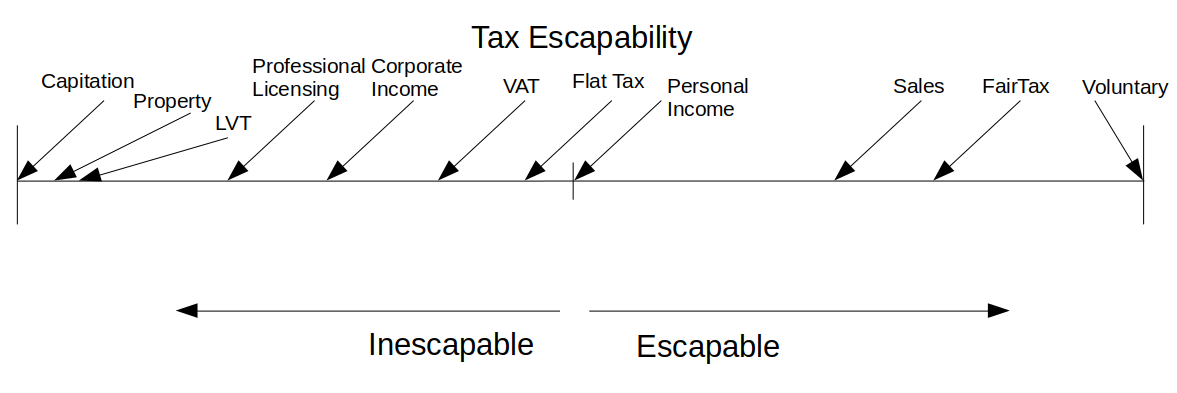
    As many well know, I find property and land taxes to be the devil. Literally the worst form of taxation (I could be convinced that a capitation tax is worse). In thinking about why I feel that way, I realized that one of the big factors in my perception of a tax is escapability. How easy is it to get around paying that tax?

    Consumption taxes (sales tax, etc) tend to be relatively easy to get around. Depending on the product, you can make it yourself, barter for it, pay for it under the table, or structure the sale so that tax isn’t applicable (online sales). Targeted consumption taxes (like the Fair Tax) are even easier to get around. Buy all but your essentials used, and you pay no tax.

    Income taxes are harder to get around, but you have options depending on the circumstances. You can put your money into tax-advantaged investment accounts. You can take your income in creative ways that alters the type of tax you pay on it. You can offset your income with the various tax loopholes provided in the tax code.

    Commerce taxes (corporate tax, VAT, etc) are even harder to get around because they’re already priced into your products when you purchase them. You’re reliant on another entity to minimize their tax burden so that you pay less taxes as passed through their products.

    Existence taxes (property, land, capitation) are impossible to get around because you have to exist somewhere. Even if you rent instead of own, you’re paying property/land tax. Even if you take no government services, you exist so you owe a capitation tax. The only thing you can do is live somewhere that has a less onerous tax burden than your current locale.


  • GlibFit Winding DownFit Challenge #1 Week #8: Killing it or done with it?

    SP’s note: The tardiness of this post is completely the fault of the site editors/schedulers. TrshMnstr had it pending in the queue and everyone thought everyone else was scheduling it. The Management Apologizes!

    With only two weeks to go, it’s time to decide. Are you going to finish out by killing it, or are you done with it? For me, I’ve been stagnating since the beginning of March, so I’m looking to revitalize my motivation and get a good head of steam built up for late spring.

    In 2 weeks, we celebrate, whether you sprint or limp across the finish line. How you finish is only a matter of personal pride!

    Now’s the time to have a logistical conversation. Is GlibFit something we want to keep doing on a regular basis? What sort of regularity should we go for? I’m thinking that 2x per year is about right. One as winter starts to drag on, and one starting in the dog days of summer. Do we want to rotate article duty across a few people? I’m happy to do it all like this first one, but sometimes I don’t get around to writing the article until the morning of, so the quality suffers those weeks. Further, if we rotate, folks may be able to do some more in-depth articles about techniques and regimens and the like. Mrs. trshmnstr may even be willing to do up an article (she’s a trainer at OrangeTheory).

    WatchFit - Felicia Romero top fitness model in USA

  • Victimhood as Social Currency: A Case Study of Victimhood Culture

    Moral Cultures

    A couple years back, a paper made the rounds through the daily “science” “journalism” blogs. It discussed three types of moral cultures that exist: honor cultures, dignity cultures, and victimhood cultures. In the context of the US, the country started as an honor culture, evolved into a dignity culture in the early 19th century, and is in the process of evolving into a victimhood culture now.

    As a background, honor culture is a type of culture where small slights are amplified into grievous insults, and are addressed with direct retribution. For example, a cad insinuates that your wife is his paramour and you slap him across the face with your glove to challenge him to a duel. A dignity culture is a type of culture where small slights are ignored and larger conflicts are elevated to a paternalistic overseer like a court or an administrator. For example, your neighbor builds a fence on your side of the property line, and you take them to court to resolve the issue. Finally, a victimhood culture is a natural outgrowth of the other two. Victimhood culture amplifies small slights into grievous insults (microaggressions) and elevates these small slights to their overseers, usually campus kangaroo courts, social media censors, or advertisers.

    Victimhood as Social Currency

    Campbell and Manning, in the linked paper, discuss the virtuosity of claiming victimhood status in a victimhood culture:

    When the victims publicize microaggressions they call attention to what they see as the deviant behavior of the offenders. In doing so they also call attention to their own  victimization. Indeed, many ways of attracting the attention and sympathy of third parties emphasize or exacerbate the low status of the aggrieved. People portray themselves as oppressed by the powerful – as damaged, disadvantaged, and needy. This is especially evident with various forms of self-harm, such as protest suicides and hunger strikes. Other such gestures include the ancient Roman practice of “squalor,” where the aggrieved party would let his hair grow out, wear shabby clothes, and follow his adversary through the streets, and the Indian practice of “sitting dharna,” where he would sit at his adversary’s door. But why emphasize one’s victimization?

    Certainly the distinction between offender and victim always has moral significance, lowering the offender’s moral status. In the settings such as those that generate microaggression catalogs, though, where offenders are oppressors and victims are the oppressed, it also raises the moral status of the victims. This only increases the incentive to publicize grievances, and it means aggrieved parties are especially likely to highlight their identity as  victims, emphasizing their own suffering and innocence. Their adversaries are privileged and blameworthy, but they themselves are pitiable and blameless. To the extent that others take their side, they accept this characterization of the conflict, but their adversaries and their partisans might portray the conflict in the opposite terms. This can give rise to what is called “competitive  victimhood,” with both sides arguing that it is they and not their adversaries who have suffered the most and are most deserving of help or most justified in retribution.

    . . .

    Appeals that emphasize the victimhood status of the aggrieved appear to arise in situations where people rely on authorities to handle their conflicts. Even relatively wealthy or powerful litigants might approach the court by presenting themselves as victims in need of assistance against a bullying adversary (see, e.g., Bryen 2013: Chapter 4). Most state propaganda, on the other hand, is not aimed at superiors or equals, but at subordinates. It seeks to inspire not sympathy, but loyalty, fear, and respect. This is also largely true of the communications between states, particularly those of similar size and military power. Warring states have no central authority to which they might appeal to handle their conflict or deter violence, and so they handle their conflicts directly through aggression and negotiation. In this respect states resemble individuals living in settings where legal authority is weak or absent.

    In essence, victims try to amplify the harm done to them, usually in an oppressor-oppressed context, to elicit pity from the authority, which they see as a parental figure. Usually, this results in an escalating comparison of grievances between opposing parties. Sound familiar? It should to all of you parents out there, especially parents of small children. Victimhood culture is the triumph of the tattle tale. One of the big themes of a victimhood culture is “actively retarding the process of growing up.”

    Victimhood Culture and Statism

    If you read the above excerpt carefully, you’ll notice something predictable, but rather telling. “Appeals that emphasize the victimhood status of the aggrieved appear to arise in situations where people rely on authorities to handle their conflicts.” Victimhood culture is a characteristically authoritarian culture. Campbell and Manning explain:

    In sum, microaggression catalogs are a form of social control in which the aggrieved collect and publicize accounts of intercollective offenses, making the case that relatively minor slights are part of a larger pattern of injustice and that those who suffer them are socially marginalized and deserving of sympathy. The phenomenon is sociologically similar to other forms of social control that involve airing grievances to authority figures or the public as a whole, that actively manage social information in a campaign to convince others to intervene, and that emphasize the dominance of the adversary and the victimization of the aggrieved. Insofar as these forms are sociologically similar, they should tend to arise in under similar social conditions. These conditions include a social setting with cultural diversity and relatively high levels of equality, though with the presence of strongly superior third parties such as legal officials and organizational administrators. Furthermore, both social superiors and other third parties are in social locations – such as being distant from both disputants – that facilitate only latent or slow partisanship. Under these conditions, individuals are likely to express grievances about oppression, and aggrieved individuals are likely to depend on the aid of third parties, to cast a wide net in their attempt to find supporters, and to campaign for support by emphasizing their own need against a bullying adversary.

    With the growth of authoritarian control factors in our society, whether through government, increasingly invasive social media, pussyfooting corporations, or university echo chambers, the flitting peacock dance of the victim isn’t truly focused on the so called offender, but is primarily signaling their virtue to the relevant authority. The demented offspring of the helicopter parent generation have choppered their way back home to roost. When somebody hurts your fee-fees, you tell your parental figure, and they will tell that nasty bully/teacher/coach/professor/employer/bigot/random internet person/wrongthinker what’s what and buy you an ice cream cone on the way home.


    Watching It All Play Out In Real Life: #NeverAgain

    As we deal with the political fallout of yet another school shooting, we can see exactly how this victimhood culture operates on a very public scale. In this case, the issue wasn’t a microaggression, but a legitimate tragedy. Of course, the backdrop of this entire charade is the fact that an activist authoritarian movement is working with a complicit media and a well-established community organizing infrastructure to ban guns.

  • Glibfit Fade Week: Challenge 1, Week 7 – You thought we forgot? Think again!

    If you’re still doing well on your glibfit task, you’re doing better than me! By now, it’s not a challenge, it’s a lifestyle for you. Congratulations! On the other hand, if you’ve been on and off about it, you may find it’s still a struggle for you. Either way, 3 weeks left, so push it hard and kick some ass!!


    My go-to healthy dinner over this challenge has been chicken and vegetables. It’s not the most exciting food, but it’s practically no calories and you can do a lot with the empty palette that is chicken. Here are a few ways we’ve done chicken and vegetables over the past few weeks:

    Chicken Stir Fry

    • sliced chicken breast marinated in teriyaki sauce (we did beef one time)
    • bell pepper (sliced)
    • onion (rough chop)
    • carrot (julienned or sliced)
    • broccoli
    • cauliflower

    • Heat a light layer of (vegetable/olive/canola… doesn’t really matter for this recipe) oil on medium-high in a large and light pan (a wok, if available) until shimmering
      • I like to stir fry on medium-high because things move a bit too fast when on full heat
    • In a large bowl, add the vegetables and enough teriyaki sauce to coat the vegetables. Toss until the vegetables are coated.
    • In the pan add a batch of vegetables and chicken.
      • Don’t crowd the pan too much, the deliciousness comes from where the food touches the oil. It can’t touch the oil when it’s stacked 2 or 3 deep
    • Stir the stir fry by tossing the food.
      • I usually let the food warm up for 30 seconds to a minute before I start tossing.
      • This is why it’s important to use a relatively light pan. Tossing with a heavy pan sucks.
    • Repeat with the other batches.


    Smoked Chicken Breast

    • Chicken Breast
    • Spices
    • Charcoal kettle grill
    • Sweet Baby Ray’s BBQ sauce
    • Apple Cider Vinegar


    • Spices (I didn’t write it down, so I’m guessing — any good chicken dry rub would work)
      • Garlic powder – 1 tbsp
      • Onion powder – 1 tbsp
      • Kosher salt – 2 tbsp
      • Cayenne – 1 tsp (add more for heat… or add red pepper flakes)
      • Thyme – 2 tsp
      • Black pepper – 1 tbsp

    • DISCLAIMER: I used chicken breast because it was on hand. There are better cuts of chicken that could be used.
    • Put the dry rub on the chicken and put it (uncovered) in the fridge.
      • Pat the chicken dry and trim off excess fat and connective tissue before doing the dry rub
      • Do this at least 2 hours before putting the chicken on the grill…. ideally 8+ hours before
    • Fire up the grill in smoking mode
      • Pile coals (I prefer lump charcoal) in one corner of the grill
      • Add chunks of smoking wood… I used hickory
      • Add a water pan either over the coals (on the top grate above the direct heating zone) or under the chicken (on the bottom grate in the indirect heating zone)
    • Place chicken on indirect side of the grill
    • Smoke for ~2 hours at 325-350

    1920x1200px Oscar The Grouch Desktop Background


    As for me, it’s been a few weeks of maintenance after a great start. I’m a bit frustrated, but I’ve had a bunch of changes at work, including a bunch of meals with law firms, resulting in my low carb goal being hit or miss. The physical activity goal is also hit or miss. I have a pair of treadmills coming in next week, so the excuses go away next Tuesday.

    Anyway, I’m a bit grouchy because of the effect of these work changes.

    pretty much lol | That's Funny | Pinterest | Pretty much ...

    Sesame Street Oscar The Grouch Lounge Tank & Hot Pants Set ...

  • GlibFit MidFit!!! Challenge 1, Week 5: The halfway week

    In honor of halfway week (we’re halfway through the first GlibFit challenge), I’m going to halfway write this article! Actually, I’ve been downtown at a conference the last 2 days, so I’m writing this Friday morning while my breakfast heats up and before baby trshmnstr wakes up.

    This is a stunt double for baby trshmnstr, not actual baby trshmnstr

    Did you know that getting some physical activity into your regular routine helps with more than just energy levels and endurance? There is evidence that it improves the quality of your sleep.

    Some of that improvement may be because of stress reduction and the alleviation of anxiety.

    http://d12xzpun4kqsb2.cloudfront.net/gen/constrain/500/500/80/2012/09/25/15/2o/5b/ph1vmqm3i81.png

    As for me, I’ve been eating conference food the last couple days so I didn’t have much control over the carbs. However, it was mostly hors d’euvres and tapas, so I didn’t eat all that much. I got a bunch of walking in, but no specific physical activity. I’ll try to get out and walk with baby trshmnstr this weekend while Mrs. trshmnstr is marathon training.

  • GlibFit Challenge #1 Week #4: Almost Half Done!!

    GlibFit Challenge #1 Week #4: Almost Half Done!!

    Well, look at this. You’re almost halfway through the challenge! Hopefully your habits have improved and you’re starting to see improvements in your fitness, however you’re measuring that. For those scoffers ne’erdowells friendly Glibs who have been GlibFit skeptics, now is the perfect time to hop on the bandwagon! All the glory with 40% less work!

    We’ve finished up all the Girl Scout cookies in our house, so that temptation is gone.

    Now is the time when eating fruits and vegetables pays off.

    As for me, this week has been a maintain week. I’ve had some good days and some bad days, but the weight hasn’t gone anywhere. I probably didn’t hit my low carb goal, and was 1 day short on my physical activity goal. Next week is gonna suck worse because I get new job responsibilities starting Monday.

    Pro-tip: when you type “sesame street exercise gif” into DuckDuckGo with the search filter off (because that’s how you find the funny ones), you get about 80% Q-bait like this:

    As a feltosexual, you fleshy humans are horrifyingly disgusting to me, but for some reason you arouse one another with your bouncing and jiggling.

  • GlibFit Challenge 1 week 3: we’re still doing this?? week

    I got a computer up and running, but Mrs trshmnstr is using it and I’ll forget to write this article if I wait for her to finish, so I’m phoning it in yet again!!

    If you’ve been diligently working toward your goals, week 3 is the week when things start to come together. If you’ve been half assing it like me, week 3 is part two of the week of suck.

    Even if you find yourself impatiently waiting for results, you’ve already established the habits necessary to succeed.

    As for my week, it was a bit of a blow to the self confidence that the diet portion didn’t go great. However, I did hit my physical activity goal for the first time, and it’s hard to be too down on yourself when you don’t have to wear pants to work. (NSFW)