Category: Yoots

  • Self-Study or: How I Learned to Stop Worrying and Love Knowledge

    The Man, The Legend

    “Education begins the gentleman, but reading, good company, and reflection must finish him.”
    –John Locke–

    To start off, I wish to thank Suthenboy and Trshmnstr in particular for inspiring me to write this after I read their pieces on rights, Natural Rights, and Natural Laws. Now for the meat of this piece.

    After my trip to the United States last month (Florida Glibs Represent!), I came back to my residence in Japan with fresh thoughts on the conditions of my fellow Americans, a few souvenirs for the office, and an old kindle from my father packed with tomes on political philosophy and the fundamentals of capitalism (such works included were The Law, The Road to Serfdom, Free To Choose, etc.). This, along with the pieces I’ve read on this website (I cannot thank the Founders enough for giving liberty-lovers like myself a home) and recommendations by fellow users here, were the inspirations for getting me back into reading for my own entertainment and knowledge. My long academic career killed most if not all of my passion for private reading and studying for quite a number of years.

    Lecture #1000 on how FDR Saved America with Socialism

    When it came to education (by education I mean the system and the curriculum), my teachers were able to convey the basic information, but they unfortunately left a lot of important details out. For example, my colleagues and I were taught about what the Bill of Rights or the Declaration of Independence were as well as the U.S. government’s structure in our Civics and American History classes, but we were never taught WHY? What made America, what made our Founding Fathers develop and implement this revolutionary system? When it came to learning contemporary or inspirational political theories, we were only taught of Jean-Jacques Rousseau, John Locke vs. Thomas Hobbes (we were only taught the titles of their works, not exactly the content or comparisons of their works such as Two Treatises of Government and Leviathan respectively), and there were only passing references to the “Father of Capitalism” Adam Smith and Common Sense’s Thomas Paine. Also an honorable mention in class was The Federalist Papers however brief the mention was.

    Regrettably, I had no idea about the significance and dare I say it, nature, of natural rights and natural law until just this last year or two! I also didn’t know about Cicero or Charles-Louis de Secondant aka Montesquieu. To those who may not know, Cicero was one of the earliest proponents of the priceless concept that is Natural Law and Montesquieu was a major influence for the United States’ system of a tripartite separation of powers. These two individuals were definitely major influences for the Founding Fathers and Writers of the Constitution, yet all the textbooks and readings we were ever assigned never mentioned them. We were also never taught about Alexis de Tocqueville and his classic work, Democracy in America among other prominent authors in early American history. Finally, we were also never taught about the intentions of the Founding Fathers or the Writers of the Constitution (as seen in Washington’s Farewell Speech, various personal letters, or in The Federalist Papers). It took me quite a few weeks of lunch breaks, slow office days, and weekends to go through various works and subsequent analyses to understand and digest them.

    Seize the Memes of Production

    This next bit tackles a very different subject from the above, but I feel it is also gravely important especially considering recent events. Another major concept we were never really taught about in school was the exact nature of Communism. To be sure, we learned the basics of Communism (The People™ own the means of production, classless society goals, y’all know the rest) or who Vladimir Ilyich Ulyanov “Lenin”, Karl Marx, Mao Zedong, and Josef Stalin (gulags were also covered, thankfully) were in our World History classes. However, we were never taught exactly WHY Communism has failed in practically every attempt it has been implemented or why the concept DOESN’T look good or function even on paper.

    With the “knowledge” I received from my school studies (this was all from Catholic private schools and my public college years), I was led to believe a government that ensures its citizens are totally equal, aren’t necessarily “poor”, and provided for is a good thing. What a shame that all the people who run this form of government always end up seizing more power and implementing Not-Real-Communism™. As a result, I was one of many young minds who merely thought it was a good concept on paper, but bad in application. To discover the answers and truth for myself, I had to dive straight into the heart of it: The Communist Manifesto. With an open mind and my almond primed, I finally read and understood for myself how rife with anti-life, anti-liberty, and anti-property rhetoric it was. I, for one, firmly believe in the concepts or the truths of Natural Laws and Natural Rights (ex. the rights to life, liberty, and property), all of which would be neutered by the philosophy and application of Communism (no absolute truths exist in Communism, Товарищ). If one is a member of the filthy “bourgeoisies” or refuses to cooperate with the revolution (looking at you Kulaks and Wreckers), their lives are to be forfeited for the sake of The People’s™ Revolution. If one wishes to ensure total equality in every way as well as micro-manage everyone’s actions and thoughts (ex. Communism requires the erasure of disgusting “Bourgeois-influenced” pre-revolutionary thoughts and memories for it to “work”), it would require a most repressive authority that would definitely violate everyone’s basic liberties. Finally, the abolishing of “Bourgeois” private property (such as the fruits of one’s own labor) and inheritance rights are self-evidently anti-property and anti-prosperity.

    In my experience, those of us who grew up after the Berlin Wall and the Soviet Union fell (I was born in May 1992) were not told of many major contemporary references that could teach us about the horrors and evils of Communism’s application (yes, there are numerous unfortunate examples even today, but these are usually hand-woven away by some of our “experts”, educators, and media as the results of “American Capitalist” corruption, poor management, or just poor luck). However, I was fortunate my grandparents who were politically exiled after the Cuban Civil War (to paint a picture of them: one of my grandfathers was a soldier who fought and suffered injuries during the fights against Fidel Castro and the other was a toy store manager who was tortured and imprisoned for a crime he and his coworkers did not commit) taught me about life under that repressive system. I also heard other experiences from people such as North Korean defector Park Yeon-mi and Chinese immigrant Lily Tang Williams (I recommend watching John Stossel’s interviews and pieces with them in “Playing the Victim” and “100 Years of Communist Disaster” linked at the bottom if you haven’t seen them yet).

    More Likely Than You Think

    To conclude my self-study to ascertain why Communism could never work and how vital natural rights and laws are, I took some time to reflect on my life. In my experience, I never liked being coerced to give away my possessions or my time to random people (I try to be a charitable person, but it is always of MY own volition). My social interacting growing up also strengthened my belief and practice of the golden rule (thank you parents and my local church for instilling that in me). I also discovered how people even under the most similar socioeconomic backgrounds could have entirely different outcomes due to all sorts of variables and factors, many of which ultimately can never be controlled. Some of my closest friends ended up working all over the country for various companies, some are still stuck with their parents and getting their acts together. Finally, upon reflecting on my experiences living in a very rural part of Japan by myself with minimal assistance for years as well as the experiences of my grandparents when they first came to the United States of America with just a suitcase at best, I learned how they, other individuals, and myself can have the strength, will, and initiative to be self-sufficient and not just survive, but THRIVE. Our natural rights give us the foundations we need to build our lives and prosper, forwarding the progress of human civilization.

    In conclusion, I believe self-study is important if not essential to an individual’s growth. Sure, our education system does a bang-up job teaching its citizens (please laugh), but for us to have a true understanding of why things are the way they are, how we can build a better future for not just ourselves, but for our families and those we care about, and what we can do as individuals to ensure the above, we must study for ourselves. Whether we study by reading the works of various minds of the past, speaking with our forefathers, the elderly, or friends about their experiences and beliefs in detail, or simply reflecting on our own lives and experiences, we should practice self-studying to complete our intellectual journey as much as possible in the short life we have.

    As a final note, I wish to encourage everyone here to follow John Locke’s advice to take a few moments when you can to sit down and read a book, even if it’s one with content you may strongly disagree with (if anything, you can learn how to argue against a particular idea/belief more effectively), spend time with your family, loved ones, and friends, and finally, spend some personal time to reflect on significant moments or influences in your life that shaped your beliefs or who you are as a person today.

    Thank you fellow Glibs for reading and I hope you all have a pleasant day.

    Credits and Inspirations:

    “What are Rights?” and “What are Rights? An Encore” – Trshmnstr
    “Not Just Self-Evident” – Suthenboy
    The Glibertarian Community
    The 5000 Year Leap: Twenty-Eight Great Ideas That Are Changing the World – W. Cleon Skousen
    The Communist Manifesto – Karl Marx and Friedrich Engels
    Two Treatises of Government – John Locke
    Ameritopia – Mark Levin
    My Parents and Grandparents (R.I.P. Abuelo Tim, I love and miss you very much)
    “Playing the Victim” with John Stossel featuring Park Yeon-Mi
    “100 Years of Communist Disaster” with John Stossel and Lily Tang Williams

  • Thursday Afternoon Links

    Artist’s rendition of BrettL hopped up on Bathsaltz and Florida sunshine

    Hey guys, it’s Thursday and Brett is either high on bathsaltz, covered in bacon fat and wrasslin’ gators or in some kind of very dull workplace meeting (your imagination knows best), so I’m filling in today. All links are safe for work, so feel free to you know, click through and then make salient comments about them.

    • Florida oysters viciously murder 71-year-old man. You knew it wasn’t safe to swim in Florida water with open wounds, but you apparently also shouldn’t eat the shellfish while vaguely immunocompromised. VISIT FLORIDA TODAY!
    • We all know that those dastardly Millenials are killing everything from industrial beer production to fabric softener, but what will they be responsible for killing next? Themselves, apparently: A Spike In Liver Disease Deaths Among Young Adults Fueled By Alcohol. Drink up, me hearties, yo ho!
    • I’m guessing you guys are just as into the fringiest Christian eschatology of (repeatedly proven) false prophets/straw-grasper Rabbi Jonathan Cahn and opportunistic asshole John Hagee as I am, so I’ll give you a heads up that a BLOOD MOON (or for the less dramatic: lunar eclipse) is happening soon and it’ll be the longest in the last century. Look to the heavens the night of 07/27 if it’s visible in your area and the weather is good, for the four horsemen will totally be coming this time.
    • Out of respect for/fear of one of the most powerful of us, I will not label this story but will only mention that those who like things trapped in amber, or issues of a herpatological nature might find the story interesting.
    • Speaking of herps, hackers may have the latest results from your HSV1/2 test Hackers Breach Network of LabCorp, US’ Biggest Blood Testing Laboratories, so you may want to engage in some proactive radical honesty with your sex partner(s). Currently the intrusion seems like it was contained and no confidential information was accessed, but that’s always how these things start and then it’s Russians reading your emails and making fun of your use of comic sans. Just be glad those doofy Chevy HHRs aren’t autonomous…yet
    • For the nerds among us…I assume that’s most of you: CNET’s 2018 SDCC roundup. I know you’re all nerds in your unique and meaningful ways and I’m not going to enact your labor if I don’t have to.

    Huh, I’m being told that not including a music link is a grievous sin. I’ll let this raccoon DJ some background jams for you while you curate your tittaaaays and whatnot.

  • Shaving, Simple Luxury, and Libertarianism

    I’ve been on a bit of an article hiatus since my laptop died. I have a desktop (which I’m on right now), but I built it 8 years ago from the clearance section of NewEgg, and it sounds like it’s about to die. In the last 12 months, we’ve had 3 computers go, and this’ll be the 4th once it kicks the bucket…. fun times.

    Anyway, I know that y’all are just dying for some Trashy insight, so I’m gonna try to make the concepts of this article come together. This is mostly a “look at the cool razors I have” post, but I’ll try to shoehorn libertarianism in there somehow. I love these stream of consciousness articles because it doesn’t involve any planning!

    I started my post-pubescent life like most other men and women. I got a free version of the latest Gillette razor in the mail, and I ran that trial pack of blades until they weren’t even sharp enough to cut tissue paper.

    The best a gender nonbinary can get
    This showed up in adolescent trashy’s mailbox

    I heard the common refrain from everybody. “They’ll give you the handle for free, but they’ll gouge you on the blades.” Turns out they were right. Gillette had a virtual monopoly, with Schick in a distant second, so they could charge anything they wanted for their blades. Add in a small psychological ploy to rely on consumers’ sunk cost fallacy, and you’re set for life.

    There were three problems that cropped up. First, I was a broke high school/college student, so I was running the blades until they started to rust. Second, the shaves were absolute shit. Third, the shaves were a chore. Slather on the disgusting canned foam, scrape 5 dull blades across your face, have razor burn for 2 days. My skin is a bit sensitive, so a poor shave meant a couple days of sore face. How did I cope? By growing a beard. Yes, in high school, I had mutton chops and a circle beard because I hated shaving.

    This seems like a good time to go on a social/libertarian tangent. There’s something about products like this that irk me, and I’m not entirely sure why. You have people with 1000 different needs from their razors, and you offer the same blades and the same orientation with the same lotion bar at the top. It strikes me like the perfectly beautiful, but completely tasteless tomatoes you can get at the grocery store. Sometimes, giving up choice in favor of the lowest common denominator results in absolute shit product, and that’s what the modern cartridge razor has become. If your cartridge razor works well for you, count yourself lucky. The cool thing about the free market is that you don’t have to follow the fickle trends of the masses. You don’t get stuck with the Comrade 4 blade because Supreme Leader Bernie decides that nobody needs 32 kinds of razors. You’re free to experiment with different types of product, both from now and from the past.

    It gets all of the muppet fur, even under the nose
    Back when razor makers were artisans

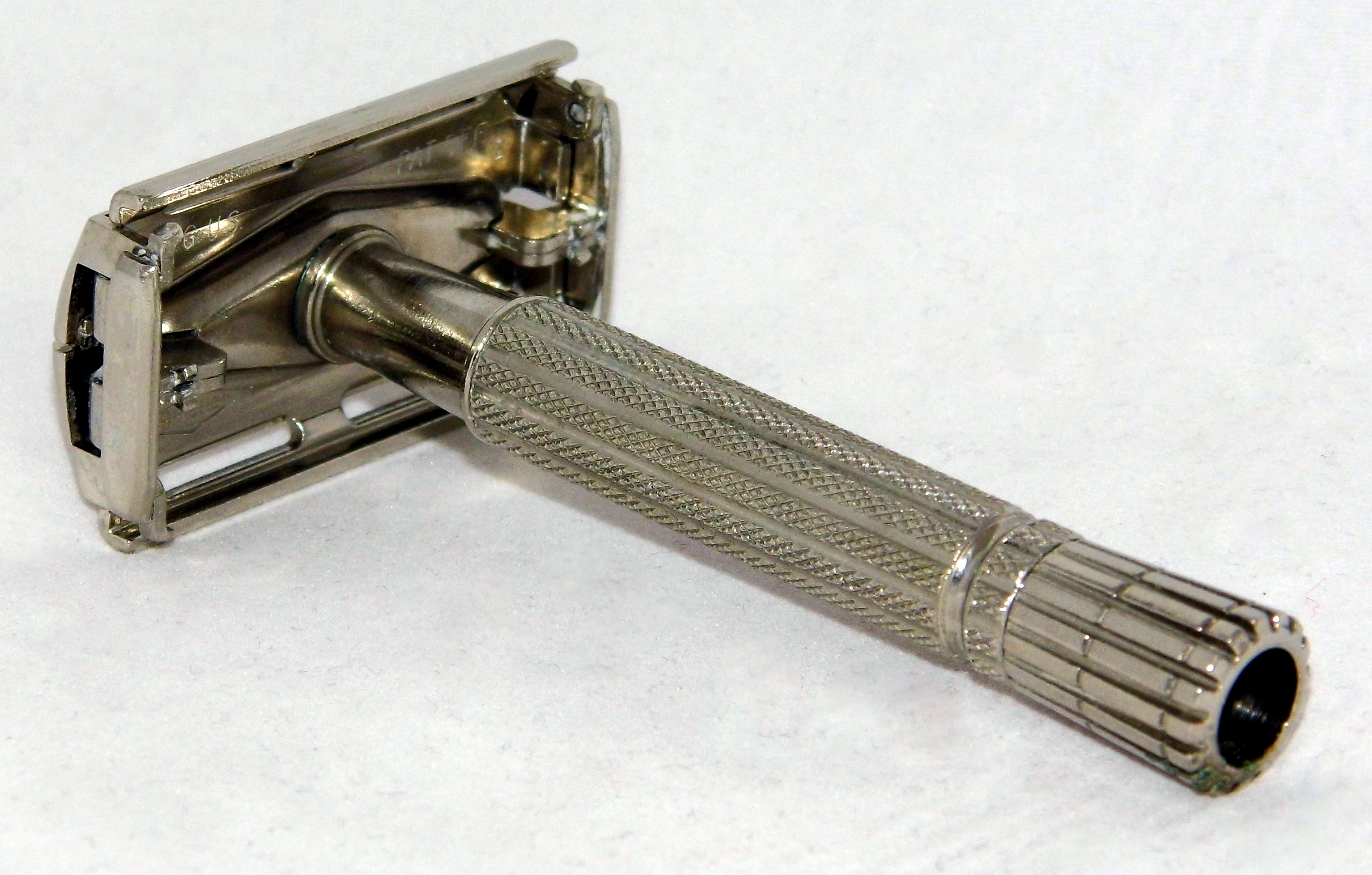
    Speaking of the past, those guys really knew how to shave back then. It was a small luxury to get to shave, and it’s something that I have found immensely enjoyable, both from a “gotta do it, so might as well enjoy it” standpoint and from a “hobby that connects me to the past” standpoint. I shave with a 1957 Gillette Super Speed.

    It cost me roughly $15 on ebay, and my razor blades cost a few pennies each and last me 5 or 6 shaves before they dull. Both men and women used to shave with safety razors like this.

    Let’s dive into the hobby aspect of this stuff, and some of the nuances will start to come out. You’ll quickly understand why a single blade type at a single preset angle isn’t preferred.

    Image result for gillette woman safety razor

    At a macro level, we’re talking about wet shaving. Just as a quick disclaimer in case some woman happens to stumble across this site (because we know there are no female liberatarians) and wonders what the hell is going on… I’m talking about shaving one’s face, but my understanding is that it translates fine to doing legs, too. Wet shaving means that there is water involved. You don’t just slather canned goop on your face and start scraping. You don’t fire up some gizmo and hope it gets close enough that you look like you actually shaved today. Wet shaving is about preparing your face to get a close shave with comfortable results. In broad generalities, there are three phases to a wet shave: skin preparation, shaving, and skin protection. You prepare your skin to be lubricated enough to allow a razor and a blade to glide across your face without catching on the skin. You also prepare your stubble to be as erect as possible so that you lop it all off when you pass the blade through each hair.

    As an aside, one reason why irritation is so common with cartridge blades is because the multiple blades act to pull the hair up out of the follicle and trim it below the skin line, resulting in irritation and a higher chance of ingrown hairs. It’s a very “close” shave, but it’s really too close.

    Image result for multiblade razor pull hairs

    You will find that most traditional forms of shaving involve a single blade, thus reducing the likelihood of such . . . uncomfortable . . . consequences. There are four types of shaving. Cartridge blade razor (including disposables), electric trimmer, safety razor, and straight razorThe bolded ones are the ones closest associated with wet shaving. Yes, you can wet shave with a cartridge razor, but you’re only getting partial benefits in that situation.

    Couldn't see a pajama boy wielding one of these suckers!
    Some of the guys who make custom straight razors do some great work!

    I’m sure we’ve got some straight razor folks here in Glibertopia, but I’m not really experienced with them. Besides the barber cleaning up the back of my neck with one, and the rare barbershop shave (which is shit once you figure out how to properly wield a safety or straight razor), I’ve never really even seen one in person.

    However, the principles between safety razors and straight razors are much the same. The muscle memory is different and the stakes are higher with straights, but the process involves lubing up your face, holding the blade at a certain angle, and dragging it across your whiskers.

    I’m big on connections to the past. Things may be “better” in the present, but often the consumerist impulses of today result in bland mass-produced products. There’s nothing beautiful about the latest Fusion razor. It’s an uninspired amalgamation of neon plastic and chromed plastic. However, I’ve seen some straight razors and safety razors that are works of art! Craftsmen made the shaving tools of old. Assembly lines stamp out today’s shaving tools.

    There’s something about using a 60 year old work of art to do a mundane hygiene task that makes it less humdrum. When you add in the other components of a wet shave, it adds a small luxury to your morning. Back in the day, men didn’t mind taking a minute and enjoying their morning routine.

    Image result for wwii shaving kit      Related imageImage result for shaving vietnam war

    Pre-Shave

    Before starting your shave, it’s important to prepare. Preparation is as important as execution in wet shaving, because your razor doesn’t have training wheels anymore. You can push pretty damn hard with a cartridge razor and not be worse for the wear. Safety razors reduce the chance of slicing your face open in comparison to a straight razor, but both types of blade are very unforgiving to mistakes.

    There are two types of pre-shave preparation. 1) Skin preparation, and 2) Mapping your beard.

    Skin Preparation

    It is important to do two things to your skin prior to shaving. You need to lubricate your skin so that the razor glides along and doesn’t get stuck. You also need to get your hair follicles to stand up as much as possible to get a close shave. There’s a simple way to do both… hop in a warm shower. Many people shave in the shower to get the maximum benefit of the warm water. I’ve never found it particularly attractive an idea, but you do you. If you didn’t just hop out of the shower, a warm, wet washcloth to the face will do the trick. If your skin tends to be dry, or if you’re a beginner prone to making mistakes, you can use a pre-shave oil or a pre-shave cream to supplement the warm water. It also adds a pleasant aroma to the beginning of your shave. Like I said, small luxuries.

    In the pic, I have one of each. There’s a Truefitt and Hill pre-shave oil with a citrus scent. Next to it is a Proraso pre-shave cream with a menthol finish. I don’t really use them very much any more. Occasionally I’ll use the oil because it is the closest to real-deal citrus as I’ve ever found in a citrus scent.

    Anyway, you take a sparing amount and rub it into your skin, and all of a sudden you’ve got a slippery face.

    Mapping your beard

    Unlike a cartridge shave, where the blades are equal opportunity offenders, single blades are quite sensitive to the grain of your beard. If you go with the grain, it’s the least uncomfortable and it’s the least close shave. If you go against the grain, it’s the most uncomfortable and the closest shave. Usually people will do 2 or 3 passes in order to get a close and comfortable shave. For example, they may do a with the grain pass, a cross-grain pass, and an against the grain pass. If you properly do three passes like that, your face will feel like a baby’s ass.

    The thing is that the grain doesn’t just go in one direction. Just like your hair on your head, your beard has whorls and direction changes and all sorts of unique challenges. For example, my left cheek grain goes down, but my right cheek goes backward. Knowing which way the whiskers go helps you avoid accidentally going against the grain in some areas on the first pass.

    Lathering Up

    You can see in the above picture the two brushes that look like huge weird makeup brushes. I’m not sharing the bathroom with Mrs. trshmnstr, so they’re not hers. Those are my shave brushes. They’re made from badger hair. Yes, they literally pluck hairs from badgers to make these brushes. You can also get boar hair brushes or synthetic brushes (think paintbrush bristles). I’ve never used either of those, but I like my badger brushes. The one on the right is a normal badger hair brush. It has enough resistance to stand up to vigorously rubbing your face, but the hairs aren’t irritating. The one on the left with the frosted tips is a silvertip badger brush. These are premium brushes due to the nature of the silver tipped hairs. The hairs stand up enough to be able to make a good shaving lather, but they’re quite soft at the tips, making for the perfect balance.

    The purpose of a brush is simple, you load it up with shaving cream and you apply the shaving cream to your face. I should be more precise. You can use shaving cream (roughly the consistency of toothpaste) or shaving soap (a hockey puck shaped bar of specially formulated soap). This is where wet shaving completely leaves normal shaving behind.

    You can see in this next photo a few shaving soaps. On the left is TSE Texas Leather Tallow Shaving Soap (yes, tallow as in animal fat… the best shave soaps are made with tallow), which literally smells like my cowboy boots. In the middle is Proraso Green, which has the same menthol hit like the pre-shave cream. On the right is Gentleman John Sandalwood Soap, which is my current go-to for everyday shaving. The left two soaps are a little bit creamier and aren’t really in puck form, so I use them directly from their containers. The Gentleman John didn’t come with a container, so it’s in my shave bowl.

    There are two primary ways of lathering up, face lathering and bowl lathering. They’re both perfectly legitimate, but they yield different types of lather. The face lather tends to be more of a wet, slick lather, whereas the bowl lather tends to be fluffier and drier. Depending on your preference for lather, you can choose the appropriate technique.

    Face Lathering

    Face lathering is my go-to. It’s easier when you don’t have a ton of space, because you don’t need additional bowls and you don’t make a foamy mess all over the counter. Face lathering is two steps: loading the brush and lathering. First, to prep for the shave, you need to add a few drops of water to the soap to “bloom” the soap (meaning that the soap absorbs some of the water and the top layer softens up. Also, I like to leave the brush in warm water while I shower. If that’s not an option, just run some hot water over the bristles, because the brush will absorb some water. Then, give the brush a single shake (you want to get rid of some water, but not all), and start swirling the bristles over the soap puck. The soap will begin to foam, but you’re only loading the bristles with the soap, so you don’t want to go too long.

    Once the brush is loaded, you proceed to swirl the brush on your cheeks until a foamy lather builds. Once the lather builds, you can paint it on other parts of your face until you have built up a nice slick, cushiony lather on all the places you’ll be shaving.

    Image result for shave scuttle

    Bowl Lathering

    Bowl lathering is very similar, but instead of taking the loaded brush to your face, you put it into a bowl and start swirling. Because of the fact that the bowl doesn’t have any moisture in it (as compared to your lubricated face), the lather tends to dry out, which makes it fluffier. Once you have a good lather built, you can just paint it on your face with the brush.

    Want an added touch of luxury? Pour some hot water into a shave scuttle and heat up your lather while you make it!

    Shaving

    I’ve written an entire article’s worth of info, but we haven’t even cut a single whisker yet. In reality, once you get a hang of things, the pre-shave portion takes 2-3 minutes at most. Now it’s time to choose a razor and blades (for the safety razors). As mentioned above, my experience is with safety razors, so that’s what I’ll talk about.

    Razors come in all different shapes and sizes, but there are three most important attributes: weight, balance, and aggressiveness. The key to shaving with a single blade razor is to avoid pressing. The blade should glide over your face, and even the slightest pressure can make for a bad shave. As such, the right weight razor keeps you from having to exert pressure to get the razor to cut. Too light, and your blade will skip right off your face. Too heavy, and you have very little control and feel as you cut. Balance also influences the control and feel. A well balanced razor can be held by two fingers and you can almost feel every whisker yield to the blade. Aggressiveness is about matching your style and skin sensitivity to how much the razor tries to take off on each pass. Some folks like really aggressive razors. Some (like me) like less aggressive razors. It’s all about getting a close cut without causing razor burn. Certain safety razors have adjustable aggressiveness. You twist a selector, and the blade bends to a different angle, reducing or increasing aggressiveness.

    The blades themselves are also seen as aggressive or not. Feather blades have a reputation for aggressiveness, but I happen to like them in my Gillette Super Speed because it mellows their aggressiveness. Others are less aggressive. Most likely these differences are due to minute differences in the manufacturing tolerances, despite the fact that the blade’s form factor has been standardized for 80 years.

    One of the great things about shaving with a safety razor is that besides the initial investment in the razor (about $10 for each of mine on ebay), the blades are super cheap. I’ve gotten deals under 10 cents per blade, and each blade usually lasts 5 or 6 shaves, if not more. However, like any other hobby, you can get lost in all of the options and spend hundreds of dollars on shave equipment. There are some rare vintage razors that go for over $100.

    Shaving is very much an exercise in muscle memory. It’s quite similar to knife sharpening in that you need to find a proper angle, hold it at that angle, and make smooth strokes. You know it’s right when you can hear the blade cutting the whiskers. It’s a soothing sound. Unlike what you’ve likely learned shaving with a cartridge razor, it’s not about pushing down and dragging across half of your face. That will end with blood everywhere. With a safety or straight razor, it’s about smooth short strokes with almost no pressure. You only exert enough pressure to keep the blade from skipping when it hits the next whisker. I’ve found that when in doubt, you’re using too much pressure. The goal is to “reduce” the hair rather than “eliminate” the hair. This is why you do two or three passes. The first pass takes the stubble down lower, the second even lower, and the third down to the skin.

    Also, this is a literal razor blade. Razor blades cut you if you drag them sideways along your skin. Your short smooth strokes should be directly perpendicular to the blade’s edge. Turning corners is an advanced move for when you stop cutting yourself.

    After a bit of practice, you start to be able to feel when a blade is getting dull. Before then, replace your blade on a regular basis. Usually 5 or 6 shaves is about as much as you can get out of a blade. If you have an old house, there may even be a blade depository in your bathroom. It dumps all the used blades into your wall for the contractor to find when you decide to remodel the bathroom.

    Image result for razor blades in wall

    Finishing Up

    After you shave and wipe off the excess lather, you’re not quite done yet. Your face is in an “open” state due to the warm water, the lather, and the razor. One refreshing way to close up your pores is to splash your face with cool water. If you have a couple tiny nicks that are thinking about bleeding, sometimes this step will convince them not to bleed.

    Once you’ve rinsed your face with cool water, it’s time to apply after-product. This is purely optional, but I find that my face thanks me. I have extremely dry skin, so this is the perfect time to add some moisture and avoid redness, cracked skin, etc. In come two categories of after-shave. In front is Clubman Pinaud, which is a traditional Home Alone aftershave. It’s alcohol based, and it’ll let you know if you nicked yourself. To me, this is the smell of a barbershop, and it lingers with you for the rest of the day.

    Behind the Clubman is some Tea Tree leave-in conditioner. I forget who recommended it to me, but this stuff is the absolute best at moisturizing my face. I just rub it in like lotion, and my dry skin issues go away within a couple hours. It doesn’t linger like Clubman, but you can still smell it a couple hours later.

    Also, while you’re cleaning up, rinse out your brush and get as much water out as you can. I hang mine alongside my razor to air dry the rest of the way. I also leave the soap container open to air dry.

    But what if you got a boo boo? Bleeding is a part of learning to shave, and it sucks. Rather than sticking toilet paper to your face or bleeding everywhere, get yourself a styptic pencil or an alum block. They both contain chemicals that help your blood clot up and stop the bleeding. They aren’t magic, so don’t start rubbing your jugular while you’re bleeding out, but they’ve stopped cuts where the blood was dripping down my chin before.

    I’ve never found out the right way to clean the styptic pencil. I usually rinse it off under the faucet, but the pencil doesn’t play well with water.


    All of this to say, nobody needs 32 different kinds of razors. In Progtopia, we’re all gonna be stuck with shitty off-brand disposables and silly-string for shaving cream.