Category: Science

  • Wednesday Afternoon Links

    Hola a todos, Brett is in meetings all day, so he’s letting me take over for the afternoon.

    • California is still on fire, and a former nuclear research site got burned. Oops. Fires are currently burning across the mountain west with concentrated activity in Idaho/Utah/Nevada and just east of the Cascades, which is just crazy since everyone knows that California’s forestry management policies are causing the fires…across 8 states.
    • Floridian—who looks like every middle aged man I know who does local community theater—has a bunch of jihaddi preferred explosives “for homemade fireworks.” “‘The white crystal powder [TATP] has been referred to as ‘Mother of Satan’ by terrorist organizations who have used it in deadly attacks around the world,’ the Volusia County Sheriff’s Office said in a statement.”
    • Speaking of Florida, our solar system is apparently about to get rocked by a “dark matter hurricane” but you probably won’t notice much unless you have severe axion sensitivity along with your EMF and gluten sensitivity.
    • Lotta folks are on losartan thanks to the Western Pattern Diet, if you are one of those people, you might want to have a chat with your GP about this recall. In related news, the USG is *begging* you to at least take the stairs instead of your off-road-capable mobility scooter. The big take away is that even brief activity counts toward the backstop goal of 150 minutes of activity per week (a week is 10080 minutes) as recommended by the AHA.

    Today’s musical number the video may be potentially work-unfriendly. If that got you in trouble, I apologize.

  • Wednesday Afternoon Links

    Before Rufus gets a chance to ask the question: yes, some of us DO work. One of those people is apparently Brett. I guess getting loaded on cocaine and blowing strangers is just for fun. In his absence, I’ll be providing links. If someone posted something earlier, I apologize. I haven’t been paying attention.

    • Cody Wilson’s no good, very bad day. I want to believe this guy has been caught up in a plot to “neutralize” him, but he seems to have set served himself up on a silver platter by signing up for a site called SugarDaddyMeet, exchanging nudes with a minor (article says the girl was *under* 17 the age of consent in Texas [you’re welcome for keeping you off a list by looking it up for you]), and then hiring her for sex. The bragging about being “a big deal” may not have been helpful either.
    • I’m sure all of you nerds have already seen that Linus Torvalds–father of Linux–is taking a breather so that he can think about not being a dick to a group of people volunteering their time. In the wake of this there’s now a code of conduct, which has of course been immediately decried as the SJWification of the Linux kernel. I’m currently fantasizing about Buddhist monastic life.
    • Normally, this story would have me glancing at the headline and moving on, but how can I resist linking to a story with the phrase “rape by use of drugs, oral copulation by anesthesia or controlled substance”. The surgeon in question is relatively pretty, and I can guarantee his near future will include rigorous training on the value of consent.
    • I assume this is just fake news meant to fluff The Meg, but it’s still neat. “the males would each travel in a V-shape pattern as many as 140 times a day. It’s unclear if the behavior is related to mating or if they are hunting for different species of fish.”
    • Speaking of unfortunate interactions between adults and minors, Mr. Michael Aliperti threatened to shoot an 11 year old who beat him at Fortnight and got arrested for it. Mr. Aliperti should fix a cup of chamomile and take a long hard look at where life has taken him.

    Our user engagement analytics department indicates that we need more Minnesota content, so…here

  • Contaminants of “Emerging Concern”


    I’ve been thinking about writing an article on this for some time as an example of the runaway regulatory state, since it is within my field of expertise. And because it is also a fine example of a regulatory agency finding excuses to regulate more things just because they can, regardless of whether there is an actual quantifiable threat to human health and the environment. So what the hell, I’m giving it a shot, and if the admins choose to post it, feel free to have at me.

    I have been in the environmental consulting and remediation field in New Jersey for approximately 30 years. New Jersey is a fine place for such work, since it has been industrialized since the early 1800s; in fact, Paterson was one of the very first industrial cities in the nation. Until about the 1970s, there were few rules regarding handling of hazardous materials and wastes, so there is ample work here for someone in the business of environmental remediation.

    The New Jersey Department of Environmental Protection, (NJDEP) has recently developed policies and requirements regarding chemicals known as Contaminants of Emerging Concern. These contaminants are chemicals that have been used in various manufacturing and production processes, but were previously not identified as contaminants of concern, and could not be easily identified via laboratory analytical techniques and detection limits. In other words, these contaminants were previously not a concern because available laboratory methodologies were not sensitive enough to detect them at the levels they are typically present. These chemicals can be found in drugs, fragrances, detergents, pesticides and disinfectants, among other common products.

    Due to the new analytical abilities of laboratories, it has allowed detection of the exceedingly low levels at which these chemicals typically occur in ground water. Although the understanding of the toxicity and health effects of these chemicals is still developing, the NJDEP has issued guidelines under authority from the Technical Requirements for Site Remediation, N.J.A.C. 7:26E which requires all contamination, including all discharged substances, hazardous waste, and pollutants, must be remediated. In other words, even though there is no data which demonstrates human toxicity at these low levels, the State is regulating it anyway, by claiming authority under a broad general statute.

    Therefore, responsible parties at a site under environmental investigation must ensure that the potential presence of these chemicals must be investigated if there is any (any!) potential that they could have been used or stored on site or were contained in any of the products and materials used on site prior to closing the case.

    A little more background: In New Jersey, there is a program under the Site Remediation Reform Act which licenses environmental professionals with specified education, training, and experience to become Licensed Site Remediation Professionals, or LSRPs. If any site in New Jersey requires any environmental remediation, it must be performed by an LSRP, and only the LSRP can eventually close the case by issuing a letter known as a Response Action Outcome, or RAO.

    Since these contaminants include chemicals such as Per- and Polyfluoroakyl Substances (PFAS) that are not included in the standard Target Analyte List, analysis for these chemicals must be specified to the lab if the LSRP suspects that they may have been present on the site. Although the science regarding health effects is still emerging (currently no data showing human toxicity), the NJDEP typically uses advisory limits recommended by the New Jersey Drinking Water Quality Institute (DWQI), which are overly conservative. The recommended limits for different PFAS range from 10 nanograms per liter (10ng/L) or 10 parts per trillion (ppt) to 70 ng/L, or 70ppt. Therefore the laboratory must be prepared to achieve the required detection limits for analyses in order to properly investigate the ground water at the site.

    Since these Contaminants of Emerging Concern can be found in a wide variety of products and materials at extremely low levels, there are recommendations for precautions to be taken when conducting sampling, in order to avoid cross-contamination and potential false positives. Among the recommendations are: don’t wear coated Tyvek protective coveralls; don’t use Teflon sampling equipment, even though Teflon sampling equipment is required for all other ground water sampling; don’t wear clothing that has been washed using fabric softener or certain detergents; and avoid fast food containers and wrappers, as they may contain PFAS. That’s right, something that is safe enough to be used to wrap and contain food for human consumption may cause an exceedance of the regulatory standard in your ground water sample if it cross-contaminates it.

    So, even though people are constantly exposed to these very low levels of PFAS in clothes treated with fabric softener, fragrances, and even fast food containers and wrappers, which are deemed safe for those purposes, and there is currently no data showing human toxicity from low-level exposure, the State has decided that since modern laboratory equipment can now detect these very low-levels (parts per trillion!) of these substances, it will now regulate them, and require full investigation and remediation, at considerable expense, because they can.

    After all, the regulatory state isn’t just going to grow organically, it needs a little help now and then.

  • I Fucking Love Astrology: The Horoscope for the Week of August 19

    MERCURY RETROGRADE continues

    Stargazing can be depressing, since it seems like there are so many bad omens.  There actually ARE a lot of bad omens, and the most interesting things (comets, novae, etc) are the worst omens.  There are two reasons for this:

    The first is that Astrology, like all real sciences, is based on empirical observation.  The celestial influences were mapped to significant events and once a correlation was established, these correlations were codified and promulgated.  The issue is that the historical eras in which this painstaking scientific research occurred sucked camel balls.  All sorts of bad shit was going on, between plagues, famines, invasions, tyrants, pubic lice, forcible conversions, slave raids, indigestion, hyena attacks and poor kitchen hygiene coupled with no toilet paper, there were many more bad events to match up than good ones.  The charts indicate this.  There is only one planet that is unambiguous in its beneficence (Venus) and even it goes retrograde every now and then.

    The second is that “interesting” things are breaks in a pattern.  But with the stars, that pattern is perfection so any breaks are Bad Things.  If auto racing were as perfect as the stars, the best driver would have won the pole position, and the race would proceed flawlessly with no changes in the race order.  Nobody would watch this.  The biggest, brightest, most noticeable deviations in astrology (a new star appearing where there wasn’t one before) are the multi-car collisions sending flaming shrapnel into the spectator seating.

    So yeah, lots of bad news to be seen in the night sky.

    So what’s the bad news for this week?  Not a lot really, at least in comparison to last week.  That massive double-alignment of despair has broken up, with a piddly little BARCO double hinging on Mars retrograde (Sol-Luna-Mars (retrograde) and Mars (retrograde)-MERCURY RETROGRADE-Terra) which gives very weak influences in the following ways:

    1.  A conflict will end.
    2. There will be bad news regarding a war
    3. A general will have his ass handed to him (possibly literally — this is the same construction that heralded Qaddafi’s death-by-bayonet-sodomy)

    As for the celestial houses:

    Leo still has to deal with MERCURY RETROGRADE, but at least the moon has skedaddled.  If you have a cat, expect more kitty zips and general destruction from the little furball.  Haircuts are still risky, but I’ll be getting one because my hair has gotten really annoying when I have to put on a cleanroom suit.  This is also backed up by the moon moving into Sagittarius; “Nocturnal hunters awaken.”

    If you are a Capricorn, do NOT get into any fights.  Mars has backed ass-first into your sign so that Saturn (retrograde) which has been hanging out pretty clearly points to “violence leads to loss.”  Yeah, I said that wasn’t going to happen.  Either I need better charts, or I need to read them better.

    Jupiter in Scorpio:  minding your own business leads to good things.  The stars give really good advice.  SCIENCE!

    Finally, Venus in Libra.  If you can keep your center, good things follow.

    This whole week is pretty pro-Glib.  Enjoy.


  • The Perfect Youtube Comment

    I present to you, the apotheosis of Youtube comments:

    We no longer need to comment on Youtube videos any longer.

  • I Fucking Love Astrology: The Horoscope for June 24

    First up:  This weeks alignments…

    None.  Nada.  Zip.  Zilch.  The planets are all being non-conformists, but not doing it together like gothlings. From a heliocentric view, the universe is an empty place devoid of meaning, lifeless planets lumbering along indifferent to the existential horror, blindingly following their paths set by unreasoning forces until all existence dies frozen in ultimate blackness.

    This is going to be a bad week for aspies.  The moon is in Virgo, bringing change to people who don’t like change.  Interestingly, even though The Virgin is typically portrayed as female by the ancients, the personality types predicted perfectly match those of today’s male virgins.  This ability of a theory to correctly predict things centuries later is why astrology is considered such a perfect science.

    Fucking magnets, how DO they work?
    How much more perfect could a science be? None. None more science.

    Remember how I used to predict good fishing?  Well that orbital mechanic has turned around and now fishing is going to suck for a while.  C’est l’etoile.

    Your mental acuity will fade down to normal levels as Sol ceases illuminating Gemini.  on the other hand, Mercury continues in Cancer, so with a bit of effort, you can still be successful in that research you’ve been doing.  If you haven’t been doing any research, disregard that last bit.  For the non-researchers, you will probably forget to log off of something or clear your browser history, leading to  embarrassment.  You should have been researching something.

    Seriously though, clear your cache.  That whole Jupiter retrograde in Scorpio does lend credence to the “your porn history will become public knowledge” thing this week.

    Also this week, there is Aquarius (the water bearer) linked with Mars. (war, conflict).  So some people will be fighting over a water vessel.


  • A Deep Dive into Cryptocurrencies and their Operations: Part 3

    A Deep Dive into Cryptocurrencies and their Operations: Part 3

    Aight! We’ve talked about Computer Science and we’ve talked about some design features used in blockchain. Now let’s put it all together and cap this series off.

    What is blockchain? It is a linked list of data structures that uses cryptographic hashing to sign each data structure, thus including it in the canonical chain. Here’s the block used by Bitcoin (most other cryptos will have mostly the same components).
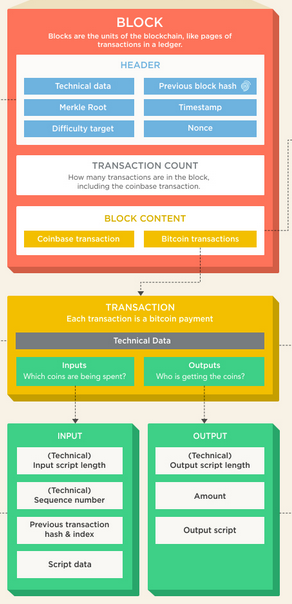
    You can see the transactions in the Block Content section, and you can see info (such as the hash of the previous block) in the Header section. Let’s relate this all together and draw a true picture of a blockchain (specifically Bitcoin) block. To do so, we’re gonna be dealing with a whole bunch of cryptographic hashes.

    Hashing: A Redux

    If you want the nitty gritty detail, you can go here. However, since we’re not writing a mining algorithm or a storefront, I’ll spare you the minutae. If you want an awesome video that explains exactly what I’m about to talk about, but in visual form? Here ya go! Want to learn more about blockchain than you ever wanted to know, but all at a layperson level? You’re welcome!

    Here’s a Bitcoin block:
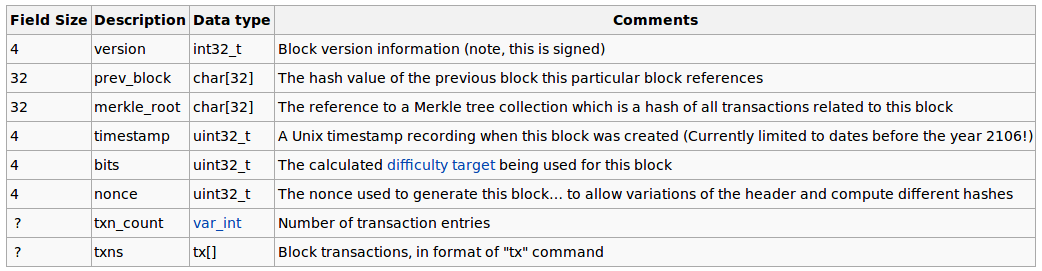
    Let’s work from the bottom up.

    txns

    The payload of a Bitcoin block is an array of transactions. Each transaction looks like this:
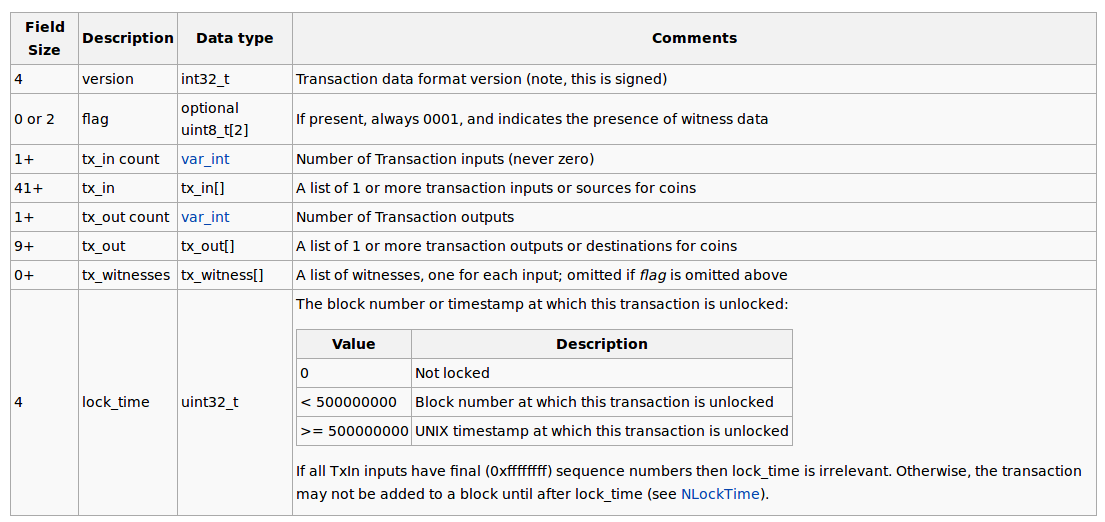
    I show the transaction mainly to show you that it contains two things: tx_in and tx_out. This is how it works, you combine a certain number of prior transactions in the blockchain (inputs) and then dole out the coins contained in those transactions in the outputs. If the inputs go over how much you’re paying the other person, you add an output to pay yourself back the overage. It’s much like cash. Just like handing bills to the cashier and receiving change back, you hand over inputs, and receive back an output for the overage.

    Let’s do a quick example. Oscar wants to pay ZARDOZ for the Gift of the Gun, and he wants to pay $150. Oscar has previously received money from Office Manager Mohammed for “Jihad related expenses” for the amount of $110. Oscar has also previously received money from Preet Bahahahaha for “Woodchipping services” in the amount of $65. In order to pay ZARDOZ, Oscar sets up the transaction by including the previous Jihad and Woodchipping transactions as inputs, and creates two outputs: one to ZARDOZ for $150, and one back to Oscar for the remainder ($25). Then those Jihad and Woodchipping transactions are marked as fulfilled, meaning that they can’t be used again as inputs.

    txn_count

    This is fairly self explanatory. This contains the number of transactions in the block.

    nonce

    From here on up in the block, everything is contained in the header. Remember that the hash of the block is really the hash of the header. The txn and txn_count parts of the block are not used in calculating the hash. However, we’ll find out really soon why the transactions are still reflected in the block hash.

    Nonce is related to mining. I’ve alluded to the way that blocks are created, and I’ll discuss it more in the next section, but suffice it to say that the nonce is a random number and has no purpose besides in calculating the hash. The way that a block is added to the blockchain is that the block’s hash must be below a certain number. How do you get the hash below a certain number? You adjust the source data used to make the hash. Since the hash comes from the header and the nonce is in the header, you can change the nonce until the hash is below a certain number. Notice that simply changing the nonce to a lower number doesn’t guarantee that the hash is a lower number. This is where luck and random chance come into play. We’ll talk more in the next section about this.

    bits

    Bits goes with the nonce. It is the “certain number” mentioned above that the hash needs to go below for the block to be accepted.

    timestamp

    Timestamp is self explanatory. It’s the time when the block was created.

    Merkle Root

    We’ve discussed the Merkle root before, but haven’t really nailed it down. Let’s do that now. The 10,000 foot view is that the Merkle root is the hash of all of the transactions. The hash of the block (which is actually the hash of the block header) takes the Merkle root into account when calculated.
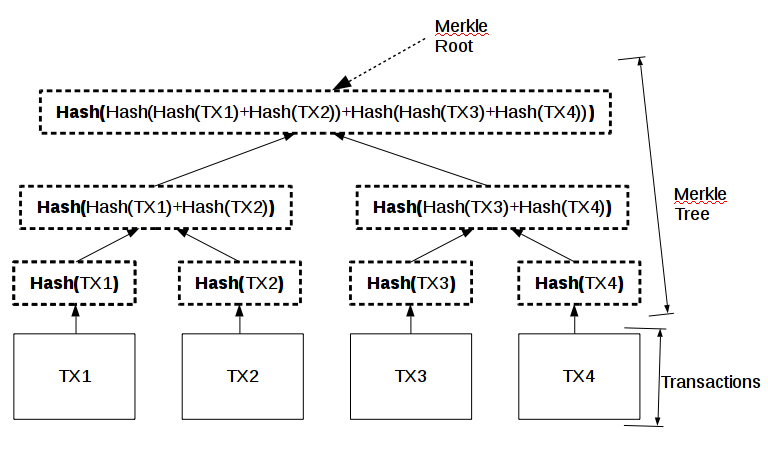
    The Merkle tree is a binary tree (each parent node has two children) that hashes from the bottom up. The bottom row of the Merkle tree contains the hashes of each transaction. The middle row hashes adjacent bottom row hashes (it’s a hash of a hash). The top row is a hash of a hash of a hash and contains information from all of the transactions. Notice what it would take to modify or replace a transaction. If STEVE SMITH tries to replace TX4 with FAKE_TX4, he has to recalculate three different hashes, as well (all of the hashes that include TX4 in them).

    Prev Hash

    This has been discussed at length in the prior two parts. This is the hash of the prior block, the link between the current block and the prior block.

    Version

    The version of the blockchain tells everybody what rules this block has been assembled under. This makes it possible to improve a blockchain without having to toss out all of the old blocks.

    Mining

    We’ve hinted at what mining is already, but now we can put all the pieces together. When transactions are posted to the blockchain network (all of the computers mining and transacting on that blockchain), they are packaged up into a block to be added to the end of the blockchain. How this happens is technical and a bit beyond this overview. Once a block is packaged up, the mining process begins. The block, sans block hash and nonce, is sent out to the network for mining. Computers that are set up as miners begin to calculate the block hash. Remember that the block hash is calculated from data that includes the Merkle root, the previous block’s hash, and the nonce. All of those pieces of data are constant except for the nonce. Therefore, miners, upon calculating the block hash, adjust the nonce to try to get the block hash to be less than the current difficulty number (represented by the bits field).

    Once a miner has calculated a block hash below the current difficulty number, they submit the hashed block to the network. If they’re the first to do so, they “win”. They end up getting a small payment of cryptocurrency for their efforts. The payment is based on an algorithm that reduces the amount of currency created for a successful mine until an end date when no more currency will be created for that coin. At that time, miners will only be compensated by transaction fees (which are currently in the tenths of a percent range).

    As you can imagine, it’s not easy to do this. Bitcoin, for example, is designed so that, on average, the winner mines the block in about 10 minutes. Given the vast amount of processing power dedicated to Bitcoin mining across the world, the chance of a single desktop computer winning even once a month is slim. In some other cryptocurrencies, it is easier, but even a second tier crypto like Monero would average one or two wins a month for a standard desktop computer. At that point, you’re probably not making enough to pay for the electricity you used.

    That’s where mining pools come in. It’s a fairly simple concept. Take a bunch of computers, let them mine as a cohesive unit, and split the winnings across members based on a pre-defined formula.

    The Big Picture of Blockchain and Different Applications

    We’ve talked about blockchain in the context of cryptos, but there are a ton of different potential applications for blockchain. The main “hot topic” for blockchain use is reputation analysis. Rather than having to go through a reputation broker (Uber, AirBnB, Yelp) to find out whether the person driving that car or renting that room or cooking that meal is trustworthy, you can reach out to the decentralized blockchain to find their reputation.

    This is a fairly simplistic application of reputation analysis, but the reason folks are excited is the application of such a thing to automation technology. What if, for example, you didn’t have to put in a reservation to get a hotel room? If your reputation is high enough and the room is available,  the lockbox automatically opens and gives you the key to the room. All you have to do is tell the system how long you plan on staying there, and you’re set.

    Another application is identity management. Does the cashier really need to see your name, address, and other personal info to know that you’re old enough to buy alcohol? There’s a whole bunch of identity leakage that sets each and every one of us up for identity theft. One proposed use of blockchain is to provide customized identity services. The cashier can query the blockchain as to whether you’re old enough to buy alcohol, but can’t access your address. Amazon can get your address, but can’t get your social security number. Starbucks can get your first name, but not your last name.

    What about securing your finances? This isn’t entirely separate from cryptocurrencies, but what if every transaction you made was from a different account? Instead of giving your bank account info or your credit card number to merchants, you give the equivalent of a Visa gift card with the exact amount of the transaction on it. If Target gets breached and your info is leaked to malevolent actors, it’s not an issue, because it points to an empty one-time account.

    Finally, the application that I think would be the most interesting. Traffic management via blockchain. As automated cars become a more likely reality, most of the traffic management interaction methods that have been designed to be centralized or distributed in nature. A decentralized traffic management system would reduce the efficacy of government meddling and the potential for an enforced monopoly a la internet service provider.

    Cryptocurrencies

    I’m not going to list out all the cryptocurrencies in detail. I trust y’all to DDG it yourselves. Let me just point out a few of the big ones in passing.

    Bitcoin – The original and most famous. There is relatively little anonymity in using Bitcoin, as shown by the Silk Road FBI takedown.  It’s also relatively slow to get new blocks integrated, at an average of 10 minutes per block.

    Bitcoin Cash – A fork of Bitcoin meant to scale to more users a bit easier by making the blocks bigger.

    LiteCoin – Billed as “silver to Bitcoin’s gold”. It generates blocks 4x faster (2.5 minutes per block), will generate more coins than BitCoin, and some different internal algorithms.

    Ethereum – Ethereum is much more than a cryptocurrency. It creates smart contracts that can take advantage of automation. Want to unlock your guestroom when somebody has enough reputation points? Ethereum is probably the best blockchain to start from to do this sort of thing.

    Monero – Billed as the “secure cryptocurrency,” it is designed slightly differently from BitCoin so that bad actors (like the FBI) can’t trace one transaction back and see your entire transaction history. Secure is a relative term, because, as seen in the Silk Road incident, there are weaknesses wherever you have to give personal info (shipping, currency conversion)

    Drawbacks and Limitations

    This could be an article in and of itself, but I’ll just hit a few that are top of mind.

    1. Blockchain length – The immense size of the Bitcoin (and other large cryptos’) blockchain means that you either need to rely on somebody else’s node to get plugged in (by using an exchange) or you need to wait a few days for all of the blocks to be downloaded.
    2. Block acceptance time – In Bitcoin, it takes an average of 10 minutes for your transaction to be included in an accepted block, and due to forks (when two different blocks are accepted in two different parts of the network), folks recommend waiting an hour before declaring the transaction “completed.” That obviously doesn’t work for somebody trying to walk out the checkout line at the supermarket.
    3. Scalability – This is kinda wrapped up in the last two, but the number of transactions in a block are limited by a maximum size. Therefore, as more and more transactions occur, the chance of your transaction making the first block goes down substantially. Then, you have to wait not only 10 minutes for your block to be mined, but you have to wait an unknown amount of time until your transaction is included in a mined block. This is where transaction fees come into play. When there are 50,000 transactions, which ones are you going to try to make into a block as a miner? The ones that pay the best, of course.
    4. Security – We’ve discussed some security concerns already, but blockchain doesn’t resolve the single biggest threat in online transactions: the other party in the transaction retaining and ultimately misappropriating your personal information.


    I hope this series was helpful to y’all! I’ve certainly learned a ton!