Category: Reviews

  • If its not Scottish (Haggis) its crap!

    In 122 AD (or CE…) Roman Emperor Hadrian discovered something so shocking, so perverse, that he had no choice but to make one of history’s most racist decisions.  What did he discover?

     The Scots.  His solution?  He built a wall.


    Yeah, there is probably more to that, but this was a research intensive article and quite frankly I’m not going to get into the why of it.  Hadrian was emperor for all of 21 years, 11 of which he spent touring the empire.  In spite of his short reign he left his mark on the empire by consolidating provinces, allowing much needed reforms, and engaging in infrastructure projects, such as a Roman Temple–located conveniently next to Solomon’s temple in Jerusalem.  That really pissed off the (((locals))), and the ensuing revolt apparently lasted three years.  He is most famous however, for building a wall across Roman Britain to keep the barbarians to the north out.

    The Scots weren’t all bad, and some of them were indeed good people.  For instance, James Watt is credited with giving us the steam engine, allowing for the Industrial Revolution which to this very day impacts the way everyone in the western world lives!

     Okay, technically Heron of Alexandria invented the first steam engine, but they did give us the greatest love story ever told! 

    Okay, technically Wallace was such a terrible statesman the nobility found it more convenient to martyr him, rather than putting up with him.  Also, the only reason you still watch that movie is because you like Longshanks for being the archetypal shitlord and Monica Belluci circa 1996.

    A Scottish regiment is famous for being the last ones to attempt a bayonet charge!  In the early days of the Iraq war, they fixed bayonets and gave Saddam the business!

     No, still not feeling it?  Fine, they gave us this:

    Not my photo

    This is my review of Founders Dirty Bastard Scottish Ale.

    Even though Scottish Ales are realistically all the same, I think a brief overview in naming convention is in order.

    The Schilling System was instituted in the 1880’s, although there is some evidence it was in use earlier than that.  By that time, it became a requirement by the British government due to a change in what was being taxed.  Rather than grain and sugar, they simply taxed the beer.  To add further confusion the tax itself was based on the invoice price of the quantity sold by the brewer (barrel vs. hogshead).  To further add confusion:

    “This dual application of pricing applied to two different liquid measures brought about complications: a 60/- ale in the barrel was a 90/- ale in the hogshead even though it was the same product. The actual price of the ale could be as little as half of the invoice cost once the calculated duties and the discounts allowed by the brewers were subtracted.”

    Paying more tax for the same stuff because it was shipped in a different size barrel? No wonder we fought a war to get away from this…

     The term, “Wee Heavy” came about during this time due to the variety produced by Scottish breweries at the time.  The highest gravity varieties were sold in “nips” in 6 ounce quantities.  Since it was a wee bit heavy you may not mind all you were getting was was then ⅓ of a pint, the beer was going to get you where you wanted to be:  too drunk to consider the taxes you were paying.

     For our purposes these come in three varieties.


    The first is a 60/-.  These are typically very light (<5%abv).  Even though they have the same malty character that defines this style, it often leaves the experienced beer drinker wishing there was something more.  A good example is Newcastle.

    We know you are watching, John

    On the other end of the spectrum is 120/-.  These are a wee bit heavier (hence the term) and quite frankly are not for everyone. Typically these operate in the 7-10% abv range. These can be a lot of fun but have one downside, which I’ll touch on shortly. A good example, is Orkney Skullsplitter.

    Finally, there is the 90/- (80/- is traditional).

    Like the proverbial third bowl of porridge, for most of us this one is just right.  A good example is Bellhaven, but in the US there are dozens of good examples as well, all around 5-6% abv.  The dominant craft brewery in my area is Four Peaks and their flagship brew is called, Kiltlifter.  This is a carbon copy of Bellhaven and they sell it in insane quantities.  So much so, they are one of the evil brands that sold out (though I argue they bought in) to InBev.  Ironically, the first time I had it off tap was in Las Vegas, so should you find yourself there, try it out.  Other examples are Great Divide Claymore, Oskar Blues Old Chubb, and Odell 90 Schilling (all from CO).

     Dirty Bastard is 7.5% abv so it fits in with the Wee Heavy category.  The only one I can really compare it to is from a brewery based in Utah, it was 10.5% abv and I seriously doubt you’ll ever find it.  The Bastard has an overwhelming malt complexity and has more body than you can wrap your arms around.  The downside is the moment it got within range of my snout I got a hearty whiff of booze.  It took a sip or two for my olfactory sense to adapt but in the end I will likely continue to buy it a few times when it becomes available. For every other time of year, there is plenty of Kiltlifter to go around. Founders Dirty Bastard Scottish Ale: 4.2/5.0
  • Review – Bell’s Roundhouse IRA

    Review – Bell’s Roundhouse IRA

    This is my review of Bell’s Brewery Roundhouse India Red Ale.

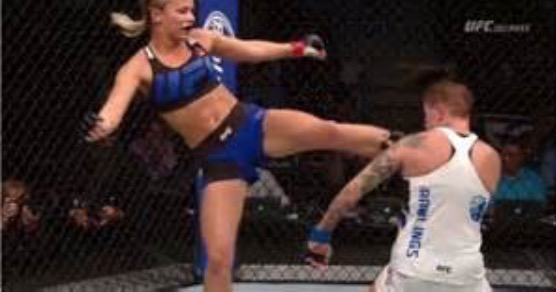
    Yeah, okay so they just hopped up Kilian’s Irish Puke and gave it a cute name? Fine.  To keep your attention, here’s UFC eye candy, Paige Van Zant delivering a roundhouse kick:

    Yeah, okay pedants.  She’s right handed, so that was technically a switch kick if you are only going to look at the still photo.  If you want to see the whole thing, this video here has it in real time and slow motion. She actually swung her strong leg forward to gain momentum toward her opponent.  Then turned her hips midair, planted her right foot, and landed a left kick to the face. If anything, this was technically a flying switch kick, but it was definitely a feat of athleticism.  I can cover the gap like this and land a knee, but a kick takes several reps for me to land it.  I would say this was her career highlight, but Dancing with the Stars and every single commercial she is in seems to be more lucrative than her fights, which might explain why she never seems to fight anymore.  So before you decide, keep in mind that on any other day she looks like this:

    Speaking of red…

    The roundhouse kick is present in many Martial Arts styles but primarily is associated with Muay Thai–or Thai boxing, the national sport of Thailand.  Yes, there is more to Thailand than ladyboys, street food, counterfeit watches, and epic weekends in Bangkok. The sport itself was developed like all Martial Arts as a means of self-defense. Developed from a fighting style called Krabi Krabong, it is centered around the mindset that you are born with 8 weapons:  2 fists, 2 elbows, 2 feet, and 2 knees.  In the early 20th century the Siamese army actually pitted fighters from competing companies in bouts against each other.  This might seem like a brutal way to build readiness but it is actually a common custom in modern militaries.  In fact, I participated in a traditional boxing match during my first deployment.  The management at Al Udeid, AB sanctioned the fights under several significant conditions.  I will admit I lost, but I contend the guy I fought was Airborne and I filled in at the last minute for another guy that wimped out that morning.  

    For more information on Muay Thai, here is a link.

    Because it is a proven fighting style as a sport, rather than an art (suck it Meryl Streep), it is popular among MMA fighters for their standing game.  Other styles such as Karate, Tae Kwon Do, and even traditional boxing are represented among professional fighters but they are fewer in number.  MMA fighters primarily train in Muay Thai, plus Ju Jitsu or wrestling for their ground game.  

    So how do you do it?  To start, you should be in a modified boxing crouch–just more upright.  Hands up, shoulders forward, hips bent, feet should be a little wider than shoulder width at a 45 degree angle, strong leg should be back with your weight slightly biased to the back, knees bent and finally you should always be on the balls of your feet.  With me so far?

    Something like this…

    From here you need to be loose.  Start by moving your back leg forward like you plan to knee you opponent.  This position from his view means either you are moving to strike with a knee, parry a kick, or kick either high or low.  Deception is a good thing here.  Then pivot your front foot towards the outside, this will put it in a better position to maintain your balance.  Then turn your hips towards your front foot, begin to extend and swing your leg.  You want to aim to strike your opponent with your shin.  If you strike intentionally with your foot, you’re going to have a bad day. See UFC Fighter, Uriah Hall for the reason why you don’t necessarily want to strike with your foot, even if it worked out for Paige…

    BTW. He won that fight.

    The last step is called “chopping the tree.”  Here you are turning your hips violently to build power and swing your leg down.  Basically, pretend to strike your opponent with the lateral malleolus.  That is the big bulging bone on the side of your ankle.  Not that it is physically possible, but to finish by striking with the front of your shin, you will need to turn your entire body as if it were.  The result should look like this:

    To see the full motion, here’s a Thai fighter engaging in clear cut deforestation (seriously). This is a devastating strike; typically compared with being hit with a baseball bat.  Some fighters have been clocked swinging their legs as fast as 130 miles per hour, delivering 1400 foot pounds of force.  This is beyond broken ribs, this is ruptured organs territory and depending on the location of impact in some cases can stop the heart.

    Now that you know this should be more than just a charming marketing scheme…the beer does have a bit more character than the garden variety IPA.  Its base is a red ale, so it does have the usual toasted, caramel malts that are common with that style.  There is a hint of sweetness which is obvious given they list honey as an ingredient in big letters on the can.  I would probably say this is good enough on its own given that I’m partial to the balanced malty side of the spectrum but they also dry hopped it.  It’s a nice counter to the usual IPA and when compared to the ubiquitous red/amber ales is much more interesting.  Odd line to tread, but it treads it well. Bell’s Brewery Roundhouse India Red Ale 4.0/5.