Category: Regulation

  • Contaminants of “Emerging Concern”


    I’ve been thinking about writing an article on this for some time as an example of the runaway regulatory state, since it is within my field of expertise. And because it is also a fine example of a regulatory agency finding excuses to regulate more things just because they can, regardless of whether there is an actual quantifiable threat to human health and the environment. So what the hell, I’m giving it a shot, and if the admins choose to post it, feel free to have at me.

    I have been in the environmental consulting and remediation field in New Jersey for approximately 30 years. New Jersey is a fine place for such work, since it has been industrialized since the early 1800s; in fact, Paterson was one of the very first industrial cities in the nation. Until about the 1970s, there were few rules regarding handling of hazardous materials and wastes, so there is ample work here for someone in the business of environmental remediation.

    The New Jersey Department of Environmental Protection, (NJDEP) has recently developed policies and requirements regarding chemicals known as Contaminants of Emerging Concern. These contaminants are chemicals that have been used in various manufacturing and production processes, but were previously not identified as contaminants of concern, and could not be easily identified via laboratory analytical techniques and detection limits. In other words, these contaminants were previously not a concern because available laboratory methodologies were not sensitive enough to detect them at the levels they are typically present. These chemicals can be found in drugs, fragrances, detergents, pesticides and disinfectants, among other common products.

    Due to the new analytical abilities of laboratories, it has allowed detection of the exceedingly low levels at which these chemicals typically occur in ground water. Although the understanding of the toxicity and health effects of these chemicals is still developing, the NJDEP has issued guidelines under authority from the Technical Requirements for Site Remediation, N.J.A.C. 7:26E which requires all contamination, including all discharged substances, hazardous waste, and pollutants, must be remediated. In other words, even though there is no data which demonstrates human toxicity at these low levels, the State is regulating it anyway, by claiming authority under a broad general statute.

    Therefore, responsible parties at a site under environmental investigation must ensure that the potential presence of these chemicals must be investigated if there is any (any!) potential that they could have been used or stored on site or were contained in any of the products and materials used on site prior to closing the case.

    A little more background: In New Jersey, there is a program under the Site Remediation Reform Act which licenses environmental professionals with specified education, training, and experience to become Licensed Site Remediation Professionals, or LSRPs. If any site in New Jersey requires any environmental remediation, it must be performed by an LSRP, and only the LSRP can eventually close the case by issuing a letter known as a Response Action Outcome, or RAO.

    Since these contaminants include chemicals such as Per- and Polyfluoroakyl Substances (PFAS) that are not included in the standard Target Analyte List, analysis for these chemicals must be specified to the lab if the LSRP suspects that they may have been present on the site. Although the science regarding health effects is still emerging (currently no data showing human toxicity), the NJDEP typically uses advisory limits recommended by the New Jersey Drinking Water Quality Institute (DWQI), which are overly conservative. The recommended limits for different PFAS range from 10 nanograms per liter (10ng/L) or 10 parts per trillion (ppt) to 70 ng/L, or 70ppt. Therefore the laboratory must be prepared to achieve the required detection limits for analyses in order to properly investigate the ground water at the site.

    Since these Contaminants of Emerging Concern can be found in a wide variety of products and materials at extremely low levels, there are recommendations for precautions to be taken when conducting sampling, in order to avoid cross-contamination and potential false positives. Among the recommendations are: don’t wear coated Tyvek protective coveralls; don’t use Teflon sampling equipment, even though Teflon sampling equipment is required for all other ground water sampling; don’t wear clothing that has been washed using fabric softener or certain detergents; and avoid fast food containers and wrappers, as they may contain PFAS. That’s right, something that is safe enough to be used to wrap and contain food for human consumption may cause an exceedance of the regulatory standard in your ground water sample if it cross-contaminates it.

    So, even though people are constantly exposed to these very low levels of PFAS in clothes treated with fabric softener, fragrances, and even fast food containers and wrappers, which are deemed safe for those purposes, and there is currently no data showing human toxicity from low-level exposure, the State has decided that since modern laboratory equipment can now detect these very low-levels (parts per trillion!) of these substances, it will now regulate them, and require full investigation and remediation, at considerable expense, because they can.

    After all, the regulatory state isn’t just going to grow organically, it needs a little help now and then.

  • Credentialism and Bureaucracy: 2018 Edition

    Long ago, in a galaxy far, far away. No, wait. Wrong story.

    Let me start again.

    In a former life, I was the owner of a hard-won and extensive set of healthcare credentials issued by the State of New York, and some other granting agencies and organizations. After I left NYS, I decided not to continue in that line of work and consequently did not transfer my credentials elsewhere to keep them active. This turns out to have been a huge miscalculation.

    For reasons too mundane and numerous to list, I’ve now decided that perhaps I want to get back into a very narrow segment of the field. The very specific skills and knowledge needed are ones for which I was universally lauded, and were a tiny portion of my previous scope of practice.

    Looking around at various job openings, I see that I am very well-qualified…except I don’t have the standalone piece of paper now needed for this.

    OK. So, how can I obtain the piece of paper? Take a certification exam. Excellent. I kick ass on certification exams, and my skills and knowledge are more than compatible with the current standards. I can do the work and can pass the exam, I should be able to get the gig.

    Nope. Can’t sit for the exam unless I have a different piece of paper from an “approved” program, attesting to my successful completion of a certain number of hours of training under the accredited program, the curriculum of which I could actually teach…and, in fact, used to teach in NYS.

    But, OK. I get it. This isn’t too different from the first time around. I’ll find a program at a college and enroll.

    Within a day of applying to the closest institution of higher education offering the required program this autumn, I was accepted. Awesome, no?

    No.

    I received a packet of information via email with the requirements that must be met before I can even register for the specific courses needed for the credentialing program.

    WTF? I can’t register for the courses even though I was accepted?

    No.

    First, I must attend an orientation session for the program. Well, that seems OK.

    There is only one offered this entire summer for a program beginning at the end of August. Still, I’m thinking, good thing I found out about it in time! I’ll sign up for it.

    Nope. No reservations or sign-ups taken, even though there is limited seating. But if you don’t get a spot in the room, you are out of luck until…next summer!


    [REDACTED EXPLETIVES]

    OK, so I’ll add it to my calendar, make some arrangements that are disruptive to the entire household, and will make sure I am there a couple hours early.

    In the meantime, let’s take another look at the list of requirements and see what else I can check off.

    *double take*

    They want…my ACT and SAT scores and high school transcripts? I graduated from high school in the early 1980s (and they know this), and I took those exams my junior year of high school. Why in the world would they want those?!

    To prove “English proficiency” and “Algebra readiness.”

    Now, I am a regularly published writer and professional editor with tear sheets, books, and lists of credits. I took higher math (unavoidable with a math professor dad!), but there is absolutely no math, and indeed, very little arithmetic, needed in this field. WTF?

    You guessed it, my Glib friends! Turns out those are some kind of government mandate. Being a published writer in English language magazines is not considered “proof” of English language literacy. Why? Because that isn’t on the list from the government.

    (Digression. High school guidance secretary, after several email exchanges: What was your name when you were here again?
    Me: Same as it is now.
    Secretary: Um…ok, I was…um, just checking. I’ll have to get back to you.
    Me: *head desk*)

    Ever dealt with the SAT and ACT folks trying to get nearly-40-year-old records? Gee, I have now. I don’t recommend it. Expensive. And takes weeks longer than I have to obtain the results.

    Because, remember, I can’t register for the courses before I get this info. Oh, and, hey, there is only one section of this program being offered at a time I can take it. And, “don’t delay on sending in your requirements as courses tend to fill quickly.”

    (I hear you wondering, “Why can’t she just use her college transcripts?” Because in the honors program I was in, we could design our own curriculum and neither English comp nor math had any place in what I was studying so aren’t on those transcripts.)

    Well, this is silly. I’ll research in what other ways I can “prove” these things.

    Turns out I can take placement tests. Seriously. Well, OK, if I have to, I can do that sooner than the other stuff will arrive.

    Except. That costs money. And the tests can only be done supervised, on-site. During limited hours which are, again, household disruptive. With an appointment that is weeks out, really pushing my registration window.

    Hmm. Before I spend any more cash, I better call the program chair and find out if there are even any openings in the course sections for which I need to register.

    “We don’t really know.”

    “Isn’t it shown right there in the computer roster?”

    “Well, things change a lot over the summer, so we can’t really know right now. I would advise you to keep going through the process and then try to register.”

    [MORE REDACTED EXPLETIVES]

    Back to the damn list.

    Proof of Residency. Check!
    Proof of Citizenship. Two for two!

    New student orientation. Crap. “NSO will teach you how to succeed in a college environment!” At least as a “non-traditional” student, I will be able to complete this as a series of webinars. With tests for each section and a final exam which must be passed with over 70% correct answers. Truth. Could I make that up?

    Meeting in person with academic advisor in counseling center. Really? For a certificate program? Yes! Mandatory, because it additionally grants college credit. Daytime hours, limited for summer, no appointments.

    Required tests and/or immunizations for healthcare programs, which must be done at the institution’s health center (yes, limited, daytime hours):

    TB 2-Step (9-day process) $9 ea
    OR T-Spot (1-2 Business day) $54 ea
    Hepatitis A Titre $22 ea
    Hepatitis B (series of 3) $46 ea
    Hepatitis B Titre (quantitative antibody) $35
    Hepatitis C Antibody $22
    Measles (proof of two) $78
    Measles Titre $35
    Mumps (proof of two) $78
    Mumps Titre $52
    Rubella (proof of two) $78
    Rubella Titre $17
    Varicella Titre $46
    Tdap $46
    Flu Shot $35

    Notice something about many of those? If the titre doesn’t provide a satisfactory result, the shots are needed. They are mostly series. Which must be spaced out by several weeks. Which takes me out of the registration window completely. (Did I ever have rubella? Doubtful. Can’t ask Mom, she rudely died a few years ago, not anticipating the inconvenience to me now.)

    Physical Exam (price varies)
    Eye Exam (price varies)

    Drug Screening – 10 panel, $50. Must be paid first at college cashier’s office after standing in line (daytime only hours, “limited for summer” !, then paperwork and receipt delivered to program secretary’s office, who will then issue the paperwork (“within 3 or 4 business days, but not Fridays during the summer”) to take to an off-site, non-local provider, with…yes, you know it, limited daytime hours, walk-ins only, no appointments.

    Sheesh. This is starting to add up. Oh, yeah, and I have to pay for all this stuff before knowing if I’ll get a spot in the program.

    Back to the list.

    Fingerprinting $28 – outside vendor, not local, limited daytime hours, walk-in, no appointments. *sigh*
    Background check $45 (Did I remember to list every address I’ve ever had?)

    Healthcare Provider CPR/AED – off-site through AHA. This one, at least, will be easy to meet as the classes are routinely scheduled for evenings and Saturdays at loads of local venues.

    Oh, look! Here’s another little wrinkle. This program is only offered with an August starting date. All the above requirements have to be met within 12 months of beginning the program in August. If I go ahead and pay for everything, get all the documents and tests completed during July to increase the chances of being able to register before the program is filled, and ultimately there is no space in the program this autumn…I have to do it all again to try to get in next year, because July is not within 12 months of next August.

    But, hey, that’s the end of the list!

    There is a cheery little message at the bottom:

    Notification will be sent to your email account when you have been granted permission to register for the program courses. If you have met all other program requirements, you will be able to register for any section that has availability, as long as the registration window is still open. Remember: enrolling in one course does not mean you will be able to enroll in the other courses required for the program. You may have to register for those courses during a later program year.

    TL:DR – I’m beginning to see why there is a shortage of healthcare workers, yo.

  • The Hyperbole’s Homebuilding Houseparty – The Penultimate Part

    Previously on H3

    Part 1: Introduction, Caveat, and Stakeout

    Part B: Permits and Foundations

    Part III: Do’h, Stumps, Rodan!!!, and Framing

    Part The Fourth: Rough-in, Decks, and Inspection


    Insulation, Drywall, Paint, Siding

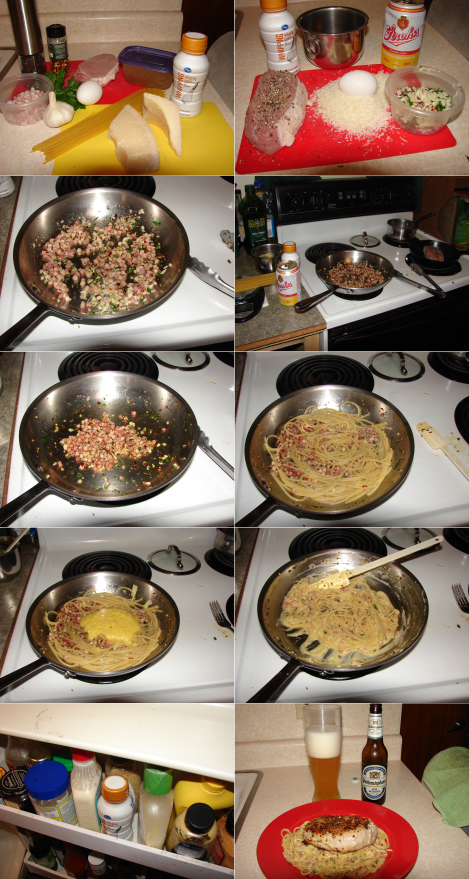
    Carbonara

    First off my apologies for the delay in getting this part out, but I’ve been busy what with building homes and whatnot1. Assuming we passed the rough-in/framing inspection we now get to cover everything up and get to finishing. First comes the insulation. We have always subbed out the insulation, in the early days we did so because installing insulation is a nasty, scratchy job and more importantly the big companies could do the job for little more than what the cost of the insulation alone would be to us, economies of scale, FTW. I hear the insulation isn’t as itchy these days and sometimes they use the sprayed in fibrous and/or foamy stuff. Today it’s still cheaper to let the pros do it, plus we now have stricter standards on just how much insulation we need and we have to “prove” that we meet those standards. One “proves” this by submitting forms filled with calculations that I’d wager no one even checks2, but it’s in the file, so it’s all good. The insulation companies have people who fill out these forms, so we let them, it costs more but at least the homeowners know that their homes are nice and tight.

    Speaking of which, with the house wrapping, caulking every crack, and the better insulation, some areas started seeing “Sick Home Syndrome,” a situation where people would get sick simply from being in certain buildings too long. Turns out all these energy efficiency regulations were making homes too tight. The answer – require a pressure test and add air exchangers so the houses can breathe3. Government – breaking your legs so it can supply you with crutches.

    After the pink stuff comes the grey stuff.4 Drywall is another trade that we have always subbed out, apart from very small jobs it’s just not worth the hassle. In ’88 we used a couple of brothers who hung and finished the jobs themselves, they used hammers and nails but the screw guns were only a few years away. Most drywallers today seem to specialize in either finishing or hanging, the guy we use today doesn’t even employ hangers; he hires a crew that works for two or three other finishers. There are not many codes concerning drywall, we have to hang fire-rated boards on any walls between living spaces and garages but that’s about it.

    After the grey stuff comes the stuff that’s whatever color you want it to be5. In the early days I spread a lot of paint6 but as my skill/value in other areas increased it became wiser to sub out the painting and staining. Which isn’t to say that painting is easy and that any hillbilly can do it. In fact, one of the most conscientious tradesmen I have worked alongside of was our long-time painter and wood finisher. Outside of the exemption in footnote #57 there aren’t any codes regarding paint…yet, you can still paint your farmhouse kitchen some shade that’s almost blue or your imperial bedroom an off yellow. I don’t know much about the technological advances in paints; what I do know is that over thirty years the cost has skyrocketed. It could be market driven, but since most things seem to come down in price over time-unless artificially manipulated- my money is on government intervention. Admittedly, this is a personal bias; I’ll gladly defer to anyone with actual knowledge of the ins and outs of the paint game.

    Outside it’s time for siding, these days that means vinyl siding and cultured stone. For the first few houses, we used T-111 sheathing and later cedar. T-111 is cheap8 and the cedar expensive, both require maintenance, so vinyl and stone it is. Other than styles, not much has changed in siding; vertical is popular right now and they have some halfway decent looking fake shakes and stone products. The tools might have improved but the application is still the same, likewise with the stone; we’ve used the same masons for 25 years and they’ve always done things the same way.9


    The Big Finish

    From here on out it’s mostly cosmetics; technically all you need for the final/occupancy permit is a WC, hot water, and a kitchen sink. This is also about the time the owners start to get happy feet, the exterior is done and all the ‘big’ steps have been taken, but there is still plenty to do. I imagine if you had a big enough crew-or separate crews-installing cabinets, hanging doors, and trim, putting in the various floor coverings and such you could finish up quickly but we10 do all that stuff ourselves, so it’s going to take some time. Back when I did our electric, I would start with the lights and outlets, as it makes finishing easier when you don’t have to drag lights and extension cords everywhere.

    Other than carpeting, which one likes to install dead last, I like to get the hardwoods, laminates, and ceramic down next; saves having to undercut doors and work around cabinets. Styles and products have changed over the years, laminates are the most popular now, and they have improved a lot. People still like hardwood and ceramics, but the cost difference is substantial. After flooring I like to set the cabinets; they, too, have improved mostly in the hardware, soft close hinges, full extension drawers and such. Countertops are mostly granite or quartz, and those farmhouse apron sinks are all the rage. I use a laser to level the cabinets, and the countertops are digitized and cut on CNC machines.

    After the countertops are installed, the plumber can return and finish up, while I move on to hanging doors and trim. All these little things seem to go on forever, installing latch sets, door stops, towel bars, closet shelving, and the inevitable “favors” we do for the homeowners- hanging the wall mount TV brackets they bought or that big mirror and heavy pictures or the swinging porch chair… But then one day it’s done, the inspector can come by and stick his tester in a few outlets11, flush all the toilets and make sure the water at the sink is hot, but not too hot. We gather up any tools and materials still around and move on to the next job.

    I know this section comes across as sparse, but other than styles and aforementioned improvements in tools and products finishing, a house hasn’t changed all that much during my 30-year career. To make up for that here’s some argument-starting clickbait type opinion stated as fact.

    Every Tom Waits Album12 Ranked Worst to First.

    test
    Proof I’m not selling wolf tickets

    The Black Riders
    Blood Money
    Real Gone
    Foreign Affair
    Alice
    Closing Time
    The Heart of Saturday Night
    Franks Wild Years
    Bad As Me
    Small Change
    Bone Machine
    Nighthawks at the Diner
    Swordfishtrombones
    Raindogs
    Heartattack and Vine
    Mule Variations
    Blue Valentine


    That’s it for the penultimate part. Next time will be the last time. I’m going to attempt to wrap all this up with some observations about what all this has to do with libertarianism, or perhaps better said, how it has influenced my particular take on libertarianism. If you have any questions or would like more details about some particular area hit me up in the comments and I’ll endeavor to address those issues as well.


    1. Mainly trying to drink all the beer Riven sent me.
    2. Not one time have I seen an inspector refer to any of the various forms we must submit while he’s doing the inspecting
    3. Just like they used to.
    4. That might be a euphemism…I’m just not sure for what
    5. Except for outside, but I’ll get to that next time
    6. [waggles eyebrows]
    7. see footnote 5
    8. But not inexpensive.
    9. Recently retired, maybe the new masons will have new tricks.
    10. With Dad pushing 80 that really should be “I”
    11. Now, there’s a euphemism!
    12. Yes, Nighthawks is technically a live album, but since it’s all original songs (aside from the Red Sovine cover) that aren’t on any other studio albums I include it here.

  • I Fucking Hate New York

    So…


    I just took my five hour I Can Haz Sekund Amendment Nao? class, and my typical “go fuck yourself” tendencies have been whipped up to a jiggly wiggly timey wimey ball of hate.

    Now, any of the following things could be true:

    • The people teaching the class didn’t know wtf they were talking about
    • I might not have correctly understood what I was being taught, even though I got a perfect score on the test afterward
    • The people teaching the class could have been trolling everyone.  NY gun laws are completely beyond Poe, after all.

    But assuming the rage-hormones haven’t broken my brain, let me share my loathing of this state’s government with you.

    Stop!  Don’t Touch!

    If you don’t have a pistol license in NYS, you are not allowed to touch a pistol.  Not own, not carry, not buy or sell, touch.  Criminal offense if you do.

    Catch Twenty-one-and-three-quarters

    In order to get a license to touch a pistol, you must submit your paperwork for said license, including the receipt of the gun you have purchased.

    https://giphy.com/gifs/reactionseditor-l0Iy9D4PZKRZ6chcQ

    Yes.  You must first buy a gun without ever having touched it.  That’s the way things work here.  Now of course, just because you bought it doesn’t give you any of the normal benefits of what we would normally think “ownership” implies.  Like, YOU CAN’T FUCKING TOUCH IT.  Or, I dunno, take it home mebbe?  You give the gun store some money, they give you a receipt (only).  You submit the receipt with your license paperwork to the judge and maybe someday you might actually own something that is a little more solid than a slip of paper (which, much like the Constitution in NYS, can be used for wiping one’s ass).

    Here Comes The Judge

    Now the class-givers were very happy to be teaching my group of people, as we live in a county with a “good” judge, 2A-wise.  Because you see, each county in NYS has a judge who determines whether or not people have their pistol licenses granted, and which version is granted.

    Everything not permitted is forbidden

    For you see, you’re not getting a license to carry a pistol; no no, that would be silly.  You are getting a license to carry a pistol for a particular purpose only.  And guess what?  Self-defense is a separate listed category not granted by the other permitted reasons.  My judge will pretty much automatically grant pistol licenses for the purposes of hunting and target shooting.  This means I can carry a gun to a gun range, from a gun range to my house, to a hunting location and from a hunting location to my house.  That’s it.  I can also use it only for target shooting and hunting.  So, if I am carrying it to a lawful destination and I am attacked by a crazed hobo, I may not use the pistol for self defense if I do not have a self-defense license.  I can roundhouse kick his face off, I can crush his skull with a rock, I can blow his head off with a shotgun, but if I use my target and hunting license pistol to stop him then I am guilty of unlawful use of a firearm.  I may not (may not, see below) be prosecuted for the dead hobo, but I will be prosecuted for the gun felony.


    Ain’t nobody wants to see that *(euphemisms helpfully marked)

    Now, open carry ist verboten in NYS.  Which means, you may not expose your gun* in public.  This includes printing it through a shirt or jacket — that’s a crime.   Once you’re inside the (private) gun range, you can take it out* and begin using your gun.*  This also applies to hunting on a piece of private land.  But what about on public lands?   No, you may not expose your gun*, you must keep it concealed at all times.  Yes.  That’s right.  According to the law, you can use a properly licensed pistol for hunting as long as you don’t take it out of your range bag/holster/etc.  Now the NYS game wardens apparently did not want to be the victim of accidental discharges so they have magnanimously agreed to not charge people so long as the hunters are a) dressed like hunters, b) are able to explain what kind of game they are hunting c) it is the season for said game and d) the pistol is appropriate for the type of game being hunted.  Unless they just feel like charging you that day, of course.

    Post Code Lottery, NYS Style

    Now there is a pistol license that allows you to just (concealed) carry the damn thing, it’s called an “unrestricted” license.  One of the reason why my judge is considered one of the good ones is that after having has a specific-purpose license for a year, I can then apply for an unrestricted license.  There are more classes involved, and they’re not offered all that often, and there is a waiting list for them when they are offered, but if I get into one, my county’s judge has a habit of granting them.  Albany county’s judge apparently never approves unrestricted licenses.  Some of the counties where the Night’s Watch are located will grant the unrestricted license without having a year of the training wheel version.  Judges change.  There’s no guarantee that the next judge of Saratoga county will be any better than Albany.

    It’s getting all Sondheim up in here

    Remember way back when you “bought” a gun?  Well, if all goes well, in a few months you might be able to take it home, once you have all your paperwork in.  Well, “you” and “your” isn’t completely accurate.  When you go to Ye Olde Sheriff’s office with your petition, you include some envelopes addressed to four NYS residents of good character who have known you for at least year.  According to the trainers, this is not a rubber stamp thing.  There will be background checks run on them, and the judge will determine whether the relationship is adequate for them to provide “proper” character references.  The Westchester judge requires that one of these four must have known you for at least five years.  So if you’ve just moved here from out of state, I hope your pistol collection wasn’t too expensive.  Once the judge accepts your four, questionnaires are stuffed into the envelopes you provided (Huzzah for saving tax dollars!) and sent out.  Until those four people return those questionnaires, your application will not be processed any further.  If they are too late in returning them, the application is canceled.  If the judge doesn’t like what they read, the application is denied.  If the application is denied, you may not apply again until three years have passed since the denial.  You’ll need to go out of state for all your pistol-touching* needs.

    It gets better.  Better, not good.

    Once you do get a pistol license, you can now touch pistols.*  This will help make your second purchase a better one, since you’ll have some idea of ergonomics.  Once you purchase your next one, the gun store will give you another piece of paper.  “What?” you may be asking. “Don’t I have a license to carry a pistol home now?”  Hahahahahahano.  Well, technically yes.  You have a license to (concealed) carry A pistol.  A single very specific pistol.  Not “your” new one. This also works in reverse. Your pistol can only be carried by the licensee (i.e. you).  You can’t lend out a gun.  Another pistol-licensed individual can touch it* and they can use it for purposes for which their pistol license is valid, but they have to do so while under your direct supervision.  The good part is that you can amend your pistol license to also include “your” new pistol.  You won’t need any additional judge’s approvals or character references, just some signed and notarized forms.  It still will take a few weeks to process.

    You’ve fucking done it now (alternative title: Fuck Andrew Cuomo with red-hot pokers covered with syphilitic hornets1)

    This has all been about pistols.  Long guns are much less regulated…  unless you get a pistol license.  Because once you’ve deigned to ask to exercise your rights, the government now has carte blanche to fuck you over.  There are vast [dammit, why can’t I find that scene from David Lynch’s Dune where Duncan Idaho says “vast numbers.  VAST.”] numbers of ways that you can violate the terms of your pistol license.  I believe they’re all crimes. Most of them are misdemeanors with no/little chance of jail time, but they are still crimes.  Which means you immediately become a gun criminal.   And gun criminals aren’t allowed to own any guns, even guns not requiring any special permission (even in NYS) to own.  It’s kind of ingenious in a Kafka/Ayn Rand villain sort of way:  make it so those people that want to own guns are more likely to violate rules.  Make the rules carry little or no penalties to keep from generating sympathetic victims but then also use it to disarm them.  Ta da!  You’re disarming people who want guns without restricting the rights of those who don’t want to exercise those rights; as far as the gun-apathetic are concerned, no violation has taken place.  Brilliant!  Though not as brilliant as my idea of opening a hipster pop-up restaurant selling heated Red Baron frozen pizzas for $35.

    And one last “Fuck You”

    All his ranting has been concerning the laws of New York State.  But the title just said “New York.”  Why?  Well, one of the laws pertaining to gaining a New York State Pistol License is… It is not valid in the five boroughs of NYC.

    I wanted to find someone flipping off the NYC skyline, or the Empire State Building. This is the best I could do


    1 Hyperbolically speaking, of course.

  • The Hyperbole’s Homebuilding Hoedown – Part The Fourth

    Previously on H3

    Part 1: Introduction, Caveat, and Stakeout

    Part B: Permits and Foundations

    Part III: Do’h, Stumps, Rodan!!!, and Framing

    Rough-in it, Hah!

    Really shoulda had an arc fault circuit breaker on those attic lights!

    The framing completed we can now move on to the electric, HVAC, and plumbing rough-in, well almost. While one could elect to start running supply lines and drain and pulling wire right away, it is preferable to ‘button-up’ the home first. Exterior doors and windows need to be installed and the roof needs to at least be felt papered if not fully shingled, this not only weatherproofs but keeps light-fingered passersby honest. Sadly with escalating cost of building supplies, theft is a serious concern even in the rural heartland of Ohio. The products and tools have improved but the processes remain the same, very few codes concerning doors, windows, and roof installation have changed or exist at all. What color they are is something else, but more on that later. Now with the buttoning-up completed lets rough-in it.

    Back in ’88 dad hired an electrician to wire the spec house. He was good enough to let me help and willing to teach me all I needed to know about wiring a home. If he was ever concerned about training his own replacement he never let on, he had plenty of other work and I have, over the years, learned that there is a friendly competition between most tradesman. Sure, some might dislike each other but most will buy rounds for each other in the local bars and swap stories about insane clients and stupid inspectors. The exception being anybody who would give the rest of us a bad name, guys who do shoddy work and rip people off. If you’re talking to a tradesman you’re thinking of hiring, and he tells you all his competition are losers and no good, be cautious, especially if he brings it up unasked. If you ask and he speaks well of his competitors that’s a good sign he’s being honest.

    Unless we were too busy, I wired our homes for the next ten or fifteen years. I stopped and we again hire an electrition to wire our jobs, mainly because the codes kept changing and it wasn’t worth it to try and keep up with them. I’d estimate in those early houses I would run a total of maybe fifteen-twenty circuits for the average house, now it can take over thirty and some need to be ground fault protected, some arc fault protected. It seems like every appliance needs to be on a dedicated circuit and you have to put fewer and fewer outlets or lights on the rest. Meaning that there are more home runs from the service entrance panel, and wire isn’t getting any cheaper. For those arc-fault protected circuits, one can lay out up to 10x what a standard one costs. Our electrician also has to install two grounding rods, tamper proof outlets, CO2 alarms, etc. I estimate that changes in the electrical code alone have added up to five thousand dollars to the cost of a new home.

    We have almost always hired out the plumbing. For the first few years, we used a father & son and son crew, the average home would take them one day to rough-in, well, the father and one son did; the other son installed the furnace. When the furnace son bought the farm, oh relax, he bought an actual farm and raises llamas or ferrets or something, dad and I took over the furnace installations. A few years later for various reasons, we switched to another plumber and he started installing our furnaces, which made me very happy. I hate ductwork, I doubt that I installed one single furnace that doesn’t have my blood on it, that metal is sharp, and I must have used up a good chunk of my profanity quota by mumbling “CodKnobbin’ Melonfarmer!” while fighting with it. Plumbing codes have not changed much, ‘Pipe’s still round, shit still runs downhill, and payday’s still on Friday’. The plastic supply lines are now the norm, copper prices being what they are. The furnace/ductwork installation is the same as well, the furnaces are more efficient but nobody has improved ductwork and it still sucks balls Seriously, you’d need armed forces to get me to install another furnace, I’ll go back to delivering pizza first.

    Decks

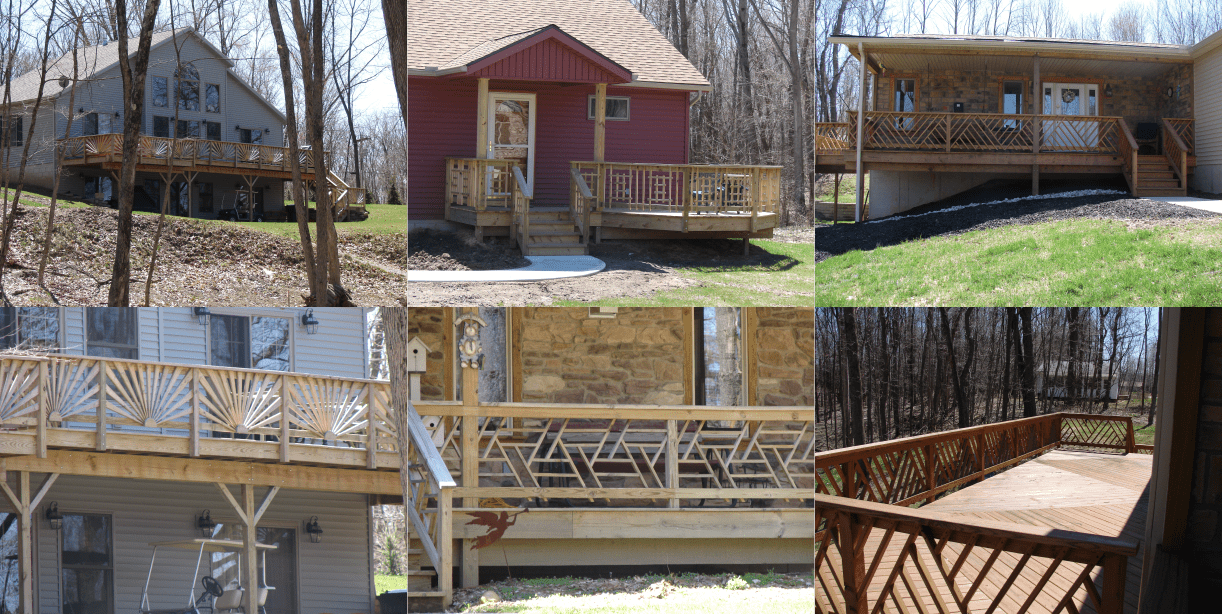
    Deck Pics!

    When I’m not involved in the roughing-in, this is usually a good time to build the decks. Unlike ductwork I love decks. I like framing, and I really like finish carpentry, but my favorite has got to be building decks. Framing gives you instant gratification, you can get a lot done quickly, but it’s crude and almost anyone can do it.  Finish work requires skill but it’s very repetitive- measure, miter, cope, install, measure, miter, cope, install -repeat ad nauseam. Decks offer the best of both worlds, they make an instant visual impression but are a finished product so one can get his woodworking on — it’s not like building a cabriole legged table but it not exactly slapping up a chicken coop either.

    Structurally decks haven’t changed much– posts and beams, joists and decking, railings and stairs. I use screws now where I used to use nails, and structural lag screws replace some of the through bolts. Somewhere along the way, the maximum spacing between the railing went from 6″ to 4″ which means you need more balusters and that could cost a pretty penny on a deck with lots of railing. After building three or four railings I was sick of the standard 2×2 balusters and since then I try to come up with a new and exciting design for each deck and railing. There are fancy kits and pre-formed balusters but they are costly, same with the composite decking boards. They have nice hidden fastening systems and an occasional power washing is a lot cheaper than staining every few years but you pay for it up front. A composite board costs between three and five times the cost of a wood one and the composite boards require more framing and labor.

    The important thing to remember is that this section was added primarily for me to show off some of my handiwork. Look on my works, ye Glibby, and despair!

    Big Deck Pics!

    Inspections

    Back in ’88, we had our first ‘inspection’ at about this point, as I’ve mentioned a few more have been added since, but this is still the first real one, the others are more ‘take a quick look and check a box on the form’ type of inspection. In ’88 the ‘inspectors’ were volunteers on the HOA’s code enforcement detail. They really didn’t know much about construction (there were a few retired engineers and they at least knew what they didn’t know), they were better suited for enforcing the HOA rules regarding how long your grass was or if you could leave the RV parked in the drive for four straight days. The Inspections were more of an open house than anything else, some ‘inspectors’ would bring their buddies or wives along, everyone wants to check out the new house on the block. Lot’s of “So this is the kitchen?” and “Are you putting in tile?” questions…not so many “What’s the span on those joists” type questions.

    Today we have a real inspector, he was an electrician and then a building inspector one county over before the HOA hired him. He is thorough and fair, he does a pressure test on the drain lines, he makes sure the wiring is secure but not too tightly stapled. He knows what is structurally required and he follows the codes. I really can’t complain about him, if you are going to have codes and enforce them better a by-the-book guy than looks-good-to-me type. You know what you’re getting with the former, some (most) of the codes may be redundant, subjective, or overkill but they are what they are. In the latter case, who knows what B.S. they might come up with.

    The Dunning–Kruger effect or ‘knows just enough to be dangerous’ rule applies here as well. Between the totally unqualified looky-loos we started with and the professional we have now the HOA went through half a dozen others. One, I mentioned in the introduction, he stuck his thumb on top of his head and extended his fingers up if his pinky could touch the ceiling there was a headroom problem. I had to explain the difference between a ridge beam and a ridge board to the next guy every time we had a cathedral ceiling that extended into a loft. A few feel it’s their job to find something wrong, not ensure things are right, they’ll make up ‘issues’ on the spot to justify their phony baloney jobs. I’ve had a few say ‘I’m happy about X but I’m not sure if that’s covered in the codes, I’ll look into it and let you know.”

    A competent inspector will add some value to a homeowner if he catches some oversight or incompetence on the part of the builder. He may also add a little peace of mind in that a second pair of eyes looked over the construction, which may be of some value. A bad one can cost the homeowner real money, either by forcing the builder to either fight some arbitrary rule, and time is money, or go along with it to get things done. Worse case scenario he misses something that causes problems down the road. People assume that if it passes ‘inspection’ it’s all good, buyer beware has gone out the window; Big daddy government or the HOA has my back.

    Due diligence is a thing of the past, we offer to show potential customers the last five homes we’ve built, not cherry-picked ones, the last five. We’ll give them the number of the owners so they can call them personally. (Yes, we get permission to do this, we have never had a client not want to show their new home to others, many tell us to send people their way without us even asking) As far as I know,  no one has ever taken advantage of this, granted we get most of our business through word of mouth so people are getting referrals in a way. But still, for most people, a new home is the single biggest expense in their life and given the chance to check out our credentials most people just give it a ‘meh’. I don’t get it.


    That’s it for Part the Fourth, I know I promised a story about color codes, but I spent a ridiculous amount of time formatting this article so that the first letter in each line spelled out a secret message, then I realized that everyone’s browser and window settings are different and all that work was for naught. So this is what you get, no anecdote, no red sauce recipe. I’ll make it up to you next time, promise.

    Not when it comes to decks or ductwork

  • The Hyperbole’s Homebuilding Hootenanny Part III

    Previously on H3

    Part 1: Introduction, Caveat, and Stakeout

    Part B: Permits and Foundations

    D’oh!

    Pizza D’oh
    What with all the excitement about lasers and my eagerness to bitch about the permitting process, I forgot a few things, so bear with me as I backtrack a bit. We used to pour the footers as soon as they were dug and/or formed, we would often call for the “mud” before they were completely ready because it could take up to two hours for the truck to get to the site. We would have the rebar delivered on the truck and place it as we poured. Now we have to have our footers ‘inspected’ before we can pour, we can’t call for the concrete until the inspector shows up and we have to have the rebar in place ahead of time, meaning we have to make a trip to the concrete plant and bring the rebar down ourselves and then sit idle for a few hours waiting on both the inspector and the truck. Those are minor annoyances; the real problems arise when the inspector can’t get to the site in time to get the pour in. Nothing is as frustrating as being ready to go, not being allowed to and then after a nice overnight rain getting to pull out rebar, scrape out mud, dig out cave-ins and get all set again only to wait for the inspector once more. Worse yet (worst if you’re Rufus) 9 times out of 10 the inspector walks up to the edge of the hole, looks around and says “looks good, see ya next time.” Now with cell phone cameras ever present, some inspectors will allow you to take photos of the footer those times that they can’t get there in a timely fashion, but it’s up to them if they want to be a pain in the ass about it they can.

    There is also a new inspection of the block walls as well. In the early days the masons would lay the block, back plaster up to the finish grade line, put in anchor bolts and if we determine it necessary, add rebar and fill cores to strengthen the wall. We would have the back plaster sprayed with tar and place sill seal and a treated 2×8 plate over the anchor bolts, tighten them down and we were ready for the framing crew. Now before we put the treated plate on we have to be inspected, the top course of block now has to be solid and every 6 to 8 cores rebar-ed and filled. The tarred back plaster is no longer good enough, now we need to have a rubbery membrane applied with a thin layer of foam stuck to that. It may be argued that these changes do in fact add value to the home, you get a stronger wall and better waterproofing. These things are true but ignore the costs, you can always build a stronger foundation, you could fill every core or use 12-inch instead of 8-inch block, you could pour a three-foot-thick solid foundation. Somewhere in that continuum, the cost of extra strength outweighs the benefit. Instead of dictating a minimum standard, which for all intents and purposes becomes ‘The Standard’, perhaps we should allow homeowners and builders to make that determination.

    Stumps

    You can use it for calzones as well
    I also forgot about clearing the lot, due to the coincidence that the first house we built and the latest one are both on treeless lots. This is very rare for the development we build in; in fact, I believe these are the only two homes we’ve built that we didn’t have to take down at least a few trees and I’d estimate three-quarters of the time the lots were completely wooded. In the early days, we would sell any trees worth harvesting for lumber to an Amish chap with a name so Amish-ish you’ll think I’m making it up. Eli Yoder would show up with a half dozen other straw enhattened fellows and piously chainsaw away for a few hours, then they haul off the logs they want and leave the rest in eight foot or so lengths, along with a large pile of branches and tops. We would then position the unwanted logs by the road and within a day they’d be gone as locals would stop and ask if they could have them for firewood, we would pop out the stumps and with the brush have a nice big fire, any stumps too big to burn we could take to the ‘stump farm’ a field outside the development owned by the HOA.

    Nowadays we still sell any trees Eli wants but we no longer are allowed to burn the brush, which as the development filled in makes some sense, however, it’s another one size fits all solution. It is a large development and there are still plenty of lots with no nearby homes, but no fires are allowed even if the nearest homes are hundreds of yards away. So we bring in the guys with the woodchipper, yes, yes, a true libertarian would have his own woodchipper, sigh. The state health department and EPA shut down the stump farm, seems stumps are a hazardous material once you dig them up, so the large stumps we must now have hauled off and disposed of in whatever approved method our tree guys use. I think that they are supposed to grind them up in one of those machines you see on youtube eating cars and couches and what have you. Again not a very big deal but you might have noticed a pattern by now, a little more cost here a little time wasted there, it’s like boiling a frog or a camel’s nose or some other animal related metaphor for slowly nickel and diming you to death.

    Rodan!!!, what’s that …Radon?.. well that’s disappointing.

    Lastly, before we start framing we need to get any underground plumbing placed and the basement floor poured. Not much has changed here, dig some trenches and a hole or two for grinder and sump pump pits, lay some Sch 40 PVC drain lines, have some Mexicans (some I assume are good people) do the work Americans won’t, and bingo bango Bob’s your uncle. Somewhere along the line we were required to add a vent for radon, a 4″ pvc pipe from the gravel base under the slab up through the roof. As far as I know, there have been no cases of radon poisoning or tests showing an unhealthy level of radon in the area, but vent it we must. It’s only a couple lengths of PVC and a tiny amount of labor, just one more drop in the ‘it’s not a big deal, whats the harm?’ bucket.

    2″ SCH 40 PVC makes a nice rolling pin

    Framing

    Okay now that we are back on schedule I’ll endeavor to keeps us on target, hopefully, my aim is true. Speaking of aim I used to be able to drive nails with the best of ’em. I could sink 16d spikes all day long, tap-sink tap-sink, or set a 6d finish nail just below the surface without a nail set and without leaving any pecker tracks. I don’t mention this to brag but to lament that I can no longer do so, I’m out of practice thanks to nail guns. In Part B when I mentioned that lasers were the biggest advancement in the trade I was surprised no one brought up nail guns in the comments. There is a good argument to be made for nail guns; for me, lasers edge them out, but just barely. My father bought our first nail gun back when we were framing that first house, but for various reasons, it took us a while to adapt. It jammed a lot, and dragging around our undersized and noisy compressor that wouldn’t always kick on in the cold was a pain, the hoses get tangled and trip you up. Within ten years or so we had fully integrated them, I must have a dozen nail guns now – framing, finish, pinners, staplers, roofing, one just for installing joist hangers and one just for hardwood floor installation. The sound of compressors running on the job site during framing is now as ubiquitous as Mötley Crüe blasting out of a battered and beaten Dewalt radio that fades in and out when it gets over 90° and you better not change the station because the tuner’s fucked and it took Randy twenty minutes to dial in WRKZ 99.7 THE BLITZ!!!

    For the most part, the actual framing hasn’t changed all that much, 2×6 exterior walls have become the norm, and only the cheapest builders still use fiberboard or foam panels for wall sheathing. For a few years, the manufactured “I” joists replaced 2x10s, but they burn up quickly in a house fire so you are required to fireproof them which has made most builders return to 2×10 joist. LVL’s have replaced steel beams and structural screws have replaced nuts and bolts. Cranes, booms, and lifts have also become common, previously they were mostly considered commercial equipment and not often used residentially. We used to ‘swing’ trusses into place, and hump materials around the job site using manpower alone. Extension ladders and jacks and planks were constantly being set up and tore down to install second story windows and gable end sheathing. Now machinery does all the heavy lifting, it’s faster, easier, and most importantly, much, much safer- I don’t have any statistics but falling off roofs, planks and ladders has got to be the most common cause of job site injury. Certainly, there are extra cost involved but that cost is easily offset by the benefits, and it is a decision builders make, you aren’t forced to make these changes or use these tools, and yet most builders have. Take that, central planning tyrants.

    There are two code related changes to our framing that I can think of. We are now required to use ‘hurricane straps’ to attach the rafters/trusses to the top plate of the walls. This fits right in with the running theme – small additional cost, doesn’t take long, adds strength that may not be necessary, should be left up to the homeowner and builder. We also now frame 2×4 walls around the perimeter of the basement, whether it is going to be finished or not, because we have to insulate the basements. Depending on the size of the house the framing and insulation can add a good bit to the cost, again might be a good idea, should be an option, not a requirement.

    That’s it for Part III, in Part the Fourth we will look at the rough in plumbing and electric, and HVAC (none of those letters stand for anything) and I’ll regale you with the curious tale of how the exterior color guidelines went from earth tones only to ‘sure you can have white trim, just this once’.

    ♫Three out of four ain’t bad♫

    Obvious song choice is obvious.