Web Dominatrix sends her apologies. She’s crazy busy finishing up websites for a couple new clients. And these are ladies you do NOT want to disappoint (unless you’re into that sort of thing).
So, you’re stuck with me as a last minute substitute. Sorry, kids.
I thought I’d post one of my favorite vegan recipes. I’ve been making this regularly since last summer (2017) and I really could just eat the entire pan by myself.
This recipe comes from America’s Test Kitchen cookbook Vegan for Everybody, which both Web Dom and I have mentioned before.
You may sub 1-3/4 pounds frozen peaches for the fresh. Make sure you thaw completely before using.
Peach Raspberry Crisp
Filling
2-1/2 pounds peaches (peeled, halved, pitted and cut into 1/2 inch wedges)
1/4 cup organic sugar
1/8 tsp salt
2 tbsp instant tapioca (finely ground)
1 tbsp lemon juice
1 tsp vanilla extract
10 ounces raspberries
Topping
1/2 cup all-purpose flour
1/4 cup organic brown sugar
1/4 cup organic sugar
1/4 tsp ground cinnamon
1/4 tsp ground ginger
1/4 tsp salt
1/4 cup coconut oil (melted and cooled)
1/2 cup old-fashioned rolled oats
1/2 cup pecans (chopped)
2 tbsp water
For the Filling
Adjust oven rack to upper-middle position and heat oven to 400 degrees. Gently toss peaches with sugar and salt in bowl and let sit, stirring occasionally, for 30 minutes. Drain peaches in colander set inside bowl; reserve 2 tablespoons juice and discard extra.
Return drained peaches to bowl and toss with reserved juice, ground tapioca, lemon juice, and vanilla. Transfer to 8-inch square baking dish, press gently into an even layer, then top with raspberries.
For the Topping
Meanwhile, process flour, brown sugar, granulated sugar, cinnamon, ginger, and salt in food processor until combined, about 15 seconds. Add melted oil and pulse until mixture resembles wet sand, about 10 pulses. Add oats, pecans, and water and pulse until mixture forms marble-size clumps and no loose flour remains, about 15 pulses. Refrigerate mixture for at least 15 minutes.
Sprinkle topping evenly over fruit, breaking into 1/2 inch pieces as necessary. Bake until topping is well browned and fruit is bubbling around edges, 30 to 35 minutes, rotating dish halfway through baking. Transfer to wire rack and let cool for at least 30 minutes. Serve warm.
The Hyperbole’s How-to Handbook Chapter One: Pizza Sauce
Is Libertarianism inherently self-reliant? Is Self-reliance inherently Libertarian? To many Glibs the answer to these questions may seem self-evident, obvious, redundant, repetitive even. We are, after all, a hardy lot of DIYers, homebrewers, self-defenders, sausage makers, board-gamers, reloaders, backyard mechanics, at least one diorama-ist, and cranky old get-off-my-lawners. Rugged Individualism, In the original Herbert Hover sense, is the antithesis of governmental paternalism. What could be more Libertarian? However there is another side to self-reliance and libertarianism, most libertarians hold capitalism and a free market in high regard. Comparative advantage, Division of labor, and Economies of scale are prized concepts. Certainly, it is great fun to shame grown men who can’t change a flat tire but is he any less a libertarian because he relies on his cell phone service and the roadside assistance supplied by personally purchased insurance. You may be thinking “okay Hyp, maybe libertarianism doesn’t require strict self-reliance, but self-reliant people are going to lean towards libertarian, its a common characteristic” Possibly, but it’s not that hard to imagine an off-the-grid, self-composting-toilet-using, chicken-raising, self-sustaining hippie-type that would be more than happy to have the government force the rest of us to live by their rules in a misguided attempt to save the planet, some endangered timberdoodle, or what not. Self Reliance while noble and to a point worth encouraging is not inherently libertarian and vice-versa. So take heart whether you Angus MacGuyver your pizza sauce from homegrown maters squeezed through the casing of a Bic pen and simmered over a solar oven made of used tin foil and roach clips, or, like Al Czervik in the Brushwood pro shop, (or should that be Thorton Melon at the Grand Lakes University bookstore) you use your vast wealth to buy the finest of the 23 types of pizza sauce that no one needs for yourself and all your friends, you can still hold your libertarian head high. As for me, when I can, this is how I’m gonna do it.
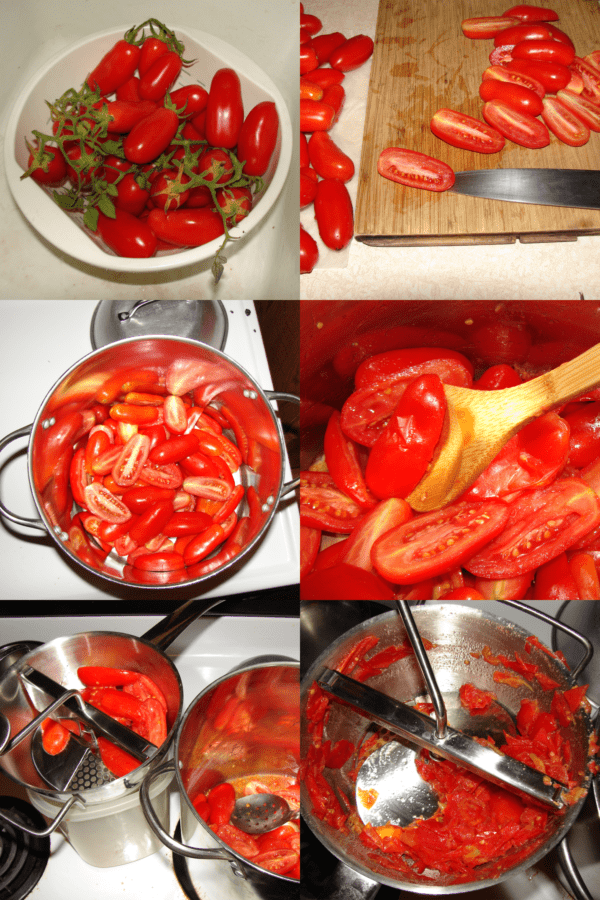
Step 1. Plant and harvest 4-5 lbs of San Marzano Tomatoes and 4 or 5 large chile peppers of the ‘not melt your face’ variety. (For more info on growing said fruits see Chapter Four: Gardening) Rinse and slice tomatoes lengthwise, check for nasty stuff, these were pristine.
Step 2. Heat over low heat, stirring for about 10 minutes, or until the skins start to loosen up.
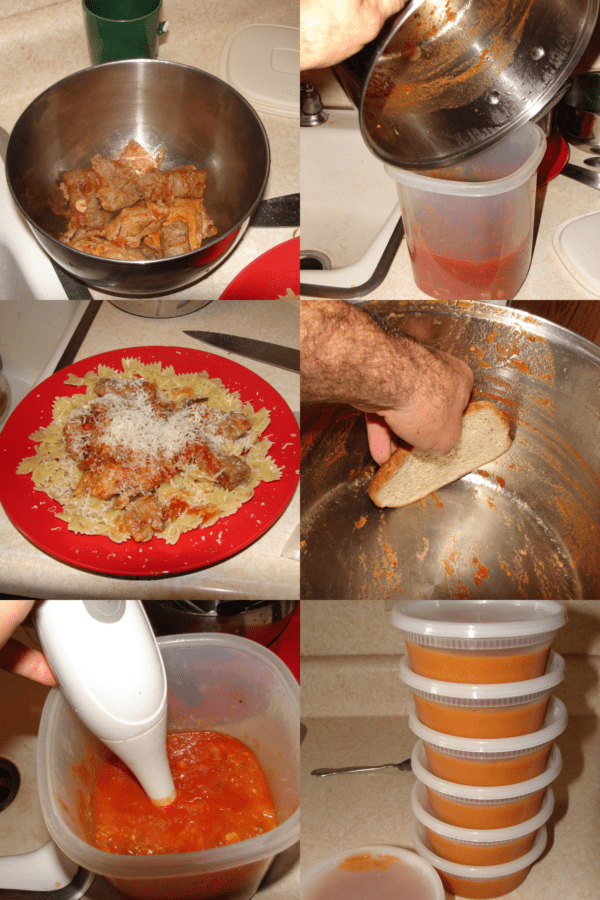
Step 3. Run tomatoes through the food mill that you use once a year, use a medium-sized sieve.
Step 4. (not shown) You’ve got enough to clean up already so put your milled tomato sauce in the fridge, wash up then walk down to the bar and grill for a mushroom bacon swiss burger, a few Strohs, and to ineffectually and awkwardly chat up the waitresses.
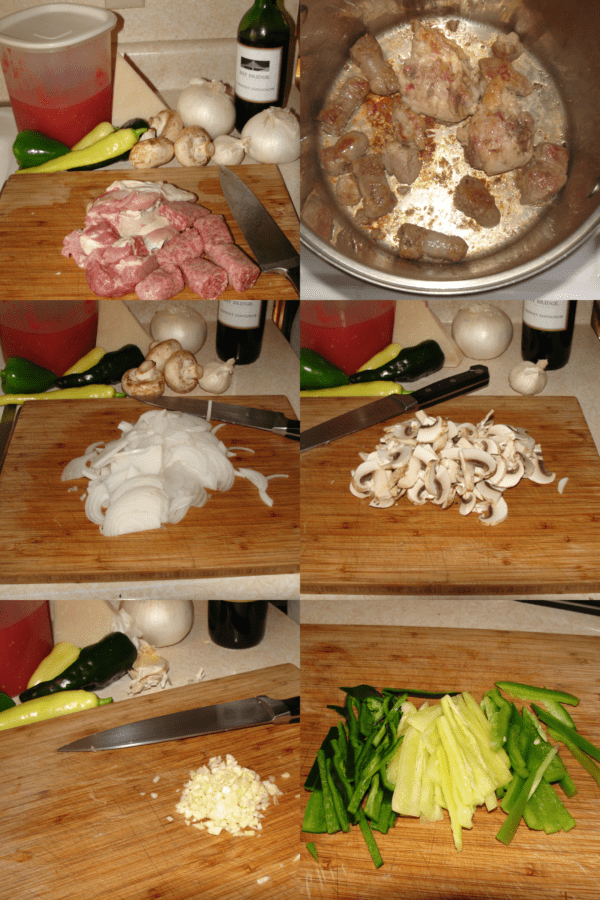
Step 5. The next evening get your shit together, tomato sauce, onions, mushrooms, garlic, peppers, red wine, and chicken thighs some sausage and some chunks of pork.
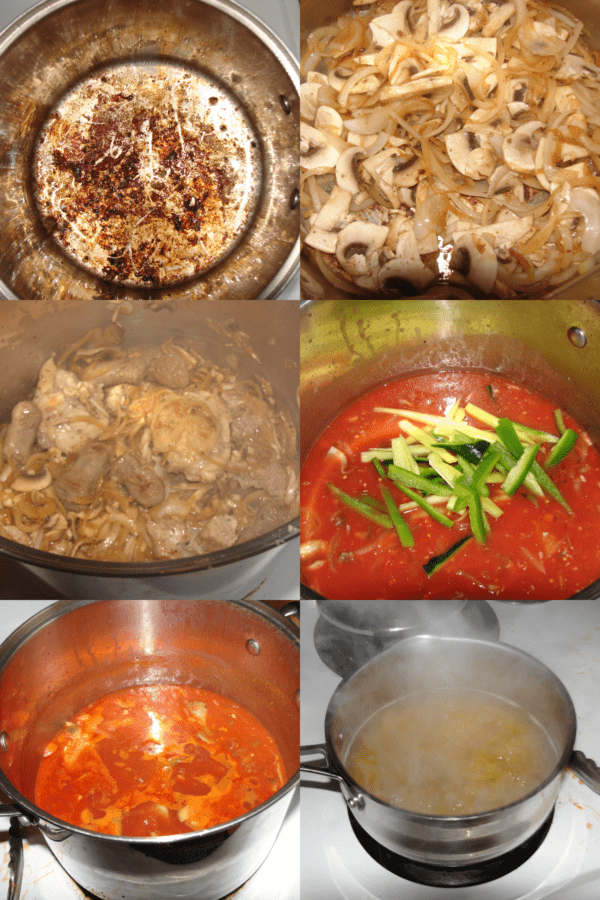
Step 6. Brown meats in oil in your heavy duty stock pot.
Step 7. Slice up about this many onions, mushrooms, and peppers.
The world of green chilies is a vast one. Everyone knows about New Mexico green chilies and their highly marketed name plate Hatch. I love green chilies, and the chili that is its namesake, and grew up eating it. I often use Hatch chilies in a pinch, but have always preferred locally grown when available, which is always if one plans right and has them in the freezer. I was unaware of the chili rivalry between Colorado and New Mexico that I uncovered during the 15 minutes I spent researching this article.
Being a semi-loyal Glib reader and a thin crust pepperoni clad warrior in the food wars, I am not afraid of voicing an opinion when it comes to food, but always just knew western Colorado chilies were far superior to anything grown in New Mexico–or anywhere else for that matter–and never gave it a second thought. I never made a big deal about it because what is the point of harping on facts to people lacking all the information since they probably never had a chili grown here.
I also never even considered anything grown on the front range, such as in Pueblo, was worth anything because the front range, anything east of the mountains, is considered by western slope folk to be pretty much western Kansas, and Pueblo has only ever been famous for being the location of the CO loony bin back in the day. In short, the only good thing about the front range is the Broncos.
This summer I have been far less enthused about fresh produce season than previous years due to a case of the mehs which I get from time to time, but I recently stopped and grabbed a handful of chilies (Big Jims) from a stand and brought them home for roasting. The best way to buy chilies is to buy big and have the seller roast them for you, but they wanted $35 for a box and I was not willing to part with $35 at the moment and it is no problem roasting small quantities ones self.
I did these on the Weber on a small pile of coals and the method consists of drinking beer and turning them until they char a bit on all sides and then put them in a paper bag to steam.
The day I roasted those chilies if I looked only through my left eye, they looked like this:
You see, there are certain factors that may cause cataracts and I checked most of the boxes.
Aging: Check (sort of, I am only early fifties)
Over exposure to UV rays: Check
I started skiing in 1972 when I was seven and back then we used the finest sunglasses one could buy at the gas station. Preferably red white and blue layered plastic frames with reflective plastic lenses, and that is what we wore during sunny days on the slopes which was most weekends when I was a kid. I have spent most of my life working outdoors in very sunny locations, and I have also done a fair amount of welding in some of the world’s finest shitholes with the finest welding masks available in said shitholes. UV protection is not a known hazard in most shitholes and you will see welders arcing beads wearing nothing but plastic sunglasses.
Diabetes: Maybe a possible Check
There is a good chance I have spent much of my life pre-diabetic due to diet and lifestyle. I was diagnosed as such in my mid 30’s but never felt bad so what was the point of following up on that right?
Drinking too much: Ya, ok, maybe, sometimes, occasionally, a time or two.
Smoking: Check. Off and on for thirty years.
It seems I most likely did this to myself in one way or another. That is something I have to come to terms with as I age. I never thought I would live long enough to ponder life’s questions of self reflection on what I have done to myself. Whether it was career choices and the hazards that come with using one’s body as a tool, recreation choices where the body is just another piece of equipment to be abused, and what is most damaging of all, what is ingested for fun or to silence the inner voice rambling on about what horrible choices you made in your life.
To go with my green chilies I dug some Italian sausage out of the fridge that I had cooked earlier for pizza, as well as a pizza dough that was made, surprisingly, for the same purpose.
Being someone who has only had one surgery when I was five when my tonsils were removed, and having a serious phobia about anything touching my eyeballs to the point I struggle to put in eye drops and even fainted during a glaucoma test once when I was in my late teens, I arrived for my surgery pretty much freaked the fuck out. But by god I could do it, “don’t be a pussy,” I kept telling myself. My blood pressure was jacked when they first hooked me up to all the monitoring devices but I eventually settled down. The doctor and the anesthetist, who introduced himself as the guy who would make me feel good, dropped by to check on me and soon they wheeled me away to the operating room.
I peeled my green chilies and laid them on the pizza dough as best they would fit, leaving enough dough on the outside edge to later fold. I placed a sliced-lengthwise piece of sausage on each green chili and covered it with cheese. I then cut around each chili leaving enough dough to fold kind of like a pinched top taco, sideways calzone or big dumpling.
They don’t put you under for cataract surgery and only mildly sedate you because you have to listen to the doctor and move your eye when he needs. During the surgery I only really freaked once and had to be told to hold still. It felt like the doc was pushing my eyeball into my brain as he wrestled the cataract infused lens out of my head and I found that a bit unnerving.
I did my green chili calzone things on my gas grill on my fire brick platform until golden brown.
They could be stuffed with anything you want, and they were good. I found they were better the next day. I ate one that night in some marinara which overtook the green chili and I was not that impressed with my creation. The next day I muckled down the rest one at a time as I reheated them one by one and ate them poolside, and the green chili really came through. They were delicious.
As to my whole cataract ordeal, it took something like 30-45 minutes in the operating room and I was at the hospital for little more than two hours. It is truly amazing the day after and I see with clarity I have not seen with in 20 years. It can only be described as how you are amazed at the clarity and drastic focus things appear after eating a small handful of mushrooms. Not the, “holy shit that chick put her makeup on with a spatula” clarity but just vivid focus that seems drastic compared to what I have been living with for the past few years when the cataract really got bad.
As they wheeled me to recovery with a patch over my eye the anesthetist asked how I felt. I said, “Disappointed, I am not near as high as I hoped I would be”. He said, “Here, we don’t give you what you want, we give you what you need.” I caught the Stones reference, but was not sharp enough to come back with a wiseass retort, but sure plan to when they do my right eye some months down the road. I am going to tell him to hell with this what you need stuff, give me what Keith would have.
It wasn’t that long ago in medical history when the procedure done to me was not possible and I indeed feel lucky I am alive when it is. It sure is better than previous techniques like poking a stick in the eye.
A stick would work to roast a green chili over a fire though.
It’s the hardest part about being vegan. I don’t really miss butter. I don’t miss milk. Sometimes I miss some half and half in my coffee, but that’s rare.
What I do miss is cheese in all its cheesy goodness.
It’s important to let go of your expectations of cheese when trying to be vegan. There are some really good vegan cheeses out there that taste like cheese, but if you expect it to act like cheese and behave like cheese, you’re probably going to be disappointed, so don’t go expecting to make a really good cheesy pizza (though if you figure it out, let me know).
With these vegan cheese recipes a lot of dishes are back on the menu.
But before I get into the recipes, here is a pantry list for you of commonly used ingredients you should have on hand:
Last time I went through the steps to turn simple pork belly into yummy smoked bacon. This week, we wander over to Italy to discuss another delicious form of “bacon”, Pancetta.
The primary difference between the two is that Pancetta is not smoked, but it is aged to reduce water content and to allow flavors and texture to develop. It actually belongs in the charcuterie family. In the beginning though, the two are actually treated pretty much the same way, with the primary difference being the use of Cure #2 instead of Cure #1 in this application. As we discussed last week, Sodium Nitrate(Cure #2), is basically a time release form of Sodium Nitrite(Cure #1), in that as it breaks down over time, it converts from one to the other. This allows the meat to sit at higher than refrigerator temperatures for an extended period of time while minimizing the fear of botulism. It is also very important that everything, including your hands, be squeaky clean when working with charcuterie.
On to the recipe. The recipe I’m using here is from Stanley Marianski, author of a number of cookbooks on meat and pretty much the go to for sausages and charcuterie in general. This recipe is from his website. It’s easy to get lost in a deep dive there.
Because every cut of meat differs in weight, ingredients are typically measured in a percentage of the weight of the meat. For this particular batch, this is what went into it.
1950gm(100%) Pork belly
47gm(2.4%) Kosher salt
5gm(.26%) Cure #2
21.5gm(1.1%) Brown sugar
37gm(1.9%) Black pepper
8.4gm(.43%) Juniper berries
1.36gm(.07%) Bay leaves
3.7gm(.19%) Nutmeg
2.34gm(.12%) Dry thyme
4 cloves Garlic, minced
Mix salt, sugar and Cure #2 together. Grind all the herbs and spices and mix them, along with the garlic, into the cure mixture. Make sure it’s mixed evenly.
Wash and dry the pork belly. Evenly distribute the mixture over both sides of the belly and the sides. Place in a 2 gallon zip lock bag, or into a vacuum bag big enough to handle the belly. Add any cure and spice mixture that did not adhere to the meat and seal.
Like the bacon, flip and massage the belly in the bag every couple of days. It will exude liquid initially, and then reabsorb it. We’re going to let this cure in the fridge for 14 days. At that point, remove from the bag, rinse and dry. Slice off a small piece and taste to see how the flavors are. Because we used Cure #2, the Pancetta is fully cured and does not have to be cooked before consuming. You can fry it, if you prefer.
At this point, we’re ready to tie it up. If you like, you can sprinkle the fat side with some black pepper. Place the belly skin side down with a piece of butcher twine(heavy string) centered and long enough to tie around the rolled belly. Roll the meat into a tight roll, you do not want any air pockets in the middle. You want the belly really dry, otherwise getting a purchase can be a pain. Tie the string tightly around the roll using a double overhand knot. Another pair of hands can also come in handy here. At this point, you are going to tie a string ever inch or so moving from the middle to the ends, taking care to keep the belly rolled tightly. You want to know the best part? You can skip this step all together and leave it flat. I don’t but you can. You would just be making Pancetta Tesa instead of Pancetta Arrotolata.
Now for ageing. The ideal conditions are 50-70 degrees Fahrenheit and 50-70% humidity. If you are fortunate enough to have a basement, or some other place with those conditions, you win! If not, many people build a curing chamber. I don’t have one, so I have found another method that allows me to age in the refrigerator. I give you: UMAi Dry Bag
UMAi dry bags are da bomb. The bags are a one way, semi-permeable membrane, which allows moisture out but not in. They are designed to be used in the refrigerator, and the normal air circulation that comes from opening the door is enough. I’ve used them in a number of different applications and am pretty pleased with the results. Until I have a place to put a curing chamber, these work quite well for me.
Weigh the cured meat and write it down. If you’re going to hang it outside of a curing chamber, wrap it lightly in a cloth and tie some string around it and hang it in your chosen spot. If you’re using an UMAi bag, follow the directions that come with the bags and place on a rack in the fridge. What we’re shooting for here is 30-33% weight loss. The downside with the UMAi bags is that it tends to take longer to achieve that goal. Hanging the Pancetta will get you there in several weeks, UMAi can take 6-8 weeks. When it’s done, the Pancetta should be firm. Smell it to make sure it hasn’t developed any off odors. If it does, there’s a possibility that spoiling has occurred and it’s not worth the risk. If handled and processed properly, there should be a very low risk of this happening.
Time to slice! I typically shoot for 3/8″ thick. Because there are only two of us, I vacuum seal two slices per package and throw it in the deep freeze. Because this is fully cured and can be eaten raw, I also slice some paper thin for charcuterie plates.
Like smoked bacon, I use Pancetta mostly as an ingredient in something else. Diced Pancetta cooked into any type of greens adds great flavor to the dish, along with the complex flavor when you chew a piece. If you have thinner slices, you can also use it in place of bacon in a BLT. Soups. The options are endless.
Heat is the enemy when you are making pie crust. If you want a good flaky crust, you need to keep it cold until you put it in the oven.
The recipe I use, which makes enough for a nine inch double crust or two single crusts, is as follows:
2 ½ C all purpose flour
2 sticks cold butter
1 T sugar
2 tsp salt
¼ C icy cold vodka
¼ C ice water
Instead of vodka you could use white or apple cider vinegar (chill it). Naptown Bill says he grandmother uses sparkling dry white wine or champagne in her pie crust. I may give that or sparkling water a try.
Mix the flour, salt, and sugar in a bowl. Cut the butter into cubes and toss with the flour.
Stick the bowl in the freezer. I also put the blade from my food processor in the freezer as well. After at least one half hour, I put the flour/butter mixture into the bowl of the food processor and give it a few pulses. Don’t over mix, you want the butter to remain in chunks.
Next add the quarter cup of vodka while pulsing the food processor.
(No! Don’t drink it! Put it in the dough.) I keep my vodka in the freezer, so it is ready to go. I keep a pitcher of water in the refrigerator and add ice cubes when I start making pie dough. Add the ice water, a tablespoon at a time until the dough starts to come together. It will still be pretty shaggy. The way to test if you have added enough water is to squeeze a handful. If it crumbles, you need to add a little more. If it breaks into big chunks, it is ready.
Cut a big piece of plastic wrap and dump the dough onto it. It won’t really seem like dough yet. That’s ok as long as you can form it into two discs – about six inches in diameter. Wrap each in plastic and put it in the refrigerator. You should still be able to see pieces of butter in the dough.
As it sits in the fridge, the flour will absorb the water and it will be less crumbly and shaggy.
I like to make pretty things, so when I saw the rose apple pie all over the internet, I had to give it a try. I don’t know who deserves the credit for inventing it. This one has an excellent tutorial for slicing the apples and making the rose. I didn’t really like the recipe though. So I added my own small touches.
If you want to do the rose design, follow the tutorial. Here are my tips and changes. You need about four medium apples. If they’re small, use five, if they’re big use three.
I increased the cinnamon and nutmeg to ½ teaspoon each and added ½ teaspoon of ground ginger and added to the sugar. Then I tossed the slices with the sugar mix and let it sit.
This lets the juice release and creates the liquid you will use for the caramel sauce.
While the apples are macerating, take one of your pie dough discs out of the fridge. Sprinkle a little flour on a cutting board and roll it out. Press hard when rolling because it will be stiff. You want to make as few passes as possible. Flip the dough every two or three passes and more flour as needed to keep it from sticking. When it’s rolled out big enough, use your pie plate as a guide and cut around it. Remember to leave plenty of room around it to account for the depth. Press the dough into the pie plate and dock it with a fork.
After the apple slices have sat for about ½ hour, you need to remove them from the liquid and squeeze the liquid out. I wear gloves for this and laying out the slices because it is ….sticky.
That’s also why I have no pictures of the process. (See the tutorial).
Preheat the oven to 375 now. It took me about five minutes more than the preheat time to lay out the apple slices. The tutorial I linked above says to overlap the ends of the slices. I think that makes the pie too ‘loose’, it creates gaps. I like my apple pie to be packed with apples. So, I put them end to end.
Start on the outside and just keep going until it is all filled in. Lastly, curl one slice and stick in the center. Cover the pie with foil and bake for about 40 minutes or until the apples are the texture you like. You can test it with a knife. Not only should the knife slide in easily, it should also slide out easily. Then bake uncovered for another 10 minutes until the crust and apples are golden. Look at the flaky crust!
While the pie is baking, make the caramel sauce with the reserved apple liquid. I added a tsp of vanilla and ¼ C of bourbon (No!, Don’t drink it! – honestly, you people.) Then reduce it to about half the volume. When it is almost done, the bubbles change. It becomes thicker and the bubbles are bigger and almost glossy.
At this point, turn off the heat and slowly pour in some cream. I am always a little nervous making caramel sauce because a work colleague de-gloved two fingers when he spilled some. He had to have two surgeries and it took months to recover. Caramel is no joke.
When you are ready to serve, pour caramel sauce over the pie.
I mean come on, it’s bacon. You want a good reason to hate on Joos, Mooslims and vegetarians/vegans? They don’t eat pork, which means they don’t eat bacon. In this two part series, we’ll go through the process of creating two glorious versions of pork belly, smoked bacon and Pancetta.
Today we do bacon. To start with, we need some fresh pork belly (also called pork sides). We have Cash & Carry here, which carries good quality products at reasonable prices. What you want to look for when making bacon, is a slab that is 2/3 meat to 1/3 fat. I find half bellies work best for me.
What we need next is to calculate the proper amount of Cure #1 (pink salt), salt and sugar. Cure #1 contains 6.25% of Nitrite, with the rest being Sodium Chloride. The FDA guidelines for Cure #1 & 2 is 1.1gm per pound. This is approximately 1tsp per five pounds of meat. A great way to figure out your quantities is to use a cure calculator. The best one I know of is the one on the Digging Dogs Farm website. Do yourself a favor and purchase a decent scale that will do small quantities. This is the one I use:
Unless you’re eating quantities of cured meats on a regular basis, you may rest easy when it comes to the bogeyman that is Nitrites/Nitrates.
“According to the Centers for Disease Control and Prevention (CDC), your daily intake of sodium nitrate shouldn’t be more than 3.7 milligrams per kilo of body weight.”
For someone weighing 150 pounds, that equates to .25gm. A five pound slab of bacon contains .34gm of pure Nitrite.
Sodium Nitrite is commonly known as Cure #1 and is typically used for meats that only undergo short term curing, usually two weeks or less. Sodium Nitrate, known as Cure #2 is used for longer curing meats such as salami. The Sodium Nitrate breaks down over time and converts to Sodium Nitrite, basically making it a time release source of Sodium Nitrite.
Celery juice “substitute”. Yeah, the naturally occurring Sodium Nitrate in celery is chemically converted to Sodium Nitrite, or left as Nitrate. You’re using the same chemical to cure your meat. This is known as “marketing”. To stay within FDA guidelines, the same quantities of both are used, regardless of source.
Okay, we used the calculator, we measure out our curing mix, now we need to add other flavorings, if you so choose. You can use whatever strikes your fancy. I’ve found what works well for me is to add a good amount of black pepper, granulated garlic and ground bay leaves. Mix this all up with your cure and rub it evenly over your rinsed, and dried belly. Rub it in good. At this point, we need to wrap it and let it rest. You can buy 2 gallon zip lock bags, which work very well, or if you have a vacuum sealer that can do large bags, it’s a great option. I think the vacuum sealing results in better penetration of the cure. Next, into the refrigerator for 10-14 days. I like two weeks. I think it produces good flavor and you know your cure has penetrated all the way through. Every couple of days, flip the package over and rub the meat. Liquid will appear in the first few days and then most of it will gradually reabsorb.
After we’re done curing our belly, it’s time to prep for smoking. Rinse all of the cure and flavorings off the belly and dry it well. Now it needs to go back on a rack in the fridge for 2-4 days. This will allow the surface to dry and form a pellicle, which is a slighty sticky surface the smoke will adhere to. This is also where you can add things like black pepper to turn it into pepper bacon just before smoking.
Cold smoking versus hot smoking:
Cold smoking will give you a product with a nice flavor and a finer crisp texture when the bacon is cooked. The bacon will still be raw when it’s done smoking. If you’re going to cold smoke, follow the directions on your smoker. Not all of them are capable of cold smoking. I have a quality electric smoker which allows me to control the conditions quite well, but it does put out a lot of smoke in the beginning, so I’ve had to develop process where I don’t over smoke the bacon, which will result in a product that smells like a campfire. The timing for cold smoking also varies widely. Some are capable of cold smoking for several days. In my situation, it’s about 4-6 hours or else there will be too much smoke.
Hot smoking is a fine alternative. You will need a temperature probe for your bacon. ThermoWorks and Maverick both make quality probes.
Follow the directions for your smoker. It should take about four hours at 200 degrees to reach an internal temperature of 150. Don’t get the smoker too hot, or you will start to render out the fat, which is not at all what we want. With hot smoking, the bacon will be fully cooked when it’s done smoking. I most definitely recommend slicing a piece off the end when you bring it inside and stuffing it into your maw for one of the finest bites of porcine known to man.
Wood choice is up to you. I find a combination of hickory and cherry, or apple gives me the best results. And for those of you who don’t like smoked meats, or don’t have a smoker, bacon doesn’t have to be smoked at all if you so choose. Once you’ve let it dry in the fridge for a few days, slice it up.
Once the bacon is done, let it rest in the fridge uncovered for up to a week to allow the smoke to penetrate.
On to processing. I cut the bacon into four squares and throw them into the freezer. You want the meat close to freezing for slicing. I cut them into pieces because I have a small slicer and it’s easier for packaging. I would recommend buying a slicer better than my cheap Cabela’s pos. I’ll be upgrading in the not too distant future. Cut the bacon to the thickness you like and then package it up. I do eight ounce packages.
From here, the rest is up to you. I actually don’t eat a lot of bacon as just bacon. More often than not, it’s an ingredient in another dish. As for cooking slices, the best method is on a rack in a 325 degree oven. The way I typically do it is to lay it in a cold skillet and turn the heat onto medium. I keep an eye on it and turn it frequently. Dry on paper towels and enjoy! In our next episode, we will explore making that delectable Italian style bacon known as Pancetta.
Even though I rarely use recipes, I love them. They provide me with inspiration and ideas for combinations I may never have thought of on my own. I also love cookbooks, especially those that focus on techniques or a cooking philosophy. It’s not unusual to find me spending a Sunday afternoon curled up on the couch with the dog and a cookbook. Today, I’d like to recommend a few cookbooks that I turn to over and over.
First is “An Everlasting Meal: Cooking with Economy and Grace” by Tamar Adler. This isn’t your typical cookbook. She has modeled it after M.F.K. Fisher’s “How to Cook a Wolf” and it is thus more like a series of essays about how to eat. Each chapter is organized around a method or ingredient and her guiding philosophy shines through. I think her philosophy could be summed up as ‘Start and keep going.’ I just love her writing. It is beautiful and she really captures cooking – not just eating – as a sensual act. Take care with your cooking and plating and you will be satisfied with less because you have satisfied all your senses, not just taste.
Sprinkled through the chapters are recipes that illustrate the methods or use the ingredients she has just discussed. Reading her descriptions, you can almost taste the dishes. Her writing is reassuring as well. Yes, you’ll make mistakes. It will be okay, there are sections devoted to explaining how to save your mistakes. If your pork chop came out dry, it can be turned into hash. I wish I’d had this book years ago, but I’m not sure I would have truly appreciated it then.
Growing up, vegetables were usually boiled until soggy and served as is. I hated them. Boiled vegetables can be wonderful (see Tamar Adler’s book) if treated correctly, but it took me years to get over my hatred of boiled vegetables. If you grew up like I did, then Susie Middleton’s “Fast, Fresh, & Green” may change your life. This book is all about how to cook vegetables so you want to eat them Each chapter is organized around a specific technique like roasting or sautéing. She gives you a base method/recipe and then several specific recipes as examples. Her Sautéed Sugar Snaps with Salami Crisps is wonderful. I sometimes make it with snow peas.
The principle behind “Ratio” by Michael Ruhlman is that you don’t need a recipe as long as you understand the appropriate ratio behind the dish. He delves into the science of cooking more than Susie Middleton or Tamar Adler. The book is organized like a typical cookbook – Doughs and Batters, Sauces, Sausages, etc and carefully explains the science behind the ratio. This is the book that inspired me to start experimenting when baking and resulted in my Holy Mole brownies.
Another book that investigates the science of cooking is “Cooking for Geeks: Real Science, Great Hacks, and Good Food” by Jeff Potter. I love this book because it, more than any other cookbook I’ve read, encourages you to experiment. Want to test the calibration of your oven, it explains how to use sugar to do so. Why are copper bowls good for making meringues? Potter explains. There are directions to make your own seitan, a DIY sous vide and resources for finding molecular gastronomy supplies like meat glue. I enjoyed the recipe to make brownies using orange peels as a little cup. Fun!
The newest addition to my library is “Salt, Fat, Acid, Heat: Mastering the Elements of Good Cooking” by Samin Nosrat. Like Adler, she is an alumnae of Chez Panisse. I find Alice Waters insufferable in interviews, but she raises good cookbook authors. This book is all about how to cook – how to use salt and fat and acid and heat to make good food. The first half of the book explains techniques, interspersed with her memories of learning to cook at home and in a restaurant. It almost feels like part memoir. The recipes start after she has explained how to cook. The book is illustrated and the illustrations remind me of Mollie Katzen’s work (excellent vegetarian cookbooks). Every recipe has variations at the end. I used her best pan fried chicken to make pork schnitzel.
If you watched Alton Brown’s “Good Eats”, then Shirley O. Corriher is likely familiar to you. She used to show up and lecture Alton about food science. Unfortunately, her cookbooks read like textbooks and she is giving a lecture. They delve deeply into the science of cooking. If you want to understand how to make a tender pie crust instead of a flaky one, she makes it clear. Each recipe explicitly lists what it is intended to illustrates. They are truly useful references, but not something you want to curl up with on the couch on a rainy day.
“The Joy of Cooking” is an all purpose cookbook. Each chapter and section starts by telling you ‘about’ the method or ingredient. For example ‘About Pancakes’ gives tips for success and is followed by a lot (I mean a lot) of recipes. If you need to know how long and what temperature to use for that four pound roast, “The Joy of Cooking” has got you covered. It is also useful for learning the tips of success (how do I make a good dumpling) and finding a basic recipe that can serve as a base for experimentation, but I rarely make any of the actual recipes here. I just learn what goes into a typical pancake or dumpling or beef stew and go from there.
As usual, this is based on various recipes found elsewhere, then adapted for my purposes and tastes. You may want more (or less) sugar than we prefer.
If you are making this for an “ethical vegan,” you will want to use organic sugars. Otherwise, regular sugars will work fine.
You will need to chill the coconut cream overnight before you start. When you purchase it, just pop it into the fridge and it will be ready whenever you need some.
1. Chill the coconut cream or milk for 8-24 hours. You are going for the separation of the milk and fat, so don’t shake or tilt the can once you place it in the fridge.
2. Once thoroughly chilled, open the can carefully and scrape out the thickened cream, leaving the thin liquid in the can for another use.
3. Place the cream in a mixing bowl and beat for 20 seconds or until creamy. Add the powdered sugar and vanilla and mix until thoroughly combined and smooth.
4. Place the bowl in the fridge until ready to use. This keeps well for a week or even more!
My double post format last week inadvertently confused people. SP and I thought it was funny, but since readers were confused, I’m combining the two posts I had planned for this week into one post.
I wanted to be able to take some photos for you today, but the janky apartment building I live in lost power when I rebooted my computer, and the landlord took hours to show up to fix it.
About the Japanese Edition
I have always been simultaneously fascinated and perplexed by Japanese culture. The town I grew up in has a fabulous Japanese cafe where all the meals are cooked by a little Japanese grandma.
When my ex and I moved to California, we first lived with his brother and his roommates, who were all very much into Japanese culture. One of their best friends was a computer programmer at Apple who immigrated from Japan. Once a week he took us all out to a different Japanese restaurant. We spent a lot of time in Japanese Town in San Francisco.
My husband is very much into Japanese culture, knows enough of the language to get by, and watches a lot of Japanese shows. We recently finished all three seasons of Shokugeki No Soma, the first two seasons of Overlord, and we’re currently in the middle of watching Hozuki No Reitesu, Kimi No Todoke, and Great Teacher Onizuka.
I know there are Glibs who know much more about Japanese culture and cuisine than I do, so this post isn’t so much about dishes I have made before, as it is about dishes I want to try. I look forward to reading comments from the community with suggestions!
So without further ado…
If I weren’t vegan…
Donburi
There is something magical about donburi. It could be a whole post in and of itself. Donburi is a perfect one dish meal, much like a Buddha Bowl, and there are so many different varieties of dons that you could eat a new don every day and not get bored.
Crispy fried Japanese chicken beats out every other fried chicken I’ve ever had. Soy and ginger come together to create a flavourful chicken dish that’s impossible to quit eating. Karaage goes great on its own, inside a bento box, or topping a donburi.
Delicious. Beefy. Teriyakiy. And super easy. What’s not to love?
Something I really love about beef teriyaki is it keeps well in the fridge, and you can easily add the leftover beef (if there is such a thing) to a donburi.
This recipe from Rasa Malaysia is not the most authentic, but it’s quick and easy. If you want to go for something more authentic, check out the Japanese Food Report where they go through the process and the glaze.
Fukusazushi
I love wrapping food inside other food, and this is no exception. This dish uses a thin omelette as the wrapper. Wrap up meat and veggies inside eggy goodness, and you have healthy food on the go.
And if you’re interested in seeing how a master makes Japanese omelettes, watch this.
But since I am vegan…
Ginger Sesame Soba Noodles
I have a thing for soba noodles. I only recently discovered (thanks to the Shokugeki anime) there are many different types of soba, and it’s based on what part of the buckwheat is used.
One of my favorite meals from the little Japanese cafe in my hometown is soba salad. I crave it. I have dreams about it.
I like to take this vegan recipe from This Savory Vegan and put the noodles on a bed of cabbage and top with fried tofu.
Vegan Onigiri
The Japanese are great at finger foods. Onigiri is a brilliant finger food. These are rice balls wrapped with nori and traditionally stuffed with some sort of meat, but this vegan recipe happily omits the meat so I can eat it.
I intend to experiment with creating a peanut tofu onigiri, but til that day comes, this recipe from Green Evi will satisfy any vegan’s onigiri craving.
Daikon Steaks
Daikon Steaks
I have no idea what this is really called in Japanese, but it is delicious. My husband says it’s one of the best dishes I’ve ever made.
1 large daikon, peeled
fresh ginger, chopped
green onions, chopped
1tbsp butter alternative (or just butter if you’re not vegan)
variable ingredients:
The exact amount of these ingredients will vary based on how much broth and sauce you make.
soy sauce
nori
mirin
sake (rice vinegar will work in a pinch)
1. Cut the peeled daikon into 2-3” segments. With paring knife, round the edges of the daikon. This is really important, and it took me a couple attempts at this dish to figure it out. Daikon is mostly water, and as it cooks the middle will shrink, leaving a raised edge around the side, and that will be the part that gets caramelized.
2. Add the daikon to a bowl and cover in a broth of equal parts water and soy sauce. Add ginger and nori. Daikon tends to float, so you may want to keep a spoon on top of the daikon to keep it under the surface so its thoroughly marinated. I marinated for several hours.
3. Turn a non-stick pan on high and let it get nice and hot. You’ll know it is ready when you add a couple drops of water to the pan and they sputter.
4. Add the daikon in the center of the pan. The water should start to exude from the daikon. Cook until slightly brown on the bottom and flip. When browned on both the top and the bottom, turn the heat down, add the broth, and cook over medium heat until the daikon is cooked throughly. It should be browned on the top and bottom and really soft to the touch. How long this takes will depend on how thick the daikon is.
5. Remove the daikon to the plate. In the pan add butter alternative. I use Earth Balance. Melt the “butter.” Add a quarter cup of soy sauce, a quarter cup of sake, and a quarter cup of mirin. Cook over medium heat, stirring constantly, until thickened. You should have about a quarter cup of sauce. I use a quarter cup of sauce per two daikon steaks. Scale up the sauce based on how many daikon steaks you’re making. The sauce should be salty, creamy, and a little sweet.
6. Drizzle the daikon with the sauce and top with fresh green onions. You can garnish with sesame seeds if you have them.
Marinated Onion Potato
I don’t know what this is actually called. This goes really well with the daikon steaks. The recipe makes one serving. Scale accordingly.
1 large white potato, peeled
1/4 cup of white onion, cut in very thin slivers
1/2 cup of soy sauce
1/4 cup of sake
1 tbsp mirin
1/2 cup of water
butter alternative to taste
1. Mix the soy sauce, sake, mirin, and water into a broth. Add the peeled potato and marinate for at least an hour.
2. Add cool water to a bowl, and add the white onion. Rub the white onion between your finger tips to break up the membrane. This helps remove some of the bite.
3. Heat a small pot of water, and boil the potato until it’s cooked.
4. Remove the potato from the water and put into a bowl. Add the onion and the onion water, 2 tbsp of broth, and mash together with a fork. Add the butter alternative, and continue to mix, and then serve.



 I. Love. Cheese.





 First is “


 Donburi