It appears a lot of you degenerates are interested in making your own alcohol (or rather, using yeast to do it for you). Thankfully, this is legal in the US (as long as you’re not making more than 100 gallons). I’m going to start with the basic equipment you’ll need and some starting tips:
Cleanser – Cleanser is needed to clean up all of your items that will be used in the process. You can buy PBW (Powdered Brewery Wash) or any of the knock offs. Personally, I generally use OxyClean free for my cleaning needs.
Sanitizer – Here, I recommend StarSan. While you can use bleach or other household products, StarSan is cheap, effective, non-toxic, and no rinse. Sanitization is a critical item, everything that touches your beverage needs to be sanitized. This will keep the risk of infection low.
Fermentor – This is where the magic happens. You can use food grade buckets (7 gallons) or carboys (glass or plastic). You can find fermentors in almost any size you want, but the standard sizes in the US are 1 gallon, 3 gallon, 5 gallon, or 7 gallons.
A siphon – This will be used to move beverages between containers and minimize oxidation.
An Airlock – There’s two basic styles, a three piece and an s-shaped one. I prefer the s-shaped ones, but if anything gets inside of it, they’re impossible to clean. Thankfully, they’re cheap. These allow gas to escape the fermentor while preventing outside air (and bugs) from getting in.
Empty bottles – You can buy them, or save up from your other ones. If you’re planning on capping, realize that you can’t use screw top bottles. If you like Grolsch, the swing top bottles will mean you don’t need the last item on the list.
Capper/Corker – Depending on what you want to make, and how you want to serve it. You’ll need to either cap or cork the bottles at the end (yes, you can cork beers, and cap wines if you wish).
Keep in mind the difference between clean and sanitized. Items need to be cleaned before they can be sanitized, and cleaned items can still cause infections. Anything that comes in contact with your must/wort (unfermented wine/cider/beer) needs to be sanitized. Don’t skimp on this step, follow the instructions on your sanitizer, and understand it.
Keep notes. Write down everything. Almost every brewer has a tale about this really great beer/mead they made where they made a mistake part way through the process, and it made the best beverage they ever had… but they forgot what they changed in the process, and haven’t been able to reproduce it.
Relax. People have been accidently making wine and beer long before they knew what they were doing. The worst you’ll do is make a batch that doesn’t taste good that you’ll have to dump.
Don’t expect to save money right away. This is a hobby with large upfront costs. If you keep doing it, you’ll eventually be making beer/wine whatever for cheap, assuming your time costs nothing.
It seems a bit of a waste to talk about fermentation without giving a recipe or project, so here’s a great starter recipe:
3.5 lbs honey (clover or a blend)
1 large orange
1 small handful of raisins
1 stick of cinnamon
1-2 whole cloves
1 teaspoon Fleishmanns bread yeast
Water to fill to a gallon.
Wash the orange, and cut into eighths. Clean your 1 gallon carboy (glass jug) and dissolve the honey in warm water. Once it’s dissolved, put it into the carboy, along with the orange (push it right on through the opening), the raisins, the cinnamon, and the cloves. Fill up to about 3 inches from the top with cold water. Shake it up (with a lid on, or not, but it’ll go better for you with a lid). Once it’s all mixed up and at room temperature, add the yeast and put on an airlock (or a balloon with some holes in it). Stick it in a cupboard in the kitchen in the dark. After about a week, you can top it off with more tap water. Then just leave it alone for a couple of months, it will eventually drop clear (and the oranges will eventually sink as well). Once it’s clear, it’s done. Just siphon into bottles and cap or cork them.
My electrophysiologist told me to eat more anti-inflammatory foods to help my heart problem. He recommended turmeric, ginger, and green tea (among others).
This past week I’ve been drinking a cup of green tea and a turmeric latte daily.
I was unhappy with the turmeric latte recipes I found, so I made my own. This recipe is quick, simple, cheap, and delicious. (Don’t worry: it doesn’t taste like curry.)
Today’s recipe is super quick and easy. It’s for vegan tortilla soup. You basically throw the ingredients in a pot and simmer til it tastes good. I’m not even kidding.
In fact, I love it so much the other night I told my husband I need to open a shop called “WebDom’s House of Pain” and it will only sell curry.
But, like all things I do, I don’t exactly play by the rules, so my curry dishes are more like a curry-ish because I love to throw in things you wouldn’t traditionally find in that type of curry.
This week’s vegan school recipe is for my quick and easy pineapple curry.
This recipe is pretty free-form, and it uses a curry paste as the base. It also uses frozen vegetables. This is what makes it “quick and easy” compared to my usual curries where I make the sauce 100% from scratch and use only fresh vegetables. Once it’s assembled you can basically walk away and let it simmer, only stirring every 5 or 10 minutes.
I use this red curry paste as it’s what is available somewhat locally. Any red curry paste would yield a fairly close result.
I use this coconut milk, which I have found to be superior to all other coconut milks. It’s very thick and very coconutty.
After a delightful dinner last week at La Bodega in Kansas City, my thoughts have turned Iberian.
What I love most in the food world is simple dishes with strong and direct flavors. These are especially welcome when 22 oversized millionaires are pounding the shit out of each other on our TV set. Spudalicious and I started a tradition of Football Sunday, wherein we start cooking and drinking early, then never stop until we pass out. Thanks be to all of the munificent gods, SP has kept up the tradition. And here’s some simple tapas recipes which are almost not even recipes because they’re so simple- but beware, this means you have to be super-picky about the quality of the raw ingredients, no cheating.
After you make these, pop a chilled bottle of fino sherry and start in on a food and drink coma. If you’re still awake by the end of the night game, you’re doing it wrong.
Tapas 1: Padron Peppers
Padrons are a wonderfully-flavored Spanish specialty. You can get them fried and salted at nearly every bar in Madrid, but they are unaccountably difficult to find here in the US. A reasonable substitute that’s easier to source is shishito peppers (or the equivalent Korean kuwari), but you miss the Russian Roulette- real Padrons are sweet, but in every bowl, there’s one that has hoarded all the Scovilles and you never know which one it is until it’s in your mouth.
4-5 tablespoons peanut or corn oil
1/2 pound Padron or shishito peppers
olive oil
kosher salt
Heat the peanut oil in a cast iron pan over medium-high flame until it’s just beginning to smoke. Drop in the peppers and spread to a single layer. Let them fry undisturbed until the bottoms are charred. Flip them over, char the other side. Scoop out, let the excess oil drain, then drizzle with olive oil, sprinkle with kosher salt and serve.
Tapas 2: Piquillo Peppers
Piquillos are what every sweet red pepper wants to be when it grows up. There’s no way you’ll ever find fresh ones to roast and peel, but the jarred ones are usually pretty good. And Trader Joe’s has them at a semi-reasonable price.
2 jars roasted and peeled Spanish piquillo peppers
2-3 tbs Spanish olive oil (you want a good, buttery oil here)
3 cloves garlic
1/2 c oloroso sherry
coarse salt (Malden)
Peel and slice the garlic thinly. Cut the piquillos into strips about 3/4″ wide. Heat the oil in a saute pan over medium flame, then add the garlic. Saute until the slices just barely begin to brown, then turn up the heat and add the sherry. Flame it and reduce by half. Toss in the piquillo strips, stir, then plate and then lightly salt. Allow to come to room temperature, taste for seasoning, then serve. If you really want decadence, grill some bread, brush it with olive oil, smear on some burrata, then top with the piquillos.
Tapas 3: Garbanzos with tomato
15 oz can garbanzos, drained and rinsed
Or if you’re ambitious, 1-1/2 c soaked and pressure-cooked garbanzos, cooled (and this does taste better)
3 tbs Spanish olive oil
1 sweet onion
1-2 ripe tomatoes, depending on size
2 cloves garlic, peeled and sliced
1/4 c dry white wine
1 tbs fresh rosemary, chopped
1 tsp fresh thyme leaves, chopped
salt and pepper
Peel and slice the onion thinly. Peel and seed the tomatoes, then cut into 3/4″ dice. Heat the olive oil in a saute pan, sauté the onion until it barely shows some brown, then add the tomatoes and garlic.
Cook until the tomatoes look wilted, then deglaze with the white wine. Add the rosemary and the garbanzos, then cook until the liquid has turned to a syrupy glaze. Remove from heat, drizzle with a bit more olive oil, then salt and pepper to taste. Sprinkle with the thyme and serve warm over a thick slice of grilled country-style bread. A young Rioja would be an excellent pairing.
Bonus Entries:
No tapas assortment is complete without two other things: some Manchego cheese layered with a thin slice of membrillo (a thick jellied quince paste), and tortilla espanola. I think the definitive tortilla is this one.
Predictably on schedule the grey gloom of winter hit New York on the 1st of October. This weather is a blessing and a curse. Mostly a curse, but it is a blessing in that I am fully embracing soups this year.
Last week I made this delicious green chile potato leek soup that my husband says is the best thing I’ve ever made. (I disagree, but my comfort foods are all Asian.)
This soup uses zero dairy, and is still delightfully creamy. You’ll need an immersion blender to whir it up at the end and blend it smooth. I use this one.
You can adjust the spice by adding or subtracting green chile. I used sauce because I had a jar made up in the fridge already, and it was a lot easier than cleaning green chiles just for the soup. But you could use freshly chopped green chile just the same.
Right before serving, I topped my husband’s dish with some freshly shredded Havarti, and then I stole a taste. It’s delicious. If you’re #notvegan, I highly recommend you add a little at the end.
Green Chile Potato Leek Soup
6 medium white potatoes (peeled and chopped)
3 leeks (cleaned and chopped)
1 large sweet onion (diced)
1 tbsp butter alternative of your choice
1 cup hard cider
1 cup green chile sauce
8 cups vegetable or not chicken broth
1 tbsp soy sauce
1 tbsp thyme
black pepper (to taste)
salt (to taste)
Havarti cheese for garnish if you're #notvegan
Clean the leeks and chop off the rough dark green ends. Leave a lot of green. Slice into thin rounds.
Melt butter alternative over medium heat. Add leeks and cook down until soft. Add the chopped onions. Cook until the onions are starting to go translucent. The leeks will be just starting to brown. Add the hard cider and turn temperature to a simmer.
Add potatoes, broth, a little freshly ground black pepper, thyme, soy sauce, and green chile sauce. Simmer until potatoes can be mashed with a wooden spoon.
Remove from heat, and whir up with an immersion blender until creamy. Add salt and pepper to taste. If you’re #notvegan, serve with some grated Havarti on top.
This potato soup uses zero dairy, but if you’re just going vegetarian and you’re not vegan, add a little Havarti right before serving.
When one has sourdough starter, one is obligated to use it regularly. I am one of those people who can’t stand to throw out the discard when I feed it, and, happily, with this recipe, I don’t have to.
1. Some recipes will tell you that you do not need to do an alkali bath. They are wrong. It is crucial to getting the outside texture and color right. DO NOT SKIP IT.
Usually, I use a simple homemade concentrated baking soda (which I also use when making bagels), but this time I didn’t realize I was out until time to add to the pot of water. Oops. So, regular baking soda will definitely do in a pinch. You’ll lose some of the deep mahogany color, but that’s OK! I can assure you that the pretzels will still be pretty and taste fabulous.
2. Many bakers, including Peter Reinhart, will tell you that you don’t need to do a boiling water bath for the alkali dip. When I was first learning to bake, I was taught to do the boiling water thing, so I still do. YMMV. Experiment! Whether doing boiling water or room temp, using a “spider” skimmer when removing the pretzels will minimize the amount of residual water you add to the baking sheet.
3. I like to weigh all my ingredients for baking, instead of using a volume measure. (I use this scale.) However, since many people lack a kitchen scale, I’ve written the recipe out in volume approximates. You may need to adjust as you go.
4. You are going to want to dive into these immediately upon removing them from the oven, but you really need to wait 3-5 minutes so as to not scorch the roof of your mouth. Use the time to portion out some mustards or other dipping sauces, and take photos for your social media or to share here.
5. You can certainly serve these with cheese sauce. I use my regular queso recipe, but any would work.
6. These are obviously great with beer, if you’re into that kind of thing (I’m not). I prefer to pair with a margarita if serving with my queso, which is quite spicy.
SP's Sourdough Soft Pretzels
Super simple, super scrumptious.
For pretzels
3/4 cup warm water
1 cup sourdough starter (either unfed or fed will work)
3-1/4 cups unbleached bread flour ((approximate))
1/2 tbsp sugar
1 tbsp olive oil
1 tsp salt
2 tsp instant yeast
whole wheat flour, as needed (optional)
coarse salt for sprinkling on pretzels before baking
For alkali bath
1/2 cup baking soda
4 cups water
For the dough
Mix water, sourdough starter, flour, sugar, olive oil, salt and instant yeast in a medium bowl until well combined. If the dough is too wet to knead, mix in whole wheat flour until a kneadable dough is formed. This will vary based on how liquid your sourdough starter is. I usually add about 1/3 cup whole wheat flour at this point.
Knead the dough until it comes together in a smooth, slightly tacky ball.
Place the dough ball in an oiled bowl and cover. Allow the dough to rest until puffy, about an hour. It doesn’t need to double, but it’s fine if it does.
Shape the pretzels
Preheat the oven to 425F. Line a baking sheet with parchment paper or a silicone baking mat. Set aside.
Deflate dough and divide into 8 uniform balls.
On a floured surface, shape each dough ball into a long rope, at least 18 inches long. The final shape and size of your pretzels will depend on this step. Make the rope longer and thinner for a more open pretzel form.
Form a large U shape with one dough rope, with the open part of the U facing away from you. Cross one end of the rope over the other, forming an X at the top center of the open space with about 3 inches of extra rope at the ends. Twist the ends around each other once more, and bring the ends toward you to rest on the curved section of dough that is closest to your body. Press the ends onto the dough. (See linked video above for shaping help if needed.)
Gently lift your formed pretzel and place on the lined baking sheet.
Repeat until all pretzels have been formed.
Bake and serve
Place 4 cups water in a sauce pan and add the baking soda. Mix until thoroughly dissolved. Bring the water to a boil.
Working one at a time, gently lift a formed pretzel and place in the boiling water. Boil the pretzel for 15 seconds. Turn over and continue boiling for another 15 seconds. Lift the pretzel out of the water using a skimmer and place it back on the baking sheet.
Repeat until all pretzels have been boiled.
Sprinkle the pretzels with coarse salt to taste.
Bake pretzels until deep brown, approximately 16 minutes. Remove from oven and place on a rack to cool for 5 minutes.
Serve with a variety of mustards and dipping sauces, or cheese sauce.
We’ve had a number of vegan recipes lately. I don’t have any issue with vegan food, like all food it can be quite good if made properly. But I thought you all might be interested in an esoteric non-vegan recipe (it has butter in it, sorry vegans.) I call it “steak.”
It’s not Christmas, but still. In one of the other cooking post comments, several of the Glibertariat complained that their stir-fries were just not… right. And most of the stir-fries I’ve gotten outside of heavily Chinese areas have been somewhere on the line segment between mediocre and really shitty. And that includes 95% of Chinese restaurants run and staffed by Chinese, but located in white, Hispanic, or black neighborhoods- they’re giving the people what they want (in the case of Jews, pork and shellfish- that was the code word for forbidden meats, “Chinese food”).
So sit back and I will attempt to make a Guide for the Perplexed. I clearly am not Chinese, or of Chinese origins, but I have decent cooking chops, traveled a lot over there, lived in Asian immigrant communities, and am not bashful about asking questions to chefs when I taste something really good, and that has reduced my level of ignorance. The word “Chinese” will be used a lot here, because that’s my personal epicenter for stir-fry cooking. But really, there’s a whole lot of other Asian cuisines that do these same sorts of things, so think Thai, Vietnamese, Laotian, or what-have-you, the principles are the same. Shit, you can even appropriate Chinese methods to prepare Italian-style food; that’s why America is great. Likewise, though I’m a vegetarian, what I’m talking about here is generic and applicable to the protein of your choice. If you prefer dead pig to seitan, you’re still making shitty stir-fries, and I’m still going to save your ass despite that offense to Yahweh.
We regularly fuck up stir-fries. Stir-frying is just a technique, widely applicable and flexible, and we still fuck them up. Here’s a partial list of the things that are most commonly wrong:
Too soggy. Everything in the dish is more like an Irish stew.
Singed ingredients that are raw in the middle.
Uneven cooking, so you get a combo of vegetables that are mushy and raw.
Gloppy. There’s a weird sauce-fetish that I think derives from old school American Chinese take-outs. The ingredients are drowned in a thick gooey brown or white sauce. And the sauces’ flavors tend to dominate the dish as well.
Sweet. And the worst offender is the sugar-fetish.
In order to help you avoid the common traps, I’ve got a couple of recipe-ish things here, but what I really want to harp on is some stupidly simple methods which come up again and again. While I’m at it, I’ll also beat you up about the shitty equipment you use. I hope that one or another of my random pieces of brain lint give you an easy fix so you’ll stop making shitty stir-fries.
Step One: Ingredients
The rule of thumb for good Chinese cooking is 60-30-10. 60% of your time should be seeking and obtaining good ingredients, 30% of your time doing preps, and 10% or less actually cooking.
By “good ingredients,” I don’t mean “exotic ingredients,” but rather quality stuff whose flavors and textures don’t need obscuring. The Chinese have been great about adapting their cuisine to local ingredients and freely appropriating. Yeah, it’s fun to use things like Szechuan pickled radish or fermented black beans, but that won’t make your shitty stir-fry less shitty. It will just be shitty but now exotically shitty. Here’s a crazy idea: buy great green beans or peppers or bean sprouts or mushrooms or chicken/beef/pork/seafood and don’t worry as much about the spices and condiments. Now you have a shot at a decent dish, even if you’re fresh out of huangdou jiang.
If you use canned bean sprouts or green beans or asparagus, I will personally come over and explain your porn history to your spouse and children.
The only real necessities peculiar to Chinese stir-fry cooking are soy sauce (have both dark and light on hand), toasted sesame oil, and Shaoxing cooking wine. Use a high smoke-point oil like peanut. All else is negotiable; I keep a variety of pastes, spices, and vinegars handy for specialty dishes, but my everyday stir fries do fine without ’em. Whatever you do, avoid the brand name generic “stir fry sauces.” Read the ingredients; most of them lead off with water and sugar. There will be other forms of sugar listed as well. And xantham gum for extra gloppiness. That stuff is a sure path to shittiness. Unless you like shitty, in which case, go get some deep dish with pineapple and spare the rest of us.
MSG frankly is rather common and not the devil that excess sugar is. Use it wisely and sparingly, but don’t reflexively avoid it.
Step Two: Tools
Since prep should be an outsize part of your time investment, it goes without saying that you need really good sharp knives to make the work go smoothly and quickly. I have a rather, um, eclectic collection. My default knife for stir-fry prep is a cheap Chinese cleaver. It says “stainless” on it and it isn’t. Which is OK, it takes a nice edge, but needs honing every ten minutes or so. Which is also OK because I bought it about 40 years ago for $8 at a Chinese grocery, given it a lot of hard use over the decades, and it’s still doin’ its thing. So while a $300 Shun is a delightful thing, it’s not really a necessity- I didn’t see many of them used in great kitchens in China.
My second-most used knife for stir-fry prep is also a cheapie, this one a 10″ Victorinox. It feels good in the hand, sharpens easily, and has held up well since we got it a few years back. Costs less than a couple of movie tickets and popcorn.
Victorinox Fibrox Pro Chef’s Knife, 8-Inch Chef’s FFP (I use a 10″ because of large hands)
Third most used knife is also a Victorinox, a 3.25″ paring knife, and cheaper than a slice of pizza and a Coke. Great for fine trimming (like the stems of tomatoes or the eyes of pineapple). I think these knives are Swiss, despite the lack of noticeable holes.
Victorinox 3.25 Inch Paring Knife with Straight Edge, Spear Point, Black
And obviously, you want your knives sharp. There’s folks among the Glibertariat who are masters of getting the finest possible edge. I am not one of them, so I cheat and use one of these, a Chef’s Choice Asian sharpener. It gives a good enough edge that I have no problem getting paper-thin slices of garlic or cutting through the skins of over-ripe tomatoes, and it’s so fast and easy, I can sharpen mid-prep without losing much time.
OK, next we bring the heat. Do you have a trendy wok, nicely ceramic non-stick coated and heavy stainless-aluminum clad construction? Toss the fucker, it’s a piece of shit. Ditto the abomination of cast iron woks. Donate them to a homeless turtle shelter or something, they’ll do more good there than on your stove. Know what you need? Something cheap, thin, and unlaminated steel. The kind of piece of shit you get for $20 at the Chinese grocery. Unlike nonstick, you can get these smokin’ hot. Unlike laminated or cast iron, you can get them smokin’ hot very rapidly. And when you turn down the heat, they cool very rapidly, so all in all, the shitty steel woks give you much better temperature control.
Shape is important. Round bottoms are the best BUT you have to have the right kind of cooking surface for that- I have a wok stand from Thailand which is superb, putting out approximately the same amount of heat as the engine from a Saturn V booster stage. I can get the wok to literally red heat in 20 seconds. It is absolutely the best stir-fry cooking I’ve ever done, with the food taking on a subtly smoky “wok hei” aroma and the food cooking in record time. THIS is the right way to do things. I shit you not, wok hei is the difference between indifference and real difference.
Unfortunately, there’s a catch- you either need a professional ventilator hood or you have to cook outside. And our outside cooking has been limited recently because of a heavy mosquito season. After our first frost, I’ll be able to do this again.
Lacking a wok stand like that, don’t even THINK about using a round-bottom pan on a flat cooktop, even with a wok ring, unless you have something like a 100,000 BTU burner. With normal stoves, you will have really shitty heat and that means really shitty, soggy, badly-cooked stir-fries without even a trace of wok hei. Find a thin steel shitty wok with a flat bottom. Not optimum, but you can at least turn out some half-decent product. Here’s mine:
Whichever you use, you want it well-seasoned and to maintain that seasoning. It’s the best non-stick surface you can get. I’ve got about 20 years of season on this wok, and as you’ll see below, I can fry difficult foods like eggs with no sticking.
You also need another utensil for the process- a steel spatula or wok turner. I don’t have one, so I get by with a big steel spoon (seen in the videos below). It works, but I’m a shitty person for not getting the right tool. Don’t be like me. Don’t be a shitty person. Get the right tool.
Techniques:
Did I mention heat? You want the ability to get that wok screaming hot, and the courage and attention to use it properly, which means not getting distracted and letting food burn, and most importantly… mis en place. You want EVERY ingredient to be prepped, chopped, measured, and handy. If you don’t make at least ten dirty little bowls and dishes for you ingredients, you’re doing it wrong and that’s why your stir fries suck. God invented dishwashers and orphans- make use of them.
Second, precooking. Most stir-fries use ingredients from their raw state, added sequentially. And that’s another reason most stir-fries are shitty. To get the best and most even degree of doneness with disparate ingredients, you need to precook (slightly undercooking) each of the major ingredients in advance, then bringing them together at the end. Typically, the protein will be cooked first, removed, then set aside. Various additives can be either parboiled and refreshed (i.e., dunked into an ice bath after boiling) or stir fried separately to get each one to the optimum cooking point. Then the actual building of the stir-fry commences by cooking aromatics (garlic, ginger, scallions, and the like), then adding the cooked ingredients and seasonings/sauces to reheat and finish.
I can’t overemphasize the latter point: stir-fry should be done in discrete stages which are brought together at the end. For years, my stir-fries were shitty because of misguided ideas about trying to time the sequence so that the ingredients were added on top of one another in the right order and would magically cook properly. This is an especially bad idea because not only does the timing become terribly critical and can’t be adjusted on the fly to accommodate variations in ingredients, but you also lose control of the cooking temperature- the first ingredients put in the wok will insure that later ingredients cook at a lower temp and with higher surrounding moisture. That is not generally a good thing.
The other advantage of the cook-shit-separately is that distinctive flavors and textures will remain distinct and not all blend together in a mish-mash. This is why German or British cooking is shitty and Chinese cooking is great. And why you need to spend time getting great ingredients.
Two Examples:
These are sort-of-recipes, but each illustrates points made before. Neither is “authentic,” but they each use mostly non-exotic ingredients and (when cooked right) show off the quality of the main ingredients. And each is linked to a video showing most of the process; the videos are pretty shitty because we didn’t have time to block out the shots or to do editing/voice-over, but future ones will be better.
Because of the aforementioned mosquitoes, I had to use my kitchen stove and the flat-bottom wok, so the heat was somewhat inadequate. But still, they turned out delicious.
Stir Fry Green Beans
This is loosely based on a classic Szechuan dish and is an example of a dry stir-fry. The Szechuan version uses pickled radish and Szechuan peppercorns, so feel free to exotify it if that’s your desire. Traditionally, the precooking is done by deep-frying in coolish (300 degree F) oil instead of the water-blanching that I do, and yard-long beans are used. Again, feel free- the important thing is to have the beans pre-cooked before the stir-frying commences.
1 lb fresh green beans, ends trimmed
1/4 cup raw peanuts
2-3 cloves garlic, sliced thin
5 or 6 dried red chiles
2-3 white parts of scallions, chopped
1 tsp Korean red pepper paste (gochujang); can substitute garlic-red-chile paste or chile-black-bean paste
1 tsp light (not lite!) soy sauce
oil to cook
Drop green beans into a pot of rapidly boiling salted water. Boil for 3-4 minutes or until the beans are about half-done. A few beans may need to be sacrificed to determine this; cook’s privilege. Drain and toss into an ice water bath, then after they cool completely, remove from the bath and drain. Set aside.
Mix the pepper paste and soy sauce together. Set aside.
Heat the wok until it’s smoking, then add in one or two tablespoons of oil. Toss in the sliced garlic and toss it around until it gets aromatic and starts coloring a little bit, 15 seconds or so. Remove the garlic from the wok. Add the dried chiles and stir around until they start to brown, then remove and set aside. Add the peanuts, and stir around until they start to color, 15 seconds or so. Remove the peanuts and set aside. Optionally, you can lightly crush or chop them after cooking for a finer texture.
Seeing a pattern?
Now it’s time to bring everything together. Add the chopped scallions, stir for a few seconds, then add the green beans. Stir-fry until the green beans are starting to show some black spots, a minute or two. Add the pepper paste/soy sauce mixture and a little extra soy sauce if you think it’s needed. Stir for a few seconds, then add the sliced garlic, the dried chiles, and the peanuts. Stir to combine, then remove to a serving bowl and eat up.
This is a standard Cantonese dish, seen in every university cafeteria in the province, and a home-cooking favorite. It’s stupid-simple and delicious. As with many standard dishes, every family makes it a little differently and will swear everyone else is doing it wrong. By contrast with the last dish, this one is very saucy, but the sauce comes mostly from the water in the tomatoes and is amazingly flavorful.
5 eggs, beaten
4 scallions, white and green parts separated and chopped
5 medium or 6 small tomatoes, cut into wedges
2 tbs ketchup
2 tbs soy sauce
1 tsp sugar (omit if your tomatoes are really good)
1 tbs shaoxing cooking wine
1/2 tsp toasted sesame oil
1/2 tsp white pepper (or more to taste)
1 tbs minced ginger
1 small onion or large shallot, slivered
1 tsp cornstarch dissolved in 2 tbs water
oil to cook
Mix together the ketchup, soy sauce, sugar, shaoxing, sesame oil, and white pepper, set aside. Heat the wok until it’s smoking, then add a couple tablespoons of oil and swirl around. Pour in the eggs. Let them fluff up a bit, then stir them around for a minute or so until done- they should be set but not browned. I like my eggs a bit loose, SP prefers them somewhere in the middle of the Mohs scale. Your choice. Scoop them out of the wok, chop them a bit with your spatula or spoon, and set aside. Wipe out any leftover egg.
Put a bit more oil in the wok. Add in the ginger and stir it for a few seconds. Lower the heat a bit, then add the whites of the scallion and the onion. Stir for a minute until they are fragrant and softened slightly, then bring the heat back up and toss in the tomatoes. Stir-fry for a minute or so until the tomatoes are heated through, then push them to the side of the wok. Add in the ketchup mixture and bring that up to a boil. Then stir everything together, stir in about half of the green parts of the scallions, and add the eggs. Stir, then add in about half of the cornstarch slurry (make sure the slurry is stirred before you pour it in) and cook until the sauce thickens. If you want it thicker, add more cornstarch.
Turn out into a serving bowl and sprinkle with the remaining chopped green parts of the scallions. Serve over rice.
The one thing that most strongly indicates whether or not you’ll success with your fitness goals is whether or not you track your intake. It doesn’t matter if you’re interested in weight loss, building strength, distance running, maintaining mobility, or any other fitness goal, garbage in results in garbage out. The most common way to track intake is MyFitnessPal, and I know that many of us here in GlibFit use it. However, there are plenty of MFP tips and tricks that you may not be aware of.
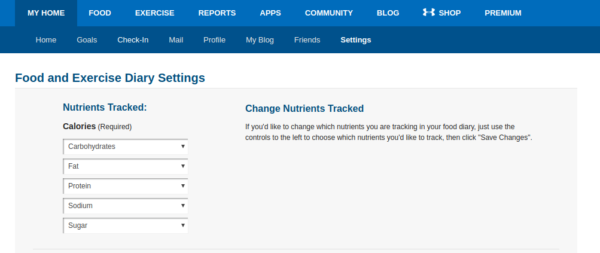
First, you can adjust which nutrients are tracked in the food diary. This is helpful if you are sensitive to certain micros, sodium for instance. It’s also helpful for macro tracking, which will be covered next week.
Second, you should be familiar with your profile and goal settings.
The information you provide here sets up all of the day-to-day numbers for MFP, including your calorie goal, your macros goals, etc. As you progress toward your goal, it’s good to check back in and make sure that MFP is configured to your life as it is currently.
Third, you should regularly track your fitness. People are notoriously bad at guessing how much food they have consumed, how many calories they have burned, and how much weight they have gained or lost. Even if you are on a purely strength building goal, tracking your progress will give you insights that you couldn’t have seen otherwise. MFP has a report function to aggregate your data.
Mrs. trshmnstr recommends relying on your Garmin/Apple watch/whatever whenever possible for tracking exercise. Most smart watches can integrate with MFP, and the data they provide will be substantially more accurate than if you manually enter the data. However, if you’re pounding the treadmill or doing weights work, your wearable isn’t going to be too much help.
Finally, Mrs. trshmnstr wants me to stress and stress again that what you don’t track, you don’t control! You may be able to make some progress by haphazardly changing your eating habits and haphazardly tossing weight around at the gym, but the pros track the minutae of food intake and of exercise in order to better understand how to best achieve their goals. It’s a bit of a burden to start, but once you get used to it, you’ll reap the rewards.
HIIT training of the week
As always, Mrs. trshmnstr recommends giving this a try 3 or 4 days this week. Also, please don’t kill yourself on these exercises. There’s a different between pushing yourself healthily beyond your comfort zone and blindly pushing your body into dangerous territory. Modify the exercises if you’re not capable of completing them as written.
Set a timer to start counting up from 0:00. Each exercise listed is a 1 minute workout. If you complete it before the minute is up, the rest of the minute is a rest period. If you haven’t completed it by the end of the minute, switch to the next exercise. Each exercise has an alternate for if you are unable to do that specific exercise. These are all fairly common exercises, so search for them if you don’t know them.
Roughly 2 lbs of chicken thighs, bone-in, skin-on if possible
3 tbsp brown sugar
3 tbsp paprika
2 tbsp kosher salt
2 tbsp black pepper
1 tbsp cayenne (i usually add another 2 tsp of red pepper flakes, as well)
1 tbsp garlic powder (or 1 clove of minced garlic if you’re feeling fancy)
1 tbsp onion powder (or a small diced onion if you’re feeling fancy)
I like to do these on my Weber kettle grill low and slow, but they’d also do fine in an oven.
combine all of the ingredients in a gallon zipper bag, trimming the chicken if it has too much excess fat.
mix everything up so that the chicken is well coated
stick the bag into the fridge for a few hours (overnight is fine)
fire up the grill and pile up the coals on one side of the grill
add any smoking chips/chunks (apple and hickory are good) and set the grill up for low and slow (full open bottom vent, nearly full closed top vent on the indirect side of the grill). For chicken, i usually don’t bother with a water pan. I cook them between 275 and 325 for only 2 or 3 hours, so I’m not particularly concerned about maintaining an even temp.
using tongs, add the chicken to the indirect side of the grill.
come back 2 hours later and temp the biggest thighs in the thickest part with a meat thermometer.
Once the biggest thighs are reading 155F at their thickest, leave the lid off the grill, adjust the coals to start burning hot again, and put the chicken on the direct side.
After a few minutes (depends how fast the coals come up to temp), flip the chicken. You should have some maillard browning as well as a small amount of sugar burn. Pull the chicken when done.


 Joe’s Ancient Orange Mead
 My electrophysiologist told me to eat more anti-inflammatory foods to help my heart problem. He recommended turmeric, ginger, and green tea (among others).
 I’m a curry fiend.