Category: Products You Need

  • Wessen Bein Muss Ich Bücken?

    Even though I don’t particularly care for this style, perhaps there should be more to this series than what I like.  So recently, I came across this:

    Hold up, I have a pair of Under Armour leggings I used to wear when I ran outside in Colorado, let me see if they still fit.

    *squeezes into tight pants*

    No. You GTFO.

    Then this happened.

    That’s not a knife, this is a knife!

    Then things predictably got out of hand.

    *orders knife* 

    This is my review of Wessterhuffenphasterphallenhoffeersheissen’s Hefeweissbier.

    HT:  DEG, MikeS, Q Continuum  and Hayeksplovises

    M’am

    Hefeweiss is the predominant German style wheat beer.  There are other varieties of course, depending on the region, but for most of us this is the one that comes to mind when the term, “German wheat beer” comes up in conversation.  People like this, apparently.  I am not one of those people.  Why?

    It tastes like banana.  I don’t like bananas.  The semi-sugary taste, the texture, the fact that none of my kids can open the damn things and will go through a bunch of them in a day.  This sentiment was developed well before the CHM 235 Organic Chemistry course taught by what I later found out to be a really awesome professor.  Think (((special forces))) awesome, but wouldn’t give anyone a definitive answer. For the lab part of this course, my lab partner and I were given several bananas.  The project was to extract and isolate an organic compound called an ester from the fruit.

    Most of it involved smashing up bananas into a paste, then putting the paste into a press.  Then squeezing the liquid out of the paste.  Then vaporizing the liquid multiple times through a distillation column, to extract a weapons grade distillate of Isoamyl Acetate–or Banana Oil in English.  It went fine until my lab partner managed to spill the vial on me.  The grad student in charge of the lab saw the whole thing so I didn’t lose any points for failing a simple distillation.  Not that there was no other way I could prove it was spilled on me.   The bad part was when I went to work immediately after the lab.  At the time I worked the sporting goods counter at the local Wal-Mart.  The clientele was the predictable group of rednecks.

    • “Hey kid, why do you smell like a monkey?”
    • “Mother of Christ.”
    • “Can you write that that mountain lion tag for yesterday?”
    • “I’m not gay or anything, but you smell really nice.”
    • “We fielded a few complaints.  Were going to go ahead and pay your remaining hours for the day. Go home.”

    Predictably, this tastes like every Top.Men-compliant hefeweizen out of Germany:  banana with a twist of lemon.  If you’re into that, have at it. Wessterhuffenphasterphallenhoffeersheissen’s Hefeweissbier 2.0/5

    Not to be outdone, others have tried to take this style to new and interesting places. Only one on this list was available in my area:

    If you are looking for a traditional Top.Men approved ale, keep looking.  It has significantly less body and you’ll probably say they over hopped it and should apologize to the German people for such an atrocity.  For me, it doesn’t taste so much like banana, so it’s not so bad.  Lagunitas Little Sumpin Ale. 2.2/5

  • Lindemann’s Kreik Lambic

    In my family, real estate is sort of a big deal.  Since we all know what happened to the housing market in 2008, we began doing something every year for Christmas:  we drew names.  Ultimately this meant I only had to buy a single gift but it did mean I was also receiving a single gift.  This year, my brother got me and while it really was thoughtful of him to get what he got me–I already had one.  Semper paratus as they say, he had the receipt handy:  Bed, Bath and Beyond.

    Shit. At least they sell beer in the “beyond” section.

    This is my review of Lindemann’s Kriek Lambic. 

    Lambic is among the oldest styles of beer, but do not confuse this to mean these are in any sense of the word, primitive.  On the palate these are as complex as they come, with several diverse sub-styles.  To get a good idea of how old these may be, the painting below titled, Peasant Wedding from around 1567 suggests, people have been enjoying Lambic for centuries.

    It’s a style believed to have originated in Belgium around the time of the Roman conquest.  The Germanic tribes viewed the wine made by Mediterranean cultures to be effeminate, which even now seems to be an opinion held by many, though not me personally.  The earliest known account was from Holy Roman Emperor Charles V, while travelling to the region he ordered a pitcher at a local pub.  He took a liking to the lambic and had several servings from the pitcher, and apparently harassed the blonde waitress.  Man of the people, he was.

    But like everything else these days, there seem to be conflicting reports.  According to this guy, there is no specific evidence that lambics existed before the 18th century. There is nothing medieval about this beer other than the stoneware Belgians used.  It is a myth perpetuated mostly by lazy beer writers who don’t know what they’re talking about and sure enough, the misconception is the story that stuck.

    The commonality between the stories is what I can assume isn’t fake news.  What is common?  Lambics are a type of sour beer that is defined by its spontaneous fermentation.  That is, the brewers will put the casks outside to allow and even siphon wild yeast and bacteria into the wort to do the dirty work. Modern lambics are not made with a biochemist on staff with some GMO yeast strain in a test tube.  It’s as natural as it gets without isolating a strain from a brewmaster’s hipster beard (Rogue), or even a yeast pulled from some lady’s yoo hoo.

    No, seriously.  A lab in Poland swabbed and isolated the strain from a Czech model. If I told you they swabbed her, would you drink it?

    Much like wine and whiskey (or whisky for your Canadians), lambics are often blended with other lambics to allow for varying levels of complexity.  Charles V himself was likely served a blend with a sweeter variety to make it more palatable. These can be served like champagne, and the sour varieties are great to pair with food because they do well to cleanse the palate.  This one is made with sour cherries, hence the name Kreik.  Others made by Lindemann include strawberry, raspberry (framboise), black currants (cassis), and peaches (peche).  This one is more tart than sour and is very light. If you happen to like cherries, you’ll like this one.  Lindeman’s Kreik Lambic 4.0/5.

  • Firearms Friday: SHOT Show MEGAPOST

    I have returned, brave glibs! Certain real life circumstances have kept me away from the site, but know that I am always here, watching, waiting, and ready to talk about guns for hours on end. SHOT Show finished off today. For those that don’t know, SHOT Show is the biggest firearms trade show on earth. It is where all the big (and small) manufacturers gather to show off their newest toys. Unfortunately, my invitation must have gotten lost in the mail so I was not able to attend in person, but I have been scouring the tubes looking for the biggest gun news to share to you, our loyal shitposters. So, without further delay, here are the biggest stories from SHOT 2018:

    • Probably the biggest shakeup of the show was Franklin Armory’s debut of a gun they call ‘The Reformation’. It’s an 11.5″ barreled fully functional AR with a stock and does not require a NFA tax stamp. People were freaking out about this thing for at least a week before the show. It turns out that the secret is a pretty big let down: it has a straight rifled barrel. This means the bullets don’t come out spinning. For those wondering, yes, that gives it terrible accuracy. They claim something like 4 moa at 50 yards before it starts keyholing. They also claim they are working with ammo manufacturers to create finned bullets specifically for this design. If it works, we could (possibly) see a major change in firearms production as companies make special non NFA sbrs with straight rifling. Most likely scenario? This thing becomes the gyrojet of the 21st century. Only time will tell.
    • On a significantly less disappointing note, Ruger has come out swinging with their ‘new’ PC Carbine. It’s a traditional looking rifle chambered in 9mm that can take either SR series magazines or Glock magazines with a simple adapter change, and the adapter is included. The gun is fully reversible for right or left hand operation, and it even breaks down into 2 parts for transport and storage. Those of you that have been around guns for awhile probably remember Ruger making a very similar gun called the police carbine, hence the quotes around new. This is basically an updated version of the same gun. This thing is a real winner, and there is a very good chance I will be picking one up in the near future.
    • IWI dropped a bombshell this year by debuting it’s new TS 12 bullpup 12 gauge shotgun. It has a fixed 15 round magazine consisting of three separate 5 round tubes that can be loaded from either side. Once the selected tube is empty, simply rotate the magazine and snap the next 5 rounds in place. Not a perfect solution but it might be good enough. It’s going to be an expensive AF shotgun, but we will have to see if it’s worth the coin. Between this and the new Tavor 7, I might have to sell some of my concubines.
    • It has finally happened. A company has made a housing for the P320 FCG that turns it into a sbr style pistol. Called the EXO ONE, it is sure to put me even further into debt.
    • Century has decided to jump on board the 9mm gravy train with it’s new Draco NAK9 pistol. It is a blowback 9mm AK style pistol that takes Glock mags. Do want.
    • Not to be outdone, CZ has come out with the Scorpion Micro. Sporting a 4 inch barrel and a collapsible stock brace, this looks like quite a nice little, uh… ‘pistol’ for your truck or other tight space.
    • This is quickly becoming the year of the 9mm and the 12 gauge. Mossberg and Remington have both come out with magazine fed 12 gauge pump guns. The Mossberg ones are slightly more interesting seeing as how the magazine are actually double stack. This allows them to hold considerably more ammo without sticking out freakishly long below the gun. Is the era of the tube fed shotgun coming to an end? Could be…
    • Strike industries has developed an AR magazine that will eject itself on the last round fired. I can see this becoming the go to standard magazine for 3 gun matches. No word on pricing or availability yet. I am anxiously awaiting their arrival.
    • Palmetto State Armory is going into production with an AK pattern 9mm carbine that takes… MP5 magazines? Huh. Well A for originality on that one. They also plan on releasing a 5.56 AK that takes AR mags and a 9mm AK that accepts Glock mags, proving that they haven’t completely lost their minds. Much more interestingly, they also are working on producing their own in house MP5 clones; however, those will not be available anytime soon.
    • However, PSA might be out of luck on their MP5 clones cause PTR just beat them to it.
    • Sig has officially announced you will be able to buy the M17 on the civilian market, ensuring a steady consumer base of up and coming Call Of Duty neckbeards for generations. They also introduced a slim frame subcompact 9mm with a 10 round capacity called the P365.
    • Attention Canada: You can now purchase Glock 19s! The Canadian legal Glock 19 has a slightly longer barrel to comply with your retarded barrel length laws. You’re welcome.
    • And last, but not least, my favorite handgun company Walther has finally release the PPQ Subcompact. Took you guys long enough.

    That is all for now, my loyal readers. As for when I shall return, I cannot say. But know this: When the future is darkest, when the world needs me the most, I shall return. Until then, I will always be watching through my magnified red dot.

  • If its not Scottish (Haggis) its crap!

    In 122 AD (or CE…) Roman Emperor Hadrian discovered something so shocking, so perverse, that he had no choice but to make one of history’s most racist decisions.  What did he discover?

     The Scots.  His solution?  He built a wall.


    Yeah, there is probably more to that, but this was a research intensive article and quite frankly I’m not going to get into the why of it.  Hadrian was emperor for all of 21 years, 11 of which he spent touring the empire.  In spite of his short reign he left his mark on the empire by consolidating provinces, allowing much needed reforms, and engaging in infrastructure projects, such as a Roman Temple–located conveniently next to Solomon’s temple in Jerusalem.  That really pissed off the (((locals))), and the ensuing revolt apparently lasted three years.  He is most famous however, for building a wall across Roman Britain to keep the barbarians to the north out.

    The Scots weren’t all bad, and some of them were indeed good people.  For instance, James Watt is credited with giving us the steam engine, allowing for the Industrial Revolution which to this very day impacts the way everyone in the western world lives!

     Okay, technically Heron of Alexandria invented the first steam engine, but they did give us the greatest love story ever told! 

    Okay, technically Wallace was such a terrible statesman the nobility found it more convenient to martyr him, rather than putting up with him.  Also, the only reason you still watch that movie is because you like Longshanks for being the archetypal shitlord and Monica Belluci circa 1996.

    A Scottish regiment is famous for being the last ones to attempt a bayonet charge!  In the early days of the Iraq war, they fixed bayonets and gave Saddam the business!

     No, still not feeling it?  Fine, they gave us this:

    Not my photo

    This is my review of Founders Dirty Bastard Scottish Ale.

    Even though Scottish Ales are realistically all the same, I think a brief overview in naming convention is in order.

    The Schilling System was instituted in the 1880’s, although there is some evidence it was in use earlier than that.  By that time, it became a requirement by the British government due to a change in what was being taxed.  Rather than grain and sugar, they simply taxed the beer.  To add further confusion the tax itself was based on the invoice price of the quantity sold by the brewer (barrel vs. hogshead).  To further add confusion:

    “This dual application of pricing applied to two different liquid measures brought about complications: a 60/- ale in the barrel was a 90/- ale in the hogshead even though it was the same product. The actual price of the ale could be as little as half of the invoice cost once the calculated duties and the discounts allowed by the brewers were subtracted.”

    Paying more tax for the same stuff because it was shipped in a different size barrel? No wonder we fought a war to get away from this…

     The term, “Wee Heavy” came about during this time due to the variety produced by Scottish breweries at the time.  The highest gravity varieties were sold in “nips” in 6 ounce quantities.  Since it was a wee bit heavy you may not mind all you were getting was was then ⅓ of a pint, the beer was going to get you where you wanted to be:  too drunk to consider the taxes you were paying.

     For our purposes these come in three varieties.


    The first is a 60/-.  These are typically very light (<5%abv).  Even though they have the same malty character that defines this style, it often leaves the experienced beer drinker wishing there was something more.  A good example is Newcastle.

    We know you are watching, John

    On the other end of the spectrum is 120/-.  These are a wee bit heavier (hence the term) and quite frankly are not for everyone. Typically these operate in the 7-10% abv range. These can be a lot of fun but have one downside, which I’ll touch on shortly. A good example, is Orkney Skullsplitter.

    Finally, there is the 90/- (80/- is traditional).

    Like the proverbial third bowl of porridge, for most of us this one is just right.  A good example is Bellhaven, but in the US there are dozens of good examples as well, all around 5-6% abv.  The dominant craft brewery in my area is Four Peaks and their flagship brew is called, Kiltlifter.  This is a carbon copy of Bellhaven and they sell it in insane quantities.  So much so, they are one of the evil brands that sold out (though I argue they bought in) to InBev.  Ironically, the first time I had it off tap was in Las Vegas, so should you find yourself there, try it out.  Other examples are Great Divide Claymore, Oskar Blues Old Chubb, and Odell 90 Schilling (all from CO).

     Dirty Bastard is 7.5% abv so it fits in with the Wee Heavy category.  The only one I can really compare it to is from a brewery based in Utah, it was 10.5% abv and I seriously doubt you’ll ever find it.  The Bastard has an overwhelming malt complexity and has more body than you can wrap your arms around.  The downside is the moment it got within range of my snout I got a hearty whiff of booze.  It took a sip or two for my olfactory sense to adapt but in the end I will likely continue to buy it a few times when it becomes available. For every other time of year, there is plenty of Kiltlifter to go around. Founders Dirty Bastard Scottish Ale: 4.2/5.0

  • Review – Bell’s Roundhouse IRA

    Review – Bell’s Roundhouse IRA

    This is my review of Bell’s Brewery Roundhouse India Red Ale.

    Yeah, okay so they just hopped up Kilian’s Irish Puke and gave it a cute name? Fine.  To keep your attention, here’s UFC eye candy, Paige Van Zant delivering a roundhouse kick:

    Yeah, okay pedants.  She’s right handed, so that was technically a switch kick if you are only going to look at the still photo.  If you want to see the whole thing, this video here has it in real time and slow motion. She actually swung her strong leg forward to gain momentum toward her opponent.  Then turned her hips midair, planted her right foot, and landed a left kick to the face. If anything, this was technically a flying switch kick, but it was definitely a feat of athleticism.  I can cover the gap like this and land a knee, but a kick takes several reps for me to land it.  I would say this was her career highlight, but Dancing with the Stars and every single commercial she is in seems to be more lucrative than her fights, which might explain why she never seems to fight anymore.  So before you decide, keep in mind that on any other day she looks like this:

    Speaking of red…

    The roundhouse kick is present in many Martial Arts styles but primarily is associated with Muay Thai–or Thai boxing, the national sport of Thailand.  Yes, there is more to Thailand than ladyboys, street food, counterfeit watches, and epic weekends in Bangkok. The sport itself was developed like all Martial Arts as a means of self-defense. Developed from a fighting style called Krabi Krabong, it is centered around the mindset that you are born with 8 weapons:  2 fists, 2 elbows, 2 feet, and 2 knees.  In the early 20th century the Siamese army actually pitted fighters from competing companies in bouts against each other.  This might seem like a brutal way to build readiness but it is actually a common custom in modern militaries.  In fact, I participated in a traditional boxing match during my first deployment.  The management at Al Udeid, AB sanctioned the fights under several significant conditions.  I will admit I lost, but I contend the guy I fought was Airborne and I filled in at the last minute for another guy that wimped out that morning.  

    For more information on Muay Thai, here is a link.

    Because it is a proven fighting style as a sport, rather than an art (suck it Meryl Streep), it is popular among MMA fighters for their standing game.  Other styles such as Karate, Tae Kwon Do, and even traditional boxing are represented among professional fighters but they are fewer in number.  MMA fighters primarily train in Muay Thai, plus Ju Jitsu or wrestling for their ground game.  

    So how do you do it?  To start, you should be in a modified boxing crouch–just more upright.  Hands up, shoulders forward, hips bent, feet should be a little wider than shoulder width at a 45 degree angle, strong leg should be back with your weight slightly biased to the back, knees bent and finally you should always be on the balls of your feet.  With me so far?

    Something like this…

    From here you need to be loose.  Start by moving your back leg forward like you plan to knee you opponent.  This position from his view means either you are moving to strike with a knee, parry a kick, or kick either high or low.  Deception is a good thing here.  Then pivot your front foot towards the outside, this will put it in a better position to maintain your balance.  Then turn your hips towards your front foot, begin to extend and swing your leg.  You want to aim to strike your opponent with your shin.  If you strike intentionally with your foot, you’re going to have a bad day. See UFC Fighter, Uriah Hall for the reason why you don’t necessarily want to strike with your foot, even if it worked out for Paige…

    BTW. He won that fight.

    The last step is called “chopping the tree.”  Here you are turning your hips violently to build power and swing your leg down.  Basically, pretend to strike your opponent with the lateral malleolus.  That is the big bulging bone on the side of your ankle.  Not that it is physically possible, but to finish by striking with the front of your shin, you will need to turn your entire body as if it were.  The result should look like this:

    To see the full motion, here’s a Thai fighter engaging in clear cut deforestation (seriously). This is a devastating strike; typically compared with being hit with a baseball bat.  Some fighters have been clocked swinging their legs as fast as 130 miles per hour, delivering 1400 foot pounds of force.  This is beyond broken ribs, this is ruptured organs territory and depending on the location of impact in some cases can stop the heart.

    Now that you know this should be more than just a charming marketing scheme…the beer does have a bit more character than the garden variety IPA.  Its base is a red ale, so it does have the usual toasted, caramel malts that are common with that style.  There is a hint of sweetness which is obvious given they list honey as an ingredient in big letters on the can.  I would probably say this is good enough on its own given that I’m partial to the balanced malty side of the spectrum but they also dry hopped it.  It’s a nice counter to the usual IPA and when compared to the ubiquitous red/amber ales is much more interesting.  Odd line to tread, but it treads it well. Bell’s Brewery Roundhouse India Red Ale 4.0/5.

  • A Deep Dive into Cryptocurrencies and their Operations: Part 3

    A Deep Dive into Cryptocurrencies and their Operations: Part 3

    Aight! We’ve talked about Computer Science and we’ve talked about some design features used in blockchain. Now let’s put it all together and cap this series off.

    What is blockchain? It is a linked list of data structures that uses cryptographic hashing to sign each data structure, thus including it in the canonical chain. Here’s the block used by Bitcoin (most other cryptos will have mostly the same components).
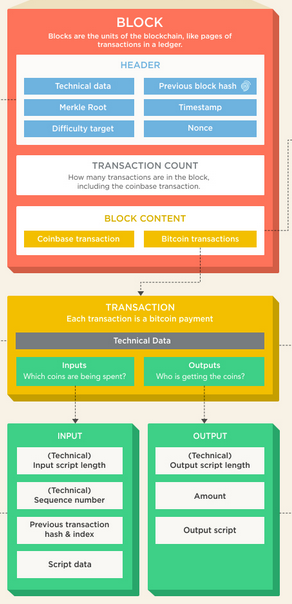
    You can see the transactions in the Block Content section, and you can see info (such as the hash of the previous block) in the Header section. Let’s relate this all together and draw a true picture of a blockchain (specifically Bitcoin) block. To do so, we’re gonna be dealing with a whole bunch of cryptographic hashes.

    Hashing: A Redux

    If you want the nitty gritty detail, you can go here. However, since we’re not writing a mining algorithm or a storefront, I’ll spare you the minutae. If you want an awesome video that explains exactly what I’m about to talk about, but in visual form? Here ya go! Want to learn more about blockchain than you ever wanted to know, but all at a layperson level? You’re welcome!

    Here’s a Bitcoin block:
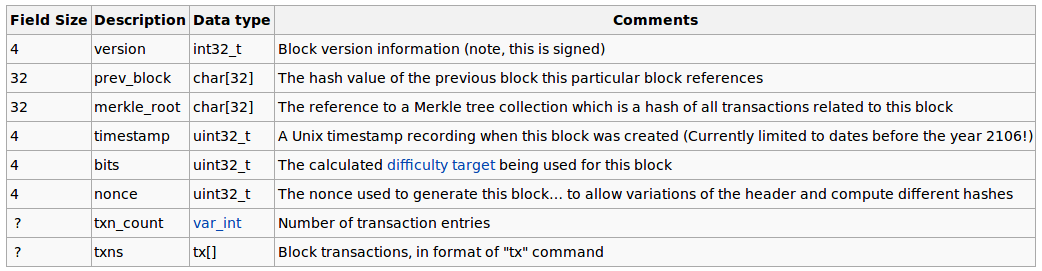
    Let’s work from the bottom up.

    txns

    The payload of a Bitcoin block is an array of transactions. Each transaction looks like this:
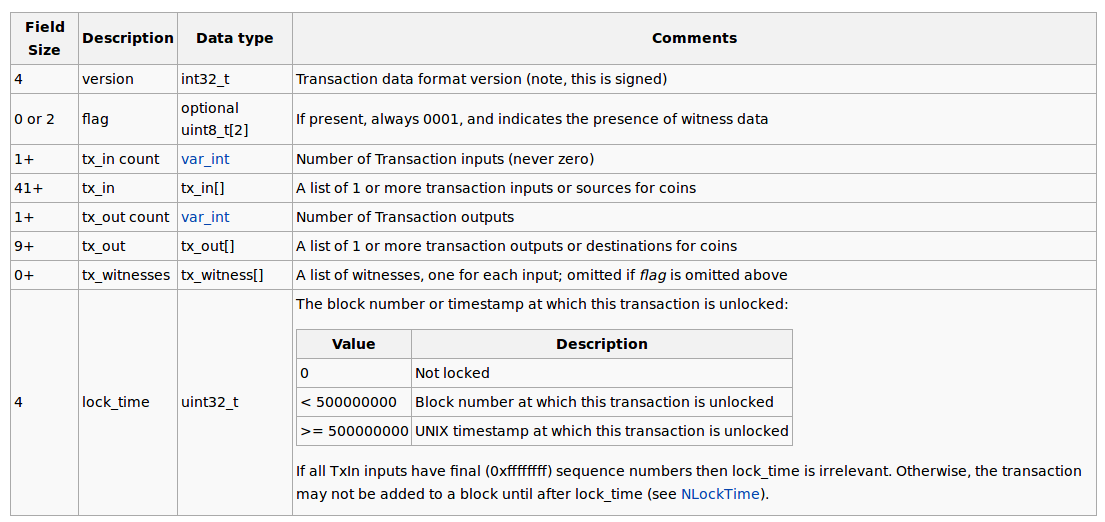
    I show the transaction mainly to show you that it contains two things: tx_in and tx_out. This is how it works, you combine a certain number of prior transactions in the blockchain (inputs) and then dole out the coins contained in those transactions in the outputs. If the inputs go over how much you’re paying the other person, you add an output to pay yourself back the overage. It’s much like cash. Just like handing bills to the cashier and receiving change back, you hand over inputs, and receive back an output for the overage.

    Let’s do a quick example. Oscar wants to pay ZARDOZ for the Gift of the Gun, and he wants to pay $150. Oscar has previously received money from Office Manager Mohammed for “Jihad related expenses” for the amount of $110. Oscar has also previously received money from Preet Bahahahaha for “Woodchipping services” in the amount of $65. In order to pay ZARDOZ, Oscar sets up the transaction by including the previous Jihad and Woodchipping transactions as inputs, and creates two outputs: one to ZARDOZ for $150, and one back to Oscar for the remainder ($25). Then those Jihad and Woodchipping transactions are marked as fulfilled, meaning that they can’t be used again as inputs.

    txn_count

    This is fairly self explanatory. This contains the number of transactions in the block.

    nonce

    From here on up in the block, everything is contained in the header. Remember that the hash of the block is really the hash of the header. The txn and txn_count parts of the block are not used in calculating the hash. However, we’ll find out really soon why the transactions are still reflected in the block hash.

    Nonce is related to mining. I’ve alluded to the way that blocks are created, and I’ll discuss it more in the next section, but suffice it to say that the nonce is a random number and has no purpose besides in calculating the hash. The way that a block is added to the blockchain is that the block’s hash must be below a certain number. How do you get the hash below a certain number? You adjust the source data used to make the hash. Since the hash comes from the header and the nonce is in the header, you can change the nonce until the hash is below a certain number. Notice that simply changing the nonce to a lower number doesn’t guarantee that the hash is a lower number. This is where luck and random chance come into play. We’ll talk more in the next section about this.

    bits

    Bits goes with the nonce. It is the “certain number” mentioned above that the hash needs to go below for the block to be accepted.

    timestamp

    Timestamp is self explanatory. It’s the time when the block was created.

    Merkle Root

    We’ve discussed the Merkle root before, but haven’t really nailed it down. Let’s do that now. The 10,000 foot view is that the Merkle root is the hash of all of the transactions. The hash of the block (which is actually the hash of the block header) takes the Merkle root into account when calculated.
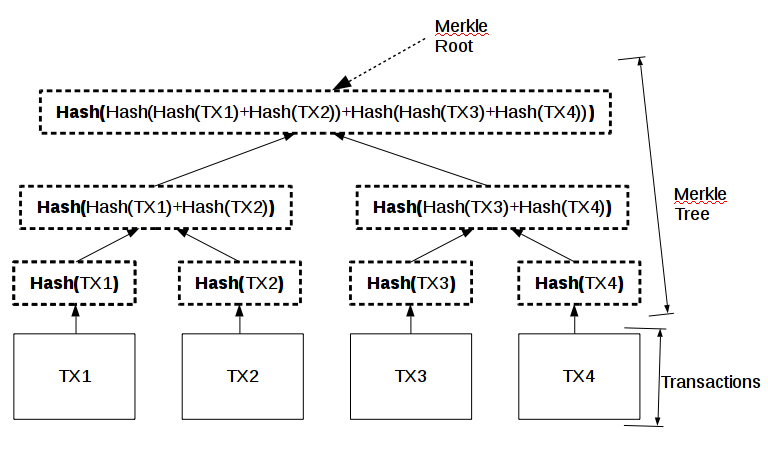
    The Merkle tree is a binary tree (each parent node has two children) that hashes from the bottom up. The bottom row of the Merkle tree contains the hashes of each transaction. The middle row hashes adjacent bottom row hashes (it’s a hash of a hash). The top row is a hash of a hash of a hash and contains information from all of the transactions. Notice what it would take to modify or replace a transaction. If STEVE SMITH tries to replace TX4 with FAKE_TX4, he has to recalculate three different hashes, as well (all of the hashes that include TX4 in them).

    Prev Hash

    This has been discussed at length in the prior two parts. This is the hash of the prior block, the link between the current block and the prior block.

    Version

    The version of the blockchain tells everybody what rules this block has been assembled under. This makes it possible to improve a blockchain without having to toss out all of the old blocks.

    Mining

    We’ve hinted at what mining is already, but now we can put all the pieces together. When transactions are posted to the blockchain network (all of the computers mining and transacting on that blockchain), they are packaged up into a block to be added to the end of the blockchain. How this happens is technical and a bit beyond this overview. Once a block is packaged up, the mining process begins. The block, sans block hash and nonce, is sent out to the network for mining. Computers that are set up as miners begin to calculate the block hash. Remember that the block hash is calculated from data that includes the Merkle root, the previous block’s hash, and the nonce. All of those pieces of data are constant except for the nonce. Therefore, miners, upon calculating the block hash, adjust the nonce to try to get the block hash to be less than the current difficulty number (represented by the bits field).

    Once a miner has calculated a block hash below the current difficulty number, they submit the hashed block to the network. If they’re the first to do so, they “win”. They end up getting a small payment of cryptocurrency for their efforts. The payment is based on an algorithm that reduces the amount of currency created for a successful mine until an end date when no more currency will be created for that coin. At that time, miners will only be compensated by transaction fees (which are currently in the tenths of a percent range).

    As you can imagine, it’s not easy to do this. Bitcoin, for example, is designed so that, on average, the winner mines the block in about 10 minutes. Given the vast amount of processing power dedicated to Bitcoin mining across the world, the chance of a single desktop computer winning even once a month is slim. In some other cryptocurrencies, it is easier, but even a second tier crypto like Monero would average one or two wins a month for a standard desktop computer. At that point, you’re probably not making enough to pay for the electricity you used.

    That’s where mining pools come in. It’s a fairly simple concept. Take a bunch of computers, let them mine as a cohesive unit, and split the winnings across members based on a pre-defined formula.

    The Big Picture of Blockchain and Different Applications

    We’ve talked about blockchain in the context of cryptos, but there are a ton of different potential applications for blockchain. The main “hot topic” for blockchain use is reputation analysis. Rather than having to go through a reputation broker (Uber, AirBnB, Yelp) to find out whether the person driving that car or renting that room or cooking that meal is trustworthy, you can reach out to the decentralized blockchain to find their reputation.

    This is a fairly simplistic application of reputation analysis, but the reason folks are excited is the application of such a thing to automation technology. What if, for example, you didn’t have to put in a reservation to get a hotel room? If your reputation is high enough and the room is available,  the lockbox automatically opens and gives you the key to the room. All you have to do is tell the system how long you plan on staying there, and you’re set.

    Another application is identity management. Does the cashier really need to see your name, address, and other personal info to know that you’re old enough to buy alcohol? There’s a whole bunch of identity leakage that sets each and every one of us up for identity theft. One proposed use of blockchain is to provide customized identity services. The cashier can query the blockchain as to whether you’re old enough to buy alcohol, but can’t access your address. Amazon can get your address, but can’t get your social security number. Starbucks can get your first name, but not your last name.

    What about securing your finances? This isn’t entirely separate from cryptocurrencies, but what if every transaction you made was from a different account? Instead of giving your bank account info or your credit card number to merchants, you give the equivalent of a Visa gift card with the exact amount of the transaction on it. If Target gets breached and your info is leaked to malevolent actors, it’s not an issue, because it points to an empty one-time account.

    Finally, the application that I think would be the most interesting. Traffic management via blockchain. As automated cars become a more likely reality, most of the traffic management interaction methods that have been designed to be centralized or distributed in nature. A decentralized traffic management system would reduce the efficacy of government meddling and the potential for an enforced monopoly a la internet service provider.

    Cryptocurrencies

    I’m not going to list out all the cryptocurrencies in detail. I trust y’all to DDG it yourselves. Let me just point out a few of the big ones in passing.

    Bitcoin – The original and most famous. There is relatively little anonymity in using Bitcoin, as shown by the Silk Road FBI takedown.  It’s also relatively slow to get new blocks integrated, at an average of 10 minutes per block.

    Bitcoin Cash – A fork of Bitcoin meant to scale to more users a bit easier by making the blocks bigger.

    LiteCoin – Billed as “silver to Bitcoin’s gold”. It generates blocks 4x faster (2.5 minutes per block), will generate more coins than BitCoin, and some different internal algorithms.

    Ethereum – Ethereum is much more than a cryptocurrency. It creates smart contracts that can take advantage of automation. Want to unlock your guestroom when somebody has enough reputation points? Ethereum is probably the best blockchain to start from to do this sort of thing.

    Monero – Billed as the “secure cryptocurrency,” it is designed slightly differently from BitCoin so that bad actors (like the FBI) can’t trace one transaction back and see your entire transaction history. Secure is a relative term, because, as seen in the Silk Road incident, there are weaknesses wherever you have to give personal info (shipping, currency conversion)

    Drawbacks and Limitations

    This could be an article in and of itself, but I’ll just hit a few that are top of mind.

    1. Blockchain length – The immense size of the Bitcoin (and other large cryptos’) blockchain means that you either need to rely on somebody else’s node to get plugged in (by using an exchange) or you need to wait a few days for all of the blocks to be downloaded.
    2. Block acceptance time – In Bitcoin, it takes an average of 10 minutes for your transaction to be included in an accepted block, and due to forks (when two different blocks are accepted in two different parts of the network), folks recommend waiting an hour before declaring the transaction “completed.” That obviously doesn’t work for somebody trying to walk out the checkout line at the supermarket.
    3. Scalability – This is kinda wrapped up in the last two, but the number of transactions in a block are limited by a maximum size. Therefore, as more and more transactions occur, the chance of your transaction making the first block goes down substantially. Then, you have to wait not only 10 minutes for your block to be mined, but you have to wait an unknown amount of time until your transaction is included in a mined block. This is where transaction fees come into play. When there are 50,000 transactions, which ones are you going to try to make into a block as a miner? The ones that pay the best, of course.
    4. Security – We’ve discussed some security concerns already, but blockchain doesn’t resolve the single biggest threat in online transactions: the other party in the transaction retaining and ultimately misappropriating your personal information.


    I hope this series was helpful to y’all! I’ve certainly learned a ton!