Category: Politics

  • This is not real glibertarianism: the importance of definitions in politics

    This is not real glibertarianism: the importance of definitions in politics

    Hello and welcome back to “Pie ponders”, in which Pie – that is me, for those who are situationally unaware – raises questions on various topics of great importance. Today, we talk about definitions and their role in politics.

    Typical glibertarian femaleWhat is glibertarianism, as a doctrine? Let me drop some definitions on you, as the self-appointed arbiter of all things glib for today.  Well it is the perfect political idea that leads to liberty, universal happiness, a better world where all the men are thicc and all the women can deadlift 800 pounds. In this utopia everyone knows wine is better than beer, scotch is better than bourbon and the NBA is the best sports league in the US. Anything else, well that is not real glibertarianism. Don’t @ me, as the kids say these days on the twits.

    I noticed a real problem with definitions in current debates on that most marvelous of mediums, the internet. Whenever something looks bad, well that is not the real deal. See socialism. While this may be seen as a version of the true Scotsman fallacy, I am not sure it is quite the same.

    Being a Scotsman, you see, can have some measurable definition- was one born in Scotland would be a start? On the other hand, one can claim any ideology one wants, without having to suffer through haggis and bagpipe music, and very often it can indeed be the case that X is not a true liberal/conservative, but just claims to be. For the actual ideology, we need to see if we can define things to see what is what, and then to measure the individual, preferably by the walk they walk as opposed to the talk they talk. Talking is exceedingly easy, after all.

    All failures of socialism were, off course, not true socialism. Well, socialism needs to have a clear definition to see what is and is not true. And this definition, like all definitions in politics, needs to respect some ground rules.

    Let us start with Wikipedia:

    Socialism is a range of economic and social systems characterized by social ownership and workers’ self-management of the means of production[10] as well as the political theories and movements associated with them.[11] Social ownership may refer to forms of public, collective or cooperative ownership, or to citizen ownership of equity.[12] There are many varieties of socialism and there is no single definition encapsulating all of them

    These are the alleged goals of socialism, while implementation takes a variety of forms, mostly authoritarian and disastrous in outcome. To go around the issue of the bear in the room, internet socialist change the definition in an idiotic manner and say socialism is some sort of perfectly just, utopian, classless society where everyone is happy. This is a neat little trick, if you define an ideology as an ideal outcome, whenever it fails, well it was not the real one.

    One rule of defining ideology should be that you cannot define it as outcome, but as the path to reach the outcome. Outcome is not guaranteed. Outcome is what is expected and needs to be proven. So you say we do socialism like this and it leads to that. If the result is an authoritarian hellhole, it does not mean it was not real socialism, it means socialism just does not lead to what proponents say it leads to. Critics of communism, on both left and right, said before it was implemented the very first time that it will lead to dystopian authoritarianism. And they were right. Which means communism is a bad ideology, not that the USSR was not real communism.
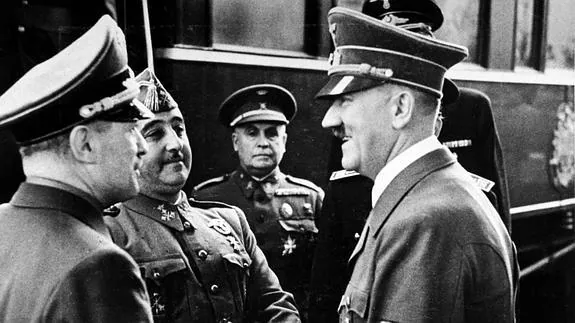
    Not real fascists, real fascism was never tried

    Certainly, one can very well claim their own personal flavor of socialism will not lead to all that. But since every attempt failed, it takes a bit of a burden of proof that a slight variation will succeed. Every attempt under the umbrella of socialism failed, and one can easily find an infinity of minor variations that are claimed different from any other minor variations attempted. Why, beyond empty claims and wishful thinking, will this variation succeed? This time the right people will be in charge is not acceptable, because that is, again, an outcome that cannot be guaranteed. I think we are at the point where we can safely say socialism failed and ignore minor variations which keep the fundamentals the same, as the fundamentals are rotten.

    The criticism of socialism is based on incompatibility with human nature, not due to minor flaws in minor variations. If, for example, there can be no functioning economy without property – no way to allocate resources, establish prices as has been shown long ago – no minor variation of property-less ideologies will help. Because the core is the problem, not the “implementation.”

    Let us take a look at another definition.

    Feminism is a range of political movements, ideologies, and social movements that share a common goal: to define, establish, and achieve political, economic, personal, and social equality of sexes.[1][2] This includes seeking to establish educational and professional opportunities for women that are equal to those for men.

    This seems a straightforward definition, with some goals that different between flavors and may or may not be achieved. On the other hand, internet feminist define feminism as „equal rights for men and women” in order to say that people who do not consider themselves feminists are against equal rights.  This is again a type of definition I oppose. You cannot define an ideology as abstract concept.

    Just another version of feminism, reallyFeminism is a loose group of ideologies who claim to strive for what they believe to be equality. That does not mean that is what they actually want, just what they say they want. It does not mean it is what they will actually achieve. It does not mean there are no other ways to achieve equality besides feminism. As such, it does not mean that those who think there is a better way are against equality. Off course, inside feminism there are also multiple subcategories, being various waves, attitudes (to men, government, trans, sex work etc etc etc) or simply opinions.

    Now that we can be somewhat more honest about definitions, we should ask ourselves how useful are they? Because one of the key words in both definitions above is “range”, which means those two labels cover a whole range of movements. So are they of any use? Do we need to break them down into subsets or can we use the whole as a guideline? And if we break down enough, do we not get to individual opinions and decide to forgo labels and focus on the individual? Off course not, that is crazy talk. And humans like to categorize things, to put them in boxes and apply labels.  In the end, we can only address an ideology by the common underlying paradigm of all variations.

    Wait Pie, but if labels may not be of use and people keep using them, that may lead to a total shitshow! Quite astute, dear reader, but fortunately, looking at the world, things somehow seem to have worked out perfectly, so no worries. Libertarianism in general has an even bigger problem as there is less than the usual amount of groupthink, the labels are even more unworkable. So what is the solution? Personally, I am going to go with get drunk and ignore all this. If you have a better plan, do tell.

  • The Hat and The Hair Extended Universe: Decision 2020 Special Report: A Preview of the Democratic Primary Field

    The Hat and The Hair Extended Universe: Decision 2020 Special Report: A Preview of the Democratic Primary Field

    “I’m the most qualified person ever to be President,” Joe whispered into the mirror, his breath fogging the glass. He couldn’t see himself begin to touch himself. The mirror shook. The bathroom shook. The train began to move, slow and ponderous, like elephants mating. “Uber for trains,” he whispered. “Now that’s a Presidential-level idea.” The train began to sway as it reached a walking pace. He rested his underballs on the cool lip of the filthy train bathroom sink and groaned. “Mr. President,” he murmured, pulling at the ragged perimeters of his abused nipples. “I will be President.”


    “So who do I have to sleep with to be President?” Kamala asked the swirling smoke in the mirror. “Old is OK. I’ve already done old. I actually like sagging ballsacks now.” The mirror tried to clear and then clouded again. “Dammit, mirror! Tell me!” The mirrored finally cleared and a face formed. The mirror made a gagging noise and Kamala fainted dead away.


    [howling winds of chaos]


    Nancy shook the plush toy in Alex’s face. “Donsha wantsh tu pay wish it?”

    “No!’ the girl screamed. She pulled at the crotch of her tights and made a face.

    “What’s the matter?” Chuck asked, looming avuncularly.

    “My cookie itches!” Alex said. She smelled her fingers and made a gagging noise.

    “Cookie?” Chuck asked Nancy.

    “Her ‘no-no,’” Nancy replied, pointing suggestively.

    “Jesus fucking Christ,” Chuck muttered.

    “I WANT MY 21 TRILLION!” Alex screamed, high and piercing. Everyone in the caucus meeting winced.

    “Fucking Astoria,” Chuck said.

    “GREEN NEW DEAL!” Alex screeched and kicked over the blocks they had given her to play with while they tried to talk.

    “Depshit Bernie and now thish,” Nancy grumbled.

    “WE LOST THE SENATE BECAUSE OF GERRYMANDERING!” the little girl yelled. “I KNOW BIG WORDS!”

    “Fucking Bronx,” Chuck said. “I’d like to bomb that shithole to the ground.”

    “THROGS NECK, MOTHAFUCKA!”

    “I’m not sure this is a productive meeting…” Kristen said quietly.

    “YOU COST US AL FRANKEN!” Al screamed in her face in the third person. He honked her boobs and stalked out of the room.

    “Who’s that?” Alex demanded. “Who’s that? Who’s that? Who’s that? Who’s that lady? Who’s that?” She kept pointing at herself in the mirror as all the rest of them slowly filed out.


    “I’m gonna be President. I’m gonna be the best President. I’m from Brooklyn. I’m tough. I’m capable. I’ll only be 79 when I get elected. I’m from Vermont. People from Vermont are very tough. The toughest. Second only to people from Brooklyn, so that makes me extra tough. Double tough. I can take on Donald. Young people love me. I’m like the kooky grandpa that farts a lot in all those movies that the kids love. Just fantastic. I can fart too, you know. Authentic Vermont farting. Smells like maple syrup and white people!”


    Amy Jean Klobuchar continued to quietly matter not one bit.


    “They want you to stay in the Senate, Elizabeth. They think you should know your place. You tell ’em: A Woman’s Place Is In The White House. That will be a great bumper sticker. I’ll take on Wall Street and Donald Trump and I’ll get rid of pay-day loans and make all the businesses have a government official on their Board of Directors. I’ll haul CEOs out into the street and feed them to the homeless. I’ll turn this entire nation into a paradise, like San Francisco! Blood! Blood will run in the streets! I LOVE BLOOD. Wait, hold on don’t think about that. Don’t think about blood. Dammit, Elizabeth, you thought about blood. Don’t. Don’t think about blood. bloodbloodbloodbloodbloodblood Deep breaths, Elizabeth. Deep breaths. In. Out. In. Out. OK, good. bloodbloodbloodbloodbloodblood”

    Elizabeth rushed to her office bathroom and locked the door behind her. She struggled out of her Spanx, clamped a handtowel between her teeth and began to masturbate furiously: pulling, twisting, tugging, flicking, slapping, pinching, splaying and finally beating her dead clitoris to elicit a feeling, any feeling. It was as numb and cold as a gravestone


    “BETO! BETO! BETO!” The chants of the crowds still rang in his ears. He lay by the small pond and gazed lovingly at his own reflection. “You will be the white Obama,” he told himself. Beside him, spooning comfortably, Cory told his reflection: “And you will be the black Obama.”


  • Trashy Tries Philosophy Pt. 1: Is this really it?

    Trashy Tries Philosophy Pt. 1: Is this really it?

    As always, when it comes to philosophy and theology, I like to start with a disclaimer that I’m not the most well-read on these topics, so I may stumble onto other people’s ideas without attribution. I may use terms that already exist, but in different ways. Also, I may stumble into traps with just as much lack of awareness. I’m intentionally vague in some areas because I don’t want to be liable for knowing the ins and outs of certain philosophies that I only know superficially.

    When thinking about this specific topic, I was reminded of the beginning of Mere Christianity by CS Lewis. His book has definitely influenced this article.

    I’m a big picture guy. I don’t like the feeling when I have a glimpse of a portion of the system, but don’t have an understanding of the system as a whole. This has worked both in my benefit and to my detriment in life. Math class was really hard when the teacher didn’t explain why the math worked, but only how the math worked. My learning curve as a software engineer was all that much steeper as I worked through all of the previously built functions of our product to learn how they worked rather than just trust that they’d do what their name implied. However, once I got over the hump, I was better at my job than my peers. My need to understand the big picture has been quite helpful in law… except where my manager needs me to just do things without understanding why.

    This need for systemic understanding also asserts itself in my political, philosophical, and theological life (I don’t consider those to be three separate areas, but three expressions of one area of my life… my worldview). You all may recognize some of the consequences of my need for systemic understanding. For example, I don’t find pragmatism very interesting or important. How things are accomplished don’t matter as much to me as whether things should be accomplished. Once I have settled on policy X being good*, and movement in the direction of X is good and any movement away from X is bad.

    * I’m using good and bad in the colloquial form. Below, as we get into the meat of this article, I’ll be using good and bad in a much more measured and intentional way.

    Is This Really It?

    The most basic philosophical question that I find interesting is “Is this really it?”, or , rephrased and reversed “Is there anything beyond the scientifically observable universe?” David Hume and Immanuel Kant, among others, basically said no. Most other well known schools of philosophers said yes, while building up a variety of different metaphysical constructs. We’ll come back to those constructs later, but let’s dwell on the question a bit longer and see if we can derive any practical applicability out of it. What does it mean for you and I if there is nothing beyond what can be observed and what can be reasoned?

    Well, it can be used to build a foundation for morality. Let’s define a few terms to start. Morality, for the purposes of this article, is the framework used to determine whether a certain action/inaction is good or bad. Good is something that conforms to a certain moral framework. Bad is something that does not conform to a certain moral framework. Amoral is something that exists outside of the moral framework (choosing a color of socks to wear today, for example). Morality can usually be distilled into a set of first principles (i.e. foundational principles), which, in applied form, creates a worldview.

    So, what does the absences of metaphysics mean for morality? Well, there seem to be three ways you can go: 1) nihilism – there is no morality; 2) normative morality – morality is baed on what is observed, felt, and intuited; 3) reasoned morality – morality is based on what is reasoned. For reasons I’ll expand on below, I believe that the first option is the only consistent moral framework in the total absence of metaphysics.

    Let’s start with the second option, normative morality. My general impression is that most normative frameworks are light on foundation and heavy on post hoc rationalization of really shitty behavior. Setting that aside for the moment, let’s figure out what normative morality is. Generally, it’s a genre of philosophies that use subjective or objective observations of reality to set the basis for their moral framework. This comes in many flavors, such as Greek hedonism (whatever feels pleasant is good),  relativistic postmodernism (good is based on lived experience), and utilitarianism (good is based on maximization of well-being). The first thing that strikes me about these “internal” philosophies is that they’re all fuzzy. They’re all based on a state of mind. While all of these philosophers would be on solid ground by starting every sentence with “I feel that . . . “, those who apply these philosophies make a fatal mistake when they expand the feelings of one onto all of humanity. The assumed egalitarianism is problematic. Taking hedonism as an example, what feels pleasurable to me may feel unpleasurable to you. As a trivial example, you may love the feeling of skydiving, and I may hate it. Is skydiving good or bad? The best we can say is that skydiving is good for you and bad for me in a hedonistic context. However, have we done anything by saying that skydiving is good for you and bad for me? Not really. We’re simply adding a layer of abstraction to the already assumed premise that skydiving feels good for you and feels bad for me.

    What happens when add the complication of an action having impact on more than one person? Rape feels good to STEVE SMITH, but feels bad to his victim. Now we’re at an impasse. We can add in concepts like lived experience (postmodernism) to attempt to bolster the victim’s position in this standoff. We can even try to quantify good and bad (utilitarianism) in a way that STEVE SMITH only feels marginally better and the victim feels massively worse, but the problem still remains. At some point, where one group’s good feelings are directly connected to the bad feelings of another group, the first group’s infliction of bad feelings on the second group is a good as long as there are enough of the first group and few enough of the second group. A rapesquatch village can have their way with a single victim until the victim is tortured to death because the intensely bad feeling of being raped to death by a roving gang of horny cryptids is outweighed by the marginally good feeling that a rapesquatch feels multiplied by the number of rapesquatches that partake, whether that be 10, 100, 1000, or 10 million.

    Finally, these normative philosophies give an overvalued weight to the subjective feelings and observations of a person. It doesn’t take much navel gazing to realize that there are people who feel and observe things that are not valid. Some of this is due to lack of information, such as when you get mad at the wrong person when you see that somebody took a bite out of your pumpkin pie while you were in the bathroom. Some is because your perceptions can be biased by your preconceptions, such as how every single hurricane is because of climate change these days. At the very least, it should be said that feelings and subjective observations have limited applicability outside of the person who has those feelings and subjective observations. What about the next person who has contradictory feelings and observations? Do they have a contradictory morality? What if a person’s feelings and observations change? Does their morality change? There’s nothing weightier here than one person’s whims. What we’re describing is a set of preferences and tastes, with the commensurate weight. “Good” and “bad” are nothing more than labels, like “fashionable” and “tacky”.  Cutting through the rhetoric, I’m attempting to expose the fact that these internal-based moralities aren’t really moralities at all. They’re rationalizations for preference and taste built on the empty foundation of nihilism.

    All moralities under the normative umbrella suffer from the “is/should” problem (this is why I called them “normative moralities”). Just because something is a certain way doesn’t mean that it should be that certain way. Ignoring the subjective aspects of the observer, empirical evidence doesn’t teach any moral or ethical principles. To derive such principles, one has to apply intuition, insight, or reason to the evidence. Now we’re falling into the same issue, these “external” moralities are really just “internal” moralities based more heavily on sensory input than on states of mind. While these sensory inputs are more strongly anchored in an objective reality than the observer’s whims, the influence of those whims are merely reduced, rather than eliminated. In essence, we have a set of preferences and tastes with the added weight of a relationship with evidence derived from the objective reality. It’s hard to get less abstract than this, because there are so many different forms of this type of philosophy out there. Utilitarianism often falls into this category. However, this is where the “is/should” problem comes in. How much more ethical weight does this evidence provide? Just because animals fight to the death doesn’t mean that murder is good.  Somebody with the presupposition that nature is good would say that the fact that animals fight to the death means that murder is good. Somebody with the presupposition that nature is evil would say that the fact that animals fight to the death means that murder is bad. If we enter the analysis without presupposing the morality of nature, then the fact that animals fight to the death has zero bearing on the morality of murder. This is the crux of the “is/should” problem. The only time that evidence of a practice or condition in objective reality can be used in favor of the morality of the practice or condition is when you presuppose that nature is moral, which is . . . metaphysics! Observational moralities have to be built on a metaphysical foundation in order to be coherent.

    This leads directly into reasoned moralities. Reasoned moralities, despite being vaunted due to the application of reason, are also normative moralities, with all the same faults and flaws. Reason is really good at applying an existing moral framework. “If A then B” works really good at proving B if A is presupposed, but just like before, you have to presuppose something in order for reason to be applied. In parallel to above, if reason can be used in favor of the morality of B when you presuppose A, the presupposition of A is . . . metaphysics! Without some sort of supernatural principle/framework/entity/etc that supports A, your reasoned morality is built on the same nihilism as the other forms of normative moralities.

    Another way to view the inherent shortcomings in these normative moralities is to view them through the lens of authority. Why should I conform to your morality? Why should you conform to your morality? If the answer, when you get to the foundation, is “because it makes me feel good”, then morality is nothing more than etiquette or preference. This is true whether the morality is a simple hedonism, or whether it is couched in much more complexity, such as Darwinist morality (good is to evolve). To attribute any more weight to good feelings than mere preference or taste is an exercise in indulging one’s ego.

    To finish out this first edition of trashy’s sophomoric blatherings, I’ll address nihilism. Nihilism, in my opinion, is one of two self-consistent moral frameworks. The other is moral absolutism based on divine natural law. We’ll obviously dive into more detail on that later. However, nihilism also has some weaknesses. One is that most humans seem to have some sort of moral compass/conscience, and the conscience is essential to their being. People who override their conscience tend to accumulate undesirable consequences in their lives. Sure, much of that may be explained by the “morality as etiquette” model (socially, poor etiquette results in negative social consequences). However, there’s something profoundly disturbing to most humans about living in a world where there is no right and no wrong, and where nothing means anything. People stare into the abyss and become profoundly afraid. I don’t think I’ve met a single person who has been able to retain a truly nihilist view for a significant period of time. Usually, their nihilism evolves into a squishy moral relativism or into existentialism.

    Clearly, if we are to reject all metaphysics as a moral foundation, we’re choosing to dive headfirst into the abyss. That may be a satisfactory answer for a select few, but the next article will address the alternative, the various metaphysical constructs that can serve as a foundation for morality.

  • Do I live in a Blue State Now?

    Floating around the ether recently is the idea that Arizona is no longer what is known as a “Red State.”  This is not really a new concept, as the media has discussed this since Bill Clinton won Arizona’s electoral college votes when he was reelected in 1996.  Back then, they cited the state’s changing demographics. I touched on this a bit in my review of a Cream Ale, citing a study from the well regarded W.P. Carey School of Business at Arizona State, the majority of people moving to Arizona for better or worse are from California.

    This is my review of Dogfish Head Sea Quench Session Sour Ale

    So does the election of Krysten Sinema spell the beginning of the end?  Maybe, maybe not.

    A pretty good post-mortem of this election can be found on Ricochet.  Jon Gabriel makes a pretty good case that Sinema won primarily because she ran a more positive, aggressive campaign, and was better known in Phoenix.  While McSally being the representative from Discrict 2, which splits Tucson, was not as well known in Phoenix where the majority of the state lives.  She also focused on portraying Sinema as the annoying girl shrieking into a megaphone outside the student union—yes, well all knew that was her, thanks.  Simply put, when half the population of the state does not live in the metro area you represent, and over half of that metro area will not support you, you might be at a disadvantage.  

    You WILL turn in your guns, so I can play with them.

    I can see this being from Phoenix, because until somebody attempted to assassinate her, I didn’t much know anything about Gabrielle Giffords—other than the photo of her with an AR-15.

    Then there was the part that McSally reminded everyone of John McCain or if you are a conservative, worse than that,  Let’s face it, she’s also a retired fighter pilot, a squishy moderate, and neither endorsed or condemned Trump in 2016.  They both even have Mc in the name.

    Let’s look at the election numbers themselves.  As I wrote previously, while there are certainly a few shenanigans that I would like the state to investigate, these wouldn’t have affected the outcome all that much, therefore I still do not believe there is much evidence of voter fraud.  That said, as of 14 November, the statewide elections break down like this:

    The State Legislature and House Districts break down like this:

    First off, note the lack of a Team L candidate for any of these races.  The one that ran for governor, Kevin McCormick, did not get enough signatures to get a name on the ballot.  I reached out to his campaign in the summer, to see what he was about, ask a few questions, and distribute his answers appropriately for the lovely people of this site to tear him apart.  Sadly, he declined.

    Where we get to have some fun with the numbers is here:

    Feel free to tear apart my math

    One thing that initially popped into my head was perhaps a significant number of team red types voted Doug Ducey for governor and declined to vote at all in the Senate race.  This is wrong, as it only accounts for 691 voters. My next thought was the difference between Ducey’s total and McSally’s, just to get a grip on what the damage is. That is -185,978, a difference of 14.67%–okay fair enough.  If we divide the margin of the Senate race by the total number that voted for Ducey, we get a percentage. 3.13% to be exact. That is the percentage of voters, otherwise happy to vote for team red in the Governor race, McSally would ultimately fail to convince to vote for her.  

    Looking at the other statewide races we see when team red won, they won by a fairly comfortable margin.  Where team blue won, they won it by a nose. An average of 4.04%, to .77%, respectfully. The legislature did not flip either.  

    With regard to the house elections, it could be a combination of the typical increased turnout of the party opposite the one in power nationally, name recognition for Greg Stanton as he is the mayor of Phoenix and the district he won is primarily in Phoenix, and Anne Kirkpatrick being well-known from her failed attempt to unseat John McCain in 2016.  Plus District 2 is made up in part from a district Kirkpatrick formerly represented in Northern Arizona.

    For all this talk about changing demographics, one would think somebody would ride Sinema’s coattails.  While you might say Hobbs may have received a favorable bump, a team blue candidate winning a downballot seat is not that uncommon in Arizona either.  Personally, I voted for Hobbs, as I typically vote that candidate for secretary of state from the opposite party I vote for governor—gridlock is a good thing.  If it were turning blue, perhaps a few progressive measures have passed in the last ten to fifteen years?  None come to mind, but feel free to dig around and prove me wrong.

    But what has passed? Constitutional Carry, and Occupational Licensing reform are the first that come to mind.  There are even a few that come to mind where team red arguably went too far that I will not link to, but I bet you heard of them.

    So is Arizona a blue state?  Maybe, maybe not.


    Is this beer any good?  I actually tried this multiple times to try to be objective, it really isn’t.  Its salt and lime, like a margarita, but without the class.  If you like sours, I’m sure you will like it just fine.  Dogfish Head Sea Quench Session Sour:  1.5/5.

  • Is there evidence of voter fraud?

    The last few days following the election saw a couple accusations of voter fraud in FL and AZ.  While the evidence seems stronger in FL, that has not stopped speculation about the senate race in AZ.

    Where the race in AZ to fill the vacancy left by Jeff Flake currently stands, is Sinema with a lead around 32,000 votes.

    There have been a few questionable things that occurred on election day, such as the foreclosure of a polling center in Chandler, AZ (part of a conservative area of the SE Phoenix area), and standing up emergency polling locations where no such emergency occurred.  The only thing that does look fishy was Maricopa County continued verifying signatures  on mail in/early ballots past election day, when other counties stopped.  This is an odd practice that typically doesn’t matter because most of the time statewide races are not this close.  These also represent the majority of ballots.  AZ allows vote by mail and the state even pays postage, making it easy to vote.  Upon a lawsuit filed by Republicans, all counties will continue to verify signatures until November 14.  Theoretically this helps McSally, as she has far greater support thus far in the rural parts of the state.  Maricopa County encompases Phoenix, and the surrounding area, with about half of the state’s population.

    Another thing to mention is there are other statewide races that have seen some growth in the lead  or closing the gap or even taking the lead of a Republican candidate.  Nobody in the national media has paid any attention to these.

    As far as the horse race goes, in the first link there is discussion of where the latest batch came from, and that is mostly from Pima county.  That county is Tucson and the surrounding area and tends to vote blue in federal and local elections.  The local business community often accuses the city government of hostility to business on a variety of issues— it is not Phoenix by a long shot.

    McSally represented a district that included Tucson, and she won that district by under 200 votes in the last election, she is an unpopular candidate in that part of the state, which means the votes that came last couple days were votes she was not going to get anyway.  Sinema represents a district that encompasses part of Maricopa county, mainly S. Phoenix, Tempe and part of Mesa.  It stands to reason she was going to get votes from these areas.

    The remainder are almost all from Maricopa county.  Phoenix itself may be blue but many surrounding cities are not.  Mesa, Gilbert, Scottsdale, Surprise, and Glendale in particular vote red.  Many believe these cities, coupled with the northern part of the state are why AZ has not turned into CO, but that’s a discussion for another day.

    Bottom line, this race is still ridiculously close, and if it is going to change leads again, its going to have to happen soon.  If there is fraud, there needs to be more than accusations from partisan hacks.  We just spent the last month defending Brett Kavanaugh over accusations without evidence, we need to approach this the same way.  Where is the evidence?


  • The Political Spectrum: A CPRM Framework

    The Rainbow of Power


    Definitions

    Anarchism: A total lack of governance.  No one holds any sway nor power over anyone else.  True anarchism can not exist in this world.

    On the chart this is bounded by Anarcho Communism to the left and Anarcho Capitalism to the right.

    Liberalism: This a where a small state begins to govern the people.  It can come in many forms, but it is a state of limited control being held through law. Classical liberalism in other words.

    This is where I put small ‘l’ libertariansim as well as many other forms of government.  I put Constitutional Property Rights Minarchism slowly skewing a bit more into statism because certain powers of government under the system could become a little larger than some libertarians may like, but is still limited in scope and size and is used for the protection of rights, not enforcement of ideals.

    *Statism: The state governs more and enforces morality and populist ideals. Towards the leftward boundary of statism, the state also interferes in the economy to a greater extent.  It is the transition of state power from protecting citizens to controlling them.

    This seems to be where the swath American government has slowly waded through since the founding.

    Fascism: The state controls the economy through excessive regulation, and enforces strict cultural norms through force of law. Property rights are still present, but become meaningless with state intrusion and control.

    Socialism: The state owns the means of production. Human behavior is heavily controlled through force of law to fit the designs of those in power. There is no free market, but citizens are given the pretense of having rights when they do not conflict with the preferred outcomes.

    Communism: All within the state. There is no private property.  All human action is governed and controlled to best suit the preferred outcomes. Rights are abolished in favor of proclaimed equality. Complete governance. There is no avenue of human behavior that is not within the purview of the state.

    Anarcho Communism: This is the end state that Marx believed would follow Communism. Because in his view once the glorious and equal world was created, the state would whither away like the petals of a dying flower.  In reality it would only fall into lawlessness and savagery, but hey ANTIFA has to dream of something!


    *A note on why I used Statism this way, when this definition is a bit outside of the average one and why certain ‘isms’ are not used.  I did not want to use capitalism, because that is more a definition of a monetary system, not about governance and this spectrum is based on governance (ie how much power is held by the government over the people) and respect of rights.  I couldn’t think of any other currently used ‘isms’ that fit this transition from liberalism to fascism, so re-purposing the broad statism seemed a workable answer. As for other ‘isms’ like republicanism and monarchism, those are about how the government is formed, but not about what the government does.  Indeed you can have a good king or a tyrannical republic.


    This is how I see the political spectrum.  It comes from the late 90’s and early 00’s when ‘socially liberal and fiscally conservative’ was the way libertarianism was described.  Back when the left pretended to be for social freedom and the right pretended to be about fiscal freedom I would tell people “I’m so far right that I’m left.”  Meaning I was for such small government I would often align with hippies about issues such a drug legalization.  Also, this helps keep the ‘left/right’ idea of thinking everyone is used to and explains how yes, to Socialists Fascism is indeed ‘right wing’ and to us, it is indeed of the left.

  • Election Day 2018

    Sadly, my darkest fears for poor SugarFree have come to pass. He’s walled himself into a cave to escape the horror of this election cycle. Not even he can indefinitely maintain his peace against it all.

    Hopefully, he’ll emerge and return to us soon.

    In the meantime, I’ve got a few questions for all my dear US citizen Glibs.

    1. Did you vote (or are you planning to)?

    2. Mind sharing for what parties and/or candidates you pulled the lever?

    3. Have any rationale that goes along with your choices?

    I plan on heading over to our polling station mid-afternoon. Try as they may to convince me, I definitely do not trust voting by mail AT ALL. The postal service routinely misplaces more important documents, so how can I trust them to actually deliver my ballot? Not to mention how simplistic it would be to “lose” a few hundred thousand of them. (I know, I know, it’s also easy to lose them when recorded any other way.)

    And…now that the day is finally here, can we move past this crap?

    HAHAHAHA, I crack myself up.

  • Larry Sharpe, Libertarian Candidate for Governor of New York

    On a recent Sunday evening I was blessed with a visit to Cornell University here in Ithaca, by New York State Libertarian Party gubernatorial candidate, Larry Sharpe.   Sharpe, needless to say, should be something of a household name to The Glibertariat, as he has been involved in Libertarian politics for some time, including running for the VP slot within the national party in 2016, and losing to noted Council on Foreign Relations establishmentarian and Gungrabber, Bill Weld.  Though I am legally prevented from voting or running for political office in America, as per the dictate of my status as a Permanent Resident, I am still a political junkie and ideologically pre-disposed towards those who would pursue smaller government and more peaceful solutions to society’s problems.  Thus, it seemed only natural that I should avail myself the opportunity to meet Larry in person, and see what he has to say about letting the people of New York lead their own lives with minimal interference, and what solutions he has for the various problems created in New York after many years under the iron grip of The Cuomo Dynasty.
    A Sunday evening is typically not a busy time on a University Campus, and it was doubly quiet at Goldwin Smith Hall, where Larry presented in a lecture room that looked like it could seat about 200+ people, but by the time the show started, only about 60 souls were in the room.  Small potatoes, but Larry was here a couple of weeks ago, too, at a winery over on Seneca Lake (I couldn’t go);  also of note that Tompkins County, of which Ithaca is the seat of government, is populated by only 105,000 people, all of whom seem to have Bernie 2016 Bumper Stickers still on their vehicles, and, Tompkins has the dubious distinction of the only county in Upstate New York to go Clinton in the 2016 election…a crowd of 60, given these circumstances, isn’t terrible.

    I took a seat near the top of the room, after purchasing a bumper sticker and t-shirt, and not long after, Larry came by my seat and introduced himself.  He did that for everyone in the room, and was pretty high energy and affable; not bad for a guy who has been touring the state relentlessly, sometimes making two or three appearances a day, as was the case on Sunday.

    Larry has been on this tour with his running mate, an affable young fellow named Andrew Hollister, a native of Rochester.  Andrew warmed up the crowd, so to speak, by waxing heartily about how much he loves New York State, and that despite the many economic reasons to leave, he wants to stay and raise a family here.  He fully acknowledges the uphill battle it will be to move NYS up from it’s 50th ranking of all the states in economic freedom, amongst others.  Our friends at CATO have a handy website which can show you each state’s rank over a number of different issues, and New York ranks at the bottom, or close to it, for most of them.

    When Larry got on stage, he asked a few questions of the crowd, one of which stuck out to me as highly relevant, given the changing nature of the media, and recent events where social media platforms have engaged in the banning of non-Tribal narrative personalities and groups.   “How many of you heard about me on TV?” he asked.   No hands.  “How many of you have heard me on a podcast.”  Nearly everyone in the room stuck up an arm.   Larry pointed out that both Presidents Obama and Trump made very effective use of social media, which helped to bring both of their campaigns to victory, and at this stage, Larry is one of the few politicos to have used podcast interviews and YouTube videos as effective and free advertising.

    If you haven’t seen any of his appearances, click for his appearance on The Joe Rogan Experience, his appearance on The Rubin Report, and his appearance with Glenn Beck. For a very warming feeling deep in the cockles of your blackened Libertarian Hearts, here Larry is speaking at Columbia University against both The War on Drugs and The War on Terror.  If only a recently confirmed Supreme Court Justice had the principles required to see these ‘Wars’ for the phony bullshit that they are …. but Kulturkampf rules supreme around …. oh, nevermind.

    Now that you have all of these videos/podcasts to look up, you don’t need me to give you any play by play of his policy position spiel, except that I might give you some brief highlights of what I thought were good and positive, and those parts of which I was skeptical, and required further elaboration and/or atonement.

    The Good

    Sharpe wants the budding (pun intended) movement for the legalization of marijuana to come to New York, and his analogy is that ‘weed should be regulated like onions’ …. as in, not at all.  I asked Sharpe about removing the current NYS cartel system for hemp growers (I’ve been working part time at a hemp farm nearby the past few months, and the removing of the cartel would actually put my employers at risk from competition, but hey, PRINCIPLES) as at present, you can only grow hemp for the purposes of pressing CBD oil, and only 6 production permits for making CBD have been issued in the entire state.   Sharpe indicated that under his administration, the cartel system would be dismantled and the free market would rule the day.

    Sharpe is also the only candidate who plans to completely repeal the NY SAFE Act.  As my collection of weaponry still resides in Canada, due in part to avoiding the tender mercies of The King’s Men here, this is music to my ears.

    The Bad

    A peculiar law recently passed in NYS has to do with the allowable amount of window tint on your vehicle.  NYC cops have wanted a serious reduction in allowable tint on vehicles in Gotham City, and for whatever reason, they got their wish at the beginning of 2017; yet the regulation applies statewide, not just in NYC.  Sharpe is big on decentralization, and indicated that he would favour removing this regulation and instead having people with tinted windows be compelled to roll their windows down immediately, if pulled over by the cops in NYC.  Not really a good enough answer for me, because my vehicle is my vehicle, and does not belong to the motherfucking government, but alas, I suppose this is what they mean by ‘pragmatism’, if Sharpe is to try and keep the peace with the constabulary.

    A young woman and I asked similar questions regards what to do about the many non-violent drug offenders currently incarcerated in NYS, and again, Sharpe gave an answer that failed my purity test and smells of ‘pragmatism’.  His plan would copy a program in Massachusetts whereby non-violent offenders would be analyzed for their likelihood to re-offend, and would have to complete a sort of societal re-entry program, rather than just be let out of prison.  His rationale comes from speaking to corrections officers (yeah, like we should be trusting them) who claim that most non-violent inmates *become* violent as part of their stay in prison ….  which sounds like some circular logic to me.  If a person can be thrown into the slammer head first and survive, seems to me that giving them their freedom back should not be nearly as hard.   I guess agreeing with state welfare parasites in order for them to further their employment trumps principle here.  Colour me unimpressed, though I am glad that Sharpe acknowledges the problem, which is more than can be said of Cuomo or Sacrificial Republican Lamb Guy.

    The Fanciful

    One of Sharpe’s more notable education reform ideas includes making attendance in school optional after 16 years old, and expands the various tracks students can take for their final two years in The Gulag …..  I mean high school.  Those tracks would include intense academics, like a prep school, or trade school, or a STEM track.  This also includes privatizing the entire system, and issuing vouchers to any kid who wants to pursue those tracks, which happen to be good for 7 years; so if you end up taking a year off to go and work or otherwise engage adult life, you can come back afterwards within this time frame.  Sharpe claimed that this system could be done at a cost of 10k per student per year, far less than the current cost of 22k per student per year of secondary school education.  He gave no indication of how this cost would come down, at all, or especially that much, except in the standard libertarian explainer that privatization always makes things cheaper; he also didn’t mention that the public school teachers unions would probably fight this tooth and nail, nevermind any ideas on how to take them on.  I like the idea of getting kids prepared for the world in faster and more robust fashion than is currently offered to them, but it would have been nice if more details were provided, especially given the hills he would have to climb in order to implement this system.

    The rest of Larry’s policy proposals and ideas can be found here.

    Throughout all of his discussion about these and other policy ideas, Sharpe remained upbeat and optimistic, and drove the point home that many of his ideas would save the state money, not require any further taxation, and spur more employment and investment.  He told the crowd about a marijuana industry investors conference he was asked to speak at in NYC several weeks ago, and how he was extremely disappointed that the many millions of dollars being pledged to investment were going everywhere but New York – California, Oregon, Colorado, Canada, etc.  It seems that he really does have an eye for helping the fortunes of people who live in New York, and is not resigning himself to further economic ghettoization of this state by The Cuomo Dynasty and the do-nothing state Republican Party.

    And it also seems, at the time of writing, that Cuomo remains steadfastly opposed to debating Sharpe, or any of the other gubernatorial candidates, bar Mark Molinaro, the Sacrificial Republican Lamb.  Cuomo, even though he seems more interested in running for President, feels so entitled to his grip on power in Albany, that he won’t even deign to acknowledge any contenders.

    In conclusion, I will leave it to the good judgment and sensibilities of those fellow Glibs whom also are subjects of King Cuomo, to choose wisely in this coming election.  Every now and then I have to trade my anarchist hat for my practical reality hat, and given the chance, I’d pull the lever for Sharpe.  Maybe you would consider Sharpe as well.

  • Illinois- Why We’re Well and Truly Fucked

    In thermodynamics, we have three laws, which can be popularly and accurately summed up as follows:

    First Law: You can’t win, the best you can do is break even.

    Second Law: You can only break even at absolute zero.

    Third Law: You can’t reach absolute zero.

    And that sums up Illinois’s finances. I spent a day reading through some wonderful and depressing information at the Illinois Policy Institute’s website (www.illinoispolicy.org) and would suggest you do the same, even if you aren’t stuck here like I am: it’s a cautionary tale. I’m just going to toss out a few illustrative highlights I’ve dug up there, which will (I hope) inspire people to look further. And it gave me some good rocks to throw (metaphorically) at our Assembly candidates.

    Illinois’s woes are legendary, numerous, and well-documented. I’m simply going to list a few highlighted facts, which lead to the unfortunate and inevitable conclusion: we’re spiraling down the toilet and there’s no way to stop it. The root causes are baked in and, as a practical matter, immutable.

    As you’d expect from a state known as The Cradle of Graft, there’s an amazing amount of money lost to corruption. I found story after story showing hundreds of millions of dollars wasted in useless projects, subsidies, payoffs, kickbacks, legal expenses for police abuse, you name it. But all of that doesn’t even make page one of the Pareto chart.

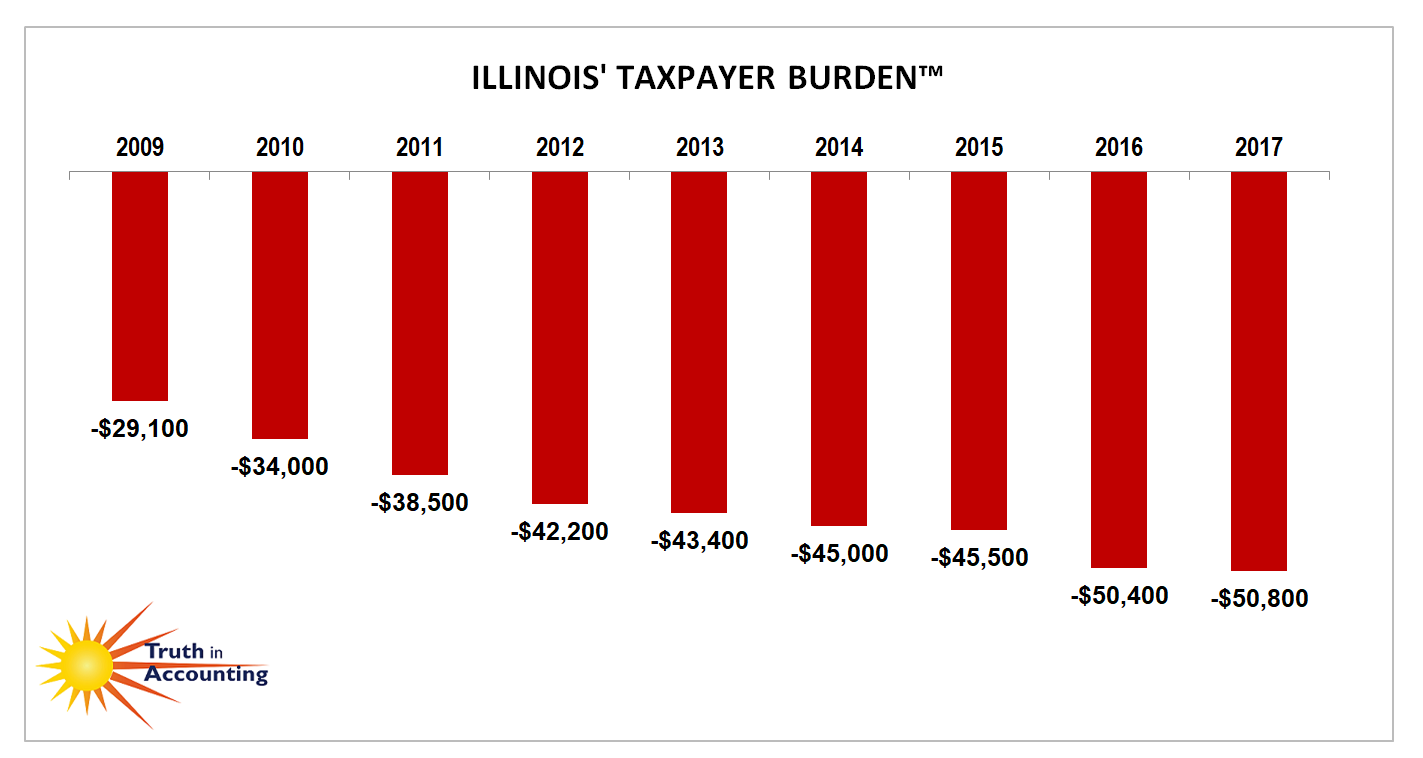
    Illinois’s debt is over $200 billion, with state assets of about $20 billion, and this doesn’t even count local debt, which adds another $100 billion onto the flaming pile. This breaks down to over $50,000 for each and every taxpayer in the state. So you can see that the Three Stooges of How We’re Going to Fix Things beloved of politicians giving speeches (“Waste, Fraud, and Abuse”) are down in the noise; $100 million dollars doesn’t scratch the surface. The tax increases that have been proposed (which will somehow magically not drive people and businesses out of the state at a faster rate than they’re already exiting) aren’t even close to enough to cover this debt.

    Well, how about cutting spending? Let’s look at that a bit, starting with what we’re spending the money on.

    Far and away the biggest cause cause is well-known: public employee pensions and health insurance benefits costs. How bad is it?

    Here’s a delightful graphic which just looks at one typical municipal issue, cops.

    Though there’s variation from county to county, the pattern remains the same.

    How about fire?

    So again, the pattern is clear. If we cut every single penny of cops and fire protection spending, closed every police stations and fire house, and could somehow get around the unions and fire every worker, we would STILL be vastly underwater. There’s nothing unique here; there’s similar charts for teachers, nurses, clerical, administrative, and every other type of state leech employee classification.

    The debt, pension and health insurance costs for retired state workers represent over $185 billion, or about 85% of the Illinois debt. It cannot be stressed enough: this is for people who are no longer working. You could fire EVERYBODY currently employed, cut every goddam program (good or bad), shutter every building, and barely dent the issue. These deals were put in place by the generations of family politicians who have run the state and municipal governments, the Daleys, the Madigans, the Stevensons, the Simons, the Jacobs… all enriching themselves and their hangers-on, while pulling hundreds of millions from the fabulously corrupt unions to indebt all the rest of us.

    So since we can’t tax our way out, we can’t reduce spending enough to make a difference, I guess there’s only one thing left to do: cut the pensions. Oh wait…

    Membership in any pension or retirement system of the State, any unit of local government or school district, or any agency or instrumentality thereof, shall be an enforceable contractual relationship, the benefits of which shall not be diminished or impaired.

    The above is Article 13 Section 5 of the Illinois Constitution. That’s right, it’s in the fucking constitution that we can’t touch the vast bulk of where the money is pouring out. If you want to cut even a dime of the vast sums of money being spent on people who aren’t working , you have to amend the constitution. To do that, there must be an affirmative vote of 2/3 of the House of Representatives and the Senate AND then be approved by a majority of voters on a special election ballot, most of whom do not pay the bulk of taxes. This is de facto a nearly impossible hurdle.

    So we can’t win, we can’t break even, and we can’t get to absolute zero debt. The politicians running who pretend to have ways to fix things and to help taxpayers and property owners are lying scumbags. We are all fucked. Like so many others, I’m doing everything I can to get the hell out of here.

    I will not miss this place.


  • Pondering pragmatism in politics redux

    A while ago I wrote about the issues of pragmatism in politics. Planning the second part, I ran into a serious dilemma: I could not find the proper alliterative title. I thought of words starting with p to indicate this is a second part of a previous post, but I found none.  Redux does not really work but r is sort of like p…

    But enough of my personal failings. Let us once more grab pragmatism by the balls… My first post was not a critique of the concept of pragmatism in itself – this can be a different story – but what I called pseudo-pragmatism. This is basically completely ignoring principles and the multitude of problems with many politicians in the name of so called pragmatism, leading descending spiral of corruption and incompetence which is not in any way “pragmatic.”

    This led me to think, get the old rusty cogs turning among the cobwebs. Where is the place of pragmatism in libertarianism? Can we find it some room of its own? The answer to this depends on who you ask. Because, otherwise, libertarianism would be thoroughly boring.

    I thought about expanding on the issue by analyzing pragmatism and ideology, not pragmatism and every day politics. Because I believe that an ideology which is not at least somewhat rooted in reality is mostly pointless, and basically not that better than utopian communism. It is quite easy – as the corpus of fantasy literature shows – to imagine all sorts of things and put them in words. Something that will actually work in our world – and not Middle Earth – is more difficult.

    To be fair, feudalism is probably better than anarcho-syndicalism

    Now, given there are 10 different opinions for every 9 libertarians, I assume few will agree to what exactly constitutes pragmatism in ideology. But, as many of our little talks around this place are in agreement, let’s get controversial.

    The main issue is: to what point can you bend a principle in service of being pragmatic, before it ceases to be a principle? Some would say not at all, slippery slope and such. Others would try to define some minimal leeway in it. Another way of viewing things is: can we design the principles to be pragmatic? My island experiment post was an attempt to start from some basic premise and define some principles, while keeping an eye on reality.

    So let us dive in the deep end… I see two types of political discussion. One idealistic, how we would like things to be in perfect universe (cough anarchism) and another what is a good enough ideology for the world we live in – presently, not 500 years from now or in some post scarcity utopia and/or dystopia. My answer is along the lines of minarchism plus, a form of limited government, free(ish) markets and personal liberty, enabling for each a life as close to what they want as can be.

    Now, I am all for talking anarchism for the sake of an interesting debate, but after a point, we need to get back on Earth Earth and see what has a chance in hell of working. What is not impossible, but merely highly improbable? Anarchy? Yeah… no. Minarchy? Probably not true minarchy. Reasonably limited government? Well that is a very long shot maybe.  Which, in the end, we might never live to see, but I am saying there is a chance.

    To clarify, by working, I mean something that allows the individual to live and thrive. Feudalism was stable for many years, but I would not say it worked. Certainly not for the serf. One out of 100 people in a harem may think it is working.  Somewhat anarchic Zomia worked a while, only if working means hunting, gathering, swidden agriculture and almost no capital accumulation.

    While this may or may not be possible, I am trying, against the modern trend, to find principles as objective as possible, otherwise it becomes a quagmire of subjectivism and feels. So I am trying to think of some basic guideline of organizing a political entity. This is not necessarily fully libertarian, but something that maybe can appeal to a slightly broader demographic.

    We can dismiss out of hand ideas that would work if humans were different. Humans have a certain nature, respond to incentives and are not some sort of altruistic angels. Teach murderers not to murder is not a viable idea, certainly not pragmatic in any sense of the word. Due to the problems associated with putting humans and power in the same room, I will say outright that no ideology without some clear limits on state power can function.

    As I believe that, quite objectively, humans are unique individuals, I believe any system needs to focus on individual human rights, not collective ones. A system must not sacrifice individuals – which are obviously a real entity, you can touch them if you want, as long as the sign the consent form – for the sage of a vaguely defined society – which may have a function as an abstract concept but does not really exist. Neither tyranny of minority or majority must rule.

    A functioning country must have some level of stability. A revolution every two years is not sustainable. At the same time there must be a way to change whatever “leaders” there are. Whoever is in a position to wield tools of coercion – police, justice, taxation, regulation, whatever – needs to be held accountable and have some skin in the game. History shows that when leaders can act with impunity, nothing good happens.

    So is socialism right out? Socialism was always right out. I never got the whole socialism would work if humans were better. If humans were better, it would still not work and anyway there would be no need of it. There is no situation where socialism is needed or desired. We can dismiss democratic socialism. It is lipstick on a pig, trying to add the veneer of legitimacy by the democratic part.

    Any form of dictatorship or monarchy should be excluded – this can rarely exist with accountability. A monarchy can be ceremonial at best. Any form of democracy must not lead to mob rule and must be restricted by the fundamental rights of the individual, as history can show us how people were often mistreated by bad laws that had the support of the majority. Excessive centralization is not desirable. This reduces accountability and skin in the game. It concentrates power and it makes corruption easier. It makes the coercive institutions distant for the individual.

    Economically, for better or worse, say what you will of the tenets of small government decentralized republics, it worked some. Yes, there was graft and government imposed monopoly and protectionism, but keeping government somewhat limited meant these could not mess things up to much. And when the state grew too much, there were always problems, even in the Swedish paradise.

    Socially, the main problems were brought by putting the so called collective over the individual. There are no clear models in history for ways of organizing that did not do this. Monarchies, republics, dictatorships, theocracies, capitalism, socialism they all wronged people. The solution is simply extending laissez faire economics of small government to the non-economic issues. I do not believe in social and economic division of freedom. They are either both or neither.

    Now what are my principles? Well I believe rights are individual and that peoplekind [hupersons?]  are social beasts. As such, living together, various conflicts appear. The core role of government is solving or mediating these conflicts in a fashion which best preserves said rights. There is an individual sphere – what is inside is none of societies damn business – and a common sphere – which is basically interaction of individuals, and the main issue with many forms of government is bringing into the common things that are individual. To take a small example, there can be a case for common involvement in health when it comes to contagious diseases e.g. quarantines, but not when it comes to broken legs.

    Believing in non-anarchy, I believe there is some taxation needed and this, in my view, is where I bend the principle some libertarians hold of taxation is theft / extortion / whatever. So to get to the actual point, basically the single land tax is a good idea, is where I am getting at.

    Anyway I think this topic can go on and on and as such I want to take it to the comments section… So how do you like your principles, fellow glibs? Medium rare or blue? Not cooked at all? Discuss …