Category: Opinion

  • BakedPenguin’s NFL Pick-’em for Week 9

    I went 9-5 last week, for a nice change from mediocracy.

    If anyone wants to know, I got my odds here, on 10/31.


    Here are this week’s picks:

    Oakland (+120) at San Francisco (-3 / -140). Two teams with bad records who both have a few close losses. The 49ers injury situation looks worse than the Raiders, however. OAK – take the points.

    Detroit (+185) at Minnesota (-5 / -220). Two tricky teams to pick. Minnesota seems slightly better, and they’re at home (even if that’s meant jack & shit this year to either team). MIN – give the points.

    Kansas City (-9 / -450) at Cleveland (+350). An improved Browns team has the ability to hold the Chiefs under that point spread, but then I also thought that last week against the Steelers, who were able to take advantage of some holes in Cleveland’s defense. The Browns had 2 interceptions against Tampa Bay, and still lost. And I don’t think Mahomes is going to throw 2 interceptions.

    Pittsburgh (+130) at Baltimore (-3 / -150). This is a tough one. One key to the game will be how well the Ravens tough pass defense matches up against Roethlisberger and the Steelers pass offense & vice versa. Pittsburgh has shown themselves to be a good road team this year, but I think Baltimore has enough to pull out a 3-point win. BAL – give the points.

    Tampa Bay (+250) at Carolina (-6.5 / -300). With either Fitzpatrick (who has historic interception problems of his own) or Winston, the Buccaneers have a definite QB disadvantage to Newton and the Panthers. With the spread under a TD, I’d go with Carolina. CAR – give the points.

    NY Jets (+140) at Miami (-3 / -160). Another tough one. Miami has a record that their stats don’t seem to support. I’m guessing that a lot of that is due to turnovers, and they will be key if the Dolphins want to win. So at home, against a mediocre team. MIA – give the points.

    Atlanta (+105) at Washington (-1.5 / -125). The Redskins are the better team, and the spread is basically a pick ‘em game. I wouldn’t bet the house, but I also wouldn’t have a problem putting three figures down on this one. WAS – give the points.

    Chicago (-10 / -500) at Buffalo (+400). Chicago has shown a talent for throwing away games this year, but the Bills terrible offense and their resultantly overstretched defense gives the Bears a good chance to meet that large point spread. CHI – give the points.

    Houston (± 100) at Denver (-1 / -120). Houston has reeled off a string of 5 straight wins, but they are mostly against teams ranging from mediocre to bad. While the Broncos fit in the top end of that description, they are also a team with a definite home advantage. (Their two home losses this year were against KC & the LA Rams).  I think Denver has a decent chance of stopping the Texans’ streak. DEN – give the point.

    LA Chargers (+105) at Seattle (-1.5 / -125). Tough one. The Chargers have a good team this year, and Seattle has had some close calls against some weak teams. LAC – take the points.

    LA Rams (+105) at New Orleans (-1.5 / -125). Another hard to call game. I’d like to take the Saints at home, and they’re certainly capable of it, but their weaker defense makes me think the Rams do have an advantage. LAR – take the points.

    Green Bay (+200) at New England (-6 / -240). The Packers are not the Bills, so that point spread strikes me as a bit high. GB – take the points.

    Tennessee (+230) at Dallas (-6 / -270). If the Cowboys can get its’ offense going, I doubt the Titans will be able to keep up. (Tennessee is just above Buffalo in points scored). I think a 6-point spread is about right. DAL – give the points.

  • Talk to the cops? Are you crazy? (part one of a multi-part series)


    I have the glory and honor of appearing on a few court-appointed lists in the area. This means I represent clients for misdemeanor, felony, and child protective/ delinquency cases. And I really don’t mind doing this kind of work. Strangely enough, going to law school really prepared me well for doing this kind of work. Go figure. Although it wasn’t taking the required criminal law classes that prepped me, it was the overall structure of the classes.

    One of the perks of my job is that I get to read a lot of police reports, and talk to police officers and detectives a lot. The reason why I say this is a “perk” is that it makes me look at the arguments law enforcement would use if the case goes to trial, and how police psychology works. It’s actually quite underhanded and manipulative once you break it down into its pieces.

    Sometimes, and it has happened more recently thanks to getting on those court-appointed lists, I have potential (retained!) clients call me with the following scenario: “I was at a party last weekend, with a lot of friends. My friends tell me that Tom says that I committed a crime against him, and that he called the cops. Should I talk to the cops?”

    My advice is always “No, you have no obligation to talk to the cops.” And then I tell the potential client, “if the cops call you, tell them you won’t be questioned without your lawyer present.”

    1. The format: Police reports are written in a good guy/ bad guy format. It’s like a play. Usually –and I can’t think of a time I have seen it any other way — the person who calls the cops is the “good” guy. Once the cops identify the rest of the players in the play, they will try to finger one person  (or possibly a group of people, who end up as co-defendants) as the “bad guy.”

    This is the beginning of how the mind set of law enforcement works. It’s easier to sell the story to a jury if the play is simple. Good guy / bad guy is a scenario we have all seen, and the jury will want vengeance, justice, or something, for the good guy. This is how a conviction is made.  Also, police and prosecutors know their audiences: it is the general public. What is the general public’s IQ? How does the general public feel about victims and justice?

    2. Corroboration: Talking to the victim, or alleged victim as I like to call him/her, gives the cops a list of other people to talk to, witnesses, before they talk to the person they’re trying to cast in the “bad guy” role.

    This is how under-handed the police mindset is, as talking to other witnesses first becomes a set-up for the defendant to put his own picture in the frame, or cast himself in the starring role. It also gives police an inside edge, as this leads to a cross-examining of the defendant from their first contact.

    This is part of the officer’s job. And it works in their favor — talking to other witnesses gives “corroboration” to the alleged victim’s story. If the witnesses back up the victim’s story, then the cops have some corroboration, and the victim’s story sounds more like it would stand up in court. Back to selling this story to a jury: if there’s a witness who says the same thing as the alleged victim, then the jury will have more sympathy toward the alleged victim, and it is easier to get a conviction.

    3. Contacting the defendant: The scene is now set, the cops have a victim, and some witnesses. Now all they need in the play is the bad guy.Once the cops call the potential defendant, they begin with what is called a “leading” question. Sometimes these are called open-ended questions. It’s the sort of question an interviewer uses on a job interview, such as, “where do you see yourself in five years?” it doesn’t lead to a “yes” or “no,” instead it leads to more of an explanatory answer.

    Or, in the potential scenario of being pulled over, it sounds more like this “How fast did you think you were going?” This leads to an answer that can be incriminating such as, “I’m not sure, but I think was going about 35.”

    Except in our “play,” as written by the police, it sounds a bit more like, “Hi, Jim. My name is officer Bishop with the County sheriff’s office. Tom talked to us, and said you committed a crime against him.”

    This open-ended statement might lead a person to possibly deny the assertion, or to try to correct the cops. The problem is that any other statement a potential defendant makes at this point can be used to cast him in the role of bad guy, no matter the answer.

    Usually by this time, again, cops have talked to other witnesses, and so once the defendant says something, an officer can counter with “Well, Mr. Johnson said you went after Tom with a carving knife.” Here’s the corroboration coming to assist the cops, and further explanations by defendants are only helping the police.

    Also, the next thing a defendant says – even if it is the truth — may lead to a credibility problem not too far down the road. The options are to either a) deny what has been said by Mr. Johnson, or possibly point the finger at someone else; or b) deny what was said totally. (Option (c) is also available, however).

    At the first contact by police, asserting an attorney’s assistance would be helpful. Instead, defendant should answer, “I’m sorry officer, but I can’t talk to you without my attorney present.” That’s option (c), which no one seems to take!

    Either way, the cops have an alleged victim, and a corroborating witness who already say nearly the same thing. But according to the defendant, those two are both liars now. That won’t seem likely to a potential jury, will it? This is just grist for the mill of the prosecution. Think again of the audience, which is the general public. Who should the jury believe: the defendant – or all of the possible ways to agree with the prosecution: instead the jury can believe the alleged victim, officer testimony, credible witness testimony . . .

    Police also know that facts are confusing – the victim and one or two witnesses usually get a few facts wrong, but this still can be OK to a jury. The victim is sympathetic; so it makes sense what with being attacked that the victim might get a few facts wrong.

    4. The defendant’s natural response works against him. This is where manipulation also comes into play, in case it wasn’t used already when contacting the defendant. Most people are raised to think that the cops are good people, and that working with the cops will help everyone (even when being questioned about something).

    A second natural response happens when police contact a suspect. The suspect wants to “set the record straight” about what really happened. This works against the suspect as well. The police aren’t interested in getting it straight, they are interested in the “good guy/bad guy” scenario.

    Back to my job: I can’t tell you how many times I have had clients tell me “I was respectful”– “I didn’t make a scene,”– or “I cooperated.” Even clients with fairly extensive criminal records tell me this, when their prior involvement with law enforcement should have them knowing better. Who cares whether you cooperate with the police? The police will do their job whether you cooperate or not. And that’s what they are paid to do, so why help them to do their job? I don’t see the cops coming along to help you do yours, now do I?

    5. The fact that cops wear uniforms works in their favor. It’s intimidating, for one. Second, it tends to lead to obedience on the part of defendants. Clients/defendants know that cops have uniforms, guns, and jails at their disposal. So it’s easier for cops to get compliance, and so defendants/clients to give in to authority: the alternative can be scary – even if you are innocent. People in that situation tend to want to get out the situation as quickly as possible, so it’s easier to tell the cops something. Third, the uniforms are de-humanizing. It’s not a guy who happens to be a cop, it’s a cop! People see the uniform, but not the individual in uniform.

    Well folks, that is all I have for now. Thanks for listening. Feel free to comment, leave suggestions, etc. My upcoming specials will be:

    Part two: The Big C: When do your Constitutional rights “attach” to the situation?

    Part three: Evidence problems. What the police report says, can it be “in” evidence?


    Lastly: this is totally worth the watch: a criminal law professor covers exactly the same topic I just did!

  • Larry Sharpe, Libertarian Candidate for Governor of New York

    On a recent Sunday evening I was blessed with a visit to Cornell University here in Ithaca, by New York State Libertarian Party gubernatorial candidate, Larry Sharpe.   Sharpe, needless to say, should be something of a household name to The Glibertariat, as he has been involved in Libertarian politics for some time, including running for the VP slot within the national party in 2016, and losing to noted Council on Foreign Relations establishmentarian and Gungrabber, Bill Weld.  Though I am legally prevented from voting or running for political office in America, as per the dictate of my status as a Permanent Resident, I am still a political junkie and ideologically pre-disposed towards those who would pursue smaller government and more peaceful solutions to society’s problems.  Thus, it seemed only natural that I should avail myself the opportunity to meet Larry in person, and see what he has to say about letting the people of New York lead their own lives with minimal interference, and what solutions he has for the various problems created in New York after many years under the iron grip of The Cuomo Dynasty.
    A Sunday evening is typically not a busy time on a University Campus, and it was doubly quiet at Goldwin Smith Hall, where Larry presented in a lecture room that looked like it could seat about 200+ people, but by the time the show started, only about 60 souls were in the room.  Small potatoes, but Larry was here a couple of weeks ago, too, at a winery over on Seneca Lake (I couldn’t go);  also of note that Tompkins County, of which Ithaca is the seat of government, is populated by only 105,000 people, all of whom seem to have Bernie 2016 Bumper Stickers still on their vehicles, and, Tompkins has the dubious distinction of the only county in Upstate New York to go Clinton in the 2016 election…a crowd of 60, given these circumstances, isn’t terrible.

    I took a seat near the top of the room, after purchasing a bumper sticker and t-shirt, and not long after, Larry came by my seat and introduced himself.  He did that for everyone in the room, and was pretty high energy and affable; not bad for a guy who has been touring the state relentlessly, sometimes making two or three appearances a day, as was the case on Sunday.

    Larry has been on this tour with his running mate, an affable young fellow named Andrew Hollister, a native of Rochester.  Andrew warmed up the crowd, so to speak, by waxing heartily about how much he loves New York State, and that despite the many economic reasons to leave, he wants to stay and raise a family here.  He fully acknowledges the uphill battle it will be to move NYS up from it’s 50th ranking of all the states in economic freedom, amongst others.  Our friends at CATO have a handy website which can show you each state’s rank over a number of different issues, and New York ranks at the bottom, or close to it, for most of them.

    When Larry got on stage, he asked a few questions of the crowd, one of which stuck out to me as highly relevant, given the changing nature of the media, and recent events where social media platforms have engaged in the banning of non-Tribal narrative personalities and groups.   “How many of you heard about me on TV?” he asked.   No hands.  “How many of you have heard me on a podcast.”  Nearly everyone in the room stuck up an arm.   Larry pointed out that both Presidents Obama and Trump made very effective use of social media, which helped to bring both of their campaigns to victory, and at this stage, Larry is one of the few politicos to have used podcast interviews and YouTube videos as effective and free advertising.

    If you haven’t seen any of his appearances, click for his appearance on The Joe Rogan Experience, his appearance on The Rubin Report, and his appearance with Glenn Beck. For a very warming feeling deep in the cockles of your blackened Libertarian Hearts, here Larry is speaking at Columbia University against both The War on Drugs and The War on Terror.  If only a recently confirmed Supreme Court Justice had the principles required to see these ‘Wars’ for the phony bullshit that they are …. but Kulturkampf rules supreme around …. oh, nevermind.

    Now that you have all of these videos/podcasts to look up, you don’t need me to give you any play by play of his policy position spiel, except that I might give you some brief highlights of what I thought were good and positive, and those parts of which I was skeptical, and required further elaboration and/or atonement.

    The Good

    Sharpe wants the budding (pun intended) movement for the legalization of marijuana to come to New York, and his analogy is that ‘weed should be regulated like onions’ …. as in, not at all.  I asked Sharpe about removing the current NYS cartel system for hemp growers (I’ve been working part time at a hemp farm nearby the past few months, and the removing of the cartel would actually put my employers at risk from competition, but hey, PRINCIPLES) as at present, you can only grow hemp for the purposes of pressing CBD oil, and only 6 production permits for making CBD have been issued in the entire state.   Sharpe indicated that under his administration, the cartel system would be dismantled and the free market would rule the day.

    Sharpe is also the only candidate who plans to completely repeal the NY SAFE Act.  As my collection of weaponry still resides in Canada, due in part to avoiding the tender mercies of The King’s Men here, this is music to my ears.

    The Bad

    A peculiar law recently passed in NYS has to do with the allowable amount of window tint on your vehicle.  NYC cops have wanted a serious reduction in allowable tint on vehicles in Gotham City, and for whatever reason, they got their wish at the beginning of 2017; yet the regulation applies statewide, not just in NYC.  Sharpe is big on decentralization, and indicated that he would favour removing this regulation and instead having people with tinted windows be compelled to roll their windows down immediately, if pulled over by the cops in NYC.  Not really a good enough answer for me, because my vehicle is my vehicle, and does not belong to the motherfucking government, but alas, I suppose this is what they mean by ‘pragmatism’, if Sharpe is to try and keep the peace with the constabulary.

    A young woman and I asked similar questions regards what to do about the many non-violent drug offenders currently incarcerated in NYS, and again, Sharpe gave an answer that failed my purity test and smells of ‘pragmatism’.  His plan would copy a program in Massachusetts whereby non-violent offenders would be analyzed for their likelihood to re-offend, and would have to complete a sort of societal re-entry program, rather than just be let out of prison.  His rationale comes from speaking to corrections officers (yeah, like we should be trusting them) who claim that most non-violent inmates *become* violent as part of their stay in prison ….  which sounds like some circular logic to me.  If a person can be thrown into the slammer head first and survive, seems to me that giving them their freedom back should not be nearly as hard.   I guess agreeing with state welfare parasites in order for them to further their employment trumps principle here.  Colour me unimpressed, though I am glad that Sharpe acknowledges the problem, which is more than can be said of Cuomo or Sacrificial Republican Lamb Guy.

    The Fanciful

    One of Sharpe’s more notable education reform ideas includes making attendance in school optional after 16 years old, and expands the various tracks students can take for their final two years in The Gulag …..  I mean high school.  Those tracks would include intense academics, like a prep school, or trade school, or a STEM track.  This also includes privatizing the entire system, and issuing vouchers to any kid who wants to pursue those tracks, which happen to be good for 7 years; so if you end up taking a year off to go and work or otherwise engage adult life, you can come back afterwards within this time frame.  Sharpe claimed that this system could be done at a cost of 10k per student per year, far less than the current cost of 22k per student per year of secondary school education.  He gave no indication of how this cost would come down, at all, or especially that much, except in the standard libertarian explainer that privatization always makes things cheaper; he also didn’t mention that the public school teachers unions would probably fight this tooth and nail, nevermind any ideas on how to take them on.  I like the idea of getting kids prepared for the world in faster and more robust fashion than is currently offered to them, but it would have been nice if more details were provided, especially given the hills he would have to climb in order to implement this system.

    The rest of Larry’s policy proposals and ideas can be found here.

    Throughout all of his discussion about these and other policy ideas, Sharpe remained upbeat and optimistic, and drove the point home that many of his ideas would save the state money, not require any further taxation, and spur more employment and investment.  He told the crowd about a marijuana industry investors conference he was asked to speak at in NYC several weeks ago, and how he was extremely disappointed that the many millions of dollars being pledged to investment were going everywhere but New York – California, Oregon, Colorado, Canada, etc.  It seems that he really does have an eye for helping the fortunes of people who live in New York, and is not resigning himself to further economic ghettoization of this state by The Cuomo Dynasty and the do-nothing state Republican Party.

    And it also seems, at the time of writing, that Cuomo remains steadfastly opposed to debating Sharpe, or any of the other gubernatorial candidates, bar Mark Molinaro, the Sacrificial Republican Lamb.  Cuomo, even though he seems more interested in running for President, feels so entitled to his grip on power in Albany, that he won’t even deign to acknowledge any contenders.

    In conclusion, I will leave it to the good judgment and sensibilities of those fellow Glibs whom also are subjects of King Cuomo, to choose wisely in this coming election.  Every now and then I have to trade my anarchist hat for my practical reality hat, and given the chance, I’d pull the lever for Sharpe.  Maybe you would consider Sharpe as well.

  • What Are We Reading – October 2018

    OMWC

    Geek books and real books. My fun real book this past month was by H.L. Mencken, who was incapable of writing anything uninteresting. Although we love him for his short and cynical essays, chock full of quotable and meme-able sentences, his scholarly work is equally enjoyable. The American Language is a study on how our version of English developed and on the taxonomy of American vocabulary, grammar, and usage. It delights my inner geek, amuses and informs on every page, and gives a fascinating insight into Mencken’s inner thoughts on the language that he used so brilliantly and effectively. I was less thrilled with a lot of the updates added by editors after Mencken’s stroke and eventual death, but at least they were kind enough to set their portions off in brackets.

    My geek book for the month is High Fidelity Circuit Design, by Norman Crowhurst and George Cooper. This is a book from the 1950s that has recently been reprinted. If you want to understand Nyquist stability criteria, feedback, and the finer points of tube amplifier design (I told you it was a geek book!), look no further. These days, engineers use computer modeling to determine gain and phase margins for stability and sims to predict performance, but back in the stone ages, they actually plotted stuff on graph paper and used rulers and protractors. I confess that reading this covered my with waves of anachrophilia.


    SugarFree

    October is the month for horror. I went back to the classics: Dracula, Frankenstein and The Strange Case of Dr. Jekell and Mr. Hyde. Old friends to cuddle up with.

    If you’ve never, Frankenstein plays out far differently that pretty much every movie adaption. The Monster is made over just a few pages of grave robbing and surgery, no electricity and no cackling, and Frankenstein is young, only about 21, and while full of hubris, he isn’t a mad scientist, just a mildly full-of-himself student. It would be interesting to see a film adaptation actually tackle the book.


    SP

    Let’s see, what have I been reading this month. I’ve just started The Pattern of Evolution by Niles Eldredge, which our European guest had selected from our library for bedtime reading and left laying on the table upon his departure. (One of the great benefits of marrying another extreme reader is that there are always books that I haven’t read, and I don’t even have to venture out to the library or pay Amazon.)

    I’m revisiting The Drunken Botanist by Amy Stewart. Stewart has put together a pretty comprehensive look at the major plants, herbs, spices, that are made into various potent potables. There are interesting historical notes about the discovery and use of the different ingredients, and some geeky botany stuff, too. Oh, and recipes for drinks. This isn’t really a book one reads straight through, although I am. But I also read cookbooks cover to cover just for fun.

    Just picked up the book mexican sharpshooter has recently reviewed, Data in Decline: Why Polling and Social Research Miss the Mark by Steve Wood. I expect a throughly interesting read.

    In fiction, I’m still working my way through the Harry Bosch series by Michael Connelly on Kindle. I haven’t viewed the series which is based on the character, but I might add it to my watchlist.

    In audio, I was listening to A Dangerous Fortune by Ken Follett, but I’ve kind of lost interest about halfway through. Plot: Horrible people do horrible things. Less horrible people also sometimes do horrible things. Especially in 19th century banking empires, British politics, and banana republics run by thugs. Eh. Probably won’t finish it unless I end up having another long, tedious drive alone.


    jesse.in.mb

    I don’t have much to report. I went on a bit of a binge of buying cookbooks including Mormioto’s Mastering the Art of Japanese Home Cooking which is accessible enough and got me to make my own dashi from scratch (god damn did my kitchen stink of fish for days, but it was very tasty). I found the content personal, but I was hoping for more…I dunno, context for the food I was preparing. I also grabbed Maangchi’s Real Korean Cooking more to kick money her way than anything as I’ve been scraping recipes from her website for years (The Boyfriend does not approve of how much I gravitate to her more gochugaru-centric offerings).

    I burned through the available issues of The Chilling Adventures of Sabrina which started off with just the right level of twisting to the character I was first introduced to by Melissa Joan Hart, but I’m not sure it is living up to its promise so far.

    Started but not finished: I circled back to The Lies of Locke Lamora, and pushed through until it found its groove. I’m a little more than half-way done at this point so maybe by next WAWR I’ll have a final opinion. I’ve been chipping away at just the introduction to James R. Walker’s Lakota Myth, which has been unskippably interesting, but also too academic for the naked-poolside-reading I was hoping the main contents would be while Iwas in Palm Springs…perhaps next time I’ll have more.


    JW

    A wise man once screamed “NO! You must not read from the book!“and I have followed that advice ever since.


    A Leap At The Wheel

    Books on Audiobook:

    The Wizard of Oz: Or so I thought.  It was actually a 2 hour radio broadcast will a full cast.  Not recommended.

    Till We Have Faces: I didn’t realize this was fiction, based only on the name I assumed it was non-fiction.  But it was one of the few Lewis books left that I hadn’t read so I threw a hold on it in the library’s audiobook application.  It is in fact fiction, and it is fantastic.  In addition to being written by an expert craftsman, this is a novel that would be pretty impossible to write in this day and age.  The concept of having a female protagonist who takes up some masculine role in society would inevitably become bogged down in the current simple-minded discussion of gender issues.  But being written in the 50s actually allows Lewis to write a stronger, more interesting female character that provides a clearer analysis of gender roles.  Nothing turns me off of fiction faster than weak women, and between this book and That Hideous Strength, its nice to see my literary hero doesn’t fall into my literary pet peeve. Also, this not really a book about gender roles.  Its not a book about any one thing, because it is about nine or so different things.  If I had to pick one thing it was about the most, it would be about how you would get along in a world where the divine is real and doesn’t really love us.  Highest Recommendation.

    Democracy in America: Ufda.  I find historical books about history and political economy really interesting, but they require a lot of concentration because you need to both consider the words on the page and the frame of reference that they were written in.  Kind of like the Screwtape Letters.  In any case, 34 hours of that is just too much for me this month, when I’ve either been too sick to do productive work (fucking strep, fucking high-false-negative strep tests), or working 7 days a week to catch up.  Only made it through about the first third, I’ll come back later.  Incomplete.

    Whitepapers: I don’t normally list all the whitepapers and journal articles that I read, but there were some interesting ones that might be of interest here

    Why Suburban Districts Need Public Charter Schools

    Honestly, there isn’t much groundbreaking here, but it lays out the argument for charter schools in the suburbs.  Just the kind of thing you would expect to find from some shitlord conservative think-tank like… *needle scratch* the Progressive Policy Institute?  Interesting for that reason alone.

    Hidden Tribes

    You know all those people saying “80% of the US is opposed to political correctness?”  This is the research that they are pulling from.  Its generally a pretty interesting look at the electorate, though I think it has some shortcomings.  It’s interesting because the categorization they propose feels truthy, and it seems to be a better signal than party affiliation for predicting opinions of the tribes.  It’s limited because it doesn’t spend a lot of time on meeeeeeee and my tribe.  Political opinion is a high dimensional space, and this projects that space onto a single axis.  It puts me in the moderate camp, which is probably right in that I’m pretty close to center on the left-right axis.  But I’m a huge outlier on a bunch of other axes on the political space.  A model is only as good or bad as its predictive power, and this seems predictive for a lot of people.  “Bad for outliers” is hardly a reason to reject a model.  And I found it to be very helpful to see the divisions within the right wing and within the left wing.  Its not news that the right and left disagree, but disagreements within the wings are pretty important these days.  Highly Recommended.

    Truth Decay

    The truest thing I’ve ever read was the argument that Killmonger was the protagonist in Black Panther, which is an Alt-Right parable.  The second truest thing I’ve ever read was this paper.  This paper documents and discusses the reduction in faith in information provided by institutions like media, government, and academia.  The interesting thing though is that this paper is *incredibly* careful to present the case in a way that doesn’t turn off anyone from any political orientation.  One of my hangups is that a lot of this distrust is the result of these institutions becoming untrustworthy because they are becoming self serving, partisan, and/or low-quality shitholes.  Guess what, it talks about that (maybe using different terminology…)  One of the hang-ups of a friend of mine is that the Right has a financial incentive in developing an ecosystem of alternative news outlet and those with the biggest financial incentive are the loudest talking about how you can’t trust the MSM.  Guess what, it talks about that too.  It is pretty clear that this has been heavily edited to take into considerations the thoughts and objections of reviewers with a very wide array of intellectual orientations, and its a very, very strong document because of that.  I told this friend that this is exhibit A for why educational institutions need intellectual heterogeneity.  While this progressive friend is not yet ready to admit that academia is a stifling monoculture, this paper is helping me change his mind. Highest Recommendation

    Podcasts: I just wanted to call this one out because it is really, really interesting

    So to Speak Podcast with Don Verrilli. Verilli was the Solicitor General in the Obama administration.  He is, quite possibly, the most skilled Supreme Court lawyer alive.  I probably don’t agree with him on anything policy-wise, but when the guy talks about how to argue in front of the Supreme Court, there aren’t too many living people with more to say.  And when he makes an admission against interest, well, that’s worth taking a note of.  He makes two here.

    First, Verilli says that he thinks the Roberts Court really does support the 1st amendment because they have an ideological commitment to it.  Its not just a tool for achieving a partisan end of being pro-business or owning the libs.  I think this too, but its nice to hear it confirmed like this.

    Second, an more importantly, Verilli comes out and says that there’s not an Originalist argument for campaign finance laws.  He talks about how the Founders had a broader understanding of corruption that the modern court does.  But even if that’s true, they didn’t think that there was an exception to the 1A to combat this.  I don’t think he says it, but this is consistent with the idea that it was the structure of the government that was supposed to prevent this type of corruption, not restrictions on civilian action.  Recommended if you follow the SC

  • BakedPenguin’s NFL Pick-’em for Week 8

    I went 6-7 last week, so I’m still doing crappy. I put in  a lot more effort last week, and got the same result as when I was half-assing it. You can probably guess what’s going to happen this week. That being said, I’ve added the moneyline odds. Moneyline odds are based around 100 – if there’s a plus in front of them, it’s the amount you’d win from a $100 bet. If there’s a minus, it’s the amount you’d have to bet to get $100. So in the first example, a $100 bet on Miami would win you $290, where a $360 bet on Houston would win you $100.

    If anyone wants to know, I got my odds here, on 10/25.


    Here are this week’s picks:

    Miami (+290) at Houston (-7.5 / -360). The Dolphins haven’t been so bad, and the Texans haven’t been so good to normally support a spread over a TD, but Ryan Tannehill is out. And while he’s not the greatest QB around, he’s the best the Dolphins have. HOU – give the points.

    Philadelphia (-3 / -165) at Jacksonville (+145). Cody Kessler seemed to breathe new life into the Jaguars in the second half of last week’s game. After screwing up for an entire month, however, they still have a lot to prove. PHI – give the points.

    Cleveland (+320) at Pittsburgh (-8.5 / -400). Cleveland has shown that they are a much better team than last year. Tough defense, decent running game. I’d be very surprised if the Steelers can meet that point spread. CLE – take the points.

    Denver (+400) at Kansas City (-10 / -520). Again, a point spread I’m not sure that the favorite can meet. The Chiefs have shown they are a strong team, but the Broncos displayed their own skills last week. Even if it was just the Cardinals that they stomped. I wouldn’t take the moneyline, even at 4 to 1, but I’d take the spread. DEN – take the points.

    NY Jets (+280) at Chicago (-7 / -340). Chicago has shown a great talent for letting me down. I think they’ll win, but again, I think it will be close. NYJ – take the points.

    Washington (-110) at NY Giants (PK / -110). The Redskins showed some toughness in their win over the Cowboys. Maybe it’s just because I haven’t paid enough attention, but I don’t see the Giants beating them. WAS

    Seattle (+135) at Detroit (-3 / -150). I’ve been underestimating the Lions all season. At home against the Seahawks, I’ll stop that. DET – give the points.

    Tampa Bay (+170) at Cincinnati (-4 / -200). Tampa isn’t a bad team, but Winston throws a lot of passes to people in the wrong jerseys. Cincinnati is a good enough team to take advantage of that. CIN – give the points.

    Baltimore (-2 / -130) at Carolina (+115). Baltimore is a good enough team to beat Carolina. Cam Newton is a good enough QB to be a pain in the ass for the Ravens, but I don’t think he’s quite good enough to get the win. And with a 2 point spread, it’s basically a pick’em game. BAL – give the points.

    Indianapolis (-3 / -155) at Oakland (+135). Oakland has lost a lot of close games, but the Colts have a good offense. A really good offense. IND – give the points.

    San Francisco (-1 / -110) at Arizona (-110). Ah, the suck bowl. Does anyone care? Meh, ARI – take the point.

    Green Bay (+350) at LA Rams (-9 / -450). I think the Rams will probably win, but again, I also think the Packers are a good enough team to cover the spread. I’d feel better about that prediction if the spread was 11 points, though. GB – take the points.

    New Orleans (-110) at Minnesota (-1 / -110). The Vikings are a good team, but I don’t know if they’re as good as the Saints. NO – give the point.

    New England ( -14 / -1250) at Buffalo (+800). Okay, now that is a point spread. Still, I think the Patriots will make that. NE – give the points.

  • I Fucking Love Astrology: The Horoscope for the Week of October 21 (Take Two)

    This week I had family staying with me, so I had to work on the horoscope in fits and starts, all the while making sure that the SIL didn’t see what I was doing.  She’s the kind of person that believes everything that’s on the news, so she has completely internalized every moral panic since the early 1980s; she strongly disapproves of the occult alternative recreational epistemology.  She only lets the kids have graph paper to do homework in order to prevent them from playing D&D.  She does make a truly excellent pie crust though, and that matters a lot.

    Anyway I had some really interesting stuff in the charts: fire, war, fire, cataclysm, death, destruction, fire and victory.  But as I was typing up the results, one of my fire indicators was Sol in Leo, which cannot happen in October.  It turns out I had laid out everything for August 8, 1945.

    Anyway, this week’s skies are much less dramatic.  Venus is still retrograde, but there’s only some BARCO alignments to spread her baleful influence.  The first being Terra-Venus(retrograde)-Mercury-Jupiter.  This means that news of your venereal sins will reach people important to you.  Maybe put those sins off for a week.  The other BARCO alignment is Terra-Mars-Luna.  This often heralds military deployments, but I understand that Obama ended all wars, so it’s more likely that the alternative reading of “Military Success” is more likely*.

    What with all this warlike stuff, it’s worth noting that Mars is still hanging out in Aquarius, where it is conjunction with the moon.  It’s an auspicious time for any naval glibs.  Scorpio’s dry spell continues with additional warnings not to try and break it in an illegal fashion.  See alignment 1 supra.  Libra is hanging around with the Sun.  And FINALLY Saturn(retrograde) in Capricorn is over!!! It’s now Saturn(direct) in Capricorn.  I don’t think I’ve ever been so happy to see the sign of famine before.  Actually, since the returning to direct motion is such a positive thing, this particular instance of it probably has more to do with success in weight loss than in Live Aid.

    Good luck in the coming week.  If you need me, I’ll be vacuuming up dog hair.

    *These are the best indicators since it doesn’t tell you for whom the success will be.  You can read Terra as indicating “us” or it can represent the country being invaded.  If I were reading this in Poland, I’d be more constrained.

  • BakedPenguin’s NFL Pick-’em: Week 7

    I think I went 6-7-1 last week, so that sucks. I’m going to put in a little more effort this week to try to improve on that.

    If anyone wants to know, I got my odds here, on 10/18.


    It’s that time of the week again. Here are this week’s picks:

    Denver (-1) at Arizona. I do believe the Broncos can handle the Cardinals, even in Arizona. They haven’t traveled well this year (0-2), but Arizona hasn’t been an intimidating place to play (Cards: 0-3 at home) The top two leaders in tackles for the Cards (who are both in the top 5 in the NFL) are both safeties, suggesting to me that they’re letting a lot of rushes into their backfield (To be fair, their #3 guy is an LB). Their offense is the really weak part of the team, however, as only Buffalo has scored fewer points this year. Denver’s biggest weakness corresponds to Arizona’s. Denver’s rushing defense (27th) hasn’t been very good this year, but Arizona’s rushing game (32nd) has been terrible. Meanwhile, their rushing game against the Cards’ rushing defense shows a pretty big advantage. DEN – give the point.

    Note: due to me sending this in late, this will be posted after this game has finished. If I got the pick wrong, you know that’s true.

    Tennessee at LA Chargers (-6.5). The Titans are another team with a mediocre offense, one I think the Chargers can deal with. On the other side of the ball, the Titans have a decent defense, although their passing defense is much better than their running defense (26th). This works in favor of the Chargers, particularly Melvin Gordon. Playing in LA, I think the Chargers will be able to get that extra TD to beat the spread. LAC – give the points.

    New England (-3) at Chicago. I wish the point spread were larger, it would give me more confidence in saying the Bears may well have a rebound game at home (against the spread, if nothing else). They’ve done well at home, while the Patriots have looked great at Gillette Stadium, and well… not so much anywhere else. The one key weakness I would fear would be Chicago’s average pass defense against Tom Brady and the rest of a team that knows how to make plays when necessary. Usually. CHI – take the points.

    Cleveland at Tampa Bay (-3.5). The one area where the Buccaneers have shown real weakness is pass defense, where they are giving up the highest average YPG and over 3 TDs a game. They are quite fortunate, therefore, to be playing the Browns, who are tied for scoring the fewest passing TDs per game behind high round draft pick Baker Mayfield. Cleveland’s running game is one of the strongest in the league, although Tampa has shown they aren’t too bad at stopping the run. I think the biggest question is, can Jameis Winston throw more TDs to his own receivers than “completions” to Denzel Ward? Assuming the answer is yes, I’ll go with the Bucs at home. TB – give the points

    Detroit (-3) at Miami. The Dolphins stats don’t seem to support their record (partially due to a large blowout loss in New England). The only statistical advantage I can see for them is Miami’s ground game against the Lions’ rushing defense. And while Miami’s passing defense has given up a lot of yardage, they also have the most interceptions in the league. Additionally, Detroit hasn’t shown they can play on the road this year. MIA – take the points

    Carolina at Philadelphia (-4.5). Another game where I think the home/road records come into play. The statistical matchups are fairly even. A lot will come down to how the Eagles’ can (or cannot) hold Cam Newton at bay (or intercept him three times as they did last year). While that’s unlikely, I do think they will be able to turn their home field into a real advantage. PHI – give the points

    Buffalo at Indianapolis (-7.5). The Bills have shown a heroic inability to score points, with the one unusual exception being their one win against Minnesota. They recently hired Former Panthers QB Derek Anderson to pump up their anemic passing. I think the most important matchup will be the Colts passing vs Buffalo’s pass defense. While the Bills could keep it close with good defensive play and better offense, I don’t expect their new QB to make that much of a difference. IND – give the points

    Cincinnati at Kansas City (-6). The Bengals had a hard time dealing with Pittsburgh’s passing, and they are now facing a similar problem facing the Chiefs and Patrick Mahomes. While the Bengals have shown they can play on the road, they’re also now facing one of the best offenses smarting over a close loss. Their best hope is going to come dealing with a mediocre Kansas City defense. KC – give the points

    Minnesota (-3) at NY Jets. The Jets are going to have a hard time stopping Kirk Cousins. The other matchups in this game are pretty much of a wash, statistically. They are probably going to get somewhere on the ground, but unless Sam Darnold plays better than he has previously this year, I think the Vikings have a definite advantage. MIN – give the points

    Houston at Jacksonville (-4.5) The Jaguars remain the league’s statistical leader on defense, although they appear to be in freefall after two big losses to Dallas and Kansas City. Meanwhile, The Texans appear to be on the rise after starting the season 0-3. I think this is one game where the numbers don’t matter nearly as much as the motivations for the players. The Jaguars will be looking to end their losing ‘streak’ at home, and they do have the talent to do so. JAC – give the points

    New Orleans at Baltimore (-2.5). The Saints have the league’s highest scoring offense going up against the league’s stingiest defense in the Ravens. Typically, in this matchup, you pick defense over offense. However, I’m feeling contrarian right now. NO – take the points

    LA Rams (-9.5) at San Francisco. I’ve been checking team and individual player stats for a while. For this one, I’m just going to take the Rams. LAR – give the points

    NY Giants at Atlanta (-5). The matchups for this one are fairly even. As above, I’m getting lazy, and it’s getting late, so I’m just going to go with the home team. ATL – give the points                                                                                                                                 .


  • So You Want To Write A Book

    I don’t know if it’s still common, but it used to be an oft-professed desire to write a book. How hard can it be? After all, you can read and write, and that’s all it takes, right? To get started, that is really all you need. Eventually you will turn out forty to a hundred thousand words if you just start cracking. The problem is, you don’t want to write A book, because your one book will suck. So if you want to write a good book, write that first book, chuck it, write a different one, chuck it and repeat. Eventually you will hone the secondary skills required. That of characterization, exposition, description and dialog. These all feed into storytelling. This, of course, assumed that you are writing fiction. Fiction is easier, you don’t actually have to know anything, you just have to string together an entertaining yarn.

    It turns out that a lot of those people who were expressing an interest in writing a book were not interested in the act of writing. What they wanted was to have written a book. Whether it is for the bragging rights or the passive income doesn’t matter, because they will never write a book. It’s simply because the amount of time it takes to sit down and puts tens of thousands or hundreds of thousands of words down on paper is a barrier to entry all its own. If you do not enjoy the act of writing for the sake of writing, the probability of finishing the volume drops to minute. In my case, I started writing stories back in high school. These stories were crap, but I wrote them to entertain myself. I needed to provide my own fiction, because the literature being foisted upon us public school students was specifically selected to make the students hate books.

    The first obstacle is scene flow. A novice writer will often have a vivid picture in their head, but the words on the page do not convey all of it. They will also know where everyone is going next but frequently fail to chain the scenes together in a manner that someone not privy to the contents of the author’s head could follow. It becomes a nightmare if they try their hand at non-linear storytelling, as you combine the problems above with a format that is inherently harder to follow. The pieces of the scene should be laid out in order and strung together in a coherent pattern. It seems obvious, but early on this requires a conscious effort. The frequent counterpoint to disjointed scenery is the ‘and then’ syndrome. Where a character does something, and then something else and then a third thing. A list of actions and events with no color or engagement. While it can be followed, it ends up boring.

    The second obstacle is description. The mistakes often fall into two categories – over-describing and under-describing. Under-describing is often from the same problem as the issues with flow. The picture is complete in their head, and they don’t fully put it on paper. If it’s not on the page, you don’t get credit for it. The opposite end of the spectrum would be trying to get every detail of the picture down on the paper, even when it doesn’t contribute to the reader’s understanding. This can come out spontaneously, or as an over-correction to a novice who had previously been bitten by not describing enough. Finding the balance is infuriating and ironically difficult to describe. Because there is no one good amount of description. Some things don’t need to be covered, while plot- and character-relevant components should be given sufficient attention.

    After the first two, novice authors become more individualistic in their flaws. Some are terrible at developing characters. Others can’t create a plot to save their stories. I have always been the latter. One of my early books started from a seed of “Twenty-five pages of nothing.” The characters were alive, the dialog entertaining, and the scenes well-set. The problem was, nothing happened. It was just a couple days in the life of a nineteenth century gentleman. Strangely, people were still entertained. My solution to break out of that rut was to focus on what I was good at. I let the characters run loose and develop the plot from their interactions. This required knowing them as people and understanding their motivations. It also tends to meander and generate a lot of banter. I’ve had to trim down otherwise entertaining banter for the sake of scene flow because it got in the way.

    For people who can write plots but not character… I got nothing.

    I never had that problem and have no advice beyond this – write more. Like all skills, storytelling and characterization improves the more it gets practiced. So the more works you churn out, the more you will learn from you mistakes. There is a point of diminishing returns, obviously, and there will be works that are not as good as those that preceded them. That is just how it goes. But it is a craft you can practice as long as your brain functions.

    I should probably address bragging and passive income. I do have passive income from my books. Last month it was $25. Most writers have to write as a sideline to a day job or other means of support. The sort of people whose writing generates sufficient passive income to live on are household names. Then there’s the matter of bragging rights. When I meet someone, I tend to say I work in IT. I’ll still talk about my writing with anyone who asks, but I’m usually not the first to bring it up. A lot of these people think they’ll go to cocktail parties and tell the local cosmos “I’m the author of…” But these people won’t ever be in that situation. They’re not the sort who’d spend their Sunday night tapping out 3,100 words in their active work, then turn around and write a thousand word article on writing for their local Libertarian preserve.

  • Illinois- Why We’re Well and Truly Fucked

    In thermodynamics, we have three laws, which can be popularly and accurately summed up as follows:

    First Law: You can’t win, the best you can do is break even.

    Second Law: You can only break even at absolute zero.

    Third Law: You can’t reach absolute zero.

    And that sums up Illinois’s finances. I spent a day reading through some wonderful and depressing information at the Illinois Policy Institute’s website (www.illinoispolicy.org) and would suggest you do the same, even if you aren’t stuck here like I am: it’s a cautionary tale. I’m just going to toss out a few illustrative highlights I’ve dug up there, which will (I hope) inspire people to look further. And it gave me some good rocks to throw (metaphorically) at our Assembly candidates.

    Illinois’s woes are legendary, numerous, and well-documented. I’m simply going to list a few highlighted facts, which lead to the unfortunate and inevitable conclusion: we’re spiraling down the toilet and there’s no way to stop it. The root causes are baked in and, as a practical matter, immutable.

    As you’d expect from a state known as The Cradle of Graft, there’s an amazing amount of money lost to corruption. I found story after story showing hundreds of millions of dollars wasted in useless projects, subsidies, payoffs, kickbacks, legal expenses for police abuse, you name it. But all of that doesn’t even make page one of the Pareto chart.

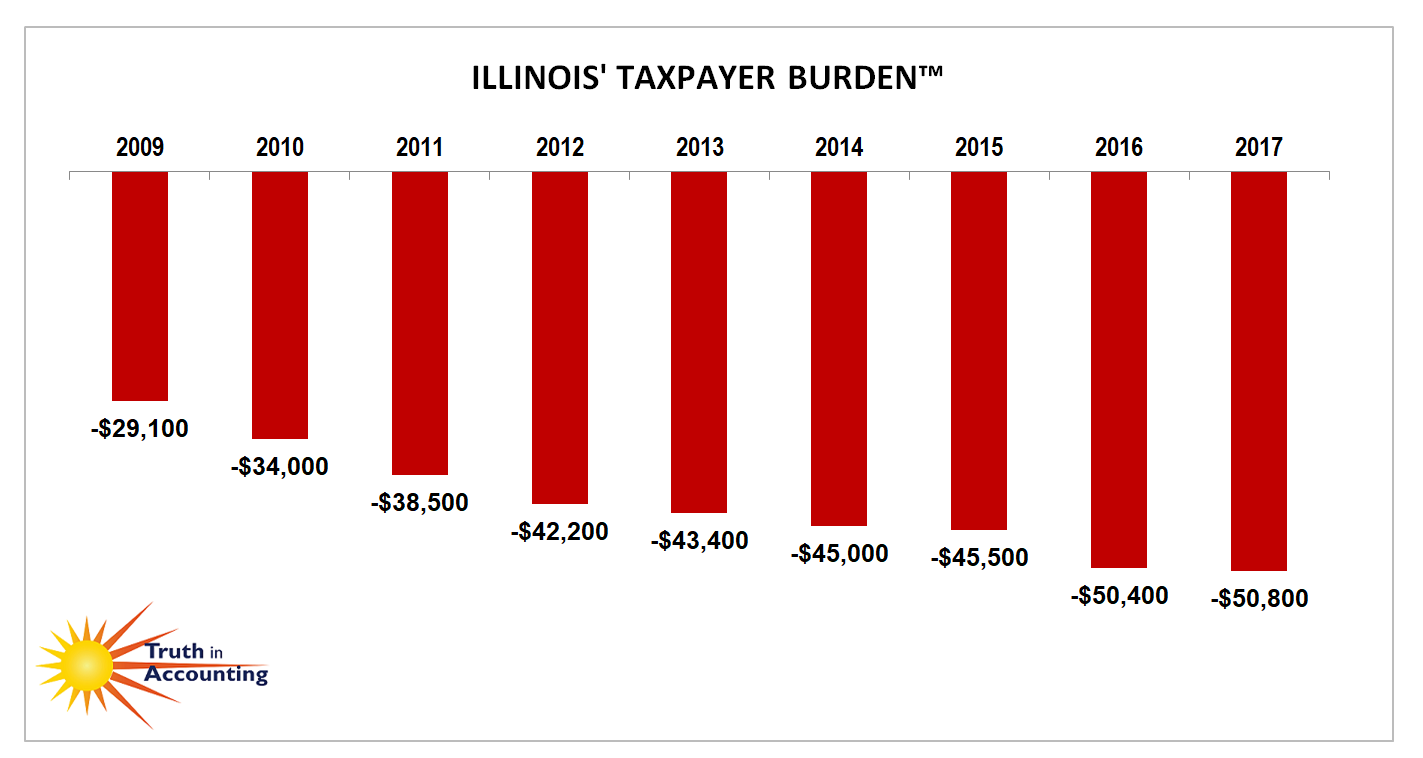
    Illinois’s debt is over $200 billion, with state assets of about $20 billion, and this doesn’t even count local debt, which adds another $100 billion onto the flaming pile. This breaks down to over $50,000 for each and every taxpayer in the state. So you can see that the Three Stooges of How We’re Going to Fix Things beloved of politicians giving speeches (“Waste, Fraud, and Abuse”) are down in the noise; $100 million dollars doesn’t scratch the surface. The tax increases that have been proposed (which will somehow magically not drive people and businesses out of the state at a faster rate than they’re already exiting) aren’t even close to enough to cover this debt.

    Well, how about cutting spending? Let’s look at that a bit, starting with what we’re spending the money on.

    Far and away the biggest cause cause is well-known: public employee pensions and health insurance benefits costs. How bad is it?

    Here’s a delightful graphic which just looks at one typical municipal issue, cops.

    Though there’s variation from county to county, the pattern remains the same.

    How about fire?

    So again, the pattern is clear. If we cut every single penny of cops and fire protection spending, closed every police stations and fire house, and could somehow get around the unions and fire every worker, we would STILL be vastly underwater. There’s nothing unique here; there’s similar charts for teachers, nurses, clerical, administrative, and every other type of state leech employee classification.

    The debt, pension and health insurance costs for retired state workers represent over $185 billion, or about 85% of the Illinois debt. It cannot be stressed enough: this is for people who are no longer working. You could fire EVERYBODY currently employed, cut every goddam program (good or bad), shutter every building, and barely dent the issue. These deals were put in place by the generations of family politicians who have run the state and municipal governments, the Daleys, the Madigans, the Stevensons, the Simons, the Jacobs… all enriching themselves and their hangers-on, while pulling hundreds of millions from the fabulously corrupt unions to indebt all the rest of us.

    So since we can’t tax our way out, we can’t reduce spending enough to make a difference, I guess there’s only one thing left to do: cut the pensions. Oh wait…

    Membership in any pension or retirement system of the State, any unit of local government or school district, or any agency or instrumentality thereof, shall be an enforceable contractual relationship, the benefits of which shall not be diminished or impaired.

    The above is Article 13 Section 5 of the Illinois Constitution. That’s right, it’s in the fucking constitution that we can’t touch the vast bulk of where the money is pouring out. If you want to cut even a dime of the vast sums of money being spent on people who aren’t working , you have to amend the constitution. To do that, there must be an affirmative vote of 2/3 of the House of Representatives and the Senate AND then be approved by a majority of voters on a special election ballot, most of whom do not pay the bulk of taxes. This is de facto a nearly impossible hurdle.

    So we can’t win, we can’t break even, and we can’t get to absolute zero debt. The politicians running who pretend to have ways to fix things and to help taxpayers and property owners are lying scumbags. We are all fucked. Like so many others, I’m doing everything I can to get the hell out of here.

    I will not miss this place.


  • I Fucking Love Astrology: The Horoscope for the week of October 14

    This week is a little annoying.  You try to read the stars, but the stars mainly care about BIG IMPORTANT PEOPLE, and that’s… not the Glibertariat.

    For example, there is a giant blinking “ruler’s spouse gets caught in extra-marital sodomy,” but since none of you are ruling so much as Andorra, I can’t really tie it into my target audience.

    So let’s see what we can find:

    Earth-Venus(retrograde)-Mercury-Luna.  We’ve got home, double-change, and bad love life.  One of the change signs (Mercury) also appears in the alignment:

    Jupiter-Mercury-Sol.  Jupiter can be read as government/rulership/legitimacy/order/status quo or as a more general happiness/good spirits sign.  The Sun is life/growth/general goodness and of course, we have Mercury, the messenger of the gods bringing news/tidings, and it is also the most powerful change sign in the heavens.

    If you smoosh these all together and force it into a political context, you get “The growth of government (government program) leads to your home life going to crap.”  But how?  You could look at the sign you haven’t given a place in your interpretation yet (the moon).  The moon is associated with change, femininity, the tides, water, and emotion.  So this gives us the possibility that you read something and go on an anti-government tirade, pissing off your S.O. who makes you sleep on the couch.  Or maybe that a new regulation shuts down your charter fishing company, resulting in a decrease of income.  However, this last bit is contraindicated by the fact that the moon in a waxing crescent, indicating growth, not loss of income.  But the moon is in Sagittarius (the archer) which could indicate that your squeeze dumps you for the newly hired game warden hottie that they met.

    But none of these interpretations are right, because forcing your reading into any particular context is a guarantee of getting it wrong.  The Universe hates a wiseacre.

    So what it the correct interpretation?  Fuck if I know.  I’ve been up all night this week getting my house in order for the arrival of family members totaling one glib, four adults, three children and a particularly large Great Pyrenees/St. Bernard cross that refuses to accept her place at the bottom of the social hierarchy.

    Moving on.

    Libra loses some of their good luck this week, but keeps their general well-being enhancement from their sign being the FOTM.  Their loss is everyone else’s gain, and Mercury moves out of Libra ind int a sign where it feels more comfortable.

    That sign being Scorpio.  Unfortunately, this is just bringing it into conjunction with Venus(retrograde) and Jupiter.  Q is really lucky his birthday was last week, because this is not a good week for the nookie.  However, you will NOT be contracting a venereal disease this week, so silver lining.

    Saturn in Capricorn and Mars in Aquarius continue to bore everyone.

    As mentioned above, the waxing moon is moving into Sagittarius.  Good omens for hunting.  Just don’t expect wonders in the sleeping bag afterwards.