The most understandable reason, obviously is utility. Certain properties of these metals can accomplish what nothing else can, or at least, at a far less cost.
However, that doesn’t seem to relate to the value of most of the precious metals.
(Note: I’d add copper) The value of these metals appears totally unrelated to any utility they have. Their utility as money (rare, stable units) may play a part today.
911 Metallurgist gives a good rundown of why people would want these metals for specific business / use purposes. And while that’s understandable, it doesn’t account for the massive price of the metals beyond what they can accomplish economically.
That’s my main point: these metals are valued at a price point far beyond their utility. So what makes them valuable?
The history of civilization does provide a massive clue: they have been used as currency for millennia. But the question regarding fiat currencies still applies: if no one values them, do they have any value?
When last we left Don Swissxote, he was musing on Spain’s pursuit of Catalan Independence leaders and the narrow election of separatist or separatist sympathizing parties in the Catalan legislature. So what has change these past few months?
Not a lot.
Spain’s government seems to have realized they had waved a meat cleaver at the Golden Goose that is business in Barcelona (though tourism there seems to be just fine). Some futile gestures, demonstrations and the like have taken place…and both sides have realized they are screwed (here is Teh Conventional Wisdom view).
The populace of Catalonia seems to be split between those that just want to go back to the way things were and those that want to passively resist Madrid. The Spanish government is going ahead toward some rebellion trials of Catalan separatist leaders, but has lowered its efforts at outright squashing of Catalonia by force.
Not a particularly helpful look“Totality of the circs!”
So Spain looks like a pack of shitheels if they come in swinging clubs and dragging people off for trial for “rebellion” when the populace seems committed to a sort of passive course of ….something. Political gridlock has set in, when you look at the Catalan parliament. Federally, the Catalan pro-independence bloc might be able to cause the current PM’s government to stumble…but what might replace it? If the rest of Spain sees the Catalans jerking them around, they could vote in people promising to kick Barcelonian butt a lot harder than the current Socialist government.
So we have a populace that will not use force to free themselves, and is not making too many waves right now, versus a central government that won’t crack heads and is leaning on the economy and votes of …the place that wants to leave. Of course, some silly things will still be happening, around the edges (what, no appeal to mediation by the Dalai Lama, the Commercial Court of the Canton of Zurich and the military junta of Burma?).
It is almost as if two semi-bored chess players see a stalemate coming, and are in hurry to push any more pieces. I sure didn’t see this coming…but it is so very…modern European, isn’t it?
This is the first in a series to discuss my Constitutional Property Rights Minarchist philosophy. I will take a look at each element individually before putting it all together. I figured I would start off with the nature of rights because that takes two of the CPRM parts off the table at once. This is because all rights are derived from property rights, which I aim to show through this thesis.
So, what exactly is a right? Is a property right different than a human right? Is the right to keep and bear arms different than the right to free speech? Where do rights come from anyway? I bet they were just made up by some old dead white guy, so they don’t matter. Most of what I’m about to say is probably old hat to most of the readers, but I decided to lay it all out just to make sure before I get to the big picture.
One note on rights off the bat (I like to reference pop culture) my favorite quote on rights actually comes from the band Powerman 5000 in their song ‘Free‘.
“It’s not something you can hold It’s not something you own It’s not something you can buy or steal You’ve got it when you’re alone”
A right is something you have regardless of where or when are born. To hit on the points above, it is a human right. Just by being human these are the rights you posses (why they’re limited to humans will be addressed later on). Well, if it doesn’t matter where or when you are born, then that means certain things can’t be rights. A person born where there is no water can not have a right to it, otherwise that ruins the whole idea that it is inherent in being human, unless you wish to posit people born in a desert are not human, but that would be awfully racist of you. For shame. I think you need counseling to deal with your racism. But you aren’t important, the idea is. So I digress. What other things can a human be born without that some call rights? Well the big one today is healthcare. But that is an even more resource intensive thing than water, I mean we could all spare some water, but there are only a limited few to provide healthcare. That would mean that to provide healthcare to masses would be to compel certain people to provide it. Another thing, which is written into the South African Constitution, is housing. Well, if you have a right to housing, that is also something someone else must be compelled to provide. I keep coming back to that word, don’t I. Compelled. It sounds so innocent. But what does that really mean? Let’s check Dictionary.com
“com·pel
kəmˈpel/
verb
past tense: compelled; past participle: compelled
1.force or oblige (someone) to do something.
“a sense of duty compelled Harry to answer her questions”
synonyms:
force, pressure, press, push, urge; More
bring about (something) by the use of force or pressure.
“they may compel a witness’s attendance at court by issue of a summons”
literary
drive forcibly.
“by heav’n’s high will compell’d from shore to shore”
Oh, gosh that sounds violent. By use of force?
No, we’ll just make a law about it.
How will that law be enforced?
Well by a tax, or a program.
And if people don’t comply?
Well, they’ll get taken to court and fined or put in jail!
And if they don’t show up to court?
They’ll show up.
But if they don’t?
Well, the cops will make them.
How will they do that?
Listen man, people do what cops say.
And if they don’t?
Then the cops make them.
How?
They just do.
Is it the fact the cops ask nicely or the fact that they have guns?
You’re killing my buzz man, leave me alone!
So to go back to the beginning. Yes it is the old ‘private island’ thought experiment, but with a small change. It’s not an Island, but any place on earth where the first humans were the first intelligent beings to move to (that intelligent beings bit will come back on my promise of why they are human rights). Ug shows up with his sharp stick and his loin cloth in lower Mongolia. When he gets there what does he own? Well, of course he owns his own body, he is a slave to no man, and ownership of everything else extends from his self ownership. And that sharp stick, he found it and chewed it for miles to sharpen it. The loin cloth, well he stole that, so that’s a bit more complicated on the ownership front. So he arrives in lower Mongolia and there is nothing there. There is like this one pissed off falcon circling overhead and Ug saw some wild dogs a hundred miles ago. But that’s it. So Ug decides he’s tired of roaming sits his ass down and says ‘shit, fuck this Ug build himself house!’ There aren’t many trees around, but Ug finds enough to build a frame for a rough stone age yurt. He then hunts enough animals and tans enough leather to to finish his new domicile. Ug found some wild grains and harvested the seeds, carefully planting them and tending to his new garden. Then a wild goat shows up, he grabs it and builds a nice pen. The goat provides him with milk to make up for the absence of an accessible source of water. Months pass and Ug has made a nice little home for himself. Then that asshole Ur shows up.
You goat be mine. You house be mine!
No me house mine!
No, me Ur be mine!
No, me Ug be mine!
After a tense stalemate. Ur makes an offer to Ug.
Me know how make fire!
Me know how milk goat!
Me want milk!
Me want fire!
Me give you fire for milk!
Me give you milk for fire!
Me take your house!
Me give you place to build house, if you give me hard rock!
Me give you hard rock, if you build me house!
And that is the right to contract. Ug created things that were not there when he arrived, and owned those as well as himself. Ur owned a rock which Ug wanted, so they traded. I know this is all farcical, but these are the underpinning ideas. You own your own body. You own the fruits of your labor, which you may trade for payment (today we call this going to work). But you know who doesn’t have any rights? Animals. You know why? It’s not because I’m racist against animals, believe me I have lots of animal friends. No, it’s because animals don’t understand rights. That is an important concept. To you this whole diatribe while slanted and farcical, is something you can understand. If I tell you this is mine and that is yours, that is a concept a human can grasp by the age of three. If you try telling that to a 100 year old tortoise it will still just eat your lettuce and shit on your floor. Tortoises are assholes.
On the side… On the back… On the front… No Glibs, it’s not that kind of three way we’re talking about. This particular THREE WAY is a “Contour” watch made by Hamilton Watch Company of Lancaster Pennsylvania for only two years – 1938 and 1939. It was a massive market failure and as a result is one the more highly desirable watches made by Hamilton because of its scarcity. The watch sold so poorly that Hamilton bought back all remaining stock from its retailers, removed the movements to re-use them in more popular case styles and recycled the Contour cases.
The New THREE-WAY “Contour”
So called “driver’s watches” that could be worn on the side of the wrist became trendy in the late 1930s. The Contour was Hamilton’s answer this trend. Hamilton watches were arguably one of the best mass produced watches of the time. Many would say they are better than anything almost anything of the period except for some limited production Swiss watches. In terms of massed produced watches the American brands were generally superior to the mass produced Swiss watches of the same time.
For whatever reason it’s also the watch that my maternal grandfather wore. I’m not sure if he liked the style or simply got a deal on a watch that didn’t sell especially well. Sadly, I never got the chance to ask him about this particular watch as I found it when cleaning out a closest in the basement after he died. Fortunately, I was close to my grandfather and we did talk about many other things.
Restored Hamilton Contour – Click for Full Size Image
When I found the watch it was missing its band and buckle as well as its stem and crown. It also had a cracked crystal. Luckily as a Hamilton collector I had an original stem and crown in my parts collection. For a band I used a period correct pigskin band with a period correct gold filled buckle. I was able to order a replacement plastic crystal that you see in my photos from a parts house. However, later a fellow collector sent me a new old stock original mineral glass crystal after he found out I was restoring a family piece.
The movement in the watch is a Caliber 980 – a 14/0 size tonneau shaped movement that is about 19mm or 0.73 inches in length. The 980 was commonly used in Hamilton’s gold filled cased watches.
Hamilton 980 Movement
This is the original and correct movement to my grandfather’s watch. However, for Hamilton’s higher end and solid gold movements they also made a more highly finished version of this movement called the 982. Functionally it’s identical to the 980, but has more jeweling and finishing. It is one of my absolute favorite Hamilton movements.
Hamilton 982 Movement
In the old days watchmakers would inscribe the inside of the case every time the watch was brought in for service. These cases are far from dust proof and the lubricants of the time also evaporated relatively quickly. As a result watches of the period needed to be serviced every 2 to 4 years. Here is the case back of the watch.
Contour Case Back
And here is a close up of the service marks:
Service Marks – Click for Full Size Image
It appears the watch was serviced from 1939 through 1955. Each watchmaker had a different code and style for service marks so it is difficult to be 100% sure. Today we don’t scar a watch like this. We use a Sharpie to note the date that we last serviced the watch and remove it with solvent when we clean the watch again. With modern synthetic lubricants and gentle usage of the watch you can easily get a decade or more between services.
The case is gold filled which means it is made of brass with thin sheets of gold applied to either side of the brass and bonded to it under high pressure. The thicker the gold the longer it will last, but it almost always wears through on the high spots and the edges of the case. After a decade or so of usage by my grandfather the corners on the top of the case have worn through. There is no way to repair it. Folks have tried to electroplate the cases, but it generally doesn’t work well. It’s a problem with watches from this era as many case styles were only available in gold filled. Here is how the case is constructed:
Case BackFront of CaseUnderside of Case
The dial of the watch is made with sterling silver and has solid gold applied numerals. I’ve never gotten a good answer as to what karat gold the numerals are. The consensus is 18K. The hands are gold plated. The dial is one of the most fragile parts of the watch. There are firms that specialize in restoring dials, but collectors prefer originality if at all possible. Best I can tell this dial is original, but during routine service of the day it wasn’t uncommon for the dial to be sent out for repair as part of a general service.
Contour Dial
Values for Contours in good condition are anywhere between $500 and $1,000 US. Needless to say for me, the watch is priceless and is basically the only watch in my collection that I wouldn’t sell.
A while ago I wrote about the issues of pragmatism in politics. Planning the second part, I ran into a serious dilemma: I could not find the proper alliterative title. I thought of words starting with p to indicate this is a second part of a previous post, but I found none. Redux does not really work but r is sort of like p…
But enough of my personal failings. Let us once more grab pragmatism by the balls… My first post was not a critique of the concept of pragmatism in itself – this can be a different story – but what I called pseudo-pragmatism. This is basically completely ignoring principles and the multitude of problems with many politicians in the name of so called pragmatism, leading descending spiral of corruption and incompetence which is not in any way “pragmatic.”
This led me to think, get the old rusty cogs turning among the cobwebs. Where is the place of pragmatism in libertarianism? Can we find it some room of its own? The answer to this depends on who you ask. Because, otherwise, libertarianism would be thoroughly boring.
I thought about expanding on the issue by analyzing pragmatism and ideology, not pragmatism and every day politics. Because I believe that an ideology which is not at least somewhat rooted in reality is mostly pointless, and basically not that better than utopian communism. It is quite easy – as the corpus of fantasy literature shows – to imagine all sorts of things and put them in words. Something that will actually work in our world – and not Middle Earth – is more difficult.
To be fair, feudalism is probably better than anarcho-syndicalism
Now, given there are 10 different opinions for every 9 libertarians, I assume few will agree to what exactly constitutes pragmatism in ideology. But, as many of our little talks around this place are in agreement, let’s get controversial.
The main issue is: to what point can you bend a principle in service of being pragmatic, before it ceases to be a principle? Some would say not at all, slippery slope and such. Others would try to define some minimal leeway in it. Another way of viewing things is: can we design the principles to be pragmatic? My island experiment post was an attempt to start from some basic premise and define some principles, while keeping an eye on reality.
So let us dive in the deep end… I see two types of political discussion. One idealistic, how we would like things to be in perfect universe (cough anarchism) and another what is a good enough ideology for the world we live in – presently, not 500 years from now or in some post scarcity utopia and/or dystopia. My answer is along the lines of minarchism plus, a form of limited government, free(ish) markets and personal liberty, enabling for each a life as close to what they want as can be.
Now, I am all for talking anarchism for the sake of an interesting debate, but after a point, we need to get back on Earth Earth and see what has a chance in hell of working. What is not impossible, but merely highly improbable? Anarchy? Yeah… no. Minarchy? Probably not true minarchy. Reasonably limited government? Well that is a very long shot maybe. Which, in the end, we might never live to see, but I am saying there is a chance.
To clarify, by working, I mean something that allows the individual to live and thrive. Feudalism was stable for many years, but I would not say it worked. Certainly not for the serf. One out of 100 people in a harem may think it is working. Somewhat anarchic Zomia worked a while, only if working means hunting, gathering, swidden agriculture and almost no capital accumulation.
While this may or may not be possible, I am trying, against the modern trend, to find principles as objective as possible, otherwise it becomes a quagmire of subjectivism and feels. So I am trying to think of some basic guideline of organizing a political entity. This is not necessarily fully libertarian, but something that maybe can appeal to a slightly broader demographic.
We can dismiss out of hand ideas that would work if humans were different. Humans have a certain nature, respond to incentives and are not some sort of altruistic angels. Teach murderers not to murder is not a viable idea, certainly not pragmatic in any sense of the word. Due to the problems associated with putting humans and power in the same room, I will say outright that no ideology without some clear limits on state power can function.
As I believe that, quite objectively, humans are unique individuals, I believe any system needs to focus on individual human rights, not collective ones. A system must not sacrifice individuals – which are obviously a real entity, you can touch them if you want, as long as the sign the consent form – for the sage of a vaguely defined society – which may have a function as an abstract concept but does not really exist. Neither tyranny of minority or majority must rule.
A functioning country must have some level of stability. A revolution every two years is not sustainable. At the same time there must be a way to change whatever “leaders” there are. Whoever is in a position to wield tools of coercion – police, justice, taxation, regulation, whatever – needs to be held accountable and have some skin in the game. History shows that when leaders can act with impunity, nothing good happens.
So is socialism right out? Socialism was always right out. I never got the whole socialism would work if humans were better. If humans were better, it would still not work and anyway there would be no need of it. There is no situation where socialism is needed or desired. We can dismiss democratic socialism. It is lipstick on a pig, trying to add the veneer of legitimacy by the democratic part.
Any form of dictatorship or monarchy should be excluded – this can rarely exist with accountability. A monarchy can be ceremonial at best. Any form of democracy must not lead to mob rule and must be restricted by the fundamental rights of the individual, as history can show us how people were often mistreated by bad laws that had the support of the majority. Excessive centralization is not desirable. This reduces accountability and skin in the game. It concentrates power and it makes corruption easier. It makes the coercive institutions distant for the individual.
Economically, for better or worse, say what you will of the tenets of small government decentralized republics, it worked some. Yes, there was graft and government imposed monopoly and protectionism, but keeping government somewhat limited meant these could not mess things up to much. And when the state grew too much, there were always problems, even in the Swedish paradise.
Socially, the main problems were brought by putting the so called collective over the individual. There are no clear models in history for ways of organizing that did not do this. Monarchies, republics, dictatorships, theocracies, capitalism, socialism they all wronged people. The solution is simply extending laissez faire economics of small government to the non-economic issues. I do not believe in social and economic division of freedom. They are either both or neither.
Now what are my principles? Well I believe rights are individual and that peoplekind [hupersons?] are social beasts. As such, living together, various conflicts appear. The core role of government is solving or mediating these conflicts in a fashion which best preserves said rights. There is an individual sphere – what is inside is none of societies damn business – and a common sphere – which is basically interaction of individuals, and the main issue with many forms of government is bringing into the common things that are individual. To take a small example, there can be a case for common involvement in health when it comes to contagious diseases e.g. quarantines, but not when it comes to broken legs.
Believing in non-anarchy, I believe there is some taxation needed and this, in my view, is where I bend the principle some libertarians hold of taxation is theft / extortion / whatever. So to get to the actual point, basically the single land tax is a good idea, is where I am getting at.
Anyway I think this topic can go on and on and as such I want to take it to the comments section… So how do you like your principles, fellow glibs? Medium rare or blue? Not cooked at all? Discuss …
“Education begins the gentleman, but reading, good company, and reflection must finish him.”
–John Locke–
To start off, I wish to thank Suthenboy and Trshmnstr in particular for inspiring me to write this after I read their pieces on rights, Natural Rights, and Natural Laws. Now for the meat of this piece.
After my trip to the United States last month (Florida Glibs Represent!), I came back to my residence in Japan with fresh thoughts on the conditions of my fellow Americans, a few souvenirs for the office, and an old kindle from my father packed with tomes on political philosophy and the fundamentals of capitalism (such works included were The Law, The Road to Serfdom, Free To Choose, etc.). This, along with the pieces I’ve read on this website (I cannot thank the Founders enough for giving liberty-lovers like myself a home) and recommendations by fellow users here, were the inspirations for getting me back into reading for my own entertainment and knowledge. My long academic career killed most if not all of my passion for private reading and studying for quite a number of years.
Lecture #1000 on how FDR Saved America with Socialism
When it came to education (by education I mean the system and the curriculum), my teachers were able to convey the basic information, but they unfortunately left a lot of important details out. For example, my colleagues and I were taught about what the Bill of Rights or the Declaration of Independence were as well as the U.S. government’s structure in our Civics and American History classes, but we were never taught WHY? What made America, what made our Founding Fathers develop and implement this revolutionary system? When it came to learning contemporary or inspirational political theories, we were only taught of Jean-Jacques Rousseau, John Locke vs. Thomas Hobbes (we were only taught the titles of their works, not exactly the content or comparisons of their works such as Two Treatises of Government and Leviathan respectively), and there were only passing references to the “Father of Capitalism” Adam Smith and Common Sense’s Thomas Paine. Also an honorable mention in class was The Federalist Papers however brief the mention was.
Regrettably, I had no idea about the significance and dare I say it, nature, of natural rights and natural law until just this last year or two! I also didn’t know about Cicero or Charles-Louis de Secondant aka Montesquieu. To those who may not know, Cicero was one of the earliest proponents of the priceless concept that is Natural Law and Montesquieu was a major influence for the United States’ system of a tripartite separation of powers. These two individuals were definitely major influences for the Founding Fathers and Writers of the Constitution, yet all the textbooks and readings we were ever assigned never mentioned them. We were also never taught about Alexis de Tocqueville and his classic work, Democracy in America among other prominent authors in early American history. Finally, we were also never taught about the intentions of the Founding Fathers or the Writers of the Constitution (as seen in Washington’s Farewell Speech, various personal letters, or in The Federalist Papers). It took me quite a few weeks of lunch breaks, slow office days, and weekends to go through various works and subsequent analyses to understand and digest them.
Seize the Memes of Production
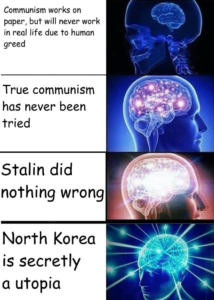
This next bit tackles a very different subject from the above, but I feel it is also gravely important especially considering recent events. Another major concept we were never really taught about in school was the exact nature of Communism. To be sure, we learned the basics of Communism (The People™ own the means of production, classless society goals, y’all know the rest) or who Vladimir Ilyich Ulyanov “Lenin”, Karl Marx, Mao Zedong, and Josef Stalin (gulags were also covered, thankfully) were in our World History classes. However, we were never taught exactly WHY Communism has failed in practically every attempt it has been implemented or why the concept DOESN’T look good or function even on paper.
With the “knowledge” I received from my school studies (this was all from Catholic private schools and my public college years), I was led to believe a government that ensures its citizens are totally equal, aren’t necessarily “poor”, and provided for is a good thing. What a shame that all the people who run this form of government always end up seizing more power and implementing Not-Real-Communism™. As a result, I was one of many young minds who merely thought it was a good concept on paper, but bad in application. To discover the answers and truth for myself, I had to dive straight into the heart of it: The Communist Manifesto. With an open mind and my almond primed, I finally read and understood for myself how rife with anti-life, anti-liberty, and anti-property rhetoric it was. I, for one, firmly believe in the concepts or the truths of Natural Laws and Natural Rights (ex. the rights to life, liberty, and property), all of which would be neutered by the philosophy and application of Communism (no absolute truths exist in Communism, Товарищ). If one is a member of the filthy “bourgeoisies” or refuses to cooperate with the revolution (looking at you Kulaks and Wreckers), their lives are to be forfeited for the sake of The People’s™ Revolution. If one wishes to ensure total equality in every way as well as micro-manage everyone’s actions and thoughts (ex. Communism requires the erasure of disgusting “Bourgeois-influenced” pre-revolutionary thoughts and memories for it to “work”), it would require a most repressive authority that would definitely violate everyone’s basic liberties. Finally, the abolishing of “Bourgeois” private property (such as the fruits of one’s own labor) and inheritance rights are self-evidently anti-property and anti-prosperity.
In my experience, those of us who grew up after the Berlin Wall and the Soviet Union fell (I was born in May 1992) were not told of many major contemporary references that could teach us about the horrors and evils of Communism’s application (yes, there are numerous unfortunate examples even today, but these are usually hand-woven away by some of our “experts”, educators, and media as the results of “American Capitalist” corruption, poor management, or just poor luck). However, I was fortunate my grandparents who were politically exiled after the Cuban Civil War (to paint a picture of them: one of my grandfathers was a soldier who fought and suffered injuries during the fights against Fidel Castro and the other was a toy store manager who was tortured and imprisoned for a crime he and his coworkers did not commit) taught me about life under that repressive system. I also heard other experiences from people such as North Korean defector Park Yeon-mi and Chinese immigrant Lily Tang Williams (I recommend watching John Stossel’s interviews and pieces with them in “Playing the Victim” and “100 Years of Communist Disaster” linked at the bottom if you haven’t seen them yet).
More Likely Than You Think
To conclude my self-study to ascertain why Communism could never work and how vital natural rights and laws are, I took some time to reflect on my life. In my experience, I never liked being coerced to give away my possessions or my time to random people (I try to be a charitable person, but it is always of MY own volition). My social interacting growing up also strengthened my belief and practice of the golden rule (thank you parents and my local church for instilling that in me). I also discovered how people even under the most similar socioeconomic backgrounds could have entirely different outcomes due to all sorts of variables and factors, many of which ultimately can never be controlled. Some of my closest friends ended up working all over the country for various companies, some are still stuck with their parents and getting their acts together. Finally, upon reflecting on my experiences living in a very rural part of Japan by myself with minimal assistance for years as well as the experiences of my grandparents when they first came to the United States of America with just a suitcase at best, I learned how they, other individuals, and myself can have the strength, will, and initiative to be self-sufficient and not just survive, but THRIVE. Our natural rights give us the foundations we need to build our lives and prosper, forwarding the progress of human civilization.
In conclusion, I believe self-study is important if not essential to an individual’s growth. Sure, our education system does a bang-up job teaching its citizens (please laugh), but for us to have a true understanding of why things are the way they are, how we can build a better future for not just ourselves, but for our families and those we care about, and what we can do as individuals to ensure the above, we must study for ourselves. Whether we study by reading the works of various minds of the past, speaking with our forefathers, the elderly, or friends about their experiences and beliefs in detail, or simply reflecting on our own lives and experiences, we should practice self-studying to complete our intellectual journey as much as possible in the short life we have.
As a final note, I wish to encourage everyone here to follow John Locke’s advice to take a few moments when you can to sit down and read a book, even if it’s one with content you may strongly disagree with (if anything, you can learn how to argue against a particular idea/belief more effectively), spend time with your family, loved ones, and friends, and finally, spend some personal time to reflect on significant moments or influences in your life that shaped your beliefs or who you are as a person today.
Thank you fellow Glibs for reading and I hope you all have a pleasant day.
Credits and Inspirations:
“What are Rights?” and “What are Rights? An Encore” – Trshmnstr “Not Just Self-Evident” – Suthenboy
The Glibertarian Community The 5000 Year Leap: Twenty-Eight Great Ideas That Are Changing the World – W. Cleon Skousen The Communist Manifesto – Karl Marx and Friedrich Engels Two Treatises of Government – John Locke Ameritopia – Mark Levin
My Parents and Grandparents (R.I.P. Abuelo Tim, I love and miss you very much) “Playing the Victim” with John Stossel featuring Park Yeon-Mi “100 Years of Communist Disaster” with John Stossel and Lily Tang Williams
Besides being a pervert, and a libertarian, I’m also motorcyclist. It is a hobby I’ve had for over 15 years and I still consider it part of my life. There’s really nothing like the feeling of freedom when riding a motorcycle down a country mountain road. This essay will be a little rambling, much the way I like to ride. Hope y’all enjoy it.
I bought my first motorcycle in 1999. My dad had been riding a few years, and I decided to ride bitch on the back to see what it was like. And I was fucking hooked. At that time, I’d had my first real job. I had my own place, and money in the bank, the recipe for first motorcycle ownership. Within a week of that ride, I had purchased a used Honda Shadow 600 and all the gear I needed. I taught myself how to ride in a parking lot and off I went for the rest of the summer, taking rides with my dad and his friends.
And my God did I enjoy it. The only thing close to the sense of acceleration I’ve ever experienced was sky diving. There’s a strange alchemy that happens; the gasoline is converted to freedom via the engine and a connection with the world around you that is simply joyful is transmuted from the speed and wind. Not to horn in on Persig, but there is something Zen about riding. Once you get the mechanics of it, you can reach a state of flow, where your body is taking in all the inputs and piloting the machine so smoothly, so perfectly, it feels like you are in that state of being one with everything.
It is dangerous though. There is no denying it. Donorcycle is a word for a reason and so is squid. There isn’t much protection on a motorcycle, and mistakes can cost you dearly. There’s ways to mitigate the risk; safety classes, good riding habits, proper gear, but there’s no denying the danger. I’m honest enough to admit that is part of the thrill. Part of the fun is that testing of your own skill and nerve.
I went on to take safety classes, teach them, and I’ve owned about 10 motorcycles over the years. From Honda to BMW, from Triumph to Harley-Davidson. I’ve worked on them in my garage. Though I’m at best good for doing bolt-on accessories and extremely simple maintenance. I’ve helped my dad change stuff on his bikes, from replacing the pipes to swapping the carb. And vice versa. There’s still an element of pride in customizing your bike, making it yours, an expression of your individuality that is satisfying. Add in spending time with your dad and it’s hard to think of a better way to spend time besides actually riding.
Current Ride. No it doesn’t mark its territory
A motorcycle allows for both solitude and camaraderie. Riding a motorcycle down a country backroad, somewhere with curving roads and beautiful scenery is a rare respite from crowds. You get to be alone with yourself in a positive way, let the motion carry off your cares and worries and focus simply on enjoying the ride with no voice but the engine’s growl and whip of the wind. Or you can ride in a group, safely ensconced in a pack of people with the same interest, enjoying that feeling of doing something fun with people you like. Making a day of it, stopping to eat and laugh and relax. I gained, and later my friends my age gained, a great deal of wisdom from such rides with my dad and his pals.
As you may have noticed, riding was often a way for my dad and I to connect. Some of the rides we took will be those memories I hold onto for a long time. I remember one year we went to a rally and as was our habit we didn’t haul the bikes in a trailer, we rode ‘em. The last night of the rally he dumped the bike on his foot and broke it. I had to rent a 20’ UHaul to get us and the bikes home as that was all that was available. I had to ride both bikes up the little loading ramp to get them in and then drive us both home 400 miles in that monster. My dad and I still reminisce about that trip and laugh. We were chatting about it and other rides that were both perfect and not so perfect last week. He’s selling his motorcycle this spring as he is no longer going to ride. He wondered if I wanted the bike, but I have one, and for now that’s enough.
I wonder though. All the miles under my belt on motorcycles, the joy I get from riding, one day the risk will be too high for the reward and I’ll hang it up too. I hope that day is a long way off.
A long time ago in a land far away there lived a tiger, who had been hunting for two long days. He was very tired, so he decided to lie down in the shade of a mango tree, underneath some cool foliage, and take a nap. He fell asleep.
Presently, he became aware that something sharp kept poking into his haunches. He opened one eye to see a little squirrel digging his claws in his side.
“Say, little squirrel, what are you doing?” asked the tiger, who was wise and could not fault the dimwitted rodent for poking a sleeping tiger.
“I’m feeling your muscles, to see how firm they are.”
“Well, little squirrel,” said the tiger, flexing his paw, “feel my arm and then go away. I have been hunting for two days, and I am tired. I want to sleep.”
So the squirrel felt the tiger’s muscle and said, “Thank you, Mr. Tiger. You’re very strong, but not as strong as the tiger in my glen.”
The tiger snorted, for it made no difference to him who was stronger, and went back to sleep.
Soon he was awakened to the feeling of his fur being rubbed the wrong way. He opened one eye. “Say, little squirrel, what are you doing? It hurts for my fur to be rubbed the wrong way.”
“Oh, no!” said the squirrel. “I’m not rubbing your fur the wrong way. I’m testing the resilience of the hair fibers.”
The tiger said, “Call it what you will—stop doing it.”
“Mr. Tiger!” cried the squirrel, even as he continued to stroke the tiger the wrong way, “why are you angry with me? I have done nothing!”
“You have awakened me, and you are rubbing me the wrong way. Please leave me to sleep, as I have been hunting for two days and I am tired. You have tested the resilience of my fur long enough now to know.”
“Well,” huffed the squirrel, “your fur isn’t nearly so resilient as that of the tiger in my glen.”
The tiger said nothing to that, understanding that the squirrel seemed even less clever now than he did before. “Go away, little squirrel. You are in my glen now, and I would sleep.” So he did.
It wasn’t long before the tiger awoke to find little squirrel-fists full of tufts of his hair being plucked. “Little squirrel,” said the tiger, beginning to lose his patience, “I thought I told you to leave me be. Did you not understand that I have been hunting, and I am tired? Do you not understand that I have been very patient with you so far, and that I could gobble you up if you anger me?”
“Well! I never!” pronounced the squirrel. “How dare you be angry with a little squirrel like me. I have done nothing to you that you should be so upset about!”
The tiger tried to be more patient, as it was clear to him that the rodent had no sense. “You have awakened me three times when I have told you of my wish to sleep, you have poked my haunches, rubbed me the wrong way, and pulled my fur out of my skin. How can you say you have done nothing? Begone, rat, before I eat you.”
The tiger saw that the squirrel was much offended by this speech. The squirrel replied, “Well, in any case, your fur is easier plucked than that of the tiger in my glen!”
“Then go torture him and leave me be so I can sleep.” And he did.
No sooner had he fallen asleep yet again when tiny rodent teeth bit down into the tender flesh of his ear. He awoke with a deafening roar.
The little squirrel scampered just out of reach and the tiger, rubbing his ear, said, “You really are not very bright, are you?”
“How dare you!” squeaked the squirrel as he danced an angry jig. “I have not lowered myself to calling you names! How petty you are! The tiger in my glen is not petty!”
The tiger, being wise and patient, would have ignored the rodent, but for the gleam of wicked intent he suddenly glimpsed in the eyes of the squirrel.
“You have been bothering me on purpose,” said the tiger slowly, seeing that the squirrel was not stupid—just disturbed and wicked. “To what purpose, I do not know, but on purpose nonetheless.”
“I have not!” said the squirrel. “I have been comparing you to the tiger in my glen! How dare you not let me perform my examination just because you are sleeping. You are out here in the open, at the mercy of just any squirrel! How dare you accuse me of bad things!”
“Well,” said the tiger thoughtfully, “did you get what you were after?”
“Oh yes!” replied the squirrel, gleefully, a look of triumph in his eyes.
“Good. Then you won’t mind if I—”
And the tiger gobbled him up—and finally got some rest.
Occasionally, it’s good to see where we stand in regards to our political infighting in the good ol’ US of A turning into armed conflict. 13 months ago, I wrote an update that highlighted some of the dynamics that may spark Civil War II. Looking back, I mostly stand by what I said at the time, but some of the dynamics have cooled off since then. Specifically, I wrote:
Overall, I’m still pessimistic on the chances of widespread fighting. I think the worst we will possibly see is an LA riots type situation. However, as shown in Charlottesville, all it takes is one body for the self-righteous leftist media to climb on top and start agitating. Like a high-stakes game of “Press Your Luck,” both sides keep smacking the button, hoping to hit the political jackpot, ignorant of the lurking Whammy.
I still believe that to be true. I’m of the belief that the Left can only muster a LA riot as their maximum amount of agitation. They simply don’t have the fortitude nor the logistical ability to take the fight to the Right. The Right is, and for the foreseeable future will be, the key to any true armed conflict. The Right has the equipment, the tactical advantage, and the fortitude to wage war on the Left if ever pushed to do so. The Left has the motivation, but no ability. The Right has the ability, but no motivation.
Except for the fact that conservative media is continuing to find its own voice by stoking outrage, driving a wedge between themselves and the leftist mainstream media, the Right has nothing to complain about. They have the reins of the federal government, as well as most state governments. They’re winning the charter school battle, and the traditional media is self-destructing. If things keep going the way they are, the leftist hegemony in the universal institutions of society will be broken within our lifetimes.
In my opinion, there are only four ways that a civil war breaks out: 1) There is a significant federal gun control act put in place; 2) the Left grows a pair of balls and takes the fight into the suburbs; 3) Trump is impeached and removed from office in a blatantly corrupt proceeding; or 4) Your average middle-class working man or woman has a substantial chance of losing their livelihood to SJW bullshit. Frankly, 1) and 2) seem highly unlikely.
However, let’s take a trip into the Derplight Zone yet again, and see what’s gonna kick off Civil War II: Antifa Boogaloo.
Isn’t that the Outer Limits?
Let’s imagine a world where this prog-leftist corporate circle jerk intensifies for a few more months. Dicks and Nike and Levi were the precursors, but now we’re seeing major companies daily announce their intentions to fund gun control groups and SJW shakedown groups, and every time a shitlord sneezes in front of an oppressed class, it’s a national case. The constant drumbeat of this shit starts to take a toll not on the A-listers, or even on journeyman race car drivers and local sports announcers. Now it’s senior regional managers and executive editors and anybody with any modicum of power in the workplace either getting #metoo’d or N-worded or pronouned into trouble with HR, no matter the veracity of the allegations. The incentives are there, ruin the life of your shitlord boss, and you’re not only a hero, but the perfect candidate to replace them.
My wife is already concerned about such things. She wants me to do the Mike Pence thing and completely refuse to meet 1:1 with women. Unfortunately, I can’t do that 100% of the time, but I do it as often as possible. I’ve even talked with a couple of coworkers who are concerned about the same thing. They’re not comfortable being 1:1 with women because all it takes is one unprincipled woman with an axe to grind or a path up the corporate ladder, and you’re radioactive.
Anyway, in a world where outrage firings go from one every few weeks to multiple per day across various industries, the primary mechanism for avoiding armed conflict begins to erode. The biggest thing that keeps the US from melting apart in a fiery battle is that most average, everyday people have more to lose by fighting than they have to gain by being rid of their political opponents. When one’s livelihood is legitimately targeted, such incentives flip, and armed conflict is inevitable. Once a critical mass of people feel substantially threatened, they will retaliate violently.
Another relief valve in American culture is slowly being eroded. The Internet, for all of the gasoline it dumped on the political and social fires burning in our culture, also gave a platform for people who agree with one another but not with the mainstream media to commiserate, vent, and discuss current events without feeling smothered by the MSM’s blatant agenda. Now that the push has started for deplatforming, the relief valve is gumming up. Folks on the right are running out of patience when it comes to abridging the 1st and 2nd amendments, and if there is a substantial leftist push to deplatform most conservative, alt-right, and libertarian voices on major social media, it’s like holding a flamethrower to a gas can. God forbid they start trying to get the DNS servicers and site hosting companies involved… overstepping into complete censorship on the Internet will end violently. The Alex Joneses of the world may get completely silenced before the right wakes up from its slumber, but if a mainstream conservative/republican were to be deplatformed or completely silenced, I think more than a few right wingers would see the writing on the wall regarding the 1st amendment.
I think that the left is moving fairly slowly and methodically right now. They know they can bide their time until the midterms, and that after the election, they can go full nutzo on Trump and the alt-right for another year and a half before they need to cool off to look semi-sane for the 2020 election. However, I think there is a narrow path to a very bad place. I think that it starts with a legit blue wave, giving the Democrats a majority in the House and a neutral split of the Senate, if not a slight majority. From there, “all is right” in the world again except for Trump, who would quickly be brought up on charges for an impeachment hearing. The inevitable vitriol from a Trump impeachment, possibly leading to isolated violence would be all the impetus a prog-leftist Congress would need to regulate social media and begin deplatforming the right en masse. Also, once that “racist, sexist, bigot” is out of the way, the easiest virtue signal in the world is to dump a ton of money into a bureaucratic leviathan for helping colleges and companies deal with the #metoo crisis through strict enforcement and a liability shield for companies who shoot first and ask questions later. Maybe toss on a recession as the cherry on top? Repealing the tax cuts and passing a medicare expansion would probably trigger a recession.
The right would very quickly go from having a ton to lose, to having nearly nothing to lose, and I think violence would be inevitable in such a situation. How likely is it that all of this falls into place? Infinitesimal. However, it is the one clear path I see to organized violence.
I’ve noticed that Glibs seem to enjoy the finer things in life and finely made things. So I figured I’d combine the two here. Now that SP has given us the ability to edit in WordPress it seemed an opportune time to share some pictures of an old hobby. Before work responsibilities and old age in the form of poor eyesight and loss of dexterity caught up with me I used to collect and repair vintage watches. I specialized in the Hamilton brand. This allowed me to become familiar with their various movements and to acquire parts for repair.
The Hamilton Watch Company had its genesis as an American watch design and manufacturing company, which incorporated in 1892 and produced its first watch in 1893.
After its formation, the Hamilton Watch Company went on to manufacture and market pocket watches and wristwatches, ending American manufacture in 1969. Through a series of mergers and acquisitions, the Hamilton Watch Company became a diversified conglomerate itself and was subsequently integrated into the Swatch group.
I don’t collect anything made after 1969 and their acquisition by the Swiss. After that point their watches used Swiss movements. Interestingly enough, variations of those Swiss movements are still in use today in many Swiss made mechanical watches.
Hamilton 12 size pocket-watch
This is a Hamilton 12 size gentleman’s pocket watch. For pretty much everyone who has no idea what that means it is 39.79 mm or 1.567 inches in diameter. That’s the width of the movement inside the watch not including the case or the crown.
This particular example is a Grade 922 movement made in 1927. Approximate total production was 14,000 units and they were made from 1924 to 1936.
Smaller pocket watches like this generally don’t have much appeal to American watch collectors. They prefer “railroad watches” which is a whole topic into itself. However, this watch is an exception. It meets all of the criteria for a so called “railroad watch” with the exception of the size – it is too small to be classified as such.
The case is 14K yellow gold, the dial is stirling silver and the hands are blued steel. It’s a beautiful timepiece. But what I find most interesting about it are the parts that very few people see. The entire watch is is engine turned or what for American and some German watches is known as damascening.
Here is a picture of the assembled movement in the watch:
And now for the interesting bits! This is the “plate” on which the watch is assembled.
Top Plate
Notice all the wonderful engine turning.
Here is the other side known as the bottom plate which is actually the hands side of the watch:
Bottom Plate
The bridges go across the top plate:
Bridges
Those are “genuine synthetic” rubies set in gold that give watches their “number of jewels”. In this case 23 jewels and the watch is manually adjusted to keep time in 5 positions.
These are gears of the watch known in the trade as the “wheels”:
Gold Wheels
Watch wheels are almost exclusively made from brass, but in this case they are made from real gold. The reason for the material choice was partly because of the metal’s softness, but mostly because of aesthetics.
Here is the heart of the watch – the balance wheel:
Balance Wheel
This is an old fashioned, blue steel spring, split bi-metallic balance wheel. The screws on the outside are there to balance the wheel. Naturally they are gold as well! Because the wheel is made from two different metals the diameter will change as the temperature changes. This is how the watch keeps accurate time when the temperature changes.
Modern mechanical watches are laser balanced and use a proprietary white metal alloy hairspring that compensates for temperature. The balance wheel in your modern Rolex is a solid piece.
Here’s a beauty shot of the the assembled movement out of the case:
Hamilton 922 Movement
And here is the sterling silver dial which is interestingly stamped “Switzerland” on the back:
Swiss Dial
And finally the cased watch. Notice this has essentially two “backs”. It has a hinged dust cover for the just the movement itself and another cover for the back of the watch. And naturally they are both made out of 14K gold!
Case and Dust Cover
As I don’t often wear suits to work anymore I don’t carry this watch much anymore. I guess I’ll have to find an excuse to wear it again.




 So to go back to the beginning. Yes it is the old ‘private island’ thought experiment, but with a small change. It’s not an Island, but any place on earth where the first humans were the first intelligent beings to move to (that intelligent beings bit will come back on my promise of why they are human rights). Ug shows up with his sharp stick and his loin cloth in lower Mongolia. When he gets there what does he own? Well, of course he owns his own body, he is a slave to no man, and ownership of everything else extends from his self ownership. And that sharp stick, he found it and chewed it for miles to sharpen it. The loin cloth, well he stole that, so that’s a bit more complicated on the ownership front. So he arrives in lower Mongolia and there is nothing there. There is like this one pissed off falcon circling overhead and Ug saw some wild dogs a hundred miles ago. But that’s it. So Ug decides he’s tired of roaming sits his ass down and says ‘shit, fuck this Ug build himself house!’ There aren’t many trees around, but Ug finds enough to build a frame for a rough stone age yurt. He then hunts enough animals and tans enough leather to to finish his new domicile. Ug found some wild grains and harvested the seeds, carefully planting them and tending to his new garden. Then a wild goat shows up, he grabs it and builds a nice pen. The goat provides him with milk to make up for the absence of an accessible source of water. Months pass and Ug has made a nice little home for himself. Then that asshole Ur shows up.







 A long time ago in a land far away there lived a tiger, who had been hunting for two long days. He was very tired, so he decided to lie down in the shade of a mango tree, underneath some cool foliage, and take a nap. He fell asleep.