Category: Media
-
Friday Night – Links After Dark
It has been a long week. A long week of nothing but Brett Kavanaugh news. Having told my news feed I didn’t want any stories tagged “Kavanaugh” twice, it started floating stories about “Supreme Court” “Law” “Dr. Ford” all of which got banned 1-2 times. Eventually it just started floating 6+ stories a day tagged “TRENDING” and occasionally “Anita Hill” which got my phone put in airplane mode for the past two days.
Now that I’m avoiding news. I’m trying my best to fill my online time with pictures of Hemsworth brothers shirtless, but even the celeb gossip rags have nothing for me because they’re all talking about people I’ve never heard of or have purposefully forgotten. Except for dear, sweet Gwyneth Paltrow who is getting married to someone I’ve never heard of after being badly abused by the CA government for misleading consumers with vaginal rejuvenation eggs. Luckily she takes everything in stride.
- Dlisted has a great bear-related Hot Slut of the Day (100% safe for work)
- Lil Wayne, back from his heroic efforts to solve the drug crisis in Mexico, has released a new album and had a party…with people, I dunno.
- Owen Wilson is every episode of Jerry Springer
- Finally, something I care about: Christopher Meloni Butt It’s not OZ-era Meloni butt but then, nothing really is.
And just to convey my disdain for this week more completely: a musical number
-
Disney and Marvel king and queen pimp of copyright kingdom.
This article is inspired by the many mentions on this site of Star Wars, Marvel, Disney and how their SJW leanings may be hurting their business. I have a theory that centers on trademark and copyright law about how in the cases of Marvel many of these crazy SJW stunts are actually evidence of Disney playing the long game and in the case of other properties such as Star Wars and The Muppets show that the company is largely being propelled by a few divisions while the rest coasts or bumbles around aimlessly.
I will start with a basic and not at all legally sound explanation of trademarks and copyrights. Trademarks are basically legal claims towards branding, brand names and mascots can be trademarked in perpetuity as long as they remain active. This can be confusing because characters can have works that exist in the public domain such as certain books or films but still be trademarked characters. This is possible because the copyright of the work which features that character can expire without the characters trademark expiring allowing that particular book or film to be reproduced for free while other uses of that character would still be protected by trademark or copyright.
Copyright is the other half of the equation and the concept is pretty clear from the term, it is the right to copy something. Copyright protects specific works rather than brands the way trademarks do. The original post colonial copyright in the United States was 14 years with the option to renew for another 14 years; by the early 20th century this had expanded to 28 years with an option for a renewal of another 28 years. In 1976, this was expanded to 75 years for corporate owned works or the life of the author plus 50 years, and in 1998–with a major push from Disney–it was expanded to 120 years after creation or 95 years after publication for corporate works or the life of the author plus 70 years.
The impact copyright can have on media franchises can get very complicated. A great example of this is the Wizard of Oz franchise. Wizard of Oz started out as a media franchise in the early 20th century with books, plays and silent films but it is the 1939 film that has become the definitive version in the minds of the general public. The original wave of books, plays and silent films are all in the public domain which means free of copyright but the 1939 film is still under copyright.
 There are distinct elements to the 1939 film such as songs, plot points and design elements such as the ruby slippers that are not public domain. The shoes were originally silver but were changed to red to showcase the then still novel format of technicolor film. The books status as public domain allows anyone to create a sequel or new interpretation of Wizard of Oz but the copyright protecting the distinctive elements of the definitive version along with the lack of a young Judy Garlands has prevented any of these from becoming seen as legitimate entries of the franchise, including two attempts by Disney. The extension of copyrights benefits almost every media company but I would argue that this is a major element of Disney’s business strategy and is used to add value to their merchandising and theme park divisions. The affect of this is most notable in the Disney Princess franchise which earns Disney millions from trademarked versions of public domain characters. It is also used recently in their live action film division through the remakes of their animated films.
The deeper use of the ins and outs of copyright laws hasn’t really expanded to companies they have purchased, such as Pixar and Lucasfilms which is responsible for Star Wars and allegedly more Indiana Jones. The exception to that I would say is Marvel. I think the difference is because of the age of Marvel places much more of the companies value closer to entering public domain. Marvel started in the late ’30s with characters such as Captain America, Sub-Mariner and other members of The All Winners Squad with the majority of Marvels most famous characters from the ’60s or ’70s. Marvel began their version of using the ruby slipper like leverage before they were bought by Disney and it has accelerated since then. I think that a major reason Marvel even still publishes comics is to strengthen their copyrights covering more and more situations making it harder and harder to write a story using their characters without infringing on a copyright. Evidence of this is how their publishing strategy changed after the success of the X-men and Spider-man films.
Marvel’s top property for decades was X-men to the point where often any book with an X on it would sell better than most of The Avengers solo books. Marvel began to shift the focus of their comics away from the X-men with events such as House of M removing power from many mutants and towards the Avengers adding Spider-man and Wolverine to the line up. This was done without any certainty that the sales of the comics would be maintained. Before this the Avengers were a team of former A-listers who had been surpassed in popularity by Spiderman and the X-men who previously were too valuable to be in The Avengers. This shift took place because the film rights to many of their characters were no longer owned by Marvel, because they were sold off during a bankruptcy. The Avengers film rights were the ones that didn’t sell and adding their star characters to the franchise helped move the focus to the avengers.
 Another example is the comics recent focus on The Inhumans. Marvel intended to replace the mutants with the inhumans because of their loss of the film rights. They did things like making some of the recently depowered mutants inhumans, retconning characters who were assumed-but-not-certain-mutants as mutants, and even in a few cases retconning characters who had previously been retconned to be mutants to cash in on the xmen’s popularity. The Inhumans before this were supporting characters in Fantastic Four who had never sustained an ongoing series more than a couple years. They also had major event series around this time which connected them with all the other ongoing comics. Marvel’s emphasis was no longer on selling comics but using the comics to lay down more copyright, and retrain and test what people think of the characters to prep for future movies and tv shows. They do something similar in the cartoons which feature upcoming characters such as Nova and Amadeus Cho.
I also believe that much of their SJW recasting of their characters is Marvel woke-proofing their franchises. Peter Parker’s adventures will eventually become public domain even if eventually is a long time from now (especially if it counts as 70 years after Stan Lee’s death) but Marvel can keep the trademark of Spider-Man in perpetuity and they just have to change who the public thinks of as Spider-man. They have tried this with several characters but the only major character they have made significant progress with is Spider-man and the upcoming animated film starring Miles Morales (a half black half Hispanic alternate universe character) Into the Spiderverse will reinforce this.

-
Cut the Cord! Vive la Révolution!
Cord cutting is a very libertarian movement. It’s all about the individual choosing what they want to watch and when they want to watch it. It’s about giving your money to targeted companies and not subsidizing those you disagree with. It’s about the end of intrusive commercials. This started off as a younger generation trend, but has been rapidly picking up steam and the cable companies are hemorrhaging subscribers across all age groups. While a few dinosaur CEOs are still holding out, other television companies sense the impending death of the bundled cable model and are trying to develop their own streaming services.
In its purest spirit, cord cutting does not include ‘TV-lite’ streaming packages like Sling. I view these as being similar to methadone for the heroin addict. You still have to abide by the set viewing schedule, have commercials, and have to financially support channels you don’t watch. Just let it go. You won’t even know it’s there after a week. I usually bring a Roku with me when I travel because I can’t even stand to watch cable tv in hotels anymore.
If you still want to watch traditional TV after cutting the cord, you’ll need to buy a package like Sling. I’ve heard PlayStation Vue is the best of these, but again, that’s like saying a can of Boyardee is better than a gas station hotdog. Shift out of that mindset entirely and get yourself a steak. I also know there will be questions about sports packages. I don’t watch sports so don’t really know the details here. I believe MLB, NASCAR, and NHL have their own packages, and ESPN is creating one. They all eventually will.
What you’ll need
High speed internet- At least 8 Mbps. More is better, especially with multiple devices.
 Streaming platform device- My opinion is that Roku is the best. They give you access to the greatest number of apps (called channels) within the platform. Both Apple and Amazon used to (and may still) restrict major competitors from their streaming platform. Roku doesn’t have this conflict of interest in their business model. There are also other options that include a Smart TV or gaming console. Make sure that the device is capable of handling 4K and HDR if your tv has this capability.
Subscription Apps or Channel Services- These are what you use to watch content. Content services are usually purchased on a monthly basis. Three different channels provide more content than a person can ever watch. Unlike with traditional Cable companies who drag you through the ringer, it’s extremely easy to cancel and add these channels online with a single mouse click, so some people even cycle through different services as new content is added. Some channels will make every episode in a season available at once to let you binge (Netflix), while others post new episodes as they air on traditional TV (Hulu, HBO Now).
Netflix– This is the staple in most streaming households. There is an incredible amount of programming available for $10/month. Most of the licensed content is so-so, but their original shows are quite good.
Amazon Prime– Meh. Their content is subpar and probably the worst value of all the major streaming channels. Definitely not worth it for $10/month. If you already have this for free-shipping and Prime Music, then it’s worth checking in every now and then.
Hulu– About $10/month for the commercial free version. This one depends on what you like. Hulu is the original joint venture of several traditional TV channels and their programming reflects that. There’s a lot of reality shows, dramas, and sitcoms that have new episodes available the day after they are broadcasted. It’s not something I would keep, but my wife really enjoys it.
Premium Channels HBO Now/ Showtime/ Starz/ Cinemax– It’s worth keeping at least one of these and they are easy to cycle through. Prices range from $8-15/month, though you can get discounts too. We have HBO Now and enjoy the original programming (Sopranos, The Wire, Game of Thrones) and movie selection.
Vudu– Vudu is my favorite and probably most underrated channel. It’s a movie streaming service that lets you keep your own library of movies online to freely access from anywhere in the world. If you have a dvd collection you can actually add these to your streaming library. Adding regular dvds are $1 or upgrade to the high definition version for $2. They also have great deals on movies to purchase and add to your library. You can also rent 4K versions of new releases for a few dollars. Vudu does not have a service fee.
This right here will be the death of the cinema. My family watched Jurassic World last week on our 65’’4k HDR TV with surround sound. It was far superior in quality to anything at the theater, and we could have our food and drinks. I haven’t set foot in a movie theater in over a decade, and it’s very likely my kids never will.
YouTube– There is a lot of free content on YouTube that especially appeals to kids. Mine really like this show type called Surprise Eggs which, is pretty much as it sounds…. strangers open eggs with toys inside. I don’t know, I don’t get it, but it’s like crack to them. YouTube also offers a paid subscription model, but I think this is more of a younger generation thing and don’t know anything about it.
PornHub- Just kidding, this isn’t available as an app. Umm, let me take that back. As I researched this to make sure I was providing accurate information, I learned PornHub does in fact have an app available for Roku. Adult apps are banned from the Roku Channel Store, but it can be added manually using the channel code. Be sure to wipe down the remote after viewing.
Traditional TV Channel Apps- As I mentioned above, the execs at many traditional tv companies have seen the writing on the wall of the future of cable tv. Their response has been to start innovating their own streaming package. These will be similar to Netflix (i.e., commercial-free and on demand) and not at all like Sling, Playstation Vue, etc. Disney is working on one now that has an anticipated release of 2019 or 2020. There is also a streaming service available now for younger kids called NOGGIN that has shows like Backyardigans, Paw Patrol, etc for $8/month. Scrips (Travel Channel, TLC, Food Network) and Discovery have recently merged companies and are creating their own streaming channel that should be available for $5/month in 2019.
Digital antenna– This will let you pick up over the air broadcasts. Enjoy it, Grandpa.
I’ll end this by noting a common criticism of cord cutting is that it becomes as expensive as cable once you start purchasing individual streaming channels. At the cost of Internet plus $30 bucks for Netflix, HBO, and Hulu (plus free Vudu and YouTube), I don’t think this is the case at all. Even if it cost the same amount, so what?! Cord cutting is commercial free and let’s you watch what you want when you want it, so the value is immensely higher even at the same cost. I can’t imagine paying money to watch commercials. You may also hear your friendly Cable Company Rep offer to throw in a TV package for the same price as you’re paying now for just Internet. Don’t believe them. The price will jack up after one year and there will be a large number of add-on fees and taxes applicable immediately.
Cut the Cord! Vive la Révolution!
-
Twitter: Private Enterprise or Public Platform?
So over on Twitter, conservative and liberty-minded users are pretty constantly complaining about the bias of Twitter, the company. They accuse Twitter of “silencing” and “censoring” non-progressive viewpoints. Of “shadow-banning” conservative users. Of suspending or deleting accounts willy-nilly for various unwoke infractions. Of being “non-transparent.”
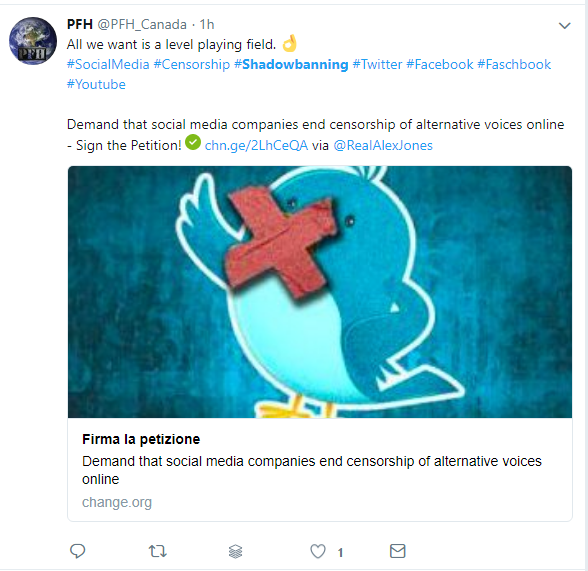
Yes, this is highly likely.
Ben Shapiro said this about the ‘shadow banning’ allegations:
And Jim Hanson wrote an opinion piece including this:
What about the First Amendment, guaranteeing freedom of speech? Like it or not, it protects us all – from the far right to the far left and everyone in between. Whether because of an inadvertent computer glitch or by design, shadow banning is wrong and, frankly, un-American. If Twitter means what it says, I look forward to the quick end to this dangerous and abhorrent practice.
Here is the First Amendment to the United States Constitution:
Congress shall make no law respecting an establishment of religion, or prohibiting the free exercise thereof; or abridging the freedom of speech, or of the press; or the right of the people peaceably to assemble, and to petition the Government for a redress of grievances.
And here are some additional court findings.
What about the Twitter Terms of Service? The TOS include this:
Our Services evolve constantly. As such, the Services may change from time to time, at our discretion. We may stop (permanently or temporarily) providing the Services or any features within the Services to you or to users generally. We also retain the right to create limits on use and storage at our sole discretion at any time. We may also remove or refuse to distribute any Content on the Services, suspend or terminate users, and reclaim usernames without liability to you.
Twitter is a private enterprise. They are not the government. They do have the ability to limit who uses their (free!) platform and how it is used.
Don’t like it? Don’t be on Twitter.
Go ahead. Convince me otherwise.
-
Hot Take: LA Judge Defies First Amendment
In a major “oopsie,” a sealed plea agreement in a police corruption case was posted publicly. So judges being what judges are (convinced that they have royalty status and don’t really have to follow the constitution), the judge here defied the First Amendment and ordered that the LA Times remove all references to the secret plea agreement. The LA Times complied with the order but is appealing it. I’m somewhat surprised that they didn’t issue the equivalent of “Fuck off, slaver!” and challenge the judge to do something about it. But they caved for the moment.
Of course, the judge either doesn’t know or doesn’t care that the Internet is a forever thing. And we have no scruples about giving that slaver the finger. So here’s the story as it originally ran, complete with the several added details that the judge thinks are FYTW exceptions to the First Amendment.
-
State of the Union Open Thread

It’s no secret that I’m somewhat less than enamored of Donald Trump as a person, and not terribly impressed with him as a president (‘better than Hillary” is not exactly a glowing encomium). But there’s ONE thing he could do which would cause me to admire him. Yes, not give a SOTU speech, complete with props (human and inanimate) and stagecraft, but revert back to the previous custom of literally mailing it in. But keeping Trump away from the spotlight is akin to getting between Gloria Allred and a TV camera, so that’s not going to happen.
So, given the inevitable, here’s a chance for you, the wise and always entertaining Glibertariat, to give your thoughts beforehand and as it happens.
Virginia Postrel would be proud.
-
Our National Conversation is a ‘Shit Hole’: A Rant

So which one of you is this? I am fed-up with the nonsense that dominates our political discourse. Nothing substantive is discussed at all anymore. We have the establishment media still throwing a hissy fit over a presidential election that they lost and it is becoming impossible to discern between the Democratic Party, CNN, the New York Times (sorry, but Stossel is right about the ‘old grey lady’), the Washington Post, MSNBC, ABC, NBC, and CBS anymore. The stupidity of our current national conversation is no more evident than the fact that on January 16, 2018, the US Senate voted to end debate on the FISA Amendments Reauthorization Act of 2017, thereby preventing an attempted filibuster by Senators Rand Paul, Ron Wyden, and Mike Lee. This act renewed (since its passage is nearly certain now, as of this writing), for six years, the federal government’s authority to gather communications between people from the United States and foreign nationals, without a warrant. Though the legislation has always been presented as ‘anti-terrorism’ legislation, the law also allows the FBI to peruse these communications to identify a crime. Thereby thoroughly gutting the 4th Amendment’s protection against “unreasonable searches and seizures.”
But, it doesn’t even matter what the particulars of the law are. What is more important is that there was no national conversation about the renewal of such an expansive piece of legislation. Instead, in the days leading-up to the Senate vote, our national media was fixated on ‘shit hole’-gate. Did the president refer to some countries as ‘shit holes’ in a private conversation in the White House? Truly gripping stuff. And, as if in an attempt to go full retard, our national media then began dissecting the president’s physical and mental health (because it’s totes cool to ask those questions now). And when the media’s speculation was rebutted by a navy physician that also served the previous president, they doubled down on stupid. These stories were more important than debating whether or not the federal government should be allowed to eavesdrop on your personal conversations without a warrant?

Democrats vs. Republicans Where are the grown-ups today? In years past, we had commentators like Christopher Hitchens, William F. Buckley, Gore Vidal, Mike Royko, and HL Mencken, to name a few, who cut through the minutia and focused on bigger issues. Today we have this ass hat, a bag of dicks, and shit for brains. And when our imbecile pundits aren’t ignoring important issues like unreasonable searches and seizures by our government, they are actively attacking commentators who do warn against such actions. Meanwhile the bulk of our political class is just as buffoonish, asinine, and unclever as the ass hats, bags of dicks, and shit for brains that cover them. There are some exceptions within our political class, and to their credit, more Republican Senators voted against renewing FISA under a Republican president than Democrats who voted against renewal under a Democratic president. And for that, I would grant Republicans a participation ribbon. This ribbon is as useless as the Republican Senate and redeemable at the midterm elections for one “I will never vote for you worthless assholes again” from me, with love.
The worst part is that the cause is most assuredly over. If a universally reviled and unstable president cannot convince Congress that the executive wields too much authority, than nothing will. FISA is permanent now. The next time renewal comes around, I doubt even a mention will be made. The State will continue to erode away at the Fourth Amendment and will continue to chip away at other parts of the Bill of Rights. All the while, our chattering class will be fixated on the latest faux outrage committed by whomever occupies the title of “literally Hitler” at the moment. Nothing is sacred anymore. This is a lost cause now.
-
Crafting a Narrative, Part 3: Lies, Damned Lies, and Public Opinion Polling
“3 out of 4 Americans believe that killing animals for meat is immoral, according to a MSNBC-MediaMatters-PETA poll. Based on this information, Congress is debating new rules put forth by the FDA to tax meat production at a higher rate than vegetables.”
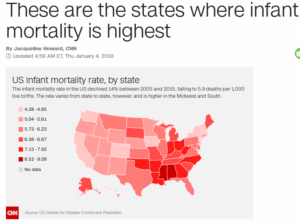
The infant mortality rate is nearly double in Mississippi and Alabama than it is in New York and California!!!! Oh wait, It is 0.4% in NY and CA and 0.8% in MS and AL. And wait, there’s more! There’s a longstanding and well-known correlation between poverty and higher infant mortality. CA and NY are 2 of the richest states and MS and AL are 2 of the poorest states. What, exactly, is the point of this article except to poor shame the south? Every media outlet has published a metric ton of articles that start just like this. It’s lazy writing, but it’s also the platinum standard for crafting a narrative. See, people are social animals that are primed to go with the crowd. When that subconscious impulse is manipulated through polling, people’s behavior becomes malleable. When you have some basic understanding about the strata of voters and their belief systems, you can get them to do your bidding without them even knowing.
Three basic concepts make public opinion polling an irresistible tool used to bias an audience: herd behavior, identity politics, and aura of authority. The formula is simple, using a favorable polling result, generalize the findings so that it is implied that a majority of an identity group believe a certain way, relying on herd behavior to solidify support of the belief within the identity group.
The ironic part is that none of what makes public opinion polling such a strong tool is based in reality. The herd behavior is based on an illusion. By and large, support for a politically controversial position sits somewhere between 40% and 60%, meaning that nearly half of people oppose said controversial position. Further, polling doesn’t allow for enough nuance to differentiate between being opposed to legalizing machine guns and being for the repeal of the 2nd Amendment. Identity politics, as well, is subtle. Take, for example, the approval/disapproval ratings of prominent politicians. If identity politics were the primary driver of public opinion, the surges and drops in approval ratings would be quite attenuated.
However, the illusion of universal agreement is very powerful.
Social Science is Modern Day Astrology
The holy grail of science is replicability. If you can produce an effect in one study, you should be able to replicate the conditions and achieve the same effect in a successive study. In physics or chemistry, this is usually fairly straight forward. Barring some unknown environmental variable affecting the experiment, the bowling ball and the feather land on the ground at the same time in a vacuum. The sodium and the water create a highly exothermic reaction when combined.
 Social science is much squishier, both in methodology and in result. When you’re working with people, they don’t behave like molecules in a vacuum. They lie, they are affected by minor biases in your methodology, they are subject to many weird psychological effects like the placebo effect, and they don’t take kindly to being locked in a laboratory for 15 years for a longitudinal study.
Resultantly, more social science is done by “poll” than by “experiment.” Not that the experimental method is any better. I experienced the infamous psychological experiment where they flash pictures of different races of people and then time how fast you click on the good word or the bad word.
This has led many skeptics to put scare quotes around social “science”, which more and more resembles phrenology than physics. Adding more fuel to the fire is the “replicability crisis.” The replicability crisis affects both experimental and poll based studies. Essentially, social science can’t find the same effect two times in a row. Not only that, but they can make a study say that any effect exists (such as, listening to songs about old people makes you younger).
However, in a world that fucking loves science and decides social policy by sound byte, the internal crisis in social science becomes a very public issue. As discussed in Part 1, science journalism is a farce. When an ethically compromised journalism industry interacts with an ethically compromised social science industry, you get science journalism that is slave to the agenda of the media. We live in a world where science is subservient to the state. If you publish something that aligns with the state’s goals, you get media coverage and additional grant funding. If you try to publish something that goes against the state’s goals, you get undermined at every step.
Manipulating the Results: Bias in the Experiment
People are quite malleable as I’ve already said, and this is evident in the results of studies. Wording is very important. Want an anti-abortion poll result, mention “mother” and “convenience.” Want a pro-abortion poll result, mention “choice” and “woman”. I’ll let the next example speak for itself.
An example of a wording difference that had a significant impact on responses comes from a January 2003 Pew Research Center survey. When people were asked whether they would “favor or oppose taking military action in Iraq to end Saddam Hussein’s rule,” 68% said they favored military action while 25% said they opposed military action. However, when asked whether they would “favor or oppose taking military action in Iraq to end Saddam Hussein’s rule even if it meant that U.S. forces might suffer thousands of casualties,” responses were dramatically different; only 43% said they favored military action, while 48% said they opposed it. The introduction of U.S. casualties altered the context of the question and influenced whether people favored or opposed military action in Iraq.
There are quite a few known phenomena that influence studies, as well.
 Acquiescence Bias – Making a statement and asking the poll taker to agree or disagree. Usually folks with lower education will agree disproportionately with the statement in comparison to when the same issue is asked in a question format.
Social Desirability Bias – We saw a bunch of this last election cycle. People tend not to like to tell others about their illegal or unpopular opinions, so they’ll simply lie to make the poll giver like them.
Question Order Bias (“Priming the Pump”) – Ask a question that will likely get a positive or negative reaction, then follow it with a question you want to influence in that positive or negative way. For example, if I were to ask y’all whether you like the current spending levels of the federal government and then followed it up with a question of whether you like deep dish pizza, the pizza question will be skewed negative.
Interviewer Effect – Related to the Social Desirability Bias. The poll taker changes their responses based on characteristics of the poll giver. For example, if a woman is giving a poll on equal pay, the poll taker may respond more favorably than if a man gives the poll.
Observer Effect – The poll taker is subtly affected by the poll giver’s unconscious cues, resulting in their responses being biased toward the poll giver’s expectations. For example, if the poll giver expects that black people will answer a question a certain way, they may change their inflection when asking the question in a way that influences a black poll taker to answer in that way.
This still ignores the cognitive biases that we have talked about in Parts 1 and 2.
How do you sort through all this crap and get to a real, measurable effect? You design a good experiment. How do you design a good experiment when taking a survey? You don’t.
Manipulating the Results: Playing with the Data
Okay, so we have highly questionable data from a shit survey, but at least we’re now in the realm of math. Nothing can go wrong here!
I’m going to start with a book recommendation: How to Lie with Statistics
A core requirement of legitimate polling is “randomization.” Taking a random sample of the group you’re trying to study is what allows you to generalize the results to the group as a whole. If you do something to disrupt the random sample, you weaken the ability to generalize the results to the group as a whole.
How do people screw with the random sample?
Weighting – Let’s say you’ve done a 1,000 person survey, but you’re concerned that your relatively small (but random) sample isn’t actually representative of the world. See, you’re a savvy poll taker and you know that a recent poll showed that there are 41% Democrats, 37% Republicans, and 22% Independents in the locality of your poll, and your poll has 39% Democrats, 40% Republicans, and 21% Independents. We’ll just inflate the results of the Democrats in the poll to reflect 41%, deflate the result of Republicans to reflect 37% and mildly inflate the results of the Independents to 22%, and we’ll do our further analysis based on this massaged data. Of course, this assumes that the pollster’s understanding of reality is correct, and it screws with the randomization of the data, resulting in a strong danger that the data no longer reflects reality.
Margin of Error – You survey 1,000 people, and 44% love Trump and 46% hate him. Therefore, Trump is unpopular on the net. Well, except for the margin of error. For a 1,000 person survey in a country of ~300 million, the results are roughly correct. Roughly correct means that your poll (and others designed in the same way) is within 3% of the reality 95% of the time. This, of course, assumes a representative (read random) sample.
Data dredging – Let’s do a huge survey asking a zillion questions. Then let’s go fishing for correlation between variables. We’ll just ignore that correlation does not imply causation, because who actually believes in that. It actually makes for some amusing reading.
Fudging the data – How about we do 15 runs of the survey, pick the 3 that most support my hypothesis, and publish a paper with the results of those 3 data runs?
A more technical issue is highlighted in Anscombe’s quartet. Four completely different sets of data that are statistically identical. Why? Let me tell a story from Poli Sci 300-something, Statistics for Political Science. One of the main statistical analyses performed by Poli Sci statisticians is linear regression. Linear regression (which you may remember from 5th grade math) is trying to fit data to a straight line (technically you can fit it to another curve). However, the problem is that you have to predetermine the type of curve you’re fitting it to. It doesn’t self-tailor. If you have an exponential relationship between being libertarianism and small government views, it won’t fit well to the straight line regression. It struck me, sitting in that class, how much statistical analysis was an art, not a science. If you don’t understand the math and conceptual understanding behind the numbers (as most social science students don’t), you’re going to come to somewhat worthless results when doing statistical analysis.
The Results are Garbage In the First Place: The Telephone Problem
Garbage in, garbage out. It’s pretty much my motto. It’s especially true with public opinion polling. Let’s quickly mention two issues so you get a sense for the type of garbage being used in modern public opinion polls. No need to linger on this issue.
 1) Self-selection bias – This has always been there. Who is likely to answer a telephone poll? Is there some inbuilt bias caused by some declining to participate? Is there a destruction of the randomness of the sample if it takes 3,000 phone calls to get 1,000 poll takers?
2) The shift away from landlines – This is new. Currently, less than 50% of people still have landlines. Cell phones really screw up some of the assumptions behind the methodology of telephone polling. For example, if a pollster wanted to survey people in central Indiana about some local issue, it’s possible that I would get a phone call. I don’t live in central Indiana, and haven’t for over 5 years. What does it mean for the poll that I’m not in the expected cohort? Nothing good. However, it’s easy enough to ask where I live at the beginning. What about the other way around. A pollster is trying to survey northern Virginians about some local issue. I’m essentially disenfranchised by that poll because my area codes is central Indiana. Further, cell phones make it really easy to block unknown numbers, resulting in even fewer “hits” for each phone call.
Knowing the Public: What Motivates Voting Behavior?
Now that I’ve thoroughly shattered your trust in the public opinion poll, let me shatter your trust in the people being polled. Let’s talk about a truly experimental social science study looking at beliefs and voting patterns.
The nature of belief systems in mass publics 1964 – Phillip Converse (His earlier work, The American Voter, is a good read, too)
The interesting result of this experimental study of people’s beliefs and voting habits is this:
There are 5 different types of voters:
- Ideological – Able to abstract their issue positions into larger conceptualizations (principles) and set those conceptualizations relative to other ideologies.
- Near Ideological – Have awareness of an ideological spectrum, but their positions don’t particularly rely on an ideology.
- Group Interest – Good ol’ identity politics. I’m black therefore I vote Democrat.
- Nature of the Times – Something bad happened in the world when Republicans were in power so I’m voting Democrat.
- No Issue Content – I vote because…well… argle bargle, incoherent rambling, no making sense. Seriously, this is the category where the pollster couldn’t make any sense of their motivations for their beliefs.
There must be a bunch of people in groups 1 and 2, a ton in 3, and a smaller amount in groups 4 and 5, right? That would be the sort of society I want to live in.
Sorry to disappoint.
Group 1 (Ideologues) – 2.5%
Group 2 (Near Ideologues) – 9%
Group 3 (Identititarians) – 42%
Group 4 (Idiots who can rationalize their opinons) – 24%
Group 5 (Idiots who can’t even coherently explain the reason for their opinions to a pollster) – 22.5%
This was taken in the early 1960s. Wanna bet it’s even worse today? Identity politics wins because that’s how a plurality of people think. Principals over principles is a thing because 42% of people care about principals and 11.5% (generously) care about principles.

The sickening part is that group 4 and 5 vote. (Table 1 of the study shows the percentages for the study as a whole and for likely voters, with only marginal changes to the percentages).
I could type more about the horrifying prospects of society based on this study, but I think it’s more impactful to let the data sink in. 89% of people base their worldview/politics/beliefs on something other than a set of principles/ethics/morals. Almost 50% have blatantly idiotic reasons for holding their opinions.
As a final note, 35% of respondents randomly varied across opposing positions for issues in successive interviews. There wasn’t a trend in these changes, which made the pollster come to the conclusion that these people weren’t able to come to the same opinion two interviews in a row.
Quick Takeaways from the series of articles
- The media is untrustworthy, and not just in the obviously biased ways
- Gell-Mann amnesia is real
- Science journalism is neither about science nor is it good journalism
- Any conclusion drawn from social science should be viewed with great skepticism
- Anything being pushed based on majoritarian or poll-tested bases is probably shit
- By thinking in terms of principles, you’ve elevated yourself into rarified air. Most people struggle to even rationalize their opinions.