Category: Markets

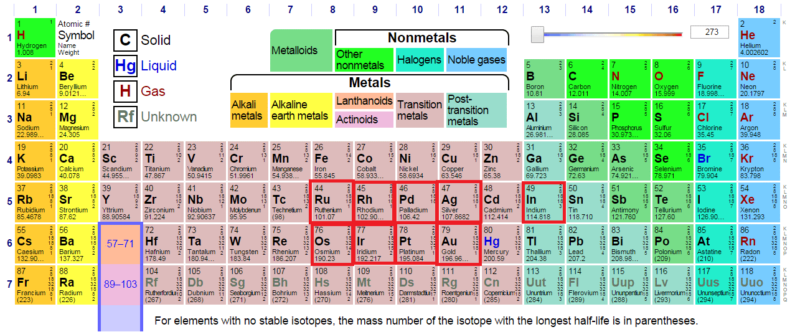
  • Why Are Precious Metals Precious?


    Why do we view these metals as valuable?

    The most understandable reason, obviously is utility. Certain properties of these metals can accomplish what nothing else can, or at least, at a far less cost.

    However, that doesn’t seem to relate to the value of most of the precious metals.


    (Note: I’d add copper) The value of these metals appears totally unrelated to any utility they have. Their utility as money (rare, stable units) may play a part today.

    911 Metallurgist gives a good rundown of why people would want these metals for specific business /  use purposes. And while that’s understandable, it doesn’t account for the massive price of the metals beyond what they can accomplish economically.

    That’s my main point: these metals are valued at a price point far beyond their utility. So what makes them valuable?

    The history of civilization does provide a massive clue: they have been used as currency for millennia. But the question regarding fiat currencies still applies: if no one values them, do they have any value?

    Please feel free to show me I’m wrong.

  • Maximizing the Value of Your Timber

    Suthenboy is not a credentialed expert. This is just his personal experience, not legal advice. Consult credentialed professionals before attempting any of this.


    Some here have asked me about this subject so here it is.

    Timber buyers, obviously, want to pay as little as possible for timber. Timber growers want to collect as much as they can for their timber. The nature of timber purchase is speculation. From the time of sale a tree may stand for months before harvest. It may stand for a couple of years. From there it can lay in a yard for a couple of years. From there it may still be a year or more before that lumber lands in The Hyperbole’s hot hands. The buyer is trying to arrive at a price that allows them to make money in a future market. They have to take a chance on, mostly housing starts, years into the future.

    *If you want to get an fairly accurate prediction about the economy’s future performance, check the price of timber. Those guys aren’t screwing around, they know what they are doing and they aren’t political. BTW, timber prices on the stump are sky high right now. Must be those pesky Russians.

    If you are selling timber you may want to have a professional forester evaluate your timber and give you and estimated value. However, it is hard to know how incestuous a relationship exists between foresters and various buyers. Here is the best way to go about it once you are certain you want to sell your timber. It is tried and true.

    1. Do some research. Find all of the potential buyers in your area. This will include all of the saw mills, pulp mills and plywood mills. You may also find some timber brokers. It is hard to say how large your area is. Because of fuel cost and highway usage fees the further from your timber a mill is the less they will be willing to pay. Out of courtesy I include everyone inside about 50 miles but I know the best offers will be from those half that far away. Write a letter to each one announcing that you intend to sell your timber in a closed bid auction on a given date and time. Include a survey of your property, directions to and legal description of the property. Include a title search confirming that you are in fact the owner. These can be found at your Clerk of Court’s office. Include a copy of your contract. Invite them to examine the timber at their leisure.
    2. Contract. You should be able to get a timber sale contract from your local clerk of court easily. Every state has different style and requirements. Get an example at your local courthouse of someone else’s completed sale from the clerk’s office. Just walk right in and tell them what you want, they are glad to help. The contract should include things like access, road building, time limits, damage repair and clean up. Use that contract as a template for your own and adjust the terms to your liking.

    Consider things that will increase your price: clean up is expensive. If they have to spend 10K or 20K on labor and gasoline pushing tree tops around, it will be reflected in your price. Those tops will rot away in a couple of years on their own.

    Remember, they are speculators. The longer you give them the better off they are. Here, most time limits are 6 months. I give ‘em two years. That will be reflected in your price. Most land will restore itself in a couple of years and bulldozers are damned expensive to operate. That will be reflected in your price. Don’t worry about minor things: Often the cutter will change oil several times and just dump the used oil on the ground. Don’t sweat it. That will be gone in a couple of years on its own.

    Lastly, make certain that the contract places liability on either the cutter or the buyer if they cut over the line. Once they crank up the saws you have no control over them so you should have no liability.

    If any of this makes you nervous, get a lawyer. There are a lot of good land guys around that will facilitate a sale for a modest fee.

    1. Clearly mark your lines with paint before the potential buyers inspect it. Most harvesters will not cut the trees with the paint on them. They are considered ‘line trees’ and will be left as future markers. Chose crooked trees, don’t mark veneer quality logs. The buyer wants those. If you are uncertain about those lines you may want to have a survey performed, but that can be expensive. If you are on good or neutral terms with your neighbors it is a good idea to have them accompany you to examine where the lines are before you paint so that you are in agreement.
    1. If you have any contact with any of the buyers do not discuss money. Do not discuss price. I cannot overemphasize this. If they try to bring it up inform them that you absolutely cannot discuss money until after the bid. If you are seen as someone who tries to manipulate a sealed bid auction no one will touch you. Word will spread and no one will show up at your bid. In fact, you may never be able to sell your timber. You will become persona non-grata. Not acting in good faith will burn you.
    1. Rent a small conference room at a mid-level hotel. Don’t go expensive, don’t go cheap. You don’t want cracked-out hookers accidentally wandering in while you are opening bids. Bring cinnamon rolls, doughnuts, etc and coffee. Lots of coffee. Most of the buyers that intend to place a bid will RSVP so you should have a good idea how many people you are serving. Hopefully you will be serving at least ten.
    1. You should have a check-list of everyone you sent an invitation to. Check them off as they arrive. If at the appointed time there are some that did not show ask the room politely if you can wait another few minutes. If you have anyone who cannot wait do not try to accommodate the person who is late.

    *At least once the winning bidder showed up about ten minutes late, and they weren’t the winner by just a little bit.

    1. Collect all of the bids in plain sight of everyone. Open them and read them out loud so that everyone can hear. Just read the numbers and then place the bids out in plain sight on the table. When you have finished, pick the largest bid and announce it and the bidder. Thank everyone for coming. If there are any who don’t have to be anywhere try to engage them in conversation so that you can pick their brain. Ask questions. These guys know the business inside and out.
    1. The winning bidder will likely have the check on them, already filled out. They will present it to you and you both will sign the sale contract. You should have two copies of the contract to sign.
    1. Immediately after the sale you want to do two, maybe four things. First go to the bank and deposit the check. Find out how soon the money will be available.

    Then go straight to the courthouse and record the contract with the Clerk of Court. Lastly, if the money is available go straight and pay any local, state, or federal tax you owe. Don’t feel flush and think you will do it later. Do it now.

    I also recommend, while you are at the bank to open a separate account to reserve some of the money for future property tax, a personal ESCROW. Those taxes are going to come due like the sun will come up. Make sure you have the money when the time comes.


    As it turns out maximizing the value of your timber is a lot of work. If you are only going to do it once in your life you want to get it right. I have included as many pointers as I can think of. My father wrote a detailed book on the subject, but I can’t seem to find my copy. It’s buried in a mountain of books. If it turns up I’ll let y’all know and anyone that wants a copy, just ask. I will be happy to share it.

    Last bit of advice – There are timber companies and land management companies that purport to manage your timber for you. In return they want exclusive rights to your timber when it comes time to harvest. They will lock you into a contract and thus into a price. NEVER ENTER ONE OF THESE CONTRACTS. They are not crooks. They think it is fair because of the services they provide which might include a survey, but probably not, justifies reducing the sale price. You will end up with a minimum price just short of being legally actionable. DON’T DO IT.


  • The Beer Wars:  An Incomplete History of the American Beer Industry (pt 1)

    Part I – Pre-prohibition

    This is part one (of five) in a series of the Beer Wars in America (primarily 1970-1990) and some before and after history.  There are much better beer historians than me who would be far more accurate.  At the end of each piece, I am going to include how the period in question effected a local brewery to me, Falls City.  It adds a bit of individuality to a big picture story.  And now let us begin.

    In the beginning of America there was beer, and it was good, but it wasn’t really an industry so I am going to ignore it.  The Mayflower had beer, Washington and Franklin brewed beer, some breweries existed on the Eastern Seaboard.  But the exciting stuff happened with a combination of the industrial revolution and the German invas…ummm, immigration wave in the 19th century.  This was followed by the commercial use of refrigeration and an industry was born.

    Below is a not-so-random selection of mostly-German, mostly Midwest, breweries that were founded in the mid 19th century and would continue to play a major part in our story in the late 20th century.  This list is by no means complete, but it gives you a flavor of the Germanic character of the industry in these days.

    Yuengling, 1829, Pottsville
    Falstaff, 1838, St Louis
    Ballantine, 1840, Newark
    Schaefer, 1842, New York
    Pabst 1844, Milwaukee
    Schlitz 1849, Milwaukee
    Stroh 1850, Detroit
    Blatz, 1851, Milwaukee
    Anheuser-Busch, 1852, St Louis
    Christian Moerlein, 1853, Cincinnati
    Leibmann, 1854, Brooklyn
    Hudepohl, 1855, Cincinnati
    Miller, 1855, Milwaukee
    Jacob Schmidt, 1855, St Paul
    Heileman, 1858, La Crosse
    Christian Schmidt, 1860, Philadelphia
    Hamm, 1865, St Paul
    Coors, 1873, Golden
    Sterling, 1880, Evansville
    Pfeiffer, 1882, Detroit
    Anchor, 1896, San Francisco

    The Seibel Institute in Chicago taught brewing in German up until World War I.  The Brewmaster’s meetings at Budweiser were held in German up until about the 1960s.  The inability to speak German limited a brewer’s advancement in the company in the first half of the 20th century.

    Prior to this time, American breweries were based in the English tradition and were primarily Ales.  Lager became King with the German influence.  In 1873 there were 4,131 breweries in America, a number that would not be topped until late 2015.  In the 60 years from 1865 to 1915, the amount of beer produced and the per capita drinking increased dramatically (from 3 to 18 gallons per capita per annum).  However, the number of breweries decreased as industrialization and refrigeration allowed for larger breweries.  See the chart below:

    1865-1915

    Year National Production (millions of barrels) Number of Breweries Average Brewery Size (barrels)
    1865 3.7 2,252 1,643
    1870 6.6 3,286 2,009
    1875 9.5 2,783 3,414
    1880 13.3 2,741 4,852
    1885 19.2 2,230 8,610
    1890 27.6 2,156 12,801
    1895 33.6 1,771 18,972
    1900 39.5 1,816 21,751
    1905 49.5 1,847 26,800
    1910 59.6 1,568 38,010
    1915 59.8 1,345 44,461

    Source: United States Brewers Association, 1979 Brewers Almanac, Washington DC: 12-13.

    Of course, by the next line in the chart, the number was zero.  At least legally.  But that is a story for another post.

    At the beginning of the 20th century, Central Consumers Company, an alliance of Louisville breweries, had many of the taverns in Louisville under contract as “tied houses.”  Basically, they had a monopoly and a contract to prevent the taverns from buying elsewhere.  Some independent taverns and grocery stores refused to sign on and instead created a cooperative brewery in 1905 – Falls City.  In 1911, Central Consumers tried to buy out Falls City, but the owners chose not to sell.  Falls City would continue to grow and succeed until a horrible shadow fell over the country with the 18th Amendment.

    But there is a point to this part of the story – even in the face of monopoly, there isn’t a need for the government to fix the problem.  The plucky upstarts were able to succeed without subsidy and without selling out.  It’s a libertarian success story … for now.

  • Money is a Bitch


    Author’s note: This isn’t an essay. It’s an excerpt from one of my books. I don’t say much here on Glibs that is particularly thoughtful because I’ve already said it either in a book or on my blog. I work out what I think while I’m writing. I try not to be didactic in my storytelling, but I probably am.

    This is a post-argument conversation between our (tidge naïve) bond trader math professor hero Jack and (street savvy) concert pianist music professor heroine Daisy while they are cooped up in a tiny dark room and tiny bed together. They’re both irritated over sex and why they aren’t having it right that moment.

    • • •

    “Talk to me about something.”

    “What,” he snapped.

    “Money.”

    His eyes popped open. “What about her?”

    “That. You called money ‘her.’ You did it yesterday, too. You talk about money like it’s a person.”

    Shit, the second he thought she couldn’t surprise him, she turned around and did. He swung his foot up into bed again and laid on his back. She turned on her side and rested her hand on his chest.

    “Money,” he began slowly, thinking. He hadn’t given this lecture in years because the people he taught were too analytical for anything but the math. They wanted skills, not philosophy. “Isn’t a person. She’s an entity. One who’s quiet and restful when she’s being kept in balance, well tended, appreciated. One who’ll rip you to shreds if you do something that upsets her equilibrium, not because she’s pissed off, but because that’s just her nature. She must be in balance. Like a ship. She’s fine when the weather’s good, but she’ll still sink if you’re not tending her, making little repairs so they don’t become big problems. When a storm comes along, she has a hard time getting back into balance.”

    “What’s the ocean?” she asked softly.

    “People. The ocean, the weather cannot be controlled but you’re forced out into it. The ship can be controlled to a certain extent, but you have to pay attention. No ship comes out of a storm without damage, without loss, but someone is going to pay for the repairs or the loss.”

    “But what about rich people?”

    “‘People’ is the operative word,” he said, winding up with the promise of a decent conversation with somebody who might understand after all. “That money is carefully tended, yes, but anything can happen. There are few things that can bankrupt the superwealthy. But economies can collapse. More and more worthless pieces of paper can be printed. A government can come in and take it all away from you. A revolution could happen and then you become Marie Antoinette. Those are things people do, though we talk about them in the collective. Economies. Currency. Governments. Revolutions. People make up those things.”

    “What about Mother Nature?”

    “She’s the supreme bitch and I don’t fuck with her, either. Coffee. Grain. Cocoa. Oranges. Hell, no, I’m not touching anything Mother Nature can get her hands on, but she’s not part of this discussion.”

    “Okay. But if the ocean is people and not Mother Nature, then the metaphor still isn’t complete,” she returned, shocking him again. Even if people did humor him or even understand him to this point, they dropped out of the conversation, thinking it was complete. “Ships sink and then disintegrate.”

    “But then,” he said throatily, suddenly very turned on and running a fingertip softly down her naked, lush body, “what you have left is wealth.”

    “Huh?”

    “Wealth is knowledge. The knowledge that she was there, the knowledge of how to build another ship. Wealth isn’t paper money or gold or anything else you can barter. Wealth is being able to live a fairly decent life without having to worry about any of that. Wealth is having what you need and being happy with what you have and the knowledge to replenish.”

    Silence. For a long time. While her thumb stroked his belly. It wasn’t his nipple, wasn’t his dick, wasn’t his lips, but fuck a duck, it felt good. “By that definition,” she finally said. Slowly. “Diogenes was wealthy.”

    He wanted to kiss her. Right now.

    “No,” he said, feeling her body twitch a little in surprise. “Diogenes was the ballast in the ship of money.”

    “Um … but strangers gave Diogenes whatever he had and he was happy with it.”

    God, he wanted to kiss and lick her from her chipped-neon-green-painted toes to the end of the longest strand of her hair. They were naked now. He could do that.

    Maybe not. Because now he had things to say to someone who got him.

    “Diogenes wasn’t happy with what he had because he wasn’t happy with what everybody else had. Diogenes made a virtue of poverty, which was stupid, because if nobody has anything, everybody dies. For real. That’s it. But strangers gave to him for whatever reason. Maybe giving made them happy. Maybe seeing him sitting there made them feel guilty for what they had that he didn’t. Maybe they believed in what he taught and wanted to support him in that. Doesn’t matter why. Diogenes’s philosophy was shit. His father was a banker, did you know that?”

    “No.”

    Jack laughed. “Yeah. So money stayed in balance because people gave. When you have too much ballast or too much cargo on the deck, money is out of balance.”

    For once in his meager acquaintance with Daisy, she was the one who was stumped. Unprepared. Unlearned. He liked this feeling, the feeling of meeting her on an intellectual field and having the edge. “Where do you fit into that?”

    “I’m the guy up in the ropes walking on the beams and taking up the sails or dropping them or whatever they do up there. Trying to keep her moving when the wind’s against her. Trying to keep her steady when the storms are coming.”

    “You love her.”

    And now he wanted to make love to Daisy all fucking night long, which he couldn’t do because she was still pissy about the clothes.

    “I do,” he answered, “but not like most people mean it. ‘I love money.’ No, I love her as an entity, as a philosophy, a concept of balance. Like a ledger.”

    “Mmm, okay. Then I have a question for you.”

    “Shoot.”

    “Where do underground economies and black markets fit on the ship of money? They exist. They have to serve some purpose or, by your description, the ship wouldn’t be balanced at all.”

    His mind went blank. Totally and completely blank. He was speechless. A fucking piano teacher had blindsided him with his own philosophical musings. “Daisy,” he said throatily. “Either you stop being so fucking brilliant or I’m going to jack off right here.”

    She chuckled softly. “Answer the question.”

    “I dunno,” he admitted easily. “Econ isn’t my specialty, so I never thought about it. I’ve never seen it. Until I got here.”

    “The way I look at it is Diogenes isn’t the ballast. The black market is the ballast. Hidden, but important. Rocks, sand, ordinary things that do as much to keep the ship sailing as the sails do. The stuff that keeps the ship steady when the storm really starts rolling. Diogenes is on some deck inside the ship, being taken care of from the top and the bottom. And when the ship breaks up and sinks, the ballast floats to the bottom of the ocean, under all the people. But they’re still doing what they do. Sitting there, minding their own business, which is business. Pure business. Providing shelter to the deep sea creatures. Hiding them from predators. Feeding them when the ocean—people—makes moss grow on them.”

    He said nothing. His chest was too tight and his dick too hard and his body too tense. She couldn’t talk and have sex at the same time. The stuff that dried her up got him hard and ready to whisper sweet economic philosophies in her ear while stroking in and out, slow and steady.

    “People still come to power,” he finally said. “Even in the underground. Organized crime. Gangs. Using fear and intimidation.”

    “The same thing the IRS uses.”

    “What?”

    “You do understand the IRS is holding a gun to your head, right? Why do you comply? Because if you don’t, you’ll get thrown in jail. If you do anything somebody in power doesn’t like, they can use the IRS to somehow get to you. You don’t pay taxes because you’re ethical. You pay them because you have no choice. You believe it’s immoral not to follow the law, yes?”

    “More or less, yes.”

    “Have you ever considered that the law and regulations are immoral?”

    “Stealing is immoral,” he said, irritated that she was diverting from the interesting part of the conversation.

    “That is a natural law,” she replied. “The IRS is a manmade institution designed to control the populace. And by providing receipts, filing 1099s, W-2s, you are complicit in that control. You don’t have to report all that. You do it because you want the write-off and that’s where your thinking ends, but it’s not about you. The black markets, the underground, would rather take its chances with an enemy they can see and fight if they have to, to get ahead, to climb the economic ladder. No, I misspoke. They’re building their own ladder.

    “Topside, with small businesses, they’re regulated to death. Margins are slim to none. One bad month can make them homeless. In a storm, you can hang on to whatever’s up there. Diogenes can cower somewhere inside the ship before it goes down. I, the black market, the ballast, can function anywhere under any circumstances. The mom’n’pops, the ones paying taxes and licenses like they’re supposed to because they’re ethical, the ones who really take care of Diogenes, but might also be paying protection money, they’re the ones who get washed overboard first. Almost nothing to hang on to. No walls to keep them safer until the storm passes.”

    He was silent for a long, long time, turning all those concepts over in his head, so many of them packed into a few sentences, things he’d never thought about. But she was wrong about one thing. “I have to report wages. It is about me.”

    “I won’t dispute that for you or any company like yours, you’d have to give the appearance of it. But it’d be easy to pay people from an offshore account—”

    “That’s illegal.”

    “But is immoral?”

    He almost said yes automatically but stopped. Was it?

    “Do you eat the cost of your employees’ withholding? Pay their share of the social security as well as yours? You could. If you have independent contractors, you can just not send them a 1099 and nobody would ever know because they aren’t going to report it and if they did, they do it from their internal bookkeeping. Likely they wouldn’t notice you didn’t send them a 1099 at all. You do it because it’s a write-off that feels like an obligation.”

    “I’d go bankrupt inside six months if I did that,” he protested.

    “And that’s how the IRS makes sure you’re complicit. Think about it. Your bottom line would improve if you could just pay people what they earned.”

    She was fucking with his mind.

    “That’s how the underground economy works. Do you know how many of your colleagues use illegal aliens to clean their houses and watch their kids? No, you don’t, because your domestics are on the record and you make sure all the T’s are crossed and the I’s are dotted. It wouldn’t occur to you to do anything else or that eighty percent of your peers hire under the table.”

    “Okay, but exploiting those people is immoral.”

    “Then you have to ask yourself if employing those people under the table is more or less immoral than letting them starve.”

    “They choose to come here.”

    “In hopes of a better future. Jack, look. I’m not trying to defend something you think is immoral or convert you. I want you to think about what the ballast really is.”

    The only thing he could really think about at the moment was how Daisy was so much more than someone who listened to him even if she didn’t understand some things, but asked questions until she did, which meant she was listening. And then could give him something entirely new.

    Not new information. Information was cheap and easy once one knew where to find it. New concepts. New principles. New philosophies. She made him think and thinking was his most favorite thing to do.

    But when she didn’t say anything more, his thinking gradually turned to feeling—feeling her hand on his chest, caressing more, massaging, looking for the knots, going deeper into his muscles. It felt so good, he didn’t know whether he wanted her to keep doing that or give him the handjob his dick was begging for.

    “There are more things involved in the balance you’re looking for,” she whispered, pressing her lips to his cheek. “It’s not just the money. Ethics don’t start with laws and stop with accurate numbers in a ledger. Morality and ethics involve people, and at your core, you just don’t like people.”
  • Creosote Achilles and the Perils of Potrepreneurship

    In the fall of 2017, the outdoor cannabis harvest was a bumper crop for growers throughout the state of Oregon. This epic weed haul was the result of two factors; weather, and bureaucracy. The weather was spectacular for growing cannabis, particularly outdoors. A wet fall, winter, and spring (nearly 220 straight days of rain) meant there was plenty of water available. And the summer was warm and dry. Conditions that are favorable for growing trees with plenty of flower on them. The sunshine helped to ensure that flower would be potent. The other cause was bureaucracy. Normally inimical to the production of any good or service of value, on occasion bureaucrats manage to step on their dicks in such a way as to help the actual productive class. Such was the case in 2017 with the OLCC (the Oregon Liquor Control Commission).

    The OLCC is the regulatory pseudo agency (much like the fed it is a non-government organization with a government mandate) responsible for enforcing Oregon’s pot laws. In 2017, the OLCC declared open season for anyone with a license to grow marijuana when it announced that “due to a lack of allocated funds, enforcement efforts will primarily be focused on those growing cannabis without legal license to do so and on those with a recreational license. However, next year will see increased enforcement for medical growers.” In plain English and practical reality, this meant that as long as you had a medical license you could grow as much pot as you wanted. The statutory limits on the number of plants one could grow was out the window. Worst case, if you were caught, they’d cut down plants of your choosing until you were down to the legally allowed number. Every grower was growing as much pot as he could get in the ground that summer as cuttings are cheap.

    Fields of Green

    The resulting harvest was huge. And while the left may not understand or believe it, the laws of supply and demand are iron. If supply is greater than demand, the price falls until an equilibrium is reached. And the result was The Glut. A situation where outdoor weed wholesale prices fell as low as $300 per pound. If you could find a buyer and had good enough quality weed. There were rumors of weed going as low as $100/lb but that had to have been either exaggeration or for some really ditch weed bullshit. Either way, that was the first bump in the road.

    Once the harvest was in, properly dried and cured, and finally trimmed and packaged up, we had enough product that once The Glut ended we’d be able to fund our next phase. Right where we need to be to build our indoor facility and go through the process of getting the rec license that would allow us to expand. That’s where the next bump in the road occurred. We just need to wait for The Glut to recede and the price to come back up to our floor of $800 to $1000/lb. While it would put a crimp in our timeline, waiting even six months wouldn’t be catastrophic.

    An aside; indoor and outdoor pot flower are of differing quality. Indoor is higher quality and fetches a relatively higher price. But outdoor is far cheaper to produce and the aforementioned conditions were conducive to outdoor pot production. In 2017 we had both indoor and outdoor operations.

    End Product

    My business partner was impatient to take the next steps however, so was looking to expand beyond our established channel of buyers to sell all that outdoor product. The short version is that the buyer was a scammer that my partner thought he knew but didn’t. My partner took his stepson with him to the transaction, verified the guy had a med card, and gave the stepson the cash to count, made the transaction “selling” 80% of our harvest, and the best quality at that, and they left. Only to get home and discover the money was, as he texted me, “counterfeit.” I didn’t hear from him for 3 days and when I finally got the full story I have never been closer to murder than I was at that moment.

    Turns out the money wasn’t counterfeit. It was movie money that looked just this side of monopoly money for verisimilitude. I wasn’t even mad at the scammer (whom my partner didn’t even take a picture of the guy’s med card or his license plate and only had a phone number that of course turned out to be a burner). I mean, the balls to try that and get away with it? But my partner and his idiot stepson? Yeah. Them I was furious at.

    Does that look like legal tender to you?

    Anyway.

    As of February, we had only 20% of our harvest, The Glut was finally receding, and we were at a crossroads. We came up with a last-ditch plan of selling that final amount to finance continued expansion of existing indoor med operations of high THC plants, and to get legal for growing outdoor hemp as we did have a legit buyer for hemp flower by that point for processing for CBD products. Those funds from a large hemp harvest could then be leveraged to do the build out for a rec license grow. As described in my previous article, a rec license allows a much larger size grow operation than a med license.

    Another digression: Marijuana and hemp are the same plant, save that hemp has been bred primarily for its fibers in the stalk and has only trace amounts of THC but plenty of CBDs, even in the flower. Marijuana flower contains both, and various strains have various proportions. THC is what gets you high and CBDs are the actual medicinal chemicals, especially for seizures, muscle & joint problems, pain, and anxiety. CBDs also don’t get you high and won’t, generally, show up on a piss test. Getting licensed for hemp is far less expensive than getting a rec marijuana license and you can grow as much as you like. There’s a fee for a 2-year license and you must have proof that the plants are hemp and not marijuana, and that’s it. Far easier compliance and we have enough acreage on the farm it could be quite lucrative. THC flower is usually more valuable, esp. indoor grown. But there’s potential in CBDs, especially with hemp as the input costs are way lower, the regulatory burden is lower, and the labor costs are lower offsetting the lower sales price one can get per pound.

    Unfortunately, due to the remainder being lower quality and The Glut being so epic, it took a long time to move that product. The revenue hasn’t come in fast enough to buy the hemp plants needed to get the hemp license or get them in the ground for a spring or summer crop. The flow has been a trickle; just enough to keep the lights on and pay the basic bills while expanding the amount of indoor plants we can grow up to the legal limit for the number of med cards we have. There’s an outside shot that by next spring there’ll be money for hemp. But I don’t see it.

    The result is that two months ago I washed my hands of it and told my partner that as long as he kept things legal and he paid the lease payments on time for the farm, he could keep going, but that I was done being actively involved. I started looking for a job and found one. I started that the last week of June and I’m enjoying it.

    The saving grace, from a financial perspective, is related to the legal technicalities on having a rec license and the land we purchased for the business. The land use regulations related to marijuana are somewhat convoluted. There are both county regulations and state regulations. The state regulates the maximum square footage of flower canopy one can have per rec license. It also insists that no individual or entity may have multiple licenses on the same tax lot. The county regulates the zoning for tax lots, which determines whether you can grow indoor, outdoor or both. It also sets a minimum size for a rec license. Usually 2-5 acres. Further, to obtain a rec license, one must prove water rights. If they aren’t already registered on the deed, this isn’t as simple as digging a well. One must obtain those rights through a process that takes 1-2 years.

    To give an example. If one purchases 40 acres in a county where the minimum size for a rec license is 4 acres you may not, then obtain 10 licenses from the OLCC. You can obtain one and lease out the other nine to other folks with a license. But if you want a second license you must buy another tax lot somewhere. Many of the larger operations are buying 5-10-acre plots with proper zoning building a minimum size rec grow, and then offering the rest as turnkey, then buying another parcel and repeating. That was part of our plan. But the number of parcels that are properly zoned in counties with relatively simple regulations is small. More importantly, the piece of land we bought has county water and therefore automatically has water rights.

    The land is valuable in and of itself. And the land is in my wife’s name and my name. It’s appreciated about 20% in value since we purchased it. And the company is leasing it from my wife and me. So worst case we have a valuable piece of property that has a current market value that is keeping pace with the rest of the money we invested and then some. Also, it’s a good place to go shooting whenever I want. We may even just keep it and build a country house as a retreat there.

    I learned my lesson. My next startup will be a side-hustle that I build until it replaces a significant portion of my income. I’ll have no partners, only employees, or minority ownership stakes if I need someone with special skills, but not a partner. And while I’m probably out $20-$40k counting lost income, it was worth the gamble as it was money I could afford to lose. I don’t regret taking the chance, though, and I learned a great deal about myself and managing people, and just how tough it is to start a business. I’ve always admired folks who run their own enterprise, but I do so even more now that I’ve taken a shot at it.

    End Note: I appreciate all the interest and encouragement as well as kind words. It’s helped immensely. This place really is a community.

  • A Deep Dive into Cryptocurrencies and their Operations: Part 3

    A Deep Dive into Cryptocurrencies and their Operations: Part 3

    Aight! We’ve talked about Computer Science and we’ve talked about some design features used in blockchain. Now let’s put it all together and cap this series off.

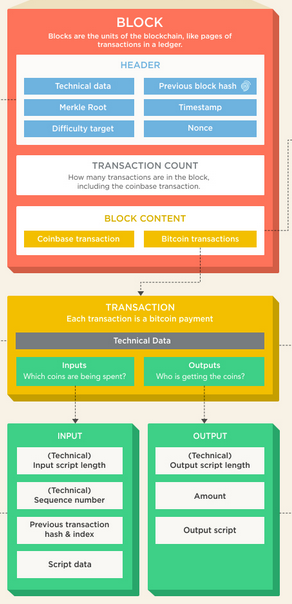
    What is blockchain? It is a linked list of data structures that uses cryptographic hashing to sign each data structure, thus including it in the canonical chain. Here’s the block used by Bitcoin (most other cryptos will have mostly the same components).

    You can see the transactions in the Block Content section, and you can see info (such as the hash of the previous block) in the Header section. Let’s relate this all together and draw a true picture of a blockchain (specifically Bitcoin) block. To do so, we’re gonna be dealing with a whole bunch of cryptographic hashes.

    Hashing: A Redux

    If you want the nitty gritty detail, you can go here. However, since we’re not writing a mining algorithm or a storefront, I’ll spare you the minutae. If you want an awesome video that explains exactly what I’m about to talk about, but in visual form? Here ya go! Want to learn more about blockchain than you ever wanted to know, but all at a layperson level? You’re welcome!

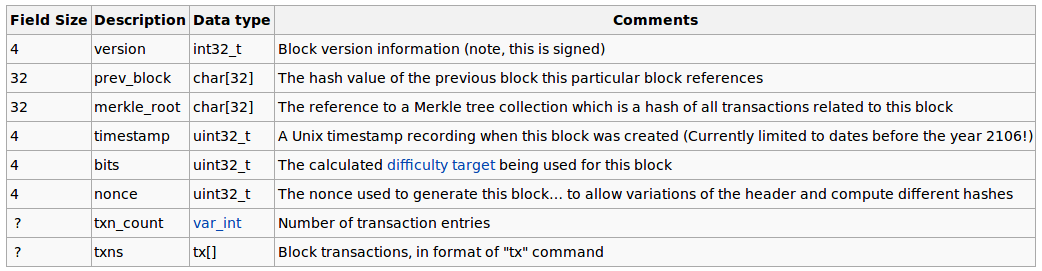
    Here’s a Bitcoin block:

    Let’s work from the bottom up.

    txns

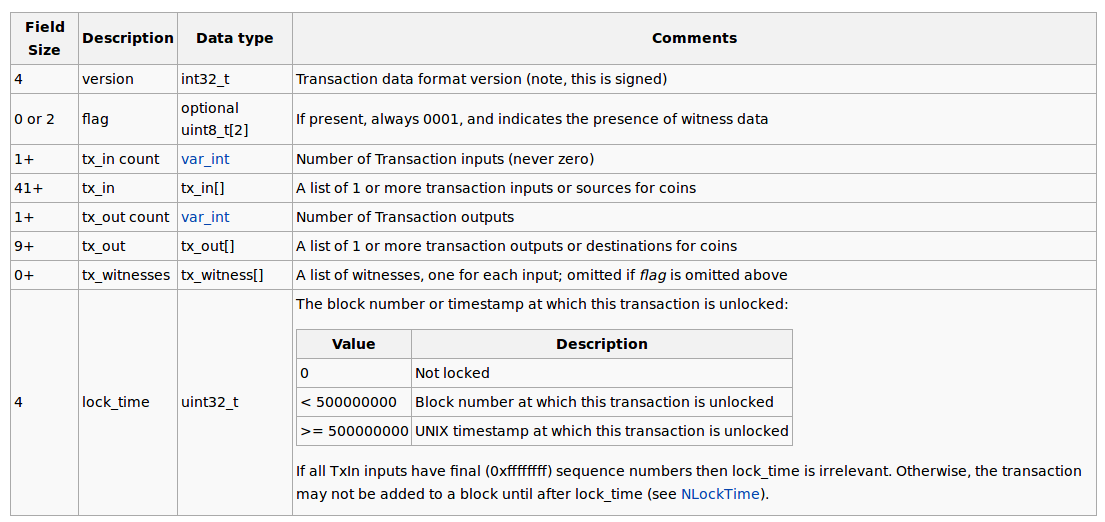
    The payload of a Bitcoin block is an array of transactions. Each transaction looks like this:

    I show the transaction mainly to show you that it contains two things: tx_in and tx_out. This is how it works, you combine a certain number of prior transactions in the blockchain (inputs) and then dole out the coins contained in those transactions in the outputs. If the inputs go over how much you’re paying the other person, you add an output to pay yourself back the overage. It’s much like cash. Just like handing bills to the cashier and receiving change back, you hand over inputs, and receive back an output for the overage.

    Let’s do a quick example. Oscar wants to pay ZARDOZ for the Gift of the Gun, and he wants to pay $150. Oscar has previously received money from Office Manager Mohammed for “Jihad related expenses” for the amount of $110. Oscar has also previously received money from Preet Bahahahaha for “Woodchipping services” in the amount of $65. In order to pay ZARDOZ, Oscar sets up the transaction by including the previous Jihad and Woodchipping transactions as inputs, and creates two outputs: one to ZARDOZ for $150, and one back to Oscar for the remainder ($25). Then those Jihad and Woodchipping transactions are marked as fulfilled, meaning that they can’t be used again as inputs.

    txn_count

    This is fairly self explanatory. This contains the number of transactions in the block.

    nonce

    From here on up in the block, everything is contained in the header. Remember that the hash of the block is really the hash of the header. The txn and txn_count parts of the block are not used in calculating the hash. However, we’ll find out really soon why the transactions are still reflected in the block hash.

    Nonce is related to mining. I’ve alluded to the way that blocks are created, and I’ll discuss it more in the next section, but suffice it to say that the nonce is a random number and has no purpose besides in calculating the hash. The way that a block is added to the blockchain is that the block’s hash must be below a certain number. How do you get the hash below a certain number? You adjust the source data used to make the hash. Since the hash comes from the header and the nonce is in the header, you can change the nonce until the hash is below a certain number. Notice that simply changing the nonce to a lower number doesn’t guarantee that the hash is a lower number. This is where luck and random chance come into play. We’ll talk more in the next section about this.

    bits

    Bits goes with the nonce. It is the “certain number” mentioned above that the hash needs to go below for the block to be accepted.

    timestamp

    Timestamp is self explanatory. It’s the time when the block was created.

    Merkle Root

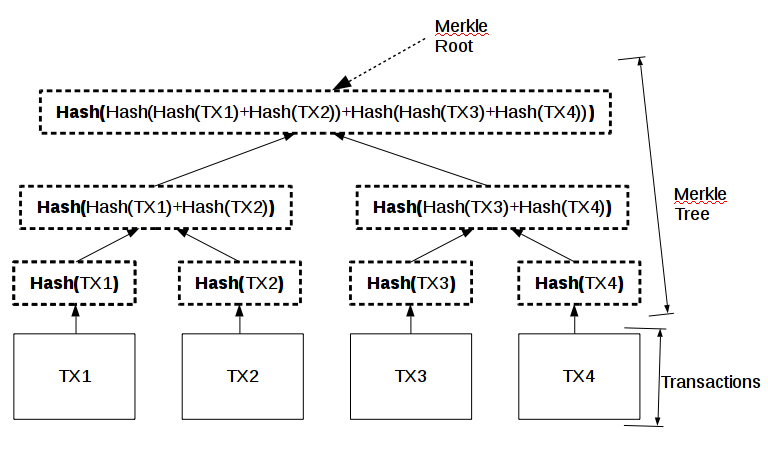
    We’ve discussed the Merkle root before, but haven’t really nailed it down. Let’s do that now. The 10,000 foot view is that the Merkle root is the hash of all of the transactions. The hash of the block (which is actually the hash of the block header) takes the Merkle root into account when calculated.

    The Merkle tree is a binary tree (each parent node has two children) that hashes from the bottom up. The bottom row of the Merkle tree contains the hashes of each transaction. The middle row hashes adjacent bottom row hashes (it’s a hash of a hash). The top row is a hash of a hash of a hash and contains information from all of the transactions. Notice what it would take to modify or replace a transaction. If STEVE SMITH tries to replace TX4 with FAKE_TX4, he has to recalculate three different hashes, as well (all of the hashes that include TX4 in them).

    Prev Hash

    This has been discussed at length in the prior two parts. This is the hash of the prior block, the link between the current block and the prior block.

    Version

    The version of the blockchain tells everybody what rules this block has been assembled under. This makes it possible to improve a blockchain without having to toss out all of the old blocks.

    Mining

    We’ve hinted at what mining is already, but now we can put all the pieces together. When transactions are posted to the blockchain network (all of the computers mining and transacting on that blockchain), they are packaged up into a block to be added to the end of the blockchain. How this happens is technical and a bit beyond this overview. Once a block is packaged up, the mining process begins. The block, sans block hash and nonce, is sent out to the network for mining. Computers that are set up as miners begin to calculate the block hash. Remember that the block hash is calculated from data that includes the Merkle root, the previous block’s hash, and the nonce. All of those pieces of data are constant except for the nonce. Therefore, miners, upon calculating the block hash, adjust the nonce to try to get the block hash to be less than the current difficulty number (represented by the bits field).

    Once a miner has calculated a block hash below the current difficulty number, they submit the hashed block to the network. If they’re the first to do so, they “win”. They end up getting a small payment of cryptocurrency for their efforts. The payment is based on an algorithm that reduces the amount of currency created for a successful mine until an end date when no more currency will be created for that coin. At that time, miners will only be compensated by transaction fees (which are currently in the tenths of a percent range).

    As you can imagine, it’s not easy to do this. Bitcoin, for example, is designed so that, on average, the winner mines the block in about 10 minutes. Given the vast amount of processing power dedicated to Bitcoin mining across the world, the chance of a single desktop computer winning even once a month is slim. In some other cryptocurrencies, it is easier, but even a second tier crypto like Monero would average one or two wins a month for a standard desktop computer. At that point, you’re probably not making enough to pay for the electricity you used.

    That’s where mining pools come in. It’s a fairly simple concept. Take a bunch of computers, let them mine as a cohesive unit, and split the winnings across members based on a pre-defined formula.

    The Big Picture of Blockchain and Different Applications

    We’ve talked about blockchain in the context of cryptos, but there are a ton of different potential applications for blockchain. The main “hot topic” for blockchain use is reputation analysis. Rather than having to go through a reputation broker (Uber, AirBnB, Yelp) to find out whether the person driving that car or renting that room or cooking that meal is trustworthy, you can reach out to the decentralized blockchain to find their reputation.

    This is a fairly simplistic application of reputation analysis, but the reason folks are excited is the application of such a thing to automation technology. What if, for example, you didn’t have to put in a reservation to get a hotel room? If your reputation is high enough and the room is available,  the lockbox automatically opens and gives you the key to the room. All you have to do is tell the system how long you plan on staying there, and you’re set.

    Another application is identity management. Does the cashier really need to see your name, address, and other personal info to know that you’re old enough to buy alcohol? There’s a whole bunch of identity leakage that sets each and every one of us up for identity theft. One proposed use of blockchain is to provide customized identity services. The cashier can query the blockchain as to whether you’re old enough to buy alcohol, but can’t access your address. Amazon can get your address, but can’t get your social security number. Starbucks can get your first name, but not your last name.

    What about securing your finances? This isn’t entirely separate from cryptocurrencies, but what if every transaction you made was from a different account? Instead of giving your bank account info or your credit card number to merchants, you give the equivalent of a Visa gift card with the exact amount of the transaction on it. If Target gets breached and your info is leaked to malevolent actors, it’s not an issue, because it points to an empty one-time account.

    Finally, the application that I think would be the most interesting. Traffic management via blockchain. As automated cars become a more likely reality, most of the traffic management interaction methods that have been designed to be centralized or distributed in nature. A decentralized traffic management system would reduce the efficacy of government meddling and the potential for an enforced monopoly a la internet service provider.

    Cryptocurrencies

    I’m not going to list out all the cryptocurrencies in detail. I trust y’all to DDG it yourselves. Let me just point out a few of the big ones in passing.

    Bitcoin – The original and most famous. There is relatively little anonymity in using Bitcoin, as shown by the Silk Road FBI takedown.  It’s also relatively slow to get new blocks integrated, at an average of 10 minutes per block.

    Bitcoin Cash – A fork of Bitcoin meant to scale to more users a bit easier by making the blocks bigger.

    LiteCoin – Billed as “silver to Bitcoin’s gold”. It generates blocks 4x faster (2.5 minutes per block), will generate more coins than BitCoin, and some different internal algorithms.

    Ethereum – Ethereum is much more than a cryptocurrency. It creates smart contracts that can take advantage of automation. Want to unlock your guestroom when somebody has enough reputation points? Ethereum is probably the best blockchain to start from to do this sort of thing.

    Monero – Billed as the “secure cryptocurrency,” it is designed slightly differently from BitCoin so that bad actors (like the FBI) can’t trace one transaction back and see your entire transaction history. Secure is a relative term, because, as seen in the Silk Road incident, there are weaknesses wherever you have to give personal info (shipping, currency conversion)

    Drawbacks and Limitations

    This could be an article in and of itself, but I’ll just hit a few that are top of mind.

    1. Blockchain length – The immense size of the Bitcoin (and other large cryptos’) blockchain means that you either need to rely on somebody else’s node to get plugged in (by using an exchange) or you need to wait a few days for all of the blocks to be downloaded.
    2. Block acceptance time – In Bitcoin, it takes an average of 10 minutes for your transaction to be included in an accepted block, and due to forks (when two different blocks are accepted in two different parts of the network), folks recommend waiting an hour before declaring the transaction “completed.” That obviously doesn’t work for somebody trying to walk out the checkout line at the supermarket.
    3. Scalability – This is kinda wrapped up in the last two, but the number of transactions in a block are limited by a maximum size. Therefore, as more and more transactions occur, the chance of your transaction making the first block goes down substantially. Then, you have to wait not only 10 minutes for your block to be mined, but you have to wait an unknown amount of time until your transaction is included in a mined block. This is where transaction fees come into play. When there are 50,000 transactions, which ones are you going to try to make into a block as a miner? The ones that pay the best, of course.
    4. Security – We’ve discussed some security concerns already, but blockchain doesn’t resolve the single biggest threat in online transactions: the other party in the transaction retaining and ultimately misappropriating your personal information.


    I hope this series was helpful to y’all! I’ve certainly learned a ton!