Category: LifeSkills

  • Talk to the cops? Are you crazy? (part one of a multi-part series)


    I have the glory and honor of appearing on a few court-appointed lists in the area. This means I represent clients for misdemeanor, felony, and child protective/ delinquency cases. And I really don’t mind doing this kind of work. Strangely enough, going to law school really prepared me well for doing this kind of work. Go figure. Although it wasn’t taking the required criminal law classes that prepped me, it was the overall structure of the classes.

    One of the perks of my job is that I get to read a lot of police reports, and talk to police officers and detectives a lot. The reason why I say this is a “perk” is that it makes me look at the arguments law enforcement would use if the case goes to trial, and how police psychology works. It’s actually quite underhanded and manipulative once you break it down into its pieces.

    Sometimes, and it has happened more recently thanks to getting on those court-appointed lists, I have potential (retained!) clients call me with the following scenario: “I was at a party last weekend, with a lot of friends. My friends tell me that Tom says that I committed a crime against him, and that he called the cops. Should I talk to the cops?”

    My advice is always “No, you have no obligation to talk to the cops.” And then I tell the potential client, “if the cops call you, tell them you won’t be questioned without your lawyer present.”

    1. The format: Police reports are written in a good guy/ bad guy format. It’s like a play. Usually –and I can’t think of a time I have seen it any other way — the person who calls the cops is the “good” guy. Once the cops identify the rest of the players in the play, they will try to finger one person  (or possibly a group of people, who end up as co-defendants) as the “bad guy.”

    This is the beginning of how the mind set of law enforcement works. It’s easier to sell the story to a jury if the play is simple. Good guy / bad guy is a scenario we have all seen, and the jury will want vengeance, justice, or something, for the good guy. This is how a conviction is made.  Also, police and prosecutors know their audiences: it is the general public. What is the general public’s IQ? How does the general public feel about victims and justice?

    2. Corroboration: Talking to the victim, or alleged victim as I like to call him/her, gives the cops a list of other people to talk to, witnesses, before they talk to the person they’re trying to cast in the “bad guy” role.

    This is how under-handed the police mindset is, as talking to other witnesses first becomes a set-up for the defendant to put his own picture in the frame, or cast himself in the starring role. It also gives police an inside edge, as this leads to a cross-examining of the defendant from their first contact.

    This is part of the officer’s job. And it works in their favor — talking to other witnesses gives “corroboration” to the alleged victim’s story. If the witnesses back up the victim’s story, then the cops have some corroboration, and the victim’s story sounds more like it would stand up in court. Back to selling this story to a jury: if there’s a witness who says the same thing as the alleged victim, then the jury will have more sympathy toward the alleged victim, and it is easier to get a conviction.

    3. Contacting the defendant: The scene is now set, the cops have a victim, and some witnesses. Now all they need in the play is the bad guy.Once the cops call the potential defendant, they begin with what is called a “leading” question. Sometimes these are called open-ended questions. It’s the sort of question an interviewer uses on a job interview, such as, “where do you see yourself in five years?” it doesn’t lead to a “yes” or “no,” instead it leads to more of an explanatory answer.

    Or, in the potential scenario of being pulled over, it sounds more like this “How fast did you think you were going?” This leads to an answer that can be incriminating such as, “I’m not sure, but I think was going about 35.”

    Except in our “play,” as written by the police, it sounds a bit more like, “Hi, Jim. My name is officer Bishop with the County sheriff’s office. Tom talked to us, and said you committed a crime against him.”

    This open-ended statement might lead a person to possibly deny the assertion, or to try to correct the cops. The problem is that any other statement a potential defendant makes at this point can be used to cast him in the role of bad guy, no matter the answer.

    Usually by this time, again, cops have talked to other witnesses, and so once the defendant says something, an officer can counter with “Well, Mr. Johnson said you went after Tom with a carving knife.” Here’s the corroboration coming to assist the cops, and further explanations by defendants are only helping the police.

    Also, the next thing a defendant says – even if it is the truth — may lead to a credibility problem not too far down the road. The options are to either a) deny what has been said by Mr. Johnson, or possibly point the finger at someone else; or b) deny what was said totally. (Option (c) is also available, however).

    At the first contact by police, asserting an attorney’s assistance would be helpful. Instead, defendant should answer, “I’m sorry officer, but I can’t talk to you without my attorney present.” That’s option (c), which no one seems to take!

    Either way, the cops have an alleged victim, and a corroborating witness who already say nearly the same thing. But according to the defendant, those two are both liars now. That won’t seem likely to a potential jury, will it? This is just grist for the mill of the prosecution. Think again of the audience, which is the general public. Who should the jury believe: the defendant – or all of the possible ways to agree with the prosecution: instead the jury can believe the alleged victim, officer testimony, credible witness testimony . . .

    Police also know that facts are confusing – the victim and one or two witnesses usually get a few facts wrong, but this still can be OK to a jury. The victim is sympathetic; so it makes sense what with being attacked that the victim might get a few facts wrong.

    4. The defendant’s natural response works against him. This is where manipulation also comes into play, in case it wasn’t used already when contacting the defendant. Most people are raised to think that the cops are good people, and that working with the cops will help everyone (even when being questioned about something).

    A second natural response happens when police contact a suspect. The suspect wants to “set the record straight” about what really happened. This works against the suspect as well. The police aren’t interested in getting it straight, they are interested in the “good guy/bad guy” scenario.

    Back to my job: I can’t tell you how many times I have had clients tell me “I was respectful”– “I didn’t make a scene,”– or “I cooperated.” Even clients with fairly extensive criminal records tell me this, when their prior involvement with law enforcement should have them knowing better. Who cares whether you cooperate with the police? The police will do their job whether you cooperate or not. And that’s what they are paid to do, so why help them to do their job? I don’t see the cops coming along to help you do yours, now do I?

    5. The fact that cops wear uniforms works in their favor. It’s intimidating, for one. Second, it tends to lead to obedience on the part of defendants. Clients/defendants know that cops have uniforms, guns, and jails at their disposal. So it’s easier for cops to get compliance, and so defendants/clients to give in to authority: the alternative can be scary – even if you are innocent. People in that situation tend to want to get out the situation as quickly as possible, so it’s easier to tell the cops something. Third, the uniforms are de-humanizing. It’s not a guy who happens to be a cop, it’s a cop! People see the uniform, but not the individual in uniform.

    Well folks, that is all I have for now. Thanks for listening. Feel free to comment, leave suggestions, etc. My upcoming specials will be:

    Part two: The Big C: When do your Constitutional rights “attach” to the situation?

    Part three: Evidence problems. What the police report says, can it be “in” evidence?


    Lastly: this is totally worth the watch: a criminal law professor covers exactly the same topic I just did!

  • Working Your Wood with McGinty – Building a Murphy Bed – Part 1

    We finally got around to sprucing up our basement which doubles as a bedroom when my dad visits. He doesn’t do stairs all that well and since the garage and basement are on the same level it’s easier for him. There is a full bathroom down there as well so he has everything he needs. When he’s not visiting it doubles as an orgy room. Just kidding. Maybe.


    While the basement is big enough to have a queen size bed laying around I always liked the idea of a Murphy bed since it would free up floor space when the bed isn’t needed. They make hardware kits for a few hundred dollars, and really only a few hundred dollars of wood is needed. However, I thought about it some and figured I could build it with just 4 bolts (3/8ths thick) and use some of the ¾ inch plywood I had in the back of my truck (that was supposed to go towards a different project). I did make a run to the lumber yard for some poplar, but if I had to buy the materials instead of using what I had I would buy ½ inch plywood for the bed frame and cut the poplar down to ½ inch thickness as well. Since the poplar is 13/16ths thick a thin blade on a band saw would do the trick in splitting it into 1/2 inch and 1/4 inch thicknesses. The leftover ¼ inch thick pieces would then be perfect for some of the trim work later on. Unfortunately, I don’t own a band saw (yet…) so I made do with what I had.


    I started with the bed frame, ripping the poplar down to 2 ½ inches and cut to length. Then I used my super handy Kreg pocket hole jig (*sticks out hand for a kick-back from Kreg) and screwed everything together. No glue needed as the frame will get glued to the plywood:

    This is a view of the foot end, and the two areas that are “notched” in are where the fold down legs will go.


    After I glued the frame to the plywood, I used my super handy Makita track saw (*sticks out hand for a kick-back from Makita) to shave off any proud edges so that the sides of the frame would have a nice even surface to glue to:


    Here is what the bed frame looks like with the sides glued on:


    The other end is the head end, and I wanted some type of built in headboard that also doubles as a support for the mattress when the bed is folded up:

    Other than a couple of screws in the sides it’s just glue holding the headboard and the brackets to the frame. The mattress we bought is really light (20 pounds?) so this is plenty strong.


    Also, I glued a piece of scrap I had that was ripped to 45 degrees to brace the corners which are also just glued together:

    For the case, the ¾ inch plywood is definitely needed as this will support the head end of the bed when it’s down, and the entire thing when it’s folded up.


    I cut dadoes on the sides where the back will attach with my super handy Makita compact router (*still waiting on my kick-back Makita!) then pre-drilled holes to make it easier to glue and screw to the back:

    I still managed to get glue all over the place while trying to attach the sides to the back. A nice, slow drying, gel type of glue would be awesome (*sticks out hand for a kick-back from Tite-Bond for the genius idea) as the regular wood glue just ran down the sides in the few minutes it took to assemble it. Perhaps construction adhesive for subfloors or even liquid nails might work better here (*retracts empty hand). Hopefully I’ll remember that next time.


    Here is the case with the sides attached:


    The top was glued all around, but just screws on the sides. The clamps really made for a nice, solid fit:


    So after the case was built I took out my tape measure to check that the inside was big enough:

    63 ½ inches.


    Next I checked the width of the frame:

    61 ½ inches. Huh. So I’m off an inch and a half. I’m not sure where I gained this extra inch and a half, but it’s a hell of a lot better than being an inch and a half short.


    So I decided some wood blocks that go where the bolts mount the frame to the case would do the trick:


    So here it is assembled in the up and down position:

    There is a lot of trim work still to do and some kind of safety latch to hold it in the upright position is needed, so I will save that for part 2.

  • GlibFit 3.0 Week 2 Wrapup – Macros

    Let’s say you’re on board with tracking your intake, and that you’ve established the habit of tracking your calories. Some of you are there, some of you are a few days into a new habit, some of you couldn’t give two shits. The next step is to dive deeper into the numbers and track your macros. I know a few of you already do this, but I want to extol the virtues of macro tracking. For the longest time in college, I tracked my calories on a daily basis. I’d hit my calorie goal most every day, but I wasn’t feeling the way I thought I should feel. I was constantly hungry, and I wasn’t seeing a ton of improvement in the gym. I had plateaued, and I couldn’t break through. It turns out that I was way heavy on carbs and too light on protein and fat, resulting in me losing traction for my fitness goals.

    Image result for CARB

    Carbs – These include everything from fiber to sugar to starches. Carbs are fuel for your body, and despite the media and the fad diets out there, carbs can be your friend. Different types of carbs have different effects and purposes. For lack of a better description, some carbs are more potent than others. Simple carbs are a quick hit of energy for your body. They’re easy to break down, and they’re quick to take effect. This is the traditional “sugar high”. Simple carbs include refined sugar (pastries, candy, etc.), simple sugars (fruits, vegetables, etc.).  Complex carbs are more difficult for your body to process, but provide a steadier source of energy over a longer period of time. This is why distance runners carb load prior to their runs. Complex carbs include starches like found in grains, potatoes, etc. As you are fully aware, spiking from sugar high to crash all day long is miserable and ends in morbid obesity after a while. Most of your carb load should be in complex carbs.

    However, it isn’t as simple as choosing complex carbs over simple carbs, you want to balance the amount of carbs you get with the other nutrition you receive, including fiber, minerals, and vitamins. One of the easiest ways to balance your carb load in comparison to other nutrition is to focus on using whole ingredients in your meals rather than processed ingredients. Next week, we’ll go into more detail.

    Protein – Ahh, meat! Protein can also be found in legumes, some grains, some vegetables, eggs, tofu, and hemp (for those of you in CO). Protein is your foundation for successful fitness. Working out, whether cardio or strength training, involves tearing down your muscles and rebuilding them stronger. How does your body rebuild your muscles? By pulling protein from your food and incorporating it into your muscles! If you wear down over long periods of working out, a protein deficiency may be the culprit. If you struggle with inordinate soreness and fatigue after strength training, protein may help with recovery. Timing can play a role in recovery, and we’ll cover that in a few weeks when we talk about post-workout eating.

    Image result for fat

    Fat – Ignoring the screams from all those who have been taken by the ’80s and ’90s fad diets, fat is a very good thing, and it’s very important to long term success of your fitness goals. If you want to be miserable, go on a low-fat diet. Fat helps you feel satiated at the end of a meal, and it helps stave off hunger throughout the day. However, one temptation with fad diets (including Keto) is to jack up the fat consumption to insane levels. Mrs. trshmnstr is skeptical about the health of going to insane in the opposite direction and eating tons of fat. As always, a balanced diet is the recommendation.

    Overall, a good baseline ratio is 35% carbs (mostly in high-fiber whole foods), 35% protein, and 30% fat. We’ll talk next week about adjusting those ratios to account for body type, fitness goals, etc.


    HIIT workout of the week

    As always, Mrs. trshmnstr recommends trying this out 3 or 4 days this week. As always, don’t kill yourself and modify the exercise where you need to based on your fitness and abilities.

    3 rounds of:

    • 50 jumping jacks
    • 10 pushups
    • 20 squats
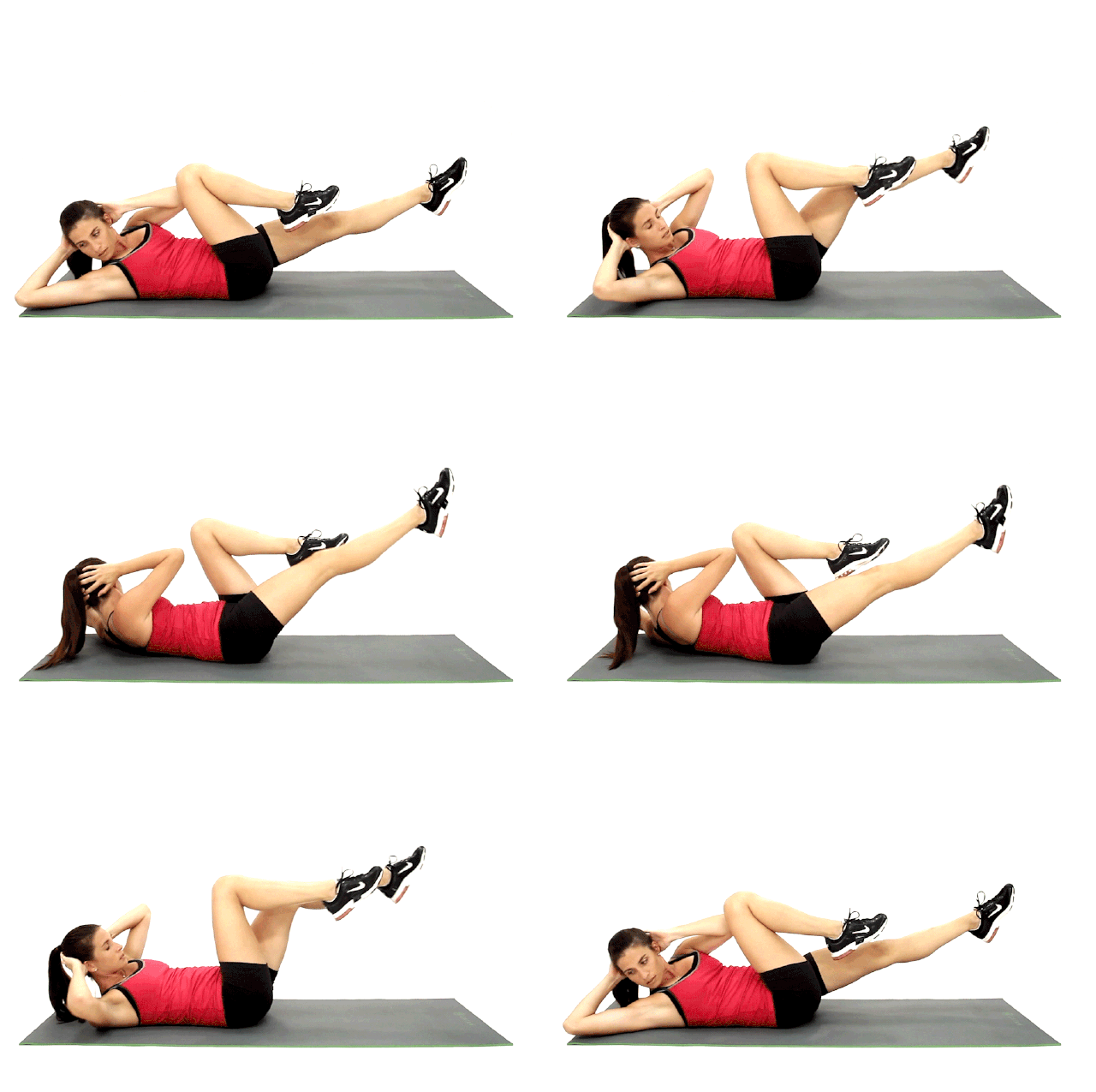
    • 20 bicycle crunches
    • 1 min rest
    • 50 high knees
    • Image result for gif high knees
    • 15 side plank crunches on your right side
    • Image result for gif side plank crunches
    • 20 squat jumps
    • Image result for gif squat jumps
    • 15 side plank crunches on your left side
    • 1 min rest
    • 50 mountain climbers
    • Image result for gif mountain climbers
    • 15 lunges each side
    • 20 plank spidermans total
    • Image result for gif plank spiderman
    • 15 situps
    • 1 min rest

    This is a 30 minute workout, so the goal is to do 2x for a full workout.

    Recipe of the week

    Trashy’s daily breakfast. Mrs. trshmnstr says this isn’t a healthy breakfast, and that I’m an idiot for posting this, but I’m gonna do it anyway!

    • 1 piece of multigrain toast
    • 2 fried eggs
    • 1 sausage patty
    • hot sauce

    I used to struggle with mid-morning hunger and fatigue issues when I ate a granola bar or nothing for breakfast. This breakfast is a good mix of fat, protein, and whole food carbs with enough flavor to get going in the morning. I think the eggs are the most important part. I could probably sub out the toast or the sausage for a fruit if I wanted to be super healthy, but I’ve found that I can lose 2+ lbs per week with this breakfast if I’m good about my other meals. I’ve also found that it doesn’t take me an hour or two to get ramped up for work in the morning. I’m firing on all cylinders the minute I open my laptop.

  • The Libertarian Vegetarian: Why Your Stir Fries Suck

    It’s not Christmas, but still. In one of the other cooking post comments, several of the Glibertariat complained that their stir-fries were just not… right. And most of the stir-fries I’ve gotten outside of heavily Chinese areas have been somewhere on the line segment between mediocre and really shitty. And that includes 95% of Chinese restaurants run and staffed by Chinese, but located in white, Hispanic, or black neighborhoods- they’re giving the people what they want (in the case of Jews, pork and shellfish- that was the code word for forbidden meats, “Chinese food”).

    So sit back and I will attempt to make a Guide for the Perplexed. I clearly am not Chinese, or of Chinese origins, but I have decent cooking chops, traveled a lot over there, lived in Asian immigrant communities, and am not bashful about asking questions to chefs when I taste something really good, and that has reduced my level of ignorance. The word “Chinese” will be used a lot here, because that’s my personal epicenter for stir-fry cooking. But really, there’s a whole lot of other Asian cuisines that do these same sorts of things, so think Thai, Vietnamese, Laotian, or what-have-you, the principles are the same. Shit, you can even appropriate Chinese methods to prepare Italian-style food; that’s why America is great. Likewise, though I’m a vegetarian, what I’m talking about here is generic and applicable to the protein of your choice. If you prefer dead pig to seitan, you’re still making shitty stir-fries, and I’m still going to save your ass despite that offense to Yahweh.

    We regularly fuck up stir-fries. Stir-frying is just a technique, widely applicable and flexible, and we still fuck them up. Here’s a partial list of the things that are most commonly wrong:

    • Too soggy. Everything in the dish is more like an Irish stew.
    • Singed ingredients that are raw in the middle.
    • Uneven cooking, so you get a combo of vegetables that are mushy and raw.
    • Gloppy. There’s a weird sauce-fetish that I think derives from old school American Chinese take-outs. The ingredients are drowned in a thick gooey brown or white sauce. And the sauces’ flavors tend to dominate the dish as well.
    • Sweet. And the worst offender is the sugar-fetish.

    In order to help you avoid the common traps, I’ve got a couple of recipe-ish things here, but what I really want to harp on is some stupidly simple methods which come up again and again. While I’m at it, I’ll also beat you up about the shitty equipment you use. I hope that one or another of my random pieces of brain lint give you an easy fix so you’ll stop making shitty stir-fries.

    Step One: Ingredients

    The rule of thumb for good Chinese cooking is 60-30-10. 60% of your time should be seeking and obtaining good ingredients, 30% of your time doing preps, and 10% or less actually cooking.

    By “good ingredients,” I don’t mean “exotic ingredients,” but rather quality stuff whose flavors and textures don’t need obscuring. The Chinese have been great about adapting their cuisine to local ingredients and freely appropriating. Yeah, it’s fun to use things like Szechuan pickled radish or fermented black beans, but that won’t make your shitty stir-fry less shitty. It will just be shitty but now exotically shitty. Here’s a crazy idea: buy great green beans or peppers or bean sprouts or mushrooms or chicken/beef/pork/seafood and don’t worry as much about the spices and condiments. Now you have a shot at a decent dish, even if you’re fresh out of huangdou jiang.

    If you use canned bean sprouts or green beans or asparagus, I will personally come over and explain your porn history to your spouse and children.

    The only real necessities peculiar to Chinese stir-fry cooking are soy sauce (have both dark and light on hand), toasted sesame oil, and Shaoxing cooking wine. Use a high smoke-point oil like peanut. All else is negotiable; I keep a variety of pastes, spices, and vinegars handy for specialty dishes, but my everyday stir fries do fine without ’em. Whatever you do, avoid the brand name generic “stir fry sauces.”  Read the ingredients; most of them lead off with water and sugar. There will be other forms of sugar listed as well. And xantham gum for extra gloppiness. That stuff is a sure path to shittiness. Unless you like shitty, in which case, go get some deep dish with pineapple and spare the rest of us.

    MSG frankly is rather common and not the devil that excess sugar is. Use it wisely and sparingly, but don’t reflexively avoid it.


    Step Two: Tools

    Since prep should be an outsize part of your time investment, it goes without saying that you need really good sharp knives to make the work go smoothly and quickly. I have a rather, um, eclectic collection. My default knife for stir-fry prep is a cheap Chinese cleaver. It says “stainless” on it and it isn’t. Which is OK, it takes a nice edge, but needs honing every ten minutes or so. Which is also OK because I bought it about 40 years ago for $8 at a Chinese grocery, given it a lot of hard use over the decades, and it’s still doin’ its thing. So while a $300 Shun is a delightful thing, it’s not really a necessity- I didn’t see many of them used in great kitchens in China.

    My second-most used knife for stir-fry prep is also a cheapie, this one a 10″ Victorinox. It feels good in the hand, sharpens easily, and has held up well since we got it a few years back. Costs less than a couple of movie tickets and popcorn.

    Victorinox Fibrox Pro Chef’s Knife, 8-Inch Chef’s FFP (I use a 10″ because of large hands)

    Third most used knife is also a Victorinox, a 3.25″ paring knife, and cheaper than a slice of pizza and a Coke. Great for fine trimming (like the stems of tomatoes or the eyes of pineapple). I think these knives are Swiss, despite the lack of noticeable holes.

    Victorinox 3.25 Inch Paring Knife with Straight Edge, Spear Point, Black

    And obviously, you want your knives sharp. There’s folks among the Glibertariat who are masters of getting the finest possible edge. I am not one of them, so I cheat and use one of these, a Chef’s Choice Asian sharpener. It gives a good enough edge that I have no problem getting paper-thin slices of garlic or cutting through the skins of over-ripe tomatoes, and it’s so fast and easy, I can sharpen mid-prep without losing much time.

    OK, next we bring the heat. Do you have a trendy wok, nicely ceramic non-stick coated and heavy stainless-aluminum clad construction? Toss the fucker, it’s a piece of shit. Ditto the abomination of cast iron woks. Donate them to a homeless turtle shelter or something, they’ll do more good there than on your stove. Know what you need? Something cheap, thin, and unlaminated steel. The kind of piece of shit you get for $20 at the Chinese grocery. Unlike nonstick, you can get these smokin’ hot. Unlike laminated or cast iron, you can get them smokin’ hot very rapidly. And when you turn down the heat, they cool very rapidly, so all in all, the shitty steel woks give you much better temperature control.

    Shape is important. Round bottoms are the best BUT you have to have the right kind of cooking surface for that- I have a wok stand from Thailand which is superb,  putting out approximately the same amount of heat as the engine from a Saturn V booster stage. I can get the wok to literally red heat in 20 seconds. It is absolutely the best stir-fry cooking I’ve ever done, with the food taking on a subtly smoky “wok hei” aroma and the food cooking in record time. THIS is the right way to do things. I shit you not, wok hei is the difference between indifference and real difference.

    Unfortunately, there’s a catch- you either need a professional ventilator hood or you have to cook outside. And our outside cooking has been limited recently because of a heavy mosquito season. After our first frost, I’ll be able to do this again.

    Lacking a wok stand like that, don’t even THINK about using a round-bottom pan on a flat cooktop, even with a wok ring, unless you have something like a 100,000 BTU burner. With normal stoves, you will have really shitty heat and that means really shitty, soggy, badly-cooked stir-fries without even a trace of wok hei. Find a thin steel shitty wok with a flat bottom. Not optimum, but you can at least turn out some half-decent product. Here’s mine:

    Whichever you use, you want it well-seasoned and to maintain that seasoning. It’s the best non-stick surface you can get. I’ve got about 20 years of season on this wok, and as you’ll see below, I can fry difficult foods like eggs with no sticking.

    You also need another utensil for the process- a steel spatula or wok turner. I don’t have one, so I get by with a big steel spoon (seen in the videos below). It works, but I’m a shitty person for not getting the right tool. Don’t be like me. Don’t be a shitty person. Get the right tool.

    Techniques:

    Did I mention heat? You want the ability to get that wok screaming hot, and the courage and attention to use it properly, which means not getting distracted and letting food burn, and most importantly… mis en place. You want EVERY ingredient to be prepped, chopped, measured, and handy. If you don’t make at least ten dirty little bowls and dishes for you ingredients, you’re doing it wrong and that’s why your stir fries suck. God invented dishwashers and orphans- make use of them.

    Second, precooking. Most stir-fries use ingredients from their raw state, added sequentially. And that’s another reason most stir-fries are shitty. To get the best and most even degree of doneness with disparate ingredients, you need to precook (slightly undercooking) each of the major ingredients in advance, then bringing them together at the end. Typically, the protein will be cooked first, removed, then set aside. Various additives can be either parboiled and refreshed (i.e., dunked into an ice bath after boiling) or stir fried separately to get each one to the optimum cooking point. Then the actual building of the stir-fry commences by cooking aromatics (garlic, ginger, scallions, and the like), then adding the cooked ingredients and seasonings/sauces to reheat and finish.

    I can’t overemphasize the latter point: stir-fry should be done in discrete stages which are brought together at the end. For years, my stir-fries were shitty because of misguided ideas about trying to time the sequence so that the ingredients were added on top of one another in the right order and would magically cook properly. This is an especially bad idea because not only does the timing become terribly critical and can’t be adjusted on the fly to accommodate variations in ingredients, but you also lose control of the cooking temperature- the first ingredients put in the wok will insure that later ingredients cook at a lower temp and with higher surrounding moisture. That is not generally a good thing.

    The other advantage of the cook-shit-separately is that distinctive flavors and textures will remain distinct and not all blend together in a mish-mash. This is why German or British cooking is shitty and Chinese cooking is great. And why you need to spend time getting great ingredients.

    Two Examples:

    These are sort-of-recipes, but each illustrates points made before. Neither is “authentic,” but they each use mostly non-exotic ingredients and (when cooked right) show off the quality of the main ingredients. And each is linked to a video showing most of the process; the videos are pretty shitty because we didn’t have time to block out the shots or to do editing/voice-over, but future ones will be better.

    Because of the aforementioned mosquitoes, I had to use my kitchen stove and the flat-bottom wok, so the heat was somewhat inadequate. But still, they turned out delicious.

    Stir Fry Green Beans

    This is loosely based on a classic Szechuan dish and is an example of a dry stir-fry. The Szechuan version uses pickled radish and Szechuan peppercorns, so feel free to exotify it if that’s your desire. Traditionally, the precooking is done by deep-frying in coolish (300 degree F) oil instead of the water-blanching that I do, and yard-long beans are used. Again, feel free- the important thing is to have the beans pre-cooked before the stir-frying commences.

    1 lb fresh green beans, ends trimmed

    1/4 cup raw peanuts

    2-3 cloves garlic, sliced thin

    5 or 6 dried red chiles

    2-3 white parts of scallions, chopped

    1 tsp Korean red pepper paste (gochujang); can substitute garlic-red-chile paste or chile-black-bean paste

    1 tsp light (not lite!) soy sauce

    oil to cook


    Drop green beans into a pot of rapidly boiling salted water. Boil for 3-4 minutes or until the beans are about half-done. A few beans may need to be sacrificed to determine this; cook’s privilege. Drain and toss into an ice water bath, then after they cool completely, remove from the bath and drain. Set aside.

    Mix the pepper paste and soy sauce together. Set aside.

    Heat the wok until it’s smoking, then add in one or two tablespoons of oil. Toss in the sliced garlic and toss it around until it gets aromatic and starts coloring a little bit, 15 seconds or so. Remove the garlic from the wok. Add the dried chiles and stir around until they start to brown, then remove and set aside. Add the peanuts, and stir around until they start to color, 15 seconds or so. Remove the peanuts and set aside. Optionally, you can lightly crush or chop them after cooking for a finer texture.

    Seeing a pattern?

    Now it’s time to bring everything together. Add the chopped scallions, stir for a few seconds, then add the green beans. Stir-fry until the green beans are starting to show some black spots, a minute or two. Add the pepper paste/soy sauce mixture and a little extra soy sauce if you think it’s needed. Stir for a few seconds, then add the sliced garlic, the dried chiles, and the peanuts. Stir to combine, then remove to a serving bowl and eat up.

    Video.

    Tomato and Eggs

    This is a standard Cantonese dish, seen in every university cafeteria in the province, and a home-cooking favorite. It’s stupid-simple and delicious. As with many standard dishes, every family makes it a little differently and will swear everyone else is doing it wrong. By contrast with the last dish, this one is very saucy, but the sauce comes mostly from the water in the tomatoes and is amazingly flavorful.

    5 eggs, beaten

    4 scallions, white and green parts separated and chopped

    5 medium or 6 small tomatoes, cut into wedges

    2 tbs ketchup

    2 tbs soy sauce

    1 tsp sugar (omit if your tomatoes are really good)

    1 tbs shaoxing cooking wine

    1/2 tsp toasted sesame oil

    1/2 tsp white pepper (or more to taste)

    1 tbs minced ginger

    1 small onion or large shallot, slivered

    1 tsp cornstarch dissolved in 2 tbs water

    oil to cook

    Mix together the ketchup, soy sauce, sugar, shaoxing, sesame oil, and white pepper, set aside. Heat the wok until it’s smoking, then add a couple tablespoons of oil and swirl around. Pour in the eggs. Let them fluff up a bit, then stir them around for a minute or so until done- they should be set but not browned. I like my eggs a bit loose, SP prefers them somewhere in the middle of the Mohs scale. Your choice. Scoop them out of the wok, chop them a bit with your spatula or spoon, and set aside. Wipe out any leftover egg.

    Put a bit more oil in the wok. Add in the ginger and stir it for a few seconds. Lower the heat a bit, then add the whites of the scallion and the onion. Stir for a minute until they are fragrant and softened slightly, then bring the heat back up and toss in the tomatoes. Stir-fry for a minute or so until the tomatoes are heated through, then push them to the side of the wok. Add in the ketchup mixture and bring that up to a boil. Then stir everything together, stir in about half of the green parts of the scallions, and add the eggs. Stir, then add in about half of the cornstarch slurry (make sure the slurry is stirred before you pour it in) and cook until the sauce thickens. If you want it thicker, add more cornstarch.

    Turn out into a serving bowl and sprinkle with the remaining chopped green parts of the scallions. Serve over rice.

    Video.

  • Components – Reloading, Part 6

     
    Read the series
     

    This article is for informational purposes only. Suthenboy is not a credentialed expert. Do not attempt any of these activities without first consulting an expert or a manual published by accredited experts or manufacturers.


    The number one consideration in choosing component cases and bullets is price. There are lots of manufacturers out there but the quality of the cases all meet the same requirements for material and dimension. I have never found that any one brand is better than another. What I have found is that used surplus military stuff can be a problem. Military brass is thicker and softer than civilian brass. This is because military loads are higher pressure and a looser fit in the chamber. The loose fit is so the cartridges will still chamber under adverse conditions (mud, sand, water). Because they are a looser fit they need to expand more to seal the chamber so they are softer. Because they are soft and higher pressure the walls of the cases are thicker. Resizing these cases can be a real struggle. I once ripped my press off of its bolts trying to resize some 7.65×51 NATO brass. The straight wall pistol cases are fine and the 5.56 NATO is ok but after that buy commercial brass. The military stuff also has shorter life because of overexpansion and the resulting work hardening.

    For standard calibers there are multiple outlets including Midway, Brownells, Cheaper than Dirt, Black Hills and a host of others. Just do a search for ‘bulk brass reloading’ and you will get oodles of suppliers. For non-standard calibers the suppliers are spotty. Some calibers are seasonal, meaning they are only produced once every ten years or so. Some suppliers will have some calibers sometimes and others not. You just have to search. I once found where Black Hills had bought all of the 375 Winchester produced and was selling it for a song. I bought a lifetime supply.

    Another consideration for cases is the priming. Standard priming means the primer flash hole is single and centered in the bottom of the case. All standard reloading dies are designed for standard priming. Another type of priming is Berdan priming. This type case has two small off-center holes in the bottom of the case. Normally these cannot be reloaded without special tools and are a pain in the ass even with that. Stay away from Berdan.

    For priming you definitely want quality, consistent, reliable primers. The best on the market I have found is CCI. Remington and Winchester are good. I have never tried any foreign manufacturers. They are pricey anyway. With primers you want to handle them carefully. I use tweezers to manage them. Never touch them with your fingers. Any oils from your fingers can kill the primer. Any oils or grease from your bench can spoil the primers. Open them fresh, use them immediately without touching and then put the package away.  Never subject the primers to any kind of shock. The priming material is very powerful. It may seem like a tiny amount but it wont seem that way if you set one off.


    The primer is a small swaged brass cup. Inside the cup is the priming material and on top of that is a little three legged anvil so that the priming material is mashed between the cup wall and the anvil upon being struck by the primer.  This little anvil can be ejected from the cup if the primer is set off outside of the cartridge case. Even smashing one with a hammer can cause small pieces of shrapnel to fly. Be careful with primers. Don’t screw around with them.  It is all fun and games until someone gets their eye put out.

    Gunpowder. I love gunpowder. I love the look, the smell of fresh powder and the smell of burned powder.

    Gunpowder does not explode. Gunpowder burns. It is a very rapid but very carefully controlled burn. Because the grains burn on the exterior adjusting the surface area of the grain can control how fast it burns. The fastest burning powders are flakes. American gun powders are small disc shaped flakes. Adjusting the width and thickness of the flakes controls the burn rate. These powders are used in pistol and shotgun rounds. They are lower pressure and lower velocity. European powders are square flakes but the principles are the same.

    Next up are tube powders. These are primarily for rifles. Tube length, outside and inside diameter governs the  burning speed. The tube powders are the ones most likely to be severed in the powder measure. If you really want precision with tube powders you have to trickle them into the scale by hand instead of using the powder dispenser. I can load without any margin of error at all using that time consuming method but with standard hunting loads I prefer using the powder dispenser.

    The last powder type are ball powders. These are the slowest powders. They are for Magnum loads in pistol and some rifles. Burn rate is governed by ball diameter. These guys can give tremendous pressures and velocities and can also be metered out very consistently.

    Remember, after choosing your load only use the exact powder, powder measure and bullet style and weight in the published load. Never mix those combinations and NEVER, EVER, EVER mix two different powders together.

    A consideration in choosing the load is recoil. For every force there is an equal and opposite force. Heavier bullets generate more recoil than light ones. Faster bullets create more recoil than slow ones. Another factor in recoil is the powder. In addition to pushing 200 grains of lead out of the barrel at 2500 fps you are also pushing 50 grains of powder out of the barrel at the same speed. You can add that mass to the bullet mass as recoil generating. Finding a load that gives comparable speeds but using less powder can make a noticeable difference.

    In general there are three different type bullets and they all require different considerations in loading.

    The first are the lead bullets. These are usually cast but sometimes swaged.  Cast bullets are made by pouring molten lead into a mold. The hardness of these bullets is adjusted by varying the mixture of the alloy. Pure lead is soft as chewing gum and will cause heavy lead deposits in your barrel. This can be very difficult to remove. I have seen barrels so heavily leaded that the rifling was completely filled. Leading occurs because the high friction between the bullet and the barrel causes the contact surface of the bullet to become liquid resulting in heavy lead streaking. Repeating this over and over results in heavy deposits. The easiest way to remove barrel leading is with Mercury but that is hard to come by these days. Stay away from pure lead. The easiest way to prevent leading is to put a small copper cup on the base of the bullet called a gas check. I highly recommend gas checks.

    Typical bullet alloy is Lead, Tin and Antimony. The lead is for weight, the Tin for hardness and the Antimony for ease of casting. You can buy pre-mixed alloys for bullet casting but my preferred source is waste lead. In the past that has been wheel weights from garages. This mixture is anybody’s guess. It is usually pretty hard but does lend itself to limited tempering. By simply dropping the bullets out of the mold into a bucket of water while they are hot you can harden them but they only keep their temper for about one year. A freshly cast and tempered bullet of this style is a wonder. I have had 44 magnum cast flatpoint bullets penetrate 12 inches of oak with almost no deformation. There are more sophisticated methods of tempering but we will get into that later.

    Swaged bullets are made by pressing sections of lead wire or lead powder into dies using a hydraulic press. Those pressed from wire are a bit softer than cast bullets and those pressed from powder (common for 22 long rifle) can disintegrate on contact with a target.

    Copper jacketed bullets allow for much higher velocity loads as copper fouls the barrel much less than lead because copper has a significantly higher melting point. Jackets can also be adjusted to allow for controlled expansion in the target. They aren’t nearly as hard as solid cast, tempered bullets but for most game they are more than sufficient. Never mix copper jacketed loads with cast bullet data and visa versa. The increase in friction between the copper jacket and the barrel causes the powder to burn at a much higher pressure.  Only use data listing jacketed bullets for jacketed bullets.

    The last kind of bullet are the solids. These are swaged or machined individually from solid copper or solid brass. They are very expensive. They are designed for high penetration and low deformation in tough, dangerous game. Because they are solid they will not compress as easily as the other type bullets causing still higher pressures to develop. Only use loading data for solid bullets with solid bullets. It is unlikely that you will ever load many, if any, of these.

    Jump over to Midwayusa.com. Choose SHOP DEPARTMENT – > RELOADING SUPPLIES and peruse the powders, primers, brass and bullets. You will get a good idea what is available and at what prices. Before you do, hide your wallet from yourself. You will be like a kid in a candy shop.

    If you have managed to slog your way through my articles, congratulations. You are probably a reloader at heart. Encyclopedias can be filled with all of the information about reloading. Everything in the world has been tried and retried but it is still fun to experiment with. You can shoot more and cheaper, you can make specialized ammunition for all kinds of uses. If you are not that into all the technical information you can buy one of the reloading kits from any of the manufacturers and stick strictly to the published data. You can load for one caliber or a hundred. You can shoot 500 S&W or 10mm Auto for nearly the same price as 38 Special. You will have access to obscure calibers or highly specialized ammo. Whatever you decide to do never forget: SAFETY, SAFETY, SAFETY.  That goes for more than just reloading.

  • The Hyperbole’s How-to Handbook Chapter One : Pizza Sauce

    [et_pb_section bb_built=”1″][et_pb_row][et_pb_column type=”4_4″][et_pb_text admin_label=”Intro Text” _builder_version=”3.13.1″]


    The Hyperbole’s How-to Handbook Chapter One: Pizza Sauce

    Is Libertarianism inherently self-reliant? Is Self-reliance inherently Libertarian? To many Glibs the answer to these questions may seem self-evident, obvious, redundant, repetitive even. We are, after all, a hardy lot of DIYers, homebrewers, self-defenders, sausage makers, board-gamers, reloaders, backyard mechanics, at least one diorama-ist, and cranky old get-off-my-lawners. Rugged Individualism, In the original Herbert Hover sense, is the antithesis of governmental paternalism. What could be more Libertarian? However there is another side to self-reliance and libertarianism, most libertarians hold capitalism and a free market in high regard. Comparative advantage, Division of labor, and Economies of scale are prized concepts. Certainly, it is great fun to shame grown men who can’t change a flat tire but is he any less a libertarian because he relies on his cell phone service and the roadside assistance supplied by personally purchased insurance. You may be thinking “okay Hyp, maybe libertarianism doesn’t require strict self-reliance, but self-reliant people are going to lean towards libertarian, its a common characteristic” Possibly, but it’s not that hard to imagine an off-the-grid, self-composting-toilet-using, chicken-raising, self-sustaining hippie-type that would be more than happy to have the government force the rest of us to live by their rules in a misguided attempt to save the planet, some endangered timberdoodle, or what not. Self Reliance while noble and to a point worth encouraging is not inherently libertarian and vice-versa. So take heart whether you Angus MacGuyver your pizza sauce from homegrown maters squeezed through the casing of a Bic pen and simmered over a solar oven made of used tin foil and roach clips, or, like Al Czervik in the Brushwood pro shop, (or should that be Thorton Melon at the Grand Lakes University bookstore) you use your vast wealth to buy the finest of the 23 types of pizza sauce that no one needs for yourself and all your friends, you can still hold your libertarian head high. As for me, when I can, this is how I’m gonna do it.

    [/et_pb_text][et_pb_text _builder_version=”3.13.1″ text_orientation=”center”]

    The Hyperbole’s Unaliterated Pizza Sauce

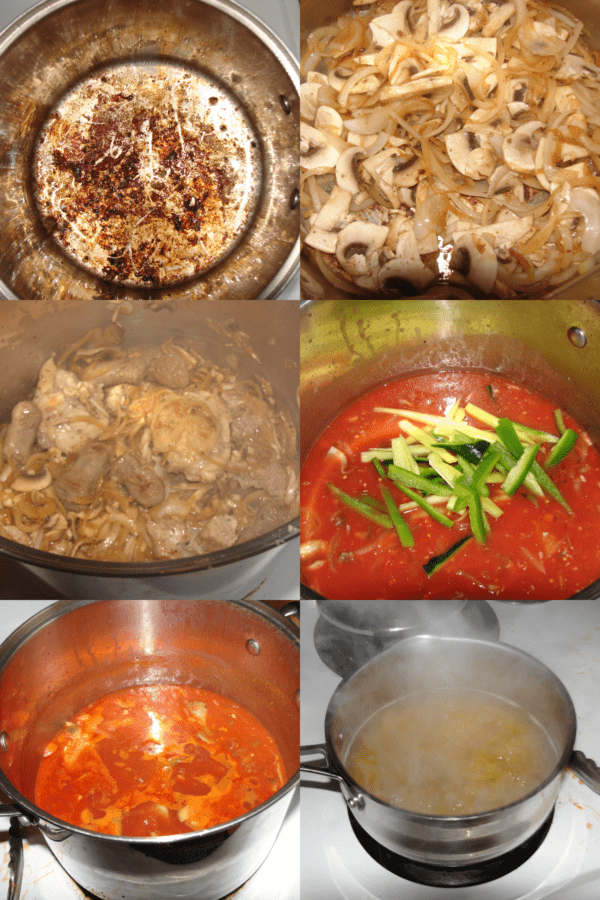
    [/et_pb_text][/et_pb_column][/et_pb_row][et_pb_row][et_pb_column type=”1_2″][et_pb_text admin_label=”steps 1-4 image” _builder_version=”3.13.1″]

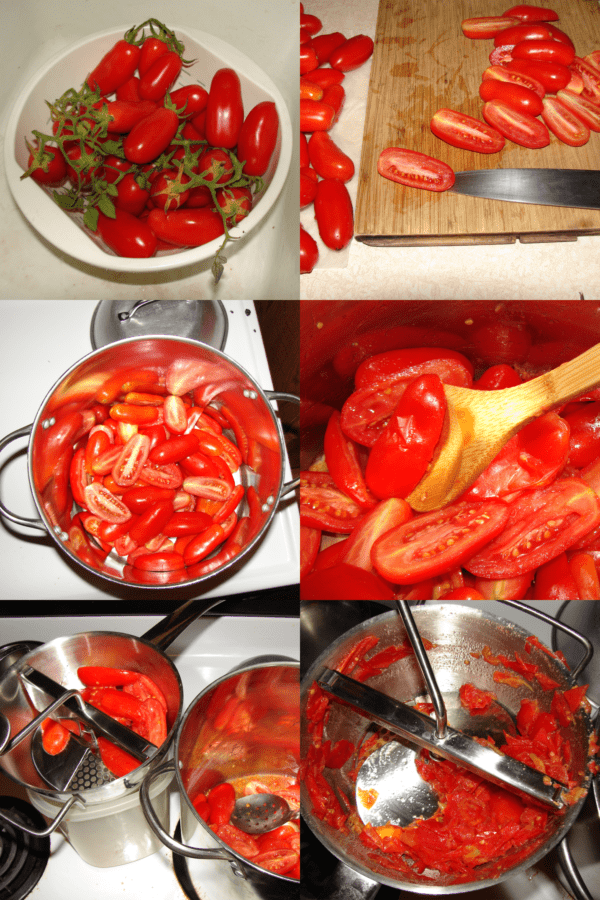
    Steps 1 – 4

    [/et_pb_text][/et_pb_column][et_pb_column type=”1_2″][et_pb_text admin_label=”Steps 1-4 Text” _builder_version=”3.13.1″]


    Step 1. Plant and harvest 4-5 lbs of San Marzano Tomatoes and 4 or 5 large chile peppers of the ‘not melt your face’ variety. (For more info on growing said fruits see Chapter Four: Gardening) Rinse and slice tomatoes lengthwise, check for nasty stuff, these were pristine.

    Step 2. Heat over low heat, stirring for about 10 minutes, or until the skins start to loosen up.

    Step 3. Run tomatoes through the food mill that you use once a year, use a medium-sized sieve.

    Step 4. (not shown) You’ve got enough to clean up already so put your milled tomato sauce in the fridge, wash up then walk down to the bar and grill for a mushroom bacon swiss burger, a few Strohs, and to ineffectually and awkwardly chat up the waitresses.

    [/et_pb_text][/et_pb_column][/et_pb_row][et_pb_row][et_pb_column type=”4_4″][et_pb_divider _builder_version=”3.13.1″ color=”#ffffff” height=”2px” /][/et_pb_column][/et_pb_row][et_pb_row][et_pb_column type=”1_2″][et_pb_text admin_label=”Steps 5-8 Text” _builder_version=”3.13.1″]


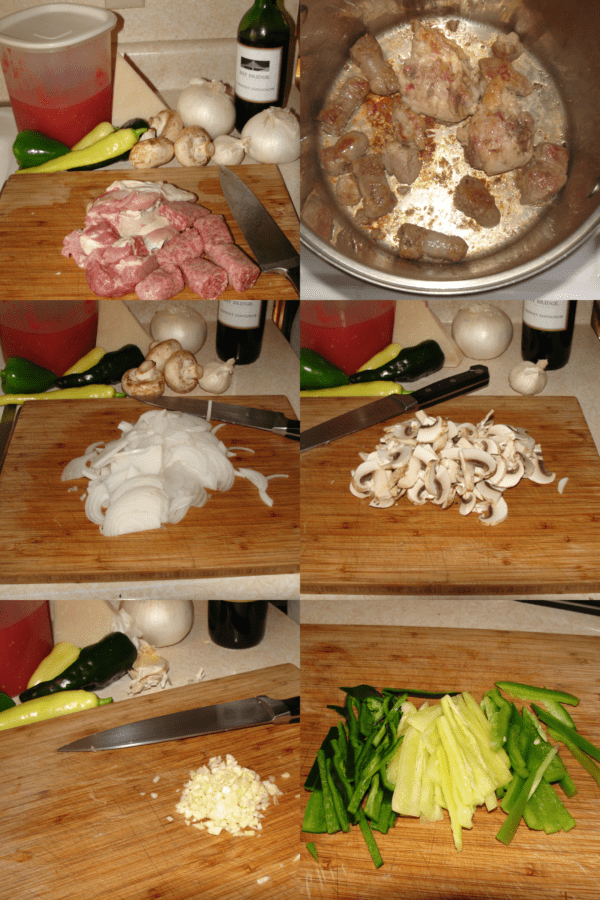
    Step 5. The next evening get your shit together, tomato sauce, onions, mushrooms, garlic, peppers, red wine, and chicken thighs some sausage and some chunks of pork.

    Step 6. Brown meats in oil in your heavy duty stock pot.

    Step 7. Slice up about this many onions, mushrooms, and peppers.

    Step 8. Mince up this much garlic.

    [/et_pb_text][/et_pb_column][et_pb_column type=”1_2″][et_pb_text admin_label=”Steps 5-8 image” _builder_version=”3.13.1″]

    Steps 5 – ?

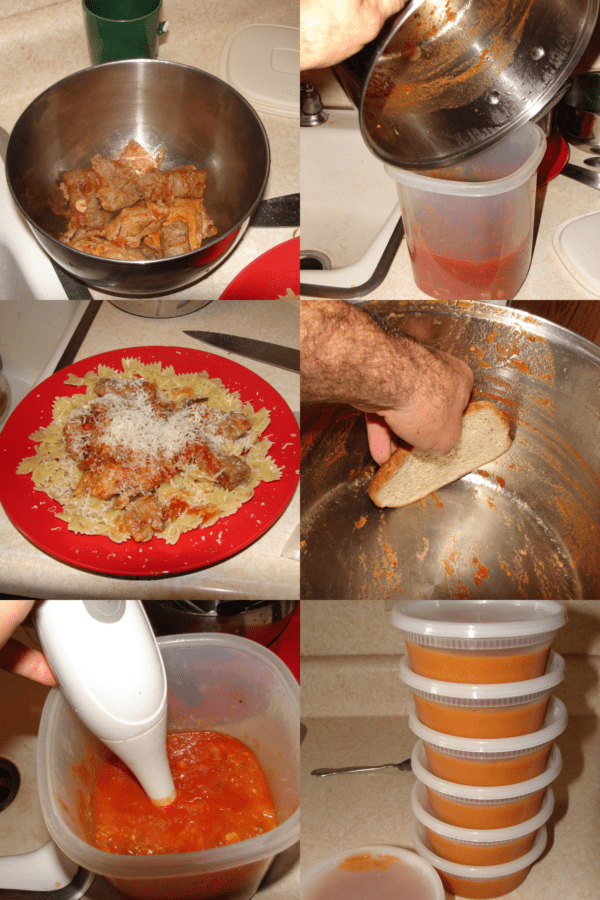
    [/et_pb_text][/et_pb_column][/et_pb_row][et_pb_row][et_pb_column type=”4_4″][et_pb_divider _builder_version=”3.13.1″ color=”#ffffff” height=”6px” /][/et_pb_column][/et_pb_row][et_pb_row][et_pb_column type=”1_2″][et_pb_text admin_label=”steps 9-13 image” _builder_version=”3.13.1″]

    Steps 9 – ?

    [/et_pb_text][/et_pb_column][et_pb_column type=”1_2″][et_pb_text admin_label=”Steps 9-13 Text” _builder_version=”3.13.1″]


    Step 9. Remove your meat. add Onions and Mushrooms (add more oil if needed)

    Step 10. When onions and mushrooms are soft, stir in garlic

    Step 11. Before garlic burns add enough wine to deglaze the pot, return your meats.

    Step 12. Add tomato sauce and peppers, simmer til meats are done or longer, just don’t let the chicken get to falling apart stage.

    Step 13. Make some pasta.

    [/et_pb_text][/et_pb_column][/et_pb_row][et_pb_row][et_pb_column type=”4_4″][et_pb_divider _builder_version=”3.13.1″ color=”#ffffff” height=”6px” /][/et_pb_column][/et_pb_row][et_pb_row][et_pb_column type=”1_2″][et_pb_text admin_label=”Steps 14-18 Text” _builder_version=”3.13.1″]


    Step 14. Remove your meats again.

    Step 15. Reserve sauce

    Step 16. Serve up meats and some sauce on pasta with grated parmesan. Eat with bread used to ‘clean’ pot.

    Step 17. Stick your stick blender in the sauce and stick blend it to pizza sauce like consistency.

    Step 18. Divide sauce into ~6oz. portions and freeze what you’re not going to use right away.

    [/et_pb_text][/et_pb_column][et_pb_column type=”1_2″][et_pb_text admin_label=”Steps 14-18 image” _builder_version=”3.13.1″]

    Steps 14 – ?

    [/et_pb_text][/et_pb_column][/et_pb_row][et_pb_row][et_pb_column type=”4_4″][et_pb_text admin_label=”time/yield” _builder_version=”3.13.1″]

    Time: 3 months 2 days and 45 mins give or take.

    Difficulty: Meh

    Yield: 1 Mushroom swiss burger, 2-4 servings of cacciatore, 48-60oz. pizza sauce.

    [/et_pb_text][et_pb_text admin_label=”voila” _builder_version=”3.13.1″ text_orientation=”center”]

    Et voilà!

    [/et_pb_text][/et_pb_column][/et_pb_row][/et_pb_section]

  • Guns And Such For Small Game

    Guns and Practices for Small Game

    Folks who are, like me, of the outdoorsy persuasion, like to talk about big game hunting.  Why?  Because it’s exciting.  Big stuff with horns, hooves and pointy teeth are more exciting to hunt, and to talk about.

    But when it comes to hunting opportunities, you can’t beat small game.  The amount of time you can spend afield in pursuit of small game far outweighs limited big-game seasons, and anything from squirrels to pheasants produces some of the best eating you’ve ever laid teeth on.  And, for the prepper/TEOTOWAKI set, small game hunting for food is far more likely to be a problem you need to solve than fighting off Mad-Maxian bands of raiders.

    So, let’s look at arms and equipment for small stuff.

    Rifles

    Rimfire rifles kind of rule the roost for small game hunting nowadays, but it was not always thus.  One of the best small-game cartridges around back in the day is the old .25-20, still available in old Winchester 92s if you’re willing to shell out the bucks for and shoot a collectible.  The Winchester 43 bolt gun was also available in this fine old round, and likewise commands a high price.  The .25-20 is a great small game round when loaded moderately with a hard-cast lead bullet, killing game up to woodchuck-size very nicely without tearing up as much meat as a .22 high-velocity hollow point.  But centerfire rifles for this and similar old small game rounds aren’t made today, with one exception:  The .22 Hornet.

    Factory loads in the .22 Hornet aren’t too useful for small game.  It’s a good 125-yard varmint round as factory-loaded, useful up to coyote-sized critters at those ranges, but factory loads do too much damage on small game.  But loaded with (again) a hard-cast lead bullet at moderate velocities, it becomes a great round for rabbits, hares, squirrels and marmots.  I keep one, a Ruger #3, as a fall turkey rifle; with the same kind of loads it will put down a big turkey inside of 100 yards right now.  And here’s the fun part:  If you have a good .22 Hornet rifle but would really, really like a .25-20 for the tad extra bullet diameter or just because you want one, you could have a barrel made; the two cartridges share a case head.  But that sounds like an expensive proposition.

    Let’s face it; in today’s small-game rifle world, rimfires are where it’s at, and there’s no sign of that changing any time soon.

    Accurate but heavy. Oops.

    I won’t discuss the various .17 rimfires, as I’ve never owned or shot one.  I’ll leave the well-informed readers to discuss those in the comments.  There are at present several .22LR rifles kicking around the gun rack at the Casa de Animal, but the one I set up for just such precision shooting, I kind of ended up outsmarting myself; I did the full-blown Ruger 10-22 conversion, with a .920” target barrel, a laminated Fajen thumbhole stock and a big target scope; the rifle shoots like a dream but weighs as much as many a big-game rifle.  A .22 should be light and handy.

    But while the .22 Long Rifle and the .22 WMR are both well-suited for most small-game work, the .22 WMR is more versatile.  Why?  Because the .22WMR will handle game up to the size of big marmots, foxes and at close ranges, coyotes.  The .22LR would not be advisable for larger animals like those, even with precise shot placement.

    That doesn’t mean the .22LR rifle isn’t great for most small game.  Back in the day my friends and I killed a whole bunch of rabbits and squirrels with .22LR rifles; ammo was cheap and plentiful, and so were the guns.  But even out of a rifle, it runs a tad on the weak side for the big hares, marmots and foxes, even with the high-velocity hollow-point rounds.  That’s where the .22WMR shines, as the 40-grain jacketed hollow-point will easily kill big hares, foxes and marmots out to about a hundred yards, and with the full-jacket solid loads available, it won’t mess up too much meat on smaller game.  Find you a rifle for either cartridge that’s light, easy to carry and accurate.  The Ruger 10-22 is available everywhere and they’re great shooters.  The famous old Marlin 60 is cheaper, and millions have been made.  There are far too many options to talk about here.  Look around!

    But it’s not always easy or convenient to tote around a rifle, even a .22, so let’s talk about…

    Handguns

    Something that seems to have fallen out of the shooting world is the “kit gun,” usually a small-frame .22 revolver intended for taking small game at short range.  The Smith & Wesson .22-32 Kit Gun was one such.  There are many good examples; I keep a Colt Officer’s Target in .22LR for such things, and it’s seen a fair amount of use on early-season mountain grouse here in Colorado, where we routinely plink dumb young birds out of trees with .22 handguns.  The old Colt is fussy about ammo, preferring CCI Green Tags above anything else, but with those it puts down grouse and rabbits handily without destroying too much meat if head shots aren’t possible.

    Colt Officer’s Target and Colorado Dusky Grouse

    But here’s the cool thing about handguns:  Most of them up to the .357 Mag will do great on even small stuff like rabbits, with the right load.  A .44/45 will work if you go for head shots, but the smaller guns are even good for body shots on rabbits and grouse with FMJ or hard lead pills.  A .357 loaded with .38 wadcutters is great for rabbit-sized game; a 9mm with FMJ bullets will kill quickly without messing up too much meat.  Find a moderate load with a non-expanding bullet and you’re set for opportunity shots at small game.  The .32 centerfires are great, too, and happily there has been something of a renaissance in .32 revolvers lately.

    As with anything handgun-related, the gun that’s most useful is the one you can shoot well.

    But the most versatile small game gun has yet to be discussed, so let’s move on to…

    Shotguns

    Short answer:  You can’t go wrong with a 12-gauge pump shotgun.  With that said, there are always other options, but let’s talk about the good old 12-gauge pump first.

    You might ask: “Why a 12-gauge, and why a pump gun?”  Well, I’ll tell you; there are two main reasons.

    1. Availability of ammo. 12-gauge shells are ubiquitous.  You can get ammo from 2 ¾” light trap loads to 3 ½” Roman candles, in every shot size known to man.  You can get mil-spec or 3” mag buckshot, slugs, and oddball shells like Dragon’s Breath.  The versatility of available 12-gauge factory ammo makes it the obvious choice.
    2. Ruggedness, reliability and versatility. Pump-guns are tough, easy to operate, and not prone to the fussiness about ammo that affects some semi-autos.  If you’re a southpaw, you can find an Ithaca 37 or a Browning BPS that features bottom ejection, so you don’t have spent shells flying across your field of vision.  There are literally millions of new and used pump shotguns available, which makes them something of an obvious choice.

    I’m something of a fan of the 16 gauge, and the 20 is still widely available and a good choice for kids or the small-framed, but if you can only own one shotgun, buy a 12.  If you can only own one gun, buy a 12-gauge pump-gun.

    Citori and Mountain Quail

    No matter what the gauge, the key to various types of small game is selecting the right choke, load and shot size.  Look here:

    • Quail/grouse/doves: Low-base loads, 7 ½ or 8 shot (AA trap loads are great here.)  An improved-cylinder choke is enough for what is normally close shooting on quail and grouse, but open-country doves require an Improved-Modified or Full choke.
    • Pheasant/rabbit/partridge: 2 ¾” field loads, 5 or 6 shot.  Modified, Improved-Modified chokes are best.
    • Hares/late season pheasant/sage grouse: 3” magnums, 4 or 5 shot.  Choke as above.
    • Spring turkey: 3 or 3 ½” magnums, buffered 4 or 6 shot.  Most spring turkey hunters favor tight chokes, and there are quite a few full and extra-full specialty turkey choke tubes floating around the market.

    There are special cases for waterfowl, but that’s probably a discussion for another day.

    Now, there are other guns than pump guns, of course.  Lots of folks prefer semi-autos, and the newer guns are more versatile than, say, the old Browning Auto-5 with its bearing bands that had to be reversed when moving from light to heavy loads.  Doubles are still popular, and few shotguns handle as sweetly as a well-balanced side-by-side or over-under; and almost no guns are as beautiful as a well-made, engraved side-by-side stocked with a nice piece of walnut.  And if your budget is tight, single-shots can be had for under a hundred bucks.

    Now, if you are in a place where you must be quiet…

    Air Guns

    Air guns have come a long way since the Crosman pump-up BB gun I toted around when my age was still in single digits.  In fact, if you read up on the Lewis & Clark expedition, they had come a long way before that, but let’s focus on today.

    Air guns have a few things going for them.  Ammo Is cheap; they can be purchased in most civilized places without all the Imperial foo-fraw about background checks and associated paperwork; they are quiet, which can be advantageous for discreetly disposing of pests in a built-up area.  A good air gun for small game should be able to deliver 600fps or better with either a .177 or .22 lead pellet; I prefer the .22 but either will work OK on squirrel/rabbit sized game at short range.  A good pump-up pellet pistol can be handy for discreet things as well, say if you have some bedraggled, exhausted house finches dragging baby cowbirds twice their size to your feeder.  Now, it’s illegal to shoot the nest-bandit cowbirds and their freeloading offspring.  I’m not saying I would use an inaudible, discreet pellet pistol to quietly dispose of such a pest.  But if I were to do so, a pump-up .22 caliber pellet pistol would sure get the job done.

    Trapping

    Big Game seasons can result in freezing your ass off.

    This is just a tad off-topic, but trapping can be fun and even somewhat profitable, although not as profitable as it was back in the Seventies when I trapped every winter; the decline in popularity of fur garments and the rise of farmed furs, which are more consistent in color and quality, has led to a crash in wild fur prices.  But trapping can be a good way to get small game in a survival situation.  A steel trap or coil of snare wire has a big advantage over, say, a .22LR or 12-gauge shotgun cartridge; you can catch an edible critter in a trap, clean and re-set the trap and use it again.  Once a round of ammo is expended, it’s expended.

    When I was a little tad back in Allamakee County, Iowa, shortly after the Earth’s crust finished hardening, I kept myself in .22 shells and pizzas by running a trapline in the winter.  Mostly muskrats and raccoons but the occasional fox or mink; I never focused much on trapping edible game (although raccoon ain’t bad stewed), but the principles involved in trapping, say, rabbits, are pretty much the same.

    Maybe I’ll write up an article on trapping sometime.

    Conclusions

    Small game hunting is loads of fun.  Seasons are measured in months instead of days or weeks, which means you can be a little choosier about the weather you want to deal with.  Bag limits are often generous, you can bring in some healthy, free range, additive-free, low-fat protein, and spend plenty of time out in the great wide open.  Licenses are cheaper.  And these days, in our increasingly shut-in, urbanized population, competition for game isn’t all that tough.

    Find you a good shotgun and bring in some bunnies or birds.  You won’t regret it.

  • Knifemaking with Leap

    The knife is likely humanity’s second or third oldest tool, with the pointy stick probably being developed from the not-pointy-stick prototype.  I’ve always been in love with knives.  Every one has its own feel.  Its own personality.  Its own special purpose.  Some of them almost leap out of your hand, ready to do their job.  Some are big and burly without being clumsy.   Some of them will slice a warm tomato paper thin, if you treat them right.  Youtube must have known about my love, and it knew I like to watch productive people make stuff on Youtube, because it kept suggesting I watch this video.  And it was right.  I wanted to learn how to make knives.

    Long story short, its really hard to do it from scratch without expensive equipment.  Its possible, but hard and tedious.  However, there are a few short cuts you can take to jump right in with minimal equipment.  Err, and minimal skill.  Like what I have.

    Mora is a maker of some really great, low-cost knives.  And they’ll sell you just the blade.  In this post, I’ll walk you through the steps I took to put my own custom handle on this 6 inch blade.  The end result is a large bushcraft knife suitable for all manor of outdoor misadventure.  Mora make a simple, bullet proof item.  Carbon steel, nothing fancy there.  A scandi blade is really basic, but that’s where the magic is.  Most blades have a primary bevel then a secondary bevel where its sharpened.  The scandi blade just has a single bevel, like a razor.  This is particularly well suited to digging under the grain of wood or other fibers.  At the cost of a bit more difficulty sharpening, this means the scandi is particularly well suited to camp tasks like preparing kindling, slicing rope, etc.

    The first step in this project is to lay out your plan.  Instead of going for a traditional scandinavian handle, as you’d expect on a scandinavian style blade like a puukko, I went for a more shaped handle.  I much, much prefer more options for bracing my fingers on forward strokes or when poking, and this design provides that.  Also, I tend to hold my knives in a saber grip.  That’s the nice thing about DIY.  You can D whatever the F U want.

    I traced the blade on paper, and then sketched out the outline of the handle I want.  The front finger groove comes a little close to the tang, so that’s something I had to keep an eye on.

    Then I laid out a few bits of material that I want to use for the handle.  I had a bit of cheap red oak from the hardware store, some green leather bits, and a block of leopardwood I grabbed on a lark when I got some exotic hardwood one time.  At this point, I also have a spacer made of black micarta scrap, but this didn’t make it into the final design since I fucked this piece up made a thoughtful decision to not include this material.  The goal here is purely design.  I’m looking for a nice balance of colors, contrasting textures, etc.  Most rules for aesthetic designs are domain independent.  That means that rules for putting together a proper suit and tie apply here as well.  High frequency next to low frequency next to no frequency next to high frequency.  Pick two colors, and add in one highlight.  Avoid symmetry and follow the rule of three or the golden ratio.

    Now that we have the general design down, its time to actually get to work.  If not done already, make sure all your stock is square and flat.  Like, really flat.  And if you aren’t sure you can pull that off… use leather spacers.  Making a knife is more like fitting jewelry than it is like carpentry.  You need everything to fit perfectly and you need to fret every detail.  Because this shit is HARD.  The bolster, that’s the part of the handle that interfaces with the knife, the bolster needs to fit the tang like a glove.  I find the center of the block, drill a row of holes smaller than the diameter of the tang, and then use needle files to connect them.  This should make a slot that is dead-on square and normal in the center of the bolster.  If you take your time, it will be perfectly square.  Just put on an audiobook and zen out, and you’ll have it perfect in no time.  Like this.

    FUCK!  Ok, not great, but not a disaster.  Anyway, the knife blade isn’t perfectly square on all surfaces, so you’ll need to fit, file, fit, file, fit, file, fit, file until your eyes are ready to fall out of your head.  Eventually, you’ll get it to seat correctly.

    Perfectly, within some margin of error.  If you look close, well, you’ll see its seated pretty well, but not perfect.  Like I said, this is jewelry, not carpentry.  I said its an easy job to pick up.  Mastering it will take a lifetime.  For my skill level, I’m looking to get a good enough seat that the finish will fill that gap.  More on that later.  Note the blue painters tape around the blade.  That’s to prevent premature hematological baptism.

    Once the bolster is fit, the rest of the handle is easy.  Using a drill bit just slightly wider than the tang, dill a hole straight and through the center of the rest of the wood blocks.  I also used a table saw to split the bolster since I ruined my spacer decided not to use the micarta spacer.  If you do this, this cut is super, super critical and you really, really need to make sure it is square and straight.  Also, mark your piece before you cut it so that you can assemble it later with proper grain orientation.

    At this point, all the material is in shape and ready for glue up.  Up till this point, its been a fidgety project but you can go nice and slow.  Well, that ends here.  Its now a fidgety project that is also gloopy and you will also be on a the clock.  So spend ten minutes dry fitting your knife so that you could assemble it blindfold, because once you mix your epoxy, shit gets real.  This is also your last chance to change the design.  Here I am out in the sunlight making sure I still like the way it looks under natural light.

    Epoxy is a hell of a material.  Its going to fill all the space in the handle and hold this knife together.  A modern epoxy, properly mixed and applied, will be harder than the wood and last longer than I will.  The task here is to fill the bolster with epoxy, slide it on, cover the spacer with epoxy, slide it on, cover the next spacer, slide it on, cover the next spacer, slide it on, fill up the last handle, slide it on, and then clamp it all together.  And make sure you use enough to fill all gaps.  But not so much it squeezes out the top of the bolster.  And don’t epoxy your knife to your clamps.  And don’t get epoxy in your hair.  And don’t tighten your clamp so much it all explodes like you just lost at Perfection.  And don’t use five minute epoxy because you will need more than 5 minutes.  Because I’ve done all that before and each one of those things sucks.

    But if, if you do it all correctly, you will be rewarded with a very stinky garage as you let this cure under a little bit of compression for at least twenty four hours.  PS make sure you orient it so that the squeeze out goes on the handle, not the blade.  Because if it cures on the blade, there’s no fixing that.  You are stuck with an ugly knife forever.

    But the next day, after your garage airs out and doesn’t smell like an old tire is fermenting in Satan’s asshole, you get to see if you’ve fucked up all your hard work.  Lets take a look.

    Success!  That squeeze out is not problem.  It’s all coming off.  What matters is the handle is one solid, rock hard piece.  No wiggle.  No wobble.  Now you just need to turn that big, blocky knob into a smooth, sleek handle like you drew on the paper.  I used a band saw to get it roughly square, then I use a belt sander to rough out the shape.  A rasp works really well here, too.  Then, once you have the shape, just sand.  And sand.  And sand.  And sand.  You really want to take it to the finest grit your wood can stand, and then maybe one more.  Oak and leopardwood are both fairly hard, so I took this to 2,000 grit.  You’ll need to get automotive sandpaper for this, but if you skimp here your knife won’t ever feel as good as it should.

    The last step is to apply a finish.  In theory, any wood finish is possible here, but poly or lacquer are not good finishes.  Superglue is actually pretty great, but I’m partial to a paste made of mineral oil and beeswax.  Its food safe, and you can oil the blade with the same oily rag as you use for the handle.  Its not as permanent as some other finishes, so it will need touched up every year or so.  But meh, if I didn’t want to put a little work into my tools, I wouldn’t be making them myself.  Also, wax is a good enough gap filler to fill the tiny gap around the base of the blade.

    This is my first time using leopardwood, and I really like the way it turned out. I also really like the way the shape turned out.  Its made to fit my hand, and I kept checking it as I roughed out the shape.  Its asymmetrical and maybe it looks a little sloppy if you look from the top down, but it fits my hand like it was made for it.  Because it was.  My thumb fits on the top of the bolster just right, and I have good purchase with my pointer and pinky.

    But most of all, every time I pick up this knife, I’m going to remember the work that I put into it.  It was my mind and my hands that brought this humble tool into the world.  It has visual and utility elements of a scandi knife, but it also has a few other particulars that I really like.  I didn’t mine the ore or smelt it.  I didn’t forge and grind the blade.  I didn’t even generate one unique feature on this knife – I copied the best from a couple different place.  But I made that knife.  And I’ll know it in my bones every time I pick it up.

  • The Steps – Reloading, Part 5

    Read the series


    This article is for informational purposes only. Suthenboy is not a credentialed expert. Do not attempt any of these activities without first consulting an expert or a manual published by accredited experts or manufacturers.


    Get ready to start loading!

    Sizing

    In a standard die set the first die is the sizing die. When firing a brass case expands and seals off the gun’s chamber like a gasket. It bounces back after the pressure drops but not all the way back to original size so the first thing to be done is to size it back to specifications. With a straight wall case carbide die this is fairly simple. Screw the die into the press until it touches the shell holder with the press in the up position then back it off about half of a turn. Make sure the pin of the center punch extends past the opening of the die but the stem of the punch does not. Place the case in the shell holder and pull the press handle a full stroke. If you meet solid resistance before the stroke is complete stop and back the die off a little bit. The die will size the case to specs and the center punch in the die will decap (remove the spent primer) the case. Run all of your cases through the die.

    With shouldered cases you must first lightly lubricate them. I use a lubed Q-tip to swab the inside of the case neck. I put a drop or so in the palm of my hand then line 6 to 8 cases in the palm of one hand. I put my hands together and rub them back and forth in a hand-warming style motion until the lube is evenly distributed on all of the cases. This method goes pretty fast. Make sure the lube is light or the excess lube will create a ripple like surface on the brass, ruining it. A trace amount is all that is needed.

    Some rifle die sets will have two sizing dies, one for sizing the neck and the other for sizing the body, making sizing a two-step process. I prefer the one step dies but I am not a benchrest shooter.

    After sizing the cases must be cleaned. As I mentioned the brass case expands during firing and becomes a brass gasket to seal off the chamber. To do this it must expand and grip the walls of the chamber. If there is lube on the case you would have the same effect as if you oiled your brakes. The bolt of the gun cannot hold the pressure. It is not designed to. It is the brass case gripping the walls of the chamber that holds the pressure. If the brass ruptures or cannot grip you may find tens of thousands of pounds of pressure escaping in your direction. This can ruin your day. Clean your cases well.

    Priming

    Various formulations (lead styphnate, antimony sulfide, barium nitrate plus secret ingredients depending on the manufacturer) are used for priming material but the first thing to know about all of them is that they are extremely sensitive to decomposition. The primary explosive in primers must be sensitive enough to ignite upon being struck by the gun’s firing pin. This means these formulations are much less stable than the secondary incindiary material – the gunpowder. You should never touch primers with your fingers. Even trace amounts of oils, water or salt from your fingers can cause the priming material to become inert. Touch a primer and you end up with a dud round or worse, delayed ignition. I keep tweezers on hand at all times to manipulate loose primers. Also, that instability means you should never subject primers to shock or heat. If you have one go off you will be surprised how much bang one of those tiny caps have.

    *Priming material is a very powerful explosive. Historically primers were assembled in small, one person sheds surrounded by sandbags. Only women were hired to do this tedious job because women can sit comfortably and focus for long periods of time much easier than narrow hipped men can. Thankfully today they are manufactured in unmanned facilities by remote control.

    Make certain that you have the proper primer for your load. Small differences in primer operation make big differences in how the gunpowder burns. Never use magnum primers for standard loads. There are:

    Small pistol
    Small pistol magnum
    Large pistol
    Large pistol magnum
    Small rifle
    Small rifle magnum
    Large rifle
    Large rifle magnum
    Various specialized formulations such as military primers

    Again, always make sure your primer matches the load you are making.

    Priming tools, either hand squeezed or lever operated, use a small plunger to press the primer into the case’s primer pocket. In both cases very little practice is needed to get the feel of properly seating a primer. I used to sit in front of the television with 500 or 1000 batches of brass and do the operation almost entirely by feel while watching TV. Make sure the mouth of the case is facing away from you, other people, pets and especially from your store of other primers or gunpowder. Press the primer in and then after each one run your finger over the primer to make sure it is properly seated. It should feel just slightly below the base of the case. If it is not in far enough it will cause revolver’s cylinders to jam as the primer will rub against the frame and in rare cases could be set off in semi-autos by being struck by the slide upon feeding. You don’t want to have one go off before it is fully chambered. Make sure they are fully seated.

    Another safety tip: If you try to fire a round and you only get a click DO NOT IMMEDIATELY OPEN THE GUN AND REMOVE THE DUD ROUND. Keep the gun pointed in a safe direction and wait for half a minute or so. It is possible to have a hang fire, that is delayed ignition. Don’t be this guy:

    https://www.youtube.com/watch?v=Za2ezCNvBeU

    Trimming and Flaring

    Cases can stretch with repeated use but with pistol cases I have never found them to stretch excessively. They work harden before that happens. With longer rifle cases the stretching can be greater and affect accuracy. Use your micrometer to check for stretching and either discard or trim cases back to specifications. I have never felt a great need to do this except for some rifle cases. Case trimmers are relatively cheap and easy to use but you can get by without one.

    It is worth the investment to buy a universal flaring die but most die sets have a flaring function. You want to flare the case the least amount possible as it will work harden the mouth of the case and after a few uses the mouth can split upon firing.

    Put a case in the shell holder and pull your press handle all the way down with no die in it. Now screw the die in and keep screwing until you feel very slight resistance. Turn the die in ¼ to ½ more turn but not so much that it starts moving the press handle. Take the case out and try to put a bullet in the mouth of the case with your fingers. If the base of the bullet clears the mouth of the case you are good. Lock the die in place with the lock ring and run all of your cases through that die. If not then screw the die in ¼ turns and put the case back in the die. Continue doing this until the base of the bullet fits into the mouth without catching on the edge of it. This allows you to seat bullets without crushing the edges of the case mouth.

    Charging the cases

    Obviously charging the case with gunpowder is the most critical step in the process. Great care must be taken.

    I am going to hit the high points here and I will write an article later on just gunpowder. It is a subject with a lot of information and I don’t want anyone lapsing into a coma while trying to slog through it.

    Gunpowder does not explode. It burns. Under confinement it burns rapidly. If you pour a little powder out on a safe surface and ignite it will make a sputtering flame for a few seconds. Under pressure or in confinement it burns much more rapidly. Ideally we want the powder to finish burning just as the bullet leaves the muzzle. We don’t want it to finish burning before the bullet leaves the muzzle because that means pressure is dropping and the bullet slowing before it leaves the gun. If it doesn’t finish burning until after the bullet leaves we end up with a lot of muzzle flash and wasted powder.

    Powders come in three types: ball, tube and flake. The powder burns on the surface so by changing the surface area/volume the rate of burn can be controlled. Obviously the ball powders are the slowest burners as a sphere has the lowest surface area/volume possible. Their burning rate is adjusted by changing the sizes of the spheres. Next are the tube powders. These grains are tiny tubes and these offer the greatest variability. They have different outside diameters, inside diameters and lengths. The fastest powders, used in shotguns and pistols, are the flake powders. These are tiny little sheets that have the greatest surface area/volume.

    Each of these offers different advantages. Ball powders can be measured very accurately because there is little variability in the number of balls that can fit in your measure. Tube powders measure reasonably well but as I have mentioned before the mechanics of your powder dispenser may chop some of the tubes changing the burning rate of some of the grains. This variability is small enough that the normal shooter wont notice but long range bench rest shooters generally use methods of measure that don’t damage the grains such as powder tricklers that measure powder by weight instead of volume. Flake powders are the most difficult to measure accurately but since they are used in pistol and shotgun (short range) this doesn’t present much of a problem.

    If you are measuring powder with a dipper… pour about a half of a pound of powder into a glass bowl that does not have corners inside. When scooping the powder with the dipper you want to start at one side of the bowl and make a sweeping motion from one side of the bowl along the inside surface all the way to the other side keeping contact with the bowl the whole time. Try to scoop using the same motion and speed each time. Set your scale for the desired amount of powder and then measure about five consecutive scoops and see how consistent the amounts are and how close they are to your desired amount. If a scoop comes up heaping with powder put it back in the bowl. Don’t try to adjust a scoop by leveling powder off of the top or adding to it. Consistent motion equals consistent measure. If you let the amount of the powder in the bowl get too low it will start scooping differently so keep the amount of powder in the bowl consistent.

    With powder dispensers put about half of a pound of powder in the hopper. Set the can of powder with the lid on it near the powder dispenser. Make sure it is the only can of powder on the table. Do not move that can until you are finished dispensing and you have poured the hopper back into the can.

    I say again: SET THE CAN OF POWDER NEAR THE DISPENSER, MAKE SURE IT IS THE ONLY CAN ON THE TABLE AND DO NOT PUT THAT CAN AWAY UNTIL ALL OF THE EXTRA POWDER IS BACK IN THE CAN. This way if you take a break or leave powder in the hopper for next time you will always know exactly what powder is in the hopper. If you fail to do this never try to remember or guess which powder is in the hopper. You will have to dispose of it. I know someone who did this. He guessed it was Unique powder, it turned out to be Bullseye, a much faster powder. He blew his gun up and escaped injury by the skin of his teeth.

    Set your scale for the desired amount. Set your dispenser over the amount you are aiming for. Dispense one charge and weight it. Adjust your dispenser down and weight again. Keep doing this until you hit the target load. Firmly set the charger adjustment with the lock ring or set screw. Now dispense about five charges and weigh each one. If it consistently hits within one to two tenths of a grain of the target load you are ready to go.

    Charge each case and set them in the loading block as you go.

    When you are finished all of the cases in the loading block will be standing close together and upright. As with the dipper method try to keep your hopper filled consistently. Don’t run it dry or near the end it will measure differently.

    STAND UP AND LOOK DIRECTLY DOWN INTO THE MOUTHS OF ALL OF THE CASES. USE A FLASHLIGHT AND SHINE IT DOWN SO THAT YOU CAN CLEARLY SEE ALL OF THE POWDER IN THE CASES. If one of the cases didn’t charge, got double charged or has more than the slightest variation in charge it will jump right out at you. You will see it easily. Pour that charge back into the hopper and recharge it.

    Now randomly choose three to five charges from one end of the loading block to the other and weigh them. Pour the weighed charges back into the hopper and recharge the cases. Check again with the flashlight.

    You are now ready to start seating bullets.

    *A revolver round that does not get charged is very dangerous. The power of the primer is enough to push the bullet partway down the barrel. If you are firing rapidly it is possible that you may fire another round while that bullet is lodged in the barrel. This will result in a catastrophic failure of your gun and likely serious injury or death for you. In a semi-auto of course the gun wont feed and you will know something is seriously wrong.

    Use the flashlight method when charging. Make safety your religion.

    Seating Bullets

    While your cases are still in the loading block use your fingers to press a bullet base down firmly and as straight as you can into each case. Because the cases are flared this should be an easy and quick operation. The bullets should stick enough that they don’t wobble around and fall out when you handle the cases. Be careful not to jostle things around or powder could splash from one case to another – firm flat surface and press straight down. Any jostling or spilled powder and you must dump them all out and start the charging process over.

    The seating die will both seat the bullet and crimp the case around it. Adjusting both of its functions can be a difficult puzzle so I will give you the key.

    1. Put one of the cases with a bullet in the mouth into the press with no die and pull the handle all the way down.
    2. On the top of the die unscrew the seating adjustment most of the way out.
    3. Screw the die in the press until it goes down most of the way over the case but you still feel no resistance.
    4. On the top of the die screw the seating adjustment down until you feel it contact the bullet.
    5. Pull the press handle up a bit and then screw the seating adjustment down 4 or 5 turns.
    6. Pull the press handle down all the way. You will feel it begin to press the bullet into the case.
    7. Raise the press handle again and see how far you pressed the bullet in.
    8. Repeat this process several times and use your micrometer if you need to to measure the loaded round until it is at proper seating depth. If your bullet has a cannelure or a crimp groove this is easy to do by eye. The bullet should be seated to the proper depth but you can still see the case mouth flared around the bullet.
    9. Unscrew the seating adjustment most of the way out then pull the press handle all the way down.
    10. Screw the die down until you feel resistance. That resistance is the crimping ring inside the die contacting the case.
    11. Move the press handle up a bit and screw the die in ¼ to ½ turn and then press the case back into it. Then examine the case. Continue this until you observer a firm crimp around the bullet but not enough to crush it.
    12. You are now at proper crimping depth but the seating adjustment is not contacting the bullet. Lock the die in place using it’s lock ring.
    13. With the cartridge still in the die screw the seating adjustment down until you feel it contact the bullet. Make sure it is screwed down firmly and then using it’s lock ring lock it in place.

    Your die is now properly adjusted and you can go to town. Run all of the cases through the die examining each as it comes out. Congratulations! you have just loaded a batch of safe, reliable ammunition at a small fraction of the cost of off of the shelf centerfire ammunition.

    *Gunpowder burn rate is strongly affected by amount of confinement. If you seat the bullets too deeply it will cause the powder to burn more quickly, raising pressure. Get yourself one of these: https://www.midwayusa.com/product/685703/rcbs-powr-pull-impact-bullet-puller-kit

    Occasionally while adjusting your seating die you may over-seat one and need to remove it. That little gem will take it back out for you without damaging the bullet.

    *When you are loading if you become tired, stop. You must be attentive and focused throughout the process. Don’t push it. This is not an emergency and the stuff wont run away. It will be there when you are rested and ready to load again.

    Next up: components

    If you are still awake, jump into the comments.

    Bonus: Hatcher’s Notebook is hands down the best technical book on ballistics ever written. It is in the public domain and you can download it as a free .pdf from Glibs, or acquire it in other formats here.

  • Choosing A Load – Reloading, Part 4

    Read the series

    This article is for informational purposes only. Suthenboy is not a credentialed expert. Do not attempt any of these activities without first consulting an expert or a manual published by accredited experts or manufacturers.

    Before beginning your reloading operation you need to choose a load. A lot of factors go into this choice. What do you intend to do with this load? Are you hunting and if you are what kind of game? Are you target shooting or plinking? How much recoil can you tolerate? Are these self-defense loads?

    First I would like to discuss self-defense loads because it is the most important to consider. There are a lot of bullets out there that are advertised as having near magical qualities. Forget them. It is all marketing and if you fall for it and ever have to use them in earnest you can land yourself in hot water. You may have to defend yourself against serious felony charges and it is a certainty that the prosecutors are going to say that you chose bullets that have multiple projectiles or super claws or extra expanding hollow points because you were itching to smoke someone. I repeat, it is a certainty. You want to have the most generic, least scary looking ammo possible. Rest assured that this ammo is just as effective as kewpie doll bullets. A simple hard cast, lead bullet with a flat nose designed for shooting paper targets is more than adequate. Don’t load them up too hot – pick a mid-range load. In a .357 Magnum or a .38 Special a 158 grain semi-wadcutter travelling from 800 to 1000 feet per second will do what you need it to do very effectively and no one can accuse you of being a vigilante wannabe. In 45ACP a 230 grain round nose at 800 fps is just as effective as Golden Swords or Blue Talons at 1000 fps.

    Another good tip: Don’t use ball powders, use flake powders for defense loads. Ball powders burn slower and hotter and tend to create large, blinding fireballs at night, especially in short barreled guns. Flake powders can be tuned to create no or nearly no flash at all. If you have to defend yourself at night you don’t want to be blinded on the first shot.

    With that unpleasantness behind us we can move on to more interesting discussion: hunting. Do you intend to harvest deer? In heavy brush or at long distance over open ground? Deer don’t require high energy bullets but heavy brush is easier to defeat with heavy bullets . This would usually be at short range so any heavy, flat nosed, hard bullet would be a good choice even if it has a flat base. Long ranges are easier to cover with boat tail bullets and the heavier the bullet the more velocity it will retain at range. Hogs are considerably tougher than deer and I recommend as much energy as you can get your hands on. Heavy, fast bullets are preferred but don’t go crazy and make something that is going to hit you as hard as it hits the hogs…keep recoil in mind. For larger animals you want deep penetration which means harder bullets that don’t expand rapidly and dump all of their energy before they hit the vitals.

    For plinking light loads and light bullets are fun because they don’t wear you out with recoil and blast. Go light. You can shoot them all day.

    Always choose loads from reputable publications. All of the manufacturers publish them and they can be found in reloading sections of stores or online. Never try to cook up a load from scratch on your own and never, ever mix powders or use powders or bullets not recommended by the loading manual. Powder manufacturers test their powders in special guns designed to measure pressures safely and you can easily find published starting and maximum loads so there is no point in taking chances. Always stay inside those parameters and work up towards the maximum loads with great caution. My favorite source for loads is www.loaddata.com. I have subscribed to them for years. They are not expensive and I have never had a load that didn’t perform as advertised.

    When making your chosen load make only one and test it. You don’t want to have to dissemble a large number of loads that are unsafe. Watch for signs of pressure as you test each change in the load. Then work up one half grain at a time until you reach your target load.

    Signs of pressure

    1. Flattened primers. The exposed part of the primer has a beveled edge. When the pressure gets high enough to start flattening that bevel out you are getting into the danger zone.
    2. Split cases or bulged cases. This should be self explanatory. In an a semi-automatic if the load is too hot it can move the slide or bolt back before all of the pressure is released resulting in a bulge, usually on one side of the case near the base. You are way into the danger zone. Split cases could be the result of work hardened brass that you need to replace or it could be a load that is hot enough to expand the brass too quickly. Splitting on the side of the case is more of a danger sign than a split mouth. The split mouth is more likely work hardened brass that has been loaded too many times. Replace it.
    3. Soot around the outside of the case. If you find an excess of soot around the outside of the mouth or down the side of the case your pressure is too low. The case is not expanding enough to seal the chamber.

    Interesting historical note and excellent tip

    Always make sure the case is at least half filled with powder. Once upon a time you could buy very light loads intended for small game in large, powerful calibers. You are out deer hunting and see a cottontail rabbit or a squirrel? Simply pop one of these load in and bag it. They were made with round balls instead of cylindrical bullets and used very light powder loads. Occasionally one of those loads would blow a gun to pieces and injure people. How could a light load do that? It took a lot of experimentation and quality checks before they figured out what was going on. You can no longer buy them but there are people out there unaware of why it happens and are wildcatting their own loads. Never do this. What happens is called SEE or Secondary Explosion Effect. It is how Primacord works. When you lay the rifle down on your target there is a small chance that the light powder load can string itself out in the lower part of the case. If the primer ignites the powder string at both ends it will burn from both ends towards the center. When those two pressure waves meet they can be additive and create enormous pressure, enough to blow the gun apart. It is difficult to duplicate but it can happen so don’t take the chance.

    One more tip: The rifling in gun barrels comes in different speeds of twist. It is designated with two numbers such as 1:9. This means one rotation of the bullet in 9 inches. The longer a bullet is the faster it has to rotate to stabilize. If it does not stabilize it will begin to tumble. This completely destroys accuracy and the effectivness of the bullet. You may find loads for your caliber using bullets that your particular gun is not designed to shoot. They are safe if you find them in a manufacturers publication but they are useless. If you find keyhole shaped or oval shaped holes in your target or cant find any holes at all you have chosen a bullet that is too long in relation to its diameter for your gun. Choose a lighter/shorter bullet.

    Next time we will go through the steps for reloading from spent brass to loaded ammunition.