Category: Liberty

  • Trashy Tries Philosophy Pt. 1: Is this really it?

    Trashy Tries Philosophy Pt. 1: Is this really it?

    As always, when it comes to philosophy and theology, I like to start with a disclaimer that I’m not the most well-read on these topics, so I may stumble onto other people’s ideas without attribution. I may use terms that already exist, but in different ways. Also, I may stumble into traps with just as much lack of awareness. I’m intentionally vague in some areas because I don’t want to be liable for knowing the ins and outs of certain philosophies that I only know superficially.

    When thinking about this specific topic, I was reminded of the beginning of Mere Christianity by CS Lewis. His book has definitely influenced this article.

    I’m a big picture guy. I don’t like the feeling when I have a glimpse of a portion of the system, but don’t have an understanding of the system as a whole. This has worked both in my benefit and to my detriment in life. Math class was really hard when the teacher didn’t explain why the math worked, but only how the math worked. My learning curve as a software engineer was all that much steeper as I worked through all of the previously built functions of our product to learn how they worked rather than just trust that they’d do what their name implied. However, once I got over the hump, I was better at my job than my peers. My need to understand the big picture has been quite helpful in law… except where my manager needs me to just do things without understanding why.

    This need for systemic understanding also asserts itself in my political, philosophical, and theological life (I don’t consider those to be three separate areas, but three expressions of one area of my life… my worldview). You all may recognize some of the consequences of my need for systemic understanding. For example, I don’t find pragmatism very interesting or important. How things are accomplished don’t matter as much to me as whether things should be accomplished. Once I have settled on policy X being good*, and movement in the direction of X is good and any movement away from X is bad.

    * I’m using good and bad in the colloquial form. Below, as we get into the meat of this article, I’ll be using good and bad in a much more measured and intentional way.

    Is This Really It?

    The most basic philosophical question that I find interesting is “Is this really it?”, or , rephrased and reversed “Is there anything beyond the scientifically observable universe?” David Hume and Immanuel Kant, among others, basically said no. Most other well known schools of philosophers said yes, while building up a variety of different metaphysical constructs. We’ll come back to those constructs later, but let’s dwell on the question a bit longer and see if we can derive any practical applicability out of it. What does it mean for you and I if there is nothing beyond what can be observed and what can be reasoned?

    Well, it can be used to build a foundation for morality. Let’s define a few terms to start. Morality, for the purposes of this article, is the framework used to determine whether a certain action/inaction is good or bad. Good is something that conforms to a certain moral framework. Bad is something that does not conform to a certain moral framework. Amoral is something that exists outside of the moral framework (choosing a color of socks to wear today, for example). Morality can usually be distilled into a set of first principles (i.e. foundational principles), which, in applied form, creates a worldview.

    So, what does the absences of metaphysics mean for morality? Well, there seem to be three ways you can go: 1) nihilism – there is no morality; 2) normative morality – morality is baed on what is observed, felt, and intuited; 3) reasoned morality – morality is based on what is reasoned. For reasons I’ll expand on below, I believe that the first option is the only consistent moral framework in the total absence of metaphysics.

    Let’s start with the second option, normative morality. My general impression is that most normative frameworks are light on foundation and heavy on post hoc rationalization of really shitty behavior. Setting that aside for the moment, let’s figure out what normative morality is. Generally, it’s a genre of philosophies that use subjective or objective observations of reality to set the basis for their moral framework. This comes in many flavors, such as Greek hedonism (whatever feels pleasant is good),  relativistic postmodernism (good is based on lived experience), and utilitarianism (good is based on maximization of well-being). The first thing that strikes me about these “internal” philosophies is that they’re all fuzzy. They’re all based on a state of mind. While all of these philosophers would be on solid ground by starting every sentence with “I feel that . . . “, those who apply these philosophies make a fatal mistake when they expand the feelings of one onto all of humanity. The assumed egalitarianism is problematic. Taking hedonism as an example, what feels pleasurable to me may feel unpleasurable to you. As a trivial example, you may love the feeling of skydiving, and I may hate it. Is skydiving good or bad? The best we can say is that skydiving is good for you and bad for me in a hedonistic context. However, have we done anything by saying that skydiving is good for you and bad for me? Not really. We’re simply adding a layer of abstraction to the already assumed premise that skydiving feels good for you and feels bad for me.

    What happens when add the complication of an action having impact on more than one person? Rape feels good to STEVE SMITH, but feels bad to his victim. Now we’re at an impasse. We can add in concepts like lived experience (postmodernism) to attempt to bolster the victim’s position in this standoff. We can even try to quantify good and bad (utilitarianism) in a way that STEVE SMITH only feels marginally better and the victim feels massively worse, but the problem still remains. At some point, where one group’s good feelings are directly connected to the bad feelings of another group, the first group’s infliction of bad feelings on the second group is a good as long as there are enough of the first group and few enough of the second group. A rapesquatch village can have their way with a single victim until the victim is tortured to death because the intensely bad feeling of being raped to death by a roving gang of horny cryptids is outweighed by the marginally good feeling that a rapesquatch feels multiplied by the number of rapesquatches that partake, whether that be 10, 100, 1000, or 10 million.

    Finally, these normative philosophies give an overvalued weight to the subjective feelings and observations of a person. It doesn’t take much navel gazing to realize that there are people who feel and observe things that are not valid. Some of this is due to lack of information, such as when you get mad at the wrong person when you see that somebody took a bite out of your pumpkin pie while you were in the bathroom. Some is because your perceptions can be biased by your preconceptions, such as how every single hurricane is because of climate change these days. At the very least, it should be said that feelings and subjective observations have limited applicability outside of the person who has those feelings and subjective observations. What about the next person who has contradictory feelings and observations? Do they have a contradictory morality? What if a person’s feelings and observations change? Does their morality change? There’s nothing weightier here than one person’s whims. What we’re describing is a set of preferences and tastes, with the commensurate weight. “Good” and “bad” are nothing more than labels, like “fashionable” and “tacky”.  Cutting through the rhetoric, I’m attempting to expose the fact that these internal-based moralities aren’t really moralities at all. They’re rationalizations for preference and taste built on the empty foundation of nihilism.

    All moralities under the normative umbrella suffer from the “is/should” problem (this is why I called them “normative moralities”). Just because something is a certain way doesn’t mean that it should be that certain way. Ignoring the subjective aspects of the observer, empirical evidence doesn’t teach any moral or ethical principles. To derive such principles, one has to apply intuition, insight, or reason to the evidence. Now we’re falling into the same issue, these “external” moralities are really just “internal” moralities based more heavily on sensory input than on states of mind. While these sensory inputs are more strongly anchored in an objective reality than the observer’s whims, the influence of those whims are merely reduced, rather than eliminated. In essence, we have a set of preferences and tastes with the added weight of a relationship with evidence derived from the objective reality. It’s hard to get less abstract than this, because there are so many different forms of this type of philosophy out there. Utilitarianism often falls into this category. However, this is where the “is/should” problem comes in. How much more ethical weight does this evidence provide? Just because animals fight to the death doesn’t mean that murder is good.  Somebody with the presupposition that nature is good would say that the fact that animals fight to the death means that murder is good. Somebody with the presupposition that nature is evil would say that the fact that animals fight to the death means that murder is bad. If we enter the analysis without presupposing the morality of nature, then the fact that animals fight to the death has zero bearing on the morality of murder. This is the crux of the “is/should” problem. The only time that evidence of a practice or condition in objective reality can be used in favor of the morality of the practice or condition is when you presuppose that nature is moral, which is . . . metaphysics! Observational moralities have to be built on a metaphysical foundation in order to be coherent.

    This leads directly into reasoned moralities. Reasoned moralities, despite being vaunted due to the application of reason, are also normative moralities, with all the same faults and flaws. Reason is really good at applying an existing moral framework. “If A then B” works really good at proving B if A is presupposed, but just like before, you have to presuppose something in order for reason to be applied. In parallel to above, if reason can be used in favor of the morality of B when you presuppose A, the presupposition of A is . . . metaphysics! Without some sort of supernatural principle/framework/entity/etc that supports A, your reasoned morality is built on the same nihilism as the other forms of normative moralities.

    Another way to view the inherent shortcomings in these normative moralities is to view them through the lens of authority. Why should I conform to your morality? Why should you conform to your morality? If the answer, when you get to the foundation, is “because it makes me feel good”, then morality is nothing more than etiquette or preference. This is true whether the morality is a simple hedonism, or whether it is couched in much more complexity, such as Darwinist morality (good is to evolve). To attribute any more weight to good feelings than mere preference or taste is an exercise in indulging one’s ego.

    To finish out this first edition of trashy’s sophomoric blatherings, I’ll address nihilism. Nihilism, in my opinion, is one of two self-consistent moral frameworks. The other is moral absolutism based on divine natural law. We’ll obviously dive into more detail on that later. However, nihilism also has some weaknesses. One is that most humans seem to have some sort of moral compass/conscience, and the conscience is essential to their being. People who override their conscience tend to accumulate undesirable consequences in their lives. Sure, much of that may be explained by the “morality as etiquette” model (socially, poor etiquette results in negative social consequences). However, there’s something profoundly disturbing to most humans about living in a world where there is no right and no wrong, and where nothing means anything. People stare into the abyss and become profoundly afraid. I don’t think I’ve met a single person who has been able to retain a truly nihilist view for a significant period of time. Usually, their nihilism evolves into a squishy moral relativism or into existentialism.

    Clearly, if we are to reject all metaphysics as a moral foundation, we’re choosing to dive headfirst into the abyss. That may be a satisfactory answer for a select few, but the next article will address the alternative, the various metaphysical constructs that can serve as a foundation for morality.

  • Liberty for Me, but Also for Thee

    Liberty for Me, but Also for Thee

    Philosophical consistency is an aspirational goal.  It is not, no matter how much we may want to believe in our own purity, something any of us will ever truly achieve.  Also, even if you drive a Prius your farts stink; you have to spring for a Tesla before they turn to perfume.

    It is easy to see the inconsistencies in the belief systems of people with whom we disagree (because they are all stupid and rude); it is much harder to recognize those in our own noble, and wise beliefs. Almost all of us here are small l libertarians.  I am a conservative leaning libertarian.  We yokels sometimes make jokes about capital “L” Libertarians being all about pot, Mexicans and ass sex which is our deliberately offensive shorthand for our belief that The Libertarian Party, (sorry I know it doesn’t really deserve a capital letter but how else do we distinguish between libertarians and Bill Weld?) campaigns exclusively on sexual liberation (which has been pretty completely achieved, and no you did not get a speck of credit from the progs), drug legalization (yay crony pot!), and open borders, to the exclusion of freedom of association, gun rights, and limiting the massive growth of government, which we see as the more significant issues.

    I set this all out as a starting point, because I am going to be examining one of my own prejudices and it helps to give some context about my belief structure.  In other words I studied law and philosophy and am now completely incapable of getting directly to the point.  Hell, just be glad I didn’t spend 5 pages defining every noun in this article.

    Up to this point you are probably thinking:  Pompous guy spouting above the fray platitudes, libertarian model II, Paulista edition, time to move to the comments, nothing interesting here.  But I am not writing this to signal virtue; I am writing this, and struggling with it, because I have realized (not for the first time) that I have a conflict in my beliefs, and one that I think quite a few people here share.  

    It has to do with everyone’s favorite non-acronym acronym.  That wonderful keyboard swipe that defines sexual politics, LGBTQ. I am not worried about the L, they take care of themselves just fine, the G, they aren’t even victims anymore, the B, doubled date chances and all, or even the Q (Hi Q thanks for the mammaries!), but I have a problem with the T.  Ok, I don’t really understand the Q, I mean literally, I do not understand what queer means if it is something not covered by the L, B, or G.  So back to that troublesome T.

    I believe that there are three phenomena lumped into that T, and that due to deliberate conflating of these phenomena, a great deal of misery is being created.  First, there are the physically intersex individuals.  That tiny minority who are born with some ambiguity in their sexual characteristics.  Second, there are those suffering from gender dysphoria.  Also a small minority, but in this case with a psychological disconnect between their otherwise normal physiology and their self perception.  Finally, there are those I think of as the snowflakes.  Generally young people who I believe identify as transgender either in confusion about their sexual desires, a search for victimhood, or just to dramatize teen angst.

    For the intersex folk out there I have nothing but compassion.  My only wish for them is that they find whatever role and path to happiness they can.  If that means surgery, hormone treatments, and selection of a gender, great; if it means some other path, also great.  For those with actual gender dysphoria my thoughts are more complicated.  I personally think that treating a psychological disconnect by changing the body is the wrong path, but it isn’t my place to decide what path someone else should take, so who cares what I think?

    For the snowflakes, less sympathy, a lot less. As with many snowflake issues the answer is that growing up is hard, but worthwhile, and I suggest they give it a try.  No, occasionally having a stereotypical feminine feeling does not a dysphoria make. You are not a lesbian woman trapped in a man’s body.     You are just a straight dude, even if you get off on wearing women’s clothes. Equally, if you are ok with your body, but want to engage in sex with another dude that is called being gay, it does not require surgery, hormones, or switching restrooms.   Just do what makes you happy, don’t harm other people and stop being so dramatic.

    And now you are all thinking:  Ok, what’s so contradictory about all this?  These are pretty bland, basic viewpoints on this issue, and even the part where I diverge from the sjw narrative I admit is none of my business so why bother to spout off? Aren’t I just being an angsty snowflake myself with all my dramatic “philosophical contradiction” nonsense?  BUT I AM SPECIAL DAMMIT!

    Well, there is a more controversial part of all this.

    What about the kids?  Pretty much anyone who claims to be libertarian is going to eventually come around to the idea that adults can make their own choices about hormones and surgery.  There may be some waffling about bathrooms, and we may think prisons, sports leagues and other sex segregated venues should go by biology, but it’s very hard to claim to be pro individual liberty and at the same time deny adults the right to make their own decisions about their bodies.  Children are a different thing. (Why will no one ever think of them!)

    Children do not have full autonomy.  Obviously, you cannot let a toddler, or grade-schooler, or even a middle-schooler  make all, or even most, of their day to day decisions.  A diet of soda, candy, and ice cream is unhealthy.  Spending all day playing Fortnite or hunting Pokemon is less productive than school (ok, maybe the kids are right on this one).  Vaccinations are actually a good thing, even if shots sting.  And, no, the dog does not want to be dressed as your caparisoned stallion and ridden to battle with the forces of evil over at Mikey’s house.  So, we all accept that children can rightly be prevented from doing as they wish.  

    We accept the concept of parental authority, and the idea that children’s basic right to liberty is in abeyance until some degree of maturation has occurred. (Or at least until they get big enough to be useful as cannon fodder.)  Very young kids have effectively no liberty, and as they get older they gradually get more autonomy until at some magic point they morph into adults and become free to go to hell in their own way, just like all of us.

    I have voiced the opinion that encouraging, or even allowing, children to take puberty blockers, or cross sex hormone treatments, is blatant child abuse.  Puberty blockers have permanent effects and the idea that prepubescent kids are developed enough to make permanent decisions, or even to decide that they are transgendered, as opposed to simply homosexual, or just unsure about their sexuality, is nonsense.  

    By definition, prepubescent kids are not sexually developed.  It is the rankest prejudice to say, “Oh, I know little Johnny is gay, or straight, or transgendered,” when little Johnny hasn’t hit puberty.  Manifestly all you can be basing that belief on are your stereotypes about how gay people, or straight people act. You see, prepubescents aren’t supposed to be engaged in sexual behavior (sorry OMWC), and sexual behavior is what actually defines you as gay, straight, bi or whatever the hell, and no, playing with dolls doesn’t mean little Johnny is gay, or a woman.

    Now, child abuse is a tough subject for libertarians and conservatives.  We can accept that children don’t have full autonomy, and default to the idea that therefore their autonomy devolves to the parents.  Since that leaves the parents effectively owning the liberty right of the child, we are skeptical about government involvement, but what about abuse situations?  If libertarian belief followed all the way left us with no way to stop parents from torturing, raping, or killing their kids, then libertarians would really be as evil as Vox says.  Fortunately, libertarian philosophy doesn’t have to take us there.  

    I think what saves us is the concept of a fiduciary.  Parents do own their children’s liberty rights, but they own them as fiduciaries.  In other words, they hold the right for the benefit of the child, not the parent’s own benefit, and Mommy and Daddy have a corresponding obligation to act in little Johnny’s interest.  So, no problem right?  If using puberty blockers is a bad idea, poorly justified, by inadequate evidence, ofpossibly nonsensical, gender confusion, with long term deleterious effects, then it is child abuse and should be illegal, just like any other permanent physical harm inflicted!

    That has been my belief and I have voiced it frequently.  Here is the problem:

    I support the right of crazy anti-vaxxers to refuse to get their kids shots.  I also got furious, along with most of the people here about Charlie Gard.  In other words I believe that medical decisions fall squarely within the parent’s role.  So, despite thinking transgender treatments for children are as stupid as the Flat Earth Society bragging that they now have chapters around the globe, and as evil as a Broward County election supervisor, I have to support the parent’s right to make this decision.  

    So, that leaves me with three possibilities:

    1.  Medical decisions must be subject to some test and the parents only get to make the ‘right’ decisions.

    The problem here is obvious.  What test?  Who decides?  Doctors? Judges? Every single case of puberty blockers being given involved a doctor, as did the decision to kill Charlie, which was upheld by the British courts.  So going this route doesn’t get me EITHER side of what I want.  When an answer requires the right top men, it is not a libertarian idea

    2.  Puberty Blockers are up to the parents and child, hopefully in consultation with doctors across a decent spectrum of understanding of the consequences, and I can sit quietly disapproving but shut up about it.

    3.  My thought process sucks and you all will let me know why I am stupid in the comments.

    Much as it pisses me off, I have to go with 2 here.  The unexamined life may not be worth living; but examining it mostly leaves you feeling a bit dirty.

  • Radical Individualism is a Blight on the Libertarian Movement

    I’ve written in the past about my view of rights. Specifically, I see them as characteristics of relationships. To paint with a broad brush, they’re the boundaries of the authority a party can assume within a certain relationship. I really like the way it tidies up certain libertarian gray zones, like minors and animals.

    Anyway, there are two ways that libertarians tend to view rights: Deferentialism and Restraintism. Deferentialism is “live and let live.” Restraintism is “mind your own business.” My conception of rights as characteristics of relationships falls heavily on the Restraintist side. One of the big themes of my article on these libertarian views of rights is that Deferentialism cedes any moral standing, but Restraintism retains moral standing. I wrote:

    Deferentialism is ineffective in two ways. First, people, even Deferentialists, tend to have a line drawn in the sand where they shift from relativistic deference to the individual to a more absolutist stance. For example, Cosmotarians tend to be Deferentialists up to the point where their particular identity politics ox is gored. Second, Deferentialism gives no answer to Cultural Marxism. Deferentialists are either forced to kowtow to the virulent left, or they end up drifting authoritarian.

    Radical Individualism is very strongly correlated with Deferentialism. The radical individualist not only rejects the government meddling that all libertarians loathe, but they also reject any attempt of society, the community, family, or friends to influence their behavior. I believe that the moral relativism inherent in “live and let live” results in a wholecloth rejection of authority, even in situations where the authority may be legitimate. In order to stay philosophically consistent, the radical individualist ends up sounding like the punk 17 year old whining that his parents can’t tell him what to do anymore. This is the most superficial way that radical individualism harms broader libertarianism.

    "man is by nature a social being since he stands in need of many vital things which he cannot come by through his own unaided effort. Hence he is naturally part of a group by which assistance is given him that he may live well. He needs this assistance with a view to life as well as to the good life." - Thomas Aquinas
    “You can tell me what to do, daddy”

    Libertarianism has a reputation for being something you grow out of once you get real life experience. I don’t know how many times I’ve heard that it makes sense on paper, but the real world is too complex for it to work. I think that a large portion of that sentiment comes from the outsized influence of the most virulent form of radical individualism, Objectivism. I’ll freely admit that I’ve never read a word of Rand, and I’m not beating the library’s door down to get a copy of Fountainhead or Atlas Shrugged. However, her influence is felt far and wide through the libertarian movement, and it undergirds the complaints that libertarianism is a pipe dream of maladjusted teenagers.

    Taking it down another level, the radical individualist answer to the complexities of the real world tends to be “fuck everything except for my rights.” You’re never going to hear me get squishy on self-ownership, but when this all or nothing attitude transcends the government-citizen relationship, the line blurs between fervent defender of self-ownership and weapons grade asshole.

    Not to pick on her, but Nikki’s view on children is an outcropping of radical individualism. (For those who do not remember, Nikki basically believed that children had full agency and that parental discipline/guidance/control was essentially a form of abuse). Despite the fact that the parent-child authority dynamic is perfectly natural and is seen in many species besides our own, Nikki’s complete inability to decouple the illegitimate authority of the state from the legitimate authority of parents led to a facially ridiculous outcome. Whether viewed emotionally, in a utilitarian lens, practically, or in a principled lens, treating children as having full agency is a non-starter.

    "man’s natural instinct moves him to live in civil society, for he cannot, if dwelling apart, provide himself with the necessary requirements of life, nor procure the means of developing his mental and moral faculties" - Pope Leo XIII
    “I’m gonna make sure you listen to me next time, you brat!”

    Just because the most visible and outspoken authority is abused doesn’t mean that there is no legitimate authority in the world. However, most legitimate authority is voluntary authority. I listen to my boss’s instructions because I want to be paid. The day I no longer need my paycheck is the day that my boss loses his authority over me.

    Of course, I’m talking in abstraction when it comes to authority relationships as if a person has carte blanche authority over another. Every authority relationship has boundaries. In the government context, those boundaries are called rights. In a familial context, violation of those boundaries is called abuse. In social settings, those boundaries are called manners, propriety, or a handful of other names.

    However, I don’t think this point needs any more belaboring. It’s not particularly interesting or controversial to say that all relationships have boundaries.

    What’s more interesting is Distributism, specifically their foundational belief that the nuclear family is the base social unit, not the individual. I’m sympathetic to this belief primarily because I think that the modern shift away from traditional family has been on the back of government programs and government incentives. If I were to jump to the crux of the issue with radical individualism, I think this is it: radical individualism is unsustainable absent government subsidy.

    Literal individualism (never marrying, never procreating) is self-defeating as a concept. You live your life, you die, and your specific form of individualism is gone like a fart on the wind. Not saying you can’t live this way or that society should disfavor people who live this way, but it’s a transient way of life. You cannot base a society on a concept that, if practiced by all, would result in the extinction of your society within one generation.

    Subsidized individualism (single parenthood, divorce, etc.) only works because government is paying for it. I was watching The Sands of Iwo Jima the other day, and there was a scene where a woman tries to trap John Wayne’s character into a marriage because her husband had run out on her (or died in the war, I forget which). Being a single parent in the 19th and early 20th centuries was ROUGH. There was no “affordable preschool”, there were no flexible work hours, there was no FMLA. There were no anti-discrimination laws for hiring single moms. By and large, people remarried quickly and relied on family to help them out in the interim. Family was necessary…. fundamental, even.

    The subsidies go even further than you see at first glance. Even though all demographics take advantage of the “free” public schooling available to babysit their kids for 8 hours a day, 5 days a week for 13 years, the effects of removing that subsidy would be felt quite unevenly across demographics. Nuclear families, while being thoroughly inconvenienced (especially those who have an inflated two income lifestyle), have the blueprint to retake supervisory authority over their kids. One parent works. One watches the kids. Icky patriarchial family structure.

    What about subsidized individualists? What happens to the single mom or dad when the government subsidies go away? Sure, the affluent can afford hired help for raising the kids, but the masses can’t afford such a thing. The masses… they could go broke paying for daycare/private school, and a few probably would. Most would change their situation by either creating a nuclear family or relying on extended family to help out. Either way, family is the core. When you take the subsidies away, all that is left is family.

    This is why radical individualism is a blight on libertarianism. It’s either self-defeating on a societal level (in the case of literal individualism), or it’s based on a lifestyle that is antithetical to libertarianism on a societal level (in the case of subsidized individualism).


    "Mommy's going to drown me in the bathtub later, isn't she?"
    You know what would make this dynamic even better? A whole bunch of government incentives aligned to tear this family apart!

    I didn’t really address voluntary community in this article for two reasons. 1) I’m not convinced that community isn’t a form of extended family. 2) Voluntary community has a history of helping on the fringes, not massively altering the incentives across society.

    Instead of turning this into an essay, I’ll just leave a few questions for the commentariat’s consideration. If the family is the base unit of society, what does a dysfunctional family mean for society? Does any of this actually matter when it comes to governance, or is it just useful as a framework to convince others to embrace libertarianism? How do individuals interact in a family-centric society?

  • Catalonia Update… Don Swissxote Rides Again!

    Catalonia/Spain


    When last we left Don Swissxote, he was musing on Spain’s pursuit of Catalan Independence leaders and the narrow election of separatist or separatist sympathizing parties in the Catalan legislature. So what has change these past few months?

    Not a lot.

    Spain’s government seems to have realized they had waved a meat cleaver at the Golden Goose that is business in Barcelona (though tourism there seems to be just fine). Some futile gestures, demonstrations and the like have taken place…and both sides have realized they are screwed (here is Teh Conventional Wisdom view).

    The populace of Catalonia seems to be split between those that just want to go back to the way things were and those that want to passively resist Madrid. The Spanish government is going ahead toward some rebellion trials of Catalan separatist leaders, but has lowered its efforts at outright squashing of Catalonia by force.

    Not a particularly helpful look
    “Totality of the circs!”


    So Spain looks like a pack of shitheels if they come in swinging clubs and dragging people off for trial for “rebellion” when the populace seems committed to a sort of passive course of ….something. Political gridlock has set in, when you look at the Catalan parliament. Federally, the Catalan pro-independence bloc might be able to cause the current PM’s government to stumble…but what might replace it? If the rest of Spain sees the Catalans jerking them around, they could vote in people promising to kick Barcelonian butt a lot harder than the current Socialist government.

    So we have a populace that will not use force to free themselves, and is not making too many waves right now, versus a central government that won’t crack heads and is leaning on the economy and votes of …the place that wants to leave. Of course, some silly things will still be happening, around the edges (what, no appeal to mediation by the Dalai Lama, the Commercial Court of the Canton of Zurich and the military junta of Burma?).

    It is almost as if two semi-bored chess players see a stalemate coming, and are in hurry to push any more pieces. I sure didn’t see this coming…but it is so very…modern European, isn’t it?

  • Self-Study or: How I Learned to Stop Worrying and Love Knowledge

    The Man, The Legend

    “Education begins the gentleman, but reading, good company, and reflection must finish him.”
    –John Locke–

    To start off, I wish to thank Suthenboy and Trshmnstr in particular for inspiring me to write this after I read their pieces on rights, Natural Rights, and Natural Laws. Now for the meat of this piece.

    After my trip to the United States last month (Florida Glibs Represent!), I came back to my residence in Japan with fresh thoughts on the conditions of my fellow Americans, a few souvenirs for the office, and an old kindle from my father packed with tomes on political philosophy and the fundamentals of capitalism (such works included were The Law, The Road to Serfdom, Free To Choose, etc.). This, along with the pieces I’ve read on this website (I cannot thank the Founders enough for giving liberty-lovers like myself a home) and recommendations by fellow users here, were the inspirations for getting me back into reading for my own entertainment and knowledge. My long academic career killed most if not all of my passion for private reading and studying for quite a number of years.

    Lecture #1000 on how FDR Saved America with Socialism

    When it came to education (by education I mean the system and the curriculum), my teachers were able to convey the basic information, but they unfortunately left a lot of important details out. For example, my colleagues and I were taught about what the Bill of Rights or the Declaration of Independence were as well as the U.S. government’s structure in our Civics and American History classes, but we were never taught WHY? What made America, what made our Founding Fathers develop and implement this revolutionary system? When it came to learning contemporary or inspirational political theories, we were only taught of Jean-Jacques Rousseau, John Locke vs. Thomas Hobbes (we were only taught the titles of their works, not exactly the content or comparisons of their works such as Two Treatises of Government and Leviathan respectively), and there were only passing references to the “Father of Capitalism” Adam Smith and Common Sense’s Thomas Paine. Also an honorable mention in class was The Federalist Papers however brief the mention was.

    Regrettably, I had no idea about the significance and dare I say it, nature, of natural rights and natural law until just this last year or two! I also didn’t know about Cicero or Charles-Louis de Secondant aka Montesquieu. To those who may not know, Cicero was one of the earliest proponents of the priceless concept that is Natural Law and Montesquieu was a major influence for the United States’ system of a tripartite separation of powers. These two individuals were definitely major influences for the Founding Fathers and Writers of the Constitution, yet all the textbooks and readings we were ever assigned never mentioned them. We were also never taught about Alexis de Tocqueville and his classic work, Democracy in America among other prominent authors in early American history. Finally, we were also never taught about the intentions of the Founding Fathers or the Writers of the Constitution (as seen in Washington’s Farewell Speech, various personal letters, or in The Federalist Papers). It took me quite a few weeks of lunch breaks, slow office days, and weekends to go through various works and subsequent analyses to understand and digest them.

    Seize the Memes of Production

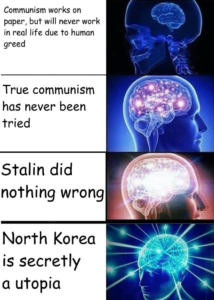
    This next bit tackles a very different subject from the above, but I feel it is also gravely important especially considering recent events. Another major concept we were never really taught about in school was the exact nature of Communism. To be sure, we learned the basics of Communism (The People™ own the means of production, classless society goals, y’all know the rest) or who Vladimir Ilyich Ulyanov “Lenin”, Karl Marx, Mao Zedong, and Josef Stalin (gulags were also covered, thankfully) were in our World History classes. However, we were never taught exactly WHY Communism has failed in practically every attempt it has been implemented or why the concept DOESN’T look good or function even on paper.

    With the “knowledge” I received from my school studies (this was all from Catholic private schools and my public college years), I was led to believe a government that ensures its citizens are totally equal, aren’t necessarily “poor”, and provided for is a good thing. What a shame that all the people who run this form of government always end up seizing more power and implementing Not-Real-Communism™. As a result, I was one of many young minds who merely thought it was a good concept on paper, but bad in application. To discover the answers and truth for myself, I had to dive straight into the heart of it: The Communist Manifesto. With an open mind and my almond primed, I finally read and understood for myself how rife with anti-life, anti-liberty, and anti-property rhetoric it was. I, for one, firmly believe in the concepts or the truths of Natural Laws and Natural Rights (ex. the rights to life, liberty, and property), all of which would be neutered by the philosophy and application of Communism (no absolute truths exist in Communism, Товарищ). If one is a member of the filthy “bourgeoisies” or refuses to cooperate with the revolution (looking at you Kulaks and Wreckers), their lives are to be forfeited for the sake of The People’s™ Revolution. If one wishes to ensure total equality in every way as well as micro-manage everyone’s actions and thoughts (ex. Communism requires the erasure of disgusting “Bourgeois-influenced” pre-revolutionary thoughts and memories for it to “work”), it would require a most repressive authority that would definitely violate everyone’s basic liberties. Finally, the abolishing of “Bourgeois” private property (such as the fruits of one’s own labor) and inheritance rights are self-evidently anti-property and anti-prosperity.

    In my experience, those of us who grew up after the Berlin Wall and the Soviet Union fell (I was born in May 1992) were not told of many major contemporary references that could teach us about the horrors and evils of Communism’s application (yes, there are numerous unfortunate examples even today, but these are usually hand-woven away by some of our “experts”, educators, and media as the results of “American Capitalist” corruption, poor management, or just poor luck). However, I was fortunate my grandparents who were politically exiled after the Cuban Civil War (to paint a picture of them: one of my grandfathers was a soldier who fought and suffered injuries during the fights against Fidel Castro and the other was a toy store manager who was tortured and imprisoned for a crime he and his coworkers did not commit) taught me about life under that repressive system. I also heard other experiences from people such as North Korean defector Park Yeon-mi and Chinese immigrant Lily Tang Williams (I recommend watching John Stossel’s interviews and pieces with them in “Playing the Victim” and “100 Years of Communist Disaster” linked at the bottom if you haven’t seen them yet).

    More Likely Than You Think

    To conclude my self-study to ascertain why Communism could never work and how vital natural rights and laws are, I took some time to reflect on my life. In my experience, I never liked being coerced to give away my possessions or my time to random people (I try to be a charitable person, but it is always of MY own volition). My social interacting growing up also strengthened my belief and practice of the golden rule (thank you parents and my local church for instilling that in me). I also discovered how people even under the most similar socioeconomic backgrounds could have entirely different outcomes due to all sorts of variables and factors, many of which ultimately can never be controlled. Some of my closest friends ended up working all over the country for various companies, some are still stuck with their parents and getting their acts together. Finally, upon reflecting on my experiences living in a very rural part of Japan by myself with minimal assistance for years as well as the experiences of my grandparents when they first came to the United States of America with just a suitcase at best, I learned how they, other individuals, and myself can have the strength, will, and initiative to be self-sufficient and not just survive, but THRIVE. Our natural rights give us the foundations we need to build our lives and prosper, forwarding the progress of human civilization.

    In conclusion, I believe self-study is important if not essential to an individual’s growth. Sure, our education system does a bang-up job teaching its citizens (please laugh), but for us to have a true understanding of why things are the way they are, how we can build a better future for not just ourselves, but for our families and those we care about, and what we can do as individuals to ensure the above, we must study for ourselves. Whether we study by reading the works of various minds of the past, speaking with our forefathers, the elderly, or friends about their experiences and beliefs in detail, or simply reflecting on our own lives and experiences, we should practice self-studying to complete our intellectual journey as much as possible in the short life we have.

    As a final note, I wish to encourage everyone here to follow John Locke’s advice to take a few moments when you can to sit down and read a book, even if it’s one with content you may strongly disagree with (if anything, you can learn how to argue against a particular idea/belief more effectively), spend time with your family, loved ones, and friends, and finally, spend some personal time to reflect on significant moments or influences in your life that shaped your beliefs or who you are as a person today.

    Thank you fellow Glibs for reading and I hope you all have a pleasant day.

    Credits and Inspirations:

    “What are Rights?” and “What are Rights? An Encore” – Trshmnstr
    “Not Just Self-Evident” – Suthenboy
    The Glibertarian Community
    The 5000 Year Leap: Twenty-Eight Great Ideas That Are Changing the World – W. Cleon Skousen
    The Communist Manifesto – Karl Marx and Friedrich Engels
    Two Treatises of Government – John Locke
    Ameritopia – Mark Levin
    My Parents and Grandparents (R.I.P. Abuelo Tim, I love and miss you very much)
    “Playing the Victim” with John Stossel featuring Park Yeon-Mi
    “100 Years of Communist Disaster” with John Stossel and Lily Tang Williams

  • The Parable of the Sleeping Tiger

    A long time ago in a land far away there lived a tiger, who had been hunting for two long days. He was very tired, so he decided to lie down in the shade of a mango tree, underneath some cool foliage, and take a nap. He fell asleep.

    Presently, he became aware that something sharp kept poking into his haunches. He opened one eye to see a little squirrel digging his claws in his side.

    “Say, little squirrel, what are you doing?” asked the tiger, who was wise and could not fault the dimwitted rodent for poking a sleeping tiger.

    “I’m feeling your muscles, to see how firm they are.”

    “Well, little squirrel,” said the tiger, flexing his paw, “feel my arm and then go away. I have been hunting for two days, and I am tired. I want to sleep.”

    So the squirrel felt the tiger’s muscle and said, “Thank you, Mr. Tiger. You’re very strong, but not as strong as the tiger in my glen.”

    The tiger snorted, for it made no difference to him who was stronger, and went back to sleep.

    Soon he was awakened to the feeling of his fur being rubbed the wrong way. He opened one eye. “Say, little squirrel, what are you doing? It hurts for my fur to be rubbed the wrong way.”

    “Oh, no!” said the squirrel. “I’m not rubbing your fur the wrong way. I’m testing the resilience of the hair fibers.”

    The tiger said, “Call it what you will—stop doing it.”

    “Mr. Tiger!” cried the squirrel, even as he continued to stroke the tiger the wrong way, “why are you angry with me? I have done nothing!”

    “You have awakened me, and you are rubbing me the wrong way. Please leave me to sleep, as I have been hunting for two days and I am tired. You have tested the resilience of my fur long enough now to know.”

    “Well,” huffed the squirrel, “your fur isn’t nearly so resilient as that of the tiger in my glen.”

    The tiger said nothing to that, understanding that the squirrel seemed even less clever now than he did before. “Go away, little squirrel. You are in my glen now, and I would sleep.” So he did.

    It wasn’t long before the tiger awoke to find little squirrel-fists full of tufts of his hair being plucked. “Little squirrel,” said the tiger, beginning to lose his patience, “I thought I told you to leave me be. Did you not understand that I have been hunting, and I am tired? Do you not understand that I have been very patient with you so far, and that I could gobble you up if you anger me?”

    “Well! I never!” pronounced the squirrel. “How dare you be angry with a little squirrel like me. I have done nothing to you that you should be so upset about!”

    The tiger tried to be more patient, as it was clear to him that the rodent had no sense. “You have awakened me three times when I have told you of my wish to sleep, you have poked my haunches, rubbed me the wrong way, and pulled my fur out of my skin. How can you say you have done nothing? Begone, rat, before I eat you.”

    The tiger saw that the squirrel was much offended by this speech. The squirrel replied, “Well, in any case, your fur is easier plucked than that of the tiger in my glen!”

    “Then go torture him and leave me be so I can sleep.”  And he did.

    No sooner had he fallen asleep yet again when tiny rodent teeth bit down into the tender flesh of his ear. He awoke with a deafening roar.

    The little squirrel scampered just out of reach and the tiger, rubbing his ear, said, “You really are not very bright, are you?”

    “How dare you!” squeaked the squirrel as he danced an angry jig. “I have not lowered myself to calling you names! How petty you are! The tiger in my glen is not petty!”

    The tiger, being wise and patient, would have ignored the rodent, but for the gleam of wicked intent he suddenly glimpsed in the eyes of the squirrel.

    “You have been bothering me on purpose,” said the tiger slowly, seeing that the squirrel was not stupid—just disturbed and wicked. “To what purpose, I do not know, but on purpose nonetheless.”

    “I have not!” said the squirrel. “I have been comparing you to the tiger in my glen! How dare you not let me perform my examination just because you are sleeping. You are out here in the open, at the mercy of just any squirrel! How dare you accuse me of bad things!”

    “Well,” said the tiger thoughtfully, “did you get what you were after?”

    “Oh yes!” replied the squirrel, gleefully, a look of triumph in his eyes.

    “Good. Then you won’t mind if I—”

    And the tiger gobbled him up—and finally got some rest.

  • Not Just Self-Evident

    Suthenboy is not a credentialed philosopher. Consult a credentialed professional before deciding.
    “We hold these truths to be self-evident, that all men are created equal; that they are endowed by their Creator with certain inalienable rights; that among these are life, liberty, and the pursuit of happiness.” -Declaration of Independence of the United States, 1776

    The notion of natural rights, that a person’s rights are inseparable from that person under any circumstances, is a relatively new concept and one that is and has been from the outset of its declaration controversial. It’s detractors say that it is an abstract concept existing only in the minds of its proponents. They claim that there is no objective evidence that such a thing exists in nature and thus that morality and ethics are arbitrary. I disagree.

    Whatever our founders believed the source of natural rights they made and appeal to the divine to justify belief in them. Perhaps it was a somewhat cynical, utilitarian approach to appeal to a nation that was strongly religious.

    “Can the liberties of a nation be thought secure when we have removed their only firm basis, a conviction in the minds of the people that these liberties are of the gift of God?” -Thomas Jefferson

    Certainly the founders were not monolithic in their belief in the origin of rights, but they were in agreement that they existed. I propose that whether a gift from God or simply existing by virtue of our nature objective evidence can be found for their existence. It does not matter where they come from, their existence is evident.

    Few rational people would argue that our world does not function on naturally existing laws. The sciences operate on this premise. Science is a method for discovering what those laws are and how they affect ourselves and the world around us. The veracity of scientific discoveries is measured by the ability of those discoveries to make accurate predictions about how we and the world around us will behave. By this measure science is a far superior system than, say, astrology. Simply put, superior systems yield superior results.

    An engineer that can produce a functioning spacecraft certainly has a superior grasp of the laws of physics and chemistry than one whose most sophisticated accomplishment is a dugout canoe. The production of a computer requires a far greater depth of knowledge about nature’s law than the production of an abacus.

    Geologists have a deeper understanding of the earth’s structure than the guy who believes in turtles all the way down and so can produce petroleum or predict earthquakes and volcanoes whereas the latter cannot. The success of this system of knowledge is evidence of its correlation with natural law.

    Those disciplines are based on an understanding of the naturally existing laws of physics and chemistry. Systems of morality and ethics are the products of ideas. Their success depends on how closely those ideas conform to the natural laws of human nature and economics.

    To whatever degree societies have allowed individual liberty – that is the belief in and respect for natural rights – success by any measure has been exponentially greater than those societies that have not. The United States is the premier example of such a society.

    The US has produced more wealth than all other nations through the history of mankind combined. The US contributed to increased worldwide health, wealth and longevity more than any other nation. The US has more social mobility than any other nation. The US produced air conditioning, flight, electricity, refrigeration, hamburgers, hotdogs, telephones, mass produced automobiles, atomic energy, chocolate for the masses, heart surgery, vulcanized rubber, computers and the internet. The list is nearly endless. As the joke goes “There are two kinds of nations: nations that do X, and nations that have put men on the moon.” Nearly everything that makes the modern world what it is is a product of the United States.

    This wild success is the product of a belief in and respect for natural rights. Innovative individuals have been free to innovate and profit from their efforts. Individuals have been able to think, speak and act as they willed more than in any other society. By respecting the concept of self-ownership – that every individual naturally owns their mind, body and conscience exclusively and thus the product of their intellectual and physical labor – a powerful incentive for those individuals to strive for success is created. As a result the United States has flourished more than any nation in history and contributed mightily to the welfare of all mankind.

    Simply put, superior systems produce superior results because they adhere more closely to the existing laws of nature. A belief in and respect for natural rights has unquestionably produced superior results.
    * Fun story: During World War II my grandfather owned a pulpwood business and had a contract with the federal government to use German POW labor. One of the jobs he secured was in south Louisiana. He transported the POWs to the job site on a route that went through Baton Rouge. The first time the POWs saw the Wilkinson bridge they were awestruck. If you have occasion to cross that bridge pay attention to it. Most people that cross the bridge take it for granted but if you really look at the scale of it it is awe inspiring. It is easy to see how the POWs were barely able to believe their own eyes. What they said to my grandfather about it really stuck with me. “If we had known what America is like we never would have gone to war against you. No one can defeat a country that can build something like this.”

  • Unseen Effects of the War on Drugs

    I have argued for a long time that the War on Drugs is the most destructive domestic policy since slavery. When you look at the inordinate rates of incarceration, it is best viewed as a direct continuation of Jim Crow laws and their impact on minority subjugation.

    While we all see the damage of the Drug War and the consequences inflicted on all involved, there are invisible and pernicious side effects that mostly go unnoticed. During my time in my hostel in Vietnam, I experienced something firsthand that often goes under the radar. The foreseeable consequences shoved down your throat.

    The guy at the front desk at my place offered me some weed. After a long day in the heat showing my mother around Hanoi, I was more than happy to purchase. I get into my room, had several drinks and smoked a large joint in the bathroom.

    I proceeded to chill, read and listen to music. And then the disturbance began.

    My private room is at the end of the hall. I hear a man and a woman, both in their early 20s by the sound of it, start to argue. It sounded like the man had gotten her down from the rooftop bar to begin his tirade.

    He is yelling at her. Something about her needing to “open [her] eyes” about something. It seemed very obvious that he was railing into her about how she could be so blind to not see how her boyfriend/significant other was cheating on her. I could be wrong about that, but that’s the gist that I got.

    I heard violent sounds. He wasn’t hitting her, but was banging doors and hollow metal, probably an air-conditioner unit. He was violently punching his own hand as punctuation. I could hear when she spoke but not what she said.

    I could only hear her sniffling and weeping.

    I was very concerned. I got on the floor and listened through the crack below the door. I got a cup to put to my ear to hear, though of no real advancement in my acoustic surveillance. The beratement continued.

    Amidst many slammed doors and stops-and-starts, a lull blanketed the hallway. I paused in introspection. My brain wants me to intervene. I’ve gotten one beating in my life and that was in Germany preventing a girl from being raped. Three men took turns kicking me in the face until I was unconscious. I was broken, but I’m very proud of that moment. I didn’t know if I’d have to do such a thing again.

    It began again. But this time it was another voice doing the shouting. I gathered that it was the boyfriend who had been called out. More door slamming. More punching of metal. More violent fists in palms.

    I decided to do something. I have two titanium hips and there’s a big concrete staircase. I can’t get directly involved, I figured. But maybe my appearance and a wary eye would keep people on their better behavior. I get dressed and put my shoes on.

    As I went to open the door, a sickening wave fell over me. I smelled my room. I evaluated myself. I am half-drunk, very stoned, and my room reeks like Paul McCartney’s in 1966. I took my hand off the knob.

    I thought about calling the lobby for help. But even then I realized that I would be a person-of-interest, and I certainly didn’t want to get in drug trouble in Commie Vietnam while on vacation with my mother.

    I was disgusted with myself. I kept listening and monitoring the situation. But I didn’t dare step outside my enclave and approach a confrontation where it sounded like imminent violence was about to ensue.

    I was too terrified to try to help this poor girl who was surrounded by at least two–drunk–large men who were doing everything that they could to intimidate her. Or possibly worse.

    This is just one of the evil, unseen effects of the Drug War. See Something; Say Something, they preach. But how many crimes go unreported because the witness is afraid to talk to the authorities or to testify because of some bullshit drug charge is hanging over them? I wasn’t being threatened by some thug or a criminal syndicate. I felt threatened by what the government could do to me and how they could ruin my life. All because of a plant.

    There isn’t much of a difference between the government and the Mafia. Punishment is punishment, regardless of who your jury is.

    I am sickened by how I responded to these external forces. But I do know why I acted the way that I did. It doesn’t make me feel better. Rather the opposite.

    People are handicapped by these immoral laws. They don’t report things that they know are wrong because they are trained to be fearful of the imminent reprisal. Is my getting beaten and sent to jail for smoking weed worth a girl getting thrashed around a bit?

    It’s a deeply disturbing calculus that goes through your head when you attempt to rationalize your decision to do nothing.

    A law on the books actively prevented me from helping a person in a very violent confrontation. That is the effect of these laws. I can only gather that this is how they want me to feel.

    Helpless. Alone. Dependent.

    And any attempt to do any good is struck down with the violent gavel of the God of Government.

    That’s the problem. Good people afraid to do good things. Because the punishment that might follow isn’t worth the gamble.

  • CODE IS FREE SPEECH

    CODE IS FREE SPEECH

    ZARDOZ SPEAKS TO YOU, HIS CHOSEN ONES. WE HERE AT GLIBERTARIANS ARE FULLY DEVOTED DEFENDERS OF THE RIGHT TO SAY, THINK, WRITE AND PUBLISH ANYTHING WITHOUT GOVERNMENT INTERFERENCE OR PRIOR RESTRAINT. RECENTLY, WE CELEBRATED WHAT WE THOUGHT WAS A BIG WIN FOR THE RIGHT OF FREE SPEECH IN AMERICA. THE FEDERAL GOVERNMENT VOLUNTARILY SETTLED A LAWSUIT WITH DEFENSE DISTRIBUTED AND CODY WILSON, REGARDING THE PUBLICATION OF SPECIFICATIONS FOR MANUFACTURING HANDGUNS ON VARIOUS TYPES OF COMPUTER CONTROLLED MACHINERY AVAILABLE TO THE GENERAL PUBLIC. TODAY, AUGUST 1ST, WAS SUPPOSED TO BE THE DAY THAT ALL OF THESE FILES WERE ONCE AGAIN AVAILABLE TO THE PUBLIC. HOWEVER, VARIOUS STATES AND LOCALITIES HAVE HAD FEDERAL JUDGES ENJOIN THIS BY EMERGENCY ORDER. WE DO NOT SUPPORT ANY SUCH RESTRICTIONS. IT IS THE CASE TODAY THAT PEOPLE PROHIBITED FROM POSSESSING A GUN BREAK THE LAW IN ORDER TO POSSESS A GUN. THEY CAN GO TO YOUTUBE RIGHT NOW AND WATCH “HOW TO” VIDEOS OF PEOPLE BUILDING GUNS WITH A DRILL PRESS, A HAMMER, AND AN ANVIL.

    IN SUPPORT OF DEFENSE DISTRIBUTED’S NOBLE WORK OF EMPOWERING CITIZENS TO BUILD AND POSSESS THE TOOLS TO FIGHT AGAINST UNJUST FORCE, OF ANY TYPE, WE PROUDLY FEATURE THIS LINK TO THE FILES. ZARDOZ BRINGS YOU THE GIFT OF THE GUN! CLICK HERE TO GET THEM FROM AN  END TO END ENCRYPTED SITE.

    THIS ACT IS PART OF THE REASON GLIBERTARIANS WAS CREATED, AND IS STILL HERE.

    ZARDOZ HAS SPOKEN.


  • Hot Take: LA Judge Defies First Amendment

    In a major “oopsie,” a sealed plea agreement in a police corruption case was posted publicly. So judges being what judges are (convinced that they have royalty status and don’t really have to follow the constitution), the judge here defied the First Amendment and ordered that the LA Times remove all references to the secret plea agreement. The LA Times complied with the order but is appealing it. I’m somewhat surprised that they didn’t issue the equivalent of “Fuck off, slaver!” and challenge the judge to do something about it. But they caved for the moment.

    Of course, the judge either doesn’t know or doesn’t care that the Internet is a forever thing. And we have no scruples about giving that slaver the finger. So here’s the story as it originally ran, complete with the several added details that the judge thinks are FYTW exceptions to the First Amendment.