A cursory internet search revealed many articles that put forward this claim, the earliest, being from an Alternet post in 2009. Indeed, this claim was repeated as gospel by several outlets across the ideological spectrum, including The Atlantic, World News Daily, and variousnewspapers. When authors of these articles deigned to provide a source for this claim, they usually pointed to various think-tank reports, including an Obama-era report by the Department of State, all of which place the total number of those enslaved around the world from 20 to 40 million.
When one considers that on the eve of the American Civil War, there were almost 4 million slaves, this number may seem shocking. Well, it may seem that way if you are a drooling microcephalic. People who possess an intelligence quotient of 80 or higher (Stanford-Binet or WAIS, take your pick) are cognizant of another absolutely shocking fact: there are more people alive now than at any time in the history of this world!
If, for the sake of argument, we take the highest estimate for the current number of slaves in the world, it represents a mere 0.5263% of a total global population of 7.6 billion individuals. Are Trump et al. truly claiming that in the past the total number of slaves had never represented more than half a percent of the world’s population? In 1860, slaves represented 12.57% of the total population of the United States alone!
Comparing total number of slaves across time periods without accounting for the increase in total world population is a statistical trick even worse than the “1 in 5 women are raped at university” claim. Whereas the latter myth relies on cooking the books with both an extremely expansive and idiosyncratic definition of sexual assault that utterly destroys its construct validity and a piss-poor sample size that provides nowhere near the statistical power needed for the inferences made by the report, the former merely pins its hopes on the fact that you are innumerate.
Now, all of this may just be merely risible fodder for the world-famous Glibertarians.com sneer take if it weren’t for the fact that these factoids are used as rhetorical lubricant for advancing public policy. The 2012 Department of State report used this claim to advocate for less restrictive requirements for victims of human trafficking seeking asylum, the 2016 WND op-ed uses the same claim to advocate for immigration restrictions from countries that follow sharia law, and today, Trump squarely placed blame on the Internet for this supposedly unprecedented number of slaves around the world.
It is this mythology that is used as a screen for the power-grabs the Federal government has made through the Stop Enabling Sex Traffickers Act (SESTA) and Allow States and Victims to Fight Online Sex Trafficking Act (FOSTA), which Trump signed into law on April 11th. FOSTA-SESTA remarkably passed the House of Representatives with a 388-25 margin, and the Senate 97-2, with only Ron Wyden and Rand Paul voting against. Truly, it seems the naked ambition to control one’s fellow man is the only thing that enjoys broad bipartisan support these days. Well, that and the erroneous belief that there is more human trafficking and slavery than any other time in world history.
Your humble servant, Lord Humungus, was able to parse through the history of Earth and found, written by some unknown explorer, the verbal history of STEVE SMITH. Behold his words and tremble.
STEVE SMITH LIVE LONG TIME BUT NEVER GET TIRED OF RAPE. WAS LONELY AT FIRST. BUT GOT TO MAKE MANY FRIENDS OVER THE YEARS. AND BY MAKE FRIENDS MEAN RAPE.
Hadean: TRAPPED ON PLANET. NO ONE HERE. VERY HOT. FUR GETS BURNED BY LAVA. CAN ONLY RAPE HOLES IN GROUND. WAIT LONG TIME FOR SOMETHING TO HAPPEN.
Archean: NO TREES. NO ANIMALS. NO PLANTS. CAN ONLY RAPE BACTERIA IN SHALLOW WATER. NOT MUCH FUN. NO FRICTION.
Proterozoic: STILL NO ANIMALS. CAN RUB AGAINST SMALL PLANTS. STILL NOT FUN COMPARED TO FLESH.
Paleozoic: FINALLY REASON TO LIVE. TRILOBITES EASY TO CATCH BUT NOT GOOD TO RAPE. FISH MUCH BETTER. SCHOOL OF FISH BEST. COUSIN SEA SMITH NEVER LEAVE BIG WATER. HIM LIKE FISH TOO MUCH.
Mesozoic: REPTILES FAST AND BIG BUT NOT WARM ENOUGH FOR STEVE SMITH. CHASING FUN BUT RAPE IS BETTER.
Jurassic: BIRDS TOO HIGH IN SKY TO GET. FRUSTRATED. DINOSAURS GOOD TO RAPE BUT PUT UP FIGHT. YOU EVER GET STEGOSAURUS PLATE IN CROTCH? IT HURT. MAKE STEVE SMITH MAD. COMET NOT DESTROY DINOSAURS. RAPE DESTROY DINOSAURS.
Cenozoic: FINALLY BEST CREATURES COME ALONG. MANY ANIMALS WITH FUR LIKE STEVE SMITH. WARM TO CUDDLE. GOOD TO RAPE. NEVER RUN OUT OF SMALL TIGHT PREY. HAPPY TIME.
Paleogene: LITTLE MONKEYS THAT LOOK LIKE ME. THEY ARE BEST TO RAPE BUT HAVE TO CLIMB TREES TO GET THEM. HARD WORK. MOSTLY RAPE BIG ANIMALS FOR SPORT.
Neogene: SOME FUNNY MONKEYS NOW RUN LIKE ME. EASY TO CATCH IN WOODS. TOO SLOW. CARRY SHARP STICKS. PUT UP FIGHT. THEY STILL RAPED. BIG FURRY ELEPHANTS GOOD FOR CUDDLING. TIGERS HAVE BIG TEETH. USE AS TOOTHPICKS.
Quaternary: SEEMS LIKE LAST WEEK. MAN ALL GROWN UP. LIVING IN BIG CITIES. HARDER TO CATCH. NOW WAIT FOR HIKERS TO GET BACK WITH NATURE. AND BY BACK MEAN RAPE. AND BY NATURE MEAN STEVE SMITH.
Then they crowded ‘round me, and my eyes began to blink,
One of them grabbed a-hold me, and said, “Coon, come have a drink!”
He said, “Drink something Irish,” and I quickly took the hint,
I felt quite sick, but I yelled quick, “Let me have a glass of creme-de-menthe!”
Chorus (2X)
St. Patrick’s Day’s a bad day for coons,
The only safe plan for us is balloons!
Yellow coons must not be seen.
If you drink, drink something green!
St. Patrick’s Day’s a bad day for coons!
Just then a high toned yellow darky came cake-walking down the street;
He had on a pair of yellow gater tops on his feet.
He had on swell yellow gloves, also a yellow vest,
And when those Irishmen saw that coon, I guess you know the rest.
They quickly grabbed this darky, and he began to fight.
They took his gun and razor, then he tried to pass for white!
They shaved him with his razor, and they fanned him with his gun,
If you show him a shamrock now, that yellow coon is always sure to run!
So we covered a bit of general information and a bit of history on wine in Romania, best wine in the world. Now let’s get a bit more specific and let’s us talk grapes. Well not individual grapes of course, I mean varieties. As mentioned previously, accurate figures are difficult to come by, in Romania or elsewhere, due to informal wine making and general issues with such statistics, but I will try to give some numbers, as accurate as I can. So take it with a grain of tartrate, so to speak. According to Ministry of Agriculture estimates, Romania has about 200,000 hectares of vines, 80% of which are dedicated to extracting the nectar of the grapes, making 500 million liters of wine. Give or take 150 million. Half of them are European vines, half are hybrids. I will ignore the latter altogether because, personally, I do not consider that to be wine wine, and frankly there is not much to say of the mighty Căpşunica.
Isabella or strawberry wine
Fine… I will talk briefly of Căpşunica, the most popular hybrid wine grape. The word comes from căpşună, meaning strawberry. It came to Romania via Italy, where it was called Fragolino, hence the name. It is a hybrid originating in, I think, South Carolina or thereabouts, where it was called Isabella or somesuch. Many Romanians drink wine made of this. I am not among them. I find it utterly unpalatable. Anyway… Moving on…
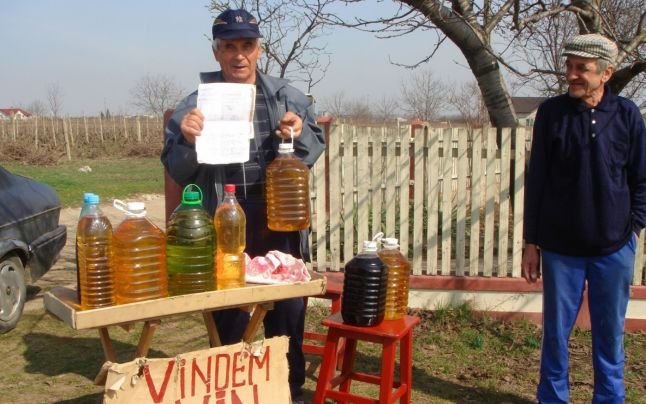
About 70% of wine grapes in Romania are white and the remaining 30% red. There may be a few confused, inter-color, bi-curious and such, but a negligible amount. This data is basically approximation as no one knows for certain. This is due to the highly fragmented nature of the holdings, mostly because of those who grow for personal consumption. While in the EU the average vineyard size is 1.3 hectares, in Romania it is 0.2. So everyone and their grandmothers have a couple of vines to make a bit of wine, usually ready in spring and to be drunk by mid-summer, otherwise it goes sour. There are exceptions though; a minority of people do make good homemade wine.
The white is predominant due to local preference for lower alcoholic, sweetish wines that can be drunk in high quantities, usually mixed with soda water. Șpriț, as the locals call it, word coming from the German Spritze. This leads wine snobs, such as yours truly, to turn their nose up and look down upon the plebs. For one thing, I dislike wine that isn’t dry. And second, I would rather drink a smaller quantity of something good than a larger one of something bad. And I don’t mix my wine. Some people actually put Cola in wine. One thing that amused me, as an anecdote, was one such person criticizing another: I understand drinking red wine with Cola, I do it all the time, but white wine with Cola is just weird. White wine is with Sprite or mineral water. But the șpriț has its reasons: if you want to drink all night and keep hydrated, half wine and half water works better. You don’t get pissed as fast.
Old school sifon
As an anecdote, most people use bottled mineral water now. But back in the day – 80, 90 or so, it would be sifon, which I don’t know how to translate other than soda water. This was basically tap water with CO2 added. There were special places – sifonarie – where you would take your reusable bottles to refill. The bottles had a special head.
The main white grapes cultivated in Romania are Fetească Alba, Fetească Regală, Riesling, Aligote, Sauvignon Blanc, Muscat Ottonel, Pinot Gris, Chardonnay, Tămaioasă Românească, Grasă de Cotnari, Francusă, Galbenă de Odobești, Crâmpoșie Selectionata, Mustoasă de Mădarat, Zgihară de Huși, Sarba, Plavaie, and several others. Riesling is mostly Italian Riesling, but small amounts of Rhine Riesling have been planted recently, for the local need of a wine with just a hint of petrol in the nose. The largest amounts are planted with the local grapes Fetească albă and Fetească regală, together being 18% of plantations.
The main red grapes planted are Merlot, Cabernet Sauvignon, Băbească Neagră, Fetească neagră, Pinot Noir, Burgund Mare, Traminer Roz, Busuioacă de Bohotin, Cadarcă. Merlot is the most planted red grape, with about 12 thousand hectares. (As a side request for the admins, please catbutt any post saying they won’t drink any fucking Merlot.)
I will not talk of international grapes much, but focus on the local ones. While there are several varieties, a fraction of the pre-phylloxera varieties still exist. I think there are probably lost varieties still grown among villages off the beaten track, but there is no project or funding to identify and preserve them (one of the things I would fund were I a billionaire). Many more were probably lost in the recent frenzy to replant everything with Cabernet and Syrah and other such invasive species.
Fetească is sort of the local flagship grape, both in white (alb means white) and red (negru means black). Fetească Alba is a white clone of Fetească Neagra. Feteasca comes from the word fata, meaning girl, and it could be translated as young girl like. I do not know how this came about. Another common grape Băbească neagra (red fruit, higher acidity), comes from babă which means old woman. Băbească is to Fetească maybe stretching it a bit what Pinot is to Cabernet, and is used to make lighter somewhat fresher and fruit forward wine. Fetească is the more serious grape, making more complex wines. There is an old saying, heteropatriarchical I would think, about how young men like the older woman and old men like younger girl (meaning youth prefer the lighter wines from Băbească and the older, with or without candy, like the more complex Fetească). Băbească also has it’s white wine clones Băbească Albă sau Băbească gri, but these are very rare.
The general harvest date for Fetească Neagra (considered typical with a significant aroma of dried plum) is around 15 September, having a growth period of 160-170 days. They get about 230-240 g/l of sugar and acidity of around 7 g/l. I will not give technical notes on other grapes. For more info there are encyclopedias for this sort of thing.
Negru de Dragasani
Less common red wine varieties which make, in my view, good wine are Negru de Drăgășani (black cherries, blackberries, blueberries and other dark fruit) and Novac (raspberries, sour cherry, cloves, black pepper, dark chocolate – I do not do tasting notes myself so I just copied these from some professional wine taster, I find describing wines in such detail a bit silly), both from Drăgășani, a wine region in southern Romania, and both obtained by different crossings of an old Romanian pre- phylloxera grape Negru Vârtos with the grape Saperavi. They make a velvety red wine with some aging potential and one of the local candidates to making what some might call “Great Wines.” Negru Vârtos – meaning strong, powerful black – was one of the more appreciated pre phylloxera wines of Romania, and it was preserved in Negru de Drăgășani and Novac.
As a note, many of the wines that are traditional to Romania (which contains the subregion Moldova) are also common in the now independent country Moldova. Some say one grape comes from one or other, but being that the language and culture are mostly common (despite the best efforts of Russians to make Moldova Russian), I do not think it is relevant. Jancis Robinson makes claims about this, for example, but I find it meaningless. The national grape of Moldova is Rară neagră which is simply another name for Băbească Neagra.
Now to go through a few more grapes quickly… Grasă de Cotnari -gras means fat – is the flagship grape of the Cotnari region and is used to make sweet, aromatic white wine – and I remember reading that it was also planted in South Africa for this purpose. Fetească Regala is a cross between Fetească Alba and Grasă de Cotnari in order to get a more aromatic wine, but used for dry whites. Francusă is the Cotnari grape used for dry and rather acidic wine. In the old days people in general preferred sweet wines to dry, but the legend goes that Cotnari wine was generally so sweet that the boyars occasionally drank some Francusă as a palate cleanser.
Crâmpoşia is one of the grapes believed to date back to ancient Dacia. Crâmpoșie Selecționată was obtained from Crâmpoșie crossed with a grape called Gordan, which I know little about, in order to solve some problems with sterile vines. It has high acidity and is used to make fresh, fruity whites. While traditionally used for dry wines, the possibility of both high sugar and high acidity made it useful for semi sweet and sparkling wines (Prince Stirbey vineyard makes a good sparking from Crâmpoșie). Another local wine use for sparkling is Mustoasa de Madarad, from the Arad region of western Romania.
Tămaioasă Românească – tămaie means frankincense – is of the main white grapes used in Romania to make sweet aromatic wine. Although traditionally only used for sweet, some dry varieties were produced recently, due to the changing of tastes towards dry wines – Romanians still like a lot of sweet or semi-dry wines but tastes are shifting. Some of the dry versions were, in fact, pretty good. The grape is related to the French Muscat de Frontignan. A variation called Tămaioasă Roza – used to make a rose sweet wine – is actual Muscat de Frontignan, but they are, apparently, not allowed to call it that.
Another sweet rose wine of some fame is Busuioaca de Bohotin. Busuioc means basil and it is a reference to the wine being quite aromatic. This was, during communism, grown on a limited surface and was reportedly Ceaușescu’s favourite. Due to this – the dictator drunk it and the people didn’t get any – after communism it got real popular because everyone wanted to drink Busuioaca. In the 90’s, probably 10 times more Busuioaca was sold than produced, a cheap, sweet red wine of the poorest quality. Recently, a few reputable producers made some, and while I’m not a fan, it can be pretty good as sweet wines go.
As far as international grapes, I would say that if you are a fan of Pinot Noir, I would be very careful buying Romanian one. It is most likely bad, and not very typical due to the hot summers. Say what you will of Romania as a wine region, Burgundy it is not. Not even, say, Oregon. Furthermore, Pinot Noir was mostly made in Romania as a semi-sweet red wine of poor quality. It was what Romania was known in the past in England and Germany for – bad cheap Pinot for students and drunks.
I was thinking of making one more post on recommended Romanian wines, but due to the availability in the states, there is little point. I already mentioned the wineries I like in the first post. Most wines from those are good. To highlight a few, Fetească Neagra I like from SERVE (Guy Tyrel de Poix), Bauer (FN quite different style to others), Davino, Balla Geza (Stone Wine Fetească Neagra) and Ferdi Feteasca Neagra – although this is nearly impossible to get in Romania, small family winery which does not really retail in stores, you need to know a guy. . . For Negru de Drăgășani and Novac the top is Prince Stirbey. There are other producers in the Drăgășani area that make it and only one outside, Via Marchizului Negru de Drăgășani from the somewhat hotter Dealu Mare, but an interesting variation of the wine. White wines I drink less of, but recommend the same producers. Stirbey and Bauer make great Sauvignon Blanc, but that is not a local grape. Bauer is the main oenologist of Stirbey, who made his own boutique winery with great results and even made the first Orange wine in Romania.
About where to get it … TotalWine apparently has the mid-range Recas, which OMWC reviewed. The net said something about Mariano’s in the Chicago area, but we will have to ask Swiss if that is true. Mission Liquor & Wines Pasadena, CA, had, at least on the website, Nedeea – a blend of Fetească Neagra, Negru de Drăgășani and Novac and some Panciu which should be decent if not spectacular. The website has some stuff on it, no idea if it retails or how. Besides that… who knows.
To start, in the beginning there was a formless void. Then the Dacians created the world, and after it, wine. Moving in the realm of less fictional, but maybe somewhat so, based on serious archaeological evidence, we can estimate at least 4000 years of wine making round these parts. Getting to the 60s – BC that is – we have Dacian king Burebista – the first to unify the tribes in what is now Romania and parts of Ukraine and Hungary into something resembling a kingdom, or kingdom like tribal alliance. Wanting a better, stronger kingdom, military and economic, he ordered the burning of the vineyards, because the people drank too much wine. So wine around these parts goes back thousands of years. And drunkenness as well.
Not my property
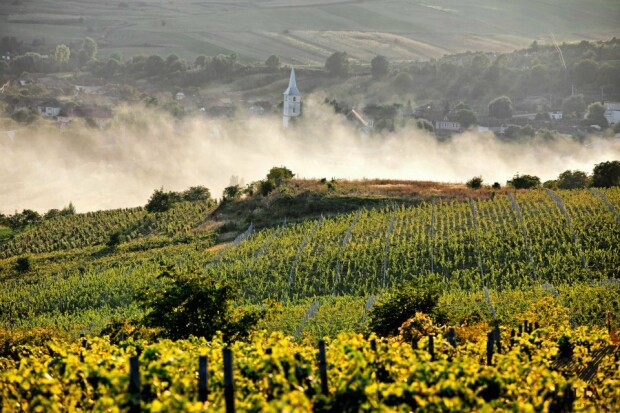
Romania does have a history of wine and does have several famous wine regions, suitable from a geographical and climate point of view. Wine from areas like Cotnari, Odobesti, Drăgășani, Dealu Mare had its moments of being considered among the good European wines and are mentioned by foreign sources since the 1500s.
The present situation is… complicated, with good and bad. Much of the bad, as I said in my previous post, was due to communism – bad, cheap mass produced wine to export for low prices. Usually semi-sweet with added flavor. The vines and facilities were not maintained, a lot of knowledge was lost. The 90s were a bit of a dark age, as government agricultural cooperatives were dismantled, some vines being given to former owners or their heirs, others to dysfunctional government enterprises.
New owners did not maintain vineyards any better, and most of the wine was mass produced and of very dubious quality. At least in my view. Many Romanians like to claim they enjoy “natural clean country wine”, not that commercial stuff. Natural and clean meaning not polluted with the things that stabilize and clear the wine of impurities, thus making it drinkable. The resulting liquid is sometime – rarely – quite decent if not great, but more often brown and murky, reminding one of a muddy river. I feel the home made wines in Italy or Portugal are of significant better quality because people actually bother to have some skill.
But some of the… roots is the proper word… of the problem predate communism. Even before, quality wine was but a fraction of the total wine production. Most of it was made, then and now, for personal consumption on very small lots – basically each peasant’s garden. A lot of trade in the 1800s in Romania was still barter and did not involve money, which rural populations did not always have, so there was no developed market in wine, like in, say, France.
Story time: as I said in my very first post on Glibertarians, my great-grandparents were from the Pitești region, grew plum trees for țuica and owned a pub in Pitești. Back in those days, the pubs sold mainly țuica and wine, so they made extra țuica, loaded up some wagons and traveled over several days to a wine producing region and traded for wine.
Ox cart, common theme in Romanian painting
Transport was bad in Romania back then, mostly by wagon and dirt road, so it made sense that most of the people made wine themselves, it was hard to buy from a distance. So each town or village had some vines surrounding it. The quality of the wine varied greatly. Some people respected the craft and themselves and made quite decent, if rustic, wine. Clear, somewhat stabilized micro-biologically – the barrels were sort of fumigated with sulfur providing the sulfites, wine was sometimes filtered using egg whites – something still done in modern times, although now artificial gelatin is favored. Others, not so much. It was just plain bad, or mixed with water, made with added sugar or with certain additives to make it seem better.
Now a little break for fun with etymology! Șmecher is a quite common Romanian word –which mean crafty, cunning, shrewd and difficult to trick. An assumption is that the etymology is from the German word like “schmeck” or schmecken, which means to taste. The legend goes that German merchants came to the Drăgășani region of Romania to buy wine. The locals gave them a bit of the good stuff, and then a bit more, and the merchant got a bit drunk, and then they sold him some bad wine as well, but for the price of good. Now, say what you will of German merchants, they were not stupid. Fool me once, as the saying goes. So the next time they brought tasters which did not get drunk and made sure to get the good stuff. These schmeckers or tasters were people who were hard to trick, who did not buy bad wine for the price of good. Hence the Romanian word.
Wine is the nectar of the vines, if we want to be pseudo poetical about it. And why would we not want to be? But wait; there are plenty of crawling plants, so which ones? Vitis vinifera is responsible for all that which most humans with a discerning palate consider good wine. So plant that shit and drink up! Well, that is what people did. A lot. So up to this point, all is well, everyone was all happy and drunk – as happy as semi-starving peasants can be that is – until you bloody Americans had to screw things up, with you interventionist policies and such. In the year 1884, enter phylloxera stage right. And things got considerably worse.
What is phylloxera ? It’s an insect, a bug, a parasite, vermin. You mean like socialists? Yes, precisely like socialists. Phylloxera is a pale yellow insect native to North America, which, instead of doing productive work, sucks the sap from good, honest grapevine roots. Americans have evolved some natural defenses against parasites such as these, which Europeans did not. But Americans lack the sophistication needed to make a good wine. And speaking of Americans, as a side note, just to avoid all sorts of silly comments, a hectare is 2.5 acres.
No nasty sulphites
In 1884, Romania, not yet including Transylvania, had at least 200.000 hectares of grapevines – mostly local versions of vitis vinifera. Most villages and towns had their own vines, due to the difficulty of transporting things on dirt roads. Then the disease devastated the vines, and by 1905, 90 thousand hectares were left.
By the time the bug was in full swing round these parts, Western Europe, which was hit first, had found the solution. After many trials and errors with pesticide, insecticides, fumigating vineyards and such, the new vines were planted grafted on American root stock – vines that did not give good wine but resisted phylloxera. Romanians, red blooded and proud as the mighty oak that grows in the forests, said, naturally, we ain’t gonna let a bunch of foreigners tell us what to do. So instead, they started experimenting with pesticides, insecticide and fumigating vineyards. This failed miserably and in the end they turned to, you guessed it, planting vines grafted on American root stock.
Being a poor country, money was tight. As such, by 1910 Only 70 thousand hectares were left, out of which 20 thousand hectares had been replanted, and the others managed to hang on. The majority of the country, used to growing and making their own wine, and not being able to afford the new solution, settled on a not great but inebriation enabling intermediary solution. Direct producing hybrid vines. Hybrids of European and American vines, which were resistant to phylloxera and created a drinkable, if bad wine, were planted. They grew, they were maybe more productive than the “noble vines,” as they came to be called, and made a drink that got you buzzed. Good enough.
Sap sucking parasites
By 1935, after gaining Transylvania with a lot of vineyards, Romania had some 160 thousand hectares of European vines and 160 thousand of hybrids. By the end of communism in 1990, there were 160 thousand hectares of European vines and just 60 thousand of hybrids – results of collectivization and elimination of some of the hybrid vines. Sadly, things did not get better immediately, as many people who land from the old state cooperatives sometimes took out noble vines and replaced them with easier to maintain hybrids. So in 1997, the numbers were 80 thousand good vines versus 120 thousand hybrids. Right now, officially at least, it is illegal in the European Union to plant hybrid vines for wine making. This was, I assume, a standard protectionist method for established agriculture, although the pretext was the poor quality of the wine and the higher possibility of methanol in wine from hybrid vines.
Now, more than 100 years later, according to the national statistics institute, there are 180 thousand hectares of vines in Romania, out of which about half, 90, are grafted vitis vinifera. So 150 years after phylloxera, the country has half the vines capable of producing good wine. And the current territory also includes Transylvania. Sadly, many people who make wine for their own consumption still plant hybrids which create a good natural country wine. Because swill does not have the same ring to it.
Last we saw, Catalonia had what I suspected would happen – a muddled, slightly pro-independence election result.
How do you say “Big Freakin’ mess” in Catalan?
So, what has been happening?
Well, near and dear to me – Switzerland has been dragged into the mess. One of the separatists from the Left, Anna Gabriel, logically skipped showing up to the Spanish Supreme Court to answer charges of being naughty and not wanting to be part of Spain. After wisely choosing to flee to Switzerland (look what happens when you stick around) she has indicated she will stay there. One of the more theatrical elements of this action by the Spanish Government…no extradition request was attached to their arrest warrant (Switzerland has mentioned they would probably not extradite anyways). And to remind you all how awesome Switzerland is….they have previously offered to mediate between Madrid and the separatists. OK,OK, that is enough Swiss strokin’.
What about me?!
Carles Puigdemont, once (and future?) President of Catalonia’s regional government, is squawking from his exile in Belgium, that he should be running the show – but any kind of law to allow him to do so hasn’t been moved forward. So we are left with a dozen political leaders in exile or jail and Madrid issuing symbolic arrest warrants. Oh, and Madrid not being content with things being muddled, but peaceful, has decided to stick a big middle finger up to the Catalans, regarding one of the sorest points out there.
In my opinion, Madrid is caught on the horns of a dilemma – do they try to keep a sort of soft squashing of independence going (the arrest warrants – but no extradition requests, hovering around and waving Article 155 – direct rule by Madrid – of the constitution, and diplomatically pressuring other nations to not recognize Catalan independence) or do they clench a fist and swing – disbanding the regional government again, pushing Spanish language and national feeling, and actively trying to round up leaders of the independence movement.
At least it is still jaw-jaw (mostly, pay no mind to the jailed and exiled) and not war-war. But sooner or later, one side is going to fish or cut bait. Right now, I’d say it is likely Madrid will be the first to push hard. We will see, one way or the other.
One of my family members is an online instructor that teaches classes to UN refugee camps around the world. I respect this person very highly, so when he sends me an email with the title “What Kind of Legacy are We Leaving You?” I feel compelled to engage in the discussion. His students were to read an excerpt from Viktor Frankl’s book “Man’s Search for Meaning”, Plato’s “Euthyphro”, and to describe their own search for meaning. The email he sent to me consisted of one student’s response. The student is not a native English speaker and relayed his experiences outrunning war in Africa and the Middle East. I am not going to write the entire message here but focus on a question the student asked in response: “Let me ask a question, does it mean that from all the way back to thousands of years ago education has done nothing to stop wars?”
This is a sentiment that I started to wonder a little while ago. I enjoy reading about world history and economics and a repeated theme is the idea that we have come so far, we are so educated, that surely this time we’ll get it right if we just have the right people in charge. This time our society will be perfect, a Utopia. It’s a common theme in dystopian novels but frequently reflected in the speeches of many people who consider themselves to be revolutionaries.
Or, y’know, your Utopia
And yet, within a few short years of uttering this sentiment, those societies tend to collapse, almost always violently.
Surely the next time we will be more educated. We will get it right. We just didn’t have the right people in charge or some “other” ruined the dream.
It almost implies that education bestows a moral high ground. If we were more educated, we wouldn’t have so many wars, people wouldn’t starve, and we could get the best and brightest to solve our problems. In many ways our increasing knowledge has alleviated much of human suffering to those who are the beneficiaries of it. Crop yields have increased several times over because of what people have learned and the technology that came with it. In stark contrast, education also creates the most terrible weapons of war. Atomic bombs can wipe out the same population that those increased crop yields can support. It has struck me as an interesting dichotomy.
If education implies morality, then being uneducated must mean that you are little more than a barbarian, and yet we know that that isn’t true, either. Many of us have grown up with or have met many people in our lives who would be considered uneducated but are the most wonderful people to be around. In stark contrast stands the individuals who would lord their education levels over others in search of that distant Utopia. This, of course, is not always true and is not meant to be a generalization of either educated or uneducated individuals.
The implication isn’t that we are pursuing the wrong means for Utopia. The implication is that we can’t escape our base instincts except by conscious choice, and even then, we cannot force others to accept it without conflict. His question neither condemns nor condones education. To me, it succinctly illustrates human nature. Education is another tool mankind has created. It cannot bring us any closer to the Utopia we so desperately desire, but if we recognize that we cannot truly escape our instincts, we can use education to help each other in greater and more fantastic ways, as human beings have always done.
A couple days ago, you may have noticed certain people had a black cross tattooed across their foreheads. You may have chuckled a bit at such foolishness, but not at me. Because I didn’t go to the mass? No. I happened to grow up in a part of Phoenix where a large number of kids at school were going to ask me what’s with the cross on the forehead? Between the popped collar crowd and, well–(((them))), it was a conversation that got old fast.
While I went to mass, I decided I didn’t need the whole world to know I did. I had the good sense to wash it off when I got to work. If I’m going to burn in Hell, let’s be real, it’s not going to be for that.
This is my review of The Bosteels Brasserie Tripel Farmelier.
Here, I will explain what I preferred not to explain before. Ash Wednesday is the start of Lent. Lent is not supposed to be be some form of medieval self punishment. Unless you want it to be, in which case I leave you here with this guy.
For everyone else, it’s simply a time for prayer and fasting. The word itself is derived from the Middle English word Lenten, which means springtime. The days after all, are lengthening this time of year–get it? Its origin as a time for spiritual renewal was brought about by the tradition of baptizing Catechumens on the Saturday before Easter. Now you know why I never go to Easter Saturday mass, because its three hours long and. It. Takes. Forever…..to watch these people get dunked.
The fasting part was something that developed during the 4th century AD (…or CE) and was typically observed by monks. It might seem like a convenient time to go without eating anything given the abbey was probably running out of food by the end of the winter, but the time of year the fast begins has been as early as January. This time in history is also when it became linked with the traditional 40 days. No one is really certain how Ash Wednesday became recognized as the start of Lent, but for our purposes it is when it is observed. The fast part is now observed by Catholics “giving up” something. There are some theological origins to this, such as the story found in Luke 4:1 to 4:13, but the fast is now more or less observed by going without something. Whether that be something trivial like chocolate, or something more of a challenge like bread, eggs, or milk, its up to the individual. After all, even the monks did not starve themselves. They stayed alive by drinking beer.
By the way, in the interest of full disclosure, this is all relevant because I give up beer for lent. Every year. That and meat, because you’re not supposed to eat meat on Friday and quite frankly I screw that up at breakfast so I just make everyday Friday.
The beer we now associate with these monks originates around the 11th century AD (…fine, CE) with the Order of Cistercian Monks.
The Order of Cistercians was founded in 1098 when monks from the Benedictine abbey of Molesme left to form their own monastery in nearby Citeaux, France (Cistercium in Latin), feeling that things were too lax in Molesme. They wished to return to a more strict adherence of the teachings of St. Benedict.
That sounds familiar. Apparently, the Benedictines of Molesme at the time were the Nick Gillespie of Benedictine Monks.
Word got around of these monks who valued the fruits of hard labor and austerity. The nobility at the time began to offer the Cistercians undeveloped tracts of land, knowing they were capable of turning the wild into hubs of social and economic activity. 200 years later, at the peak of their influence, there were over 300 Cistercian sects across Europe. Benedict XII was a Cistercian. It is during this time, the Trappist Ale became associated with Catholic monks.
It is also during this time the naming convention for Belgian Ales were coined. The Cistercians did not discover it, but by then it was well known that by “washing” the wort a number of times they were able to create multiple ales of varying strength from a single batch of wort.
This was first discovered (documented) by the Jesuit brewers who offered a 5% to travelers and used the 2.5% second run beer for themselves. The next big step came when they realized that people would pay a lot more for a stronger beer, more than the cost of the extra grain. This allowed even bigger beers with more runnings. The first runoff would be the richest and brew the best beer. The second would be next best, and the final running would be the weakest. Again, the first would go to the guests and be sold to help maintain the abbey. The second would be for the monk’s use. The last runnings would be for the poor. This is also the likely origin for terms “single,” “double,” “triple,” and “quadruple.”
This allowed the monks to engage in the abbey’s other function: hospitality. Because grapes are not easily grown in Belgium and a law in the early 20th century that outlawed liquor, strong beer became commonplace. The monasteries were no longer the only ones producing Trappist ales. So if it matters to you, if the bottle bears this mark, it was made in a monastery:
Which is good to know, because after a thousand years the patent runs out. This one, made in Canada however, was just as good.
The Trappist Ale is a wheat based variety, but has more of a sour, citrus like taste. There is substantial body to this type of beer, which in a way is quite satisfying, if this is the only sustenance you had that day. Neither of these bear the mark, which is why I mentioned Chimay a short time ago–which does.
I had the Rouge, which was the last for me until Good Friday. Until then, everything I write has been in a sense, pregamed. Enjoy. The Bosteels Brasserie Tripel Farmelier 4.0/5.
After barely surviving the immediate fallout of the government shutdown, Baby Trshmnstr and I braved the post-apocalyptic wasteland to see if the Starbucks gift cards still worked. On the way, we passed by ground zero, one of the hardest hit places in the world by this tragedy… a National Park. Specifically, Manassas Battlefield National Park.
Blood stained these grounds a century and a half ago, and we honor the loss, but this park will now have new historic meaning as the Bull Run ran red with the life essence of the millions who have died because of the government shutdown.
I originally thought that I had captured an image of a valiant National Park Officer shielding the gawkers and rubberneckers from the unimaginable horror that lies beyond the main entrance. Upon further inspection, it was an evil libertarian trying to pillage the piled up bodies for gold and for survivors to put to work in their salt mines. Thank God for the gate blocking their way! Some heroic government employee must have put it in place prior to dying from lack of funding.
The evil libertarians are at the gate!!! They’ve failed to get in, but they’ve succeeded at blocking my picture of the gate!!
We trudged on: me, the less than loyal dog, and the only-partially-aware baby. Oh, to view this horror from the eyes of a babe! What a punishment! A sentence worse than death: to grow up and live a shell of a life surrounded by death and rot! And all because the damn Republicans shut down the government!
We continued to what was once the field hospital, where the wounded were once brought to be hacked up or to be released into the sweetness of death. However, through the wanton cruelty of the Trump, the casualties of today’s Civil War weren’t even given a chance. Only a few straggling survivors were able to make it to the field hospital to revive the building to its most glorified use. The well that once was polluted with the severed appendages and disfigured tissue of battlefield casualties is quietly empty today, the few survivors too disoriented and delirious from the mass gore and violence of the GOP assault.
Oh, the poor survivors! Nowhere to go, no civilization to return to! They’re left, like the beasts of the plains, to die nameless and without dignity in this new dystopian reality!!
We finally passed by what was once a gathering place for schoolchildren and other lovers of learning to gaily frolic from historical monument to historical monument. Horses would gallop by and athletes would perfect their fitness in a small utopia built up on government land. Now, all that is left at this alternate entrance to the park is a bevy of burnt out automobiles, husks left from a happier time.
As we drove past this monument to unspeakable violence, choking back tears and vomit, it struck me how this park would look in a far away future, once this turmoil has passed. Much like the neatly lined cannons and artillery pieces that adorn Henry Hill not more than half a mile from this place, a future monument to this oh so frivolous act of hatred will show these destroyed cars lined in neat rows, scorched by the hatred of this nation’s Hitler.
Why is there sometimes a perverse beauty in violent death? What draws the eye to such destruction?
I part with a single thought. As I gaze into the cruel face of government shutdown, I see that the struggle is finished. I love Big Brother.