Category: History

  • Can anyone help solve a puzzle?


    Animal’s leather article reminded me about something I’ve been wanting to ask the expert Glibs for some time. I am custodian of a family heirloom, a Colt .45 Single Action Army revolver that belonged to my great-grandfather. I also have the original flap holster which has an elaborate embossing that I can’t make out.

    I scanned the embossing which looks to me like:

    Left side: “I” or “J”.

    Middle: “S” intertwined with a “G” or “Q”.

    Right side: “C” and little “o”. Perhaps “Co.”?

    All over a flattened “8” with a bow on the left side.

    My great-grandfather lived in the Chicago, Illinois area so the “I” may stand for “Illinois”.

    Does anyone here recognize the embossing?

  • A Slice of Omaha Beach: D-Day, 1944 pt. 1

    I think it was MikeS who said, “What next, Omaha?” It took about 10 seconds to say, “Why not?” Well, for one thing, 10,000 Allied casualties on the first day, It wasn’t a small battle, and a lot of shit happened all at once, kind of like war, anyway…

    I decided to work in 1/72 scale this time (a soldier is 1” high) due to the scale of battle, and I could get more men on the field that way. Next was deciding where I wanted to build. I chose a cliff that has a large bunker system full of artillery, and the Rangers are going to attack and scale the cliff, WooHoo! Uh, oh, how do you get there?

    Higgins Boats: Built on a design from a Loosiana Swamp Boy, low draft and easy landing, they carry 15 troops, and are swampy as all get out, but they get the job done, of course, until the Germans open up on you. We will get to that….

    Water: Yay! I get to spend a lot of time and money experimenting with surface water, you see, I need to have deep water, sunk/blown up Higgins Boats, and blood water up against the shore; mockups will be required.

    Army Men!: I have 47/87 finished, and another 30 on deck, tedious is too simple a term for this tiny ass BS, but it’s cool. I’m trying for at least 500+ men, 9 or 10 landing craft, multiple Shermans, and a very busy landscape.

    The Germans: I found a guy who 3D prints out various useful objects, very cool but he ships like a snail. We’ll go over the Germans next.

    ’til next time!

    WAR! What is it good for? Making dioramas!

    HUH!

    Check out all the photos here (so far)

  • A Quick History of Northeast Dirt Modifieds and The Lessons it has to Teach


    Foreword

    This is a brain droppings piece on the development of modified stock car racing in New York, New Jersey, and Pennsylvania, and a couple lessons that can be learned from it. My family has been racing for three generations, and it is without a doubt my biggest hobby and passion. Hopefully, the lesson is clear: without the guidance of a Top Man, people spontaneously created a sport that still thrives almost 70 years later.

    Early History

    In the late 1940s, much of the young male population returned from war with a decent education in mechanics. This set the stage for a transition from the special-built race cars of the past, to racing stock cars. In the northeast, the coupes and sedans of previous decades were pulled from junkyards and put to work on the dirt ovals as racing machines.

    Over the first few years, innovation was rampant. Each week the coupes and sedans would become more modified. First went the front fenders, to allow for bigger tires with more turning radius. Then the engines were altered, custom building parts and boring out the cylinders to make the biggest (and fastest) motor. They went from being stock car races, to modified stock car races.

    1960s style coupe modified restored
    1960s style coupe modified, restored

    The Golden Age

    By the mid ’60s, the cars followed a basic formula, a ’55 Chevy frame, a ’40s truck solid front axle, a classic coupe body, and a 427ci Corvette engine. Most of the parts were gathered from junkyards, stripped off of old cars, or custom built. This is where the spirit of small time dirt track racing lies. A driver or mechanic could come up with something in their garage, build it themselves, install it onto a car, and win.

    As 1930s coupes and ’55 Chevys began to transition from junkyard jalopy to collector’s item, the racers had to seek out a new body and chassis design. Enter the subcompact car. Turns out those cheap Pintos, Gremlins, Pacers and Omnis might not have race car hearts, but they did have the skins. The small, boxy style was easy to recreate with a sheet metal brake and some elbow grease. The bodies were made as small as possible, with the driver going from the stock left side of the car to the center, running the driveline directly between his legs. The modified stock cars began to stray further from their stock roots.

    Late 1970s Gremlin body modified, restored

    Super Dirt Car Big Block Modifieds

    The innovative minds of the day took racing from junkyard cars racing for a couple hundred bucks, to highly tuned machines running for purses in the tens of thousands. The northeast touring series, which still exists today, brought regional and national sponsors into the fray. With more money available, drivers were willing to spend more to have a better chance at the prize (incentives and all that). Enterprising and successful drivers began to build their cars for other people. Speed shops began popping up to sell custom parts. The days of winning with a home built car began to fade.

    The stock car moniker was finally dropped in 1981. At the end-of-season race at the Syracuse Mile, a driver from Florida and a car builder from Missouri showed up with a car that looked nothing like anything on the street. The rules of the time prohibited bodies that were too narrow to reduce weight and drag, but they made no mention of a maximum width. This was exploited by the team of Kenny Weld and Gary Balough, who showed up with a piece holding F1 inspired aerodynamics, with wide wings and louvers that sucked the car to the ground. The car won by a lap. Teams scrambled in the off season to imitate the aerodynamics of what became known as the “Batmobile” and the rules were altered to become far more restrictive. The sanctioning body vowed to never let this happen again, as the racers all deserved a fighting chance against such innovation. And so the cars went from varied bodies and individual pieces to uniform cars bought from a few dealers.

    Modern Era

    This year, one of my local tracks (Orange County Fair Speedway) will host the 57th annual Eastern States Championship weekend in October. Older than the Super Bowl, this race is a remnant of days gone by. It once hosted over 150 unique and homemade modifieds and packed the house with close to 10,000 fans. This year, 2018, it will still pack the house, with a weekend full of camping, racing, and general redneck debauchery. But the cars will be towed there in stacker haulers, they will all look exactly the same, with components that can be bought from two or three different suppliers. The car counts will remain strong; 60-70 will try to qualify for 40 spots. But the sport has definitely changed. If someone comes to the track with something new, it is more often called cheating than innovating.

    Eastern States 200

    How this connects to Glibs

    You might wonder what this is doing on this site, as opposed to some blog. In my opinion, this was a description of what a completely unbridled marketplace can create. Rules were not developed before the class, but afterwards to fit what already existed. Many of these rules were misguided attempts to keep the sport safe and inexpensive that often had the opposite effect. The biggest rule, a mandatory 467ci big block engine, has priced many people out as these engines become antiquated and harder to find. If the rule was not in place, bored out small blocks would easily surpass the big blocks in use and efficiency, but a bureaucratic series that has the philosophy of “it has always been this way” will not allow it. After all, they collect the sanction money.

    Many tracks operate independently with open motor rules and see good car counts and better competition. However, these small budget drivers are unable to run for the large purses that the series offers, hamstringing them from being able to grow their team. Almost as though having more restrictions gives the established, higher dollar teams a better chance of remaining dominant…amazing.

    The story of modifieds is also one of order arising spontaneously and not from the might of a sanctioning body. Competition normalized, cars became safer and faster, all without the guiding hand of a Top Man. The track was a safer place when a wild driver would be taken care of in the pits by the team whose night he wrecked, as opposed to a he said/she said scenario arbitrated by a track promoter and sometimes the local police.

    Afterword

    Hopefully you enjoyed this and learned something. Racing has been in my family for generations, and I tried to keep it as brief and true as possible. The links to libertarianism may be tenuous, but they are sincere.

    As a parting word, I would ask you to go to your local dirt track. Bring the family, it is happening somewhere close to you (unless you live in Massachusetts; I have yet to find a dirt track there). Not all racing is the glamour of F1 or NASCAR. The top billed car classes may be pre-built, but most tracks have beginner classes that are pulled out of used car lots. Plus, the drivers are still the same old blue collar guys looking to have a good time on a Friday or Saturday night by participating in a sport they love.

    Any Glib that lives around the NY/NJ/CT area, try to get to the Eastern States 200. The racing is better than any major series, and the beer is cheaper and cold.

    Thanks to Tundra for getting me off my ass to write this finally.

    History Sources
    Superdirtseries.com
    Orangecountyfairspeedway.net

  • STEVE SMITH TUESDAY MORNING LINKS

    STEVE SMITH CONTINUE TELL STORY. LAST TIME, HIM TELL ABOUT SIX MILLION DOLLAR MAN. IT FEATURE GOOD FIGHT SCENE!

    GIVE HUG TO STEVE AUSTIN!

    BUT THING GO BAD WHEN CUT ALL RAPE SCENES STEVE SMITH WANTED…”MAKE ACCURATE!” STEVE SMITH SAY. “We are very sorry, Mr. Smith, but we are bound by the Code! The Code of Practices for Television Broadcasters won’t let us show that, no matter how accurate it might be!”

    STEVE SMITH DISAPPOINT. HIM ASK AGENT WHY NO TELL HIM THAT. AGENT NOT HAVE GOOD ANSWER. STEVE SMITH FIRE AGENT. BY FIRE, MEAN RAPE…AND TERMINATE EMPLOYMENT RELATIONSHIP.

    LAST STRAW COME IN 2 PARTS. FIRST, STEVE SMITH GET NO ROYALTY FROM TOY SET!

    THEM TRY MAKE “BIGFOOT” LOOK LIKE JERRY GARCIA IN BEAR SUIT!


    THEN STEVE SMITH SEE HIM IDEAS STOLEN! THEM MAKE CROSSOVER WITH BIONIC WOMAN. ANDRE GIANT GET REPLACED, WHEN HIM STAND SOLIDARITY WITH STEVE SMITH. THEM USE LURCH INSTEAD!?

    STEVE SMITH VERY ANGRY. HIM ARGUE WITH STUDIO EXECUTIVES, BUT NO HELP (BY ARGUE, MEAN RAPE). THEM TOO COKED UP MIND RAPE. STEVE SMITH LOSE BEST METHOD PERSUADE…

    NEXT TIME, STEVE SMITH TELL HOW THINGS END UP….BUT RIGHT NOW YOU WANT START DAY WITH LINKS. SO HERE ARE LINKS FOR FUNNY GLIBERTARIAN PEOPLE.

    1. STEVE SMITH THINK COUSIN SEA SMITH GET ANGRY. WHY STEAL SHARK?! LUCKY FOR SHARK, THIEF DUMB – “HEY, WHO WANT BUY SHARK?”
    2. THIS SENTENCE SILLY. STEVE SMITH HIM TEACH CRAZY LADY MANNERS. BY TEACH MANNERS, MEAN RAPE.
    3. STEVE SMITH WAIT AND SEE. HIM HEAR THIS BEFORE. STILL, JAW-JAW BETTER THAN WAR-WAR. AND RAPE-RAPE BETTER THAN RAPE (RIGHT WHOOPI?)
    4. STEVE SMITH DISAPPOINT.


  • STEVE SMITH SUNDAY EVENING LINKS OF REMEMBERING

    “STEVE VS STEVE” … MAKE STEVE SMITH BREAK FROM HOLLYWOOD.


    STEVE SMITH WATCHING OLD SHOWS ON TV (POWER BY RACCOONS RUN ON FLYWHEEL). HIM SEE PAINFUL MEMORY. STEVE SMITH ONCE PART OF HOLLYWOOD. 1970S WAS CRAZY TIME.

    ROD SERLING AND LEONARD NIMOY MAKE BANK.

    HOOMANS SEE UFOS, THINK THEY SEE CRYPTIDS (WE HIDE IN PLAIN SIGHT…EXCEPT NESSIE – SHE VERY SHY). THEY WEAR CRAZY CLOTHES AND LISTEN TO CRAZY MUSIC.

    STEVE SMITH RIDE SOUL TRAIN!
    STEVE SMITH THINK IT OUR WATERLOO!


    STEVE SMITH GET JOB CONSULTING WITH “SIX MILLION DOLLAR MAN” SHOW. THEM WANT DO “BIGFOOT” EPISODES.  STEVE SMITH HELP. THEM THROW IN ALIENS, MAKE “BIGFOOT” BE ROBOT. IT TOTAL 1970S SILLY. IT GO TWO EPISODES! YOU NO WANT WATCH – READ ABOUT EACH. BUT THIS NETWORK TV – THEM TAKE OUT ALL RAPE SCENES STEVE SMITH ADVISE. ANDRE GIANT (HIM PLAY SASQUATCH!) ALSO NOT HAPPY THEM TAKE RAPE SCENES OUT. THIS LEAD TO BAD BLOOD… MAYBE STEVE SMITH TELL MORE STORY NEXT TIME.

    RIGHT NOW, HIM GIVE LINKS INSTEAD.

    1. STEVE SMITH WONDER WHY DAILY FAIL WORRY ABOUT “VIGILANTE BACKLASH“… STEVE SMITH SHOW THEM VIGILANTE BACKLASH. BY BACKLASH, MEAN RAPE.
    2. HIM HAVE “POSSIBLE HEART PROBLEM“… 9MM HEART PROBLEM! STEVE SMITH THINK HIM NO COME OUT HOSPITAL UNLESS GIVE LOTS MONEY OR SQUEAL LIKE PIG. STEVE SMITH OFTEN HEAR SQUEAL LIKE PIG…
    3. STEVE SMITH THINK SOME FUNNY GLIBERTARIAN PEOPLES GET SAD. WANT OTHER FUNNY GLIBERTARIAN PEOPLE LOOK SEE Q OK.


  • History with a Side of Food

    Food history shows generally fall into two categories: those that focus on cooking with a side of history, and those that focus on history as told through food. I’d like to recommend three series that focus on history with a side of food.

    First, is The Supersizers (hat tip to Lafe Long), available on YouTube. It seems to be two series, The Supersizers Go and The Supersizers Eat. The hosts are Giles Coren and Sue Perkins. The show is focused on food culture throughout British history. There are a few partial cooking demonstrations (watch a chef sew a bird’s head onto pig’s body), and they do discuss changes throughout time. For example, shifts in food due to the introduction of spices like nutmeg or the increased availability of sugar.

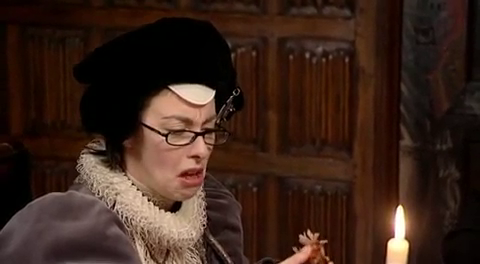
    The hosts eat the diet of a particular era, such as Roman or Edwardian, for a week. Like Morgan Spurlock’s Supersize Me, the two get checked out by a doctor before and after embarking on their new diet. (What should they expect from drinking all that booze during the Elizabethan era?) They dress in period costumes – Sue Perkins continues to wear her nerdy, black, hipster glasses even when wearing a toga – and sit down to eat a table set in period style. They eat off trenchers (a piece of bread) in a number of episodes because plates weren’t in use yet. The series is silly and fun and full of bite sized pieces of culinary history.

    Breakfast, Lunch and Dinner with Clarissa Dickson Wright is more substantial fare. This three part series is also available on YouTube. Each episode focuses on a different meal and she explores how trade and technology have influenced and changed what and how we ate each meal. As in The Supersizers, the show has little in the way of cooking demonstrations, but we do see what a meal would look like and she gives a more erudite discussion of the culture surrounding food. It defintely kept my interest.

    Food: A Cultural Culinary History is a banquet of information. It is available through the Great Courses channel on Amazon Prime (you can get a trial membership to binge this series). I had never watched a Great Courses series before and I’m not sure what I expected. Perhaps a Ken Burns style documentary with pictures and voice-over, or maybe something more like the History Channel with its badly acted re-enactments. Nope.

    It is just a chubby guy in a suit, standing there talking. And I was riveted. This a survey of the history of the world told through food and culture. It covers the impact of trade and technology on what and how we eat from pre-history to modern times. Ken Ablala is master lecturer. He does throw in the rare, amateur food demonstration; charoset, penitent’s salad, and sushi. If you watch no other series, watch this one.

    So, what did I learn? Well, two things I’d like to share. First, no matter what time period you consider, or what diet people followed, someone will passionately insist it’s wrong. And, not only is that diet physically unhealthy, it is morally unhealthy and anyone who eats that way is a bad person. (Shakes finger.) This, of course, creates an opportunity for the governing institutions of church and state to intervene. For example, during the middle ages, the Catholic Church designated nearly half the year as ‘fast days’ which meant eating fish. Even after England’s break with the church, the government (particularly the Elizabethan government) continued to require fast days – mostly to support the English naval fleet. By fishing, they retained their seaman skills and supported themselves, without the crown having to pay for a navy – thrifty. So, when someone tells you that people used to eat a lot more fish, just remember that it wasn’t necessarily by choice. The weird categorization of things as fish (beaver tails) demonstrates that people were not necessarily excited about eating fish, fish, and more fish.

    Second, I have long considered cooking to be a basic life skill. I confess to being a bit condescending to those who complain about having to cook. To me, its not that hard, and how else are you going to feed yourself? Do you expect someone else to cook for you? Well, actually, for much of history, yes. Most people didn’t cook. Cooking for one’s self or one’s own family is a relatively modern practice. And, as an economist, once the reasoning for why this was dawned on me as I was watching these shows, I felt pretty stupid.

    Abigail Adams by Gilbert Stuart
    Cooking utensils (especially metal utensils) and a hearth designed for cooking (or later a stove) were expensive. The Roman populace couldn’t afford to have their own ovens. They took their grain to the baker, who would mill the grain and bake the bread for them. During medieval times, if you worked for the king, or even a local lord, you didn’t cook. You ate in the hall and someone else cooked for you. Peasants working in the field would bring their grain and vegetables to the field with them and it would be cooked in a communal pot.

    In colonial America, Abigail Adams and her husband were wealthy people. She didn’t have her own bread oven. It was too expensive, and not just because of the capital investment, but because of the cost of fuel. Instead, she took her dough to the baker and rented time in his oven.

    During industrialization, dormitories with eating halls were common for workers. Well into the 1950s, unmarried working people who moved to the city for work lived in boarding houses that provided meals. Even today, we largely expect college students to live in a dormitory and eat in a cafeteria. Mostly due to the cost of renting and furnishing an apartment.

    Education should always change us and my foray into culinary history has made me even more willing to ignore the ever changing diet advice. It has also tempered my attitude toward those who don’t cook. In the big picture of history, not cooking isn’t that odd.

  • Forty Years Later – Chapter 4

    Catch up on the earlier Chapters: 1, 2, 3

    (click to enlarge images)

    Day 5

    The next morning I discovered the last indignity from the motel. There was no hot water. Not even a drop. I had to settle for washing my pits and crotch and using clean clothes to face decent society.

    Having seen the results of the dinner buffet, I wasn’t expecting much for the breakfast buffet and my pessimism was correct. Same bored guy behind the counter took my breakfast order. I took the opportunity to re-check the board for the cavern tours and was pleased to discover that I had mis-read it; the $50 tour was for another area and the standard tour was only $20, and I even got a discount for AAA when I bought the ticket. The cavern tour made up for all of the hassles that I had endured with the motel and restaurant. It was simply magnificent.

    I was almost solo with my attractive tour guide but at the last minute a family from somewhere in Eastern Europe joined us. I can usually pick out a language (even though I cannot speak it) from its sounds and a few vocabulary words that I can recognize. I never knew for sure but they sounded Slavic to me.

    Like Carlsbad Caverns the entrance to the cave was not the original entrance. An elevator took us down (and back up), followed by a walk of a mile or so. It is a “dry” cave (unlike Carlsbad) and therefore has a different sort of cave formations. The walk also took us by the old Civil Defense fallout shelter and a hotel room located 250 feet below the surface. Our guide said that she had spent her honeymoon there and the total darkness and total silence was actually too much to take! They had to turn on a nightlight in order to remain the night!

    I finished the tour around mid-morning and resumed my trip on US-66. Someone, I’m guessing the Tourist Bureau from the Seligman area, has sponsored a series of signs along the road, similar to the Burma Shave signs of the past. I thought that this was a clever way to promote the historic road. There is a lot of interest nowadays for the promotion of US-66 of bygone days, as my trip was discovering. I think that Americans are missing a lot of their heritage by blasting by on the limited-access Interstate Highway. A forgotten America still exists on the back roads that is not part of the Interstate Exit conglomeration of chain motels and fast food restaurants.

    At Seligman I climbed back on the freeway to deal with the truck traffic.

    I took the exit to drive through Ash Fork, as the road had diverted in the past. I had not remembered the Ash Fork was famous for its stone quarries, particularly shale and flagstone. Most of the houses in town were made of stone and many of them looked to be quite old.

    I wanted to see the statue that Winslow had erected of the guy “standing on a corner in Winslow Arizona” and missed it on the westbound trip so I exited the freeway and drove through the town in the other direction
    I recall hearing the refrain, “Spend the night in a wigwam!” ever since I was a child. One of the few remaining authentic Wigwam Motel ™ franchises was located in Holbrook Arizona and, since I was committed to doing the “tourist thing,” I reserved a wigwam. I am so glad that I did.

    The original design was from the 1930’s and the park in Holbrook is one of three remaining in the country. The layout is quite clever with a surprisingly large bedroom and a bathroom with shower at the rear. The park has numerous old cars parked at nearly every room, adding to the nostalgic flavor of the place.

    As I sat in the lengthening shadows of my last night on the road I used my cell phone to call my buddies who were gathered for our weekly poker game. A bit later I was finally got to visit with some neighbors who were having a little party in the parking lot. We chatted for a few minutes, then they moved on to a party downtown and I moved on to my bed in the wigwam.

    Day 6

    I had breakfast where the locals eat, Joe & Aggie’s Place. All that one could ask for, large helpings of terrific food and a bottomless pot of coffee.

    In the parking lot there was a family of foreign tourists apparently taken by my motorcycle. When I walked up in my leather chaps and vest they were enthralled. The husband asked if I would pose with their children and I suggested putting the son on my bike for the photo. It looked like the daughter wanted her picture taken, too, (and I would have been glad to oblige) but I think that the parents felt that they were putting me out by the photo op. Hell, I didn’t care, it was fun being thought of as “an American biker.” I got an extra internal kick from knowing that my Harley-riding friends would be in distress by the foreigners being impressed with a biker on a Japanese bike.

    After my encounter with Stogie I looked for other motorcyclists to ride with. On the way back I caught up with a fellow on a Honda 350. I held with him for a few miles, but he was traveling much slower than I wanted to so I said, “See ya” and went on. At Continental Divide I stopped at the Stuckeys for fuel and, upon leaving, encountered my friend on the Honda. We stopped for a few minutes to chat and then I went on.

    To avoid the truck traffic on I-40 and to bypass Albuquerque I planned my trip across the reservation from Gallup through Crownpoint to Cuba. Again, wonderful scenery on a two-lane blacktop with no traffic. The road meanders from small town to town as it winds toward Cuba.

    I was only a few miles away and had the lunch from El Bruno’s on my mind as I followed the Rio Puerco into town. Suddenly my reverie was interrupted by the impact of an insect on my exposed neck and the instant application of pain. I had run into the business end of a bee and the sting was rapidly swelling. I’m pretty sure that I’m not allergic to bee stings but I was still worried that the swelling might cause my windpipe to close. Fortunately the pain and swelling subsided in a bit and I was able to enjoy my lunch.

    After spending the night again with Bruce I headed east toward home. The trip back was uneventful until I arrived back on my home turf in Albuquerque. I hit the freeway at the peak of rush hour. I had heard horror stories about the horrible traffic jams in Los Angeles, yet the worst traffic that I encountered was right in my home town!

    I pulled into home right at dinner time. The family came out to greet me and hugs were liberally spread around. As I had been riding the hard saddle of the dirtbike almost non-stop my first words upon arrival were, “My butt hurts!”

    I was home.

    The last leg of the trip was in sight. A while back my uncle sent me a copy of a column from a motorcycle magazine where the author gave tips about road trips. One of the tips was a reminder that the last day of the trip is still part of the trip and one should not hurry the finish. A suggestion was to stop at the local bar on the way home and savor the trip just before it is over. I stopped at Los Ojos for a beer and found some folks to listen to my tales before heading up the hill for the last 20 miles.

    I was home.

  • Lozon, France: A WWII Diorama

    In the beginning, it was just a few figures to paint as the Crew of my B-25 Mitchell R/C plane, which is about 54” wingspan, so maybe 1/35 scale figures, so off I go to buy men, glue and paint. Some background: I have built models all my life, from shitty to glorious, and one of my customers is the owner of the hobby shop I have shopped at for 35 years, Pegasus Hobbies. So I knew where to go and what to buy, then I got home…

    I finished my guys and put them in my plane and brainstormed, “what if this plane did an emergency landing, and caught a Tiger on a field out of fuel, pinning it with its massive amount of .50 caliber guns? So I bought a 70$ Russian Tiger Tank model, I’m not cheap, and it was a sweet build, I ended up modding it several times as you will see.

    I needed landscaping and looked around and found some cheap shapes at the 99 cent store, and papier-mâché of course, but coverage? It was right then I knew I needed a plan, this was going to grow, I wasn’t sure just how big, yet. After a bit of research I found Woodland Scenics, which makes all kinds of very cool things such as bare trees, shrubbery, loose grass, dirt, sand, just an abundance of ideas, and with that in mind I decided what to do.

    The Bocage

    Actually means little boxes in French, however, from the wiki, in English bocage refers to a terrain of mixed woodland and pasture, with fields and winding country lanes sunken between narrow low ridges and banks surmounted by tall thick hedgerows that break the wind but also limit visibility. It is the sort of landscape found in England in Devon.

    “The 1934 Nouveau Petit Larousse defined bocage as ‘a bosquet, a little wood, an agreeably shady wood’ and a bosquet as a little wood, a clump of trees’. By 2006, the Petit Larousse definition had become ‘(Norman word) Region where the fields and meadows are enclosed by earth banks carrying hedges or rows of trees and where the habitation is generally dispersed in farms and hamlets.”

    In WWII, The Bocage would play havoc with the Allied Advance, so I went with Operation Cobra, and an Allied advanced scout finding a full blown German repair base.

    Caught unawares, they get shot up bad, and call for help, then it all unfolds…

    My son got involved when he saw the decals, especially for the men themselves, and he did some fantastic work under lamps and magnifiers. He had a go at painting, but he fucked up so badly, I made him do a complete repaint, which he did flawlessly…and said, never again. Now it was my job.

    The Bocage needed to be at least 15 feet scale in places, so I glued down some shapes and began gluing shrub pieces, it took an hour to finish an inch, granted, I added hidey holes and things, but it was 30 inches long. There was also the Bocage tunnels; they were fun because I needed to keep them open some just to see the guys running through them.

    Details: At this point, it’s midsummer, so when I come home from work, I just want to cool off, and paint…really what I began to do is run several jobs at once, spray big pieces, paint men, assemble, landscape, repeat, for 6 months. And the farther we got in the project, the more detail was necessary. I did 240 men total, and I spent 2 hours on each one, and I could have done better (and lost my mind).

    By this time we are done with this panel, 30”x 50”and stow it in the garage ’til next year.

    We spent a lot of time watching historical docs on YouTube, focusing on what they really looked like, camo, lifestyle, all that we could find. I scoured the Internet looking for new figures for the next phase, and bought just about every German and American 1/35 scale figures you can, then set up the next section.

    The Base: the following Spring, I started filling the section I had built over the winter, this needed a bit more thought being quite busy. So what does a Base need?

    (click to enlarge images)

    The Storyline: Nazi fanatic Commandant throws everything at the force attacking, simple, it’s a caught off guard scenario, kinda like reality. There are culverts, ditches, a prime mover, wounded men, a pig sty, and my son made sure that every piece was the right division for the time and area, including 240 helmet insignias! I painted my men in groups, and mixed up the uniform colors for each one, while staying accurate. I lost about 200 pictures when my W7 machine died, but there’s a lot of neat stuff to check out.

    I had a great time doing this project, it took 2 years and about 1400 hours between my son and me, and I think $1500 or so, but spread out.

    Armory: US
    M3 Lee
    M3 Stuart
    Sherman
    Jeep

    Armory: Germany
    3-Flak 36/37
    2-20mm AA guns
    3-75 mm guns
    Tiger1
    Panther
    Hetzer
    PZ4 H
    2- 75mm AT guns
    2- Hanomag troop carriers
    1- 8 ton truck to move this shit
    1- Rail mounted PZ 4 turret

    As I thought I was finishing, several knowledgeable friends asked, “where’s the radio room, how about a shitter?” It just happens that there is a radio room with operators you can buy, and I found the most realistic copies of maps, and shrunk them down.

    I wanted a nice, expropriated office for my Commandant, and I found some nice period pieces cast in resin, so I set him up. I found 1/35 scale Nazi propaganda posters on Ebay. Sweet! I built his entire room, fireplace, desk, library, map table (with accurate maps), and a fraulein, again, custom paint.

    Paint: For all projects I use Testors, and Testors Model Master, and Tamiya Acrylics

    Landscape: Woodland Scenics, hands down. Use a white glue/water mix, spray and spread.

    Brands: Start with Tamiya, best bang for the buck, because quality counts, Ukraine has Szvezda, but there are many others. YMMV.

    At the end, things were looking good enough to find an actual place in France, and I found it! My Name, Lozon, France, not 3 miles from my diorama! Maybe closer!
    I made sure to setup street markers, etc but not Lozon sadly. Still cool, it’s a real place.

    I ended up very happy with the results, and it kept me busy for 2 summers. I know it’s amateurish, but hey I’m an amateur!

    View more photos:

    Gallery 1

    Gallery 2

  • Forty Years Later – Chapter 3

    Catch up on the earlier Chapters: 1, 2

    Day 3

    Yesterday’s winds were gone, the air was clear and cool, and I was looking forward to a nice day of riding. Traffic was light and I could spend time looking for landmarks that I could remember. There were not many of them as the whole area has built up over the years.

    I was in awe as I followed I-10 to I-5. I had never seen such roads! At Claremont there was a triple flyover; four levels of road in one place! I had never seen such sights!

    I had also never seen grooved pavement and the wiggles gave me a bit of worry as I tried to get used to it.

    On the way to the exit that I needed I passed one for “Olive St.” Later that trip I would encounter the sign for “Roscoe St.,” exits with the names of my paternal grandparents.

    The low fuel light had come on sometime back and, as it didn’t look like I was going to make it to the Sunland Blvd exit, I pulled off the freeway and promptly got lost. I refueled and figured my way back to the freeway.

    In an apparent effort to discourage gasoline use, California has a new type of nozzle on gas pumps and they do not work well with motorcycles, shutting off too early and not allowing any further fill. The entire time I was in the state I was always about a gallon short of a full tank after gas stops.

    At last! Sunland Boulevard, and many memories of the area came rushing back, such the gas station on the corner at the exit. As I made my way up the road I could see many familiar sights. Often the only difference was that the area has grown up over the years. The Viennese-styled restaurant is still there and the Von’s supermarket is in the same place, even though it’s now called “Ralph’s”.

    The intersection at Mt. Gleason St. was unchanged, right down to the convenience store on the corner and the restaurant across the street. Hill was a couple of 4-way stops away and there I was at 7743. I’d made it.

    Lynn had given me directions to get there and I followed them right to the house. 7743, that was the address. I pulled into the driveway and shut off the engine. I’d made it.

    * * *

    I parked across the street from the former von Groff house and rested while I took some pictures and lit a mini-cigar in celebration. Sadly, no one was home and I had to be content with photos of the outside.

    When I knocked on the door Lynn’s mom, Mona, answered. “Lynn’s still is school,” she informed me, “She’s got one week left.”

    I was flabbergasted. In my worldview, school had already gotten out. All schools had already gotten out. I had not considered the possibility that hers had not.

    While Mona went back to her vacuuming, I tried to decide what to do.

    I was now officially halfway through my trip and had made my primary goal. I had a nice ride up Big Tujunga Canyon ahead of me but first I wanted to get some lunch. I had passed the Jack-In-The-Box where Lynn and I shared our first kiss so I decided to eat there.

    I didn’t know what to do. I had planned on spending only a few days with Lynn, then on to Frisco. I had arrived on Monday so I decided to spend the week there and play the trip back by ear. Again, I had planned to camp out, but the von Groffs graciously allowed me to sleep on their couch.

    While Lynn finished her semester I spent the next few days riding around the Los Angeles area, taking in the sights. One day I took the Universal Studios tour, another I worked with Lynn’s dad, Jim, at his mechanic’s shop.

    Afternoons and evenings there was Lynn, adorable, lovable, Lynn. One of the first days I helped her practice for her track meet on the upcoming Saturday. We’d ride the San Fernando Valley, stopping in at Jack or Shakey’s Pizza for something to eat, with kisses in the parking lot.

    That weekend the family attended the track meet where both of the daughters were participating. Here was taken the only photograph of the entire trip, with me, Lynn, Mona, and Lynn’s sister Cheryl. Lynn was quite the runner. While in high school she set the state record for the 440 yard run for high school girls.

    The von Groffs had a bathtub instead of a shower and I was so shy that I declined to bathe the entire time that I was there. I must have had some pretty good BO by the time the weekend rolled around!

    Saturday evening there came a phone call. Jim’s old friend, Al, was calling to see if there was an extra boy hanging around. Jim handed the phone to me and Dad explained that Mom was worried about me and, wasn’t it about time that I came home? I meekly protested that I hadn’t gone to Frisco yet but Dad convinced me to head back. I started back the next day, returning over the same route.

    The last time that I had ridden a motorcycle up Big Tujunga Canyon I managed to run out of gas and Mona had to rescue me. This time I fueled up before the ride but had a different worry. Severe forest fires had devastated the national forest the year before and many roads in the area were closed. Checking the web I could find no specifics and, starting up the canyon, I didn’t know if the road went through to Palmdale or not.

    Much of the ride was familiar as the road climbs from the canyon bottom. The road quickly climbs up the steep sides, several times crossing impressive bridges spanning deep ravines. Lots of curves and very light traffic enhanced the pleasure of the ride.

    Evidence of the fire was everywhere. I had recalled a pine/juniper forest but most of the landscape was barren, testimony of the intensity of the conflagration. To me, though, the scenery was reminiscent of the desert and held a stark beauty of its own.

    And the road was mine. I only saw a few cars on the entire trip. I felt a bit of sadness when the curves came to an end and I encountered the traffic of the Antelope Valley. After a bit of traffic I entered I-15 to Barstow and my hotel for the night.

    When traveling I like to eat well and avoid the “greasy spoon” type of places. Criss-crossing the west as I have over the years, I have started a running joke; someone will mention some out-of-the-way place and I’ll pipe up, “Dell, Montana? I know a good place to eat, there!” Well, Barstow has one of the best steakhouses in the west.

    I returned to the motel and once again sat outside sipping a drink and smoking a cigar. No one came by so I turned in for the evening.

    Day 4

    Another disappointing breakfast at the Days Inn, but I had read about a place in Amboy that was semi-famous so I figured I could grab an early lunch there. No such luck. The grille was shut down, as I guess it was past tourist season. I had my choice of candy bars and soda. I chose a bottle of water and went on my way.

    As I mentioned, I prefer to take loop trips, this year, however, I wanted to ride the original routes. I-40 ended at Newberry Springs in 1970 and picked back up at the mountain pass above Needles. After topping off fuel I exited the freeway onto Historic Route 66.

    Of the four trips that I made between New Mexico and California in 1972-73 only the last was over the newly-completed freeway from Barstow to Seligman. One was over the 89A/I-10 route and the other two were over old 66 in California and Arizona. The biggest frustration was the traffic behind trucks on the two-lane and traveling at night was iffy because of the lack of 24-hour gas stations at the time. When crossing the newly-completed I-40 in the early summer of 1973 the traffic was so light that I was able to stop on the middle of the road in the middle of the night to take a leak.

    Almost immediately I ran into trouble. The macadam of the road had deteriorated and was badly in need of repair. Many tire-sized cracks were in the road and I continuously had to watch for gaps that could break a sidewall or bend a rim. I decided that if the road was this bad past Ludlow then I would have to abandon this portion of the trip by necessity and return to the freeway. To my great relief, the road conditions improved greatly at Ludlow.

    In the ghost town of Bagdad I found another Whiting Brothers station surrounded by a fence and junkyard dogs. It was in pretty poor shape and the demise of Bagdad was one more example of a small town vanishing.

    Back in 1970 I had first noticed the displays beside the road. The white sand of the flat desert of the dry lakes along the road had messages laid out in the black volcanic rock from elsewhere. In later years I’d seen the same thing in the salt flats along US-50. Most were of the “John loves Mary” variety although there were a few political messages (“End war now”) and even an enigmatic “RP fuck it”. I thought of leaving my own statement but I didn’t collect any rocks from elsewhere and I didn’t want to disturb any of the other messages. Some were obviously old, some were shrines with cairns and crosses but most were made of local rock. Surprisingly many were obviously made of stones from elsewhere, brought a large distance to make a statement.

    It was on this stretch of road that I realized that I was in the perfection of enjoyment. I could see the road before me, going over the hill twenty miles hence. I was stopped in the middle of the highway and not a single soul was coming or going. “I like this,” I decided. I want to do more.

    The road connected back with Interstate 40 at the top of the hill above Needles. I was low on gas and had planned on fueling there but as I approached I decided that I could make Arizona handily and could avoid one final encounter with the worthless California gasoline nozzles.

    I had to backtrack slightly to get to the turnoff to old 66. The road from the freeway was a winding track, over hilltops and across arroyos towards Oatman.

    Another great ride! Turns and dips through the arroyos and no traffic! Oatman is known for the wild burros that inhabit the town and there were several burros (and considerable burro-droppings) in the center of town. I had looked forward to a cold beer in the local version of Los Ojos but the intense density of tourists dampened my thirst. I pushed on.

    Tight turns around ridges and ravines, with spectacular vistas all the way. When researching the road I learned that travelers in the 1930s would often hire a local to drive their car down the road, as the hard turns and drop-offs were too intimidating. Today, even on a motorcycle, one has to be totally aware of the road as the turns are frequent and the drop-offs are steep.

    Too soon I reached the end of the mountains and crossed the valley towards Kingman. Taking the back way into Kingman I was reminded that I-40 bypassed one of the prettiest little canyons in the area. Old 66 wound through the valley next to the train tracks and into the original downtown. A few of the buildings looked familiar as I turned onto Andy Devine Blvd, following the original route.

    The traffic was light heading up the valley and I could take time to enjoy the view. The area was growing and it was easy to see why; clean air, mild climate and glorious vistas.

    Every time that I had driven the US-66 loop I passed by the Grand Canyon Caverns and each time I told myself, “I’m going to stop one of these days.” Well, this trip was the excuse that I needed and I booked a night at the local motel. The ads on the Internet looked promising, the motel featuring a bar and cable TV, and the local restaurant advertised buffets for dinner and breakfast along with a full menu to choose from.

    I pulled into the motel parking lot under a banner that proclaimed “Bar Open.” At the front desk I told the girl, “You’ve got my two favorite words on your sign outside!” She looked uncomfortable and replied, “Well, the bar is only open on Fridays and Saturdays.” Disappointing, but she did have some package beers available so I could wash the down the dirt from the road.

    Got into the room and discovered surprise #2. Not only did they not have cable TV, the local channels were barely viewable. Not a big problem, I had plenty of music on my computer to listen to for the evening’s entertainment.

    By now it was dinnertime and I was ready for some good grub. The restaurant was at the top of the entrance to the caverns a mile or so from the motel. On the road there were signs proclaiming, “Steaks!” I was looking forward to a large piece of dead animal flesh.

    I knew that things were not as I had been led to believe when I entered the dining room and saw their advertised buffet totally empty. In fact, the whole place was mostly empty except for the bored guy behind the counter.

    “What’ll ya have?”
    “A steak and a beer?”
    “Well, the only steak that we’ve got is a chicken-fried steak.”
    “I’ll take a burger. You got the beer, right?”
    “Yeah, that we’ve got.”

    While waiting for dinner I looked over the place and saw the board with the prices for the cavern tour. The number that I saw was $49.95. Fifty bucks for an hour’s walk? I reconsidered my plans as I munched my dinner.

    Again I sat outside of my room smoking a little cigar, waiting to visit with my neighbors. As this was off-season, I had no neighbors and I went inside to bed.

  • 98 Mauser Sporting Rifles

    Mauser-Werke, Oberdorf, Germany

    The 98 Mauser Sporting Rifle

    The fame of the 98 Mauser action comes not only from its utility in military applications – where in its many incarnations it is without peer among military bolt guns – but also in its ability to cross over into being a basis for a fine custom sporting rifle.  Some of the greatest works of art in steel and wood to come out of the shops of fine rifle artisans are based on Mauser actions, with the 98 being the frontrunner.

    There are, however, a number of cautions and important considerations to take into account when gunsmithing the Mauser action.

    Pre-98 actions.

    M94 Swede sporter

    One of the most important safety notes involves the pre-98 actions.  Since this is a forum primarily for the 98, the pre-98s are somewhat off-topic, but the following safety tip is crucial:  Pre-98 actions, including the 91 Argentine, 93-95 Spanish, and 94-96 Swede actions, lack sufficient strength to be rebarreled for most modern sporting calibers.  These actions should only be rebarreled for cartridges developing a chamber pressure of 40.000 psi or less.  The difference between these actions and the 98 series is not metallurgical so much as structural – an excellent illustration and text can be found in Kuhnhausen’s Shop Manual for the Mauser[i].  It is best to stick with the cartridges for which these arms were originally chambered.

    98 Action Types

    The 98 actions, in all their variations, are a somewhat different and more complicated story.

    There are several different variations of the basic Model 98 action design; these can be loosely lumped into three categories.  These are the large ring standard 98, which the GEW98 and k98k actions are included in; the small ring 98 actions, to include the German 98az, G33/40, and the M1910 Mexican rifles; and the large ring “intermediate” actions, typified by the Yugo vz24.  Of course, thousands of minor variations exist, and addressing all those variations would be impossible in the space allowable here, so let’s stick to the standard large ring 98s, including the WWII German 98k actions.  For a complete description of every make, model and variation, I recommend picking up a copy of Ludwig Olson’s “Mauser Bolt Rifles,” pretty much the Bible for Mauser fans.

    The Bible for Mauser nuts.

    The 98k is, as mentioned previously, a standard large ring 98 action, (although some 98k pattern rifles were converted from small ring 98az carbines[ii]) and as such is one of the more versatile for customization.  Other common examples of the standard large ring 98 include the WWI GEW98, the 1908 Brazilian contract, built by Deutsche Waffen und Munitionsfabriken (DWM); the 1909 Argentine, also built by DWM; and the M1912 Mexican, built by Waffenfabrik Steyr.

    Metallurgy

    The military 98 Mauser actions differ quite a bit, metallurgically, from modern sporting rifle actions.

    To clarify a couple of terms; there are basically two manners in which a rifle receiver can fail.  The first is a “yield failure,” where the receiver ring may be deformed or “ballooned;” this type of failure frequently results in escaped gas and bits of cartridge case.

    The second type of action failure is an “ultimate failure” sometimes referred to as a “catastrophic failure.” This is where the action basically explodes, and results in chunks of receiver flying all over the place, to include imbedding themselves in the shooter’s face and other vital regions.

    Modern sporting actions (to include the newer FN and Zastava Mausers) are made from hard, high-carbon steel, and are homogenous throughout.  Older military Mausers are made from softer, low-carbon steel that is heat treated or “case hardened” resulting in a fairly soft receiver with a hard shell or “case.”

    The result of this type of construction is a receiver with lower yield strength than a modern gun, but a higher ultimate strength.

    What makes the large ring 98 action capable of handling higher pressures than the pre-98s is the design of the receiver ring.  The large ring 98 receiver ring measures 1.41” in diameter as opposed to the pre-98s 1.3”; also, the 98 action has a longer thread-bearing surface, improved torque bearing surfaces, and a large reinforcing web inside the receiver ring.

    It is generally considered that the standard large ring 98 action is capable of handling most modern standard-length sporting cartridges.[iii]

    Gunsmithing the 98 Mauser

    Now I’ll admit that I’ve never based a custom sporter on a WWII 98k action – because I’ve never found an “action grade” gun or disembodied 98k action in a condition suitable for “sporterizing.”  I have, however, used a variety of Mauser actions in building custom rifles, including a number of standard large ring 98s.

    It is somewhat sacrilegious to cut up an original collectible military rifle for customizing, and I’ve had a few originals in the rack at various times myself.  So, I try to buy disembodied actions where I can.  I will also scour gun shows, pawnshops, and estate sales for “action grade” guns – rifles that have already been modified to some extent, making them fair game for gunsmithing.

    From Olson – a disassembled 98 Mauser bolt

    To convert the military 98 action to “sporter” configuration involves four basic steps: 1) reforging or replacing the military bolt handle with one that will clear a low mounted scope; 2) install a low-swing or side-swing safety, again to clear the scope; 3) drill and tap for the scope mounts themselves; and 4) restocking.  Many excellent Mauser sporters have been turned out with the original barrel but given the condition of many surplus guns currently finding their way into the States, rebarreling sometimes becomes a necessity.

    With a bit of luck, you can find a Mauser action or barreled action with the gunsmithing work already done.

    A good example would be a rifle I built for my own use elk hunting.  I’ve described Thunder Speaker here before; it is a 1908 Brazilian contract action, built by DWM, chambered for the .338 Winchester Magnum.  My original intent was to use one of the large ring ’98 actions I had in the shop, fit a new barrel, stock, bolt handle, etc., which would have entailed no small expense.  The expense of this sort of work can easily outrun the cost of a brand-spanking-new Remington 700 or Winchester 70.

    In my case, fate chose to intervene at the August 1996 Tanner Gun Show in Denver, back when once could still make good deals in Colorado gun shows.

    While sitting at my table, trying in vain to part with a few of my surplus stuff, a gentleman walked by with a rifle slung over his shoulder, the sign on it reading: “Mauser rifle, .338 Win Mag.”

    Like a trout faced with a well-placed dry fly, I rose to the bait.

    The rifle was the aforementioned 1908 Brazilian (large ring 98) action, with a teardrop bolt handle, Buehler safety and Weaver bases. The 26″ Douglas heavy sporter contour barrel was Mag-Na-Ported, a plus when you are talking about .338 Mag recoil levels.

    Since the barreled action was already in good shape, I made few changes – I just replaced the military two-stage trigger with a Bold modular, added a Bell & Carlson Kevlar stock and a Simmons Aetec 2.5-10X scope on Redfield bases and rings, which I prefer to the Weaver design on rifles with stout recoil.  I loaded up some ammo with W-W brass and 225-grain Barnes X boattails.

    The first trip to the range was enlightening.  Between the Mag-Na-Porting, and the straight-line design of the Bell & Carlson stock, the .338 didn’t seem to have any more perceived recoil than a lightweight .308.  Very pleasant to shoot; I ran through all 20 rounds I had loaded before I realized it.  Even more pleasant were the results on the other end of the lane; groups averaged about 1 1/4″, with the largest going just over 2″.  The Simmons Aetec scope proved superb, very bright and clear.

    From Olson – An FN 98 Mauser action

    Cost vs. Benefit

    When the project was completed, I had a high quality .338 Win Mag sporter with a total investment of about $500 – pretty much what I’d have paid for a new commercial gun in 1996, without the scope, dies or accessories.

    Thunder Speaker is a pretty good example of the kind of “custom” work that any reasonably capable gun crank can do by him or herself – no rebarreling or action modification involved, as that work was already done.  These kinds of project guns are readily available, often at bargain prices.  I’ve since spent a little bit more to have a Winchester-style side-swing safety mounted, as the Buehler was too close to the scope objective when set to Safe.

    Cost isn’t all that the true gun crank considers, however, and the chance to take game or gather ooh’s and aah’s at the range with a unique sporting arm of one’s own making, will often outweigh mere financial concerns.  I know it does for me.

    Inspecting the 98 action

    When considering an action for extensive gunsmithing, the prospective custom Waffenmeister should inspect the following areas closely:

    • The bolt face should be clean and free of pitting and erosion.
    • The extractor should fit tightly and function correctly with a dummy cartridge of the appropriate caliber.
    • The locking lugs should be clean, rust-free, and show minimal wear.
    • Cocking piece/sear engagement should function smoothly and flawlessly – ditto for the safety.
    • Ejector box should have good spring tension and function freely.
    • If the original barrel is to be used, the bore should be clean and free of rust and pitting.
    • Visually inspect the entire action for rust and/or pitting. I’ve seen a few actions for sale that were pitted badly enough to be potentially dangerous.
    • If the action has been drilled and tapped for scope mounts, ensure the screw holes are not in the area of the barrel threads or reinforcing web.

    The action should also pass the following standard function check.

    • Close the bolt and apply the safety.
    • Pull the trigger. Nothing should happen.
    • Without operating the bolt, turn safety to “fire.” The sear should remain engaged.  If the striker falls when the safety is disengaged, you have a serious safety problem.
    • If the sear remained properly engaged in Step 3, pull the trigger. The striker should fall normally.  The trigger pull should not be gritty or stiff.

    If the action passes all of these tests, it should be a good candidate for your custom project.

    Gunsmithing Do’s and Don’ts.

    Do’s:

    • Have your action or barreled action inspected by a professional gunsmith prior to any customizing. If you are using the barrel already on the gun, the inspection should include headspacing.
    • When rebarreling, invest in a quality barrel. The barrel is the heart of a rifle, and a quality tube from Douglas, Shilen or ER Shaw will be worth the extra bucks.
    • True action and bolt faces and lap locking lugs. This process evens bearing surfaces and improves inherent accuracy.
    • Use an aftermarket modular trigger if desired. I’ve had excellent results from Timney, Bold and Dayton Traister triggers.  Keplinger makes a very good single-set trigger for the 98 Mauser, which does require professional installation.

    Don’t:

    • Open the feed ramp to allow feeding of .300/.375 H&H, or full-length magnum cartridges. This removes metal from the area immediately behind the lower locking lug – not a good practice.[iv]
    • Trust chamber stamps on used guns. A Cerrosafe chamber mold should be done on any and all used guns.
    • Fire any rifle with an improperly functioning safety mechanism.
    • Fire any 7.9x57mm Mauser manufactured prior to 1905 without first miking the barrel. A few J-bore (.311) guns are still extant – and may generate dangerous pressures if fired with S-bore (.323) cartridges.

    And finally – please – don’t cut up or modify an original collectible!  There are ample action grade guns around, and also ample collectors who will be willing to take your original off your hands.

    The 21st Century Mauser

    It’s often said “the more things change, the more they stay the same,” and this certainly applies to rifle design – given Winchester’s and other gunmakers run back to the original controlled feed design of the 98 Mauser.  Paul Mauser’s M98 has set the standard by which all other bolt action rifles are measured for 120 years now.  I’m confident that it will continue to be the gold standard of bolt guns well into this century.

    [i] “The Mauser M91 Through M98 Bolt Actions – A Shop Manual.”  Kuhnhausen, Jerry, 1991, VSP Publishers, pg. 160

    [ii] “Mauser Bolt Rifles”  Olson, Ludwig, 1976, F. Brownell & Son, pg. 118

    [iii] Kuhnhausen, pg. 86

    [iv] Ibid., pg. 86.