Category: Games

  • Nephilium’s Games Corner

    This week is going to be a little bit different.  I’ve been trying to stick with games that are easily available, and for a reasonable price.  This week, I’m going to mention three games that have had availability issues for a while.  All of them are excellent games, and well worth trying.


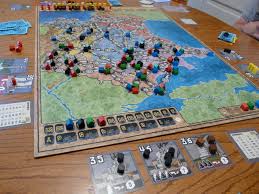
    Game 1) Colonizing the Empire (or Britannia, or Hispania, or …) – Concordia (2-5 players)

    This is a great game that is unfortunately almost always underprinted.  There was a recent print run in order to support the expansion being reprinted, but it appears to be out of stock at Amazon.  Your local store may have a copy, or you can play this online at BoiteAJeux.net.  Every player starts with an identical hand of cards, two colonists in the starting city, some cash, and some resources.  Each card in the game also has a god’s name on it, which will be used at end game scoring.  The scoring options are:


    1. Vesta – 1 point for every 10 money you have at the end of the game.  Every player gets one of these, and there are no more available for purchase through the game.
    2. Jupiter – Each house you have in a non-brick city is worth 1 point.
    3. Saturnus – Each province you have a house in is worth 1 point.
    4. Mercurius – For each of the 5 different goods you can produce, you earn 2 points.
    5. Mars – For each colonist you have on the board (you start with 6), you earn 2 points.
    6. Minerva – There are 5 different cards here, each for a different kind of good.  They grant you points for being in the cities that produce the goods, ranging between 3-5 points a city.


    The rules for this game are very, very simple.  On your turn, you play a card, and do what it says.  This can have you produce goods, earn money, move colonists (and build houses), place colonists on the board, trade goods, or buy new cards.  Any of the new cards you buy will have a god on them (and the distribution is printed on the board), which will also score you points at the end of the game.  So players are given an incentive to focus on specific gods and scoring methods to get the best score at the end of the game.  The end game is triggered once a player either places his last house or the last card is purchased.  The player who triggered the end game gets a card worth a bonus 7 points, and everyone else gets one final turn.  The only randomness in the game is the order in which cards come out (they are sorted into stacks that are in numeric order based on the number of players), and what cities produce what goods (each is assigned a letter so there’s a set of A cities, B cities, etc.).This game is a mid-weight game that has very little direct player interaction, but lots of indirect player interaction.


    Game 2) Exploitation in the age of sails – Endeavor (3-5 players)

    This game has been out of print for a while, with a reprint on Kickstarter now (my only connection here is as a backer).  The game takes place over seven turns with the following phases:


    1. Build Phase – Players can build a new building
    2. Growth Phase – Players gain Population Markers (workers)
    3. Salary Phase – Workers you pay can be used again (which frees up buildings to be used again)
    4. Action Phase – Players take actions to earn resources, occupy cities, attack other players, draw cards, work towards opening up new area, or pay workers to use them again


    Each player has a board which tracks their statuses in four different tracks: the Industry track, which indicates what level of buildings the player can build; the Culture track, which indicates how many workers they gain each turn; the Finance track, which indicates how many payment actions you can take; and the Politics track, which determines how many cards you may hold after passing.  The player boards can be audited any time by checking icons on buildings cards, and claimed tokens.  


    Each region has a network of cities with tokens on them.  As you take actions, you can occupy these cities and claim the tokens on them.  These will be worth points at the end of the game, as will certain connections between the cities (indicated on the board clearly), and also with their own token you can claim if you control both endpoints.  As you ship, you open up new territories and can claim governor cards (which also grant points on the different tracks).  As the new territories are opened up, players can then expand into them as well.  There are also slavery cards, which can grant large bonuses, but will cause problems if abolition happens in the course of the game.  


    As the board fills up, eventually players will need to use cannons to remove pieces from cities, so that you can move in.  The reprint is coming with a double sided board for different player counts.  This will help keep the board tight, and decisions difficult in lower player count games.


    At the end of the seven turns, the players add up their scores (from cards, cities, connecting paths, buildings, and your level on the various tracks).


    Game 3) Area control while avoiding the king – El Grande

    This is an area control game that relies heavily on bluffing and reading the other players.  The base game has been out of print for a while, and it is currently available only in a Big Box format (with a lot of unnecessary expansions).  One of the interesting aspects of this game is managing your pieces (called Caballeros throughout the rules, they’re blocks or meeples depending on the version of the game).  You start with only so many pieces that you have available, and must move them from an inactive supply (called the Province) and an active supply (called the Court).


    The base game plays over 9 rounds, during which the following phases happen:


    1. Reveal Action cards – There are four stacks of cards, and the top card on each stack is revealed.  These (as well as the King’s Card) are the available actions for the round.
    2. Play Power Cards – The starting player plays a power card from their hand faceup in front of them.  Then in clockwise order, each player does the same.  However, no player can play a card that matches the value of a card that was played before them in the round.  The power cards determine turn order, as well as how many pieces you get to move into your useable area.
    3. Take your turn – Each player takes a turn, which has the following phases:
      1. Move pieces into the active supply.
      2. Select an action card – Each action card has a special action, as well as a listing of how many pieces you may move from your active supply to the board.
    4. End of Round – As Action cards are used, they are placed at the bottom of the deck.  The player who played the lowest action card takes the first player marker, and the round marker is moved down 1 space.
    5. Scoring Round – This happens after the 3rd, 6th, and 9th round of the game.  I’ll detail the specifics below for this.


    Now, the board is split up into regions, each region has an indicator on it as to how many points can be earned in each region.  They can indicate a first, second, and third place for each region.  In the case of a tie, tied players get the next lowest position (so if you have two players tied for first place, they both get second place points).  There will also be a region on the board that has the king in it.  If you control the region with the king (ties are not allowed here), you earn 2 additional points; however, the king’s region is also not allowed to be the target of any action cards or piece assignments.  There is one other special region on the board called the Castillo.  It’s a small cardboard castle that you may assign pieces to during your turn.  The rules state you must clearly announce how many pieces you’re assigning to it, and other players are supposed to keep track (some players prefer to play this as open information, but that’s another column).  There is also a special piece that starts on the board for each player referred to as their Grande (it’s a larger piece).  The Grande is the home region for each player, and works to provide 2 additional points if a player controls their home region (no ties).


    Everyone still with me here?  I know the game sounds complicated, with lots of moving parts.  It really is an elegant design, and quite simple to follow the rules after a couple of rounds.  The key points so far is that you want the most pieces in high scoring regions, with your Grande, and with the king.  Now onto the scoring round, this happens through several phases:


    1. Chose a secret region – Each player has a dial that allows them to select a region secretly.  Each player does this, and it will come into play in the third phase here.
    2. Score the Castillo – This is the first region scored, as the pieces in the Castillo get revealed here
    3. Move the pieces from the Castillo – Remember that secret region?  Now you move all of your pieces you had in the Castillo to the region you selected (unless you chose the region the king is in – that region can’t be targeted by anything)
    4. Score the Regions – The board has a helpful guide to walk you through each region to make sure you don’t miss any
    5. Bonuses – Assign the bonus points for the king’s region and the home regions.


    At the end of the game, the player with the most points wins.


    I’ll be out of pocket for a bit at a convention in Southern Ohio.  I’m hoping to be able to get a write up of the convention to show you that while it may be just geeks playing these games, there’s a lot of us.


  • Nephilium’s Games Corner

    Last time here, I talked about some heavier games.  Time to switch it back up and go with some luck heavy games.  Luck heavy games generally involve either dice or decks of cards and tend towards the lighter side.  The more luck involved in a game, the more likely a less skilled player in the game will win.  All of these games feature heavy luck elements, and we’ll be going from lighter to heavier as the games go on.


    Game 1) We’ve got goblins and swords – Welcome to the Dungeon / Welcome Back to the Dungeon (2-4 players)

    NOT a song by Guns n’ Roses

    These are two games that are essentially the same game with a some minor tweaks.  So if you have to pick one, pick the one that has heroes that sound more interesting to you.  This game features a strong element of push your luck, and playing the other players.  This game does feature player elimination, but it plays quickly (15-20 minutes a game) so no one has to sit too long.  Each round a hero is selected, and all of his (or her) gear is set out.  Each hero has different gear that gives different abilities (as an example, the warrior gets a torch that kills monsters that have odd values, while the thief has an item to avoid any one creature).  There is then a deck of monster cards that are shuffled.  Taking turns, players may either pass, or draw a card.  If they draw a card they look at it, and either put it into the dungeon, or remove it from the dungeon and take a piece of gear away from the hero.  If you pass, you are out of the round.  Once only one player hasn’t passed, the final player runs the hero through the dungeon of monsters.  If they survive, they claim a treasure card.  If they fail, the first time they take damage, the second time they are dead and eliminated from the game.  The game ends when either one player has claimed two treasures, or only one player has survived.  This is a light filler game, with nice chunky cardboard pieces for the hero equipment, and is well suited to playing with younger gamers.


    Game 2) Gambling without the risk – Las Vegas (3-6 players)

    VIVA?

    Las Vegas… you’re probably expecting mobs, and guns, and neon, but instead you get a bunch of dice, some casino boards, and cards with various amounts of money listed on them.  Each player starts with eight 6 sided dice in their supply, and if you are playing with less than 6 players (which I would recommend) a set number of white dice that represent the house.  The setup is easy, set out the six casino boards (each labeled with a die value of 1 to 6) in order, shuffle the money cards and start dealing them to each casino, stopping when they have a value of at least $50,000 on them.  On each player’s turn, they roll all of their dice, sort them based on the displayed value, then select one set of dice to place on a casino tile.  So if your first roll is three 1’s, two 2’s, one 3, one 4, and one 6.  You can select the 1’s, and you place the three dice on the casino board with the 1 value listed on it.  The round ends when all players have placed all of their dice.  Then the winnings are awarded, and whoever has the most dice on a casino gets the highest value card, second most the second most valuable card (if there is one), and so on.  The trick comes when you get to ties.  If more than a single player have the same amount of dice on a casino board, those dice are removed from the board.  So if Abby, Brandon, and Carol are playing, and Abby and Brandon have 4 dice on a board, while Carol has 1.  Carol wins the valuable card from that board, and Abby and Brandon walk away empty handed.  If you’re playing with less than six players, then those white dice represent the house, and are placed with your dice following the same rules.  The game goes for four rounds (or more or less as long as you agree to it before hand), with the start player moving between rounds, with the winner being the player with the most cash at the end.


    Game 3) Sneaking into a dragon’s lair – Clank (2-4 players)

    Recipient of the Swiss Servator Big Thumbs Up!

    Clank is a relatively new game, and is a twist on the traditional deck-builder games.  In this game, each player represents an adventurer trying to sneak into a dragon’s lair, grab an artifact and get out of dodge before the dragon kills them.  This is done by building a personal deck of cards (all players start with the same personal deck) by purchasing new cards from a communal display.  These purchased cards either have an immediate effect, or they are placed into your discard pile and you hope to see them again soon.  Cards can provide some or all of the following:


    • Movement – Allows you to move your meeple on the board
    • Skill – Allows you to purchase new cards
    • Coins – Victory points at the end of the game, and can be used to purchase some items
    • Swords – Combat strength to kill monsters, and move through dangerous passages
    • Clank – Being noisy in the dungeon, attracting the attention of the dragon
    • Other special abilities (healing, ability to purchase items, draw cards, etc).


    As each player accumulates Clank, they put a colored cube into a region of the board.  As players purchase cards from the communal display, new cards come out, and some of these cards trigger the dragon to attack.  Any time the dragon attacks, all of the Clank cubes on the board go into a bag (which also contains a number of neutral black cubes) the bag is shaken up, and a number of cubes is drawn from the bag.  If a cube of your color comes out, you’ve taken damage and must move a tracking cube down one space on your health tracker.  If a neutral cube comes out, no one is injured this time, but there are now less neutral cubes in the bag.  The end game is triggered by either a person dying, or by the first player who grabs an artifact and escapes the dungeon (all players who successfully escape get a token worth 20 points).  Once the end game is triggered, all of the remaining players have four turns to get their artifacts and escape, with the dragon attacking more ferociously every turn.  If you run out of turns and are in the bottom half of the dungeon after your last turn, you have been buried in the collapsing dungeon.  If you’ve at least made it to the top half alive, then the villagers dig you out, and you score your deck.  At the end of the game, all of the players add up their victory points from cards, tokens, artifacts, coins, and crowns.  The winner is the player with the most points.


    If the dungeon raiding aspect doesn’t appeal to you, there is also a rethemed version called Clank! In! Space! (don’t blame me for the name…) which is set in space.

    …Okay.

    Here’s hoping one of these press your luck games is up your alley, and we’ll be back soon with some games that are a bit harder to acquire (but can still be found without breaking the bank)..

  • Nephilium’s Games Corner – Heavy Edition

    I’ve discussed game weight before, and today I’m going to the heavy end of the spectrum.  If you’re just starting out, these may not be the games for you.  These are three games that are all wildly different, but will help to burn your brain a bit.

    Heavy GAMES, not Heavy D!

    Game 1) Auctioning and Actioning and Activating, Oh My – Keyflower (2-6 players)

    On paper, Keyflower sounds like a short game, it’s only played over four rounds.  However, each round will take some time, and if you have someone prone to AP (Analysis Paralysis – being unable/unwilling to commit to a decision until they analyze all the options) this is probably not the game for them.  All of the players start the game with a hut, a village tile, 8 random meeples, and 3 winter tiles.  The village tiles determine player order for the start of the game, the hut is to hide your meeples, and we’ll get back to the winter tiles later.  The meeples are your currency in the game, they start in three colors (red, blue, and yellow), with green being available through tiles.  Each round is named after a season, so we start in Spring.  To set up the round, we pull meeples from a bag and put them on boats, we draw skill tiles to put on the boats, we place turn order tiles, and then we place a number of spring tiles (determined by the number of players) between all of the players.  On a player’s turn, they can either bid on a tile by placing meeples on their edge, activate a tile by placing meeples on the tile, or pass.  The round ends when all players pass in a row, and unlike most games, you can pass, and then take an action later in the round. Where things get complicated is that once a color of meeple has been used on a tile, all further bids and activations of that tile must use the same color.  If you’re activating a tile, you must put at least one more meeple on it then the previous activation (so if the first activation was a single meeple, the second activation would require at least two meeples), and a tile can never have more than six meeples on it.  If you have been outbid on a tile, you can move the group of meeples you bid with to shore up another bid, or to activate a tile; but you cannot take them back into your hut, and they must all be moved as a group.  Once a round ends, the winner of the best turn order tile selects a boat, and takes any meeples and skill tiles on it, this continues until all of the players have selected a boat.  Then people take any tile that they won the bid on, and place it in their village.  They also add any meeples that were on the tiles they won to their hut, while all of the bids (winning and losing) go into the bag for randomization.  At that point, boat distributions may change, and a random selection of the next season’s tiles come out.  In these later rounds, you are able to use tiles in other player’s villages by placing meeples on them (of course the person who owns the tile will get the meeples, but it can be worth it).  Tiles can also be upgraded with certain actions, which will improve the tile, and usually be worth endgame points.  The only season where the tiles coming out for the auction isn’t random is winter.  Each player must select at least one of their winter tiles (told you we’d get back to them) to put into the center for auctions.  Winter tiles will award endgame points based on different criteria, which can help to guide your strategy through the game.  The full game will take between 90-120 minutes.


    Game 2) Blame the Game, not the player – Ponzi Scheme (3-5 players)

    Ok, I couldn’t stay away from offering up a good game for relatively new players.  This is more of a midweight game, but the interaction is where it gets dense.  If you don’t know what a Ponzi scheme is, get thee to a wiki.  For the rest of you, in this game the players are all running their own Ponzi schemes.  To play, each player starts with a shield, a countdown rondel, a reference card, and a pen card (to keep track that everyone’s been moving their countdown rondel correctly).  A play board with three rows is set in the center, and the initial funding cards are organized by their payouts.  The remaining funding cards are shuffled and placed next to the board.  The game is then played in phases, starting with the funding phase.  In the funding phase, starting with the first player, players can take a funding card.  The funding cards have a dollar amount on them, a payout amount, and a payout time (for the math challenged, they also calculate the interest rate of the payments).  What row you select from is dependant on how many industry tiles you have.  Each time you take a funding card, you must take an industry tile at the same time.  If you have no industry tiles in that same color, you pick from the first row, if you have one industry tile in the same color, the second row, and if you have two industry tiles in the same color, the third row.  The industry tiles will be worth points, and limit trading in later phases.  Whenever a funding card is removed from the board, a new one is drawn and the cards are reordered based on their payout values.  After the funding phase, we move on to the clandestine trading phase (this is skipped in the first round of the game).  Starting with the first player, each player gets to put some of their money (hidden behind their player shield) into a fancy leather wallet.  Then they hand that wallet to a player with a matching industry tile, and name the industry they want to purchase.  The player who receives the wallet has two options: keep the money in the wallet, and hand over the industry tile; or they double the money in the wallet and hand it back to the initiator and purchase one of their industry tiles.  The wallet gets passed on to the next player in player order and this repeats until everyone has made an offer or passed.  The third phase is to pass the first player marker (a cardboard pen), and the player who is receiving the pen selects a funding card to remove from the player board.  After that the fourth phase is to check if there’s a bear market.  A bear market happens when the number of funding cards with a bear in the background is equal to or greater than the number of players.  If there’s not a bear market, then every player rotates their countdown rondel one tick and must payback any loans that have the red arrow pointing at them.  If there’s a bear market, each player must discard one industry tile from the industry they have the most tiles in (if the player has a tie between two industries they pick), then the rondel moves two places, and any that the red arrow moves through or end on must be paid.  After the loans are paid, the loan cards get placed back at their payout number on the rondel.  You didn’t think you ever paid these loans back, did you?  The game ends when any player is unable to make all of the loan payments that are required of them, this can happen to more than one person at the same time.  All players who went bankrupt lose, and do not score points.  The other players score points for their industry tiles.  The industry tiles are scored where the first one in any industry is worth 1 point, the second is worth 2 points, the third, 3 points, etc.  Money is worth nothing at the end of the game.  So if a player had 3 green tiles, 4 red tiles, and 2 blue tiles, their final score would be: (1+2+3) + (1+2+3+4) + (1+2) = 19 points.  This game will go between 45 – 90 minutes.


    Game 3) If you can’t handle the heat, get out of the field – Scoville (2-6 players)

    IT BURNS!

    Scoville is a game that looks like it should be friendly, you’re trying to plant hot peppers, cross breed them, harvest them, and either sell them for cash or completing chili recipes for points.  There are two time periods of the game, the morning and the afternoon.  The time period dictates which Auction card deck you user, as well as which market tiles are available for purchase.  The game is played in turns, which have the following phases:


    1. Auction – All players secretly bid coins to select their place in turn order.  If you don’t spend at least 1 coin, you just maintain the same relative turn order.  After the turn orders are set, in the new turn order, players select Auction cards, which provide pepper(s).
    2. Planting – In turn order players each must plant one pepper into the communal field.  The pepper must be adjacent to a pepper already in the field (two are seeded in the field during the setup).  If you plant a non-basic pepper, and there’s a score tile available, you may claim it.
    3. Harvesting – In reverse turn order, players move their farmer through the field, moving up to 3 steps.  They cannot pass through other farmers, and must move forward or turn in 90 degree angles.  For every pair of peppers they pass between, they harvest new peppers based on the cross breeding chart (as an example a red pepper + a blue pepper = a Purple pepper; there are 4 tiers of peppers in the game).
    4. Fulfillment – In turn order players may each claim a market tile with peppers, complete a chili recipe, or sell a batch of peppers to the bank.  Each player can only do each item once, but they can do all three.  
    5. Time Check – Depending how many recipe cards, and/or market tiles are available, the game can move to afternoon or to a final round.  


    Each player keeps their peppers, money, and claimed tiles/cards behind a player screen.  So it becomes important to keep in mind how much money players have, as well as what peppers they may have.  Each player also starts with three bonus action tiles that allow them to either break a movement rule or plant an extra pepper during their turn.  These tiles are worth 4 points at the end of the game if you haven’t used them.  The real meat is in planting peppers to make your movements more valuable, while causing other people to have movements that don’t provide them what they need.  During the fulfillment phase, players who claim a market tile will get cash or more peppers, while recipes are worth only points.  The game scales quite well, with a different number of cards and tiles coming out dependant on player counts (and all of the amounts printed on the board for easy reference).  Adding players does add play time, so I would recommend sticking with 3-4 for your first play.  At the end game, players score up their points, with peppers being worth nothing at the end of the game.  The highest score wins.

    I hope that some of you that have been reading along are willing to make an attempt at some of these more complicated games.  Keyflower has a decent implementation on BoardGameArena.com (which I discussed briefly in an early column) in case you wanted to try one of these out without purchasing them.

  • Nephilium’s Games Corner

    Mobile gaming, allowing people to play board games on their phones or tablets (either hotseat or against online players), has been growing, with Asmodee digital doubling down in this category.  Several of the games I’ve discussed earlier have solid mobile versions already: Patchwork and Jaipur.  Both implementations allow for hotseat, online play, or play against an AI.  Today we’ll go over a couple of other games that have been ported to Android (and I believe they are all on iOS as well, so fear not Apple fans).


    Game 1) It’s time to save the world – Pandemic

    Pandemic is a co-op game, this means that it is the players vs. the game instead of the players vs. the players.  In general, I’m not a big fan of co-op games in face to face play, because the game plays more like a puzzle with multiple people all trying to solve it at once.  Playing solo removes my aversion for co-ops, as no longer do I have to worry about someone else making a poor move costing the game, now I just have to worry about me making a poor move.  In this game, there are four different diseases spreading across the country, and your team of specialists (between 2-4 of them) must cure all four of the diseases to win.  There are different roles, all of which allow you to take special actions, or modify a rule.  The game ends when you have either cured all four diseases, you are unable to place a disease cube of the correct color, or eight outbreaks have occurred.  Each specialist gets four action points a turn, which can be spent on:


    1. Moving.  Move to an adjacent city, discard a card for a city and move there, or discard the card of the city you’re in to move to any other city.  If you are at a research station, you can move to any other research station.
    2. Treat disease.  Remove one cube of one color from the city you are in (all cubes if the disease is cured).
    3. Build a Research Station.  Discard the city you are in and place a research station
    4. Share cards.  Give another player in the same city as you the card for that city.
    5. Cure Disease.  Use five cards of the same color to cure a disease.
    6. Pass.  End the specialists turn (Not used frequently)


    There are also Event cards that you can play which do not require action points.  After ending your turn, you draw from the city deck.  Then you draw from the infection deck to see where the diseases spread, which includes a number of Epidemic cards (I’ll explain those in a bit).  The number of cities you draw from the infection deck depends on the difficulty and how many outbreaks have occured.  In each of the locations you drew from the infection deck, you must place a cube of the appropriate color disease.  If any city then winds up with three cubes (or more) of the same color in it, then you have an outbreak which spreads the disease to all cities adjacent to the one suffering the outbreak (this can cascade through multiple cities).  The only time cubes aren’t added to the board is if the disease has been eradicated.  An eradicated disease has no cubes on the board at all.  When you hit an Epidemic card, one city is selected to get three cubes of the correct color added to it, and then you shuffle the infection deck back together and draw cards again.  As you can see, it’s very easy to watch your game spiral out of control.


    Game 2) Lightweight economic engine building – Splendor (2-4 players online, solo against 1-3 AI’s)

    Splendor is a race to 15 points.  Each turn a player can take one of the following four actions:


    1. Take three gems of different colors (with a limit of 10 in their hand)
    2. Take two gems of the same color, as long as there are at least 4 to begin with
    3. Purchase a card by paying gems
    4. Reserve a card by putting it into their hand (limit of 3), and taking a gold gem (wild card)


    As you purchase cards, they will provide you a free gem for any later purchases you make.  This allows you to purchase more expensive cards later in the game.  There are three tiers of cards, each with their own deck.  The first tier of cards are worth at most 1 point (with most being worth no points), while the second tier is between 1 – 3 points, and the third tier between 3 – 5 points.  There are also nobles that you can claim at the end of your turn.  Nobles will either require that you have four free gems of two colors, or three free gems of three colors.  Each noble is worth 3 points.  The end game is triggered once one player reaches 15 points, at that point play continues until everyone has taken an equal number of turns.


    Game 3) Deck building that doesn’t require shuffling – Star Realms

    This is a small, light deck building game that you can pick up a physical copy of for ~$10.  We touched on deck building games earlier, but this is the first I’ve brought up.  Both players start with the same 10 card deck.  Through the course of the game, players buy cards from the center to make their deck better.  While this is going on, both players are attacking the other, trying to reduce them to 0 authority (health).  There are four different colors of cards you can buy, and most have a bonus ability if you play more than one of them a turn.  They have special names for the colors, but each color has a focus:


    1. Blue – Healing and drawing more cards
    2. Green – Massive damage and base destruction
    3. Red – Trashing cards from your hand/discard pile
    4. Yellow – Drawing more cards, and forcing your opponent to discard cards


    You can play the AI for free, but you will need to pay if you wish to play online against real opponents.  The game allows for real time and asynchronous (48 hours a move) play.


    Game 4) Yes, I am breeding sheep – Agricola: All Creatures Big and Small

    Uwe Rosenberg returns, with another two player game.  This game is a worker placement game in which you are trying to efficiently build up a farm.  You do this by getting resources, building fields, and getting animals to put into the field.  When placing animals on your board, each area can only contain one type of animal.  So you need to plan ahead to enclose enough areas that you will be able to store all of the animals you’re getting.  At the end of each round, there is also a breeding phase, where if you have at least 2 of a type of animal, you’ll get another one.  The game is played over 8 rounds, with each player getting 3 actions per round.  At the end of the game, you’ll score points based on how many of each type of animal you have, any fully utilized extension boards, and for buildings.  If you have any animals that you did not get at least 3 of, then you will lose points for that type of animal.


    We’ve gone through some midweight games, and with this little breather, next week I’ll be tackling some of the heavier games that are out there.

  • Nephilium’s Game Corner – These games are the training squats for the mind

    Last time we talked about playing online, today we go back to the realm of cardboard, plastic, and wooden bits.  We’re going to branch into some mid-weight games.  I’m sure some of you are wondering what this weight I’ve mentioned before means.  It’s a measure of how complex the ruleset of the game and the interactions are.  As an example, checkers is lightweight, chess is mid-weight, go is heavy.  Other terms to reference heavier games include brain burner or “thinky” games. They will generally focus on efficiency and planning ahead, with less random elements.  Now that you know that, let’s get into some mid-weight games:


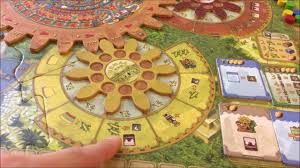
    Game 1: Avoid angering the gods – Tzolk’in (2-4 players, 5 with an expansion)

    Tzolk’in is a game of timing, efficiency, worker placement, and corn.  The rules of the game are fairly simple, each turn you may either put workers onto the gears, or you may pick workers up off of gears and take an action available to that worker.  After all of the players have taken their turn, you turn the center gear one crank, which moves all of the other gears one step forward.  There are six gears in the game, five of which can hold workers, with the center one timing the game.  The game is played over 27 turns broken down into 4 periods. Each gear focuses on different items:


    1. A gear for getting wood and food, the higher up the space, the more wood or the more food you get
    2. A gear for getting other resources, the higher up, the better the resources you acquire
    3. A gear for moving up in technology, building buildings or monuments, or moving up the temple tracks
    4. A gear for getting more workers, or exchanging corn for other items
    5. The final gear for placing crystal skulls for points and temple steps

    As you place workers, you need to put them in the earliest open space on the gear.  So if you’re the first to place a worker on a gear, you place it in spot 0.  If you then place a second worker on the same gear, you place him in spot 1.  You must pay corn for placing in any spot other than 0, and for placing more than 1 worker a round.  When picking workers up, you only need to pay if you wish to backtrack spaces on the gear (taking the action at spot 2 when you’re at spot 4 would require you to pay 2 corn).  You can pick up all of your workers in one turn if you wish (and good players try to plan it that way for the last turn of the game).  At the end of each period, you also must feed your workers who require 2 corn each.  If you can’t feed a worker, you lose 3 points per starving worker.  There are multiple ways to get points:


    1. Placing Crystal Skulls on one of the gears
    2. At the midpoint of the game and the end of the game, you will score points based on how far up the three temple tracks you are with bonuses for being the highest.
    3. Certain buildings give you points
    4. Technologies can give you points
    5. Monuments are worth points at the end of the game


    At the end of the game, all of your resources get traded for corn, and every 4 corn is worth one victory point.  


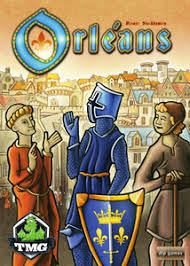
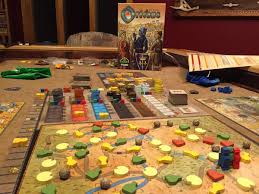
    Game 2: Building a bag out of workers – Orleans (2-4 players, 1-5 with expansions)

    Bag building, the kissing cousin of deck building (which I’ll be getting to soon).  The premise of both systems is that all of the players start with the same resources, and through the course of the game purchase new ones that make their bags/decks better.  In this game this is done by hiring workers.  The game is played over 18 turns with the following steps being taken each turn:

    1. Flip over the top hardship tile (the one for the first turn is set)
    2. Draw a number of discs out of your bag based on your position on the Knight track
    3. Arrange your discs under the actions you want to take
    4. Starting with the first player take an action that have all of the worker places under them filled.  The next player then takes an action or passes.
    5. Once all players have passed, pass the first player token to the next player


    Most of the actions involve you purchasing a new disc and moving up the associated track.  As you move up the various tracks you gain certain benefits.  If you are ever at the end of a track, or there are no further discs of that type to take, you are unable to take that action.  Other actions have you moving around a board, building trading houses, picking up goods, and increasing your position on the development track.  The goods and trading houses are both worth points at the end of the game, and some of the hardship tiles will require you to give up certain types of goods tiles.  The final type of action allows you to send some of your workers out of your bag by moving them to the beneficial deeds board.  Here they will give you development points or coins.  Through the course of the game, players will also acquire citizen tokens which will be worth points at the end of the game.  Once the final round is completed, a citizen is awarded for the person with the most trading houses, and everyone scores their points, which are made up of the following:


    1. Money is worth one point each
    2. Goods are worth between 1-5 points for each tile
    3. Citizens and Trading houses are worth a number of points based on the threshold you’ve passed on the development track
    4. Some buildings award end game points


    The player with the most points win.


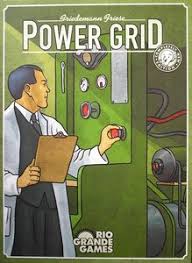
    Game 3: You can’t win with Green power – Power Grid (2-6 players – recommended for 4-6)

    This is one of the first economic engine games I’ve touched on.  In this game, each player represents a power company working to power cities through connecting them to their network, purchasing power plants, and buying the fuel the plants need to operate.  This is done through several phase each round:

    1. Power Plant auction – Starting with the first player, a player may (except for the first round, where they must) put a power plant up for auction.  Each plant has a number printed on it, which is the minimum price of the power plant
    2. Purchase Resources – In reverse player order, players purchase resources to power their plants
    3. Expand network – In reverse player order, players pay to expand their network to other cities
    4. Power network – In player order, each player decides which plants to run, and how many cities in their network to power (which generates income)
    5. Bureaucracy – More resources come into the market, power plants get moved around, and player order is determined by number of cities in each player’s network, with ties being broken by the numbers on their highest numbered power plant.


    The game does a decent job of simulating a market with a set number of resources coming out each turn and watching players value plants differently based on what other players have been buying through the game.  There are coal plants, oil plants, garbage plants (natural gas in different versions), nuclear plants, and green plants (which require no resources).  The end game is triggered when a player has a certain number of cities in their network (the number is based on player count).  However, the winner of the game is the one who can power the most cities in their network, with the tiebreaker being remaining money.  As each player can only have 3 power plants at a time (and they’re public knowledge), you can see how many cities each player can power.  The only randomness in this game is the order in which the power plants come out, which is mitigated by them being placed in numeric order, and which ones can be auctioned off.


    Hopefully you haven’t been run off by these more complicated games, and at least one of these piques your interest.  Again, feel free to bring up questions or complaints below, and I’ll be back next week with some games that you can play on your Android (and iOS) devices.

  • Nephilium’s Games Corner – On the internet, no one knows you’re a Glibertarian

    Nephilium’s Games Corner – On the internet, no one knows you’re a Glibertarian

    Last time, we discussed two player games.  But what to do if you can’t even scrounge up one other person to play with?  Like most things, the answer is on the internet.  Specifically, the answer is on several websites that allow players to play games online, and enforce the rules (which can help you learn that you were playing a rule incorrectly previously).  I’m going to focus on just two of the sites that I use, and focus on the games that one of the sites has on it.

    The first site is Boite-A-Jeux, a site based out of France that allows for a large number of games to be played.  You can sign up for a free account, which permits play of all of their games.  What it doesn’t allow you to do is modify any of the time restrictions when setting a game up, so if you’re a free player, all of your games will have a timeout on moves of 30 days.  You also cannot write notes in the game, nor can you select your prefered color of pieces, and you’re limited to being in 20 games at a time.  

    The second site is Board Game Arena, which has a different selection of games (there is only 1 game that overlaps both sites that I’m aware of), and also allows free accounts.  Here, free accounts cannot create tables for all of the games, but can join them.  BGA (Board Game Arena), allows you to play in real time, or turn based.  In both modes, you start with a bank of time, and each turn you complete adds a set amount of time to it.

    Both sites will remove players if they run out of play time.  On BAJ (Boite-A-Jeux), you can request a replacement player for a player who has had their time expire.  The person kicked from the game has it count as a loss for them, and the new player can join a game that will not affect their ELO score.  BGA allows you to skip players when they run out of time, but the game as a whole is considered a forfeit from them at that point, and everyone else is considered a winner at a percentage based on how much of the game was completed.  I prefer BAJ, but I’m here to give options.  BGA has both Incan Gold and Jaipur which I discussed before.  Now to go to some heavier games that are on BAJ (but not BGA):

    Game 1) Drinking poison is bad?  Alchemists

    This is an interesting blend of hedging knowledge, hidden knowledge, and logic puzzle.  If you play the cardboard version of this game, it requires either a smartphone application or a player who acts as an adjudicator (and doesn’t get to play).  There are 8 different ingredients, and there are 8 different “alchemicals” that can be associated with them.  Each alchemical is made of three parts, one of each color (red, green, and blue).  Each of those parts has two attributes associated with it: the size (small or large), and the sign (negative or positive).  Through using artifacts, testing potions on yourself (and a student), and selling potions, the key is to determine what alchemical is associated with each ingredient and publish the theory.  The logic system is fairly simple, a small and a large of the same color and sign make a potion.  So if you mix something that has a large red negative with a small red negative, you get a negative red potion.  When publishing a theory, you have the option to either claim it with a flag that’s worth points at the end of the game, or you can hedge one of the colors.  So if you know that scorpion has a negative red and a positive blue, but you’re not sure on the green, you can publish a theory and hedge it on the green color.  Why would you do this?  Because one of the actions you can take is to debunk a theory that has been published.  The method of this is different based on the Apprentice or Master variant; but in short, you debunk a theory on a specific color and if there are any flags there that didn’t hedge on the color you debunked on, they take a large reputation (part of end game scoring) hit.  At the end of the game, all of the correct alchemical associations are revealed, and if you were correct (and not hedged) you score points based on the flag you placed, gold flags (of which you have 2) are worth 5 points, silver (of which you have 3) are worth 3.  You will also get points based on your gold and artifacts purchased through the course of the game.

    Game 2) Point Salad fun!  Castles of Burgundy (Die Burgen von Burgund)

    I’ve mentioned a couple of other designers in the past, and this game brings up another one.  This is a game by Stefan Feld, who is known for randomness (with mitigation options being available) and point salad.  I hear the question now, “What’s point salad?”  Point salad is a term used to describe games in which nearly every action gets you some number of points.  You put down a building – get 3 points, you completed an area – get 8 points, you took some workers – they’ll be worth points at the end of the game.  The key in his games is to optimize the points you are getting for the actions you take.  Castles of Burgundy is one of the more popular of Feld’s games.  I prefer playing this online, as it makes the setup between phases and cleanup much easier.  The game plays between 2-4 players, and scales the options available based on the number of players.  This game is played by having all of the players roll 2 dice, and then in turn order use their 2 dice to take actions.  The actions are as follows:

    1. Take a tile from the central board
    2. Place a tile from your personal store
    3. Sell goods
    4. Get 2 workers
    5. Spend 2 silver to purchase from the black market (does not use a die)

    Workers allow you to modify the number you rolled by +/-1 per worker used helping to mitigate the randomness.  For the other three actions, you can only take the action if the number on your die matches what you want to do.  The central board has seven areas: 6 associated with the faces of the die, and one that represents the black market.  Each player’s personal board also has numbers in every hex, and when placing a tile, you must match that number, be next to a tile you have already placed, and the tile you’re placing must match the color of the hex you’re placing it in.  All tiles provide either an immediate effect, an end game effect, or an ongoing effect.  The game is over after 25 turns, with the high score at the end being the winner.

    Game 3) Sacrifice is the name of the game.  Deus

    Deus is a tableau building game, you start with a hand of cards and each turn you either play a card to your tableau, or sacrifice any number of cards to a deity.  To play a card to your tableau, you must meet certain requirements:

    1. You must have a building piece for the building type on your personal board (each player starts with 2 pieces for each of 5 building types)
    2. Be able to afford the cost in coin and resources
    3. Have a space on the board where you can play the piece (two of the same piece cannot be in the same space, and you cannot play in a space that’s a barbarian village or that has an opponent’s piece in it)

    If you meet those requirements, you then activate all of the cards of that type from the earliest played to the one you just played.  There’s also a sixth type of building called a Temple, which only requires you to be able to afford the cost, and have a space on the board with at least one of your pieces on it.  The temples will give you end game points for meeting specific goals.  If you can’t build, then you need to sacrifice to one of the five gods.  This is done by selecting one card, and putting as many other cards from your hand under it.  The whole stack is then discarded, and you receive the bonus for the card on top.  Each god gives you different items, from coins, goods, drawing extra cards, victory points, and/or more wooden buildings to place on your board.  The other way to earn victory points is to surround a barbarian village with at least one military unit assisting.  The barbarian village is then removed from the game, and the player with the most military units around it gets the points the village is worth.  The game continues until one of two endgame criteria is met: all barbarian villages are removed from the game, or the communal supply of temples is exhausted.  At that point, everyone has two final turns to score themselves some more points, and the game ends.  

    Feel free to invite me to a game on either of the services, I’m under the same handle there.  Next time, I plan on finally writing about some games on the heavier side of the spectrum.