Category: Food & Drink

  • Ain’t My Bitch

    A question was posed, that got a lot of response:

    At which point it became apparent that nobody liked my suggestion.

    Later that week, it became apparent that nobody likes my music.  Sad.

    Surely, there must be somebody else around here with some level of discerning taste.

    *raises glass to Certified Public Asshat*

    Today is my review of beer that I picked because it got a song stuck in my head at the time of purchase.  I will post links, but given my audience, you have my word as a Spaniard that none of them will be Metallica.**

    First up, is this Belgian Style Ale from Victory Brewery.  I should be H/T somebody here, but to be honest I forgot who it was.  Here is the song.

    This is not half bad, and while I generally do like the Saison and/or Farmhouse style this one is a tad on the bitter side.  I think Boulevard does it better with their Tank #7.  Victory Golden Monkey Ale:  3.5/5

    Up next is Wells’s Banana Bread Ale (H/T: Riven)  I regret this one.  It is expertly brewed, but I believe I made my feelings for bananas clear in a previous review.  For this one, there can really only be one thing running in my head.  In the event you actually clicked that, and wish to murder me, consider that I only played you a clip.  Wells Banana Bread Ale:  2.0/5


    Left Coast Brewery VooDoo American Stout. This is a bit heavier than the run of the mill milk stout.  It has more coffee notes so think of this as more of the type like Guinness Extra Stout.   The song of course is something that also manages to be both heavy and mellow.  I played it as loud as the terrible speakers in my car could play.  Left Coast Brewery VooDoo American Stout:  3.8/5.


    Finally, this one was pretty blatant about the music choice.  I happened to like Deftones when I was in high school but they kind of fell off the face of the earth until that day I found this.  They were always just a little bit…different.  Anyhow, they picked an IPA and one that is particularly gruesome.  Lot of heavy citrus notes in this one, and as you can tell is very hazy.  A few of you will like the song, somebody here will like the beer, but nobody will like the price tag ($14 for  4-pack).  Belching Beaver Digital Bath IPA:  2.5/5.


    **Right, I’m no Spaniard, but none of the links were Metallica.  At least give me that.

  • Peach Raspberry Crisp

    [et_pb_section bb_built=”1″][et_pb_row][et_pb_column type=”4_4″][et_pb_text admin_label=”intro text” _builder_version=”3.15″]

    Web Dominatrix sends her apologies. She’s crazy busy finishing up websites for a couple new clients. And these are ladies you do NOT want to disappoint (unless you’re into that sort of thing).

    So, you’re stuck with me as a last minute substitute. Sorry, kids.

    I thought I’d post one of my favorite vegan recipes. I’ve been making this regularly since last summer (2017) and I really could just eat the entire pan by myself.

    Except it would be wrong not to share.

    Right?

    [/et_pb_text][/et_pb_column][/et_pb_row][et_pb_row][et_pb_column type=”4_4″][et_pb_divider _builder_version=”3.15″ height=”2px” color=”#ffffff” /][/et_pb_column][/et_pb_row][et_pb_row][et_pb_column type=”1_2″][et_pb_text admin_label=”Recipe ” _builder_version=”3.15″]

    This recipe comes from America’s Test Kitchen cookbook Vegan for Everybody, which both Web Dom and I have mentioned before.

    You may sub 1-3/4 pounds frozen peaches for the fresh. Make sure you thaw completely before using.

    Peach Raspberry Crisp

    Filling

    • 2-1/2 pounds peaches (peeled, halved, pitted and cut into 1/2 inch wedges)
    • 1/4 cup organic sugar
    • 1/8 tsp salt
    • 2 tbsp instant tapioca (finely ground)
    • 1 tbsp lemon juice
    • 1 tsp vanilla extract
    • 10 ounces raspberries

    Topping

    • 1/2 cup all-purpose flour
    • 1/4 cup organic brown sugar
    • 1/4 cup organic sugar
    • 1/4 tsp ground cinnamon
    • 1/4 tsp ground ginger
    • 1/4 tsp salt
    • 1/4 cup coconut oil (melted and cooled)
    • 1/2 cup old-fashioned rolled oats
    • 1/2 cup pecans (chopped)
    • 2 tbsp water

    For the Filling

    1. Adjust oven rack to upper-middle position and heat oven to 400 degrees. Gently toss peaches with sugar and salt in bowl and let sit, stirring occasionally, for 30 minutes. Drain peaches in colander set inside bowl; reserve 2 tablespoons juice and discard extra.

    2. Return drained peaches to bowl and toss with reserved juice, ground tapioca, lemon juice, and vanilla. Transfer to 8-inch square baking dish, press gently into an even layer, then top with raspberries.

    For the Topping

    1. Meanwhile, process flour, brown sugar, granulated sugar, cinnamon, ginger, and salt in food processor until combined, about 15 seconds. Add melted oil and pulse until mixture resembles wet sand, about 10 pulses. Add oats, pecans, and water and pulse until mixture forms marble-size clumps and no loose flour remains, about 15 pulses. Refrigerate mixture for at least 15 minutes.

    2. Sprinkle topping evenly over fruit, breaking into 1/2 inch pieces as necessary. Bake until topping is well browned and fruit is bubbling around edges, 30 to 35 minutes, rotating dish halfway through baking. Transfer to wire rack and let cool for at least 30 minutes. Serve warm.

    [/et_pb_text][/et_pb_column][et_pb_column type=”1_2″][et_pb_text admin_label=”image” _builder_version=”3.15″]


    [/et_pb_text][/et_pb_column][/et_pb_row][/et_pb_section]

  • The Hyperbole’s How-to Handbook Chapter One : Pizza Sauce

    [et_pb_section bb_built=”1″][et_pb_row][et_pb_column type=”4_4″][et_pb_text admin_label=”Intro Text” _builder_version=”3.13.1″]


    The Hyperbole’s How-to Handbook Chapter One: Pizza Sauce

    Is Libertarianism inherently self-reliant? Is Self-reliance inherently Libertarian? To many Glibs the answer to these questions may seem self-evident, obvious, redundant, repetitive even. We are, after all, a hardy lot of DIYers, homebrewers, self-defenders, sausage makers, board-gamers, reloaders, backyard mechanics, at least one diorama-ist, and cranky old get-off-my-lawners. Rugged Individualism, In the original Herbert Hover sense, is the antithesis of governmental paternalism. What could be more Libertarian? However there is another side to self-reliance and libertarianism, most libertarians hold capitalism and a free market in high regard. Comparative advantage, Division of labor, and Economies of scale are prized concepts. Certainly, it is great fun to shame grown men who can’t change a flat tire but is he any less a libertarian because he relies on his cell phone service and the roadside assistance supplied by personally purchased insurance. You may be thinking “okay Hyp, maybe libertarianism doesn’t require strict self-reliance, but self-reliant people are going to lean towards libertarian, its a common characteristic” Possibly, but it’s not that hard to imagine an off-the-grid, self-composting-toilet-using, chicken-raising, self-sustaining hippie-type that would be more than happy to have the government force the rest of us to live by their rules in a misguided attempt to save the planet, some endangered timberdoodle, or what not. Self Reliance while noble and to a point worth encouraging is not inherently libertarian and vice-versa. So take heart whether you Angus MacGuyver your pizza sauce from homegrown maters squeezed through the casing of a Bic pen and simmered over a solar oven made of used tin foil and roach clips, or, like Al Czervik in the Brushwood pro shop, (or should that be Thorton Melon at the Grand Lakes University bookstore) you use your vast wealth to buy the finest of the 23 types of pizza sauce that no one needs for yourself and all your friends, you can still hold your libertarian head high. As for me, when I can, this is how I’m gonna do it.

    [/et_pb_text][et_pb_text _builder_version=”3.13.1″ text_orientation=”center”]

    The Hyperbole’s Unaliterated Pizza Sauce

    [/et_pb_text][/et_pb_column][/et_pb_row][et_pb_row][et_pb_column type=”1_2″][et_pb_text admin_label=”steps 1-4 image” _builder_version=”3.13.1″]

    Steps 1 – 4

    [/et_pb_text][/et_pb_column][et_pb_column type=”1_2″][et_pb_text admin_label=”Steps 1-4 Text” _builder_version=”3.13.1″]


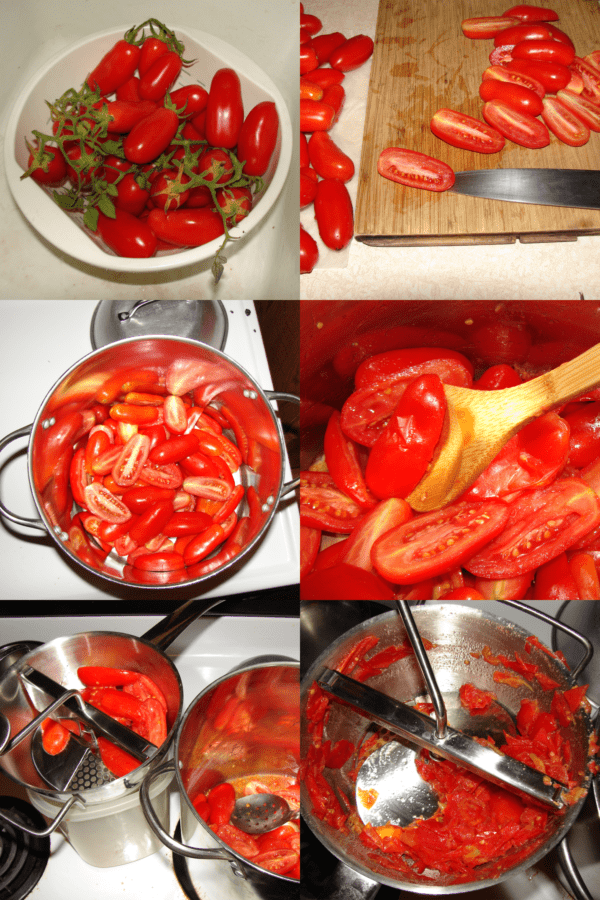
    Step 1. Plant and harvest 4-5 lbs of San Marzano Tomatoes and 4 or 5 large chile peppers of the ‘not melt your face’ variety. (For more info on growing said fruits see Chapter Four: Gardening) Rinse and slice tomatoes lengthwise, check for nasty stuff, these were pristine.

    Step 2. Heat over low heat, stirring for about 10 minutes, or until the skins start to loosen up.

    Step 3. Run tomatoes through the food mill that you use once a year, use a medium-sized sieve.

    Step 4. (not shown) You’ve got enough to clean up already so put your milled tomato sauce in the fridge, wash up then walk down to the bar and grill for a mushroom bacon swiss burger, a few Strohs, and to ineffectually and awkwardly chat up the waitresses.

    [/et_pb_text][/et_pb_column][/et_pb_row][et_pb_row][et_pb_column type=”4_4″][et_pb_divider _builder_version=”3.13.1″ color=”#ffffff” height=”2px” /][/et_pb_column][/et_pb_row][et_pb_row][et_pb_column type=”1_2″][et_pb_text admin_label=”Steps 5-8 Text” _builder_version=”3.13.1″]


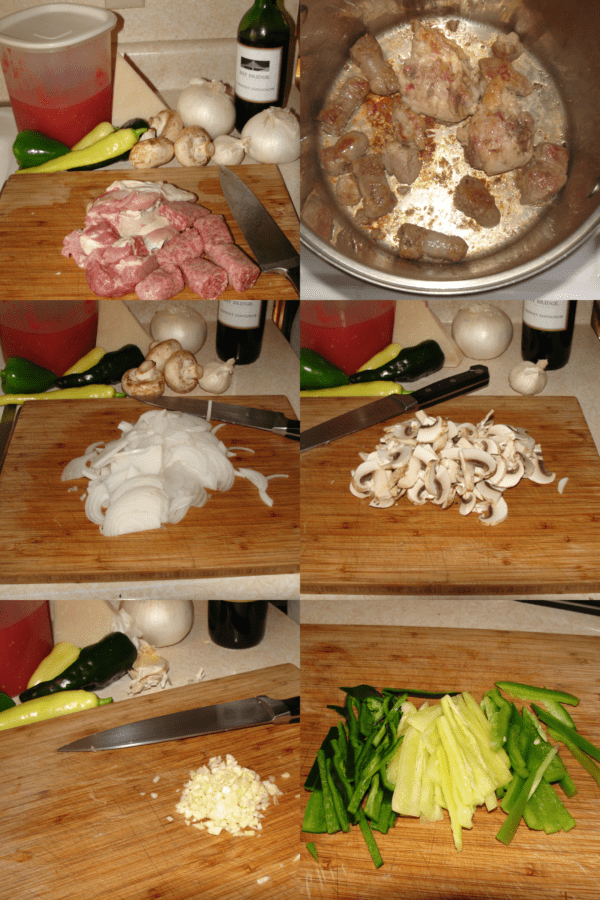
    Step 5. The next evening get your shit together, tomato sauce, onions, mushrooms, garlic, peppers, red wine, and chicken thighs some sausage and some chunks of pork.

    Step 6. Brown meats in oil in your heavy duty stock pot.

    Step 7. Slice up about this many onions, mushrooms, and peppers.

    Step 8. Mince up this much garlic.

    [/et_pb_text][/et_pb_column][et_pb_column type=”1_2″][et_pb_text admin_label=”Steps 5-8 image” _builder_version=”3.13.1″]

    Steps 5 – ?

    [/et_pb_text][/et_pb_column][/et_pb_row][et_pb_row][et_pb_column type=”4_4″][et_pb_divider _builder_version=”3.13.1″ color=”#ffffff” height=”6px” /][/et_pb_column][/et_pb_row][et_pb_row][et_pb_column type=”1_2″][et_pb_text admin_label=”steps 9-13 image” _builder_version=”3.13.1″]

    Steps 9 – ?

    [/et_pb_text][/et_pb_column][et_pb_column type=”1_2″][et_pb_text admin_label=”Steps 9-13 Text” _builder_version=”3.13.1″]


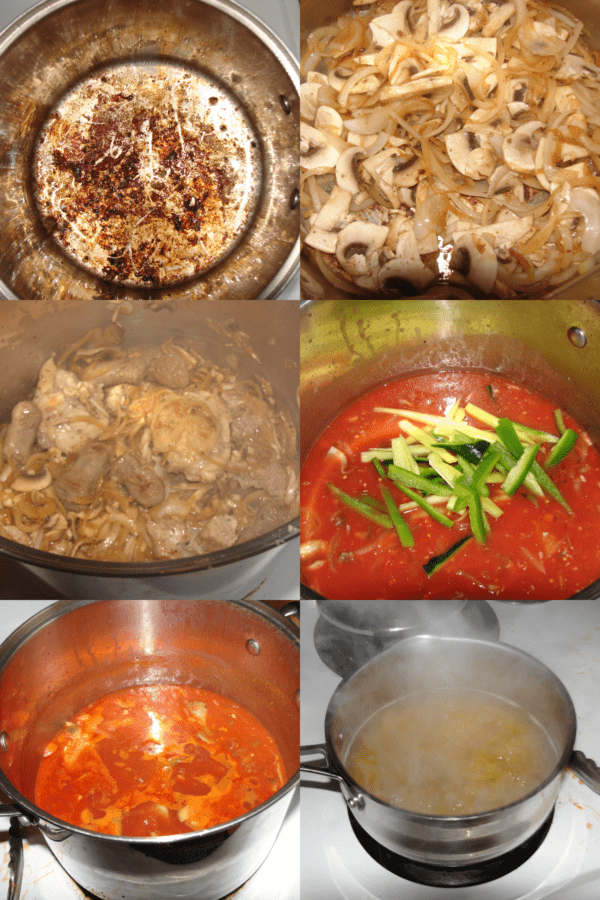
    Step 9. Remove your meat. add Onions and Mushrooms (add more oil if needed)

    Step 10. When onions and mushrooms are soft, stir in garlic

    Step 11. Before garlic burns add enough wine to deglaze the pot, return your meats.

    Step 12. Add tomato sauce and peppers, simmer til meats are done or longer, just don’t let the chicken get to falling apart stage.

    Step 13. Make some pasta.

    [/et_pb_text][/et_pb_column][/et_pb_row][et_pb_row][et_pb_column type=”4_4″][et_pb_divider _builder_version=”3.13.1″ color=”#ffffff” height=”6px” /][/et_pb_column][/et_pb_row][et_pb_row][et_pb_column type=”1_2″][et_pb_text admin_label=”Steps 14-18 Text” _builder_version=”3.13.1″]


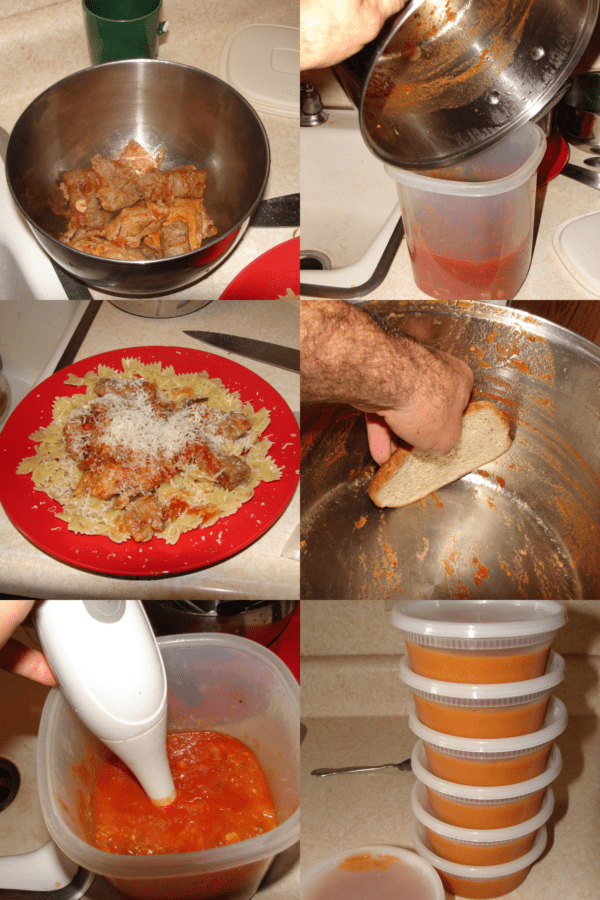
    Step 14. Remove your meats again.

    Step 15. Reserve sauce

    Step 16. Serve up meats and some sauce on pasta with grated parmesan. Eat with bread used to ‘clean’ pot.

    Step 17. Stick your stick blender in the sauce and stick blend it to pizza sauce like consistency.

    Step 18. Divide sauce into ~6oz. portions and freeze what you’re not going to use right away.

    [/et_pb_text][/et_pb_column][et_pb_column type=”1_2″][et_pb_text admin_label=”Steps 14-18 image” _builder_version=”3.13.1″]

    Steps 14 – ?

    [/et_pb_text][/et_pb_column][/et_pb_row][et_pb_row][et_pb_column type=”4_4″][et_pb_text admin_label=”time/yield” _builder_version=”3.13.1″]

    Time: 3 months 2 days and 45 mins give or take.

    Difficulty: Meh

    Yield: 1 Mushroom swiss burger, 2-4 servings of cacciatore, 48-60oz. pizza sauce.

    [/et_pb_text][et_pb_text admin_label=”voila” _builder_version=”3.13.1″ text_orientation=”center”]

    Et voilà!

    [/et_pb_text][/et_pb_column][/et_pb_row][/et_pb_section]

  • You know what really grinds my gears?

    You know what really grinds my gears? Disappointment. Kind of like below:

    I will resist the urge to point out thst it is not I that lacks taste.  On some level I decided I should be open minded enough to write something objective about Unfiltered Sculpin….

    …but this article is about disappointment.  They had no Unfiltered Sculpin, therefore this is my review of Breakside Lunch Break IPA.

    Left: sickeningly sweet. Right: unsweetened.

    Seriously, though. How hard can it be to stock things and stock things correctly? I did the retail thing before and I get that its demeaning, menial work.  Totally suited for somebody with a philosophy degree. Then people like Starbucks have to go, and make things with pretty much the same label. For example, their Cold Brew Coffee comes in multiple versions but the one I get is Black. I get the Black Unsweetened. The problem is—morons, who hire other morons to design the format of their bottles, run Starbucks.  In short, Starbucks are a bunch of morons. Here’s what I mean.

    Notice how they look nearly identical? I am in a rush and want some coffee in the morning because like most of us, I have an addiction to caffeine. I don’t want the dizzying high and the spellbinding low that comes from the ensuing insulin dump that comes from drinking several spoonful’s of sugar. I just want the buzz.

    I can hear you now, “don’t they teach people how to read in Mexico?” I don’t know, but they did teach me to read in Arizona and yes, I can just read the label. This is my own damn fault and I recognize that; I really do. I am half awake, in a rush, and quite frankly I am not the only one that misses this, as I often find the sweetened coffee in the place of the unsweetened coffee. That tells me the morons that run the local Kroger are also in the business of hiring morons that think there is no difference between sweetened coffee and unsweetened coffee, to stock their refrigerated beverages section.

    The worst part is I always find out by opening it and taking a swig. I expect to get a blast of burnt coffee and then BAM! Instant tooth decay. This is an outrage, and something should be done to prevent morons from creating confusing labels, so other morons can put the wrong product on the wrong shelf. Something like this:

    Don’t tell me libertarians never have any solutions to societal ills.

    Its not rocket surgery, Starbucks, just make it green or blue or something, and I will stop calling you morons….okay I’m probably not going to stop calling you morons.  I will, however buy from somebody else.  Turns out Stōk keeps it simple by having a red label (sweetened) and a green label (not sweet).

    As far as the beer goes, its not bad for an IPA. In the grand scheme of things it is disappointing that I can’t find Unfiltered Sculpin at the moment but I probably wouldn’t really like that either. Breakside Lunch Break IPA: 3.2/5.

  • The Beer Wars:  An Incomplete History of the American Beer Industry (pt 1)

    Part I – Pre-prohibition

    This is part one (of five) in a series of the Beer Wars in America (primarily 1970-1990) and some before and after history.  There are much better beer historians than me who would be far more accurate.  At the end of each piece, I am going to include how the period in question effected a local brewery to me, Falls City.  It adds a bit of individuality to a big picture story.  And now let us begin.

    In the beginning of America there was beer, and it was good, but it wasn’t really an industry so I am going to ignore it.  The Mayflower had beer, Washington and Franklin brewed beer, some breweries existed on the Eastern Seaboard.  But the exciting stuff happened with a combination of the industrial revolution and the German invas…ummm, immigration wave in the 19th century.  This was followed by the commercial use of refrigeration and an industry was born.

    Below is a not-so-random selection of mostly-German, mostly Midwest, breweries that were founded in the mid 19th century and would continue to play a major part in our story in the late 20th century.  This list is by no means complete, but it gives you a flavor of the Germanic character of the industry in these days.

    Yuengling, 1829, Pottsville
    Falstaff, 1838, St Louis
    Ballantine, 1840, Newark
    Schaefer, 1842, New York
    Pabst 1844, Milwaukee
    Schlitz 1849, Milwaukee
    Stroh 1850, Detroit
    Blatz, 1851, Milwaukee
    Anheuser-Busch, 1852, St Louis
    Christian Moerlein, 1853, Cincinnati
    Leibmann, 1854, Brooklyn
    Hudepohl, 1855, Cincinnati
    Miller, 1855, Milwaukee
    Jacob Schmidt, 1855, St Paul
    Heileman, 1858, La Crosse
    Christian Schmidt, 1860, Philadelphia
    Hamm, 1865, St Paul
    Coors, 1873, Golden
    Sterling, 1880, Evansville
    Pfeiffer, 1882, Detroit
    Anchor, 1896, San Francisco

    The Seibel Institute in Chicago taught brewing in German up until World War I.  The Brewmaster’s meetings at Budweiser were held in German up until about the 1960s.  The inability to speak German limited a brewer’s advancement in the company in the first half of the 20th century.

    Prior to this time, American breweries were based in the English tradition and were primarily Ales.  Lager became King with the German influence.  In 1873 there were 4,131 breweries in America, a number that would not be topped until late 2015.  In the 60 years from 1865 to 1915, the amount of beer produced and the per capita drinking increased dramatically (from 3 to 18 gallons per capita per annum).  However, the number of breweries decreased as industrialization and refrigeration allowed for larger breweries.  See the chart below:

    1865-1915

    Year National Production (millions of barrels) Number of Breweries Average Brewery Size (barrels)
    1865 3.7 2,252 1,643
    1870 6.6 3,286 2,009
    1875 9.5 2,783 3,414
    1880 13.3 2,741 4,852
    1885 19.2 2,230 8,610
    1890 27.6 2,156 12,801
    1895 33.6 1,771 18,972
    1900 39.5 1,816 21,751
    1905 49.5 1,847 26,800
    1910 59.6 1,568 38,010
    1915 59.8 1,345 44,461

    Source: United States Brewers Association, 1979 Brewers Almanac, Washington DC: 12-13.

    Of course, by the next line in the chart, the number was zero.  At least legally.  But that is a story for another post.

    At the beginning of the 20th century, Central Consumers Company, an alliance of Louisville breweries, had many of the taverns in Louisville under contract as “tied houses.”  Basically, they had a monopoly and a contract to prevent the taverns from buying elsewhere.  Some independent taverns and grocery stores refused to sign on and instead created a cooperative brewery in 1905 – Falls City.  In 1911, Central Consumers tried to buy out Falls City, but the owners chose not to sell.  Falls City would continue to grow and succeed until a horrible shadow fell over the country with the 18th Amendment.

    But there is a point to this part of the story – even in the face of monopoly, there isn’t a need for the government to fix the problem.  The plucky upstarts were able to succeed without subsidy and without selling out.  It’s a libertarian success story … for now.

  • You Win Again, Kentucky!

    So this one time I went to Kentucky….

    Relax it wasn’t like that. I was in Lexington for work and I rather liked the town. The first thing about Lexington I noticed was–horses. I mean, hello! It’s called an automobile. It is faster than your horse. The other thing I noticed, once I got out of the class I was in, is the glut of whiskey, and whiskey related things.

    This is my review of beers aged in Bourbon Barrels.

    Why put it into a barrel? Why not?  Even if I already gave you a pretty good rundown on barrels, expanding beyond stouts may be prudent.  Besides, the chances are pretty good at least one of you has three fingers of whiskey and an open bottle of beer. More of you probably switched to whiskey once your college football team managed to knock itself out of contention–already. You were going to do both, and quite frankly the people that sell mind altering substances know their buyer.

    Supposedly, this craze began 1992, when

    Greg Hall of Goose Island Beer Company in Chicago produced a bourbon barrel-aged beer by filling six barrels that had previously contained Jim Beam with his beer. He premiered it at the Great American Beer Festival in Denver that fall, effectively debuting an entirely new style.

    So if you hate it, blame that guy. Stouts aren’t the only thing you can throw into bourbon barrels, they simply bode well with the smooth vanilla notes the wood imbues into the beer.  They even put wine in them for reasons I cannot give an intelligent answer.

    What I can discuss, however:

    This one was pretty good. I would think a pale ale would be overpowered by the taste of whisky, and I don’t think I was wrong. Still if you happen to sip whiskey you will probably like it. Full Sail Kentucky Cream Bourbon Barrel Aged Pale Ale. 4.0/5

    I rather enjoyed this one. While I normally don’t go for an IPA, the red varieties I do find interesting. This one stands up better than the pale ale due to the robustness in ale to begin with. The whiskey mutes out a lot of the hoppiness. Founders Dank Wood Red India Pale Ale: 4.2/5

  • Philosophy of Food

    I’m an animal lover.  I have two very spoiled dogs and a long history of pet ownership ranging from reptiles, rodents, cats and farm animals.  In high school I was a member of Future Farmers of America and showed poultry at the state fairs.  My parents owned a hobby farm populated with cows, goats, pigs, geese, ducks, chickens and one very fat turkey hen named Tiger.  I was showing Tiger at a fair and stopped for dinner at a sub shop.  I got a turkey sandwich.  As I ate my turkey sandwich looking at the turkey I had raised from an egg and had trained to follow me around, I heard a little voice say, “Isn’t that a little cruel to eat in front of your pet?”  Being 17 or 18 at the time, I wasn’t exactly a deep thinker and excused the thought due to the fact that I had no relationship with the turkey on my sandwich.

    The animals my family raised were never eaten by us.  Sure, we sold them knowing they would be butchered, but our hands were clean.  But as I grew older and started reflecting more on life, often while eating, I thought of the cows that I’d named and sold to market.  I could never have killed one of them.  I don’t think I could enjoy eating them even if someone else had butchered them, but here I am eating a hamburger.  I’d outsourced my killing. Did that make me morally superior or inferior?  I would never pay someone to do something I wasn’t willing to do myself, so how could I outsource my dirty work.  I decided around 27 years old to stop eating beef because of the time I’d spent close to cows, learning how curious and gentle they can be, each with their own unique personality.  Later I questioned what made cows special, other than the fact that I like them.  We had a pot belly pig that liked a good scratch and treat.  It is widely acknowledged pigs are intelligent animals, so pork fell off the menu.

    The little voice said: “Why only beef and pork?  Isn’t that an arbitrary line drawn by nothing but your feelings?”

    My hypocrisy was glaring and I decided I would eat no mammals.  An arbitrary line to be sure, but we are mammals ourselves and that seemed fair at the time.  So another year goes by eating fish, poultry and the occasional reptile when I thought back to Tiger the turkey and remembered eating that sandwich and the little voice reminding me that I wouldn’t have killed any turkey.  Well, I enjoy fishing and have no shellfish allergies so pescatarianism here I come.  Finally I could honestly say that although I was hiring someone else to catch and provide my food, I would be willing to do it myself.  I remained on that diet for several years and continued enjoying animals through zoos, aquariums, nature walks and television programs.  I love nature shows.  I find any animal fascinating.  The way they live, breed and hunt. Watching lions hunt on tv as a child I always rooted for the gazelle to get away.  As I got older I realized that the lion needs to eat too.

    Little Voice: “Is the lion an immoral creature because it hunts?”

    Only the most rabid PETA person would say yes.  So if the lion is not immoral for hunting, why did I myself consider it immoral?  Because I have agency?  I can choose not to kill.  I have empathy.  I can image what other people and animals feel.

    Little Voice: “What about the bass you love to catch?”

    That, I told myself was different; they aren’t a higher animal.

    Little Voice: “They fight for their lives.  They want to live.”

    Fine, fish off the menu.

    Little Voice: “What about shellfish?  They didn’t evolve those hard defensive shells for no reason.”

    Fine, all animals off the menu.  Are you happy now voice in my head?!?  I’ll go vegetarian!

    Little Voice: “Cows are slaves to dairy farmers.”

    Fine, vegan!  Good enough for you conscience?!?

    Once again,  I was watching a nature program, this time about wild tobacco plants.  Tobacco plants produce natural pesticides to protect themselves from insects and when exposed to a new pest that is resistant to their chemical warfare, they evolve a new pesticides in a never ending evolution of defense.  Not only do tobacco plants fight to live, they send a message to other tobacco plants with the design for the new pesticide.  The plants have empathy, they shared their hard work so the species could survive.

    Little Voice: “Seems like plants want to live as much as bass.”

    Fruit?  How about that brain? You got anything against fruit?  I’ll go full Jainism!  Not to offend any Jainist reading, but if you look into evolutionary history, that fruit isn’t meant for humans.  The reason that ripe fruit changes color is to signal birds that it is ready for them, not some local primate.  Prior to color vision development in primates, only birds could see the color change and the plants were offering a tasty snack to the birds in exchange for spreading seeds far and wide.  If a monkey ate the fruit, the distribution would be limited, so plants, specifically peppers, developed capsaicin in an effort to discourage mammals from eating their precious seeds.  Birds, fish and reptiles don’t have capsaicin receptors.  This was a limited chemical attack aimed at mammals, including us.

    Little Voice: “So animals don’t want us to eat them and plants don’t want us to eat them, what are you going to eat smart guy?”

    I thought about it.  Single cell organisms that use photosynthesis and have no defensive mechanism?  They aren’t even harmless!  I’m sure, little voice in my head you are familiar with the great oxygen event.  You must, you know what I know! Those little light consuming bastards wiped all other life off the planet with poisonous oxygen!  As I gained control of my addled mind, I began to think about how a small organism changed an entire planet and took my attention from the very small to the very large; our universe.

    The universe is big place and the vast majority is empty and yet filled with danger; vacuums, extreme cold, radiation, black holes and burning balls of gas.  The universe is racing to reach it lowest form of energy through constant expansion and organisms are fighting the flow of energy seeking its lowest state as the heat death of the universe approaches. Microbes to man are engaged in a Sisyphean challenge of rolling a rock up an energy hill, forever.  In that context, living is fighting. It is the ultimate fight club with no holds barred.  Our ancestors came down from the trees and developed efficient locomotion to pursue game; a unique shoulder design that allows for projectile weapons such as slings and arrows.  We learned to use fire to make meat more digestible and with that calorie boost our brains grew to develop even more complex hunting schemes and weapons.

    Little Voice:  “Does that mean YOU can do whatever you please with no consideration for life?”

    No.  Humans are still cursed/gifted with sentience.  We are not bound strictly by evolution.  We can make choices about what and how we eat.

    Little Voice: “Are animals nothing more than property?”

    That is a debatable question for another post, but let us assume yes, animals are property AND in need of special consideration.  Just because animals are a food source doesn’t mean we can’t still show empathy.  With these revelations my diet expanded to include animals once again, but with a wider consciousness.  I thought, what is the most ethical way to procure food?  A shallow thinker may conclude a vegan diet hurts no animals.  I already posited that plants may not want to be food, but conceding that point, growing vegetables isn’t harmless.   The land where soybeans and kale are grown had to be cleared and the native animals displaced.  After the animals and non-commercial plants are eradicated, the land needs constant protections from animals trying to eat the crops and plants invading the inviting soil.  A clear battle line is marked at the edge of the farm and pesticides must be applied which kill not only pest but other harmless insects.

    The veggie farm is just another arena in the fight club of life.  Cattle ranches and poultry farms have the same issues but with added ethical considerations of living conditions for the animals.  Buying cage free and free range is an option but still the animals aren’t wild and the land still managed.  Commercial fishing has it own set of issues such as long net vessels catch the target fish for market, but also thousands of fish with no food value.

    Little Voice: “There ought to be a law!”

    There oughtn’t, I counter.  Everything comes with a price, including ethical farming, fishing and ranching.  I choose to pay extra for what I consider to be the more ethical methods, but not everyone has room in the budget to make those same choices or has the same set of values as I do.

    Little Voice: “Clearly hunting is the most cruel.  Everyone knows that.”

    Not so fast my imaginary friend.  Recreational hunting is limited to only certain times of the year and subject to bag limits for native animals; on private land you can target invasive species year round.  In both cases, the land is left in a natural state so all non-game animals and plants can live without molestation.  Only a few of the game species are harvested so the majority is left to thrive and the sacrificed few aren’t wasted by responsible hunters, since the meat is eaten and the hides turned into trophies. Sport fishing is the cousin of hunting, where limits are set and only a sustainable number of animals taken during certain seasons.  Hunting and fishing are the most honest ways to procure meat in my opinion.  The hunted have a chance for escape and ethical hunters give fair chase to the animal.  The cow has no chance for life beyond the ranch and may even see the rancher as a friend who provides food, until led to the abattoir.

    After years of self reflection and deep though, I have made peace with the little voice in my head.  I try to eat sustainable fish, free range/cruelty free animals and this year I plan to buy a lifetime hunting/fishing license for the state of Florida, so I can supplement my diet with what I consider the most ethical meat source.  I would grow my own vegetables too, but it turns out I don’t have much of a green thumb or patience for weeding.  How is any of this of interest to libertarians?  Libertarianism is a governing philosophy, not a moral code.  Where the debate comes into play is how government regulates use of public lands for hunting, seas for fishing, animal cruelty laws for ranching and regulation of herbicides/pesticides/GMO for farming.

    As libertarians, we can debate how heavy the regulatory hand should be.  No FDA?  I’m listening.  No FWC?  I think they provide a valuable service of ensuring native species aren’t over hunted on public lands.  A better solution would be selling public lands to private conservation groups and have private regulation.  Mandate cruelty free food?  This is where my standards for myself and the law come into conflict.  I chose a diet that I believe to be ethical, but as a libertarian I would never force others to make that same choice.  If enough people would choose to pay the price difference the market will provide cruelty free alternatives.  As the market grows, prices should come down.  In the end, it is up to each individual to make peace with that little voice in their head.

  • Green Chilies, Life and Rolling Stone References

    The world of green chilies is a vast one.  Everyone knows about New Mexico green chilies and their highly marketed name plate Hatch.  I love green chilies, and the chili that is its namesake, and grew up eating it.  I often use Hatch chilies in a pinch, but have always preferred locally grown when available, which is always if one plans right and has them in the freezer.  I was unaware of the chili rivalry between Colorado and New Mexico that I uncovered during the 15 minutes I spent researching this article.

    Being a semi-loyal Glib reader and a thin crust pepperoni clad warrior in the food wars, I am not afraid of voicing an opinion when it comes to food, but always just knew western Colorado chilies were far superior to anything grown in New Mexico–or anywhere else for that matter–and never gave it a second thought.  I never made a big deal about it because what is the point of harping on facts to people lacking all the information since they probably never had a chili grown here.

    I also never even considered anything grown on the front range, such as in Pueblo, was worth anything because the front range, anything east of the mountains, is considered by western slope folk to be pretty much western Kansas, and Pueblo has only ever been famous for being the location of the CO loony bin back in the day.  In short, the only good thing about the front range is the Broncos.

    This summer I have been far less enthused about fresh produce season than previous years due to a case of the mehs which I get from time to time, but I recently stopped and grabbed a handful of chilies (Big Jims) from a stand and brought them home for roasting.  The best way to buy chilies is to buy big and have the seller roast them for you, but they wanted $35 for a box and I was not willing to part with $35 at the moment and it is no problem roasting small quantities ones self.

    I did these on the Weber on a small pile of coals and the method consists of drinking beer and turning them until they char a bit on all sides and then put them in a paper bag to steam.

    The day I roasted those chilies if I looked only through my left eye, they looked like this:

    You see, there are certain factors that may cause cataracts and I checked most of the boxes.

    Aging: Check (sort of, I am only early fifties)

    Over exposure to UV rays:  Check

    I started skiing in 1972 when I was seven and back then we used the finest sunglasses one could buy at the gas station.  Preferably red white and blue layered plastic frames with reflective plastic lenses, and that is what we wore during sunny days on the slopes which was most weekends when I was a kid.  I have spent most of my life working outdoors in very sunny locations, and I have also done a fair amount of welding in some of the world’s finest shitholes with the finest welding masks available in said shitholes.  UV protection is not a known hazard in most shitholes and you will see welders arcing beads wearing nothing but plastic sunglasses.

    Diabetes:  Maybe a possible Check

    There is a good chance I have spent much of my life pre-diabetic due to diet and lifestyle.  I was diagnosed as such in my mid 30’s but never felt bad so what was the point of following up on that right?

    Drinking too much:  Ya, ok, maybe, sometimes, occasionally, a time or two.

    Smoking:  Check.  Off and on for thirty years.

    It seems I most likely did this to myself in one way or another.  That is something I have to come to terms with as I age.  I never thought I would live long enough to ponder life’s questions of self reflection on what I have done to myself.  Whether it was career choices and the hazards that come with using one’s body as a tool, recreation choices where the body is just another piece of equipment to be abused, and what is most damaging of all, what is ingested for fun or to silence the inner voice rambling on about what horrible choices you made in your life.

    To go with my green chilies I dug some Italian sausage out of the fridge that I had cooked earlier for pizza, as well as a pizza dough that was made, surprisingly, for the same purpose.

    Being someone who has only had one surgery when I was five when my tonsils were removed, and having a serious phobia about anything touching my eyeballs to the point I struggle to put in eye drops and even fainted during a glaucoma test once when I was in my late teens, I arrived for my surgery pretty much freaked the fuck out.  But by god I could do it, “don’t be a pussy,” I kept telling myself.  My blood pressure was jacked when they first hooked me up to all the monitoring devices but I eventually settled down.  The doctor and the anesthetist, who introduced himself as the guy who would make me feel good, dropped by to check on me and soon they wheeled me away to the operating room.

    I peeled my green chilies and laid them on the pizza dough as best they would fit, leaving enough dough on the outside edge to later fold.  I placed a sliced-lengthwise piece of sausage on each green chili and covered it with cheese.  I then cut around each chili leaving enough dough to fold kind of like a pinched top taco, sideways calzone or big dumpling.


    They don’t put you under for cataract surgery and only mildly sedate you because you have to listen to the doctor and move your eye when he needs.  During the surgery I only really freaked once and had to be told to hold still.  It felt like the doc was pushing my eyeball into my brain as he wrestled the cataract infused lens out of my head and I found that a bit unnerving.

    I did my green chili calzone things on my gas grill on my fire brick platform until golden brown.

    They could be stuffed with anything you want, and they were good.  I found they were better the next day.  I ate one that night in some marinara which overtook the green chili and I was not that impressed with my creation. The next day I muckled down the rest one at a time as I reheated them one by one and ate them poolside, and the green chili really came through. They were delicious.

    As to my whole cataract ordeal, it took something like 30-45 minutes in the operating room and I was at the hospital for little more than two hours.  It is truly amazing the day after and I see with clarity I have not seen with in 20 years.  It can only be described as how you are amazed at the clarity and drastic focus things appear after eating a small handful of mushrooms.  Not the, “holy shit that chick put her makeup on with a spatula” clarity but just vivid focus that seems drastic compared to what I have been living with for the past few years when the cataract really got bad.

    As they wheeled me to recovery with a patch over my eye the anesthetist asked how I felt.  I said, “Disappointed, I am not near as high as I hoped I would be”.  He said, “Here, we don’t give you what you want, we give you what you need.”  I caught the Stones reference, but was not sharp enough to come back with a wiseass retort, but sure plan to when they do my right eye some months down the road.  I am going to tell him to hell with this what you need stuff, give me what Keith would have.

    It wasn’t that long ago in medical history when the procedure done to me was not possible and I indeed feel lucky I am alive when it is.  It sure is better than previous techniques like poking a stick in the eye.

    A stick would work to roast a green chili over a fire though.

  • Milch ist Eine Schlechte Wahl!

    One of the problems I find with my preferences is that it is simply too damn hot for me to be drinking the type of beer that I normally go for. When it’s 110 degrees outside, the last thing I want to drink is milk. I hate the stuff. The way it coats your mouth, the full feeling, probably sourced from a few dozen Holsteins… On a hot day it’s a bad choice and let’s be real—I get a lot of hot days. A close second is an IPA but given my purchasing habits no longer revolve around what I want to drink and what serves a sufficient writing prompt, I have to choke that down from time to time. But imperial stout? I could but it’s just not refreshing, and quite frankly I am drinking copious amounts of beer because I am thirsty.


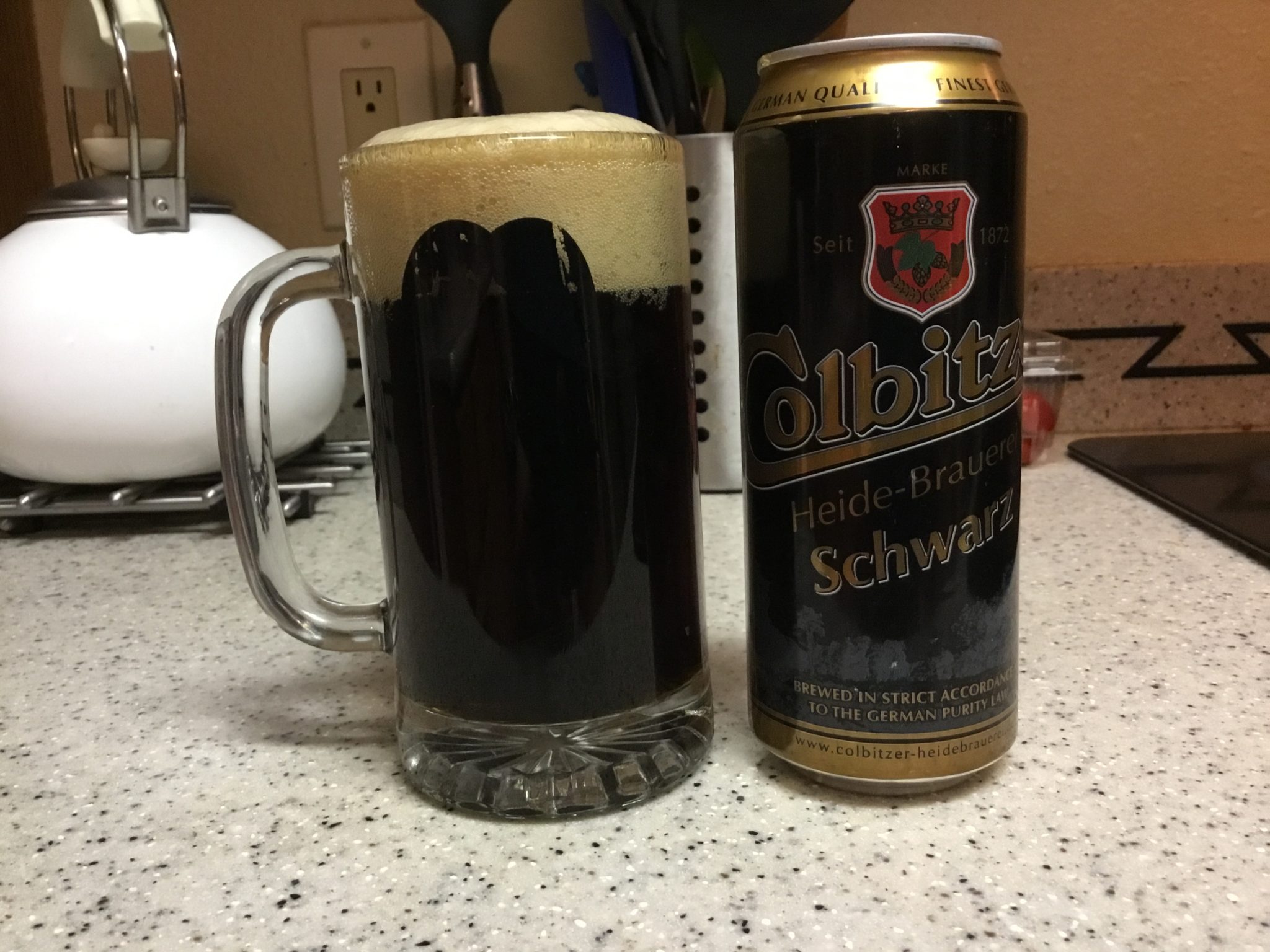
    This is my review of Colbitz Heide-Braurer Schwartzbier.  Cue the Space Balls-related puns.

    This beer reminds me of a friend of mine who got into Black Lager about ten years ago during college. We would take advantage of the $0.50 wings Tuesdays on Buffalo Wild Wings and get a bunch of wings. Until that one day it occurred to me I got a free T-Shirt if I did the Blazing Wing challenge. The challenge was only to eat 24 within their time constraint of an hour. Later they made it more difficult where you had to eat fewer of them, but had to do it in a few minutes.

    So…um…would ya?

    So I did it, and had a Sam Adams Black Lager or two along with it.

    Word to the wise–do not do this to yourself. You might think it’s a good idea to eat 24 ghost pepper wings, with the capsicum burning your lips the entire time. The pH balance in your stomach altering ever so slightly that you feel like your insides are digesting themselves. The mild acid reflux, the stench of fried chili grease oozing from your pores. Then there’s the morning after…. I was in ROTC at the time and had PT at 0600 the morning after. They accepted my stupidity as an excuse for missing it, because they were laughing too hard to stay serious enough to admonish me at the time.

    By the way, I didn’t get a free t-shirt.

    Eventually we made it a weekly thing. I didn’t do the challenge again, because as it turns out I am not that much a glutton for punishment, but the Black Lager thing continued.

    What is Schwartzbier anyways? You may not know it, but it is apparently one of the oldest styles around.

    Schwarzbier, literally “black beer,” is probably the longest continuously brewed beer style in the world, with its known ancestors close to three millennia in age and with definitive origins in the modern brewing cradle.

    Today’s schwarzbier combines Old World rusticity with the graceful smoothness of lagerbier, and a clean roasted edge with German malt complexity. It’s deep, ruby-black color and modest strength makes schwarzbier the lager equivalent of basic stout.

    The origin of schwarzbier lies in what perhaps the most significant historical brewing region in the world: southeastern Germany, including some of Bavaria, and portions of the former Bohemia, now the Czech Republic. The most famous, and arguably the most important, development from there was the invention of pilsner beer less than 200 years ago in Plzen, Bohemia. But the true gems from the region are the ancient, but modernly polished styles: schwarzbier and the smoky rauchbier.

    There is concrete evidence that crude schwarzbier was being brewed there as long ago as the ninth century B.C. (and undoubtedly, well before). This proof comes from an 1935 archaeological discovery seven miles west of Kulmbach in Northern Bavaria. The venture unearthed an Iron Age Celtic tomb that dated to about 800 B.C. That grave held an amphora with some residual brewing material and the charred crumbs of partially baked wheat bread, known to be the raw material for Celtic and Germanic brews of the time. Since this discovery places the oldest evidence of brewing in Central Europe in Kulmbach, and that beer was black, we can deduce that the world’s oldest, and still-produced, style of beer was schwarzbier.

    The result is something that has the dark roasted complexity of a stout (minus the lactose) combined with the refreshing nature of lager.

    Serve it cold, in tall mugs with a group of friends. This one in particular was actually pretty inexpensive for a six pack of pint cans and like all German beer is made in compliance with the Reinheitsgebot, assuming that means anything to you at all. Colbitz Heide-Braurer Schwartzbier 3.5/5

  • ?Pour Some Coffee On Me!


    Hmm, sounds painful.  Friends, as promised a review of the pour over method and the quick guide extraordinaire, Pro/Con list.

    Chemex is one of the better known brands for pour overs but I went with LePrem mostly because I clicked the wrong button when shopping on Amazon.  LePrem sounds more pretentious, Chemex more nerdy, so that may be the deciding factor for you.  I’m getting ahead of myself.

    What is a pour over coffee, you may ask.  Pour over is exactly what it sounds like. You place ground coffee in a filter on top of an hour glass shaped device and pour hot water over the grounds and fresh coffee is collected in the bottom chamber.  The filter is removed and you pour the hot fresh coffee into your cup.  You can also purchase a single serving brewer which replaces the hour glass vessel for a filter that sits on top of your mug.

    Water temperature is the same as always, 175℉, grind should be medium, which is standard for drip coffee makers.  I recommend pre-wetting the filter with hot water, then tossing the used water.  This will reduce the influence of the filter on the final product.  The real adjustable variable is how quickly you pour the water over the grounds.  Some people wet the grounds and wait for the “bloom,” which is just the coffee expanding as it releases carbon dioxide.  Water is poured in separated phase until you reach your desired volume or pour the total volume in one go if you’re making a small batch.  Always pour in a spiral so as to wet the grounds evenly.  That is pretty much it.

    You can’t make espresso with this method and adjusting grinds doesn’t seem to change the end product much.  The carafes themselves are aesthetically pleasing and are appropriate to leave out in your coffee space.  Pour overs range from single serving sizes up to 1L.  If you sometimes entertain or have a family of coffee drinkers, I strongly recommend the larger size if you have the storage space, because you aren’t required to make the maximum amount each time.

    Filters are required for this device, but reusable metal filters are available, which I’m sure will produce a slightly less “clean” cup.  The paper filters took a youtube video to figure out as the box instructions read like an origami project, but once you watch a video it is simple.

    So how do I like the LePrem?  The product is well made and attractive.  Cleaning it can be difficult depending on what size you buy.  The smaller sizes are difficult to get a hand in the collection chamber.  The used filters lift straight out, but tend to drip, so I take the entire brewer to the trash to toss the wet grounds.  A nice feature is a glass stopper to help keep the coffee warm until ready for use.  Perpetration time depend on how much coffee you are making and how slow you want to pour.  Appropriately sized devices will serve a family well and single size take up less room in a studio apartment.

    Now, the really important question, does it make a good cup of coffee?  Yes, you can get a great cup of coffee out of the LePrem, but I wouldn’t say it is a superior extraction method to the French Press or AeroPress.  Of the devices I’ve used so far, this one is my least favorite.  It doesn’t make coffee as fast as the AeroPress and it doesn’t provide the subtle flavors of the French press.  It lacks the ability to make espresso (AeroPress) or cold brew (Fresh Press) and for those reasons, I can’t recommend the pour over as your sole coffee brewing method. However, if you are a hobbyist like myself, it is an attractive addition to the brewing collection.


    How to Use

    Step 1. Place filter (thick layer over spout).


    Step 2. Wet filter with hot water, discard water.


    Step 3. Place medium ground coffee in filter.


    Step 4. Pour hot water over grounds in a spiral pattern


    Step 5. Remove filter


    Step 6. Pour coffee into mug & enjoy.


    Pro

    • Cost – Small off brand brewers are as cheap as $7.  The 6 cup LePrem was $37.97
    • Ease of use – really simple and fairly quick
    • Cup – if you use paper filters you get a really clean cup
    • Aesthetics – I think they look pretty cool
    • Volume –  if you buy an appropriate size you can do without a tradition drip maker

    Con

    • Consumables – the paper filters aren’t cheap. $14 for 100
    • flexibility – just makes coffee.
    • Cost – can be spend. $108.07 for 13 cup Chemex
    • metal filter – save money, muddy cup