Category: Education

  • Self-Study or: How I Learned to Stop Worrying and Love Knowledge

    The Man, The Legend

    “Education begins the gentleman, but reading, good company, and reflection must finish him.”
    –John Locke–

    To start off, I wish to thank Suthenboy and Trshmnstr in particular for inspiring me to write this after I read their pieces on rights, Natural Rights, and Natural Laws. Now for the meat of this piece.

    After my trip to the United States last month (Florida Glibs Represent!), I came back to my residence in Japan with fresh thoughts on the conditions of my fellow Americans, a few souvenirs for the office, and an old kindle from my father packed with tomes on political philosophy and the fundamentals of capitalism (such works included were The Law, The Road to Serfdom, Free To Choose, etc.). This, along with the pieces I’ve read on this website (I cannot thank the Founders enough for giving liberty-lovers like myself a home) and recommendations by fellow users here, were the inspirations for getting me back into reading for my own entertainment and knowledge. My long academic career killed most if not all of my passion for private reading and studying for quite a number of years.

    Lecture #1000 on how FDR Saved America with Socialism

    When it came to education (by education I mean the system and the curriculum), my teachers were able to convey the basic information, but they unfortunately left a lot of important details out. For example, my colleagues and I were taught about what the Bill of Rights or the Declaration of Independence were as well as the U.S. government’s structure in our Civics and American History classes, but we were never taught WHY? What made America, what made our Founding Fathers develop and implement this revolutionary system? When it came to learning contemporary or inspirational political theories, we were only taught of Jean-Jacques Rousseau, John Locke vs. Thomas Hobbes (we were only taught the titles of their works, not exactly the content or comparisons of their works such as Two Treatises of Government and Leviathan respectively), and there were only passing references to the “Father of Capitalism” Adam Smith and Common Sense’s Thomas Paine. Also an honorable mention in class was The Federalist Papers however brief the mention was.

    Regrettably, I had no idea about the significance and dare I say it, nature, of natural rights and natural law until just this last year or two! I also didn’t know about Cicero or Charles-Louis de Secondant aka Montesquieu. To those who may not know, Cicero was one of the earliest proponents of the priceless concept that is Natural Law and Montesquieu was a major influence for the United States’ system of a tripartite separation of powers. These two individuals were definitely major influences for the Founding Fathers and Writers of the Constitution, yet all the textbooks and readings we were ever assigned never mentioned them. We were also never taught about Alexis de Tocqueville and his classic work, Democracy in America among other prominent authors in early American history. Finally, we were also never taught about the intentions of the Founding Fathers or the Writers of the Constitution (as seen in Washington’s Farewell Speech, various personal letters, or in The Federalist Papers). It took me quite a few weeks of lunch breaks, slow office days, and weekends to go through various works and subsequent analyses to understand and digest them.

    Seize the Memes of Production

    This next bit tackles a very different subject from the above, but I feel it is also gravely important especially considering recent events. Another major concept we were never really taught about in school was the exact nature of Communism. To be sure, we learned the basics of Communism (The People™ own the means of production, classless society goals, y’all know the rest) or who Vladimir Ilyich Ulyanov “Lenin”, Karl Marx, Mao Zedong, and Josef Stalin (gulags were also covered, thankfully) were in our World History classes. However, we were never taught exactly WHY Communism has failed in practically every attempt it has been implemented or why the concept DOESN’T look good or function even on paper.

    With the “knowledge” I received from my school studies (this was all from Catholic private schools and my public college years), I was led to believe a government that ensures its citizens are totally equal, aren’t necessarily “poor”, and provided for is a good thing. What a shame that all the people who run this form of government always end up seizing more power and implementing Not-Real-Communism™. As a result, I was one of many young minds who merely thought it was a good concept on paper, but bad in application. To discover the answers and truth for myself, I had to dive straight into the heart of it: The Communist Manifesto. With an open mind and my almond primed, I finally read and understood for myself how rife with anti-life, anti-liberty, and anti-property rhetoric it was. I, for one, firmly believe in the concepts or the truths of Natural Laws and Natural Rights (ex. the rights to life, liberty, and property), all of which would be neutered by the philosophy and application of Communism (no absolute truths exist in Communism, Товарищ). If one is a member of the filthy “bourgeoisies” or refuses to cooperate with the revolution (looking at you Kulaks and Wreckers), their lives are to be forfeited for the sake of The People’s™ Revolution. If one wishes to ensure total equality in every way as well as micro-manage everyone’s actions and thoughts (ex. Communism requires the erasure of disgusting “Bourgeois-influenced” pre-revolutionary thoughts and memories for it to “work”), it would require a most repressive authority that would definitely violate everyone’s basic liberties. Finally, the abolishing of “Bourgeois” private property (such as the fruits of one’s own labor) and inheritance rights are self-evidently anti-property and anti-prosperity.

    In my experience, those of us who grew up after the Berlin Wall and the Soviet Union fell (I was born in May 1992) were not told of many major contemporary references that could teach us about the horrors and evils of Communism’s application (yes, there are numerous unfortunate examples even today, but these are usually hand-woven away by some of our “experts”, educators, and media as the results of “American Capitalist” corruption, poor management, or just poor luck). However, I was fortunate my grandparents who were politically exiled after the Cuban Civil War (to paint a picture of them: one of my grandfathers was a soldier who fought and suffered injuries during the fights against Fidel Castro and the other was a toy store manager who was tortured and imprisoned for a crime he and his coworkers did not commit) taught me about life under that repressive system. I also heard other experiences from people such as North Korean defector Park Yeon-mi and Chinese immigrant Lily Tang Williams (I recommend watching John Stossel’s interviews and pieces with them in “Playing the Victim” and “100 Years of Communist Disaster” linked at the bottom if you haven’t seen them yet).

    More Likely Than You Think

    To conclude my self-study to ascertain why Communism could never work and how vital natural rights and laws are, I took some time to reflect on my life. In my experience, I never liked being coerced to give away my possessions or my time to random people (I try to be a charitable person, but it is always of MY own volition). My social interacting growing up also strengthened my belief and practice of the golden rule (thank you parents and my local church for instilling that in me). I also discovered how people even under the most similar socioeconomic backgrounds could have entirely different outcomes due to all sorts of variables and factors, many of which ultimately can never be controlled. Some of my closest friends ended up working all over the country for various companies, some are still stuck with their parents and getting their acts together. Finally, upon reflecting on my experiences living in a very rural part of Japan by myself with minimal assistance for years as well as the experiences of my grandparents when they first came to the United States of America with just a suitcase at best, I learned how they, other individuals, and myself can have the strength, will, and initiative to be self-sufficient and not just survive, but THRIVE. Our natural rights give us the foundations we need to build our lives and prosper, forwarding the progress of human civilization.

    In conclusion, I believe self-study is important if not essential to an individual’s growth. Sure, our education system does a bang-up job teaching its citizens (please laugh), but for us to have a true understanding of why things are the way they are, how we can build a better future for not just ourselves, but for our families and those we care about, and what we can do as individuals to ensure the above, we must study for ourselves. Whether we study by reading the works of various minds of the past, speaking with our forefathers, the elderly, or friends about their experiences and beliefs in detail, or simply reflecting on our own lives and experiences, we should practice self-studying to complete our intellectual journey as much as possible in the short life we have.

    As a final note, I wish to encourage everyone here to follow John Locke’s advice to take a few moments when you can to sit down and read a book, even if it’s one with content you may strongly disagree with (if anything, you can learn how to argue against a particular idea/belief more effectively), spend time with your family, loved ones, and friends, and finally, spend some personal time to reflect on significant moments or influences in your life that shaped your beliefs or who you are as a person today.

    Thank you fellow Glibs for reading and I hope you all have a pleasant day.

    Credits and Inspirations:

    “What are Rights?” and “What are Rights? An Encore” – Trshmnstr
    “Not Just Self-Evident” – Suthenboy
    The Glibertarian Community
    The 5000 Year Leap: Twenty-Eight Great Ideas That Are Changing the World – W. Cleon Skousen
    The Communist Manifesto – Karl Marx and Friedrich Engels
    Two Treatises of Government – John Locke
    Ameritopia – Mark Levin
    My Parents and Grandparents (R.I.P. Abuelo Tim, I love and miss you very much)
    “Playing the Victim” with John Stossel featuring Park Yeon-Mi
    “100 Years of Communist Disaster” with John Stossel and Lily Tang Williams

  • #Metoo In a Time Before #Metoo

    It was an early, cool spring day. I doubt that the daytime temperatures had even reached sixty degrees that day. For the most part it seemed like a typical Saturday at the fraternity house. We started early that day . . . well . . . we started early most days. Over the course of the evening I must’ve had about twenty-five Busch Lights. Nothing spectacular for an all day drinking fest, but I wouldn’t say I was at the peak of sobriety. I was still a freshman and still living in the dorms, at least nominally. The fraternity house was made to accommodate about 40 guys, but there were only about ten members at the time (that’s another story). So, I had my own room that I stayed in on nights that I obliged in the binge drinking. I stayed there most nights.
    Truthfully, the day was rather uneventful. As usual, I was part of the last group still awake and drinking. It was probably about 4am and we had moved the party up from the basement to the couches in the living room. The TV was on, the lights were low, I had a Rolling Rock in my hand that had been stolen from my big brothers room. I was probably half a beer from calling it a night. I certainly didn’t think I’d be getting laid that night.

    Pretty soon there was a commotion at the front door. A group of clearly intoxicated girls arrived. And not our usual girls who show up at 4am. Ashley came in and fell onto me, her head landing at my feet one the couch. She started snuggling with my feet and telling how much fun she had earlier that night. I had my shoes off, so essentially she was rubbing her face all over my socks. I have to admit, I was actually a little disgusted. I had athlete’s foot at the time and all I could think was that she was rubbing her face all over that. She was clearly there to see me and was quite aggressive. I remember my phrasing exactly when I drunkenly said, “ I’m going upstairs to get another beer, you can come if you want.” (Now that’s a pick up line). I guess I was a little surprised when she said yes, but I can’t say I wasn’t happy. I got up and she grabbed my hand. I lead her up the stairs and into the bedroom.

    Let’s take a step back for a minute and gather some background on some things. First things first, and do I hesitate in admitting this, but I was a virgin at the time. My college friends didn’t know that. Well, they might have suspected, but I never volunteered the information. I wasn’t completely inexperienced, I had done everything but sexual intercourse. Also, Ashley lived exactly one floor above me in the dorms. Her roommate was in my social circle, so I knew her relatively well. Well enough that I had a small crush on her. I had always suspected she had a crush on me too. The week before, while I was drinking at the fraternity house, she slept with my roommate. I’ll have more on that later. But for now, let’s just say that I was a little disheartened that she had slept with him and not me. I wasn’t in love with her, but I knew he didn’t care at all, so there was a little sting.

    When we reached the bedroom I shut the door. We started making out immediately. I casually broke her hold and grabbed another Rolling Rock, opened it and took a swig. I was nervous and I needed that moment of regularity, that pattern and feeling of normalcy to calm my nerves. I can’t exactly remember, but I assume I offered her some. I couldn’t have taken two more swigs before I was accosted and thrown on the couch. I didn’t mind. We were making out and doing some heavy petting for a few minutes. Clothes were coming off a piece at a time. Not in a fast and furious way that you see in movies, but steadily we were becoming more and more naked.

    At the point that there weren’t anymore clothes blocking the way, she began touching me intimately. I returned the favor. A few minutes later, I went down on her. I was fairly experienced at that and, again, it gave me a sense of normalcy, it let me remain confident. I was building up to the moment I would lose my virginity. I was nervous, I was happy, I was elated.

    I was certain that she was more experienced than me. I mean, she had a one night stand with my roommate the weekend before. That added to the pressure that I was experiencing. As I started to fumble my way through the process of losing my virginity, I got as far as resting my penis against her vulva. Was this it? Was this going to be the moment? No, it wasn’t. I was drunk, I was tired, I was limp.

    As I knelt against the edge of the couch, looking down Ashley, I realized I didn’t want to do this. At least not at this time, not in this place, and not in this way. In that split second of clarity, I knew that I didn’t want to lose my virginity drunk, half-erect, and on a filthy frat house couch at 4am. As cliché as it sounds, I wanted it all to be more special. Also, I didn’t want to have a quick fling with Ashley. I liked Ashley. I ask her out on a date and see if we could have something more.

    She seemed fine with stopping at that point. She was tired and drunk too and it was time for bed. We got half dressed and crawled up onto my mattress in the loft above us. It was a small twin bed in a cold drafty room. She snuggled into my arms and I fell asleep quickly.

    About 2 hours later, probably close to 7am, she attempted to wake me. I wasn’t fully cognizant yet and was definitely still drunk. She asked if I would walk her back to the dorms. What I should have said was, “No, It’s 7am and I’m tired and drunk. We’re both minors, we live in a zero tolerance county. I just went to jail last month for a minor consumption charge. Several of my friends have gone to jail for minor consumption charges while walking back to the dorms. It’s cold outside and a terrible idea. I’d like you to stay here with me for a few more hours and I’ll happily walk you back then.” But that’s not what I said. I uttered out, “no, but you can leave if you want.” I rolled over and fell back asleep. Now, I do realize that on the surface that looks a little rude. But, I didn’t mean to be so rough, I was drunk and groggy. I was awoken suddenly from a deep drunken sleep and not ready to answer any questions. I really didn’t think that she would gather her belongings and leave, but apparently she did.

    I woke up several hours later and realized Ashley was gone. I felt a little odd about it all, but figured that’d all work out. I was hoping that I could talk to her later and maybe arrange a date, or at least talk. When I went downstairs it seemed like everyone in the house knew I had gotten laid. I was young and dumb, so I let them believe we went all the way. I didn’t tell them that it only ended up going as far as me going down on her. I let them believe we had intercourse. When I got back to the dorms, I told my roommate that I had slept with her too. I chalk that up to being young, stupid, and insecure.

    I can’t recall if it was that day or a few days later when her roommate Casey knocked on the door of my room. I do remember being floored when Casey asked if I had raped Ashley. She elaborated that Ashley had told her that I had raped her that night. She told me that Ashley elaborated that not only had I raped her, but I kicked her out afterwards and made her walk home in the cold. Again, I never kicked her out, I phrased an answer to a question very poorly in my incoherent state. I explained the situation Casey in full detail. I told her that not only there not been a single no uttered throughout the night, but that Ashley was the aggressor in all of it. Casey clearly believed me, going as far as hand waiving the entire situation away. Saying, “that’s just the way Ashley gets when she’s drunk.” “She blacks out sometimes when she’s drinking.” But none of that really helped.

    I can’t describe the vast amount of emotions and thoughts that ran through my head. “How can this be? I’ve never hurt anyone! How can she think that happened? We didn’t even have sex! Hell, I’m a virgin! I kind of like her, why would I screw that up? This can’t be happening! What the fuck is going on? Shit, am I going to jail? Am I getting kicked out of school?” A million other thoughts in a similar vane passed through my head over the next few weeks. She never approached me directly. No police reports were filed. That didn’t stop her from telling others though. Now I won’t say that she ran around campus telling everyone everything. She didn’t. But she did tell her circle of friends. I knew all of the girls in that circle. I would have casually called them my friends before this incident. They stopped talking to me. They looked at me with disgust when they walked by. They stopped dropping by the frat house on the weekends.

    My friends all stayed by my side through the ordeal. A few of them saw her when she showed up at the house that night. They saw her snuggle with my feet. They saw that she was the instigator and aggressor. The ones who didn’t witness the event had no doubts either, they knew that I could never do anything like that. One of them confronted her about it. She straight up told him that she was blackout drunk, but she just knew what I had done.

    She sent me an email a few years ago. She apologized. She said that she had been blackout drunk that night and just assumed the worst when she woke up. She told me that she had talked to a mutual friend and my version of events was much more plausible than what she had conjured up in her head. The email seemed sincere, and it did make me feel better,  but I never responded.

    This all happened in the early aughts at a small college in the midwest. I can’t image what would have happened to me if this had happened in today’s environment, especially on the coasts. I still have a chip on my shoulder about the incident. I still worry that she’ll decide to #metoo me any day. In the current environment and with the way memories can change over time, I can’t help but worry. Even with her email apology on file, it could still completely upend my life. Isn’t it amazing that we live in a time that well over a decade later I’m still scared that she could ruin my life.


    As an addendum: In that email she sent. I found out that she lost her virginity to my roommate the in that encounter the week before ours. She wasn’t as experienced as I thought. Apparently, she had a crush on me too. That night she had gotten blackout drunk, went looking for me, couldn’t find me, and fucked my roommate. It looks like under different circumstances we could have had a relationship. It’s probably best that we didn’t.


    * names have been changed to protect the privacy of all parties involved.

  • Components – Reloading, Part 6

     
    Read the series
     

    This article is for informational purposes only. Suthenboy is not a credentialed expert. Do not attempt any of these activities without first consulting an expert or a manual published by accredited experts or manufacturers.


    The number one consideration in choosing component cases and bullets is price. There are lots of manufacturers out there but the quality of the cases all meet the same requirements for material and dimension. I have never found that any one brand is better than another. What I have found is that used surplus military stuff can be a problem. Military brass is thicker and softer than civilian brass. This is because military loads are higher pressure and a looser fit in the chamber. The loose fit is so the cartridges will still chamber under adverse conditions (mud, sand, water). Because they are a looser fit they need to expand more to seal the chamber so they are softer. Because they are soft and higher pressure the walls of the cases are thicker. Resizing these cases can be a real struggle. I once ripped my press off of its bolts trying to resize some 7.65×51 NATO brass. The straight wall pistol cases are fine and the 5.56 NATO is ok but after that buy commercial brass. The military stuff also has shorter life because of overexpansion and the resulting work hardening.

    For standard calibers there are multiple outlets including Midway, Brownells, Cheaper than Dirt, Black Hills and a host of others. Just do a search for ‘bulk brass reloading’ and you will get oodles of suppliers. For non-standard calibers the suppliers are spotty. Some calibers are seasonal, meaning they are only produced once every ten years or so. Some suppliers will have some calibers sometimes and others not. You just have to search. I once found where Black Hills had bought all of the 375 Winchester produced and was selling it for a song. I bought a lifetime supply.

    Another consideration for cases is the priming. Standard priming means the primer flash hole is single and centered in the bottom of the case. All standard reloading dies are designed for standard priming. Another type of priming is Berdan priming. This type case has two small off-center holes in the bottom of the case. Normally these cannot be reloaded without special tools and are a pain in the ass even with that. Stay away from Berdan.

    For priming you definitely want quality, consistent, reliable primers. The best on the market I have found is CCI. Remington and Winchester are good. I have never tried any foreign manufacturers. They are pricey anyway. With primers you want to handle them carefully. I use tweezers to manage them. Never touch them with your fingers. Any oils from your fingers can kill the primer. Any oils or grease from your bench can spoil the primers. Open them fresh, use them immediately without touching and then put the package away.  Never subject the primers to any kind of shock. The priming material is very powerful. It may seem like a tiny amount but it wont seem that way if you set one off.


    The primer is a small swaged brass cup. Inside the cup is the priming material and on top of that is a little three legged anvil so that the priming material is mashed between the cup wall and the anvil upon being struck by the primer.  This little anvil can be ejected from the cup if the primer is set off outside of the cartridge case. Even smashing one with a hammer can cause small pieces of shrapnel to fly. Be careful with primers. Don’t screw around with them.  It is all fun and games until someone gets their eye put out.

    Gunpowder. I love gunpowder. I love the look, the smell of fresh powder and the smell of burned powder.

    Gunpowder does not explode. Gunpowder burns. It is a very rapid but very carefully controlled burn. Because the grains burn on the exterior adjusting the surface area of the grain can control how fast it burns. The fastest burning powders are flakes. American gun powders are small disc shaped flakes. Adjusting the width and thickness of the flakes controls the burn rate. These powders are used in pistol and shotgun rounds. They are lower pressure and lower velocity. European powders are square flakes but the principles are the same.

    Next up are tube powders. These are primarily for rifles. Tube length, outside and inside diameter governs the  burning speed. The tube powders are the ones most likely to be severed in the powder measure. If you really want precision with tube powders you have to trickle them into the scale by hand instead of using the powder dispenser. I can load without any margin of error at all using that time consuming method but with standard hunting loads I prefer using the powder dispenser.

    The last powder type are ball powders. These are the slowest powders. They are for Magnum loads in pistol and some rifles. Burn rate is governed by ball diameter. These guys can give tremendous pressures and velocities and can also be metered out very consistently.

    Remember, after choosing your load only use the exact powder, powder measure and bullet style and weight in the published load. Never mix those combinations and NEVER, EVER, EVER mix two different powders together.

    A consideration in choosing the load is recoil. For every force there is an equal and opposite force. Heavier bullets generate more recoil than light ones. Faster bullets create more recoil than slow ones. Another factor in recoil is the powder. In addition to pushing 200 grains of lead out of the barrel at 2500 fps you are also pushing 50 grains of powder out of the barrel at the same speed. You can add that mass to the bullet mass as recoil generating. Finding a load that gives comparable speeds but using less powder can make a noticeable difference.

    In general there are three different type bullets and they all require different considerations in loading.

    The first are the lead bullets. These are usually cast but sometimes swaged.  Cast bullets are made by pouring molten lead into a mold. The hardness of these bullets is adjusted by varying the mixture of the alloy. Pure lead is soft as chewing gum and will cause heavy lead deposits in your barrel. This can be very difficult to remove. I have seen barrels so heavily leaded that the rifling was completely filled. Leading occurs because the high friction between the bullet and the barrel causes the contact surface of the bullet to become liquid resulting in heavy lead streaking. Repeating this over and over results in heavy deposits. The easiest way to remove barrel leading is with Mercury but that is hard to come by these days. Stay away from pure lead. The easiest way to prevent leading is to put a small copper cup on the base of the bullet called a gas check. I highly recommend gas checks.

    Typical bullet alloy is Lead, Tin and Antimony. The lead is for weight, the Tin for hardness and the Antimony for ease of casting. You can buy pre-mixed alloys for bullet casting but my preferred source is waste lead. In the past that has been wheel weights from garages. This mixture is anybody’s guess. It is usually pretty hard but does lend itself to limited tempering. By simply dropping the bullets out of the mold into a bucket of water while they are hot you can harden them but they only keep their temper for about one year. A freshly cast and tempered bullet of this style is a wonder. I have had 44 magnum cast flatpoint bullets penetrate 12 inches of oak with almost no deformation. There are more sophisticated methods of tempering but we will get into that later.

    Swaged bullets are made by pressing sections of lead wire or lead powder into dies using a hydraulic press. Those pressed from wire are a bit softer than cast bullets and those pressed from powder (common for 22 long rifle) can disintegrate on contact with a target.

    Copper jacketed bullets allow for much higher velocity loads as copper fouls the barrel much less than lead because copper has a significantly higher melting point. Jackets can also be adjusted to allow for controlled expansion in the target. They aren’t nearly as hard as solid cast, tempered bullets but for most game they are more than sufficient. Never mix copper jacketed loads with cast bullet data and visa versa. The increase in friction between the copper jacket and the barrel causes the powder to burn at a much higher pressure.  Only use data listing jacketed bullets for jacketed bullets.

    The last kind of bullet are the solids. These are swaged or machined individually from solid copper or solid brass. They are very expensive. They are designed for high penetration and low deformation in tough, dangerous game. Because they are solid they will not compress as easily as the other type bullets causing still higher pressures to develop. Only use loading data for solid bullets with solid bullets. It is unlikely that you will ever load many, if any, of these.

    Jump over to Midwayusa.com. Choose SHOP DEPARTMENT – > RELOADING SUPPLIES and peruse the powders, primers, brass and bullets. You will get a good idea what is available and at what prices. Before you do, hide your wallet from yourself. You will be like a kid in a candy shop.

    If you have managed to slog your way through my articles, congratulations. You are probably a reloader at heart. Encyclopedias can be filled with all of the information about reloading. Everything in the world has been tried and retried but it is still fun to experiment with. You can shoot more and cheaper, you can make specialized ammunition for all kinds of uses. If you are not that into all the technical information you can buy one of the reloading kits from any of the manufacturers and stick strictly to the published data. You can load for one caliber or a hundred. You can shoot 500 S&W or 10mm Auto for nearly the same price as 38 Special. You will have access to obscure calibers or highly specialized ammo. Whatever you decide to do never forget: SAFETY, SAFETY, SAFETY.  That goes for more than just reloading.

  • The Steps – Reloading, Part 5

    Read the series


    This article is for informational purposes only. Suthenboy is not a credentialed expert. Do not attempt any of these activities without first consulting an expert or a manual published by accredited experts or manufacturers.


    Get ready to start loading!

    Sizing

    In a standard die set the first die is the sizing die. When firing a brass case expands and seals off the gun’s chamber like a gasket. It bounces back after the pressure drops but not all the way back to original size so the first thing to be done is to size it back to specifications. With a straight wall case carbide die this is fairly simple. Screw the die into the press until it touches the shell holder with the press in the up position then back it off about half of a turn. Make sure the pin of the center punch extends past the opening of the die but the stem of the punch does not. Place the case in the shell holder and pull the press handle a full stroke. If you meet solid resistance before the stroke is complete stop and back the die off a little bit. The die will size the case to specs and the center punch in the die will decap (remove the spent primer) the case. Run all of your cases through the die.

    With shouldered cases you must first lightly lubricate them. I use a lubed Q-tip to swab the inside of the case neck. I put a drop or so in the palm of my hand then line 6 to 8 cases in the palm of one hand. I put my hands together and rub them back and forth in a hand-warming style motion until the lube is evenly distributed on all of the cases. This method goes pretty fast. Make sure the lube is light or the excess lube will create a ripple like surface on the brass, ruining it. A trace amount is all that is needed.

    Some rifle die sets will have two sizing dies, one for sizing the neck and the other for sizing the body, making sizing a two-step process. I prefer the one step dies but I am not a benchrest shooter.

    After sizing the cases must be cleaned. As I mentioned the brass case expands during firing and becomes a brass gasket to seal off the chamber. To do this it must expand and grip the walls of the chamber. If there is lube on the case you would have the same effect as if you oiled your brakes. The bolt of the gun cannot hold the pressure. It is not designed to. It is the brass case gripping the walls of the chamber that holds the pressure. If the brass ruptures or cannot grip you may find tens of thousands of pounds of pressure escaping in your direction. This can ruin your day. Clean your cases well.

    Priming

    Various formulations (lead styphnate, antimony sulfide, barium nitrate plus secret ingredients depending on the manufacturer) are used for priming material but the first thing to know about all of them is that they are extremely sensitive to decomposition. The primary explosive in primers must be sensitive enough to ignite upon being struck by the gun’s firing pin. This means these formulations are much less stable than the secondary incindiary material – the gunpowder. You should never touch primers with your fingers. Even trace amounts of oils, water or salt from your fingers can cause the priming material to become inert. Touch a primer and you end up with a dud round or worse, delayed ignition. I keep tweezers on hand at all times to manipulate loose primers. Also, that instability means you should never subject primers to shock or heat. If you have one go off you will be surprised how much bang one of those tiny caps have.

    *Priming material is a very powerful explosive. Historically primers were assembled in small, one person sheds surrounded by sandbags. Only women were hired to do this tedious job because women can sit comfortably and focus for long periods of time much easier than narrow hipped men can. Thankfully today they are manufactured in unmanned facilities by remote control.

    Make certain that you have the proper primer for your load. Small differences in primer operation make big differences in how the gunpowder burns. Never use magnum primers for standard loads. There are:

    Small pistol
    Small pistol magnum
    Large pistol
    Large pistol magnum
    Small rifle
    Small rifle magnum
    Large rifle
    Large rifle magnum
    Various specialized formulations such as military primers

    Again, always make sure your primer matches the load you are making.

    Priming tools, either hand squeezed or lever operated, use a small plunger to press the primer into the case’s primer pocket. In both cases very little practice is needed to get the feel of properly seating a primer. I used to sit in front of the television with 500 or 1000 batches of brass and do the operation almost entirely by feel while watching TV. Make sure the mouth of the case is facing away from you, other people, pets and especially from your store of other primers or gunpowder. Press the primer in and then after each one run your finger over the primer to make sure it is properly seated. It should feel just slightly below the base of the case. If it is not in far enough it will cause revolver’s cylinders to jam as the primer will rub against the frame and in rare cases could be set off in semi-autos by being struck by the slide upon feeding. You don’t want to have one go off before it is fully chambered. Make sure they are fully seated.

    Another safety tip: If you try to fire a round and you only get a click DO NOT IMMEDIATELY OPEN THE GUN AND REMOVE THE DUD ROUND. Keep the gun pointed in a safe direction and wait for half a minute or so. It is possible to have a hang fire, that is delayed ignition. Don’t be this guy:

    https://www.youtube.com/watch?v=Za2ezCNvBeU

    Trimming and Flaring

    Cases can stretch with repeated use but with pistol cases I have never found them to stretch excessively. They work harden before that happens. With longer rifle cases the stretching can be greater and affect accuracy. Use your micrometer to check for stretching and either discard or trim cases back to specifications. I have never felt a great need to do this except for some rifle cases. Case trimmers are relatively cheap and easy to use but you can get by without one.

    It is worth the investment to buy a universal flaring die but most die sets have a flaring function. You want to flare the case the least amount possible as it will work harden the mouth of the case and after a few uses the mouth can split upon firing.

    Put a case in the shell holder and pull your press handle all the way down with no die in it. Now screw the die in and keep screwing until you feel very slight resistance. Turn the die in ¼ to ½ more turn but not so much that it starts moving the press handle. Take the case out and try to put a bullet in the mouth of the case with your fingers. If the base of the bullet clears the mouth of the case you are good. Lock the die in place with the lock ring and run all of your cases through that die. If not then screw the die in ¼ turns and put the case back in the die. Continue doing this until the base of the bullet fits into the mouth without catching on the edge of it. This allows you to seat bullets without crushing the edges of the case mouth.

    Charging the cases

    Obviously charging the case with gunpowder is the most critical step in the process. Great care must be taken.

    I am going to hit the high points here and I will write an article later on just gunpowder. It is a subject with a lot of information and I don’t want anyone lapsing into a coma while trying to slog through it.

    Gunpowder does not explode. It burns. Under confinement it burns rapidly. If you pour a little powder out on a safe surface and ignite it will make a sputtering flame for a few seconds. Under pressure or in confinement it burns much more rapidly. Ideally we want the powder to finish burning just as the bullet leaves the muzzle. We don’t want it to finish burning before the bullet leaves the muzzle because that means pressure is dropping and the bullet slowing before it leaves the gun. If it doesn’t finish burning until after the bullet leaves we end up with a lot of muzzle flash and wasted powder.

    Powders come in three types: ball, tube and flake. The powder burns on the surface so by changing the surface area/volume the rate of burn can be controlled. Obviously the ball powders are the slowest burners as a sphere has the lowest surface area/volume possible. Their burning rate is adjusted by changing the sizes of the spheres. Next are the tube powders. These grains are tiny tubes and these offer the greatest variability. They have different outside diameters, inside diameters and lengths. The fastest powders, used in shotguns and pistols, are the flake powders. These are tiny little sheets that have the greatest surface area/volume.

    Each of these offers different advantages. Ball powders can be measured very accurately because there is little variability in the number of balls that can fit in your measure. Tube powders measure reasonably well but as I have mentioned before the mechanics of your powder dispenser may chop some of the tubes changing the burning rate of some of the grains. This variability is small enough that the normal shooter wont notice but long range bench rest shooters generally use methods of measure that don’t damage the grains such as powder tricklers that measure powder by weight instead of volume. Flake powders are the most difficult to measure accurately but since they are used in pistol and shotgun (short range) this doesn’t present much of a problem.

    If you are measuring powder with a dipper… pour about a half of a pound of powder into a glass bowl that does not have corners inside. When scooping the powder with the dipper you want to start at one side of the bowl and make a sweeping motion from one side of the bowl along the inside surface all the way to the other side keeping contact with the bowl the whole time. Try to scoop using the same motion and speed each time. Set your scale for the desired amount of powder and then measure about five consecutive scoops and see how consistent the amounts are and how close they are to your desired amount. If a scoop comes up heaping with powder put it back in the bowl. Don’t try to adjust a scoop by leveling powder off of the top or adding to it. Consistent motion equals consistent measure. If you let the amount of the powder in the bowl get too low it will start scooping differently so keep the amount of powder in the bowl consistent.

    With powder dispensers put about half of a pound of powder in the hopper. Set the can of powder with the lid on it near the powder dispenser. Make sure it is the only can of powder on the table. Do not move that can until you are finished dispensing and you have poured the hopper back into the can.

    I say again: SET THE CAN OF POWDER NEAR THE DISPENSER, MAKE SURE IT IS THE ONLY CAN ON THE TABLE AND DO NOT PUT THAT CAN AWAY UNTIL ALL OF THE EXTRA POWDER IS BACK IN THE CAN. This way if you take a break or leave powder in the hopper for next time you will always know exactly what powder is in the hopper. If you fail to do this never try to remember or guess which powder is in the hopper. You will have to dispose of it. I know someone who did this. He guessed it was Unique powder, it turned out to be Bullseye, a much faster powder. He blew his gun up and escaped injury by the skin of his teeth.

    Set your scale for the desired amount. Set your dispenser over the amount you are aiming for. Dispense one charge and weight it. Adjust your dispenser down and weight again. Keep doing this until you hit the target load. Firmly set the charger adjustment with the lock ring or set screw. Now dispense about five charges and weigh each one. If it consistently hits within one to two tenths of a grain of the target load you are ready to go.

    Charge each case and set them in the loading block as you go.

    When you are finished all of the cases in the loading block will be standing close together and upright. As with the dipper method try to keep your hopper filled consistently. Don’t run it dry or near the end it will measure differently.

    STAND UP AND LOOK DIRECTLY DOWN INTO THE MOUTHS OF ALL OF THE CASES. USE A FLASHLIGHT AND SHINE IT DOWN SO THAT YOU CAN CLEARLY SEE ALL OF THE POWDER IN THE CASES. If one of the cases didn’t charge, got double charged or has more than the slightest variation in charge it will jump right out at you. You will see it easily. Pour that charge back into the hopper and recharge it.

    Now randomly choose three to five charges from one end of the loading block to the other and weigh them. Pour the weighed charges back into the hopper and recharge the cases. Check again with the flashlight.

    You are now ready to start seating bullets.

    *A revolver round that does not get charged is very dangerous. The power of the primer is enough to push the bullet partway down the barrel. If you are firing rapidly it is possible that you may fire another round while that bullet is lodged in the barrel. This will result in a catastrophic failure of your gun and likely serious injury or death for you. In a semi-auto of course the gun wont feed and you will know something is seriously wrong.

    Use the flashlight method when charging. Make safety your religion.

    Seating Bullets

    While your cases are still in the loading block use your fingers to press a bullet base down firmly and as straight as you can into each case. Because the cases are flared this should be an easy and quick operation. The bullets should stick enough that they don’t wobble around and fall out when you handle the cases. Be careful not to jostle things around or powder could splash from one case to another – firm flat surface and press straight down. Any jostling or spilled powder and you must dump them all out and start the charging process over.

    The seating die will both seat the bullet and crimp the case around it. Adjusting both of its functions can be a difficult puzzle so I will give you the key.

    1. Put one of the cases with a bullet in the mouth into the press with no die and pull the handle all the way down.
    2. On the top of the die unscrew the seating adjustment most of the way out.
    3. Screw the die in the press until it goes down most of the way over the case but you still feel no resistance.
    4. On the top of the die screw the seating adjustment down until you feel it contact the bullet.
    5. Pull the press handle up a bit and then screw the seating adjustment down 4 or 5 turns.
    6. Pull the press handle down all the way. You will feel it begin to press the bullet into the case.
    7. Raise the press handle again and see how far you pressed the bullet in.
    8. Repeat this process several times and use your micrometer if you need to to measure the loaded round until it is at proper seating depth. If your bullet has a cannelure or a crimp groove this is easy to do by eye. The bullet should be seated to the proper depth but you can still see the case mouth flared around the bullet.
    9. Unscrew the seating adjustment most of the way out then pull the press handle all the way down.
    10. Screw the die down until you feel resistance. That resistance is the crimping ring inside the die contacting the case.
    11. Move the press handle up a bit and screw the die in ¼ to ½ turn and then press the case back into it. Then examine the case. Continue this until you observer a firm crimp around the bullet but not enough to crush it.
    12. You are now at proper crimping depth but the seating adjustment is not contacting the bullet. Lock the die in place using it’s lock ring.
    13. With the cartridge still in the die screw the seating adjustment down until you feel it contact the bullet. Make sure it is screwed down firmly and then using it’s lock ring lock it in place.

    Your die is now properly adjusted and you can go to town. Run all of the cases through the die examining each as it comes out. Congratulations! you have just loaded a batch of safe, reliable ammunition at a small fraction of the cost of off of the shelf centerfire ammunition.

    *Gunpowder burn rate is strongly affected by amount of confinement. If you seat the bullets too deeply it will cause the powder to burn more quickly, raising pressure. Get yourself one of these: https://www.midwayusa.com/product/685703/rcbs-powr-pull-impact-bullet-puller-kit

    Occasionally while adjusting your seating die you may over-seat one and need to remove it. That little gem will take it back out for you without damaging the bullet.

    *When you are loading if you become tired, stop. You must be attentive and focused throughout the process. Don’t push it. This is not an emergency and the stuff wont run away. It will be there when you are rested and ready to load again.

    Next up: components

    If you are still awake, jump into the comments.

    Bonus: Hatcher’s Notebook is hands down the best technical book on ballistics ever written. It is in the public domain and you can download it as a free .pdf from Glibs, or acquire it in other formats here.

  • Choosing A Load – Reloading, Part 4

    Read the series

    This article is for informational purposes only. Suthenboy is not a credentialed expert. Do not attempt any of these activities without first consulting an expert or a manual published by accredited experts or manufacturers.

    Before beginning your reloading operation you need to choose a load. A lot of factors go into this choice. What do you intend to do with this load? Are you hunting and if you are what kind of game? Are you target shooting or plinking? How much recoil can you tolerate? Are these self-defense loads?

    First I would like to discuss self-defense loads because it is the most important to consider. There are a lot of bullets out there that are advertised as having near magical qualities. Forget them. It is all marketing and if you fall for it and ever have to use them in earnest you can land yourself in hot water. You may have to defend yourself against serious felony charges and it is a certainty that the prosecutors are going to say that you chose bullets that have multiple projectiles or super claws or extra expanding hollow points because you were itching to smoke someone. I repeat, it is a certainty. You want to have the most generic, least scary looking ammo possible. Rest assured that this ammo is just as effective as kewpie doll bullets. A simple hard cast, lead bullet with a flat nose designed for shooting paper targets is more than adequate. Don’t load them up too hot – pick a mid-range load. In a .357 Magnum or a .38 Special a 158 grain semi-wadcutter travelling from 800 to 1000 feet per second will do what you need it to do very effectively and no one can accuse you of being a vigilante wannabe. In 45ACP a 230 grain round nose at 800 fps is just as effective as Golden Swords or Blue Talons at 1000 fps.

    Another good tip: Don’t use ball powders, use flake powders for defense loads. Ball powders burn slower and hotter and tend to create large, blinding fireballs at night, especially in short barreled guns. Flake powders can be tuned to create no or nearly no flash at all. If you have to defend yourself at night you don’t want to be blinded on the first shot.

    With that unpleasantness behind us we can move on to more interesting discussion: hunting. Do you intend to harvest deer? In heavy brush or at long distance over open ground? Deer don’t require high energy bullets but heavy brush is easier to defeat with heavy bullets . This would usually be at short range so any heavy, flat nosed, hard bullet would be a good choice even if it has a flat base. Long ranges are easier to cover with boat tail bullets and the heavier the bullet the more velocity it will retain at range. Hogs are considerably tougher than deer and I recommend as much energy as you can get your hands on. Heavy, fast bullets are preferred but don’t go crazy and make something that is going to hit you as hard as it hits the hogs…keep recoil in mind. For larger animals you want deep penetration which means harder bullets that don’t expand rapidly and dump all of their energy before they hit the vitals.

    For plinking light loads and light bullets are fun because they don’t wear you out with recoil and blast. Go light. You can shoot them all day.

    Always choose loads from reputable publications. All of the manufacturers publish them and they can be found in reloading sections of stores or online. Never try to cook up a load from scratch on your own and never, ever mix powders or use powders or bullets not recommended by the loading manual. Powder manufacturers test their powders in special guns designed to measure pressures safely and you can easily find published starting and maximum loads so there is no point in taking chances. Always stay inside those parameters and work up towards the maximum loads with great caution. My favorite source for loads is www.loaddata.com. I have subscribed to them for years. They are not expensive and I have never had a load that didn’t perform as advertised.

    When making your chosen load make only one and test it. You don’t want to have to dissemble a large number of loads that are unsafe. Watch for signs of pressure as you test each change in the load. Then work up one half grain at a time until you reach your target load.

    Signs of pressure

    1. Flattened primers. The exposed part of the primer has a beveled edge. When the pressure gets high enough to start flattening that bevel out you are getting into the danger zone.
    2. Split cases or bulged cases. This should be self explanatory. In an a semi-automatic if the load is too hot it can move the slide or bolt back before all of the pressure is released resulting in a bulge, usually on one side of the case near the base. You are way into the danger zone. Split cases could be the result of work hardened brass that you need to replace or it could be a load that is hot enough to expand the brass too quickly. Splitting on the side of the case is more of a danger sign than a split mouth. The split mouth is more likely work hardened brass that has been loaded too many times. Replace it.
    3. Soot around the outside of the case. If you find an excess of soot around the outside of the mouth or down the side of the case your pressure is too low. The case is not expanding enough to seal the chamber.

    Interesting historical note and excellent tip

    Always make sure the case is at least half filled with powder. Once upon a time you could buy very light loads intended for small game in large, powerful calibers. You are out deer hunting and see a cottontail rabbit or a squirrel? Simply pop one of these load in and bag it. They were made with round balls instead of cylindrical bullets and used very light powder loads. Occasionally one of those loads would blow a gun to pieces and injure people. How could a light load do that? It took a lot of experimentation and quality checks before they figured out what was going on. You can no longer buy them but there are people out there unaware of why it happens and are wildcatting their own loads. Never do this. What happens is called SEE or Secondary Explosion Effect. It is how Primacord works. When you lay the rifle down on your target there is a small chance that the light powder load can string itself out in the lower part of the case. If the primer ignites the powder string at both ends it will burn from both ends towards the center. When those two pressure waves meet they can be additive and create enormous pressure, enough to blow the gun apart. It is difficult to duplicate but it can happen so don’t take the chance.

    One more tip: The rifling in gun barrels comes in different speeds of twist. It is designated with two numbers such as 1:9. This means one rotation of the bullet in 9 inches. The longer a bullet is the faster it has to rotate to stabilize. If it does not stabilize it will begin to tumble. This completely destroys accuracy and the effectivness of the bullet. You may find loads for your caliber using bullets that your particular gun is not designed to shoot. They are safe if you find them in a manufacturers publication but they are useless. If you find keyhole shaped or oval shaped holes in your target or cant find any holes at all you have chosen a bullet that is too long in relation to its diameter for your gun. Choose a lighter/shorter bullet.

    Next time we will go through the steps for reloading from spent brass to loaded ammunition.

  • Dies – Reloading, Part 3

    Read: Part 1; Part 2

    This article is for informational purposes only. Suthenboy is not a credentialed expert. Do not attempt any of these activities without first consulting an expert or a manual published by accredited experts or manufacturers.

    Last time I hit the high points of beginning reloading and briefly discussed the different style of presses and other equipment. The presses are useless without dies specific to the cartridge that you intend to reload. Let’s talk about dies.

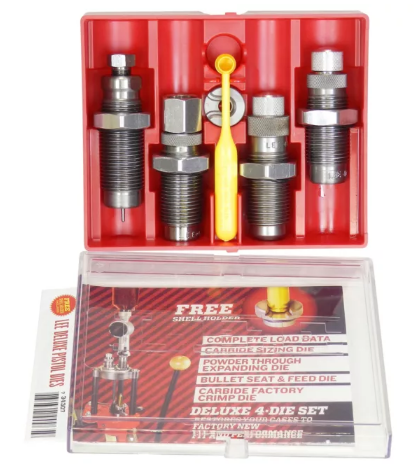
    There are two basic style cartridges: straight walled cases and cases with shoulders on them. Because of the different shape, properties of brass and steel we end up with two different kinds of dies: tool steel and carbide steel.

    Carbide steel is extremely hard making it prohibitively expensive to machine a cavity in the die to fit shouldered cases. You can get such a critter but when you see the price tag you will be purchasing tool steel dies. Because tool steel is not nearly as hard and kind of rubbery lubrication is requied to avoid having a brass case stick inside the die. These can be very difficult to remove and the die may be damaged in the process. This adds two extra steps to the reloading process: lubrication and subsequent cleaning of the cases.

    Dies for straight walled cases are usually fitted with a carbide steel liner. Because they are so hard and highly polished straight walled brass cases do not stick and slide right out with a polished surface. This greatly adds to the convinience of sizing spent cases back to size specifications. Always get carbide dies for straight walled cases.

    Of the manufacturers I prefer Lee Precision dies. Dies are full length threaded on the outside in 7/8×14 so that it screws into the press. This is pretty universal. There is a lock ring that rides on the outside of the die to set it firmly in the press. Lee is the only manufacturer that uses an easily replacable rubber O-ring to tension that lock ring. The other manufacturers use a set screw in the lock ring. That tiny set screw can become frozen and difficult to remove. It also sets against the 7/8×14 threads on the outside of the die and can damage them. Also, Lee dies are of high quality, low cost and combine several operations in single dies. Because some people prefer other brand dies but want the Lee style lock ring Lee will happily sell you as many of their lock rings as you wish to buy.

    All of the manufacturers produce high quality dies and I own at least one set from all of them. There is one more type of die worth noting. These are high-precision dies aimed at the long range rifle shooter. These allow for more precise sizing and seating of bullets, something we will discuss in a later article. The stand-outs are the Redding and Forster dies.

    If you are getting into benchrest shooting you would definitely want to shell out the bucks for some of these. I don’t have any because the dies I already have make ammunition that is more accurate than I can shoot anyway.

    This is a highly technical, tedious subject that is impossible to write about with inspiration. I will try to include as many tips and tricks I have learned over the years that you can’t find in any book so that those who intend to start reloading will be saved the time and trouble of learning on their own. I hope there are enough gun nerds around here that some will slog their way through and any other reloaders out there please add your tips in the comments.

  • Other Necessary Equipment – Reloading, Part 2

    Read Part 1

    This article is for informational purposes only. Suthenboy is not a credentialed expert. Do not attempt any of these activities without first consulting an expert or a manual published by accredited experts or manufacturers.

    The press is the heart of the reloading set but the beginning reloader will also need a good scale, a powder charger, a micrometer and a priming tool.

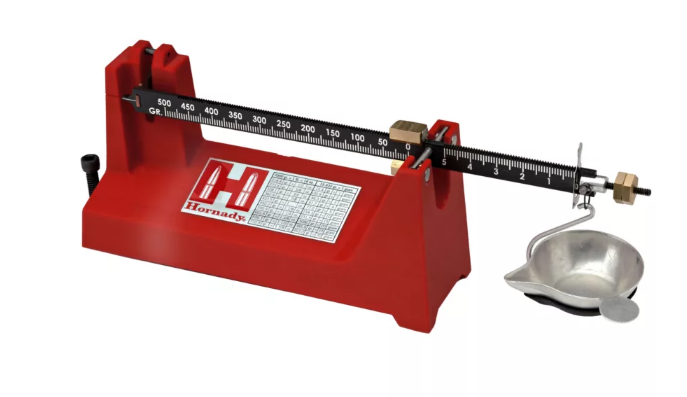
    Scales can be analog or digital but they must be calibrated in grains. The grain is an ancient unit of measure that originally meant the weight of one grain of wheat. Today it is defined as 1/7000 of a pound. As far as I know, the only people to use that measure any are in the firearms industry. My scale is a Hornady analog scale and is accurate to 1/10 of a grain. It cannot malfunction as it is a balance beam scale.

    There are also digital scales and powder dispensers with built in digital scales. I have never tried these but a lot of reloaders swear by them.

    A good micrometer can be had for a few bucks at any tool store. I recommend the dial type rather than the digital ones as they are easy to use and last much longer than battery powered micrometers. I also recommend one calibrated for inches as most calibers are measured in inches. Conversions are simple for metric calibers.

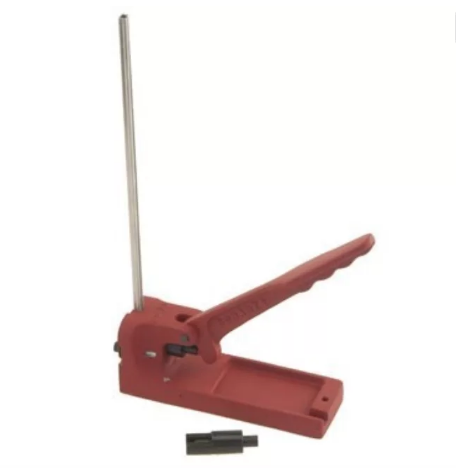
    Priming tools are another matter. There are many on the market and many presses have a priming function built in. It is important that primers be seated just below the base of the case and a good priming tool will do that in addition to allowing you to seat primers rapidly and accurately. You don’t want a tool that can mash a primer so hard that it ignites. After Lee precision changed the design of their hand tool it worked less smoothly so I switched to an RCBS which works fine for me but I am thinking of switching again to a Forster bench mounted priming tool. It is specially designed to seat primers very accurately without danger of ignition. It uses a tube style hopper instead of the pan style, which I like because it is easy to turn all of the primers correctly in a pan and then peck them up with the tube. Shell holders are not required and the bench mounted tool is easier on your hands.

    Powder dispensers can be fairly simple affairs or very complicated. I like simple. The old style has a hopper on top that feeds into a cavity drilled in a rotating block. The cavity has a piston style floor that can be moved into the cavity at various depths to adjust the amount of powder that can enter the cavity. When the handle is in the down position the cavity opening faces up and the hopper fills it. When you turn the handle down the rotating block turns and the cavity faces down, emptying through a small spout directly into the case which you hold under the dispenser in contact. The problem with these is that as the cavity opening passes away from the hopper on its way to the spout it can chop grains of gunpowder. This can change the weight of the charge slightly and also causes the gunpowder to burn at a different rate. It doesn’t really create danger but it does affect accuracy. This is a bigger problem with tube powders than flake or ball which means rifle powders where accuracy is more of an issue. A simple solution is to empty the case back into the hopper if you feel an especially hard chop as you move the handle. A better fix is the Lee Precision charger which is designed to not chop any powder grains.

    The automatic dispensers are much more complicated but easy to use. I have never used one, but I get good reports from the users.

    A couple of other tips:

    Your bench should be sturdy and large enough to mount your equipment on but not so large that clutter accumulates on it. Space has a tendency to fill up. If your bench is not too large it will be easier to keep clean and organized.

    A loading block is a cheap accessory that holds your cases in between loading steps so that they don’t get knocked over. It helps keep the process organized and you can keep a better eye on everything. You can get one for just a couple of bucks. Get one.

    A primer tray is another very cheap, very useful item. It is a small plastic tray with tiny ridges in it. Primers are placed in it and it can then be lightly shaken back and forth. As the primers slide around in it the open edges of the primers catch on those ridges and the primers flip to face all in the same direction. They can then be more easily loaded into the priming tool hopper.

    Clean cases are easier to work with and function better in firearms. You don’t have to clean your cases after every firing but after every second or third loading is a good idea. Most hardware stores sell vibrators for cleaning tool parts and the reloading suppliers sell them. Pick up a vibrator and some crushed walnut shell so you can keep your brass clean. These also help reduce corrosion if you store loaded ammo for long periods of time. Always use the vibrator on empty brass, never on loaded cartridges. Vibrating loaded ammo will damage the powder grains which will greatly increase its burning speed creating dangerous pressures.

    If the Lords of the Glibs keep publishing these next time we will go through dies and toss in more tips and tricks.

  • Beginning Reloading

    Read the series

     
    This article is for informational purposes only. Suthenboy is not a credentialed expert. Do not attempt any of these activities without first consulting an expert or a manual published by accredited experts or manufacturers.


    I developed a passion for shooting and hunting at an early age. I suppose my Grandfather’s and Father’s love of firearms rubbed off on me. Shooting for me was what golf is to others. It is an activity that requires discipline, an activity where focus and precision pays off. I constantly competed against myself always trying to improve and over time with effort the improvement was very evident to me. Like most the majority of my shooting was done with 22 Long Rifle because of economy. When I was about 14 years old my father gave me a wonderful Christmas gift – a Lee Precision handloading set and a Ruger No.3 rifle chambered in 22 Hornet. Suddenly I could shoot center fire for less than the price of 22 Long Rifle.

    Since that Christmas, I have reloaded hundreds of thousands of rounds, maybe approaching a million and a half, in every caliber you can imagine, save the new-fangled rounds that have come out in recent years. Yes, I said it. Get the hell off of my lawn.

    Since those days our economy has expanded dramatically, the cost of reloading components has risen and the cost of bulk ammunition in common calibers has fallen. For plinking ammo reloading is not as economical as it used to be but reloading still has an important place. Uncommon calibers can be exorbitantly expensive and difficult to find. Precision rifle shooters cannot obtain the quality of ammunition their sport demands off the shelf. For people like me, reloading is a very enjoyable hobby and an end in itself. With experience one can acquire one heck of an education about the sport, and with a small stock of components and tools never lack for ammo in a pinch.

    Many people, like me, got their introduction to reloading with a Lee Precision handloader kit. It is simple to use and at about forty bucks the smallest outlay of cash to get started making your own ammunition. I haven’t found any distributors for these little gems but you can buy them directly from Lee Precision.

    I am not aware of any other companies that fill that niche but if you want to step up to more sophisticated tools there are many manufacturers. The big names are RCBS, Lee Precision, Redding, Lyman, Hornady, Dillon, Forster and MEC. All of these companies have websites (links above) and are distributed through a large number of suppliers. I am not going to make strong endorsements for any of them because they all make quality products that are better in some ways than the others. Like choosing a firearm the beginning reloader will have to decide by their own personal preferences.

    As for distributors there is a plethora of them. If you prefer shopping in-store Bass Pro and Cabela’s keep a good stock on the shelf. There is also the odd and end small sporting goods stores around. For mail order there are number of large houses for comparison shopping. I find that their prices are very competitive, their stock reliable and their service top-notch. These include Midway USA, Wideners, Brownells, Precision Reloading, Natchez Shooter’s Supply and Cheaper Than Dirt. This is by no means a comprehensive list.

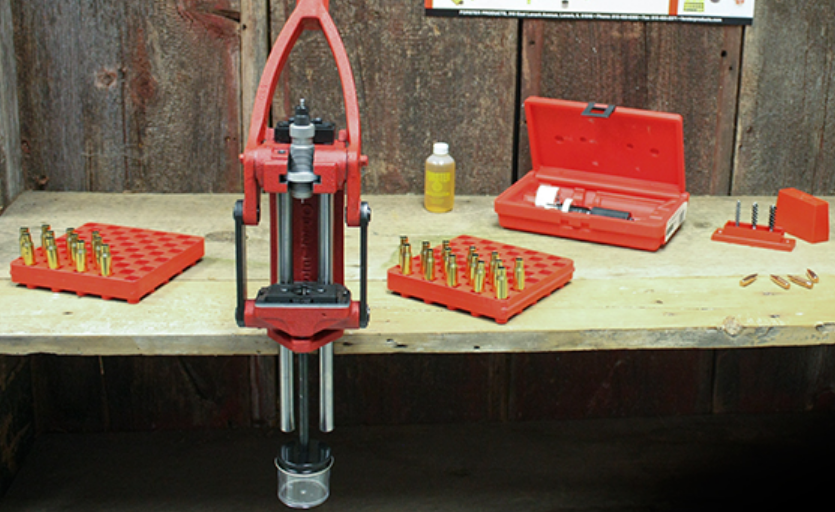
    The first step up from the Lee handloader kit is a single stage press. This press bolts onto a sturdy work bench and holds one die at a time. There are some very high quality single stage presses out there and these happen to be my personal favorite. I can concentrate on one step at a time and pay close attention to every detail. My personal press is a Forster. I consider it of the highest quality. It also has great advantage in convenience as the dies are held in a groove so you don’t spent time screwing them in and readjusting each time you change dies. Additionally it has clamping jaws to hold the cases so no large sets of shell holders are needed.

    Forster co-axial press
    Forster co-axial presses are not cheap but definitely worth every penny for the hard core reloader.

    The next step up from the single stage press are multi-stage presses. These presses hold more than one die at a time and each crank of the handle performs one step of the process on multiple cases as they progress around a turret. Spent brass goes in one end and a fully loaded case comes out with each crank of the handle. Obviously these presses produce loaded ammunition for the high volume shooter.

    The last step up would be motor powered presses. Many of the manual progressive loaders can be accessorized with motors and by now we are talking about high budget equipment. Dillon is commonly considered the top of the line motorized progressive loader and most competitive shooters use them but there are others that work well.

    I have a progressive loader but I prefer to use my single stage press. With the multi-stage press there are too many things going on at once for me to fully pay attention. If you are a novice intending to get into loading your own ammunition I highly recommend starting out with a single stage press. Safety must always come first so take your time. Don’t get in over your head. When you have learned all of the ins and outs of the loading process and all of the things that can go wrong then move up to a multi-stage press.

    Addendum

    A recent study showed that CCL holders are six times less likely to commit crimes than police officers.

    There is a reason for that. These are people who are law abiding by nature and interested in keeping their licenses. I suspect the same is true for reloaders. These people pay attention to detail. They follow the rules. That becomes second nature to them. Safety is a huge concern and they become accustomed to thinking that way. If you program yourself to behave that way reloading can be safe and rewarding. Never forget and become careless or have lax standards. You are dealing with inflammable materials that can develop very high pressures very quickly. Bullets, even travelling at low speed have incredible momentum. They carry more energy than you think even at speeds low enough to see with your eye. A relatively light lead slug travelling at the speed of an airsoft pellet can be deadly. You can lose eyes, fingers, get broken bones or severed arteries. You can receive severe burns. If you have a store of gunpowder in your reloading area, depending on how much, you might want to consider that if your house catches fire you may have to stand in the street and stop the firemen from approaching the structure. Let it blow. Nothing in your house is worth someone losing a life over. I threw all of the candles out of my house years ago. I don’t smoke in my reloading room.

    Safety. Safety. Safety. Always on my mind. In the forty years or so that I have been reloading ammunition I have never had a single failure. Every single cartridge I make is done with great care. I own about a dozen fire extinguishers. Kitchen, living room, Jeep, Honda, bedroom, garage, outside shed, mule, and two extra bedrooms.

    Don’t be that guy. Be Safe. Stuff can be replaced. People can’t be.

  • On Political Extremes (And What to Do About Them)


    A Polarizing immigrantIt seems the word of the last two years, if not the last decade, is “polarizing.” The media runs countless stories about how polarized the country has become, with each segment of the media casting political opponents as the cause of the polarization. I do not deny that some people in our society espouse extreme or outrageous viewpoints; such is a known risk when freedom of speech and freedom of conscience make up the framework of our governing philosophy. But despite a few oddballs and whack jobs, I think we find that most people, whether conservative or progressive, hold beliefs that are not irrational. The polarization, then, comes from opponents misrepresenting the other side’s views to their own bases. So rather than finding common ground to have a dialogue we are left with hysterical screaming in defense of or against some view or another. This is my attempt to cut through some of the screaming to help each side understand the other a little better in three specific areas: immigration, education, and wealth/poverty gap.

    I read a story like this about MS-13 attracting girls to their ranks–and yes, it’s Salvadorans and not Mexicans–and the very real truth is that there are violently-minded people illegally immigrating to the United States. To deny that is naïvete at best and utter mendacity at worst. Some of these girls are driven to MS-13 or affiliated gangs because of some past trauma, but only a dyed-in-the-wool progressive would argue that assimilation to American culture radicalized them.

    Still, not every immigrant that comes to this country illegally is ready to behead someone or stab a man 153 times with fellow gang members watching and laughing. In fact, many come here in spite of the danger that illegal entry presents because the opportunities continue to be far better than what they can achieve in their countries of origin. Even the risk of deportation and a lifetime ban from re-entering the United States (which means leaving other family and even offspring behind) does not deter many who just want to provide for themselves and their families. A new documentary series on Netflix called Ugly Delicious, produced by renowned chef David Chang, explores this very issue in its second episode on tacos.

    In a similar vein, but on the topic of education instead of immigration, my wife and I were discussing some of the students in her class last week. She seems to have quite a few bad apples this year, but one girl in particular stands out. This girl failed sixth grade last year and was actually held back to repeat the sixth grade again (shocking in Chicago Public Schools!), and is now in danger of failing again. My wife says the girl’s mom has to work 2-3 jobs and crazy hours just to provide for her daughter, and the mother was in tears about what to do since she can’t be home to watch the girl do her homework every night. The girl attends a magnet school but chooses to hang out after school with kids that go to the much worse neighborhood school. Basically, the girl is a textbook case of total apathy toward education (and life in general), even with a mother who wants her to become something more.

    Many people believe education is so important that it should be provided for free to students at taxpayer expense. And I agree that education is vitally important. But progressives who demand public subsidizing of education deny the existence of students like the one in my wife’s classroom. When my wife has to focus more attention on this girl and other students who are not interested in learning, it holds back the potential of many others in the class. The “Education is a Right!” crowd would have us believe that every student has an innate desire to learn and the only thing preventing them from doing so is a lack of money or profit-seeking charter schools. (In fact, the latter may actually address the needs of apathetic students more by giving them a school to be proud of. See The Ron Clark Academy, for example.)

    I think the other side, however, plays up the apathy or entitlement a bit too much. There are plenty of students who grow up in homes where education is not valued, but with the right teacher or educational environment they could thrive. Unfortunately, our system rewards teachers based on tenure and not on merit, creating a structure that chews up and spits out young and inspiring teachers who can reinvigorate apathetic students with a passion for education. Meanwhile, thousands, tens of thousands, or even hundreds of thousands of jaded teachers clock in at 7:30 and clock out at 2:30 just so they can collect a paycheck and employee benefits that are funded by the taxpayer, and care little for the time and attention it takes to nurture a student’s desire for learning.

    With public education, most families are at a complete loss when assigning value to their kids’ education because they do not have any direct costs. On the other hand, they know how much their groceries cost; they can see how expensive refueling the car is. They even know, for the most part, how expensive a new car or cell phone is (although there are a lot of hidden fees in those contracts that can ensnare the unsuspecting buyer). But when it comes to education, people have accepted the belief that education is “free,” and therefore they assign no value to it. It’s just something one has to do, going through the motions from K-12 and beyond because society tells us its important.

    A final example of the polarizing extremes that people ascribe to their opponents comes from personal finances. One side believes that all wealth is inherited and every millionaire only got where he or she is by stepping on others. Dave Ramsey, on his national radio show, disproves this theory regularly with a segment he calls “The Millionaire Theme Hour.” He asks millionaires–those whose net worth is over one million dollars–to call in and asks a series of questions about how they obtained their wealth. Only a tiny fraction of callers received any inheritance, and for those who did it was a paltry sum from a family member who died well after they were already self-made millionaires. By and large, the secret to success is, wait for it… spending less than you make!

    The other side, however, categorizes the poor and downtrodden as lazy, dumb, or victims of divine judgment. There is a common perception that because most successful people have pulled themselves up by their bootstraps, anyone who is struggling must not be working hard enough. Although free markets and laissez faire government offer the best economic opportunity for people to rise from nothing to something, reality intrudes on that idealistic worldview in that some people just get bad breaks. Whether they are immigrants whose options are limited because of their legal status, or they come from a family of under-educated individuals, or they just have unplanned expenses continue to assault their monthly income, life has plenty of people who can’t get ahead.

    Ultimately, the solution to all of these situations–immigration, education, poverty–lies not in either of the extremes, but in looking past the collective and at the individual. A system that cares more about enabling hungry, driven, and dedicated individuals to thrive will prosper far more than one that seeks only to sustain a lower class in poverty. If we focus on providing incentives to make good decisions rather than making decisions for others, we will prosper. This means that some people will continue to make bad decisions, and we have to be okay with that. We–as individuals–can show them grace; we can show them compassion and mercy; we can even show them charity and generosity. But if we–as a society–continue to enable people to coast instead of strive to succeed, everyone suffers.

  • Education


    One of my family members is an online instructor that teaches classes to UN refugee camps around the world.  I respect this person very highly, so when he sends me an email with the title “What Kind of Legacy are We Leaving You?” I feel compelled to engage in the discussion.  His students were to read an excerpt from Viktor Frankl’s book “Man’s Search for Meaning”, Plato’s “Euthyphro”, and to describe their own search for meaning.  The email he sent to me consisted of one student’s response.  The student is not a native English speaker and relayed his experiences outrunning war in Africa and the Middle East.  I am not going to write the entire message here but focus on a question the student asked in response: “Let me ask a question, does it mean that from all the way back to thousands of years ago education has done nothing to stop wars?”

    This is a sentiment that I started to wonder a little while ago. I enjoy reading about world history and economics and a repeated theme is the idea that we have come so far, we are so educated, that surely this time we’ll get it right if we just have the right people in charge. This time our society will be perfect, a Utopia. It’s a common theme in dystopian novels but frequently reflected in the speeches of many people who consider themselves to be revolutionaries.

    Or, y’know, your Utopia

    And yet, within a few short years of uttering this sentiment, those societies tend to collapse, almost always violently.

    Surely the next time we will be more educated. We will get it right. We just didn’t have the right people in charge or some “other” ruined the dream.

    It almost implies that education bestows a moral high ground. If we were more educated, we wouldn’t have so many wars, people wouldn’t starve, and we could get the best and brightest to solve our problems. In many ways our increasing knowledge has alleviated much of human suffering to those who are the beneficiaries of it. Crop yields have increased several times over because of what people have learned and the technology that came with it. In stark contrast, education also creates the most terrible weapons of war.  Atomic bombs can wipe out the same population that those increased crop yields can support.  It has struck me as an interesting dichotomy.

    If education implies morality, then being uneducated must mean that you are little more than a barbarian, and yet we know that that isn’t true, either.  Many of us have grown up with or have met many people in our lives who would be considered uneducated but are the most wonderful people to be around.  In stark contrast stands the individuals who would lord their education levels over others in search of that distant Utopia.  This, of course, is not always true and is not meant to be a generalization of either educated or uneducated individuals.

    The implication isn’t that we are pursuing the wrong means for Utopia. The implication is that we can’t escape our base instincts except by conscious choice, and even then, we cannot force others to accept it without conflict.  His question neither condemns nor condones education. To me, it succinctly illustrates human nature. Education is another tool mankind has created. It cannot bring us any closer to the Utopia we so desperately desire, but if we recognize that we cannot truly escape our instincts, we can use education to help each other in greater and more fantastic ways, as human beings have always done.