Category: Economy

  • From Asteroids to 3-Day Weekends

    I’ve had some thoughts on how our civilization should already be having 3-day weekends at the least, in perpetuity. Usually these thoughts are output from a brain lubricated by adult beverages, and are spouted to others likely lubed, who assure me that I make complete sense. Sober reflection on these ideas has not been easy, putting them in some kind of logical order nearly impossible. A stream of consciousness is my best option, as usual…

    I often wonder why, as time has slugged along, with all the labor saving technology and increased division of labor, we went from single income households to dual, rather than to the lone-breadwinner-of-yore’s having to work less hours while maintaining his/her/their/its standard of living? How do we convert our technological advances into the laid back, gold backed, paradise of a Galt’s Gulch, sans the holographic projection head in the sand BS?

    Given, we have better standards of living and more stuff now than “back in the day” – cell phones, video games, computers, jet skis, etc. – and most everything is now generally safer and better and thus more expensive relatively. Is that solely what’s taking up my extra money, money that could be converted to leisure time? Of course not.

    There’s insurance, that oft mandated fave of crony capitalists, to use as a tool to transfer wealth to the unproductive. We all know the obvious fixes for that mess.

    There are the insane levels of gubmint spending, most of which go to unnecessary bureaucracy. It’d probably be cheaper just to put all those leeches on welfare rather than making shit up for them to do. Or just eliminate the jobs. Either way, if I had only to pay 10% in income taxes rather than 30%, I’d be freed from 2.7 months of slave labor each year! That should at least allow me to work 4 days per week as opposed to 5. 3 day weekends achieved!!!

    And I imagine the end of scarcity economics, especially with the upcoming mining of asteroids. As the prices of things decrease, will we just consume more, buy even more stuff to utilize our disposable income? Will gubmint reg’s increase and the cost of things go right back up with them? Will the gubmint tax/enslave us more, knowing the productive can afford it when the prices of goods are falling? Will we keep the productive peeps working the status quo 40+ hours a week while the headcount of welfare recipients rises as less and less labor is needed to keep civilization running?

    Most likely, the answer would be a combination of all, as the various ambitious incompetents hustle to jack their pie.

    In this context, I could see a Universal Basic Income as an interim step to spreading out the leisure that should come from the end of scarcity economics and from ever increasing productivity, until the prices of life deflate and a new economy is normalized. This however, assumes our society would recognize that a new economic situation was evolving into existence; and that *leisure time, rather than wealth, should be distributed.*
    (Not to say that anything *should* be distributed, as in forced, but getting from hither to thither, from our current situation to Libertarian paradise, naturally wouldn’t happen instantaneously.)

    As I see it now, my increased productivity – due to whatever factors – doesn’t result in my having to work less hours. The nonproductive, via gubmint sanctioned/administered theft, are taking it and converting it into leisure time for themselves. I want it back!!!

  • 8 Forms of Capital or Why Equality of Outcome is Impossible

    One of my favourite Canadians, the Canadian Mike Rowe (Curtis Stone) introduced me to an interesting concept that solidified in my mind why equality of outcome is ridiculously impossible.


    Curtis pulled this from a book that I haven’t read, but he cites it in the video if you’re interested. Frankly, the concept is a bit hippy-dippy for me, so you may see a bit of measured skepticism from me.

    The premise of the video is that there are 8 forms of capital:

    Financial capital – money

    Material capital – non-liquid assets

    Living capital – plants/animals/ability to cultivate plant and animals

    Social capital – relationships with others

    Cultural/Power capital – things your community values, tradition, powerful connections, reputation

    Intellectual capital – book knowledge

    Experiential capital – practical knowledge

    Spiritual/Habitual capital – religious attainment, unflappability, disposition toward success

    My broad definition of capital captures all of these. Capital is a thing of value that is able to be bestowed upon others in an exchange. You can group these categories into three main groups. Asset Capital  – (Financial, Material, Living), Human Capital (Intellectual, Experiential), and Relational Capital – (Social, Cultural, Spiritual). I’ve sort of modified the spiritual capital category to include non-spiritual habits. I think it’s a bit of a stretch to call spirituality a form of capital, so I’m bolstering it. Similarly, I’ve bolstered cultural capital to include reputation and powerful connections such as exists when you’re a government representative, for example.

    The reason why equality of outcome will never happen is simple. You can only confiscate and redistribute asset capital. It is impractical to the extreme to redistribute Human Capital and Relational Capital.

    A prog may argue, however, that it doesn’t matter. The only “real” capital is Asset Capital. So, they go full commie… from each according to their ability to each according to their need, and we’re all now on exact equal footing asset-wise. How long before somebody with more human and relational capital trades something of value for some money? Now that person has $10 more than the rest of us and one less chicken. How long before the carpenter lends his services to me, takes my tree and returns me a finished table in exchange for $100? It’s not long before the communist utopia turns into a mess of inequality and oppression again.

    It comes down to a basic truism. Knowledge, relationships, assets, habits, and power are all of value, and they’re all interrelated to one another. Just like a loom increases the value of a textile worker, non-asset capital increases the ability of a person to acquire asset capital. After all, rich people do rich people things and poor people do poor people things. When a poor person wins the lottery, they’re as likely as not to be broke within a few years.

    I don’t know if I fully believe in this model. Calling things like traditions and religious attainment “capital” seems a bit wonky. However, this exposes a basic truth. Equality of opportunity will, by definition, result in inequality of outcome. We each have a unique mix of these 8 categories of “capital”, and even when presented with the same base set of laws and opportunities, we will apply our “capital” differently from one another. Equality of outcome is exposed as the soft bigotry that it is. It’s a forced leveling, a social engineering to subsidize those who have less human and relational capital and to punish those who have more of it.

  • Illinois- Why We’re Well and Truly Fucked

    In thermodynamics, we have three laws, which can be popularly and accurately summed up as follows:

    First Law: You can’t win, the best you can do is break even.

    Second Law: You can only break even at absolute zero.

    Third Law: You can’t reach absolute zero.

    And that sums up Illinois’s finances. I spent a day reading through some wonderful and depressing information at the Illinois Policy Institute’s website (www.illinoispolicy.org) and would suggest you do the same, even if you aren’t stuck here like I am: it’s a cautionary tale. I’m just going to toss out a few illustrative highlights I’ve dug up there, which will (I hope) inspire people to look further. And it gave me some good rocks to throw (metaphorically) at our Assembly candidates.

    Illinois’s woes are legendary, numerous, and well-documented. I’m simply going to list a few highlighted facts, which lead to the unfortunate and inevitable conclusion: we’re spiraling down the toilet and there’s no way to stop it. The root causes are baked in and, as a practical matter, immutable.

    As you’d expect from a state known as The Cradle of Graft, there’s an amazing amount of money lost to corruption. I found story after story showing hundreds of millions of dollars wasted in useless projects, subsidies, payoffs, kickbacks, legal expenses for police abuse, you name it. But all of that doesn’t even make page one of the Pareto chart.

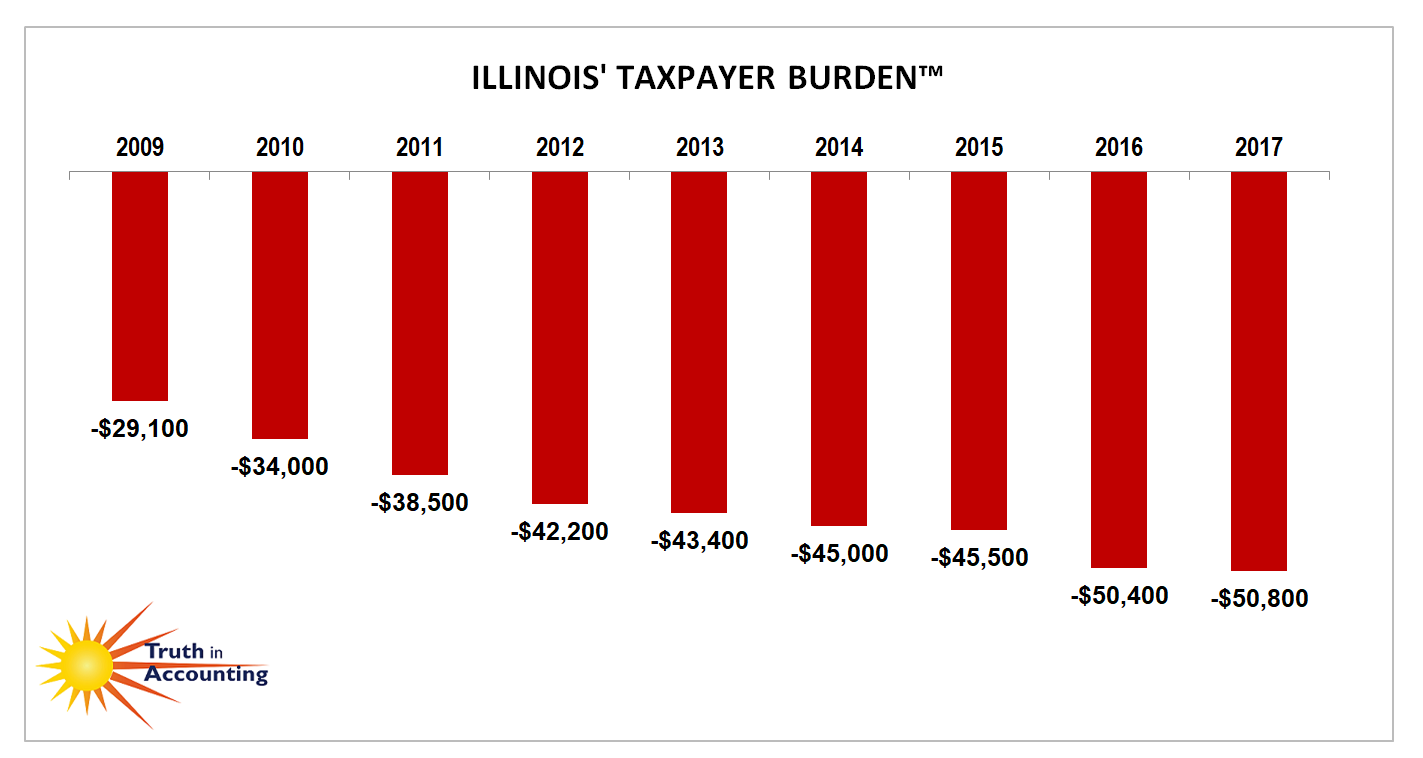
    Illinois’s debt is over $200 billion, with state assets of about $20 billion, and this doesn’t even count local debt, which adds another $100 billion onto the flaming pile. This breaks down to over $50,000 for each and every taxpayer in the state. So you can see that the Three Stooges of How We’re Going to Fix Things beloved of politicians giving speeches (“Waste, Fraud, and Abuse”) are down in the noise; $100 million dollars doesn’t scratch the surface. The tax increases that have been proposed (which will somehow magically not drive people and businesses out of the state at a faster rate than they’re already exiting) aren’t even close to enough to cover this debt.

    Well, how about cutting spending? Let’s look at that a bit, starting with what we’re spending the money on.

    Far and away the biggest cause cause is well-known: public employee pensions and health insurance benefits costs. How bad is it?

    Here’s a delightful graphic which just looks at one typical municipal issue, cops.

    Though there’s variation from county to county, the pattern remains the same.

    How about fire?

    So again, the pattern is clear. If we cut every single penny of cops and fire protection spending, closed every police stations and fire house, and could somehow get around the unions and fire every worker, we would STILL be vastly underwater. There’s nothing unique here; there’s similar charts for teachers, nurses, clerical, administrative, and every other type of state leech employee classification.

    The debt, pension and health insurance costs for retired state workers represent over $185 billion, or about 85% of the Illinois debt. It cannot be stressed enough: this is for people who are no longer working. You could fire EVERYBODY currently employed, cut every goddam program (good or bad), shutter every building, and barely dent the issue. These deals were put in place by the generations of family politicians who have run the state and municipal governments, the Daleys, the Madigans, the Stevensons, the Simons, the Jacobs… all enriching themselves and their hangers-on, while pulling hundreds of millions from the fabulously corrupt unions to indebt all the rest of us.

    So since we can’t tax our way out, we can’t reduce spending enough to make a difference, I guess there’s only one thing left to do: cut the pensions. Oh wait…

    Membership in any pension or retirement system of the State, any unit of local government or school district, or any agency or instrumentality thereof, shall be an enforceable contractual relationship, the benefits of which shall not be diminished or impaired.

    The above is Article 13 Section 5 of the Illinois Constitution. That’s right, it’s in the fucking constitution that we can’t touch the vast bulk of where the money is pouring out. If you want to cut even a dime of the vast sums of money being spent on people who aren’t working , you have to amend the constitution. To do that, there must be an affirmative vote of 2/3 of the House of Representatives and the Senate AND then be approved by a majority of voters on a special election ballot, most of whom do not pay the bulk of taxes. This is de facto a nearly impossible hurdle.

    So we can’t win, we can’t break even, and we can’t get to absolute zero debt. The politicians running who pretend to have ways to fix things and to help taxpayers and property owners are lying scumbags. We are all fucked. Like so many others, I’m doing everything I can to get the hell out of here.

    I will not miss this place.


  • Creosote Achilles and the Perils of Potrepreneurship

    In the fall of 2017, the outdoor cannabis harvest was a bumper crop for growers throughout the state of Oregon. This epic weed haul was the result of two factors; weather, and bureaucracy. The weather was spectacular for growing cannabis, particularly outdoors. A wet fall, winter, and spring (nearly 220 straight days of rain) meant there was plenty of water available. And the summer was warm and dry. Conditions that are favorable for growing trees with plenty of flower on them. The sunshine helped to ensure that flower would be potent. The other cause was bureaucracy. Normally inimical to the production of any good or service of value, on occasion bureaucrats manage to step on their dicks in such a way as to help the actual productive class. Such was the case in 2017 with the OLCC (the Oregon Liquor Control Commission).

    The OLCC is the regulatory pseudo agency (much like the fed it is a non-government organization with a government mandate) responsible for enforcing Oregon’s pot laws. In 2017, the OLCC declared open season for anyone with a license to grow marijuana when it announced that “due to a lack of allocated funds, enforcement efforts will primarily be focused on those growing cannabis without legal license to do so and on those with a recreational license. However, next year will see increased enforcement for medical growers.” In plain English and practical reality, this meant that as long as you had a medical license you could grow as much pot as you wanted. The statutory limits on the number of plants one could grow was out the window. Worst case, if you were caught, they’d cut down plants of your choosing until you were down to the legally allowed number. Every grower was growing as much pot as he could get in the ground that summer as cuttings are cheap.

    Fields of Green

    The resulting harvest was huge. And while the left may not understand or believe it, the laws of supply and demand are iron. If supply is greater than demand, the price falls until an equilibrium is reached. And the result was The Glut. A situation where outdoor weed wholesale prices fell as low as $300 per pound. If you could find a buyer and had good enough quality weed. There were rumors of weed going as low as $100/lb but that had to have been either exaggeration or for some really ditch weed bullshit. Either way, that was the first bump in the road.

    Once the harvest was in, properly dried and cured, and finally trimmed and packaged up, we had enough product that once The Glut ended we’d be able to fund our next phase. Right where we need to be to build our indoor facility and go through the process of getting the rec license that would allow us to expand. That’s where the next bump in the road occurred. We just need to wait for The Glut to recede and the price to come back up to our floor of $800 to $1000/lb. While it would put a crimp in our timeline, waiting even six months wouldn’t be catastrophic.

    An aside; indoor and outdoor pot flower are of differing quality. Indoor is higher quality and fetches a relatively higher price. But outdoor is far cheaper to produce and the aforementioned conditions were conducive to outdoor pot production. In 2017 we had both indoor and outdoor operations.

    End Product

    My business partner was impatient to take the next steps however, so was looking to expand beyond our established channel of buyers to sell all that outdoor product. The short version is that the buyer was a scammer that my partner thought he knew but didn’t. My partner took his stepson with him to the transaction, verified the guy had a med card, and gave the stepson the cash to count, made the transaction “selling” 80% of our harvest, and the best quality at that, and they left. Only to get home and discover the money was, as he texted me, “counterfeit.” I didn’t hear from him for 3 days and when I finally got the full story I have never been closer to murder than I was at that moment.

    Turns out the money wasn’t counterfeit. It was movie money that looked just this side of monopoly money for verisimilitude. I wasn’t even mad at the scammer (whom my partner didn’t even take a picture of the guy’s med card or his license plate and only had a phone number that of course turned out to be a burner). I mean, the balls to try that and get away with it? But my partner and his idiot stepson? Yeah. Them I was furious at.

    Does that look like legal tender to you?

    Anyway.

    As of February, we had only 20% of our harvest, The Glut was finally receding, and we were at a crossroads. We came up with a last-ditch plan of selling that final amount to finance continued expansion of existing indoor med operations of high THC plants, and to get legal for growing outdoor hemp as we did have a legit buyer for hemp flower by that point for processing for CBD products. Those funds from a large hemp harvest could then be leveraged to do the build out for a rec license grow. As described in my previous article, a rec license allows a much larger size grow operation than a med license.

    Another digression: Marijuana and hemp are the same plant, save that hemp has been bred primarily for its fibers in the stalk and has only trace amounts of THC but plenty of CBDs, even in the flower. Marijuana flower contains both, and various strains have various proportions. THC is what gets you high and CBDs are the actual medicinal chemicals, especially for seizures, muscle & joint problems, pain, and anxiety. CBDs also don’t get you high and won’t, generally, show up on a piss test. Getting licensed for hemp is far less expensive than getting a rec marijuana license and you can grow as much as you like. There’s a fee for a 2-year license and you must have proof that the plants are hemp and not marijuana, and that’s it. Far easier compliance and we have enough acreage on the farm it could be quite lucrative. THC flower is usually more valuable, esp. indoor grown. But there’s potential in CBDs, especially with hemp as the input costs are way lower, the regulatory burden is lower, and the labor costs are lower offsetting the lower sales price one can get per pound.

    Unfortunately, due to the remainder being lower quality and The Glut being so epic, it took a long time to move that product. The revenue hasn’t come in fast enough to buy the hemp plants needed to get the hemp license or get them in the ground for a spring or summer crop. The flow has been a trickle; just enough to keep the lights on and pay the basic bills while expanding the amount of indoor plants we can grow up to the legal limit for the number of med cards we have. There’s an outside shot that by next spring there’ll be money for hemp. But I don’t see it.

    The result is that two months ago I washed my hands of it and told my partner that as long as he kept things legal and he paid the lease payments on time for the farm, he could keep going, but that I was done being actively involved. I started looking for a job and found one. I started that the last week of June and I’m enjoying it.

    The saving grace, from a financial perspective, is related to the legal technicalities on having a rec license and the land we purchased for the business. The land use regulations related to marijuana are somewhat convoluted. There are both county regulations and state regulations. The state regulates the maximum square footage of flower canopy one can have per rec license. It also insists that no individual or entity may have multiple licenses on the same tax lot. The county regulates the zoning for tax lots, which determines whether you can grow indoor, outdoor or both. It also sets a minimum size for a rec license. Usually 2-5 acres. Further, to obtain a rec license, one must prove water rights. If they aren’t already registered on the deed, this isn’t as simple as digging a well. One must obtain those rights through a process that takes 1-2 years.

    To give an example. If one purchases 40 acres in a county where the minimum size for a rec license is 4 acres you may not, then obtain 10 licenses from the OLCC. You can obtain one and lease out the other nine to other folks with a license. But if you want a second license you must buy another tax lot somewhere. Many of the larger operations are buying 5-10-acre plots with proper zoning building a minimum size rec grow, and then offering the rest as turnkey, then buying another parcel and repeating. That was part of our plan. But the number of parcels that are properly zoned in counties with relatively simple regulations is small. More importantly, the piece of land we bought has county water and therefore automatically has water rights.

    The land is valuable in and of itself. And the land is in my wife’s name and my name. It’s appreciated about 20% in value since we purchased it. And the company is leasing it from my wife and me. So worst case we have a valuable piece of property that has a current market value that is keeping pace with the rest of the money we invested and then some. Also, it’s a good place to go shooting whenever I want. We may even just keep it and build a country house as a retreat there.

    I learned my lesson. My next startup will be a side-hustle that I build until it replaces a significant portion of my income. I’ll have no partners, only employees, or minority ownership stakes if I need someone with special skills, but not a partner. And while I’m probably out $20-$40k counting lost income, it was worth the gamble as it was money I could afford to lose. I don’t regret taking the chance, though, and I learned a great deal about myself and managing people, and just how tough it is to start a business. I’ve always admired folks who run their own enterprise, but I do so even more now that I’ve taken a shot at it.

    End Note: I appreciate all the interest and encouragement as well as kind words. It’s helped immensely. This place really is a community.

  • Funding Libertopia – a gedankenexperiment

    Introduction

    For those of you of an AnCap mindset, this article is probably not of much benefit. But for those of us that think a minarchy is necessary (and sufficient), the discussion of how to fund a micro-state is of more interest.
    Also, yes, this will be, in large part, a discussion of the Single Land Tax (SLT.) This is not the article on the SLT that I promised a year ago, but this is the one you are going to get. At least for now.

    Recent discussions of the SLT have got me thinking in different ways and led me to what I needed to do. it’s the answer to almost every problem: DO THE MATH

    The Auction

    I. Let us start with the premise of this thought experiment. A group of libertarians discovers a previous unfound island or planet or whatever. Either way, whether on sea or through space, I am pretty sure the ship is named Der Sausagefest. This land is entirely undeveloped. Their established minarchy will never spend any money it does not already have in its coffers. The land needs to be divided in a just manner. So they decide: We will divide the land into parcels and auction off the parcels. However, the auction won’t be for the price of land, the bidding will be the amount of land tax you (or any future owners) are committing to pay on the parcel each year going forward for all eternity. The land itself will be free, and come with complete property rights, except for being encumbered with the tax.

    There shall be one exception to the eternal nature of the tax: if the owner wishes to, he may forfeit the property back to the state for re-auctioning. He may decide the tax is too damn high and try to “buy” It back at a lower tax. Or he may just decide he doesn’t want it. Whatever.

    The libertopian state will have a fixed income based on the initial auction. As it is sensible, the currency will be something like gold that is stable over the long term and so inflation won’t be a problem.

    II. Why an auction for the tax amount instead of selling the land? Technically, they are the same thing. The price you would pay is equal to the present value of the future cash flows of the property. And the same for the tax stream, the amount you are willing to bid is a stream with the same present value. But I can think of 3 reasons that the tax is better than an upfront cost:

    1. I don’t trust any state, even libertopia, with a large sum of money. Better to give them an annual income than a lump sum.

    2. While the state could turn around and invest the money, generating the same income stream as the tax, that involves the state choosing investments. We have seen how well that kind of thing works with CalPERS, for example. We don’t want the state choosing winners or losers or getting some PC thing going and divesting from the hookers and blow industries.

    3. This one is a little weird, and if you want to discount it, so be it. But the make-up of the initial libertopians may be diverse. Some will be flush with cash, others may be poor. While the poor could get a mortgage to pay the initial cost, that adds a level of risk that would lead to lower bidding by them. I find the stream payment to be more equitable.

    I see the obvious argument against the tax vs initial purchase price idea. The former is effectively an eternal mortgage, while the latter is over and done with. But as they are mathematically equivalent, I don’t see that as an actual issue. As I said in the introduction, we have to do the math.

    Application to Real Life

    I. None, probably. But I was thinking about it for two reasons. First, the recent discussion in which UCS and RCDean questioned the reality of imputed value. The fact that someone will pay for undeveloped land shows that imputed value or economic rents or whatever is a real thing. Even in my scenario, people would bid a positive amount for the plots, which implies that the imputed value is, in fact, a real thing that they do value.

    The second, and possibly more important, reason was that I have been thinking about what a land tax would due to the resale price of unimproved land. I came up with an answer but didn’t really like it. Hence, I had to do the math. And this gedankenexperiment was the result of that. A properly valued land value tax that was exactly at the value of the economic rents (no more and no less) would reduce the resale price of unimproved land to zero.

    That isn’t actually a real life situation though, as “unimproved” land is all but non-existent. Think about an empty lot in a neighborhood. Is it unimproved? Does it have a road bordering it? That is an improvement that increases the value of the land. So is a functioning court system. And deeds that can be trusted. And national defense. While they aren’t DIRECT improvements to the land, they all increase the value of the land. Being secure in your ownership is an improvement.

    In fact, it might even be a flaw in my gedankenexperiment. The landing of the spaceship Sausagefest may have improved the land. But it’s a small enough improvement that I stand behind the results.

    II. So how do we get from here to there? We really can’t. Without a tyranny, we can’t take all the land and auction it off. The land has improvements anyway. It would take a series of nukes to unimprove the land. The good thing about the auction was it valued the land tax properly. If we implemented one, it wouldn’t be done that way. A rate would be set, valuations would be calculated, and a crappy fiat money system would be used that wouldn’t allow anything like a stable pricing system. Humans would be involved and they screw everything up. Plus, people did pay for their land, and some of them oppose the idea of having to pay rent on it forever, too. Even if it did mean getting rid of every other form of taxation. Like any change in the tax system, there would be winners and losers (even if overall taxation was cut to a level that we won big overall), which is why it is so hard to make a change.

    The Georgist Single Land Tax is a utopian fantasy. And I still favor it over the current system or any other anyone has proposed.

  • Pity v. Compassion: A distinction without a difference or all the difference?

    There are thoughts that gnaw at me sometimes. One, for example, is the extent to which my faith-informed morals (DISCLAIMER: I may skirt around some Jesus-y stuff in this article, where necessary) allow for resistance against those who would take advantage of me, whether it be asserting my interests when somebody is being manipulative or whether it be using violence in defense of self and others. Another example is the difference between charity and welfare.

    My faith-informed morals also compel me to be charitable with my time, my money, and my efforts. I don’t believe that it is something “over the top” for me to do as a “good” person. It is, to me, a basic component of obedience to the morals and principles that guide me. As such, it can sometimes be hard to conceptually separate charity from welfare when you strip away the ad hominems, the dystopian undertones, and the inherent force of government and view welfare in its most favorable light, as “people more effectively helping their neighbors out of a hard place.” Yes, this is a rather unfaithful definition of welfare, but it’s important to be able to address opponents at their most mendacious.Now Our Charity Is Born! - Chris's Cancer Community

    Of course, when addressing welfare, it’s easy for a libertarian to toss out a few cliches and dismiss the entire thing. Taxation is theft. The ends don’t justify the means. There is a man with a gun behind every government program. However, cliches don’t change minds. Cliches also don’t address the emotional imbalance that is equivalent to the economic imbalance discussed in Economics in One Lesson. Specifically, when the warm-fuzzies are openly apparent and the pain is diffused among an entire tax base and hidden in withholding lines of a pay stub, it’s important to address this issue on an emotional level.

    Most who advocate for welfare do so under the guise of compassion. Their overwrought whinging about how everybody against welfare hates the poor is convincing to many who feel true compassion for the poor. They are apparent emotional allies with the welfare advocates. Any amount of nuance and rationality on our part feels to them like equivocation and excuse-making. However, I’ve found that hearts are a blunt-force instrument and minds are a precision instrument. The heart is really bad at differentiating similar emotions or similar intentions. Without engaging the mind, the heart can easily mistake compassion for the similar emotion of pity. However, pity is different enough to completely change the emotional tenor of a situation.

    Compassion is an emotion of similarity. You feel compassion because you recognize the innate human dignity of another. You see somebody who is suffering and want to help them overcome their suffering. It’s an emotion of humility.

    Pity is an emotion of difference. You feel pity for something beneath you. Something pitiable is low and less than you. Pity is an emotion of pride. There’s a tinge of smug condescension that comes with pity.  As libertarians, we know that if anything describes statists, it’s smug condescension.

    Welfare isn’t driven by compassion, but by pity. This is why welfare is rotten to its core. The dehumanizing effects of welfare dependency are easily observed, but it’s no clearer than when somebody tries to get off of welfare. If you want to see somebody’s “compassion” for the needy vaporize, watch them interact with somebody who isn’t willing to stay enslaved to the welfare system. It starts with a guilt trip, continues with anger, and finishes with jealousy. See, the competitive undergirding of their pity motive for supporting welfare can’t deal with their lessers becoming their equals. When they say “think about the people who haven’t been as successful as you,” they’re really saying “mind your place in the order of things.” When they say “you’re being ungrateful for the help you were given” they’re really saying “welfare comes with strings, and these strings can’t be cut.” When they say “you’re self-hating” they’re really saying “back to the plantation, slave!”Top 10 Tips: Avoid Pickpockets & Thieves On Your Next ...

    If welfare were truly about compassion, it wouldn’t merely be a check-writing mission. Compassion imparts dignity, and cutting a check isn’t always the dignified action to take. Compassion is a personal connection, welfare is profoundly bureaucratic and impersonal. To the extent that welfare moves beyond writing checks, it is still completely beholden to the pity that drives it. Welfare programs are designed to maintain and increase enrollment in order to show a need for further investment. Much like any other government program, any initial “good intention” is quickly corrupted by the perverse incentives that come with “free” money. Of course, I question the initial good intention in the first place. Pity is lazy, and welfare is lazy. The hard work of understanding the poor and formulating a dignified response to their challenges is a herculean effort, not something that a government program is usually known for.


    This "Sesame Street" Photo Will Give You Nightmares ForeverCharity shows what true compassion looks like. Most charity isn’t front page news. It isn’t touted. People aren’t shamed for not throwing their whole-hearted support behind a cause. Recipients aren’t shamed for no longer needing charity or for making suggestions for improvement. By removing the competitive dynamic that exists in pity based relationships, charity becomes more effective than welfare. This may seem counter-intuitive to those who are used to talking about competition as a primary driver of the free market, but social competition between the provider and the recipient is a very different competition than economic competition between similarly situated providers.

    In summary, the supposed compassion of the welfare advocate is truly pity, which introduces a competitive dynamic between the provider and the recipient. This pity-based giving has the potential to be a net harm and is based in pride rather than humility. Charity, on the other hand, is a true act of compassion and is based in humility. This is why charity is effective while welfare is chronically ineffective.

  • Nothing. Left. to. Cut.


    I have this ongoing conversation with the wife. She works for the federal government here in Canuckistan, and I’ve worked on a few government contracts over the years. I walk the delicate line of telling her that, while I respect what she does, there’s no reason that the government should do it. Which is not to say that it should not be done, just that it could be done through other means.

    At least it wasn’t unintentionally left blank…

    I’ve posited that you could cut the size of the federal government here by 60% and hardly anyone would notice. How would I do it? First, cut the 20% of programs that no one will miss. I’ve worked on some of these projects in the past. On one, I was working on a public-facing website to provide data ostensibly for “the public good”, at a cost of millions of dollars. One day, one of my colleagues got the idea to pull the website statistics to see how often and from where it was being accessed. Turns out, in the previous year, it had been accessed exactly twice from IP addresses outside of the department. Hardly anyone would miss that program.

    Second, I’m sure that there’s 20% savings to be found by cutting bureaucratic overhead. When the wife tells me about her day, most of it relates to how she’s working against the bureaucracy to try to get her job done. In my small consulting business, I’ve increasingly moved away from doing federal government contracts – the overhead is just too much. It’s much cheaper and faster to find and perform work for private clients.

    Third, I’d cut 20% of the people. If you look around your own workplace, you can identify a certain percentage of people who don’t pull their weight, or worse, contribute negatively. You know, the ones who are constantly at cross-purposes with the rest of the team, or the ones who spend all of their time commenting on Glibertarians.com, or the ones who just aren’t good at their jobs. I once led a team on which I didn’t have the authority to hire and fire (yeah, it sucked). I spent inordinate amounts of time trying to get contributions from non-performers. Then, one day, I just stopped. I ignored them. And, you know what? Our productivity went up. Strange, that. It happens everywhere, but the existence of public-sector unions exacerbates this situation.

    I wouldn’t do it all at once. I’d do it gradually, say over 12 years. I think that doing it more gradually would lessen the degree to which people would notice it (which is, hardly at all).

    Anyhoo, in the case of the U.S. federal government, I came across this neat-o website that breaks down U.S. federal government spending (I’m actually shocked that it’s a .gov website because it’s pretty well done). According to it, the U.S. government spent $3.85 trillion last year. I started looking at it like a minarchist softball coach, and here’s what I came up with:

    Social Security: $916.1B (23.0%) – CUT

    National Defense: $595.3B (14.9%) – CUT to $584.6B
    I opted to keep national defense spending, except for “Defense-related activities”, which sounds an awful lot like a slush fund for defense contractors. If you eliminate foreign interventions and limit spending to national defense, this number should be much lower. Since I’m not getting that fine-grained in this analysis, let’s leave it for now.

    Medicare: $594.5B (14.9%) – CUT

    Income Security: $514.7B (12.9%) – CUT to $144.8B
    Here, I’ve eliminated everything except federal employee retirement and disability. If you’ve already made those commitments to your employees, then you’ve got to keep them.

    Health: $511.3B (12.8%) – CUT

    Net Interest: $240.7B (6.0%) – KEEP
    You gotta pay the bank. Although there’s something to be said for the government skipping out on loan repayments and tanking their credit rating so that they can’t borrow any more. Picture your favorite congresscritter walking into a pawn shop or payday loans joint.

    Veterans Benefits and Services: $174.5B (4.4%) – CUT to $167.2B (4.2%)
    Here, I cut “Other veterans benefits and services”, because it sounds like more government cheese for contractors. In general, I think that you should look after military vets, to the extent that they can be injured during their service, but I’m sure that there’s more here to cut. For example, the largest slice of this category is $86.8B for “Income security for veterans”; most of the veterans I know are eminently employable.

    Education, Training, Employment, and Social Services: $108.1B (2.7%) – CUT

    Transportation: $92.9B (2.3%) – CUT

    Administration of Justice: $57.1B (1.4%) – CUT to $52.1B
    This is one of the fundamental roles of government, although if you end the war on drugs, I’m sure you could cut a bunch here, too. I did cut $5.0B for “Criminal justice assistance”, which is described as transfers to state and local governments for something or other.

    International Affairs: $45.3B (3.5%) – CUT to $13.9B
    Here, I’ve cut out everything except “Conduct of foreign affairs”. The rest looks like cash that will end up in the pockets of the Mugabes of the world.

    Natural Resources and Environment: $37.8B (1.0%) – CUT to $26.6B
    Honestly, I don’t know what most of this actually is. Maybe it’s within the domain of government, and maybe not. But “Other natural resources” (slush fund) and “Recreational resources” sure aren’t.

    General Science, Space, and Technology: $30.2B (0.8%) – CUT

    Community and Regional Development: $21.2B (0.5%) – CUT

    Agriculture: $20.1B (0.5%) – CUT

    General Government: $18.6B (0.5%) – CUT to $11.9B
    Here, I’ve cut “General purpose fiscal assistance” and “Other general government” as slush funds.

    Energy: $3.7B (0.1%) – CUT to $0.2B
    Here, I’ve cut everything except “Emergency energy preparedness”.


    So, let’s add everything up here. Let’s see … carry the 1 … Sweet Feathery Jesus, it’s worse than I thought. We’re down to $1.28 trillion, or to about 33% of the current budget. And, I’m fully aware that there’s still lots of waste in there.

    Earlier, I stated that most people wouldn’t notice if you cut the government by that much. Sure, some of the things that I’ve cut here would be noticed by people, but this is analysis is really only about cutting program spending, not eliminating bureaucracy and ineffective people. You know what people would notice? More money in their pockets. You’re welcome! I’m sure your rebate checks are already in the mail.


  • Scenes from a Wasteland: Ground Zero for the Carnage of the Government Shutdown

    After barely surviving the immediate fallout of the government shutdown, Baby Trshmnstr and I braved the post-apocalyptic wasteland to see if the Starbucks gift cards still worked. On the way, we passed by ground zero, one of the hardest hit places in the world by this tragedy… a National Park. Specifically, Manassas Battlefield National Park.

    Blood stained these grounds a century and a half ago, and we honor the loss, but this park will now have new historic meaning as the Bull Run ran red with the life essence of the millions who have died because of the government shutdown.

    I originally thought that I had captured an image of a valiant National Park Officer shielding the gawkers and rubberneckers from the unimaginable horror that lies beyond the main entrance. Upon further inspection, it was an evil libertarian trying to pillage the piled up bodies for gold and for survivors to put to work in their salt mines. Thank God for the gate blocking their way! Some heroic government employee must have put it in place prior to dying from lack of funding.

    The evil libertarians are at the gate!!! They’ve failed to get in, but they’ve succeeded at blocking my picture of the gate!!

    We trudged on: me, the less than loyal dog, and the only-partially-aware baby. Oh, to view this horror from the eyes of a babe! What a punishment! A sentence worse than death: to grow up and live a shell of a life surrounded by death and rot! And all because the damn Republicans shut down the government!

    We continued to what was once the field hospital, where the wounded were once brought to be hacked up or to be released into the sweetness of death. However, through the wanton cruelty of the Trump, the casualties of today’s Civil War weren’t even given a chance. Only a few straggling survivors were able to make it to the field hospital to revive the building to its most glorified use. The well that once was polluted with the severed appendages and disfigured tissue of battlefield casualties is quietly empty today, the few survivors too disoriented and delirious from the mass gore and violence of the GOP assault.

    Oh, the poor survivors! Nowhere to go, no civilization to return to! They’re left, like the beasts of the plains, to die nameless and without dignity in this new dystopian reality!!

    We finally passed by what was once a gathering place for schoolchildren and other lovers of learning to gaily frolic from historical monument to historical monument. Horses would gallop by and athletes would perfect their fitness in a small utopia built up on government land. Now, all that is left at this alternate entrance to the park is a bevy of burnt out automobiles, husks left from a happier time.

    As we drove past this monument to unspeakable violence, choking back tears and vomit, it struck me how this park would look in a far away future, once this turmoil has passed. Much like the neatly lined cannons and artillery pieces that adorn Henry Hill not more than half a mile from this place, a future monument to this oh so frivolous act of hatred will show these destroyed cars lined in neat rows, scorched by the hatred of this nation’s Hitler.

    Why is there sometimes a perverse beauty in violent death? What draws the eye to such destruction?

    I part with a single thought. As I gaze into the cruel face of government shutdown, I see that the struggle is finished. I love Big Brother.

  • Employment Survey

    Employment Survey

    Artists working


    Often in the links comment threads, Glibs mention various aspects of their employment lives. It got me wondering what all everyone does, and for whom.*

    Do you work for a small, medium, or large company? Is it multinational or local? Are you self-employed? Are you government-employed? Student? Retired? Independently wealthy?

    Are you a butcher, baker, or candlestick maker?

    SP in 15 years

    I’ll start. I am self-employed. I work as both a professional artist and I help clients solve various business and marketing challenges through my digital strategy company.


    UPDATE! This was so interesting and something to which the community may want to refer in the future, so I’m linking it permanently in the website front page side bar, just above the Recent Comments section.

    Thank you! I loved learning about all the interesting stuff everyone does and getting to know you better.


    *Yes, I’m expecting many replies to be, “Fuck off, Slaver!”

  • A Deep Dive into Cryptocurrencies and their Operations: Part 3

    A Deep Dive into Cryptocurrencies and their Operations: Part 3

    Aight! We’ve talked about Computer Science and we’ve talked about some design features used in blockchain. Now let’s put it all together and cap this series off.

    What is blockchain? It is a linked list of data structures that uses cryptographic hashing to sign each data structure, thus including it in the canonical chain. Here’s the block used by Bitcoin (most other cryptos will have mostly the same components).
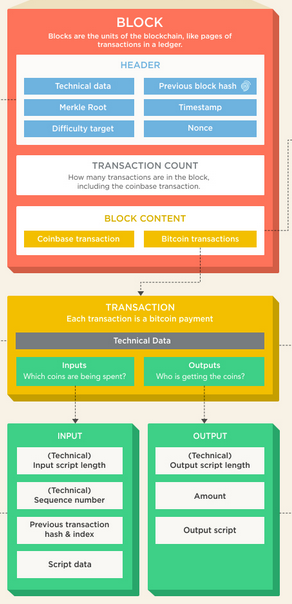
    You can see the transactions in the Block Content section, and you can see info (such as the hash of the previous block) in the Header section. Let’s relate this all together and draw a true picture of a blockchain (specifically Bitcoin) block. To do so, we’re gonna be dealing with a whole bunch of cryptographic hashes.

    Hashing: A Redux

    If you want the nitty gritty detail, you can go here. However, since we’re not writing a mining algorithm or a storefront, I’ll spare you the minutae. If you want an awesome video that explains exactly what I’m about to talk about, but in visual form? Here ya go! Want to learn more about blockchain than you ever wanted to know, but all at a layperson level? You’re welcome!

    Here’s a Bitcoin block:
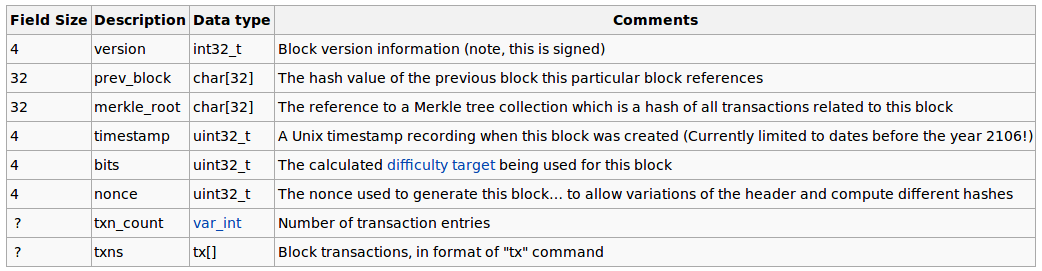
    Let’s work from the bottom up.

    txns

    The payload of a Bitcoin block is an array of transactions. Each transaction looks like this:
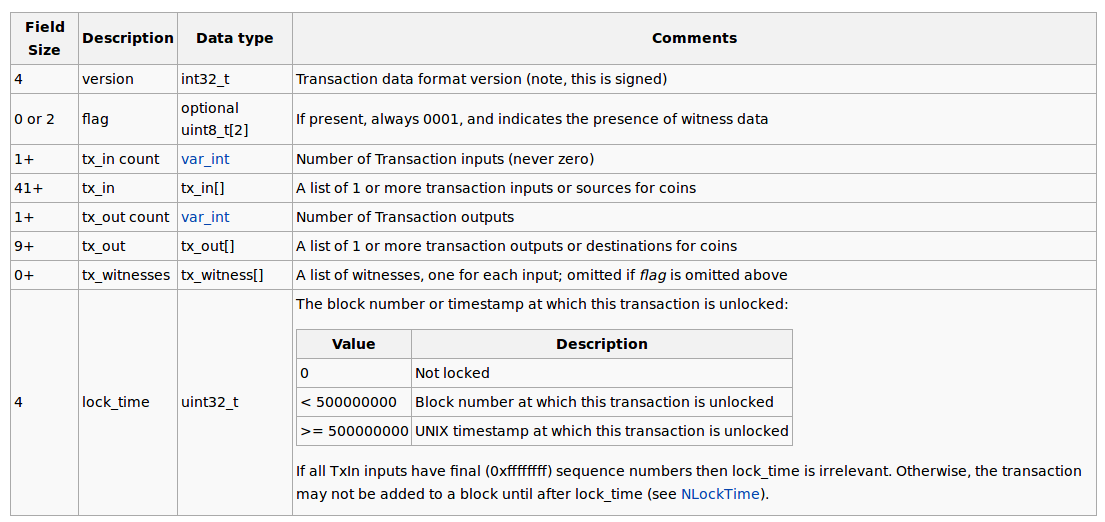
    I show the transaction mainly to show you that it contains two things: tx_in and tx_out. This is how it works, you combine a certain number of prior transactions in the blockchain (inputs) and then dole out the coins contained in those transactions in the outputs. If the inputs go over how much you’re paying the other person, you add an output to pay yourself back the overage. It’s much like cash. Just like handing bills to the cashier and receiving change back, you hand over inputs, and receive back an output for the overage.

    Let’s do a quick example. Oscar wants to pay ZARDOZ for the Gift of the Gun, and he wants to pay $150. Oscar has previously received money from Office Manager Mohammed for “Jihad related expenses” for the amount of $110. Oscar has also previously received money from Preet Bahahahaha for “Woodchipping services” in the amount of $65. In order to pay ZARDOZ, Oscar sets up the transaction by including the previous Jihad and Woodchipping transactions as inputs, and creates two outputs: one to ZARDOZ for $150, and one back to Oscar for the remainder ($25). Then those Jihad and Woodchipping transactions are marked as fulfilled, meaning that they can’t be used again as inputs.

    txn_count

    This is fairly self explanatory. This contains the number of transactions in the block.

    nonce

    From here on up in the block, everything is contained in the header. Remember that the hash of the block is really the hash of the header. The txn and txn_count parts of the block are not used in calculating the hash. However, we’ll find out really soon why the transactions are still reflected in the block hash.

    Nonce is related to mining. I’ve alluded to the way that blocks are created, and I’ll discuss it more in the next section, but suffice it to say that the nonce is a random number and has no purpose besides in calculating the hash. The way that a block is added to the blockchain is that the block’s hash must be below a certain number. How do you get the hash below a certain number? You adjust the source data used to make the hash. Since the hash comes from the header and the nonce is in the header, you can change the nonce until the hash is below a certain number. Notice that simply changing the nonce to a lower number doesn’t guarantee that the hash is a lower number. This is where luck and random chance come into play. We’ll talk more in the next section about this.

    bits

    Bits goes with the nonce. It is the “certain number” mentioned above that the hash needs to go below for the block to be accepted.

    timestamp

    Timestamp is self explanatory. It’s the time when the block was created.

    Merkle Root

    We’ve discussed the Merkle root before, but haven’t really nailed it down. Let’s do that now. The 10,000 foot view is that the Merkle root is the hash of all of the transactions. The hash of the block (which is actually the hash of the block header) takes the Merkle root into account when calculated.
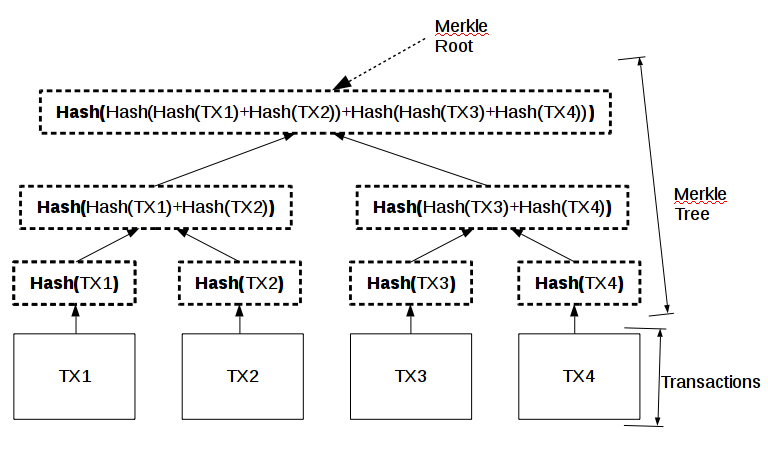
    The Merkle tree is a binary tree (each parent node has two children) that hashes from the bottom up. The bottom row of the Merkle tree contains the hashes of each transaction. The middle row hashes adjacent bottom row hashes (it’s a hash of a hash). The top row is a hash of a hash of a hash and contains information from all of the transactions. Notice what it would take to modify or replace a transaction. If STEVE SMITH tries to replace TX4 with FAKE_TX4, he has to recalculate three different hashes, as well (all of the hashes that include TX4 in them).

    Prev Hash

    This has been discussed at length in the prior two parts. This is the hash of the prior block, the link between the current block and the prior block.

    Version

    The version of the blockchain tells everybody what rules this block has been assembled under. This makes it possible to improve a blockchain without having to toss out all of the old blocks.

    Mining

    We’ve hinted at what mining is already, but now we can put all the pieces together. When transactions are posted to the blockchain network (all of the computers mining and transacting on that blockchain), they are packaged up into a block to be added to the end of the blockchain. How this happens is technical and a bit beyond this overview. Once a block is packaged up, the mining process begins. The block, sans block hash and nonce, is sent out to the network for mining. Computers that are set up as miners begin to calculate the block hash. Remember that the block hash is calculated from data that includes the Merkle root, the previous block’s hash, and the nonce. All of those pieces of data are constant except for the nonce. Therefore, miners, upon calculating the block hash, adjust the nonce to try to get the block hash to be less than the current difficulty number (represented by the bits field).

    Once a miner has calculated a block hash below the current difficulty number, they submit the hashed block to the network. If they’re the first to do so, they “win”. They end up getting a small payment of cryptocurrency for their efforts. The payment is based on an algorithm that reduces the amount of currency created for a successful mine until an end date when no more currency will be created for that coin. At that time, miners will only be compensated by transaction fees (which are currently in the tenths of a percent range).

    As you can imagine, it’s not easy to do this. Bitcoin, for example, is designed so that, on average, the winner mines the block in about 10 minutes. Given the vast amount of processing power dedicated to Bitcoin mining across the world, the chance of a single desktop computer winning even once a month is slim. In some other cryptocurrencies, it is easier, but even a second tier crypto like Monero would average one or two wins a month for a standard desktop computer. At that point, you’re probably not making enough to pay for the electricity you used.

    That’s where mining pools come in. It’s a fairly simple concept. Take a bunch of computers, let them mine as a cohesive unit, and split the winnings across members based on a pre-defined formula.

    The Big Picture of Blockchain and Different Applications

    We’ve talked about blockchain in the context of cryptos, but there are a ton of different potential applications for blockchain. The main “hot topic” for blockchain use is reputation analysis. Rather than having to go through a reputation broker (Uber, AirBnB, Yelp) to find out whether the person driving that car or renting that room or cooking that meal is trustworthy, you can reach out to the decentralized blockchain to find their reputation.

    This is a fairly simplistic application of reputation analysis, but the reason folks are excited is the application of such a thing to automation technology. What if, for example, you didn’t have to put in a reservation to get a hotel room? If your reputation is high enough and the room is available,  the lockbox automatically opens and gives you the key to the room. All you have to do is tell the system how long you plan on staying there, and you’re set.

    Another application is identity management. Does the cashier really need to see your name, address, and other personal info to know that you’re old enough to buy alcohol? There’s a whole bunch of identity leakage that sets each and every one of us up for identity theft. One proposed use of blockchain is to provide customized identity services. The cashier can query the blockchain as to whether you’re old enough to buy alcohol, but can’t access your address. Amazon can get your address, but can’t get your social security number. Starbucks can get your first name, but not your last name.

    What about securing your finances? This isn’t entirely separate from cryptocurrencies, but what if every transaction you made was from a different account? Instead of giving your bank account info or your credit card number to merchants, you give the equivalent of a Visa gift card with the exact amount of the transaction on it. If Target gets breached and your info is leaked to malevolent actors, it’s not an issue, because it points to an empty one-time account.

    Finally, the application that I think would be the most interesting. Traffic management via blockchain. As automated cars become a more likely reality, most of the traffic management interaction methods that have been designed to be centralized or distributed in nature. A decentralized traffic management system would reduce the efficacy of government meddling and the potential for an enforced monopoly a la internet service provider.

    Cryptocurrencies

    I’m not going to list out all the cryptocurrencies in detail. I trust y’all to DDG it yourselves. Let me just point out a few of the big ones in passing.

    Bitcoin – The original and most famous. There is relatively little anonymity in using Bitcoin, as shown by the Silk Road FBI takedown.  It’s also relatively slow to get new blocks integrated, at an average of 10 minutes per block.

    Bitcoin Cash – A fork of Bitcoin meant to scale to more users a bit easier by making the blocks bigger.

    LiteCoin – Billed as “silver to Bitcoin’s gold”. It generates blocks 4x faster (2.5 minutes per block), will generate more coins than BitCoin, and some different internal algorithms.

    Ethereum – Ethereum is much more than a cryptocurrency. It creates smart contracts that can take advantage of automation. Want to unlock your guestroom when somebody has enough reputation points? Ethereum is probably the best blockchain to start from to do this sort of thing.

    Monero – Billed as the “secure cryptocurrency,” it is designed slightly differently from BitCoin so that bad actors (like the FBI) can’t trace one transaction back and see your entire transaction history. Secure is a relative term, because, as seen in the Silk Road incident, there are weaknesses wherever you have to give personal info (shipping, currency conversion)

    Drawbacks and Limitations

    This could be an article in and of itself, but I’ll just hit a few that are top of mind.

    1. Blockchain length – The immense size of the Bitcoin (and other large cryptos’) blockchain means that you either need to rely on somebody else’s node to get plugged in (by using an exchange) or you need to wait a few days for all of the blocks to be downloaded.
    2. Block acceptance time – In Bitcoin, it takes an average of 10 minutes for your transaction to be included in an accepted block, and due to forks (when two different blocks are accepted in two different parts of the network), folks recommend waiting an hour before declaring the transaction “completed.” That obviously doesn’t work for somebody trying to walk out the checkout line at the supermarket.
    3. Scalability – This is kinda wrapped up in the last two, but the number of transactions in a block are limited by a maximum size. Therefore, as more and more transactions occur, the chance of your transaction making the first block goes down substantially. Then, you have to wait not only 10 minutes for your block to be mined, but you have to wait an unknown amount of time until your transaction is included in a mined block. This is where transaction fees come into play. When there are 50,000 transactions, which ones are you going to try to make into a block as a miner? The ones that pay the best, of course.
    4. Security – We’ve discussed some security concerns already, but blockchain doesn’t resolve the single biggest threat in online transactions: the other party in the transaction retaining and ultimately misappropriating your personal information.


    I hope this series was helpful to y’all! I’ve certainly learned a ton!