Time to move on to the next part of brewing: bittering agents. The oldest known bittering agents were herb blends (the most famous being gruit), the modern bittering agent of choice is hops. The herbal beers are still being made today (but not a lot of it) by some of the American craft brewers looking to revive old styles and flavors. There’s lots of options for brewing with herbs instead of hops, here’s an article that talks about the various herbs, and how to use them.
We’re in the modern age now, which in the beer making world means almost a thousand years of history. So that means hops are the primary bittering agent. The bittering component of the hops is known as Alpha Acids, and any hops you buy from the homebrew shop will have an AA% on them. These get measured in a final beer by a scale called IBU (International Bittering Units). IBU’s aren’t the final determination in how bitter a beer tastes though, as that will depend on the residual (or non-fermentable) sugars left in the beer.
If you’re looking to replicate a recipe exactly, the AA% will be important to you. Most recipes will have the variety of hops, listed with an AAU number. That number is just the AA% times the weight in ounces. So, for an AAU of 30, you would need two ounces of 15 AA% hops.
Hops add a lot more flavors then just bitterness, and these flavors can lend themselves to different styles. One way of classifying hops is by the most frequent use for them:
Bittering – These are hops that are being used primarily for their AA% and to bitter the beer, they will be added at the beginning of the boil, and be boiled for 45 minutes or more. This will drive out most of the flavor and aromatic components of the hop.
Flavor – These are hops that are used with 30 – 15 minutes or so of time remaining in the boil. These will add some flavor, but most of the aroma notes from the hops will be driven off.
Aroma – These are hops added towards the end of the boil, or even after the boil has ended (either in a whirlpool or through dry hopping). These will add little to no bitterness, but will retain all of their aroma and flavor notes.
Another type of hops are the Noble hops. This is a special category of four different varieties of hops (Hallertau, Saaz, Spalt, and Tettnang). The term just came into being in the past couple of decades, and the hops from their original regions are generally in high demand. These classifications are more of guidelines, as any hop can be a bittering hop if enough of it is used, and some bittering hops have some very good flavor and aroma notes. Hops can have a wide variety of flavors, with the most common being: earthy, pine, citrus, spice, grapefruit, and tropical fruit.
Another use for hops is dry hopping. This is when hops are added to the beer after the yeast has been pitched, and will add no bitterness, but will add tons of aroma. There are even some beers being released now called 0 IBU beers where all of the hops are added at the beers flameout, or used as dry hops.
New and experimental hops are being cultivated every year for new characteristics, such as disease resistance, flavor, and high alpha acid percentage. These are generally released in small batches to breweries and home brew shops. At this point they’ll generally have letters and/or a number to identify them, only getting a name when they go into wide scale production.
If you say you don’t like hops, it can help to learn the varieties so you can learn which ones you don’t like. There are also several hops that can add negative qualities to beer if used with too heavy of a hand (garlic, catty, vegetal, etc.). Good brewers will avoid this, but not all breweries use good brewers.
At this point, you may have two batches of mead, a batch of wine, a batch of cider, and a batch of beer fermenting away in your basement. So, let’s take a step away from making something this week and start going over the main ingredients in beer.
First, what is malt? Malting is a process to soften the outer husk of a grain, and allow access to enzymes that break down starches into sugars. This process has several steps which are:
Germination – The grains are mixed into water in a dark room to begin the germination process.
Kilning – At this point the grain is dried and heated. The heating will change the quality of the grain making different types of malt (we’ll get to those in a bit)
Cleanup – Now they want to break off the little dried out rootlets that have sprouted, test the malt to check the quality and the specs of this batch.
Many grains can be malted (including corn, wheat, rice, and oats), but barley is the main one for beer. Malts can be broken down into a couple of broad families:
Base Malts [Diastatic Malt] – These malts have enough diastatic power (measurement of the amount of enzymes present in the malts) to convert the starches in themselves and a certain amount of other malts. The main ones used in beer are referred to as 2-row and 6-row (based on the structure of the head of barley) with many regional ones being used for specialty beers (Marris Otter – British, Munich – German, Pils – Pilsners). These can add biscuit and bready notes to the beer.
Crystal/Caramel Malts – While the process to make Crystal and Caramel malts is different, the end result is very similar and at the homebrew level the two terms are generally used interchangeable. These are malts that have been roasted and to force the sugars to be modified into a non-fermentable state. These are referred to by their Lovibond rating (this is a measure of the color, the higher the number, the darker). These malts will add body, some caramel notes, some sweetness, and (for the darker ones) some roasted notes.
Specialty Malts – These are used in small amounts for specific characteristics they can impart to the beer. Carapils is a popular one that’s said to increase head retention and body, smoked malts have been smoked and add that flavor, chocolate malt will add chocolate notes, roasted barley is non-malted and will add a dark color and roasted flavors. Technically all Crystal/Caramel malts could be considered specialty malts as well.
A beer recipe will generally have between 50-75% of the grist (crushed malts) made up of base malts, with the rest being crystal/caramel or specialty malts. You can also make a beer with nothing but base malts or just a single base malt. The vast majority of the time, you can also freely swap between base malts (although it will change the flavor) in a recipe, unless it’s using a large amount of specialty malts or adjuncts.
Now that I’ve mentioned adjuncts, I should probably explain them. When talking about an adjunct in the brewing world, you’re referring to anything that isn’t malted barley (or wheat in some cases), hops, water, and yeast. So rice, corn, oats, and rye are all adjuncts, as are Candi syrup, table sugar, or fruit juice. Spices, vegetables, fruits, and herbs also qualify. Do adjuncts make a beer bad? No, forget the Reinheitsgebot. It was passed to protect the income of nobility who were making wheat beers. It sets price controls!
So why use adjuncts? The main reason is for different qualities that the grain and sugar additions can make. You want that creamy mouthfeel of an oatmeal stout? You need to use some oats. Want to make a milk stout? You’ll need to include some lactose (milk sugar). The other is flavor, there’s nothing wrong with a good fruit beer, or a nice spiced porter. According to a couple of books I’ve read, some of the Belgian breweries (if you drink good beer, you’ve probably had their stuff) use flour as an adjunct in the mash. And you can’t say the Belgians don’t make good beer.
So we’ve made cider and wine, let’s move on to what is commonly claimed to be the oldest fermented beverage in the world, Mead. What is mead? Mead is a fermented beverage where the majority of the sugars are coming from honey. Honey is naturally antibiotic, and is unique in that it doesn’t spoil (while it will crystallize, it stays edible). So, since we want the yeast to survive, we’re going to need to water it down. There’s several different paths you can go to add water to the honey, each with different drawbacks:
Boiling – Get water up to boiling, then add in honey. This runs the risk of scorching the honey, as well as driving off aromatics, but will ensure that the honey is equally mixed into the water. You’ll also need a way to cool the must before putting it into a fermentor and pitching yeast.
Hot water – Get water up to ~160 F, and mix in the honey. This will help the honey dissolve, but will drive off some aromatics. This also may require some method of cooling before putting it in a fermentor and pitching yeast.
Cold water – Mix water with honey. This will require more mixing and more stirring to make sure the honey is fully dissolved, has the highest risk of infection (still not a high one), but preserves the honey aromatics the best.
You won’t need any new equipment for making mead, but you may need a couple of additional ingredients. Yeast nutrients and yeast energizer. Fruit (and barley) have the compounds that yeast need naturally occurring in them, honey does not. While you can make mead without yeast nutrients and energizer, using both will help the yeast do well and convert the sugars into alcohol. With the cost of honey, it’s well worth the extra couple of dollars to ensure a good ferment.
There’s an ongoing debate in most of the mead forums about the best way to use yeast nutrients, with everyone certain that their way is the best (sound familiar?). You can either add it all in at the beginning of fermentation, you can do step additions (add 25% at the beginning, then an additional 25% each following week).
For those who think there’s too many different styles in beer, there’s a large list of different types of mead. For those of you here, I’m guessing the most popular will be:
Braggot – A mead made with malted barley and honey
Capsicumel – A mead flavored with chili peppers
Cyser – A mead that users cider instead of water to dilute the honey
Hydromel – A light/low alcohol mead (think around 5% ABV)
Pyment – A mead that uses grape juice instead of water to dilute the honey
Sack mead – A strong mead with more honey then a standard mead (to get to ~15% ABV)
For your standard mead, plan on between 2.5-4 lbs.of honey per gallon. Adjust as you wish for higher/lower ABV, and based on if you’re using a fruit juice to dilute (which will have sugar of its own). Be aware of the different types of honey, and realize that they will have different flavors when the fermentation is done. I recommend starting with small batches until you find something you like, then ramping that up to a higher volume.
Now for the recipe of a mead I made that came out really well, and should be ready for your next Thanksgiving. Yes, I’m talking about the one in 2019, most meads do well with a lot of mellowing and aging on them. Since it’s a 1 gallon batch, I generally bottle this into about ten 375 ml bottles instead of risking only getting four and some change into 750 ml bottles (remember that there’s sediment you don’t want in your bottles).
Cranberry Mead (1 gallon batch):
1.5 lbs Cranberries – Reduced to juice (or just buy cranberry juice)
3.5 lbs honey
Water to top off to one gallon
Blend the cranberries (or buy juice) and run the resultant liquid through a filter. Mix that with 3.5 lbs. honey and top off with cold water to get to one gallon. Shake it up (which will both aerate it, and make sure that the honey is mixed in with everything else) until the honey is dissolved. Figure out what nutrient schedule you want to use, and pitch a white wine yeast. Fermentation will take at least a month, so be patient with this one. After fermentation is done, wait for it do drop clear (sediment will settle at the bottom of the carboy), then bottle it up.
Time to move up the level of difficulty to making something that has a couple more steps… wine. While you can harvest your own grapes, and crush them yourself, in the modern day it’s usually easier to buy a wine kit. You can find kits for making 1 gallon batches or 6 gallon batches. These kits will come with everything you need to make a batch of wine (including a dry yeast packet). The kits will come with a plastic bladder full of grape juice concentrate, which you’ll put into a bucket (or carboy), and mix with warm water to get up to your total volume. Then you stir, and stir some more, and keep stirring to make sure that everything is mixed well. Your kit may come with some packets of items to be added in at this time (wood chips are common), follow your kit instructions here. At this point, you can take a sample and measure your gravity (if you want to know the starting gravity), check the temperature (to make sure the yeast won’t die), and pitch the yeast.
After a couple of weeks, the primary fermentation is done. At this point we want to minimize contact with oxygen, so we’ll move it from the bucket into a 6 gallon carboy. Use a sanitized siphon to move it over, and add any additions that your wine kit say to add. Then put on an airlock, and let it sit for another couple of weeks. Once fermentation is done (check this with your hydrometer), the final gravity will generally be below 1.000.
Now, fermentation should be complete, but we’re not done yet. Next we need to clarify it and degas it. Yeast breaks down sugar into alcohol and CO2, depending on the ambient temperature, some amount of that CO2 will have been absorbed by your wine. Most styles of wine do not have carbonation, so we need to do something to get that gas out. You can either take up more stirring (over 5 minutes, go ahead, count it out) or you can use a degassing wand. These labor saving tools go into your drill, and make degassing much easier. For clarifying, your kit will most likely have a couple of packets that need to be added in a certain order. Follow the instructions (or if you’re really patient, you can wait and the wine will eventually drop clear) with your kit (side note for those who are vegetarian, keep in mind the clarifying agent is where you may find animal products).
Back to waiting for a couple of weeks (or as your kit says) for the clarifying agents to work their magic. Now, you just need to carefully siphon of the wine into bottles (without stirring up that layer of sediment at the bottom), and cork or cap them. If you corked them, stand them up for 3-4 days for the corks to seal, then you can store them on their side. At this point, you’re done and will have around 30 bottles of wine (assuming a 6 gallon batch and standard 750 mL bottles).
Sorry for the lack of recipes this time around. The only non-kit wine I’ve made is beyond the level that I’ve gotten to in these tales. But if you want to follow it, you can find it here.
I have argued for a long time that the War on Drugs is the most destructive domestic policy since slavery. When you look at the inordinate rates of incarceration, it is best viewed as a direct continuation of Jim Crow laws and their impact on minority subjugation.
While we all see the damage of the Drug War and the consequences inflicted on all involved, there are invisible and pernicious side effects that mostly go unnoticed. During my time in my hostel in Vietnam, I experienced something firsthand that often goes under the radar. The foreseeable consequences shoved down your throat.
The guy at the front desk at my place offered me some weed. After a long day in the heat showing my mother around Hanoi, I was more than happy to purchase. I get into my room, had several drinks and smoked a large joint in the bathroom.
I proceeded to chill, read and listen to music. And then the disturbance began.
My private room is at the end of the hall. I hear a man and a woman, both in their early 20s by the sound of it, start to argue. It sounded like the man had gotten her down from the rooftop bar to begin his tirade.
He is yelling at her. Something about her needing to “open [her] eyes” about something. It seemed very obvious that he was railing into her about how she could be so blind to not see how her boyfriend/significant other was cheating on her. I could be wrong about that, but that’s the gist that I got.
I heard violent sounds. He wasn’t hitting her, but was banging doors and hollow metal, probably an air-conditioner unit. He was violently punching his own hand as punctuation. I could hear when she spoke but not what she said.
I could only hear her sniffling and weeping.
I was very concerned. I got on the floor and listened through the crack below the door. I got a cup to put to my ear to hear, though of no real advancement in my acoustic surveillance. The beratement continued.
Amidst many slammed doors and stops-and-starts, a lull blanketed the hallway. I paused in introspection. My brain wants me to intervene. I’ve gotten one beating in my life and that was in Germany preventing a girl from being raped. Three men took turns kicking me in the face until I was unconscious. I was broken, but I’m very proud of that moment. I didn’t know if I’d have to do such a thing again.
It began again. But this time it was another voice doing the shouting. I gathered that it was the boyfriend who had been called out. More door slamming. More punching of metal. More violent fists in palms.
I decided to do something. I have two titanium hips and there’s a big concrete staircase. I can’t get directly involved, I figured. But maybe my appearance and a wary eye would keep people on their better behavior. I get dressed and put my shoes on.
As I went to open the door, a sickening wave fell over me. I smelled my room. I evaluated myself. I am half-drunk, very stoned, and my room reeks like Paul McCartney’s in 1966. I took my hand off the knob.
I thought about calling the lobby for help. But even then I realized that I would be a person-of-interest, and I certainly didn’t want to get in drug trouble in Commie Vietnam while on vacation with my mother.
I was disgusted with myself. I kept listening and monitoring the situation. But I didn’t dare step outside my enclave and approach a confrontation where it sounded like imminent violence was about to ensue.
I was too terrified to try to help this poor girl who was surrounded by at least two–drunk–large men who were doing everything that they could to intimidate her. Or possibly worse.
This is just one of the evil, unseen effects of the Drug War. See Something; Say Something, they preach. But how many crimes go unreported because the witness is afraid to talk to the authorities or to testify because of some bullshit drug charge is hanging over them? I wasn’t being threatened by some thug or a criminal syndicate. I felt threatened by what the government could do to me and how they could ruin my life. All because of a plant.
There isn’t much of a difference between the government and the Mafia. Punishment is punishment, regardless of who your jury is.
I am sickened by how I responded to these external forces. But I do know why I acted the way that I did. It doesn’t make me feel better. Rather the opposite.
People are handicapped by these immoral laws. They don’t report things that they know are wrong because they are trained to be fearful of the imminent reprisal. Is my getting beaten and sent to jail for smoking weed worth a girl getting thrashed around a bit?
It’s a deeply disturbing calculus that goes through your head when you attempt to rationalize your decision to do nothing.
A law on the books actively prevented me from helping a person in a very violent confrontation. That is the effect of these laws. I can only gather that this is how they want me to feel.
Helpless. Alone. Dependent.
And any attempt to do any good is struck down with the violent gavel of the God of Government.
That’s the problem. Good people afraid to do good things. Because the punishment that might follow isn’t worth the gamble.
Dearest Glibertariat, as some of you may know (or not), every day is a national day of something, to the point where the entire concept almost becomes empty…like my glass…right this second *runs off to fix that*, but what you need to know is that July 24th–TODAY–is national tequila day, and I can think of no better reason to clear some space off of your shelf and celebrate the pluralism of ‘murrica by drinking something that cannot be legally produced here! I have recruited the Boyfriend (henceforth TBF) to help me drink a bit of every tequila in my home and asked the other Glibs to join in with their notes on such an effective beverage.
My portion of this is storied including a reposado that I received as a gift for marrying a couple who met on TOS, a bottle given to me by my aunt and destroyed by a theater major 14 years ago, a couple of bottles that my roommate LOVES and a bottle of mezcal that she declines to finish, so I’ll be helpful. We’ll be rolling through easiest to hardest to drink.
This has a special place in my heart. 15 years ago my aunt gave me this bottle, which I saved for New Year’s Eve. I brought this and a bottle of OJ, took the first sip of the tequila and gave the OJ to someone who had a bottle of vodka and looked lost…it made her night and I proceeded to drink the Casa Noble straight all night until a theater major cracked the cork into the bottle and I—most of the bottle deep at this point, and quite possibly stoned (things are fuzzy here)–proceeded to spend the night enjoying it in reverse. Because of the corking it’s sat on a shelf for years and I’m using today as an excuse to try it again.
TBF: You goofed. I can tell this was good once but it’s oxidized to shit. All the flavors are muted to the point of being uninteresting. I’m getting some wood and leather, it’s like drinking Jesus’s sex dungeon, but it’s incredibly smooth.
Jesse: [glumly] I goofed. *pours out the rest of the bottle with chunks of cork floating in it, contemplates buying a new bottle because it was that good…even at this price point.
I’m pairing these together because they were similar. The reposado was a bit softer than the Añejo, which we found surprising, and the reposado was a bit simpler with the Añejo having a more complicated and more bourbon-ey profile.
TBF: *cracks reposado bottle open* HELLOOOO SPRING BREAK. This is all very agave, very drinkable, but not a ton of complexity. This screams going to a frat party in your sweatpants senior year of college. This is why your roommate’s margaritas are so good. I just thought she was skilled. *tries the añejo* way more complex, more vanilla and bit harsher. The bourbon notes ask the question “Jesse, why are you making me drink tequila when you have bourbon in your house?” This is a frat party in sweatpants in KY.
Jesse: If we kill off everything below [the reposado] and make this the plastic jug tequila the world will be a better (or maybe worse) place. Still sippable but we’ve definitely stepped down a tier from the Clase Azul and Casa Noble [circa 2004]. The añejo is good, but I’m happier with the reposado *has more reposado*.
Kinda the oddball here. I hoped TBF would enjoy it since he likes Islays. My roommate decided it was undrinkable and I’ve been chipping away at it for a while.
TBF: This smells like nail polish and smoke. It’s like a structure fire at a nail salon off the nose. *Sips* Do moonshine distilleries explode like meth labs? You know what, they probably do. That’s what I’m getting from the flavor. Can we go back to the Clase Azul?
Jesse: I’m getting more smoke and less “Vietnamese women perishing in a fire”. It’s got a warm front, extremely bland middle and smoky/spicy finish. It’s surprisingly easy drinking for how smoky it is, but not particularly interesting. I’m definitely circling back to the Clase Azul.
In the fall of 2017, the outdoor cannabis harvest was a bumper crop for growers throughout the state of Oregon. This epic weed haul was the result of two factors; weather, and bureaucracy. The weather was spectacular for growing cannabis, particularly outdoors. A wet fall, winter, and spring (nearly 220 straight days of rain) meant there was plenty of water available. And the summer was warm and dry. Conditions that are favorable for growing trees with plenty of flower on them. The sunshine helped to ensure that flower would be potent. The other cause was bureaucracy. Normally inimical to the production of any good or service of value, on occasion bureaucrats manage to step on their dicks in such a way as to help the actual productive class. Such was the case in 2017 with the OLCC (the Oregon Liquor Control Commission).
The OLCC is the regulatory pseudo agency (much like the fed it is a non-government organization with a government mandate) responsible for enforcing Oregon’s pot laws. In 2017, the OLCC declared open season for anyone with a license to grow marijuana when it announced that “due to a lack of allocated funds, enforcement efforts will primarily be focused on those growing cannabis without legal license to do so and on those with a recreational license. However, next year will see increased enforcement for medical growers.” In plain English and practical reality, this meant that as long as you had a medical license you could grow as much pot as you wanted. The statutory limits on the number of plants one could grow was out the window. Worst case, if you were caught, they’d cut down plants of your choosing until you were down to the legally allowed number. Every grower was growing as much pot as he could get in the ground that summer as cuttings are cheap.
Fields of Green
The resulting harvest was huge. And while the left may not understand or believe it, the laws of supply and demand are iron. If supply is greater than demand, the price falls until an equilibrium is reached. And the result was The Glut. A situation where outdoor weed wholesale prices fell as low as $300 per pound. If you could find a buyer and had good enough quality weed. There were rumors of weed going as low as $100/lb but that had to have been either exaggeration or for some really ditch weed bullshit. Either way, that was the first bump in the road.
Once the harvest was in, properly dried and cured, and finally trimmed and packaged up, we had enough product that once The Glut ended we’d be able to fund our next phase. Right where we need to be to build our indoor facility and go through the process of getting the rec license that would allow us to expand. That’s where the next bump in the road occurred. We just need to wait for The Glut to recede and the price to come back up to our floor of $800 to $1000/lb. While it would put a crimp in our timeline, waiting even six months wouldn’t be catastrophic.
An aside; indoor and outdoor pot flower are of differing quality. Indoor is higher quality and fetches a relatively higher price. But outdoor is far cheaper to produce and the aforementioned conditions were conducive to outdoor pot production. In 2017 we had both indoor and outdoor operations.
End Product
My business partner was impatient to take the next steps however, so was looking to expand beyond our established channel of buyers to sell all that outdoor product. The short version is that the buyer was a scammer that my partner thought he knew but didn’t. My partner took his stepson with him to the transaction, verified the guy had a med card, and gave the stepson the cash to count, made the transaction “selling” 80% of our harvest, and the best quality at that, and they left. Only to get home and discover the money was, as he texted me, “counterfeit.” I didn’t hear from him for 3 days and when I finally got the full story I have never been closer to murder than I was at that moment.
Turns out the money wasn’t counterfeit. It was movie money that looked just this side of monopoly money for verisimilitude. I wasn’t even mad at the scammer (whom my partner didn’t even take a picture of the guy’s med card or his license plate and only had a phone number that of course turned out to be a burner). I mean, the balls to try that and get away with it? But my partner and his idiot stepson? Yeah. Them I was furious at.
Does that look like legal tender to you?
Anyway.
As of February, we had only 20% of our harvest, The Glut was finally receding, and we were at a crossroads. We came up with a last-ditch plan of selling that final amount to finance continued expansion of existing indoor med operations of high THC plants, and to get legal for growing outdoor hemp as we did have a legit buyer for hemp flower by that point for processing for CBD products. Those funds from a large hemp harvest could then be leveraged to do the build out for a rec license grow. As described in my previous article, a rec license allows a much larger size grow operation than a med license.
Another digression: Marijuana and hemp are the same plant, save that hemp has been bred primarily for its fibers in the stalk and has only trace amounts of THC but plenty of CBDs, even in the flower. Marijuana flower contains both, and various strains have various proportions. THC is what gets you high and CBDs are the actual medicinal chemicals, especially for seizures, muscle & joint problems, pain, and anxiety. CBDs also don’t get you high and won’t, generally, show up on a piss test. Getting licensed for hemp is far less expensive than getting a rec marijuana license and you can grow as much as you like. There’s a fee for a 2-year license and you must have proof that the plants are hemp and not marijuana, and that’s it. Far easier compliance and we have enough acreage on the farm it could be quite lucrative. THC flower is usually more valuable, esp. indoor grown. But there’s potential in CBDs, especially with hemp as the input costs are way lower, the regulatory burden is lower, and the labor costs are lower offsetting the lower sales price one can get per pound.
Unfortunately, due to the remainder being lower quality and The Glut being so epic, it took a long time to move that product. The revenue hasn’t come in fast enough to buy the hemp plants needed to get the hemp license or get them in the ground for a spring or summer crop. The flow has been a trickle; just enough to keep the lights on and pay the basic bills while expanding the amount of indoor plants we can grow up to the legal limit for the number of med cards we have. There’s an outside shot that by next spring there’ll be money for hemp. But I don’t see it.
The result is that two months ago I washed my hands of it and told my partner that as long as he kept things legal and he paid the lease payments on time for the farm, he could keep going, but that I was done being actively involved. I started looking for a job and found one. I started that the last week of June and I’m enjoying it.
The saving grace, from a financial perspective, is related to the legal technicalities on having a rec license and the land we purchased for the business. The land use regulations related to marijuana are somewhat convoluted. There are both county regulations and state regulations. The state regulates the maximum square footage of flower canopy one can have per rec license. It also insists that no individual or entity may have multiple licenses on the same tax lot. The county regulates the zoning for tax lots, which determines whether you can grow indoor, outdoor or both. It also sets a minimum size for a rec license. Usually 2-5 acres. Further, to obtain a rec license, one must prove water rights. If they aren’t already registered on the deed, this isn’t as simple as digging a well. One must obtain those rights through a process that takes 1-2 years.
To give an example. If one purchases 40 acres in a county where the minimum size for a rec license is 4 acres you may not, then obtain 10 licenses from the OLCC. You can obtain one and lease out the other nine to other folks with a license. But if you want a second license you must buy another tax lot somewhere. Many of the larger operations are buying 5-10-acre plots with proper zoning building a minimum size rec grow, and then offering the rest as turnkey, then buying another parcel and repeating. That was part of our plan. But the number of parcels that are properly zoned in counties with relatively simple regulations is small. More importantly, the piece of land we bought has county water and therefore automatically has water rights.
The land is valuable in and of itself. And the land is in my wife’s name and my name. It’s appreciated about 20% in value since we purchased it. And the company is leasing it from my wife and me. So worst case we have a valuable piece of property that has a current market value that is keeping pace with the rest of the money we invested and then some. Also, it’s a good place to go shooting whenever I want. We may even just keep it and build a country house as a retreat there.
I learned my lesson. My next startup will be a side-hustle that I build until it replaces a significant portion of my income. I’ll have no partners, only employees, or minority ownership stakes if I need someone with special skills, but not a partner. And while I’m probably out $20-$40k counting lost income, it was worth the gamble as it was money I could afford to lose. I don’t regret taking the chance, though, and I learned a great deal about myself and managing people, and just how tough it is to start a business. I’ve always admired folks who run their own enterprise, but I do so even more now that I’ve taken a shot at it.
End Note: I appreciate all the interest and encouragement as well as kind words. It’s helped immensely. This place really is a community.
Hello boils and ghouls, it’s your old pal the Cryptkeeper here…no wait, that’s not my name. Sorry, sometimes I get caught up in the moment.
Though I gave up the regular movie review beat, I still thought I’d bang out an article like I did last year on our experiences at TFW. To celebrate, one of the below links will go to a hardcore porn site – the rest are safe. This is your NSFW warning. You’ll never know which one it is until you try. C’mon, don’t be a pussy.
This one will be a bit different in content, since many of you would have already read my post on this from last year, and thus are already familiar with the context. For those of you who are new to the site within the past year, or didn’t read my previous write-up, in brief, TFW is the southwest’s largest horror convention, and my wife & I spend the weekend there every year.
Like last year, I’ll have a few images in the text, but most all the photos will be at the bottom of the article. It’s mostly just pics of costumes & the stuff we bought, because almost all the celebrities this year charged extra for photos with them, and the few times I tried a creepshot, it came out terribly. The other photos are mostly terrible as well due to the fact that this is literally the only time of the year I ever take photos of anything, so please understand and forgive. The only ones I really regret it on are two cosplay photos of Tippi Hedren & Spawn, which were both good costumes but when I reviewed the pics afterward, you can barely see them due to bad backlighting. It was too crowded during the main hours to take shots, so I tried to snag a lot of them in the hotel lobby. Also as before, I had trouble formatting them into a row, so you’ll have to forgive me & simply scroll down the photos in a line at the end.
The guest lineup this year was fabulous. They had all of the original cenobites (minus the chick from the first film, because she never does any conventions, ever – so the guest in her place was the chick from the second movie, which was still a good horror film). To round that group out, we had a *very* special treat – Mr. Clive Barker. He doesn’t do a lot of these kinds of things, so we were overjoyed. In addition to his prolific painting and film work, if you haven’t read any of his fiction, I highly recommend it. His Books of Blood is one of my favorite collected works of short stories ever. If you dig fantasy/horror short fiction, check it out, seriously.
Also making appearances were Ron Perlman, Adrienne Barbeau, Billy Zane, Phil Fondacaro, Tommy Flanagan, Brad Dourif, Tom Savini, Matthew Lillard, all the kids from the new IT movie, Charles Band and a shit-load of people from the various Friday the 13th films. The Friday night party was themed Camp Crystal Lake, so they were heavy on those guests (as this is the 13th year of TFW). Since I’m honestly not crazy about that film series outside of the first two movies & a few creative kills, I didn’t much care about their presence. If you don’t recognize the names of anyone just listed, check the links – I promise you’ll recognize them or at least have heard of their work.
The weekend got started off right, with Adrienne Barbeau flying in Thurs. night to attend a screening of Escape from New York at the Texas Theater, and do a Q&A afterward. The print they used was fantastic, better than my dvd, and Adrienne was an engaging speaker. She said she has done so much voicework that she has frankly forgotten most of it, and only recalls that she took some particular job once every year when some check shows up for $0.96 and has “Judge Dredd” written on the memo line (she was uncredited as the voice of the computer in that film). She tossed that out as the example, but said she just gets checks for tiny amounts every day for random old things she did. I thought this must be a strange thing, to go to your mailbox every day and be like, “Huh, I got 8 checks in the mail totaling $5.72.”
So the next day the spousal unit & I took a half-day off of work & rolled into the convention in mid afternoon, though it doesn’t open until 6. On the plus side, in their fruit-infused water jug up front, the fruit was cut into the shape of skulls.
Skull-melons“White people are fucking weird”. Also, wood.Stupid
Also amusingly, the little cute Asian girls they have working there had to wear wound makeup and have silly horror accessories, like this photo of an attractive young lady with scissors sticking out of her head. I’ve often wondered what they think about that, because the racial breakdown of the con attendees is about 70% white, 25% hispanic, and the rest is miscellaneous. Like seriously, my wife is one of maybe 20 Asian people there actually attending, and I can always count the numbers of black folks on my fingers. I have no idea why that is, but it’s true. Less amusing was the eyeroll-inducing naming of the food on the menu. I mean come on, Trembling Turkey? Blood-Dripping Buffalo Wings? And what the fuck happened to the Southwest Shrimp Cocktail, didn’t warrant a new name because it’s already so awful?
The convention started off poorly – it was so fucking crowded that Friday night, I panicked. This thing frankly outgrew the convention space last year, and this year was worse. We try to do signature hunting on Fri. night & Sun., when it’s less crowded. Well we spent an hour in line for Clive Barker, only to be told that he was leaving to do his scheduled photo shoot & wouldn’t return to the signature line that night due to feeling poorly.
Yay
So the first hour was a waste, but it kind of worked out. If you recall last year, we purchased a crocheted Count Orlock. Well the same vendor was there and she had a big crocheted xenomorph, but only one of them. She told us it had been a right bitch to make, and she was never going to make another one, so we pounced on it. If we hadn’t been forced to do a little browsing on Friday evening, I’m certain someone else would have bought it & then I’d have had to have killed my wife and myself, and possibly my extended family as well.
5 of the 6 sides are now signed – four cenobites & Clive Barker
We did get the rest of the cenobites, Adrienne, and Billy Zane that night. A few anecdotes – the cenobites, despite being English and therefore you’d think reserved, will talk your ear off, even if you’re actively trying to exit the conversation. Nicholas Vince, who played Chatterer, was dressed in nice proper business-formal attire, except for some weird Pinhead Hello Kitty cufflinks, and to his delight my wife was the first to notice them that evening. Of course it’s because she’s fucking Asian, so she saw the Hello Kitty shit immediately somehow. Also, Barbie Wilde, the female cenobite, was selling her horror fiction books, and apparently is a very nasty-minded girl. Everything was a sexual innuendo or reference, and we all had a good laugh when, midway through our conversation, we could hear someone in another row (a worker, we believe, trying to repair something in a guest’s booth) said, “Damnit, I thought sitting in this chair would make it easier, but I think I was having more success on my knees.” Barbie, my wife and I all just looked at each other for a second before bursting out laughing. The photo you see is of the nice mahogany & etched brass puzzlebox we purchased to collect all their signatures on.
Also true fact: Billy Zane was just a leeeetle-bit of a dick. The best line in Zoolander pertains to him; “You should listen to your friend Billy Zane – he’s a cool dude”. Well we purposefully waited until there wasn’t anyone in his line, so that we wouldn’t be holding anybody up, and I asked him, “Hey, I know this is a bit unorthodox, but could you possibly sign this, ‘You should listen to me – I’m a cool dude’?” He smiled and kind of laughingly said, “Absolutely not”, then just stared at us. We thought he was joking for a second, because he said it kind of jovially, but then he said, “So…you just want me to make this out to the two of you or what?” So we said sure, and that was that. I mean hey, celebrities don’t owe me anything, I know that. But perhaps a, “Sorry man I don’t do personalizations to that extent” could be used instead of, “Hahaha NO”. Anyway he seemed nice enough in every other way, so maybe he’s just sick of that request. He was in a tracksuit & cowboy hat, and so looked kind of like a Russian gangster.
Phil Fondacaro’s line was short enough I was able to chat with him a bit. I asked him if it was just an outsider’s perception, or if there really were fewer opportunities for physically different actors like himself & Warwick Davis, with the advent of digital effects. He said absolutely, but it’s something of a mixed blessing because as he’s gotten older, and especially for someone who is physically limited to begin with, it’s a relief to not have to wear all the latex and costuming that he used to. A lot of the stuff that’s added in post now were the most cumbersome things to wear and act in, so the digital revolution isn’t all bad from his perspective. Of course the photo I got signed was of him as Vohnkar! And if you don’t get that reference, you’re no true child of the 80s.
Saturday was given to drinking, shopping, and making merry. It still sucked, because I had to wake my ass up at 7:30 to get in line for Clive Barker. Keep in mind the convention didn’t open until 11. So over three hours I sat there, but was 10th in line and so assured a chance to meet the great artist. Still, it left me a bit depleted for the remainder of the day.
We learned our lesson from previous years, and brought some beers, a bottle of bourbon (Larceny, which was very good for being as affordable as it was), and a bottle of Fireball. The hotel doesn’t care as long as you don’t get belligerently drunk – like David Arquette from a few years back. We were there and we saw bizarre things from a man still supposedly on the wagon. At least he drunkenly bought me a beer while we were both waiting at the bar. Anyway I attached a bunch of photos of all the shit we bought below, and some of the costumes we encountered.
That evening we spent a bit of time in the karaoke party, & went to a screening of Takashi Miike‘s live action adaptation of the manga, As the Gods Will. Now granted I wasn’t exactly sober, or anything even really resembling sober, by the time I saw this thing, but I still have no fucking clue what was going on. A weird doll was playing red-light, green-light with a class of students, and when it caught them moving their heads exploded, then the survivors went to their gym & dressed as mice and a giant maneki-neko was eating them, and it just got stranger from there. We finished out the night hanging out with all our friends on the patio, and there was a dude giving away free cigars for some reason, so that went well with the last of my bourbon (yes, the bottle was killed, with the able assistance of a couple of our friends).
Sunday was recovery day, so we went to the Ron Perlman panel. He’s a fun speaker – extremely foul-mouthed and self-deprecating. We snagged his signature and called it a weekend. As of the time of my writing this (Monday evening), yesterday was the saddest day of our year. This is our biggest event, and we get to spend it with a lot of great friends, and get a lot of great merchandise and add to our already ludicrous collection of autographs. Monsters everywhere, blood and guts, toys, movies, games, it just doesn’t get any better for the dedicated horror fan. And now it’s a whole other year until it comes around again. Oh well, less than six months to Halloween.
Love this shirt. I put this in just to trigger Old Man With Candy. “You all know me, know how I earn a living.” Great scene.This film stars a resident of Bronson, Missouri.Good costume tandem.I had no idea what the fuck this midget/child was dressed as.Sadly, they just don’t make movies like this anymore.This was sitting next to the coffee at the breakfast buffet.American Werewolf in London. Fucking awesome.A good group effortThis is some monster from an anime I don’t watch, but he did a good job with it.Oddly enough we were in the market for a new shower curtain, so we picked this up.I purchased this shirt to use as evidence because it has an unauthorized use of my likeness.A Game of Thrones Super Friends print. The Wonder Twins are Jaime & Cersei. Check out how their Wonder Twin powers activate.A bunch of little Aliens figurines we boughtMy wife bought this shirt. I was so pleased with her, I gave her the gift of the penis that very night.Remember Mad Balls? I remember Mad Balls. Now they’ve come back in the general wave of nostalgia, and there are Aliens Mad Balls.Great Spawn costume. You can’t see it well, but the eyes do glow bright green.For some fucking reason, there was a ton of Halloween III merch everywhere. I have no idea why, nobody likes that movie. Or I guess it’s trendy to claim to like it.The maid from the first season of American Horror Story. Also, wood.Of course I bought this shirt.A pretty good female Pennywise. Also, wood.Sloth loves inkAndrew Lincoln stealthily infiltrated the conventionHottie Ash. Also, wood.I liked this shirt.Creepy random guy. It’d be great if he just showed up like that and didn’t know there was a horror convention going on.Oh you *know* I bought this movie.Succubus. Also, wood.I liked how the only part of her costume that glows is one little strip right beneath her eyes. Wood knot, however.Well she normally wouldn’t have bought a denim vest, but the damned thing fit like it had been tailor made for her, so fuck it, the wife picked this up.Mutilated Disney princesses. Wood knot, to both.It’s really a shame you can’t see this properly, because she really does have like four or five birds attached to this thing attacking her. Wood knot.This was a great heavenly Pinhead costume. The insert glowing heart really sold it. Kudos to this guy.The whole Game of Thrones Super Friends.Sadly, did not buy this movie.If you can tell what that creature with the one large yellow eye is at the bottom of the poster, I’ll buy you a cookie if we ever meet. *HINT* It was one of my favorite movies when I was a kid.It’s like the fuckers are purpose-designing posters to try and get me to leave my current job and apply with them.I appreciated that he did the whole costume head from the first movie. Very few Captain Spauldings go through that extra effort.Hard to see, but she has a super realistic werewolf baby. Wood knot.I have no fucking clue what this is supposed to be.Mexican Deadpool being eaten by a guy in a big inflatable dinosaur skeleton costume. I should have also gotten a head shot of Mexican Deadpool for you – he had a sombrero & a big mustache. Such problematic, so appropriation.What the fuck is this I can’t evenOh look, The Shining. Wood knot.A representative from Dark Hour Haunted House in Plano, TX.Loved this idea – it’s Jason as he appeared in the NES game. Clever. Sadly, I had no rocks to throw at him, to keep try and act out the game.I liked the work this guy did on his head piece.A kid dressed as something from Five Nights At Freddy’s.Don’t know what the character is from, butt wood.Some anime, I’m sure. Wood.I thought this to be a clever way to do something different from the dozen bloody-soaked Carries walking around.The less said about this, the better.Wood knot.Silent Hill. Respectively, from the left, wood, knot knot knot.Star Trek…spiders? WTF is this even…?I thought about buying this for those days I feel like identifying as female.Great shirt – I had to zoom a lot to get it, so if you can’t tell, it’s our two protagonists from “They Live”. If you haven’t seen that movie, you’re a disgrace of a human being.There were a lot of IT costumes about. This was one of like, fifty.Hmm – from the left: wood knot, knot, wood, knot.It seems strange and grimly hilarious to me that a horror convention chooses depression as it’s charity of choice.The family that slays together…And of course you can’t even go to a fucking FFA convention anymore without there being multiple Deadpools.
So you want to be a fortuneteller. Congratulations! You’re a moron!
There are a very few limited instances when putting up a crystal ball shingle is a good less than catastrophically bad idea:
It’s a front for your illegal business
It’s a money-laundering operation
You are otherwise unemployed, and/or bored AND you have no expenses involved with obtaining your venue.
In the same vein as giving a junkie some chlorox with which to sterilize their shared needles, here’s a little advice about succeeding in the X-mancy business.
This is the look you’re going for
First off, be a woman. You might get away with being an astrologer with a Y chromosome, but for palmisty, cartomancy, scrying or psychic reading ain’t nobody gonna pay you for your opinion. Once you are a woman, invest in chunky jewelry and scarves. Consider dying your hair, but for the love of Gaia, do not have it professionally done. You need to do it yourself. The look you are cultivating is “sketchy.” Respectable people make crappy fortunetellers. There needs to be something… off about your appearance — the difference between “underbridge dweller” and “reclusive gypsy” is in the attitude and how you set up your surroundings.
Nice try
Do you think you’re psychic? Great! This is going to help lot. It’s like they say, “sincerity is important, once you can fake that, you’ve got it made.” The most successful psychic I know acts exactly as if they believe their own bullshit completely. She has never dropped the facade in front of me. Remember, you’re mostly a salesperson at this point, so have confidence in your product! What if you can’t actually believe that you have the power to foretell the future? Well, there is a solution to that.
Remember the oracle at Delphi? Paint huffer. Not from a spray can, but all natural organic hydrocarbons straight from Mother Earth’s crack. If you want to go with the classics, you can choose ether, but what with the usual accouterments of candles and incense, I wouldn’t recommend it if you don’t want to go all Richard Prior. But be careful that you don’t overdo it. “Not entirely safe, not entirely sane” will draw the attention of the mark; “Crackhead” will have them scurrying for the door without paying. The point of the drugs is to take the edge off your internal censor and *ahem* “open your mind to” the possible connections between the real world and your divinatory tools. The only difference between “psychic” and “psychotic” is “cot,” which is what you’re probably going to be sleeping on if you choose to ply this trade.
There is one skill that is pretty much mandatory if you’re going to make this business a sole/unaugmented source of income: cold reading. This is a skill that can be learned, so do it. Prestidigitation is also extremely useful, both for forcing cards and well… we’ll get to that
Notice that the mark must ALWAYS be wealthier than you
Last thing: if you want to make real money, you’re going to need a permanent premises so that you can build a clientele of suckers. And if you want to really take them for what you can get, you’re going to need to commit some felony-level fraud. This is going to end badly, if for no other reason that former marks, even ones that you that you didn’t even rip off will eventually be upset with your advice and having a fixed place of business means they know where to find you to make their displeasure known, or to send the local constabulary. If you are satisfied by the rewards of one-off clients and the occasional petty larceny (this is where prestidigitation comes in: if you keep your workspace cluttered, claustophobic, and filled with garish colors and patterns, this can make the mark more distracted and less likely to remember that he set down something small and salable, particularly if he didn’t notice you palming it.) then it’s safer to adopt the M.O. of grifters everywhere and keep mobile. Carney life here we come! Actually, renaissance fairs are a pretty good deal for an aspiring fortuneteller: the one-person tent is the cheapest premises you can have and is perfect for the kind of work you need to do, you have a constant flow of new clients pushed right in front of your flap, and those clients are in a pretty good mood and won’t actually take your advice too seriously. Plus lots of them are drunk. Blessings to Eris and Dionysus for drunken marks!
I should probably also mention that dial-a-psychic is a thing that exists and my closest fortuneteller friend makes her living doing this, but I’ve never seen it in operation first-hand. so not only do I not know anything about it, I don’t even know enough to be entertainingly ignorant about it.
Renfair. Pros: lots of one-off clients, steady income. Cons: herpes.
Now, on to this week’s chart!
This week has a couple of strong markers, and an oddly large number of tension/uncertainty indicators. The more definite signs are for good fishing, and an extraordinary alignment (Sol-Mercury-Venus-Saturn retrograde) for relationships. This is an excellent week to meet new partners, but a terrible week for breakups. If the squeeze hasn’t gotten his crap out of the house KK, maybe it would be better to put it off until next week. On the tension front, we have TWO different cross-alignments of opposition influencts; we have change and stability signs on top of each other (Mercury in Capricorn) as well as balance/flux juxtaposition (Luna in Libra). If you are having difficulty figuring out WTF is going on in your life, this probably is why.* The positioning last week that encourages sports betting (Mars-Saturn retrograde in Capricorn) and masturbation (Jupiter retrograde in Scorpio) remain this week, so have fun with that .
Aight! We’ve talked about Computer Science and we’ve talked about some design features used in blockchain. Now let’s put it all together and cap this series off.
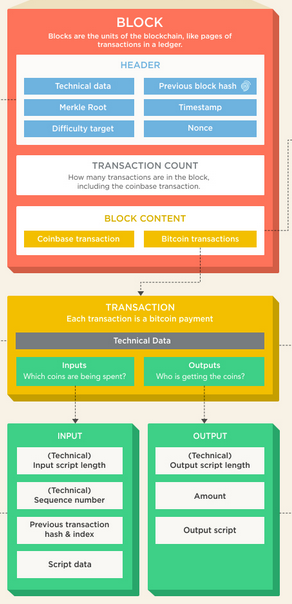
What is blockchain? It is a linked list of data structures that uses cryptographic hashing to sign each data structure, thus including it in the canonical chain. Here’s the block used by Bitcoin (most other cryptos will have mostly the same components).
You can see the transactions in the Block Content section, and you can see info (such as the hash of the previous block) in the Header section. Let’s relate this all together and draw a true picture of a blockchain (specifically Bitcoin) block. To do so, we’re gonna be dealing with a whole bunch of cryptographic hashes.
Hashing: A Redux
If you want the nitty gritty detail, you can go here. However, since we’re not writing a mining algorithm or a storefront, I’ll spare you the minutae. If you want an awesome video that explains exactly what I’m about to talk about, but in visual form? Here ya go! Want to learn more about blockchain than you ever wanted to know, but all at a layperson level? You’re welcome!
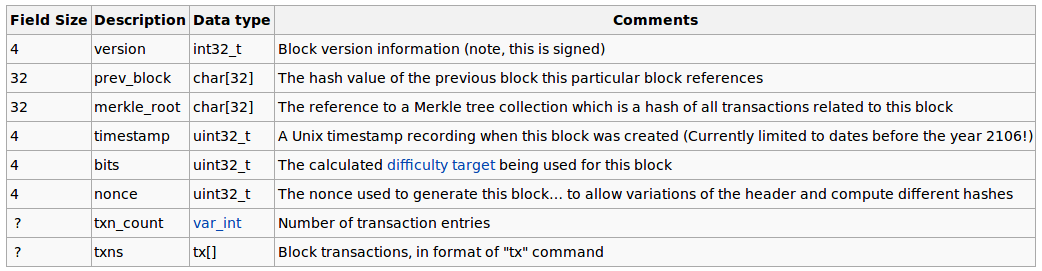
Here’s a Bitcoin block:
Let’s work from the bottom up.
txns
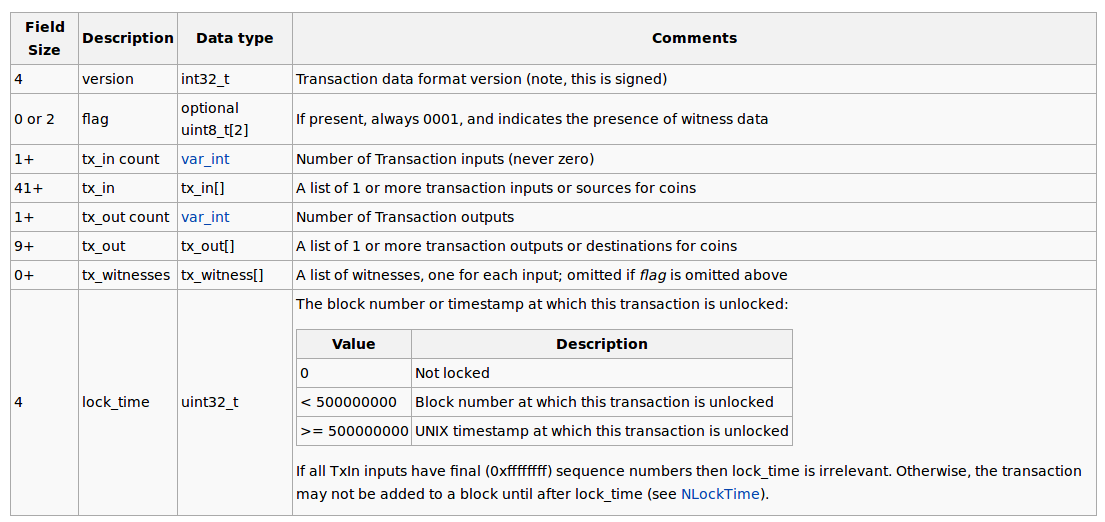
The payload of a Bitcoin block is an array of transactions. Each transaction looks like this:
I show the transaction mainly to show you that it contains two things: tx_in and tx_out. This is how it works, you combine a certain number of prior transactions in the blockchain (inputs) and then dole out the coins contained in those transactions in the outputs. If the inputs go over how much you’re paying the other person, you add an output to pay yourself back the overage. It’s much like cash. Just like handing bills to the cashier and receiving change back, you hand over inputs, and receive back an output for the overage.
Let’s do a quick example. Oscar wants to pay ZARDOZ for the Gift of the Gun, and he wants to pay $150. Oscar has previously received money from Office Manager Mohammed for “Jihad related expenses” for the amount of $110. Oscar has also previously received money from Preet Bahahahaha for “Woodchipping services” in the amount of $65. In order to pay ZARDOZ, Oscar sets up the transaction by including the previous Jihad and Woodchipping transactions as inputs, and creates two outputs: one to ZARDOZ for $150, and one back to Oscar for the remainder ($25). Then those Jihad and Woodchipping transactions are marked as fulfilled, meaning that they can’t be used again as inputs.
txn_count
This is fairly self explanatory. This contains the number of transactions in the block.
nonce
From here on up in the block, everything is contained in the header. Remember that the hash of the block is really the hash of the header. The txn and txn_count parts of the block are not used in calculating the hash. However, we’ll find out really soon why the transactions are still reflected in the block hash.
Nonce is related to mining. I’ve alluded to the way that blocks are created, and I’ll discuss it more in the next section, but suffice it to say that the nonce is a random number and has no purpose besides in calculating the hash. The way that a block is added to the blockchain is that the block’s hash must be below a certain number. How do you get the hash below a certain number? You adjust the source data used to make the hash. Since the hash comes from the header and the nonce is in the header, you can change the nonce until the hash is below a certain number. Notice that simply changing the nonce to a lower number doesn’t guarantee that the hash is a lower number. This is where luck and random chance come into play. We’ll talk more in the next section about this.
bits
Bits goes with the nonce. It is the “certain number” mentioned above that the hash needs to go below for the block to be accepted.
timestamp
Timestamp is self explanatory. It’s the time when the block was created.
Merkle Root
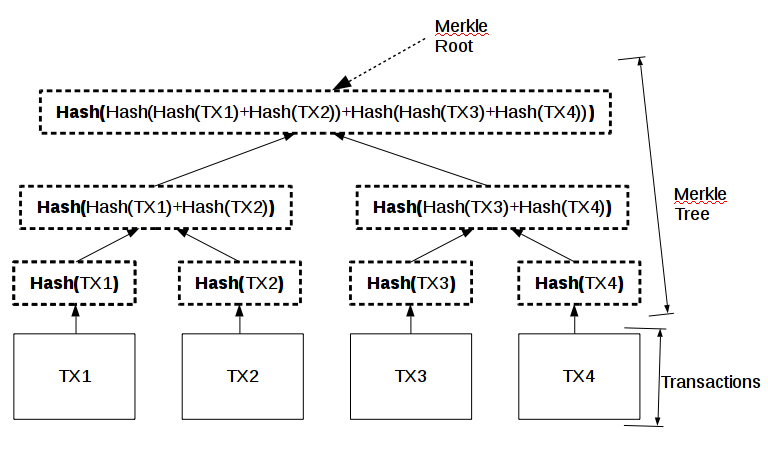
We’ve discussed the Merkle root before, but haven’t really nailed it down. Let’s do that now. The 10,000 foot view is that the Merkle root is the hash of all of the transactions. The hash of the block (which is actually the hash of the block header) takes the Merkle root into account when calculated.
The Merkle tree is a binary tree (each parent node has two children) that hashes from the bottom up. The bottom row of the Merkle tree contains the hashes of each transaction. The middle row hashes adjacent bottom row hashes (it’s a hash of a hash). The top row is a hash of a hash of a hash and contains information from all of the transactions. Notice what it would take to modify or replace a transaction. If STEVE SMITH tries to replace TX4 with FAKE_TX4, he has to recalculate three different hashes, as well (all of the hashes that include TX4 in them).
Prev Hash
This has been discussed at length in the prior two parts. This is the hash of the prior block, the link between the current block and the prior block.
Version
The version of the blockchain tells everybody what rules this block has been assembled under. This makes it possible to improve a blockchain without having to toss out all of the old blocks.
Mining
We’ve hinted at what mining is already, but now we can put all the pieces together. When transactions are posted to the blockchain network (all of the computers mining and transacting on that blockchain), they are packaged up into a block to be added to the end of the blockchain. How this happens is technical and a bit beyond this overview. Once a block is packaged up, the mining process begins. The block, sans block hash and nonce, is sent out to the network for mining. Computers that are set up as miners begin to calculate the block hash. Remember that the block hash is calculated from data that includes the Merkle root, the previous block’s hash, and the nonce. All of those pieces of data are constant except for the nonce. Therefore, miners, upon calculating the block hash, adjust the nonce to try to get the block hash to be less than the current difficulty number (represented by the bits field).
Once a miner has calculated a block hash below the current difficulty number, they submit the hashed block to the network. If they’re the first to do so, they “win”. They end up getting a small payment of cryptocurrency for their efforts. The payment is based on an algorithm that reduces the amount of currency created for a successful mine until an end date when no more currency will be created for that coin. At that time, miners will only be compensated by transaction fees (which are currently in the tenths of a percent range).
As you can imagine, it’s not easy to do this. Bitcoin, for example, is designed so that, on average, the winner mines the block in about 10 minutes. Given the vast amount of processing power dedicated to Bitcoin mining across the world, the chance of a single desktop computer winning even once a month is slim. In some other cryptocurrencies, it is easier, but even a second tier crypto like Monero would average one or two wins a month for a standard desktop computer. At that point, you’re probably not making enough to pay for the electricity you used.
That’s where mining pools come in. It’s a fairly simple concept. Take a bunch of computers, let them mine as a cohesive unit, and split the winnings across members based on a pre-defined formula.
The Big Picture of Blockchain and Different Applications
We’ve talked about blockchain in the context of cryptos, but there are a ton of different potential applications for blockchain. The main “hot topic” for blockchain use is reputation analysis. Rather than having to go through a reputation broker (Uber, AirBnB, Yelp) to find out whether the person driving that car or renting that room or cooking that meal is trustworthy, you can reach out to the decentralized blockchain to find their reputation.
This is a fairly simplistic application of reputation analysis, but the reason folks are excited is the application of such a thing to automation technology. What if, for example, you didn’t have to put in a reservation to get a hotel room? If your reputation is high enough and the room is available, the lockbox automatically opens and gives you the key to the room. All you have to do is tell the system how long you plan on staying there, and you’re set.
Another application is identity management. Does the cashier really need to see your name, address, and other personal info to know that you’re old enough to buy alcohol? There’s a whole bunch of identity leakage that sets each and every one of us up for identity theft. One proposed use of blockchain is to provide customized identity services. The cashier can query the blockchain as to whether you’re old enough to buy alcohol, but can’t access your address. Amazon can get your address, but can’t get your social security number. Starbucks can get your first name, but not your last name.
What about securing your finances? This isn’t entirely separate from cryptocurrencies, but what if every transaction you made was from a different account? Instead of giving your bank account info or your credit card number to merchants, you give the equivalent of a Visa gift card with the exact amount of the transaction on it. If Target gets breached and your info is leaked to malevolent actors, it’s not an issue, because it points to an empty one-time account.
Finally, the application that I think would be the most interesting. Traffic management via blockchain. As automated cars become a more likely reality, most of the traffic management interaction methods that have been designed to be centralized or distributed in nature. A decentralized traffic management system would reduce the efficacy of government meddling and the potential for an enforced monopoly a la internet service provider.
Cryptocurrencies
I’m not going to list out all the cryptocurrencies in detail. I trust y’all to DDG it yourselves. Let me just point out a few of the big ones in passing.
Bitcoin – The original and most famous. There is relatively little anonymity in using Bitcoin, as shown by the Silk Road FBI takedown. It’s also relatively slow to get new blocks integrated, at an average of 10 minutes per block.
Bitcoin Cash – A fork of Bitcoin meant to scale to more users a bit easier by making the blocks bigger.
LiteCoin – Billed as “silver to Bitcoin’s gold”. It generates blocks 4x faster (2.5 minutes per block), will generate more coins than BitCoin, and some different internal algorithms.
Ethereum – Ethereum is much more than a cryptocurrency. It creates smart contracts that can take advantage of automation. Want to unlock your guestroom when somebody has enough reputation points? Ethereum is probably the best blockchain to start from to do this sort of thing.
Monero – Billed as the “secure cryptocurrency,” it is designed slightly differently from BitCoin so that bad actors (like the FBI) can’t trace one transaction back and see your entire transaction history. Secure is a relative term, because, as seen in the Silk Road incident, there are weaknesses wherever you have to give personal info (shipping, currency conversion)
Drawbacks and Limitations
This could be an article in and of itself, but I’ll just hit a few that are top of mind.
Blockchain length – The immense size of the Bitcoin (and other large cryptos’) blockchain means that you either need to rely on somebody else’s node to get plugged in (by using an exchange) or you need to wait a few days for all of the blocks to be downloaded.
Block acceptance time – In Bitcoin, it takes an average of 10 minutes for your transaction to be included in an accepted block, and due to forks (when two different blocks are accepted in two different parts of the network), folks recommend waiting an hour before declaring the transaction “completed.” That obviously doesn’t work for somebody trying to walk out the checkout line at the supermarket.
Scalability – This is kinda wrapped up in the last two, but the number of transactions in a block are limited by a maximum size. Therefore, as more and more transactions occur, the chance of your transaction making the first block goes down substantially. Then, you have to wait not only 10 minutes for your block to be mined, but you have to wait an unknown amount of time until your transaction is included in a mined block. This is where transaction fees come into play. When there are 50,000 transactions, which ones are you going to try to make into a block as a miner? The ones that pay the best, of course.
Security – We’ve discussed some security concerns already, but blockchain doesn’t resolve the single biggest threat in online transactions: the other party in the transaction retaining and ultimately misappropriating your personal information.
I hope this series was helpful to y’all! I’ve certainly learned a ton!