Category: Cooking

  • The Libertarian Vegetarian: Why Your Stir Fries Suck

    It’s not Christmas, but still. In one of the other cooking post comments, several of the Glibertariat complained that their stir-fries were just not… right. And most of the stir-fries I’ve gotten outside of heavily Chinese areas have been somewhere on the line segment between mediocre and really shitty. And that includes 95% of Chinese restaurants run and staffed by Chinese, but located in white, Hispanic, or black neighborhoods- they’re giving the people what they want (in the case of Jews, pork and shellfish- that was the code word for forbidden meats, “Chinese food”).

    So sit back and I will attempt to make a Guide for the Perplexed. I clearly am not Chinese, or of Chinese origins, but I have decent cooking chops, traveled a lot over there, lived in Asian immigrant communities, and am not bashful about asking questions to chefs when I taste something really good, and that has reduced my level of ignorance. The word “Chinese” will be used a lot here, because that’s my personal epicenter for stir-fry cooking. But really, there’s a whole lot of other Asian cuisines that do these same sorts of things, so think Thai, Vietnamese, Laotian, or what-have-you, the principles are the same. Shit, you can even appropriate Chinese methods to prepare Italian-style food; that’s why America is great. Likewise, though I’m a vegetarian, what I’m talking about here is generic and applicable to the protein of your choice. If you prefer dead pig to seitan, you’re still making shitty stir-fries, and I’m still going to save your ass despite that offense to Yahweh.

    We regularly fuck up stir-fries. Stir-frying is just a technique, widely applicable and flexible, and we still fuck them up. Here’s a partial list of the things that are most commonly wrong:

    • Too soggy. Everything in the dish is more like an Irish stew.
    • Singed ingredients that are raw in the middle.
    • Uneven cooking, so you get a combo of vegetables that are mushy and raw.
    • Gloppy. There’s a weird sauce-fetish that I think derives from old school American Chinese take-outs. The ingredients are drowned in a thick gooey brown or white sauce. And the sauces’ flavors tend to dominate the dish as well.
    • Sweet. And the worst offender is the sugar-fetish.

    In order to help you avoid the common traps, I’ve got a couple of recipe-ish things here, but what I really want to harp on is some stupidly simple methods which come up again and again. While I’m at it, I’ll also beat you up about the shitty equipment you use. I hope that one or another of my random pieces of brain lint give you an easy fix so you’ll stop making shitty stir-fries.

    Step One: Ingredients

    The rule of thumb for good Chinese cooking is 60-30-10. 60% of your time should be seeking and obtaining good ingredients, 30% of your time doing preps, and 10% or less actually cooking.

    By “good ingredients,” I don’t mean “exotic ingredients,” but rather quality stuff whose flavors and textures don’t need obscuring. The Chinese have been great about adapting their cuisine to local ingredients and freely appropriating. Yeah, it’s fun to use things like Szechuan pickled radish or fermented black beans, but that won’t make your shitty stir-fry less shitty. It will just be shitty but now exotically shitty. Here’s a crazy idea: buy great green beans or peppers or bean sprouts or mushrooms or chicken/beef/pork/seafood and don’t worry as much about the spices and condiments. Now you have a shot at a decent dish, even if you’re fresh out of huangdou jiang.

    If you use canned bean sprouts or green beans or asparagus, I will personally come over and explain your porn history to your spouse and children.

    The only real necessities peculiar to Chinese stir-fry cooking are soy sauce (have both dark and light on hand), toasted sesame oil, and Shaoxing cooking wine. Use a high smoke-point oil like peanut. All else is negotiable; I keep a variety of pastes, spices, and vinegars handy for specialty dishes, but my everyday stir fries do fine without ’em. Whatever you do, avoid the brand name generic “stir fry sauces.”  Read the ingredients; most of them lead off with water and sugar. There will be other forms of sugar listed as well. And xantham gum for extra gloppiness. That stuff is a sure path to shittiness. Unless you like shitty, in which case, go get some deep dish with pineapple and spare the rest of us.

    MSG frankly is rather common and not the devil that excess sugar is. Use it wisely and sparingly, but don’t reflexively avoid it.


    Step Two: Tools

    Since prep should be an outsize part of your time investment, it goes without saying that you need really good sharp knives to make the work go smoothly and quickly. I have a rather, um, eclectic collection. My default knife for stir-fry prep is a cheap Chinese cleaver. It says “stainless” on it and it isn’t. Which is OK, it takes a nice edge, but needs honing every ten minutes or so. Which is also OK because I bought it about 40 years ago for $8 at a Chinese grocery, given it a lot of hard use over the decades, and it’s still doin’ its thing. So while a $300 Shun is a delightful thing, it’s not really a necessity- I didn’t see many of them used in great kitchens in China.

    My second-most used knife for stir-fry prep is also a cheapie, this one a 10″ Victorinox. It feels good in the hand, sharpens easily, and has held up well since we got it a few years back. Costs less than a couple of movie tickets and popcorn.

    Victorinox Fibrox Pro Chef’s Knife, 8-Inch Chef’s FFP (I use a 10″ because of large hands)

    Third most used knife is also a Victorinox, a 3.25″ paring knife, and cheaper than a slice of pizza and a Coke. Great for fine trimming (like the stems of tomatoes or the eyes of pineapple). I think these knives are Swiss, despite the lack of noticeable holes.

    Victorinox 3.25 Inch Paring Knife with Straight Edge, Spear Point, Black

    And obviously, you want your knives sharp. There’s folks among the Glibertariat who are masters of getting the finest possible edge. I am not one of them, so I cheat and use one of these, a Chef’s Choice Asian sharpener. It gives a good enough edge that I have no problem getting paper-thin slices of garlic or cutting through the skins of over-ripe tomatoes, and it’s so fast and easy, I can sharpen mid-prep without losing much time.

    OK, next we bring the heat. Do you have a trendy wok, nicely ceramic non-stick coated and heavy stainless-aluminum clad construction? Toss the fucker, it’s a piece of shit. Ditto the abomination of cast iron woks. Donate them to a homeless turtle shelter or something, they’ll do more good there than on your stove. Know what you need? Something cheap, thin, and unlaminated steel. The kind of piece of shit you get for $20 at the Chinese grocery. Unlike nonstick, you can get these smokin’ hot. Unlike laminated or cast iron, you can get them smokin’ hot very rapidly. And when you turn down the heat, they cool very rapidly, so all in all, the shitty steel woks give you much better temperature control.

    Shape is important. Round bottoms are the best BUT you have to have the right kind of cooking surface for that- I have a wok stand from Thailand which is superb,  putting out approximately the same amount of heat as the engine from a Saturn V booster stage. I can get the wok to literally red heat in 20 seconds. It is absolutely the best stir-fry cooking I’ve ever done, with the food taking on a subtly smoky “wok hei” aroma and the food cooking in record time. THIS is the right way to do things. I shit you not, wok hei is the difference between indifference and real difference.

    Unfortunately, there’s a catch- you either need a professional ventilator hood or you have to cook outside. And our outside cooking has been limited recently because of a heavy mosquito season. After our first frost, I’ll be able to do this again.

    Lacking a wok stand like that, don’t even THINK about using a round-bottom pan on a flat cooktop, even with a wok ring, unless you have something like a 100,000 BTU burner. With normal stoves, you will have really shitty heat and that means really shitty, soggy, badly-cooked stir-fries without even a trace of wok hei. Find a thin steel shitty wok with a flat bottom. Not optimum, but you can at least turn out some half-decent product. Here’s mine:

    Whichever you use, you want it well-seasoned and to maintain that seasoning. It’s the best non-stick surface you can get. I’ve got about 20 years of season on this wok, and as you’ll see below, I can fry difficult foods like eggs with no sticking.

    You also need another utensil for the process- a steel spatula or wok turner. I don’t have one, so I get by with a big steel spoon (seen in the videos below). It works, but I’m a shitty person for not getting the right tool. Don’t be like me. Don’t be a shitty person. Get the right tool.

    Techniques:

    Did I mention heat? You want the ability to get that wok screaming hot, and the courage and attention to use it properly, which means not getting distracted and letting food burn, and most importantly… mis en place. You want EVERY ingredient to be prepped, chopped, measured, and handy. If you don’t make at least ten dirty little bowls and dishes for you ingredients, you’re doing it wrong and that’s why your stir fries suck. God invented dishwashers and orphans- make use of them.

    Second, precooking. Most stir-fries use ingredients from their raw state, added sequentially. And that’s another reason most stir-fries are shitty. To get the best and most even degree of doneness with disparate ingredients, you need to precook (slightly undercooking) each of the major ingredients in advance, then bringing them together at the end. Typically, the protein will be cooked first, removed, then set aside. Various additives can be either parboiled and refreshed (i.e., dunked into an ice bath after boiling) or stir fried separately to get each one to the optimum cooking point. Then the actual building of the stir-fry commences by cooking aromatics (garlic, ginger, scallions, and the like), then adding the cooked ingredients and seasonings/sauces to reheat and finish.

    I can’t overemphasize the latter point: stir-fry should be done in discrete stages which are brought together at the end. For years, my stir-fries were shitty because of misguided ideas about trying to time the sequence so that the ingredients were added on top of one another in the right order and would magically cook properly. This is an especially bad idea because not only does the timing become terribly critical and can’t be adjusted on the fly to accommodate variations in ingredients, but you also lose control of the cooking temperature- the first ingredients put in the wok will insure that later ingredients cook at a lower temp and with higher surrounding moisture. That is not generally a good thing.

    The other advantage of the cook-shit-separately is that distinctive flavors and textures will remain distinct and not all blend together in a mish-mash. This is why German or British cooking is shitty and Chinese cooking is great. And why you need to spend time getting great ingredients.

    Two Examples:

    These are sort-of-recipes, but each illustrates points made before. Neither is “authentic,” but they each use mostly non-exotic ingredients and (when cooked right) show off the quality of the main ingredients. And each is linked to a video showing most of the process; the videos are pretty shitty because we didn’t have time to block out the shots or to do editing/voice-over, but future ones will be better.

    Because of the aforementioned mosquitoes, I had to use my kitchen stove and the flat-bottom wok, so the heat was somewhat inadequate. But still, they turned out delicious.

    Stir Fry Green Beans

    This is loosely based on a classic Szechuan dish and is an example of a dry stir-fry. The Szechuan version uses pickled radish and Szechuan peppercorns, so feel free to exotify it if that’s your desire. Traditionally, the precooking is done by deep-frying in coolish (300 degree F) oil instead of the water-blanching that I do, and yard-long beans are used. Again, feel free- the important thing is to have the beans pre-cooked before the stir-frying commences.

    1 lb fresh green beans, ends trimmed

    1/4 cup raw peanuts

    2-3 cloves garlic, sliced thin

    5 or 6 dried red chiles

    2-3 white parts of scallions, chopped

    1 tsp Korean red pepper paste (gochujang); can substitute garlic-red-chile paste or chile-black-bean paste

    1 tsp light (not lite!) soy sauce

    oil to cook


    Drop green beans into a pot of rapidly boiling salted water. Boil for 3-4 minutes or until the beans are about half-done. A few beans may need to be sacrificed to determine this; cook’s privilege. Drain and toss into an ice water bath, then after they cool completely, remove from the bath and drain. Set aside.

    Mix the pepper paste and soy sauce together. Set aside.

    Heat the wok until it’s smoking, then add in one or two tablespoons of oil. Toss in the sliced garlic and toss it around until it gets aromatic and starts coloring a little bit, 15 seconds or so. Remove the garlic from the wok. Add the dried chiles and stir around until they start to brown, then remove and set aside. Add the peanuts, and stir around until they start to color, 15 seconds or so. Remove the peanuts and set aside. Optionally, you can lightly crush or chop them after cooking for a finer texture.

    Seeing a pattern?

    Now it’s time to bring everything together. Add the chopped scallions, stir for a few seconds, then add the green beans. Stir-fry until the green beans are starting to show some black spots, a minute or two. Add the pepper paste/soy sauce mixture and a little extra soy sauce if you think it’s needed. Stir for a few seconds, then add the sliced garlic, the dried chiles, and the peanuts. Stir to combine, then remove to a serving bowl and eat up.

    Video.

    Tomato and Eggs

    This is a standard Cantonese dish, seen in every university cafeteria in the province, and a home-cooking favorite. It’s stupid-simple and delicious. As with many standard dishes, every family makes it a little differently and will swear everyone else is doing it wrong. By contrast with the last dish, this one is very saucy, but the sauce comes mostly from the water in the tomatoes and is amazingly flavorful.

    5 eggs, beaten

    4 scallions, white and green parts separated and chopped

    5 medium or 6 small tomatoes, cut into wedges

    2 tbs ketchup

    2 tbs soy sauce

    1 tsp sugar (omit if your tomatoes are really good)

    1 tbs shaoxing cooking wine

    1/2 tsp toasted sesame oil

    1/2 tsp white pepper (or more to taste)

    1 tbs minced ginger

    1 small onion or large shallot, slivered

    1 tsp cornstarch dissolved in 2 tbs water

    oil to cook

    Mix together the ketchup, soy sauce, sugar, shaoxing, sesame oil, and white pepper, set aside. Heat the wok until it’s smoking, then add a couple tablespoons of oil and swirl around. Pour in the eggs. Let them fluff up a bit, then stir them around for a minute or so until done- they should be set but not browned. I like my eggs a bit loose, SP prefers them somewhere in the middle of the Mohs scale. Your choice. Scoop them out of the wok, chop them a bit with your spatula or spoon, and set aside. Wipe out any leftover egg.

    Put a bit more oil in the wok. Add in the ginger and stir it for a few seconds. Lower the heat a bit, then add the whites of the scallion and the onion. Stir for a minute until they are fragrant and softened slightly, then bring the heat back up and toss in the tomatoes. Stir-fry for a minute or so until the tomatoes are heated through, then push them to the side of the wok. Add in the ketchup mixture and bring that up to a boil. Then stir everything together, stir in about half of the green parts of the scallions, and add the eggs. Stir, then add in about half of the cornstarch slurry (make sure the slurry is stirred before you pour it in) and cook until the sauce thickens. If you want it thicker, add more cornstarch.

    Turn out into a serving bowl and sprinkle with the remaining chopped green parts of the scallions. Serve over rice.

    Video.

  • Peach Raspberry Crisp

    [et_pb_section bb_built=”1″][et_pb_row][et_pb_column type=”4_4″][et_pb_text admin_label=”intro text” _builder_version=”3.15″]

    Web Dominatrix sends her apologies. She’s crazy busy finishing up websites for a couple new clients. And these are ladies you do NOT want to disappoint (unless you’re into that sort of thing).

    So, you’re stuck with me as a last minute substitute. Sorry, kids.

    I thought I’d post one of my favorite vegan recipes. I’ve been making this regularly since last summer (2017) and I really could just eat the entire pan by myself.

    Except it would be wrong not to share.

    Right?

    [/et_pb_text][/et_pb_column][/et_pb_row][et_pb_row][et_pb_column type=”4_4″][et_pb_divider _builder_version=”3.15″ height=”2px” color=”#ffffff” /][/et_pb_column][/et_pb_row][et_pb_row][et_pb_column type=”1_2″][et_pb_text admin_label=”Recipe ” _builder_version=”3.15″]

    This recipe comes from America’s Test Kitchen cookbook Vegan for Everybody, which both Web Dom and I have mentioned before.

    You may sub 1-3/4 pounds frozen peaches for the fresh. Make sure you thaw completely before using.

    Peach Raspberry Crisp

    Filling

    • 2-1/2 pounds peaches (peeled, halved, pitted and cut into 1/2 inch wedges)
    • 1/4 cup organic sugar
    • 1/8 tsp salt
    • 2 tbsp instant tapioca (finely ground)
    • 1 tbsp lemon juice
    • 1 tsp vanilla extract
    • 10 ounces raspberries

    Topping

    • 1/2 cup all-purpose flour
    • 1/4 cup organic brown sugar
    • 1/4 cup organic sugar
    • 1/4 tsp ground cinnamon
    • 1/4 tsp ground ginger
    • 1/4 tsp salt
    • 1/4 cup coconut oil (melted and cooled)
    • 1/2 cup old-fashioned rolled oats
    • 1/2 cup pecans (chopped)
    • 2 tbsp water

    For the Filling

    1. Adjust oven rack to upper-middle position and heat oven to 400 degrees. Gently toss peaches with sugar and salt in bowl and let sit, stirring occasionally, for 30 minutes. Drain peaches in colander set inside bowl; reserve 2 tablespoons juice and discard extra.

    2. Return drained peaches to bowl and toss with reserved juice, ground tapioca, lemon juice, and vanilla. Transfer to 8-inch square baking dish, press gently into an even layer, then top with raspberries.

    For the Topping

    1. Meanwhile, process flour, brown sugar, granulated sugar, cinnamon, ginger, and salt in food processor until combined, about 15 seconds. Add melted oil and pulse until mixture resembles wet sand, about 10 pulses. Add oats, pecans, and water and pulse until mixture forms marble-size clumps and no loose flour remains, about 15 pulses. Refrigerate mixture for at least 15 minutes.

    2. Sprinkle topping evenly over fruit, breaking into 1/2 inch pieces as necessary. Bake until topping is well browned and fruit is bubbling around edges, 30 to 35 minutes, rotating dish halfway through baking. Transfer to wire rack and let cool for at least 30 minutes. Serve warm.

    [/et_pb_text][/et_pb_column][et_pb_column type=”1_2″][et_pb_text admin_label=”image” _builder_version=”3.15″]


    [/et_pb_text][/et_pb_column][/et_pb_row][/et_pb_section]

  • The Hyperbole’s How-to Handbook Chapter One : Pizza Sauce

    [et_pb_section bb_built=”1″][et_pb_row][et_pb_column type=”4_4″][et_pb_text admin_label=”Intro Text” _builder_version=”3.13.1″]


    The Hyperbole’s How-to Handbook Chapter One: Pizza Sauce

    Is Libertarianism inherently self-reliant? Is Self-reliance inherently Libertarian? To many Glibs the answer to these questions may seem self-evident, obvious, redundant, repetitive even. We are, after all, a hardy lot of DIYers, homebrewers, self-defenders, sausage makers, board-gamers, reloaders, backyard mechanics, at least one diorama-ist, and cranky old get-off-my-lawners. Rugged Individualism, In the original Herbert Hover sense, is the antithesis of governmental paternalism. What could be more Libertarian? However there is another side to self-reliance and libertarianism, most libertarians hold capitalism and a free market in high regard. Comparative advantage, Division of labor, and Economies of scale are prized concepts. Certainly, it is great fun to shame grown men who can’t change a flat tire but is he any less a libertarian because he relies on his cell phone service and the roadside assistance supplied by personally purchased insurance. You may be thinking “okay Hyp, maybe libertarianism doesn’t require strict self-reliance, but self-reliant people are going to lean towards libertarian, its a common characteristic” Possibly, but it’s not that hard to imagine an off-the-grid, self-composting-toilet-using, chicken-raising, self-sustaining hippie-type that would be more than happy to have the government force the rest of us to live by their rules in a misguided attempt to save the planet, some endangered timberdoodle, or what not. Self Reliance while noble and to a point worth encouraging is not inherently libertarian and vice-versa. So take heart whether you Angus MacGuyver your pizza sauce from homegrown maters squeezed through the casing of a Bic pen and simmered over a solar oven made of used tin foil and roach clips, or, like Al Czervik in the Brushwood pro shop, (or should that be Thorton Melon at the Grand Lakes University bookstore) you use your vast wealth to buy the finest of the 23 types of pizza sauce that no one needs for yourself and all your friends, you can still hold your libertarian head high. As for me, when I can, this is how I’m gonna do it.

    [/et_pb_text][et_pb_text _builder_version=”3.13.1″ text_orientation=”center”]

    The Hyperbole’s Unaliterated Pizza Sauce

    [/et_pb_text][/et_pb_column][/et_pb_row][et_pb_row][et_pb_column type=”1_2″][et_pb_text admin_label=”steps 1-4 image” _builder_version=”3.13.1″]

    Steps 1 – 4

    [/et_pb_text][/et_pb_column][et_pb_column type=”1_2″][et_pb_text admin_label=”Steps 1-4 Text” _builder_version=”3.13.1″]


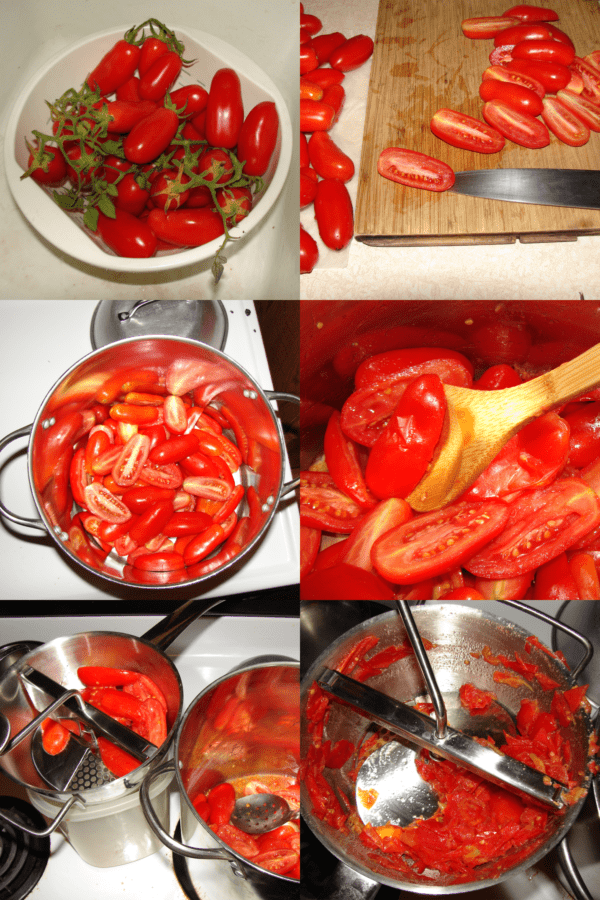
    Step 1. Plant and harvest 4-5 lbs of San Marzano Tomatoes and 4 or 5 large chile peppers of the ‘not melt your face’ variety. (For more info on growing said fruits see Chapter Four: Gardening) Rinse and slice tomatoes lengthwise, check for nasty stuff, these were pristine.

    Step 2. Heat over low heat, stirring for about 10 minutes, or until the skins start to loosen up.

    Step 3. Run tomatoes through the food mill that you use once a year, use a medium-sized sieve.

    Step 4. (not shown) You’ve got enough to clean up already so put your milled tomato sauce in the fridge, wash up then walk down to the bar and grill for a mushroom bacon swiss burger, a few Strohs, and to ineffectually and awkwardly chat up the waitresses.

    [/et_pb_text][/et_pb_column][/et_pb_row][et_pb_row][et_pb_column type=”4_4″][et_pb_divider _builder_version=”3.13.1″ color=”#ffffff” height=”2px” /][/et_pb_column][/et_pb_row][et_pb_row][et_pb_column type=”1_2″][et_pb_text admin_label=”Steps 5-8 Text” _builder_version=”3.13.1″]


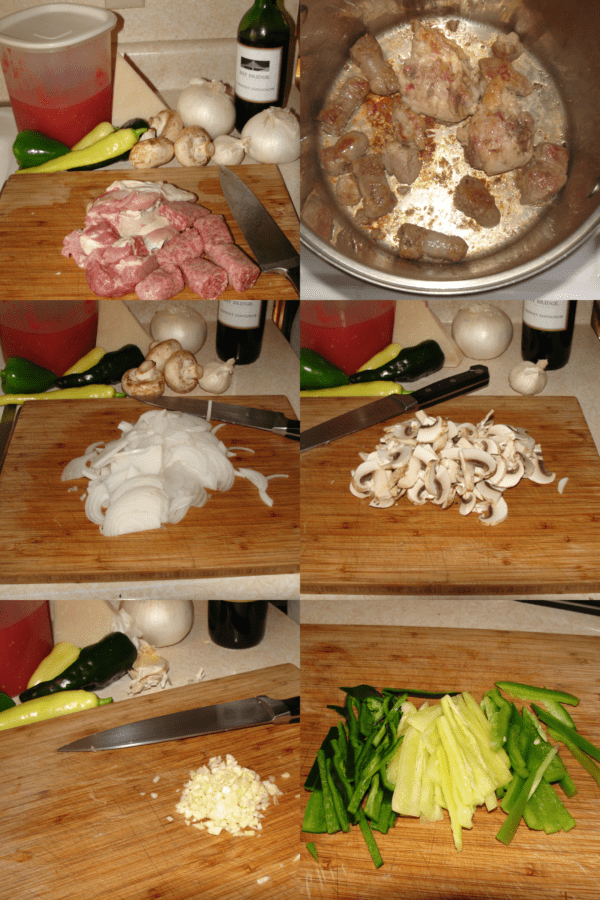
    Step 5. The next evening get your shit together, tomato sauce, onions, mushrooms, garlic, peppers, red wine, and chicken thighs some sausage and some chunks of pork.

    Step 6. Brown meats in oil in your heavy duty stock pot.

    Step 7. Slice up about this many onions, mushrooms, and peppers.

    Step 8. Mince up this much garlic.

    [/et_pb_text][/et_pb_column][et_pb_column type=”1_2″][et_pb_text admin_label=”Steps 5-8 image” _builder_version=”3.13.1″]

    Steps 5 – ?

    [/et_pb_text][/et_pb_column][/et_pb_row][et_pb_row][et_pb_column type=”4_4″][et_pb_divider _builder_version=”3.13.1″ color=”#ffffff” height=”6px” /][/et_pb_column][/et_pb_row][et_pb_row][et_pb_column type=”1_2″][et_pb_text admin_label=”steps 9-13 image” _builder_version=”3.13.1″]

    Steps 9 – ?

    [/et_pb_text][/et_pb_column][et_pb_column type=”1_2″][et_pb_text admin_label=”Steps 9-13 Text” _builder_version=”3.13.1″]


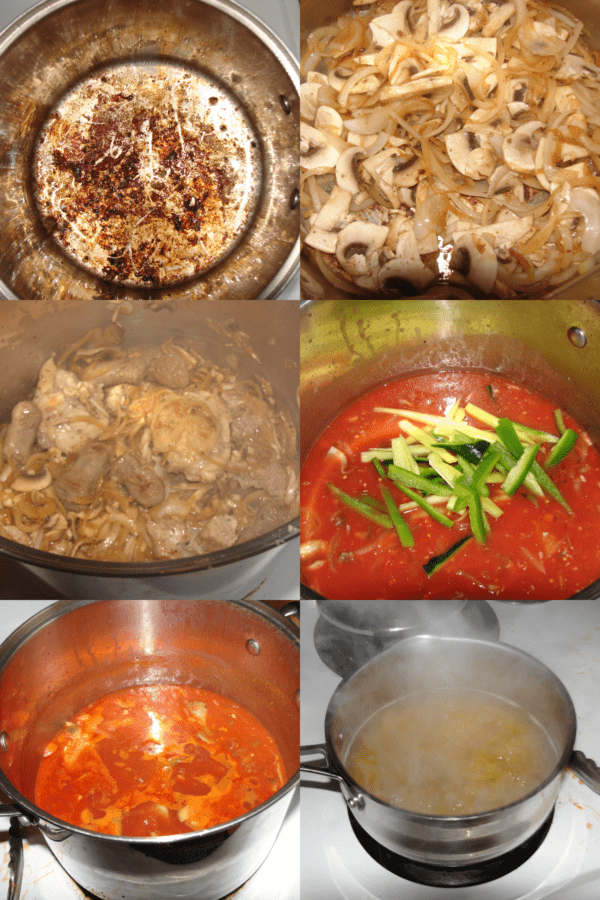
    Step 9. Remove your meat. add Onions and Mushrooms (add more oil if needed)

    Step 10. When onions and mushrooms are soft, stir in garlic

    Step 11. Before garlic burns add enough wine to deglaze the pot, return your meats.

    Step 12. Add tomato sauce and peppers, simmer til meats are done or longer, just don’t let the chicken get to falling apart stage.

    Step 13. Make some pasta.

    [/et_pb_text][/et_pb_column][/et_pb_row][et_pb_row][et_pb_column type=”4_4″][et_pb_divider _builder_version=”3.13.1″ color=”#ffffff” height=”6px” /][/et_pb_column][/et_pb_row][et_pb_row][et_pb_column type=”1_2″][et_pb_text admin_label=”Steps 14-18 Text” _builder_version=”3.13.1″]


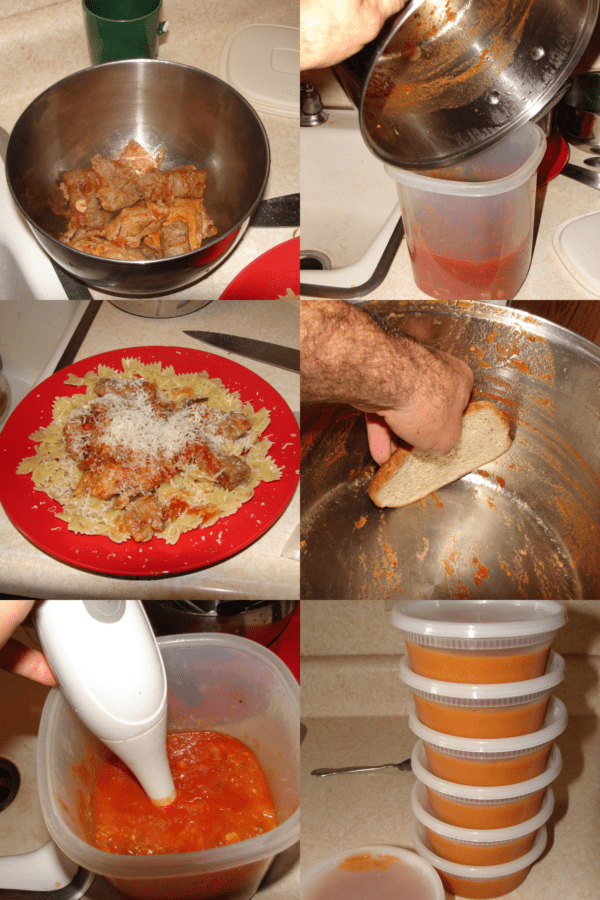
    Step 14. Remove your meats again.

    Step 15. Reserve sauce

    Step 16. Serve up meats and some sauce on pasta with grated parmesan. Eat with bread used to ‘clean’ pot.

    Step 17. Stick your stick blender in the sauce and stick blend it to pizza sauce like consistency.

    Step 18. Divide sauce into ~6oz. portions and freeze what you’re not going to use right away.

    [/et_pb_text][/et_pb_column][et_pb_column type=”1_2″][et_pb_text admin_label=”Steps 14-18 image” _builder_version=”3.13.1″]

    Steps 14 – ?

    [/et_pb_text][/et_pb_column][/et_pb_row][et_pb_row][et_pb_column type=”4_4″][et_pb_text admin_label=”time/yield” _builder_version=”3.13.1″]

    Time: 3 months 2 days and 45 mins give or take.

    Difficulty: Meh

    Yield: 1 Mushroom swiss burger, 2-4 servings of cacciatore, 48-60oz. pizza sauce.

    [/et_pb_text][et_pb_text admin_label=”voila” _builder_version=”3.13.1″ text_orientation=”center”]

    Et voilà!

    [/et_pb_text][/et_pb_column][/et_pb_row][/et_pb_section]

  • For the love of cheese

    I. Love. Cheese.

    It’s the hardest part about being vegan. I don’t really miss butter. I don’t miss milk. Sometimes I miss some half and half in my coffee, but that’s rare.

    What I do miss is cheese in all its cheesy goodness.

    It’s important to let go of your expectations of cheese when trying to be vegan. There are some really good vegan cheeses out there that taste like cheese, but if you expect it to act like cheese and behave like cheese, you’re probably going to be disappointed, so don’t go expecting to make a really good cheesy pizza (though if you figure it out, let me know).

    With these vegan cheese recipes a lot of dishes are back on the menu.

    But before I get into the recipes, here is a pantry list for you of commonly used ingredients you should have on hand:

    You’ll also need a food processor and cheesecloth for some of these.

    And now for the recipes:

    1. Aged Camembert Cheese
    2. Blue Cheese
    3. Cheddar
    4. Cream Cheese
    5. Feta
    6. Mozzarella 
    7. Parm
    8. Queso
    9. Ricotta

    Do you have a great vegan cheese recipe to add to this list (she asks doubtfully)? Drop it in the comments.

    Or  don’t.

    See if I care.

  • Products You Need for a Vegan Kitchen

    A vegan kitchen is not too unlike a non-vegan kitchen, but there are some tools and products that make life much, much easier.

    Foodsaver

    I am new to the ways of vacuum saving food, but I am already in love. SP & OMWC gifted me with this FoodSaver for my birthday, and I can’t get over how awesome it is.

    One of the biggest challenges for me being vegan is that it’s very hard for me to get fresh produce unless I hop over to a farm stand, and they almost never have lettuces. With my FoodSaver I’m able to vacuum pack my produce, tofu, and leftovers, and get many more meals out of them. I haven’t tried it yet, but I will be trying to reheat my vegetables using the sous vide method now that I have my food so well sealed.

    A Fuckload of Mason Jars

    For a well-stocked vegan kitchen (where you also don’t need to spend hours every night cooking), you really need a fuckload of Mason jars. One of the great things about the FoodSaver is there is an accessory attachment you can order and you can vacuum seal jars. Now, as the package will remind you about 10 million times, this is no replacement for canning food, but you can do salad jars. Throw some greens and veg into a jar and seal it up. It can last in the fridge for over a week.

    The meal prepper in me is planning to do this Asian inspired salad jar, Buddha bowls in jars, oatmeal in jars, peanut noodles in jars, and anything else that comes to mind.

    Cookhelp

    Ever want to make cool spiraled veggies? Zucchini noodles? Other spiraly things? Cookhelp at your service. This tool will make your vegan salads a lot more interesting.

    An Award Winning Spatula

    I originally got this award winning spatula (another gift from SP) for breadmaking, but I use it for basically everything. It’s rigid yet flexible. It does the best job scraping bowls out of every spatula I’ve ever used.

    Glass Milk Jugs

    These are so freaking useful for iced tea and non-dairy milks like oat milk (which is super easy to make at home and much, much cheaper).

    Immersion Blender

    I am in love with my immersion blender. It’s changed the way I make soups, and I would argue it’s an essential kitchen tool whether or not you’re vegan.


    AND Bonus Link!

    Football season is almost upon us. Here’s a story for vegetarian athletes everywhere.

  • A Vegan Kitchen: Cookbooks

    I don’t have time to cook this week (or to write a long post) so I don’t have an “If I weren’t vegan…” post for you, so I thought I would do a quick roundup of vegan cookbooks. Over the coming weeks I’ll do these small roundups when I don’t have the time to do a long article for you.

    Cookbooks

    Vegan for Everybody By the folks at America’s Test Kitchen, Vegan for Everybody is one of those books I keep giving to people who say they want to go vegan, but aren’t sure how to do it. The tortilla soup recipe hits my craving for tortilla soup from Blue Corn Cafe in Santa Fe. Another favourite is Red Lentil Soup with North African Spices, by which they mean paprika, coriander, cumin, cinnamon, and ginger.

    Simple Recipes for Joy If you can get past the name, this is a really amazing cookbook. Written by Sharon Gannon, these recipes are largely drawn from the Jivamuktea Café she has co-owned in NYC since 1984. Recipes are plant based, and delicious. I haven’t made one dish from this cookbook that disappointed me. The maharani dal recipe is so good, and has the same comforting effect on me as sambar.

    Vegans Know How to Party I have no idea how this book came into my life; it just appeared on my bookshelf one day, but it’s amazing, and the title cracks me up. This is the perfect book for the vegan who likes to host dinner parties, which isn’t me…I don’t like having people in my house, but it might be you.

    On my cookbook wishlist:

    Thug Kitchen: Eat Like You Give a Fuck Anyone who knows me personally knows that I love swearing and gangsta rap. Combined with vegan food, this cookbook looks perfect for me. Everyone I know who has this cookbook says it’s incredible and there isn’t one bad recipe.

    Vegan Comfort Classics Comfort food gone vegan. If there’s one thing I don’t do very well in the kitchen, it’s traditional American comfort food. It’s probably because most of my comfort foods are Indian, Thai, Japanese, or Middle Eastern, but sometimes I really want traditional comfort food like I grew up with. This cookbook has some promising reviews.

    That’s it from me this week. See you all in the comments!

  • Tulip’s Favorite Cookbooks

    [et_pb_section bb_built=”1″][et_pb_row][et_pb_column type=”4_4″][et_pb_text admin_label=”Intro” _builder_version=”3.10.1″]

    Even though I rarely use recipes, I love them. They provide me with inspiration and ideas for combinations I may never have thought of on my own. I also love cookbooks, especially those that focus on techniques or a cooking philosophy. It’s not unusual to find me spending a Sunday afternoon curled up on the couch with the dog and a cookbook. Today, I’d like to recommend a few cookbooks that I turn to over and over.

    [/et_pb_text][et_pb_divider _builder_version=”3.10.1″ color=”#ffffff” height=”8px” /][et_pb_text admin_label=”Adler” _builder_version=”3.10.1″]

    First is “An Everlasting Meal: Cooking with Economy and Grace” by Tamar Adler. This isn’t your typical cookbook. She has modeled it after M.F.K. Fisher’sHow to Cook a Wolf” and it is thus more like a series of essays about how to eat. Each chapter is organized around a method or ingredient and her guiding philosophy shines through. I think her philosophy could be summed up as ‘Start and keep going.’ I just love her writing. It is beautiful and she really captures cooking – not just eating – as a sensual act. Take care with your cooking and plating and you will be satisfied with less because you have satisfied all your senses, not just taste.

    Sprinkled through the chapters are recipes that illustrate the methods or use the ingredients she has just discussed. Reading her descriptions, you can almost taste the dishes. Her writing is reassuring as well. Yes, you’ll make mistakes. It will be okay, there are sections devoted to explaining how to save your mistakes. If your pork chop came out dry, it can be turned into hash. I wish I’d had this book years ago, but I’m not sure I would have truly appreciated it then.

    [/et_pb_text][et_pb_divider _builder_version=”3.10.1″ color=”#ffffff” height=”8px” /][et_pb_text admin_label=”Middleton” _builder_version=”3.10.1″]

    Growing up, vegetables were usually boiled until soggy and served as is. I hated them. Boiled vegetables can be wonderful (see Tamar Adler’s book) if treated correctly, but it took me years to get over my hatred of boiled vegetables. If you grew up like I did, then Susie Middleton’sFast, Fresh, & Green” may change your life. This book is all about how to cook vegetables so you want to eat them Each chapter is organized around a specific technique like roasting or sautéing. She gives you a base method/recipe and then several specific recipes as examples. Her Sautéed Sugar Snaps with Salami Crisps is wonderful. I sometimes make it with snow peas.

    Snow Peas and Salami
    Snow Peas and Salami Done

    [/et_pb_text][et_pb_divider _builder_version=”3.10.1″ color=”#ffffff” height=”8px” /][et_pb_text admin_label=”Ruhlman” _builder_version=”3.10.1″]

    The principle behind “Ratio” by Michael Ruhlman is that you don’t need a recipe as long as you understand the appropriate ratio behind the dish. He delves into the science of cooking more than Susie Middleton or Tamar Adler. The book is organized like a typical cookbook – Doughs and Batters, Sauces, Sausages, etc and carefully explains the science behind the ratio. This is the book that inspired me to start experimenting when baking and resulted in my Holy Mole brownies.

    [/et_pb_text][et_pb_text admin_label=”Potter” _builder_version=”3.10.1″]

    Another book that investigates the science of cooking is “Cooking for Geeks: Real Science, Great Hacks, and Good Food” by Jeff Potter. I love this book because it, more than any other cookbook I’ve read, encourages you to experiment. Want to test the calibration of your oven, it explains how to use sugar to do so. Why are copper bowls good for making meringues? Potter explains. There are directions to make your own seitan, a DIY sous vide and resources for finding molecular gastronomy supplies like meat glue. I enjoyed the recipe to make brownies using orange peels as a little cup. Fun!

    [/et_pb_text][et_pb_text admin_label=”Nosrat” _builder_version=”3.10.1″]

    The newest addition to my library is “Salt, Fat, Acid, Heat: Mastering the Elements of Good Cooking” by Samin Nosrat. Like Adler, she is an alumnae of Chez Panisse. I find Alice Waters insufferable in interviews, but she raises good cookbook authors. This book is all about how to cook – how to use salt and fat and acid and heat to make good food. The first half of the book explains techniques, interspersed with her memories of learning to cook at home and in a restaurant. It almost feels like part memoir. The recipes start after she has explained how to cook. The book is illustrated and the illustrations remind me of Mollie Katzen’s work (excellent vegetarian cookbooks). Every recipe has variations at the end. I used her best pan fried chicken to make pork schnitzel.

    Breaded Pork Schnitzel
    Quick Frying Pork Schnitzel

    [/et_pb_text][et_pb_divider _builder_version=”3.10.1″ color=”#ffffff” height=”8px” /][et_pb_text admin_label=”reference books” _builder_version=”3.10.1″]

    Here are three other books that serve as useful references: “Cookwise: The Secrets of Cooking Revealed” and “Bakewise: The Hows and Whys of Successful Baking” both by Shirley O. Corriher, and, of course, “The Joy of Cooking” by Irma S. Rombauer and Marion Rombauer Becker.

    If you watched Alton Brown’sGood Eats”, then Shirley O. Corriher is likely familiar to you. She used to show up and lecture Alton about food science. Unfortunately, her cookbooks read like textbooks and she is giving a lecture. They delve deeply into the science of cooking. If you want to understand how to make a tender pie crust instead of a flaky one, she makes it clear. Each recipe explicitly lists what it is intended to illustrates. They are truly useful references, but not something you want to curl up with on the couch on a rainy day.

    [/et_pb_text][et_pb_text admin_label=”Joy ” _builder_version=”3.10.1″]

    “The Joy of Cooking” is an all purpose cookbook. Each chapter and section starts by telling you ‘about’ the method or ingredient. For example ‘About Pancakes’ gives tips for success and is followed by a lot (I mean a lot) of recipes. If you need to know how long and what temperature to use for that four pound roast, “The Joy of Cooking” has got you covered. It is also useful for learning the tips of success (how do I make a good dumpling) and finding a basic recipe that can serve as a base for experimentation, but I rarely make any of the actual recipes here. I just learn what goes into a typical pancake or dumpling or beef stew and go from there.

    [/et_pb_text][et_pb_divider _builder_version=”3.10.1″ color=”#ffffff” height=”8px” /][et_pb_text admin_label=”closing” _builder_version=”3.10.1″]

    There are a lot of wonderful cookbooks out there. I hope I’ve introduced you to a few that will help you enjoy cooking as much as I do.

    [/et_pb_text][/et_pb_column][/et_pb_row][/et_pb_section]

  • Spontaneous Cooking: Pantry Meals

    [et_pb_section bb_built=”1″][et_pb_row][et_pb_column type=”4_4″][et_pb_text _builder_version=”3.9″]

    So far, I have talked about cooking from fresh ingredients and avoided the use of processed ingredients. But, just as I think everyone should have a date night dinner they can pull out to make, I think everyone should be able to make dinner strictly from pantry items. This is useful when you (like me) have recently been traveling and haven’t been able to get to the grocery store, or if (like me) you are just swamped at work and haven’t been able to get to the grocery store. Knowing how to make a meal from the pantry means you can still avoid the high calorie, high volume of take out.

    I have a pretty extensive pantry. As a partial list, I keep canned beans (black, white and red), canned tomatoes, canned green beans, canned artichoke hearts, canned tuna, and cream of mushroom soup on hand. I also always have frozen broccoli, artichoke hearts, Brussels sprouts, and salmon or other frozen fish in the freezer. I keep rice, wheat pasta, rice noodles, and bouillon in my pantry as well. In addition to canned, frozen, and dry goods, I think of a few fresh (fresher) items like kielbasa, or other pre-cooked sausage, onions, garlic, spinach, and lemons or limes as pantry items because I always have them on hand. Your pantry items may be different.

    Pantry meals do have a downside. They aren’t as tasty as cooking from scratch and downside for me – upside for some – they make more than one serving. I take the leftovers to work for lunch.

    Sausage and Beans

    I make sausage and beans from pre-cooked sausage (most recently chicken and garlic), white beans (usually cannellini, but others work), garlic and spinach.

    Sausage & Beans Ingredients

    I cut about one third of the kielbasa into rounds,the rest I put in the refrigerator – it will keep for a few days for other recipes – and sauté the rounds.

    Sausage Saute

    I just brown the slices on both sides. I don’t even add any oil. The slices will give off fat while browning. Next, I add some chopped garlic and a drained and rinsed can of white beans. I like the beans toasted, so I give it a minute or two, stirring occasionally.

    Add Beans
    Add Spinach

    Then add about one half of a bag of spinach.

    Turn off the heat and toss it until the spinach wilts.

    Sausage Sauté with Spinach

    Squeeze a lemon quarter over it, it does make a difference. This makes about three servings for me.

    But why not just get takeout? I timed this. It took me sixteen minutes to make, including slicing the sausage and chopping the garlic, and I wasn’t rushing. It also cost much less than takeout and I think it is better for me.

    Variations: You can use black or red beans, even chickpeas, instead. On one occasion, I didn’t have sausage, but I did have pepperonis. So I put a little oil in the pan, sautéed the garlic, added the beans and pepperonis, then the spinach. It was good. You could substitute chorizo or other sausage as well. If it isn’t pre-cooked, though, it will take longer to make.

    Another use for sausage is a variation of the stove top hotdish I grew up with. Stove top hotdish is a package of mac ‘n’ cheese combined with a cut up hot dog and frozen veggies or a can of tuna and frozen peas. I no longer buy packaged mac ‘n’ cheese. Instead I use a little pasta, frozen veggies and whatever cheese I have on hand. Most recently I had cream cheese to use up. I sautéed my sausage, microwaved a broccoli cauliflower mix and combined it with some pasta, cream cheese, cheddar, and cayenne pepper.

    Spinach, sausage, and garlic are fresh(er) ingredients. What if you don’t have those on hand?

    Easy, make 8 minute soup. This is a strictly canned goods dish. Drain and rinse a can of black beans and a can of red beans. Put in a pot. Add a can (including liquid) of tomatoes. Add a drained and rinsed can of corn. Add two or three cups of broth (made with bouillon if needed) and a tablespoon of chili powder and ½ tsp of cayenne and ¼ tsp of black pepper. Taste, then add salt. All those canned goods have salt, so make sure you taste to avoid an overly salty dish. Bring to a boil and boil for 8 minutes. If you use vegetable broth, you have a vegan soup. (You’re welcome, SP).

    These are just three of what I call pantry meals. There are hundreds more that you can make. As I mentioned above, it really depends on what you keep in the pantry. So, Glibertarians, what do you keep in your pantry, and what are your favorite pantry meals?

    [/et_pb_text][et_pb_text _builder_version=”3.9″]

    Done!

    [/et_pb_text][/et_pb_column][/et_pb_row][/et_pb_section]

  • Cooking for One Without a Recipe

    Sous Chef Oscar
    Sous Chef Oscar
    I love recipes and cookbooks. I often read cookbooks on Sunday mornings, but I usually cook without a recipe. Cooking without a recipe is a useful skill because it lets me just look through the refrigerator, pull stuff out and make dinner. In addition, most recipes are designed to serve four or more, which for a single woman like me, means leftovers.

    I don’t like to eat leftovers. Leftovers can be convenient for lunches or future dinners, but with the exception of chilis, stews or some soups, most recipes just don’t benefit from reheating. If a recipe doesn’t reheat well, it doesn’t freeze well. Making a single portion lets me eat good food and avoid leftovers.

    It is easy to come home from work and order in or use processed food to throw together a dinner– that’s not healthy for my waistline or wallet. I need to make sure that cooking dinner is easier and better than ordering in or eating something already prepared.

    A few principals of cooking for one before we start:

    1) Season your food. Salt is why food in a restaurant tastes good. Use it.

    2) Use garnishes like parsley, chives, a bit of cheese or nuts. Those little touches at the end really do improve the experience for very little effort.

    3) Pay attention to presentation. When the food looks inviting, it tastes better. And, even though it seems counter-intuitive, when food looks inviting and tastes good, you actually eat less because it is more satisfying. So, if you are interested in losing weight, take time to make your food special.

    I need something that is quick and easy to prepare and cleanup for those nights when I don’t feel like cooking. So, let’s start with the simplest method I know; the brown and bake. I want to make this feel like a composed dish by using two or more vegetables. It makes the meal feel more special than just tossing something together. To demonstrate the method, I’m making a chicken thigh with sweet potato and spinach.

    1. Preheat the oven to 400F.

    2. Season a skin on, bone in chicken thigh with salt and pepper. Add a little oil or butter to an oven safe skillet, then add the chicken thigh, skin side down.

    3. While the chicken browns, peel and chop a sweet potato into 1 inch pieces. Once the chicken skin is brown and crispy, add the sweet potato to the pan and season with a little salt. Put the pan into the oven keeping the chicken skin side down, and bake for 15 minutes.

    4. After 15 minutes, turn the chicken over and stir the sweet potato around, then return to the oven for another 10 to 15 minutes.

    5. When the chicken is done (at least 165F – use a meat thermometer) remove from the oven, and put the chicken thigh on a plate.

    6. Add spinach to the pan with the sweet potato and toss until the spinach wilts. Sprinkle on a little blue cheese and serve.

    That’s it. Crispy chicken skin, soft sweet potatoes and tangy blue cheese paired with the slight bitterness of spinach. You have a satisfying dinner for one that looks and tastes like a composed dish in about one half hour and with little effort and an easy cleanup. Perfect for a weeknight.

    Voila!
    Done!

    This method is easily adaptable for a variety of proteins and vegetables. For example you could use new potatoes cut in half and tossed with a little fresh, chopped, rosemary before adding to the pan. Then toss with the spinach as above. A little blue or feta cheese works here as well. Butternut squash can also be substituted for the sweet potato.

    Other variations:

    Cut carrots and parsnips into matchsticks and toss with honey and cayenne pepper before adding to the pan. Top with a little chopped fresh chives.

    Pair a thick pork shop with Brussels sprouts and apple. Cut the Brussels sprouts in half or quarters depending on the size. Cut the apple into pieces about the same size as the Brussels sprouts – add the apple at the halfway point.

    Salmon works well, but choose vegetables that cook quickly – like asparagus and cherry tomatoes, finished with a splash of balsamic vinegar and some capers. Or, use green beans and mushrooms.

    Your imagination is the only limit.

    Next time I will talk about making a skillet dinner with a pan sauce.