I am going to try to spice things up a bit and tell you about that one time I went to Jamaica. Turns out, the cruise ship I was on made a stop there and I got to look around a bit as the bus drove us to Montego Bay. Okay, maybe I just got the Cliff’s Notes version of Jamaica, but the island seemed like a nice place, at least the tourist areas. Something I found kind of odd was when the group transferred from one Jamaican chaperone to the other, they all seemed to fill in the time by telling the group about their country’s tax code.
No, seriously.
This is my review of the beer in the short, stubby, ugly bottle: Red Stripe!
I have been dying to use that picture.
First, I got off the ship and hopped on the bus. The bus driver explained a few things unique to Jamaica, such as their habit of locals letting loose their goats off the side of the road. It served two purposes: to feed their goats and to keep the grass trim, that way the government saves money cutting grass along the side of the highways. Clever. He also explained that Jamaica had a general consumption tax and a property tax. That was it.
Later the guys on the catamaran said the same thing. There’s a general consumption tax, and a property tax, but they also explained there was a tax on some imported goods, like gasoline. Then a different bus driver again explained their tax code.
I thought that was pretty cool, if true. Maybe there are places besides the US where a libertarian can be somewhat welcome. After all, they had pretty well maintained roads, even by US standards and there was other infrastructure like overhead powerlines and sewers. They even speak English! Snorkeling with my 3 year old only created more interest; perhaps something rubbed off on this particular former British colony. This one has some awesome things to do and the people here seemed to be every bit as fun as you want them to be.
Nope. I was wrong.
Here is a basic breakdown of Jamaica by the things that people around here tend to pay attention to. As always, everyone here is welcome to call bullshit.
State Legitimized Theft
There is a tax on real property, but it is broken down by value as determined by the Jamaican government. This table below has a breakdown of property values.
There is also a tax levied upon the transfer/sale of real property of 5% or 1% for shares–if the capital gains made on the property exceed 37.5%. There is also a stamp duty for the same transactions of 1% of shares and 4% for real property–there are exemptions on the stamp duty for shares sold on the Jamaican Stock Exchange.
General Consumption Tax. It’s basically a VAT at 16.5%. Taxes on some imported goods, such as petroleum products and alcohol apply.
There is no income tax!…..if you make under 1,500,000 JMD/year. Over that, its a flat 25% unless you make more than 6,000,000 JMD/year–then it is 30%. There are also some considerations for Jamaicans living abroad vs. on the island.
You’ll like this one. There is no tax on capital gains or inheritance.
Minimum Business Tax: 60,000JMD/year for all corporate bodies. This also applies to tradesmen, professionals, and businesses exceeding 6,000,000 JMD/year–this tax can be deducted from an individual’s income tax. Source
It is well-known that Ganja is illegal. Culturally, they don’t care. In fact, I was propositioned twice to purchase Ganja and I was on the island for about 10 hours.
4.-(1) The following Commonwealth citizens (not being persons deemed to belong to the Island as defined by subsection (2) of section 2) are prohibited immigrants-
(a) any person who is likely if he entered the Island to become a charge on public funds by reason of infirmity of body or mind or of ill-health or who is not in possession of sufficient means to support himself and such of his dependants as he shall bring with him to the Island;
(b) any idiot or epileptic or any person who is insane or mentally deficient or any person who is deaf and dumb or deaf and blind, or dumb and blind, unless in any such case he or a person accompanying him or some other person gives security to the satisfaction of the Chief Immigration Officer for his permanent support in the Island or for his removal therefrom whenever required by the Chief Immigration Officer;
(c) any person certified by a Health Officer to be suffering from a communicable disease which makes his entry into the Island dangerous to the community;
(d) any person over sixteen years of age who by reason of deficient education is unable to fill up the prescribed form of declaration for immigrants in his own handwriting and is likely to become a charge on public funds;
(e) any prostitute or any person who may be living on or receiving or may have lived on or received the proceeds of prostitution; cf, the children under the age of sixteen years being dependants of a prohibited immigrant;
(g) any member of a class of persons deemed by the Minister on economic grounds or on account of standard or habit of life to be undesirable immigrants and so declared by order published in the Gazette; […] “
On the surface, they look like they are on par with one of the more restrictive states in the US. In practice? Forget it.
I tried. Jamaica is no libertarian paradise, but the goat curry is tasty.
So is Red Stripe any good? Not really. The owner of the $400,000 catamaran generously informed us the Red Stripe was on him at the boat’s mini bar, just tip the nice lady serving you. So in effect, its cheap enough that even Jamaicans give it away for free. It’s not without its charms though and certainly something I’d grab out of nostalgia for that time I went snorkeling with my family in Montego Bay. Red Stripe Jamaican Lager 2.0/5.
Back in September, I posted about an act of actual evil. Where an anonymous vote of a State body stopped a hospital expansion, including addition of services that did not exist in the area. Despite the efforts of a local reporter and yours truly, we never were able to pin down who torpedoed the approval.
I wanted to update everyone on the situation. It got better. And the best part of the story is that the scum who opposed this have now come out in the open:
A representative for state Sen. Dave Syverson, R-Rockford, who also serves as a Mercyhealth board member, spoke against Swedes’ expansion plan on Tuesday. So did other representatives of Mercyhealth, including its CEO Javon Bea.
So the dirtbag politician with the conflict of interest (he serves on the board of a local competitor health group) that had been opposing this from behind the scenes, has now stepped into the light, to show his true asshat colors. And the CEO of the same competitor came in to throw around some slander and BS in an attempt to avoid competition:
Bea said he is “against unnecessary duplication” of SwedishAmerican’s 10-bed Neonatal Intensive Care Unit. “They have higher death and disability rates because for 10 beds they cannot employ the entire range of pediatric subspecialties on-site,” he said after testifying before the Review Board.
Bea said SwedishAmerican will send its sickest babies to Wisconsin, forcing parents and families to travel. SwedishAmerican is a division of UW Health.
“Families will have to figure out how to take care of babies for months at a time,” Bea said.
Mercyhealth has 52 NICU beds that are part of its $505 million new hospital campus at Interstate 90 and Riverside Boulevard, which is expected to open in January.
Born said the claims that SwedishAmerican would operate a substandard Level III NICU are “insulting and absurd.”
“It’s insulting because of SwedishAmerican and UW Health’s long-term commitment to quality and safety,” Born said. “It’s absurd because a Level III NICU at SwedishAmerican would be held to the same standards of any other Level III NICU in the state.” [emphasis added]
Allow me translate Mr. Bea’s complaint…
“Hey, competition?! Dammit. I guess having a State Senator in our pocket wasn’t enough to stop it….so here, let me throw out a defamatory smoke screen and run away.”
So justice was delayed, but denied, in this matter. I have to give credit to the Rockford Register Star reporter – Georgette Braun – for shining some light on the dirtbags in this story. (This was the reporter I had contacted and found out we had both been stymied in our attempts to find out who had voted which way last year).
And an extended middle finger to both of you, Dave Syverson and Javon Bea.
This is a bittersweet result – while this individual injustice has been rectified, the intrusion of the State into this field is still there, ripe for continued abuse by preventing of medical care being expanded.
An amusing news story yesterday caused some discussion. These seem to pop up every year or so and are generally used as a way for academics to bash their latest not-a-leftist target. Eight straight years of “see, Bush is horrible!” followed by eight straight years of “Obama is dreeeeamy!” sort of triggered my cynicism meter. Of course, the inclusion of presidents still in office is de rigeur for sending the desired signals, and putting Trump on the list after barely a year in office is reminiscent of Obama’s affirmative action Nobel Peace Prize, just before he started six new wars and began drone-killing Americans.
Likewise, historians love presidents who were incredibly active, preferably ones who killed a few hundred thousand people. The bias that “doing something” is better than “leaving us alone” is a powerful means of slanting the ratings. So given OUR biases as libertarians, how would you rank our presidents?
My own personal feeling is that there’s probably 5 or six great ones, five or six horrendous ones, and most of the rest form a blob in the middle and ranking them is useless.
My Top Five:
Calvin Coolidge- did a wonderful job of leaving us alone, and look what happened. Economic boom time, which only ended when a more activist president and congress decided to start meddling.
George Washington- for doing what every president ought to do: serve his time, then go home and shut up. I put him here in the top 5 because he wasn’t John Adams.
Grover Cleveland- someone whose first instinct is to avoid federal action unless specifically demanded by the constitution ought to get more libertarian love. And he had a wonderful way of phrasing.
Bill Clinton- wait, what? His arrival here wasn’t due to anything he deliberately did, but what he managed to do accidentally was totally tie the government into knots so that they were too busy with perjury and blowjobs to fuck things up. Economic boom, balanced budgets, only minor wars, who can complain?
William Henry Harrison- for the obvious reason.
My Bottom Five:
45. Richard Nixon- the guy who came close to killing a million, brought us the War On Drugs, the EPA, wage-and-price controls, “Affirmative Action,” decoupling of currency from hard assets… he was a fucking disaster, top to bottom.
44. Lyndon Johnson- easily the most corrupt and murderous human to ever occupy the Oval Office. Besides killing millions, he halted the progress of black Americans and destroyed their next several generations.
43. Woodrow Wilson- it was hard to not rank him the worst, and I think a good argument could be made for that. Besides getting us into a world war and setting the conditions for an even bigger one, he was famous for his intense racism, his love of eugenics, his complete disregard for the constitution, and… well, I can think of absolutely nothing in the favor of that disgusting piece of shit.
42. James Buchanan- sometimes the historians are right.
41. John Adams- the Alien and Sedition Act and the Quasi War sent the US in the wrong direction from which we still haven’t fully recovered.
I have not towed the libertarian lion of putting Lincoln in that bottom five, mostly because (unlike the guys there) he was a mixed bag and besides the obvious evil, accomplished some great things as well (like Amendment XIII). And FDR came oh so close to the final cut, and I would not argue about his inclusion…
I have this ongoing conversation with the wife. She works for the federal government here in Canuckistan, and I’ve worked on a few government contracts over the years. I walk the delicate line of telling her that, while I respect what she does, there’s no reason that the government should do it. Which is not to say that it should not be done, just that it could be done through other means.
At least it wasn’t unintentionally left blank…
I’ve posited that you could cut the size of the federal government here by 60% and hardly anyone would notice. How would I do it? First, cut the 20% of programs that no one will miss. I’ve worked on some of these projects in the past. On one, I was working on a public-facing website to provide data ostensibly for “the public good”, at a cost of millions of dollars. One day, one of my colleagues got the idea to pull the website statistics to see how often and from where it was being accessed. Turns out, in the previous year, it had been accessed exactly twice from IP addresses outside of the department. Hardly anyone would miss that program.
Second, I’m sure that there’s 20% savings to be found by cutting bureaucratic overhead. When the wife tells me about her day, most of it relates to how she’s working against the bureaucracy to try to get her job done. In my small consulting business, I’ve increasingly moved away from doing federal government contracts – the overhead is just too much. It’s much cheaper and faster to find and perform work for private clients.
Third, I’d cut 20% of the people. If you look around your own workplace, you can identify a certain percentage of people who don’t pull their weight, or worse, contribute negatively. You know, the ones who are constantly at cross-purposes with the rest of the team, or the ones who spend all of their time commenting on Glibertarians.com, or the ones who just aren’t good at their jobs. I once led a team on which I didn’t have the authority to hire and fire (yeah, it sucked). I spent inordinate amounts of time trying to get contributions from non-performers. Then, one day, I just stopped. I ignored them. And, you know what? Our productivity went up. Strange, that. It happens everywhere, but the existence of public-sector unions exacerbates this situation.
I wouldn’t do it all at once. I’d do it gradually, say over 12 years. I think that doing it more gradually would lessen the degree to which people would notice it (which is, hardly at all).
Anyhoo, in the case of the U.S. federal government, I came across this neat-o website that breaks down U.S. federal government spending (I’m actually shocked that it’s a .gov website because it’s pretty well done). According to it, the U.S. government spent $3.85 trillion last year. I started looking at it like a minarchist softball coach, and here’s what I came up with:
Social Security: $916.1B (23.0%) – CUT
National Defense: $595.3B (14.9%) – CUT to $584.6B
I opted to keep national defense spending, except for “Defense-related activities”, which sounds an awful lot like a slush fund for defense contractors. If you eliminate foreign interventions and limit spending to national defense, this number should be much lower. Since I’m not getting that fine-grained in this analysis, let’s leave it for now.
Medicare: $594.5B (14.9%) – CUT
Income Security: $514.7B (12.9%) – CUT to $144.8B
Here, I’ve eliminated everything except federal employee retirement and disability. If you’ve already made those commitments to your employees, then you’ve got to keep them.
Health: $511.3B (12.8%) – CUT
Net Interest: $240.7B (6.0%) – KEEP
You gotta pay the bank. Although there’s something to be said for the government skipping out on loan repayments and tanking their credit rating so that they can’t borrow any more. Picture your favorite congresscritter walking into a pawn shop or payday loans joint.
Veterans Benefits and Services: $174.5B (4.4%) – CUT to $167.2B (4.2%)
Here, I cut “Other veterans benefits and services”, because it sounds like more government cheese for contractors. In general, I think that you should look after military vets, to the extent that they can be injured during their service, but I’m sure that there’s more here to cut. For example, the largest slice of this category is $86.8B for “Income security for veterans”; most of the veterans I know are eminently employable.
Education, Training, Employment, and Social Services: $108.1B (2.7%) – CUT
Transportation: $92.9B (2.3%) – CUT
Administration of Justice: $57.1B (1.4%) – CUT to $52.1B
This is one of the fundamental roles of government, although if you end the war on drugs, I’m sure you could cut a bunch here, too. I did cut $5.0B for “Criminal justice assistance”, which is described as transfers to state and local governments for something or other.
International Affairs: $45.3B (3.5%) – CUT to $13.9B
Here, I’ve cut out everything except “Conduct of foreign affairs”. The rest looks like cash that will end up in the pockets of the Mugabes of the world.
Natural Resources and Environment: $37.8B (1.0%) – CUT to $26.6B
Honestly, I don’t know what most of this actually is. Maybe it’s within the domain of government, and maybe not. But “Other natural resources” (slush fund) and “Recreational resources” sure aren’t.
General Science, Space, and Technology: $30.2B (0.8%) – CUT
Community and Regional Development: $21.2B (0.5%) – CUT
Agriculture: $20.1B (0.5%) – CUT
General Government: $18.6B (0.5%) – CUT to $11.9B
Here, I’ve cut “General purpose fiscal assistance” and “Other general government” as slush funds.
Energy: $3.7B (0.1%) – CUT to $0.2B
Here, I’ve cut everything except “Emergency energy preparedness”.
So, let’s add everything up here. Let’s see … carry the 1 … Sweet Feathery Jesus, it’s worse than I thought. We’re down to $1.28 trillion, or to about 33% of the current budget. And, I’m fully aware that there’s still lots of waste in there.
Earlier, I stated that most people wouldn’t notice if you cut the government by that much. Sure, some of the things that I’ve cut here would be noticed by people, but this is analysis is really only about cutting program spending, not eliminating bureaucracy and ineffective people. You know what people would notice? More money in their pockets. You’re welcome! I’m sure your rebate checks are already in the mail.
“3 out of 4 Americans believe that killing animals for meat is immoral, according to a MSNBC-MediaMatters-PETA poll. Based on this information, Congress is debating new rules put forth by the FDA to tax meat production at a higher rate than vegetables.”
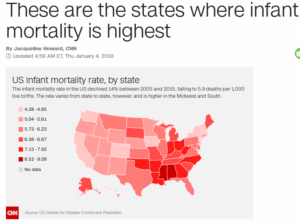
The infant mortality rate is nearly double in Mississippi and Alabama than it is in New York and California!!!! Oh wait, It is 0.4% in NY and CA and 0.8% in MS and AL. And wait, there’s more! There’s a longstanding and well-known correlation between poverty and higher infant mortality. CA and NY are 2 of the richest states and MS and AL are 2 of the poorest states. What, exactly, is the point of this article except to poor shame the south?
Every media outlet has published a metric ton of articles that start just like this. It’s lazy writing, but it’s also the platinum standard for crafting a narrative. See, people are social animals that are primed to go with the crowd. When that subconscious impulse is manipulated through polling, people’s behavior becomes malleable. When you have some basic understanding about the strata of voters and their belief systems, you can get them to do your bidding without them even knowing.
Three basic concepts make public opinion polling an irresistible tool used to bias an audience: herd behavior, identity politics, and aura of authority. The formula is simple, using a favorable polling result, generalize the findings so that it is implied that a majority of an identity group believe a certain way, relying on herd behavior to solidify support of the belief within the identity group.
The ironic part is that none of what makes public opinion polling such a strong tool is based in reality. The herd behavior is based on an illusion. By and large, support for a politically controversial position sits somewhere between 40% and 60%, meaning that nearly half of people oppose said controversial position. Further, polling doesn’t allow for enough nuance to differentiate between being opposed to legalizing machine guns and being for the repeal of the 2nd Amendment. Identity politics, as well, is subtle. Take, for example, the approval/disapproval ratings of prominent politicians. If identity politics were the primary driver of public opinion, the surges and drops in approval ratings would be quite attenuated.
However, the illusion of universal agreement is very powerful.
Social Science is Modern Day Astrology
The holy grail of science is replicability. If you can produce an effect in one study, you should be able to replicate the conditions and achieve the same effect in a successive study. In physics or chemistry, this is usually fairly straight forward. Barring some unknown environmental variable affecting the experiment, the bowling ball and the feather land on the ground at the same time in a vacuum. The sodium and the water create a highly exothermic reaction when combined.
Social science is much squishier, both in methodology and in result. When you’re working with people, they don’t behave like molecules in a vacuum. They lie, they are affected by minor biases in your methodology, they are subject to many weird psychological effects like the placebo effect, and they don’t take kindly to being locked in a laboratory for 15 years for a longitudinal study.
Resultantly, more social science is done by “poll” than by “experiment.” Not that the experimental method is any better. I experienced the infamous psychological experiment where they flash pictures of different races of people and then time how fast you click on the good word or the bad word.
This has led many skeptics to put scare quotes around social “science”, which more and more resembles phrenology than physics. Adding more fuel to the fire is the “replicability crisis.” The replicability crisis affects both experimental and poll based studies. Essentially, social science can’t find the same effect two times in a row. Not only that, but they can make a study say that any effect exists (such as, listening to songs about old people makes you younger).
However, in a world that fucking loves science and decides social policy by sound byte, the internal crisis in social science becomes a very public issue. As discussed in Part 1, science journalism is a farce. When an ethically compromised journalism industry interacts with an ethically compromised social science industry, you get science journalism that is slave to the agenda of the media. We live in a world where science is subservient to the state. If you publish something that aligns with the state’s goals, you get media coverage and additional grant funding. If you try to publish something that goes against the state’s goals, you get undermined at every step.
Manipulating the Results: Bias in the Experiment
People are quite malleable as I’ve already said, and this is evident in the results of studies. Wording is very important. Want an anti-abortion poll result, mention “mother” and “convenience.” Want a pro-abortion poll result, mention “choice” and “woman”. I’ll let the next example speak for itself.
An example of a wording difference that had a significant impact on responses comes from a January 2003 Pew Research Center survey. When people were asked whether they would “favor or oppose taking military action in Iraq to end Saddam Hussein’s rule,” 68% said they favored military action while 25% said they opposed military action. However, when asked whether they would “favor or oppose taking military action in Iraq to end Saddam Hussein’s rule even if it meant that U.S. forces might suffer thousands of casualties,” responses were dramatically different; only 43% said they favored military action, while 48% said they opposed it. The introduction of U.S. casualties altered the context of the question and influenced whether people favored or opposed military action in Iraq.
There are quite a few known phenomena that influence studies, as well.
Acquiescence Bias – Making a statement and asking the poll taker to agree or disagree. Usually folks with lower education will agree disproportionately with the statement in comparison to when the same issue is asked in a question format.
Social Desirability Bias – We saw a bunch of this last election cycle. People tend not to like to tell others about their illegal or unpopular opinions, so they’ll simply lie to make the poll giver like them.
Question Order Bias (“Priming the Pump”) – Ask a question that will likely get a positive or negative reaction, then follow it with a question you want to influence in that positive or negative way. For example, if I were to ask y’all whether you like the current spending levels of the federal government and then followed it up with a question of whether you like deep dish pizza, the pizza question will be skewed negative.
Interviewer Effect – Related to the Social Desirability Bias. The poll taker changes their responses based on characteristics of the poll giver. For example, if a woman is giving a poll on equal pay, the poll taker may respond more favorably than if a man gives the poll.
Observer Effect – The poll taker is subtly affected by the poll giver’s unconscious cues, resulting in their responses being biased toward the poll giver’s expectations. For example, if the poll giver expects that black people will answer a question a certain way, they may change their inflection when asking the question in a way that influences a black poll taker to answer in that way.
This still ignores the cognitive biases that we have talked about in Parts 1 and 2.
How do you sort through all this crap and get to a real, measurable effect? You design a good experiment. How do you design a good experiment when taking a survey? You don’t.
Manipulating the Results: Playing with the Data
Okay, so we have highly questionable data from a shit survey, but at least we’re now in the realm of math. Nothing can go wrong here!
A core requirement of legitimate polling is “randomization.” Taking a random sample of the group you’re trying to study is what allows you to generalize the results to the group as a whole. If you do something to disrupt the random sample, you weaken the ability to generalize the results to the group as a whole.
How do people screw with the random sample?
Weighting – Let’s say you’ve done a 1,000 person survey, but you’re concerned that your relatively small (but random) sample isn’t actually representative of the world. See, you’re a savvy poll taker and you know that a recent poll showed that there are 41% Democrats, 37% Republicans, and 22% Independents in the locality of your poll, and your poll has 39% Democrats, 40% Republicans, and 21% Independents. We’ll just inflate the results of the Democrats in the poll to reflect 41%, deflate the result of Republicans to reflect 37% and mildly inflate the results of the Independents to 22%, and we’ll do our further analysis based on this massaged data. Of course, this assumes that the pollster’s understanding of reality is correct, and it screws with the randomization of the data, resulting in a strong danger that the data no longer reflects reality.
Margin of Error – You survey 1,000 people, and 44% love Trump and 46% hate him. Therefore, Trump is unpopular on the net. Well, except for the margin of error. For a 1,000 person survey in a country of ~300 million, the results are roughly correct. Roughly correct means that your poll (and others designed in the same way) is within 3% of the reality 95% of the time. This, of course, assumes a representative (read random) sample.
Data dredging – Let’s do a huge survey asking a zillion questions. Then let’s go fishing for correlation between variables. We’ll just ignore that correlation does not imply causation, because who actually believes in that. It actually makes for some amusing reading.
Fudging the data – How about we do 15 runs of the survey, pick the 3 that most support my hypothesis, and publish a paper with the results of those 3 data runs?
A more technical issue is highlighted in Anscombe’s quartet. Four completely different sets of data that are statistically identical. Why? Let me tell a story from Poli Sci 300-something, Statistics for Political Science. One of the main statistical analyses performed by Poli Sci statisticians is linear regression. Linear regression (which you may remember from 5th grade math) is trying to fit data to a straight line (technically you can fit it to another curve). However, the problem is that you have to predetermine the type of curve you’re fitting it to. It doesn’t self-tailor. If you have an exponential relationship between being libertarianism and small government views, it won’t fit well to the straight line regression. It struck me, sitting in that class, how much statistical analysis was an art, not a science. If you don’t understand the math and conceptual understanding behind the numbers (as most social science students don’t), you’re going to come to somewhat worthless results when doing statistical analysis.
The Results are Garbage In the First Place: The Telephone Problem
Garbage in, garbage out. It’s pretty much my motto. It’s especially true with public opinion polling. Let’s quickly mention two issues so you get a sense for the type of garbage being used in modern public opinion polls. No need to linger on this issue.
1) Self-selection bias – This has always been there. Who is likely to answer a telephone poll? Is there some inbuilt bias caused by some declining to participate? Is there a destruction of the randomness of the sample if it takes 3,000 phone calls to get 1,000 poll takers?
2) The shift away from landlines – This is new. Currently, less than 50% of people still have landlines. Cell phones really screw up some of the assumptions behind the methodology of telephone polling. For example, if a pollster wanted to survey people in central Indiana about some local issue, it’s possible that I would get a phone call. I don’t live in central Indiana, and haven’t for over 5 years. What does it mean for the poll that I’m not in the expected cohort? Nothing good. However, it’s easy enough to ask where I live at the beginning. What about the other way around. A pollster is trying to survey northern Virginians about some local issue. I’m essentially disenfranchised by that poll because my area codes is central Indiana. Further, cell phones make it really easy to block unknown numbers, resulting in even fewer “hits” for each phone call.
Knowing the Public: What Motivates Voting Behavior?
Now that I’ve thoroughly shattered your trust in the public opinion poll, let me shatter your trust in the people being polled. Let’s talk about a truly experimental social science study looking at beliefs and voting patterns.
The interesting result of this experimental study of people’s beliefs and voting habits is this:
There are 5 different types of voters:
Ideological – Able to abstract their issue positions into larger conceptualizations (principles) and set those conceptualizations relative to other ideologies.
Near Ideological – Have awareness of an ideological spectrum, but their positions don’t particularly rely on an ideology.
Group Interest – Good ol’ identity politics. I’m black therefore I vote Democrat.
Nature of the Times – Something bad happened in the world when Republicans were in power so I’m voting Democrat.
No Issue Content – I vote because…well… argle bargle, incoherent rambling, no making sense. Seriously, this is the category where the pollster couldn’t make any sense of their motivations for their beliefs.
There must be a bunch of people in groups 1 and 2, a ton in 3, and a smaller amount in groups 4 and 5, right? That would be the sort of society I want to live in.
Sorry to disappoint.
Group 1 (Ideologues) – 2.5%
Group 2 (Near Ideologues) – 9%
Group 3 (Identititarians) – 42%
Group 4 (Idiots who can rationalize their opinons) – 24%
Group 5 (Idiots who can’t even coherently explain the reason for their opinions to a pollster) – 22.5%
This was taken in the early 1960s. Wanna bet it’s even worse today? Identity politics wins because that’s how a plurality of people think. Principals over principles is a thing because 42% of people care about principals and 11.5% (generously) care about principles.
The sickening part is that group 4 and 5 vote. (Table 1 of the study shows the percentages for the study as a whole and for likely voters, with only marginal changes to the percentages).
I could type more about the horrifying prospects of society based on this study, but I think it’s more impactful to let the data sink in. 89% of people base their worldview/politics/beliefs on something other than a set of principles/ethics/morals. Almost 50% have blatantly idiotic reasons for holding their opinions.
As a final note, 35% of respondents randomly varied across opposing positions for issues in successive interviews. There wasn’t a trend in these changes, which made the pollster come to the conclusion that these people weren’t able to come to the same opinion two interviews in a row.
Quick Takeaways from the series of articles
The media is untrustworthy, and not just in the obviously biased ways
Gell-Mann amnesia is real
Science journalism is neither about science nor is it good journalism
Any conclusion drawn from social science should be viewed with great skepticism
Anything being pushed based on majoritarian or poll-tested bases is probably shit
By thinking in terms of principles, you’ve elevated yourself into rarified air. Most people struggle to even rationalize their opinions.





 Social science is much squishier, both in methodology and in result. When you’re working with people, they don’t behave like molecules in a vacuum. They lie, they are affected by minor biases in your methodology, they are subject to many weird psychological effects like the placebo effect, and they don’t take kindly to being locked in a laboratory for 15 years for a longitudinal study.
 Acquiescence Bias – Making a statement and asking the poll taker to agree or disagree. Usually folks with lower education will agree disproportionately with the statement in comparison to when the same issue is asked in a question format.
 1) Self-selection bias – This has always been there. Who is likely to answer a telephone poll? Is there some inbuilt bias caused by some declining to participate? Is there a destruction of the randomness of the sample if it takes