Category: Big Government

  • 8 Forms of Capital or Why Equality of Outcome is Impossible

    One of my favourite Canadians, the Canadian Mike Rowe (Curtis Stone) introduced me to an interesting concept that solidified in my mind why equality of outcome is ridiculously impossible.


    Curtis pulled this from a book that I haven’t read, but he cites it in the video if you’re interested. Frankly, the concept is a bit hippy-dippy for me, so you may see a bit of measured skepticism from me.

    The premise of the video is that there are 8 forms of capital:

    Financial capital – money

    Material capital – non-liquid assets

    Living capital – plants/animals/ability to cultivate plant and animals

    Social capital – relationships with others

    Cultural/Power capital – things your community values, tradition, powerful connections, reputation

    Intellectual capital – book knowledge

    Experiential capital – practical knowledge

    Spiritual/Habitual capital – religious attainment, unflappability, disposition toward success

    My broad definition of capital captures all of these. Capital is a thing of value that is able to be bestowed upon others in an exchange. You can group these categories into three main groups. Asset Capital  – (Financial, Material, Living), Human Capital (Intellectual, Experiential), and Relational Capital – (Social, Cultural, Spiritual). I’ve sort of modified the spiritual capital category to include non-spiritual habits. I think it’s a bit of a stretch to call spirituality a form of capital, so I’m bolstering it. Similarly, I’ve bolstered cultural capital to include reputation and powerful connections such as exists when you’re a government representative, for example.

    The reason why equality of outcome will never happen is simple. You can only confiscate and redistribute asset capital. It is impractical to the extreme to redistribute Human Capital and Relational Capital.

    A prog may argue, however, that it doesn’t matter. The only “real” capital is Asset Capital. So, they go full commie… from each according to their ability to each according to their need, and we’re all now on exact equal footing asset-wise. How long before somebody with more human and relational capital trades something of value for some money? Now that person has $10 more than the rest of us and one less chicken. How long before the carpenter lends his services to me, takes my tree and returns me a finished table in exchange for $100? It’s not long before the communist utopia turns into a mess of inequality and oppression again.

    It comes down to a basic truism. Knowledge, relationships, assets, habits, and power are all of value, and they’re all interrelated to one another. Just like a loom increases the value of a textile worker, non-asset capital increases the ability of a person to acquire asset capital. After all, rich people do rich people things and poor people do poor people things. When a poor person wins the lottery, they’re as likely as not to be broke within a few years.

    I don’t know if I fully believe in this model. Calling things like traditions and religious attainment “capital” seems a bit wonky. However, this exposes a basic truth. Equality of opportunity will, by definition, result in inequality of outcome. We each have a unique mix of these 8 categories of “capital”, and even when presented with the same base set of laws and opportunities, we will apply our “capital” differently from one another. Equality of outcome is exposed as the soft bigotry that it is. It’s a forced leveling, a social engineering to subsidize those who have less human and relational capital and to punish those who have more of it.

  • Illinois- Why We’re Well and Truly Fucked

    In thermodynamics, we have three laws, which can be popularly and accurately summed up as follows:

    First Law: You can’t win, the best you can do is break even.

    Second Law: You can only break even at absolute zero.

    Third Law: You can’t reach absolute zero.

    And that sums up Illinois’s finances. I spent a day reading through some wonderful and depressing information at the Illinois Policy Institute’s website (www.illinoispolicy.org) and would suggest you do the same, even if you aren’t stuck here like I am: it’s a cautionary tale. I’m just going to toss out a few illustrative highlights I’ve dug up there, which will (I hope) inspire people to look further. And it gave me some good rocks to throw (metaphorically) at our Assembly candidates.

    Illinois’s woes are legendary, numerous, and well-documented. I’m simply going to list a few highlighted facts, which lead to the unfortunate and inevitable conclusion: we’re spiraling down the toilet and there’s no way to stop it. The root causes are baked in and, as a practical matter, immutable.

    As you’d expect from a state known as The Cradle of Graft, there’s an amazing amount of money lost to corruption. I found story after story showing hundreds of millions of dollars wasted in useless projects, subsidies, payoffs, kickbacks, legal expenses for police abuse, you name it. But all of that doesn’t even make page one of the Pareto chart.

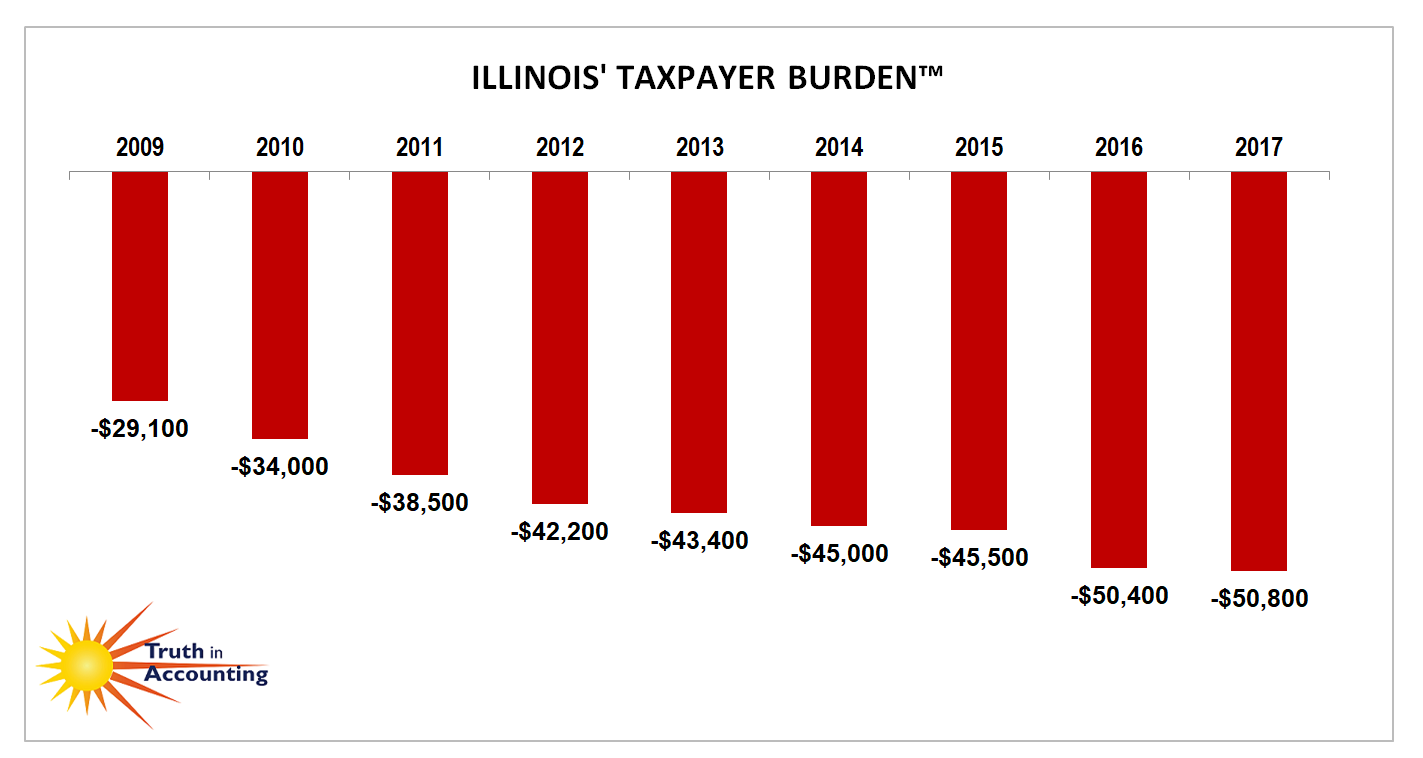
    Illinois’s debt is over $200 billion, with state assets of about $20 billion, and this doesn’t even count local debt, which adds another $100 billion onto the flaming pile. This breaks down to over $50,000 for each and every taxpayer in the state. So you can see that the Three Stooges of How We’re Going to Fix Things beloved of politicians giving speeches (“Waste, Fraud, and Abuse”) are down in the noise; $100 million dollars doesn’t scratch the surface. The tax increases that have been proposed (which will somehow magically not drive people and businesses out of the state at a faster rate than they’re already exiting) aren’t even close to enough to cover this debt.

    Well, how about cutting spending? Let’s look at that a bit, starting with what we’re spending the money on.

    Far and away the biggest cause cause is well-known: public employee pensions and health insurance benefits costs. How bad is it?

    Here’s a delightful graphic which just looks at one typical municipal issue, cops.

    Though there’s variation from county to county, the pattern remains the same.

    How about fire?

    So again, the pattern is clear. If we cut every single penny of cops and fire protection spending, closed every police stations and fire house, and could somehow get around the unions and fire every worker, we would STILL be vastly underwater. There’s nothing unique here; there’s similar charts for teachers, nurses, clerical, administrative, and every other type of state leech employee classification.

    The debt, pension and health insurance costs for retired state workers represent over $185 billion, or about 85% of the Illinois debt. It cannot be stressed enough: this is for people who are no longer working. You could fire EVERYBODY currently employed, cut every goddam program (good or bad), shutter every building, and barely dent the issue. These deals were put in place by the generations of family politicians who have run the state and municipal governments, the Daleys, the Madigans, the Stevensons, the Simons, the Jacobs… all enriching themselves and their hangers-on, while pulling hundreds of millions from the fabulously corrupt unions to indebt all the rest of us.

    So since we can’t tax our way out, we can’t reduce spending enough to make a difference, I guess there’s only one thing left to do: cut the pensions. Oh wait…

    Membership in any pension or retirement system of the State, any unit of local government or school district, or any agency or instrumentality thereof, shall be an enforceable contractual relationship, the benefits of which shall not be diminished or impaired.

    The above is Article 13 Section 5 of the Illinois Constitution. That’s right, it’s in the fucking constitution that we can’t touch the vast bulk of where the money is pouring out. If you want to cut even a dime of the vast sums of money being spent on people who aren’t working , you have to amend the constitution. To do that, there must be an affirmative vote of 2/3 of the House of Representatives and the Senate AND then be approved by a majority of voters on a special election ballot, most of whom do not pay the bulk of taxes. This is de facto a nearly impossible hurdle.

    So we can’t win, we can’t break even, and we can’t get to absolute zero debt. The politicians running who pretend to have ways to fix things and to help taxpayers and property owners are lying scumbags. We are all fucked. Like so many others, I’m doing everything I can to get the hell out of here.

    I will not miss this place.


  • Stone Wall and Sudley Ford: A photographic tour of Manassas Battlefield National Park

     
    I want to start off with a few mentions. First off, thanks to Yusef for the diorama posts. I wouldn’t have bothered writing this article without your articles showing the interest the glibertariat has in historic battles. Thanks also to straffinrun for encouraging me to snap some pics and linking the Mises podcast.

    The Mises podcast is absolutely kickass and worth a listen.

    Part 1
    Part 2

    Part 3
    Part 4

    Part 5
    Part 6

    I’ll preface the bulk of this article by saying that I’m no expert on the Civil War, and I may get some details wrong.

    Also, I highly recommend the following atlas if you are a civil war buff.


    Here’s a basic view of the area surrounding the battlefield:


    Now we zoom in to the battlefield.


    I annotated the map to include some of the important landmarks:

    From east to west between Henry Hill and Matthews Hill is the Warrenton turnpike. From north to south between Henry Hill and Chinns Ridge is Sudley Road.

    I spent all of my time on Henry Hill, as I had my 1 year old with me and didn’t want to cross US 29 (Warrenton Turnpike) with her to walk Matthews Hill. These images are all hi res, so you should be able to zoom in by clicking on the images. Edit: the site choked on my super hi res images, so these are lower resolution but still clickable.

    The Museum at Manassas
    Looking East across the top of Henry Hill. Bull Run is about 1/2 mile into the woods.
    Looking North from Stonewall Jackson’s statue at Henry House.
    Henry House with Bull Run mountains in the distance
    Still looking North at Henry House, Matthews Hill can be seen on the top right of the image

    The above image is a bit deceptive. There is a large valley between Henry House and Matthews Hill.


    Henry House and a monument to the battle
    Turning to the East, you can see a Union artillery line
    Union Cannons
    Confederate Artillery on the West side of Henry Hill pointing east
    From the Confederate Artillery to the Union Artillery is maybe 1/4 mile west to east
    Mrs. Henry’s grave at Henry House
    Henry House
    You can go into some of the houses, including Henry House and Matthews House
    Looking East from Henry House. Stone Bridge is buried in the distant woods out of sight.
    Matthews House at the base of Matthews Hill. Warrenton turnpike passes right in front of the house

    Chinns Ridge is back in the woods to the West across Sudley Road. I didn’t make it back there.
    Working East along a loop around Henry Hill, there are info boards in various places.
    Northeast of Henry Hill is Robinson House, which is around 200 yards away from Warrenton Turnpike
    The foundation of Robinson House
    Working back South toward the Union Artillery
    Another info board
    View from the Union artillery West toward the Confederate line

    Natural Beauty
    Sudley Church
    My photography assistant


    A picture is worth a thousand words, so this is like a zillion word article! Let me know if you have any questions or want to see something more in specific.

  • Unseen Effects of the War on Drugs

    I have argued for a long time that the War on Drugs is the most destructive domestic policy since slavery. When you look at the inordinate rates of incarceration, it is best viewed as a direct continuation of Jim Crow laws and their impact on minority subjugation.

    While we all see the damage of the Drug War and the consequences inflicted on all involved, there are invisible and pernicious side effects that mostly go unnoticed. During my time in my hostel in Vietnam, I experienced something firsthand that often goes under the radar. The foreseeable consequences shoved down your throat.

    The guy at the front desk at my place offered me some weed. After a long day in the heat showing my mother around Hanoi, I was more than happy to purchase. I get into my room, had several drinks and smoked a large joint in the bathroom.

    I proceeded to chill, read and listen to music. And then the disturbance began.

    My private room is at the end of the hall. I hear a man and a woman, both in their early 20s by the sound of it, start to argue. It sounded like the man had gotten her down from the rooftop bar to begin his tirade.

    He is yelling at her. Something about her needing to “open [her] eyes” about something. It seemed very obvious that he was railing into her about how she could be so blind to not see how her boyfriend/significant other was cheating on her. I could be wrong about that, but that’s the gist that I got.

    I heard violent sounds. He wasn’t hitting her, but was banging doors and hollow metal, probably an air-conditioner unit. He was violently punching his own hand as punctuation. I could hear when she spoke but not what she said.

    I could only hear her sniffling and weeping.

    I was very concerned. I got on the floor and listened through the crack below the door. I got a cup to put to my ear to hear, though of no real advancement in my acoustic surveillance. The beratement continued.

    Amidst many slammed doors and stops-and-starts, a lull blanketed the hallway. I paused in introspection. My brain wants me to intervene. I’ve gotten one beating in my life and that was in Germany preventing a girl from being raped. Three men took turns kicking me in the face until I was unconscious. I was broken, but I’m very proud of that moment. I didn’t know if I’d have to do such a thing again.

    It began again. But this time it was another voice doing the shouting. I gathered that it was the boyfriend who had been called out. More door slamming. More punching of metal. More violent fists in palms.

    I decided to do something. I have two titanium hips and there’s a big concrete staircase. I can’t get directly involved, I figured. But maybe my appearance and a wary eye would keep people on their better behavior. I get dressed and put my shoes on.

    As I went to open the door, a sickening wave fell over me. I smelled my room. I evaluated myself. I am half-drunk, very stoned, and my room reeks like Paul McCartney’s in 1966. I took my hand off the knob.

    I thought about calling the lobby for help. But even then I realized that I would be a person-of-interest, and I certainly didn’t want to get in drug trouble in Commie Vietnam while on vacation with my mother.

    I was disgusted with myself. I kept listening and monitoring the situation. But I didn’t dare step outside my enclave and approach a confrontation where it sounded like imminent violence was about to ensue.

    I was too terrified to try to help this poor girl who was surrounded by at least two–drunk–large men who were doing everything that they could to intimidate her. Or possibly worse.

    This is just one of the evil, unseen effects of the Drug War. See Something; Say Something, they preach. But how many crimes go unreported because the witness is afraid to talk to the authorities or to testify because of some bullshit drug charge is hanging over them? I wasn’t being threatened by some thug or a criminal syndicate. I felt threatened by what the government could do to me and how they could ruin my life. All because of a plant.

    There isn’t much of a difference between the government and the Mafia. Punishment is punishment, regardless of who your jury is.

    I am sickened by how I responded to these external forces. But I do know why I acted the way that I did. It doesn’t make me feel better. Rather the opposite.

    People are handicapped by these immoral laws. They don’t report things that they know are wrong because they are trained to be fearful of the imminent reprisal. Is my getting beaten and sent to jail for smoking weed worth a girl getting thrashed around a bit?

    It’s a deeply disturbing calculus that goes through your head when you attempt to rationalize your decision to do nothing.

    A law on the books actively prevented me from helping a person in a very violent confrontation. That is the effect of these laws. I can only gather that this is how they want me to feel.

    Helpless. Alone. Dependent.

    And any attempt to do any good is struck down with the violent gavel of the God of Government.

    That’s the problem. Good people afraid to do good things. Because the punishment that might follow isn’t worth the gamble.

  • Contaminants of “Emerging Concern”


    I’ve been thinking about writing an article on this for some time as an example of the runaway regulatory state, since it is within my field of expertise. And because it is also a fine example of a regulatory agency finding excuses to regulate more things just because they can, regardless of whether there is an actual quantifiable threat to human health and the environment. So what the hell, I’m giving it a shot, and if the admins choose to post it, feel free to have at me.

    I have been in the environmental consulting and remediation field in New Jersey for approximately 30 years. New Jersey is a fine place for such work, since it has been industrialized since the early 1800s; in fact, Paterson was one of the very first industrial cities in the nation. Until about the 1970s, there were few rules regarding handling of hazardous materials and wastes, so there is ample work here for someone in the business of environmental remediation.

    The New Jersey Department of Environmental Protection, (NJDEP) has recently developed policies and requirements regarding chemicals known as Contaminants of Emerging Concern. These contaminants are chemicals that have been used in various manufacturing and production processes, but were previously not identified as contaminants of concern, and could not be easily identified via laboratory analytical techniques and detection limits. In other words, these contaminants were previously not a concern because available laboratory methodologies were not sensitive enough to detect them at the levels they are typically present. These chemicals can be found in drugs, fragrances, detergents, pesticides and disinfectants, among other common products.

    Due to the new analytical abilities of laboratories, it has allowed detection of the exceedingly low levels at which these chemicals typically occur in ground water. Although the understanding of the toxicity and health effects of these chemicals is still developing, the NJDEP has issued guidelines under authority from the Technical Requirements for Site Remediation, N.J.A.C. 7:26E which requires all contamination, including all discharged substances, hazardous waste, and pollutants, must be remediated. In other words, even though there is no data which demonstrates human toxicity at these low levels, the State is regulating it anyway, by claiming authority under a broad general statute.

    Therefore, responsible parties at a site under environmental investigation must ensure that the potential presence of these chemicals must be investigated if there is any (any!) potential that they could have been used or stored on site or were contained in any of the products and materials used on site prior to closing the case.

    A little more background: In New Jersey, there is a program under the Site Remediation Reform Act which licenses environmental professionals with specified education, training, and experience to become Licensed Site Remediation Professionals, or LSRPs. If any site in New Jersey requires any environmental remediation, it must be performed by an LSRP, and only the LSRP can eventually close the case by issuing a letter known as a Response Action Outcome, or RAO.

    Since these contaminants include chemicals such as Per- and Polyfluoroakyl Substances (PFAS) that are not included in the standard Target Analyte List, analysis for these chemicals must be specified to the lab if the LSRP suspects that they may have been present on the site. Although the science regarding health effects is still emerging (currently no data showing human toxicity), the NJDEP typically uses advisory limits recommended by the New Jersey Drinking Water Quality Institute (DWQI), which are overly conservative. The recommended limits for different PFAS range from 10 nanograms per liter (10ng/L) or 10 parts per trillion (ppt) to 70 ng/L, or 70ppt. Therefore the laboratory must be prepared to achieve the required detection limits for analyses in order to properly investigate the ground water at the site.

    Since these Contaminants of Emerging Concern can be found in a wide variety of products and materials at extremely low levels, there are recommendations for precautions to be taken when conducting sampling, in order to avoid cross-contamination and potential false positives. Among the recommendations are: don’t wear coated Tyvek protective coveralls; don’t use Teflon sampling equipment, even though Teflon sampling equipment is required for all other ground water sampling; don’t wear clothing that has been washed using fabric softener or certain detergents; and avoid fast food containers and wrappers, as they may contain PFAS. That’s right, something that is safe enough to be used to wrap and contain food for human consumption may cause an exceedance of the regulatory standard in your ground water sample if it cross-contaminates it.

    So, even though people are constantly exposed to these very low levels of PFAS in clothes treated with fabric softener, fragrances, and even fast food containers and wrappers, which are deemed safe for those purposes, and there is currently no data showing human toxicity from low-level exposure, the State has decided that since modern laboratory equipment can now detect these very low-levels (parts per trillion!) of these substances, it will now regulate them, and require full investigation and remediation, at considerable expense, because they can.

    After all, the regulatory state isn’t just going to grow organically, it needs a little help now and then.

  • Influences & Formative Experience. A journey to Libertarianism

    Being a libertarian can be tough.  As our logo (I think of it as ours.  The founders may be first among equals, but its the participation of the Glibertariat that makes this place amazing.) alludes to some of the misconceptions people have about libertarianism. The public discourse and the education complex don’t discuss the ideas that underlie the philosophy.  So how do people arrive at it?  I like hearing other people’s stories so I thought I’d share mine.

    I grew up a poor black boy in…wait, no, I know the difference between shit and Shinola so that’s another guy.  I did grow up in a rural area of N. Carolina and went to a Southern Baptist church.  I suppose that had an impact on me.  I started out a kid with not much appetite for authority, tons of questions about why, and intolerance for bullshit.

    My favorite show was the Dukes of Hazzard.  I think that had a big impact on me.  I don’t know of any other show on TV that was so anti-authoritarian and so subversive while appearing to be nothing more than country kitsch.  The authorities were corrupt, venal, petty and incompetent.  Which almost made it a documentary.  The Duke family were loving, fun, and had cool cars.  And they never meant anyone any harm, even the corrupt government trying to destroy them.  I didn’t realize for decades how formative that show was, but it set the stage later.

    I grew older and more obstinate.  The more I learned, the more questions I asked about why.  And the more I realized that most of the authority figures in life didn’t know their ass from a hole in the ground, and either way couldn’t find it with both hands and a map. And with that realization, the more I began to question why they should be able to tell me what to do simply because they had managed to remain breathing. From there to questioning others in authority like politicians and cops wasn’t a huge leap and fortunately, around the time I was 11 I had an experience that helped me make the jump.

    In the 5th grade the sad, pathetic nature of bureaucracy became crystal clear to me.  We had an assistant principal that all the kids and parents adored.  She truly was great with us kids; a good balance of discipline and love.  When the principal announced his retirement due to health reasons a temporary principal was put in place while the school board decided on a permanent replacement. Full of nonsense about our form of government and a naive belief in the right of the people impacted to petition the government for redress I started a petition.  I sent it around to kids and parents, asking for signatures supporting Mrs. Sandy (the asst. principal) for the principal position. The temp principal who had worked for the system longer and wanted it because of that, despite having spent years trying for a principal position without success, was not pleased.  She went so far as to call me into her office for a dressing down and to demand I hand over my ‘stupid little petition’.  This did not go well for her when I told my parents about our little meeting and her threats to suspend me if I didn’t comply.

    My mom was something of a mama bear; if I was in the right she’d go to the mattresses for me.  But woe betide my ass if I didn’t behave well.  And the words, “This is bad enough your dad will handle it” struck a kind of liquid terror in my bowels on the few occasions I heard it.  Dad was usually the less strict, so if he had to do the disciplining I knew I had seriously fucked up.  Anyway, they both had my back and went up to the principal’s office the next morning and had a little come to Jesus meeting with the harridan.  I am still not privy to the exact conversation, but she steered clear of me from then on out.

    It was at the next school board meeting where I had that lesson about petty bureaucrats reinforced even harder and cemented my hatred of those pathetic types.  The hiring of a permanent principal was on the list, I showed up with my petition and duly handed it in to the board.  I was interviewed by the local newspaper for a front page story.  And thus the lessons.

    First, despite the petition having about 70% of the parents and students at the school signing on, Mrs. Sandy was passed over for the bitchy-bitch.  The board accepted the petition, but they didn’t even look it over or read it.  I mean, after all, what do the peasants and their children know about education?

    Second, the news reporter got my quote wrong in the front page article the next day.  They quoted an 11 year old wrong, changing the meaning of my words.  I mean, this adult had one fucking job in a small town newspaper and they couldn’t even accurately write down what I said.  That also made me pretty furious and long before the The Orange Cheeto turned the phrase around on them, cemented the idea of Fake News in my head and further stoked the fires of my skepticism.

    By the time I hit college I’d had seven more years to shape my philosophy of politics and negative experiences of people in power.  I labeled myself a conservative.  But my religious indoctrination had also created a disgust with hypocrisy and a desire for clear, moral consistency so I often found myself at odds with certain conservative opinions. I’d also started reading Heinlein.

    It is a little hard to articulate how big of an impact Heinlein’s novels had on me in regard to political thought.  While it was never stated outright in that fashion, the NAP was there in his work,  presented questions of moral agency, letting others live their lives as they see fit so long as they don’t offer your violence.  (And the idea of non-monogamy, but that is a different post).  It gave me a springboard to start looking for other works to help my burgeoning interest in a political ideology based on liberty and personal autonomy.

    The final piece was a principled lefty prof, my adviser. In an age of ‘speech is violence’, no platforming, and all the rest of the Ctrl Left totalitarianism, it sounds odd that a lefty prof might recommend such kulaks and wreckers as HL Mencken, Rothbard, Milton Friedman, FA Hayek, and the like to a student discovering his politics seems unimaginable.  But it happened.  Because Mr. Collins was a liberal, but he was also a man who felt he had a duty to his students, and who took the goal of educating his students into thinking for themselves quite seriously.

    I can’t claim I was completely reasoned into my thoughts on politics and libertarianism, but those are some of the sources that helped shape my thinking as I grew up.  That’s how a corny country show from the ’80s, a petty bureaucrat, an incompetent reporter, a science fiction author, and a lefty professor helped me to develop my politics and outlook on life.

    What’s your story?

  • Libertarianism basics: a classic thought experiment

    No man is an island, entire of itself…any man’s death diminishes me, because I am involved in mankind; and therefore never send to know for whom the bell tolls; it tolls for thee. – Decebalus, king of Dacia

    But Pie! Thought experiments are dumb! you will say… Well possibly, but they can be vaguely useful and I was always particularly fond of this one, as it was somewhat foundational for my views back in the day. So this is about The Desert Island. It is my attempt to see if this though experiment is or can be made useful as a tool to talk to non-libertarians about certain fundamentals. I will give my own interpretation, open to corrections, addenda  and whatnot.

    The thought experiment I would say is one on individual rights. Humans, after birth, sign a contract and get to live in a society of sorts. Due to all these messy social interactions, it is sometimes hard to see the border between individual and group – everyone who has been in a 6+ people orgy knows this. The point of this experiment is to simply isolate an individual from the rest and analyze.

    So the way this goes, let’s say someone lives alone on an island. In this case there are no constraints on behavior outside of nature –gravity still gravitates. If you build that, you got it, if not, you don’t. If you brought with you your book and record (mixed tape whatever), and no one takes them they are yours to keep. Otherwise do without. Of course, as you don’t have electricity you cannot listen to the music anyway, but if you could, it could be real loud, no one would complain. You can yell obscenities or vocally support Trump – freedom of speech would be quite absolute-, worship whatever interesting rock you see on the island or  the local volcano or lightning or some weird notion of an transcendent god.

    Basically live as you choose in the limits of you possibilities and possessions, as long as no other human acts against you. Life, liberty and the pursuit of coconuts one might say. In this scenario there are no obligations to others, nor from others to you. No right to things not produced, by the simple fact that there are none available, but absolute right to those you have or make.

    Such a human is free from aggression, as there is no one to initiate it. The only issue may be if his island is truly his – that is if he paid the required single land tax. So I consider these a sort of tire 1 rights, purely individual.

    Off course, if any of us were in this situation,  sometimes we would feel we’re gonna break down and cry, nowhere to go, nothing to do with our time … lonely, so lonely, living on our own. Anyway… In the end coconut oil only gets you so far. So people seek other people. And this is where the average no libertarian will tell you the experiment is useless and there is no point to it, not even making loneliness and lubricant jokes. But I disagree, I fell it helps to see the lone individual in itself. So let us say each human is an island – metaphorically speaking off course.

    Let’s say there are other islands all around – with other people. And you can meet them, shoot the shit, trade some, talk, you can even show them your coconuts. Off course, they may be selfish bastards and not want to do all hose things with you. And here is where the philosophy part kicks in. The essence of libertarianism is that those tire 1 rights – the ones the humans have in themselves, as individuals, absent all others – should be preserved in the presence of other people, society if you will. Furthermore these should form the basis of social organization, as unobstructed as possible. The other philosophies of the world beg to differ.

    Humans under a certain level of wealth do not live each alone on his island, there simply are not enough islands to go around. So I am going to switch metaphors in the middle of the text … hmmm… people are boats, that works. And boats on the water can run into each other. Some at this point would tell libertarians absolute freedom liberty cannot exist. As if libertarians do not know this… It is implied liberty for all that you cannot be at liberty to infringe upon others’, as my liberty to swing my oar ends at the tip of your boat. So societies create various rules in order to solve or prevent conflict – either codified into legislation or as unwritten rules of society – manners and morality. The purpose of these rules is in much debate by various ideologies. From a libertarian standpoint, the goal is to preserve liberty as much as possible and to minimize infringement of individual rights – defined as rights of individual absent the group.

    Life liberty and the pursuit of coconuts

    On various levels the conflict is true of a society as a whole, as it is of people living together in the same home or friends going together to a restaurant. You can no longer do anything you want, you have to take into account others and compromise, even if you may end up in a place serving Hawaiian deep dish. Although, to be sure, all people have some limits to the amount of freedom they are willing to give up. So most ideologies at least vaguely pretend to care about some level of individual rights and liberty, because it does not sound good not to. Off course they mostly lack any clear definition of these rights, which end up being whatever someone likes at a given time.

    Which aspects of life are the business of the individual alone, which of the group or family, which of society, and which of government institutions if such institutions exist is the main question of politics. Or, in other words, where the line is drawn – over this line government and/or others do not cross, do not interfere. And this is where such a thought experiment can be useful, although not sufficient.

    So this thought experiment got us nowhere in the end, beyond presenting the idea that a human can be seen as a thing in itself, outside society. Isn’t this just preaching to the choir round these parts? Well, maybe, but still. A blog needs posts, does it not? So I dunno, comment or don’t, as is your right


  • A Lone Voice in the Wilderness

    Supreme Court Photo: SAUL LOEB/AFP/Getty Images
    In 1981, Elena Kagan wrote her undergrad thesis on why socialism failed in the United States. It is a mixture of the usual litany of excuses, but primarily she contends that: A) the right people weren’t in charge; and B) the people were deplorables who voted against their own interests. They were unworthy of the glories of socialism.

    Aside from sitting on the Supreme Court, there is not anything notable about her daftness. Almost to a man this is the line that leftists use to excuse the catastrophic results that socialism yields each time it is instituted, without exception. If it were not so serious, it would be entertaining to listen to the gibberish that is indistinguishable from insanity; after all these are people who cannot accept objective reality and wish to impose their views on the population as a whole.

    What I find more alarming is that the inability to completely grasp reality is not limited to the left. Last night, I made the mistake of watching news on television. There was a lot of ranting about the evils of the Obama administration, the calling out of bad actors and explicit accusations of corruption since the 2016 presidential election in our entrenched and unaccountable bureaucracy. One phrase kept coming up: abuse of power.

    It is frustrating to me that so many people only ever get it almost right. Of course there has been gross abuse of power. Of course there have been and are bad actors. The chances of this not happening are exactly zero. What the bobblehead pundits are missing is the fundamental premise that the Founders based our constitution on.

    I hear people cite the separation of powers fairly often but it is not really that. It is not about separating of powers, it is about dividing power into smaller and smaller portions until no one person or group has the ability to do serious damage to our society. The Founders knew from experience that bad actors and abuse of power are inevitable so they crafted a system that dispersed power as much as possible.

    Eventually some discussion of Senator Rand Paul’s hesitancy for endorsing Supreme Court nominee Brett Kavanagh came up. There seems to be much alarm about this yet no real examination of why Senator Paul has taken this position. While Kavanagh is a brilliant jurist and a fine human being, Paul’s hesitancy is based on Kavanagh’s less than stellar stance on Fourth Amendment rights. I think in the end Paul will vote to confirm, but now is his chance to call attention to the massive surveillance state we have built that is trampling our inalienable rights with impunity. You cannot have a massive surveillance state and secret courts in a free country. It is a simple fact. The FISA law and its courts should be burned to the ground and the ashes thrown in the sea. This is what Paul is trying to draw our eye to. This ain’t rocket science.

    I would be satisfied with Kavanagh sitting on the court. He is probably the best we can hope for. He would be a huge help in undoing much of the undiluted evil that has been inflicted on us by statists, but he is not a cure for the problem. We must dismantle the apparatus of the surveillance state and the concentration of unaccountable power. As long as it remains, we will continue to have gross abuses of power.

  • Credentialism and Bureaucracy: 2018 Edition

    Long ago, in a galaxy far, far away. No, wait. Wrong story.

    Let me start again.

    In a former life, I was the owner of a hard-won and extensive set of healthcare credentials issued by the State of New York, and some other granting agencies and organizations. After I left NYS, I decided not to continue in that line of work and consequently did not transfer my credentials elsewhere to keep them active. This turns out to have been a huge miscalculation.

    For reasons too mundane and numerous to list, I’ve now decided that perhaps I want to get back into a very narrow segment of the field. The very specific skills and knowledge needed are ones for which I was universally lauded, and were a tiny portion of my previous scope of practice.

    Looking around at various job openings, I see that I am very well-qualified…except I don’t have the standalone piece of paper now needed for this.

    OK. So, how can I obtain the piece of paper? Take a certification exam. Excellent. I kick ass on certification exams, and my skills and knowledge are more than compatible with the current standards. I can do the work and can pass the exam, I should be able to get the gig.

    Nope. Can’t sit for the exam unless I have a different piece of paper from an “approved” program, attesting to my successful completion of a certain number of hours of training under the accredited program, the curriculum of which I could actually teach…and, in fact, used to teach in NYS.

    But, OK. I get it. This isn’t too different from the first time around. I’ll find a program at a college and enroll.

    Within a day of applying to the closest institution of higher education offering the required program this autumn, I was accepted. Awesome, no?

    No.

    I received a packet of information via email with the requirements that must be met before I can even register for the specific courses needed for the credentialing program.

    WTF? I can’t register for the courses even though I was accepted?

    No.

    First, I must attend an orientation session for the program. Well, that seems OK.

    There is only one offered this entire summer for a program beginning at the end of August. Still, I’m thinking, good thing I found out about it in time! I’ll sign up for it.

    Nope. No reservations or sign-ups taken, even though there is limited seating. But if you don’t get a spot in the room, you are out of luck until…next summer!


    [REDACTED EXPLETIVES]

    OK, so I’ll add it to my calendar, make some arrangements that are disruptive to the entire household, and will make sure I am there a couple hours early.

    In the meantime, let’s take another look at the list of requirements and see what else I can check off.

    *double take*

    They want…my ACT and SAT scores and high school transcripts? I graduated from high school in the early 1980s (and they know this), and I took those exams my junior year of high school. Why in the world would they want those?!

    To prove “English proficiency” and “Algebra readiness.”

    Now, I am a regularly published writer and professional editor with tear sheets, books, and lists of credits. I took higher math (unavoidable with a math professor dad!), but there is absolutely no math, and indeed, very little arithmetic, needed in this field. WTF?

    You guessed it, my Glib friends! Turns out those are some kind of government mandate. Being a published writer in English language magazines is not considered “proof” of English language literacy. Why? Because that isn’t on the list from the government.

    (Digression. High school guidance secretary, after several email exchanges: What was your name when you were here again?
    Me: Same as it is now.
    Secretary: Um…ok, I was…um, just checking. I’ll have to get back to you.
    Me: *head desk*)

    Ever dealt with the SAT and ACT folks trying to get nearly-40-year-old records? Gee, I have now. I don’t recommend it. Expensive. And takes weeks longer than I have to obtain the results.

    Because, remember, I can’t register for the courses before I get this info. Oh, and, hey, there is only one section of this program being offered at a time I can take it. And, “don’t delay on sending in your requirements as courses tend to fill quickly.”

    (I hear you wondering, “Why can’t she just use her college transcripts?” Because in the honors program I was in, we could design our own curriculum and neither English comp nor math had any place in what I was studying so aren’t on those transcripts.)

    Well, this is silly. I’ll research in what other ways I can “prove” these things.

    Turns out I can take placement tests. Seriously. Well, OK, if I have to, I can do that sooner than the other stuff will arrive.

    Except. That costs money. And the tests can only be done supervised, on-site. During limited hours which are, again, household disruptive. With an appointment that is weeks out, really pushing my registration window.

    Hmm. Before I spend any more cash, I better call the program chair and find out if there are even any openings in the course sections for which I need to register.

    “We don’t really know.”

    “Isn’t it shown right there in the computer roster?”

    “Well, things change a lot over the summer, so we can’t really know right now. I would advise you to keep going through the process and then try to register.”

    [MORE REDACTED EXPLETIVES]

    Back to the damn list.

    Proof of Residency. Check!
    Proof of Citizenship. Two for two!

    New student orientation. Crap. “NSO will teach you how to succeed in a college environment!” At least as a “non-traditional” student, I will be able to complete this as a series of webinars. With tests for each section and a final exam which must be passed with over 70% correct answers. Truth. Could I make that up?

    Meeting in person with academic advisor in counseling center. Really? For a certificate program? Yes! Mandatory, because it additionally grants college credit. Daytime hours, limited for summer, no appointments.

    Required tests and/or immunizations for healthcare programs, which must be done at the institution’s health center (yes, limited, daytime hours):

    TB 2-Step (9-day process) $9 ea
    OR T-Spot (1-2 Business day) $54 ea
    Hepatitis A Titre $22 ea
    Hepatitis B (series of 3) $46 ea
    Hepatitis B Titre (quantitative antibody) $35
    Hepatitis C Antibody $22
    Measles (proof of two) $78
    Measles Titre $35
    Mumps (proof of two) $78
    Mumps Titre $52
    Rubella (proof of two) $78
    Rubella Titre $17
    Varicella Titre $46
    Tdap $46
    Flu Shot $35

    Notice something about many of those? If the titre doesn’t provide a satisfactory result, the shots are needed. They are mostly series. Which must be spaced out by several weeks. Which takes me out of the registration window completely. (Did I ever have rubella? Doubtful. Can’t ask Mom, she rudely died a few years ago, not anticipating the inconvenience to me now.)

    Physical Exam (price varies)
    Eye Exam (price varies)

    Drug Screening – 10 panel, $50. Must be paid first at college cashier’s office after standing in line (daytime only hours, “limited for summer” !, then paperwork and receipt delivered to program secretary’s office, who will then issue the paperwork (“within 3 or 4 business days, but not Fridays during the summer”) to take to an off-site, non-local provider, with…yes, you know it, limited daytime hours, walk-ins only, no appointments.

    Sheesh. This is starting to add up. Oh, yeah, and I have to pay for all this stuff before knowing if I’ll get a spot in the program.

    Back to the list.

    Fingerprinting $28 – outside vendor, not local, limited daytime hours, walk-in, no appointments. *sigh*
    Background check $45 (Did I remember to list every address I’ve ever had?)

    Healthcare Provider CPR/AED – off-site through AHA. This one, at least, will be easy to meet as the classes are routinely scheduled for evenings and Saturdays at loads of local venues.

    Oh, look! Here’s another little wrinkle. This program is only offered with an August starting date. All the above requirements have to be met within 12 months of beginning the program in August. If I go ahead and pay for everything, get all the documents and tests completed during July to increase the chances of being able to register before the program is filled, and ultimately there is no space in the program this autumn…I have to do it all again to try to get in next year, because July is not within 12 months of next August.

    But, hey, that’s the end of the list!

    There is a cheery little message at the bottom:

    Notification will be sent to your email account when you have been granted permission to register for the program courses. If you have met all other program requirements, you will be able to register for any section that has availability, as long as the registration window is still open. Remember: enrolling in one course does not mean you will be able to enroll in the other courses required for the program. You may have to register for those courses during a later program year.

    TL:DR – I’m beginning to see why there is a shortage of healthcare workers, yo.
  • Hot Take: LA Judge Defies First Amendment

    In a major “oopsie,” a sealed plea agreement in a police corruption case was posted publicly. So judges being what judges are (convinced that they have royalty status and don’t really have to follow the constitution), the judge here defied the First Amendment and ordered that the LA Times remove all references to the secret plea agreement. The LA Times complied with the order but is appealing it. I’m somewhat surprised that they didn’t issue the equivalent of “Fuck off, slaver!” and challenge the judge to do something about it. But they caved for the moment.

    Of course, the judge either doesn’t know or doesn’t care that the Internet is a forever thing. And we have no scruples about giving that slaver the finger. So here’s the story as it originally ran, complete with the several added details that the judge thinks are FYTW exceptions to the First Amendment.