Category: Beer

  • Enslaving Yeast – Cider

    Enslaving Yeast – Cider

    Let’s move onto something simple and seasonal.  Cider. Cider is pretty easy to make, it requires cider (or fruit juice) and yeast.  To make hard cider, find cider you like to drink (find ones without any preservatives other than ascorbic acid), and add yeast (this will happen naturally if you let it sit in an area that’s about 65 F but it’ll taste better if you select the yeast and pitch it).  I’d recommend buying a batch of yeast from your local homebrew store (it’ll cost you about $8 assuming average prices).  Put the yeast into your cider, slap on a sanitized airlock (you remember we talked about both of these things, right?), and let it sit for a couple of weeks.  Keep in mind that everything that touches your cider needs to be sanitized, unless you want to make sours, which will be a much longer and involved series of articles.

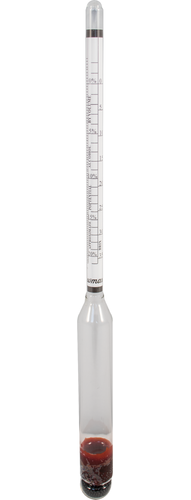
    How will you know when it’s done?  Time for the next pieces of homebrewing equipment you’ll need.  A hydrometer and a wine thief.  The wine thief will be used to pull a sample of your fermented cider to test it with the hydrometer (remember to sanitize it).  The hydrometer is a device that is used to measure the specific gravity of a liquid. Pure water has a specific gravity of 1.00.  Alcohol has a lower gravity (about 0.78), and sugar adds to the specific gravity of a liquid. So those OG and FG written on brewery stats, and on the sides of some of your bottles, are just a measurement of the Original Gravity (measure of how much sugar was in to start) and the Final Gravity (measure of the specific gravity after fermentation).  Keep in mind that hydrometers are calibrated to be used at a specific temperature, and if your liquid is a different temperature, you’ll have to adjust that. There’s lots of calculators online to do that math for you. With both the OG and FG of your beverage, you can figure out the percentage of alcohol.  If (and only if) you sanitized your hydrometer and sample tube, you can pour the sample but it does increase the risk of infection.  Most people just drink the sample (or pour it out).

    But back to finding out when your cider is done fermenting, what you want are two readings, at least three days apart with the same gravity reading.  Do not bottle without verifying that fermentation is done. Bottle bombs are a real thing, and can be very dangerous. Do not assume fermentation is done because you don’t see any airlock activity or bubbling in the cider.

    If you want it to be carbonated, then you’ll need to add sugar at this point (here is a decent calculator, but assume just under an ounce a gallon).  Take your sugar, and mix it with boiling water.  Then add it to the cider (stirring with a sanitized spoon) and then bottle it. To bottle, you’ll need a siphon (points at the equipment article), and a bottling wand.  Bottling wands are  a tube with a spring loaded stopper at the bottom. Push it down, liquid flows out. Lift it off the bottom, the bottom locks up. If you’re using swing tops, mix your sugar into your fermented cider (with a sanitized spoon or your siphon), and then bottle.  If you need to cap or cork your bottles, I’d recommend filling them all before doing that, or use an orphan assistant for the capping/corking.  After that, let them sit for about 3-4 weeks in a room that’s close to 65 F so they condition up (fancy term for letting the yeast eat the extra sugar to make carbonation).  Then put them in the fridge and enjoy.

    Keep in mind, if you like your first batch, you can easily modify your second batch.  Add simple things like ginger, cinnamon, cloves, or whatever. The longer you let the cider sit on the spices, the more flavor it’ll pick up.  For your first attempt, I’d recommend no more than 1 tbsp. per gallon, it’s always easier to add more spice, or let it sit on the spices longer, but you can’t easily take the flavor out.

  • Do I live in a Blue State Now?

    Floating around the ether recently is the idea that Arizona is no longer what is known as a “Red State.”  This is not really a new concept, as the media has discussed this since Bill Clinton won Arizona’s electoral college votes when he was reelected in 1996.  Back then, they cited the state’s changing demographics. I touched on this a bit in my review of a Cream Ale, citing a study from the well regarded W.P. Carey School of Business at Arizona State, the majority of people moving to Arizona for better or worse are from California.

    This is my review of Dogfish Head Sea Quench Session Sour Ale

    So does the election of Krysten Sinema spell the beginning of the end?  Maybe, maybe not.

    A pretty good post-mortem of this election can be found on Ricochet.  Jon Gabriel makes a pretty good case that Sinema won primarily because she ran a more positive, aggressive campaign, and was better known in Phoenix.  While McSally being the representative from Discrict 2, which splits Tucson, was not as well known in Phoenix where the majority of the state lives.  She also focused on portraying Sinema as the annoying girl shrieking into a megaphone outside the student union—yes, well all knew that was her, thanks.  Simply put, when half the population of the state does not live in the metro area you represent, and over half of that metro area will not support you, you might be at a disadvantage.  

    You WILL turn in your guns, so I can play with them.

    I can see this being from Phoenix, because until somebody attempted to assassinate her, I didn’t much know anything about Gabrielle Giffords—other than the photo of her with an AR-15.

    Then there was the part that McSally reminded everyone of John McCain or if you are a conservative, worse than that,  Let’s face it, she’s also a retired fighter pilot, a squishy moderate, and neither endorsed or condemned Trump in 2016.  They both even have Mc in the name.

    Let’s look at the election numbers themselves.  As I wrote previously, while there are certainly a few shenanigans that I would like the state to investigate, these wouldn’t have affected the outcome all that much, therefore I still do not believe there is much evidence of voter fraud.  That said, as of 14 November, the statewide elections break down like this:

    The State Legislature and House Districts break down like this:

    First off, note the lack of a Team L candidate for any of these races.  The one that ran for governor, Kevin McCormick, did not get enough signatures to get a name on the ballot.  I reached out to his campaign in the summer, to see what he was about, ask a few questions, and distribute his answers appropriately for the lovely people of this site to tear him apart.  Sadly, he declined.

    Where we get to have some fun with the numbers is here:

    Feel free to tear apart my math

    One thing that initially popped into my head was perhaps a significant number of team red types voted Doug Ducey for governor and declined to vote at all in the Senate race.  This is wrong, as it only accounts for 691 voters. My next thought was the difference between Ducey’s total and McSally’s, just to get a grip on what the damage is. That is -185,978, a difference of 14.67%–okay fair enough.  If we divide the margin of the Senate race by the total number that voted for Ducey, we get a percentage. 3.13% to be exact. That is the percentage of voters, otherwise happy to vote for team red in the Governor race, McSally would ultimately fail to convince to vote for her.  

    Looking at the other statewide races we see when team red won, they won by a fairly comfortable margin.  Where team blue won, they won it by a nose. An average of 4.04%, to .77%, respectfully. The legislature did not flip either.  

    With regard to the house elections, it could be a combination of the typical increased turnout of the party opposite the one in power nationally, name recognition for Greg Stanton as he is the mayor of Phoenix and the district he won is primarily in Phoenix, and Anne Kirkpatrick being well-known from her failed attempt to unseat John McCain in 2016.  Plus District 2 is made up in part from a district Kirkpatrick formerly represented in Northern Arizona.

    For all this talk about changing demographics, one would think somebody would ride Sinema’s coattails.  While you might say Hobbs may have received a favorable bump, a team blue candidate winning a downballot seat is not that uncommon in Arizona either.  Personally, I voted for Hobbs, as I typically vote that candidate for secretary of state from the opposite party I vote for governor—gridlock is a good thing.  If it were turning blue, perhaps a few progressive measures have passed in the last ten to fifteen years?  None come to mind, but feel free to dig around and prove me wrong.

    But what has passed? Constitutional Carry, and Occupational Licensing reform are the first that come to mind.  There are even a few that come to mind where team red arguably went too far that I will not link to, but I bet you heard of them.

    So is Arizona a blue state?  Maybe, maybe not.


    Is this beer any good?  I actually tried this multiple times to try to be objective, it really isn’t.  Its salt and lime, like a margarita, but without the class.  If you like sours, I’m sure you will like it just fine.  Dogfish Head Sea Quench Session Sour:  1.5/5.

  • Fall BIF Special — Part 2

    By The Hyperbole

    The beer you’ll all want to hear about is the one mexican sharpshooter reviewed here, and he got accused of trolling for his efforts. I can relate.

    This is my review of the Autumn BIF.

    I too have had my sincere opinions dismissed as the contrarian trolling of a prog plant simply because I won’t toe the line and accept the Republic… er… Glibertarian narrative. In fact, I put up with a lot of bullshit around here. There’s no need to rehash the whole Logo fiasco, I’m over that, but what about the Glib specific ‘First’ GIFs I created for the site. Zardoz still trots his out occasionally but that’s it, I can’t remember the last time my Thicc Edit Fairy GIF was used, and I don’t think they ever used my favorite ‘First’ GIF ( the one with the “winking” cat under the One’s top hat). I can handle it though, I’ve had decades of practice accepting rejection. I could mention how I single-handedly ushered in the golden age of commenter submitted articles with a legendary drunken rant, but why bother? What thanks did I get, a nice little e-mail asking me to stop submitting articles that’s what. Oh and you guys are happy to hit me up for construction advice, yet I’ve baked more pizza than any ten of you combined have eaten, I gave you my secret dough and one-of-a-kind sauce recipes, hell, I helped Trashy with his soggy crust problem, and am I respected as a master pie man? Am I fuck. The indignities are almost too many to list. I get no credit for my puns in the pun threads, which are actual wordplay not just using a word related to the theme in its normal way… “Oh a fish themed pun thread, I’m going to add ‘he took the bait’ ha-ha”… How is that even a pun? I mention all that just for the Halibut, it was all water under the bridge. Then mexican sharpshooter tries to poison me, sealing used motor oil thinned with turpentine in a beer bottle.

    You mean this guy?

    I may not be able to take a hint but I’m not totally obtuse, so I’m pulling an ‘Eddie’, well maybe not an ‘Eddie’, I’m not going to request that the editors scrub the site of my submissions, and I’m not going to exchange nasty emails with the founders (unless they’re into that kinda thing) but I’m definitely pulling a ‘The guys who’s avatar was a naked dude on a futon with some guitars.’ I hope you assholes enjoy your echo chamber.

    How were the other beers?

    • The Husstler Series American Lager Huss Brewing Co. – classic lager could see this as an everyday beer 3.167
    • Koffee Kölsch Huss Brewing Co. – A light colored coffee beer? yup, kind of odd flavor and visual combination but very good 4.135
    • White Russian Imperial Coffee Stout Sunup Brewing Co. – Ah that’s more normal, coffee flavor in a dark beer, not as good however and more chocolatey than coffee 2.997
    • Noche Dulce Moonlight Vanilla Porter Borderlands Brewing Co.- By far my favorite of the bunch great taste, hints of coffee/chocolate/vanilla but not slapping you in the face 4.835
    • Moon Juice Galactic IPA SanTan Brewing Co. – It’s an IPA, I guess there are some fruity undertones, but it’s an IPA 2.417


    Thanks to mexican sharpshooter for the beers and Neph for setting this all up. looking forward to the spring B….oh wait I’m outta here, Auf Wiedersehen jerks!

  • Enslaving Yeast – Basic Equipment

    It appears a lot of you degenerates are interested in making your own alcohol (or rather, using yeast to do it for you).  Thankfully, this is legal in the US (as long as you’re not making more than 100 gallons). I’m going to start with the basic equipment you’ll need and some starting tips:

    1. Cleanser – Cleanser is needed to clean up all of your items that will be used in the process.  You can buy PBW (Powdered Brewery Wash) or any of the knock offs. Personally, I generally use OxyClean free for my cleaning needs.
    2. Sanitizer – Here, I recommend StarSan.  While you can use bleach or other household products, StarSan is cheap, effective, non-toxic, and no rinse.  Sanitization is a critical item, everything that touches your beverage needs to be sanitized. This will keep the risk of infection low.
    3. Fermentor – This is where the magic happens.  You can use food grade buckets (7 gallons) or carboys (glass or plastic).  You can find fermentors in almost any size you want, but the standard sizes in the US are 1 gallon, 3 gallon, 5 gallon, or 7 gallons.
    4. A siphon – This will be used to move beverages between containers and minimize oxidation.
    5. An Airlock – There’s two basic styles, a three piece and an s-shaped one.  I prefer the s-shaped ones, but if anything gets inside of it, they’re impossible to clean.  Thankfully, they’re cheap. These allow gas to escape the fermentor while preventing outside air (and bugs) from getting in.
    6. Empty bottles – You can buy them, or save up from your other ones.  If you’re planning on capping, realize that you can’t use screw top bottles.  If you like Grolsch, the swing top bottles will mean you don’t need the last item on the list.
    7. Capper/Corker – Depending on what you want to make, and how you want to serve it.  You’ll need to either cap or cork the bottles at the end (yes, you can cork beers, and cap wines if you wish).

    Keep in mind the difference between clean and sanitized.  Items need to be cleaned before they can be sanitized, and cleaned items can still cause infections.  Anything that comes in contact with your must/wort (unfermented wine/cider/beer) needs to be sanitized.  Don’t skimp on this step, follow the instructions on your sanitizer, and understand it.

    Keep notes.  Write down everything.  Almost every brewer has a tale about this really great beer/mead they made where they made a mistake part way through the process, and it made the best beverage they ever had… but they forgot what they changed in the process, and haven’t been able to reproduce it.

    Relax.  People have been accidently making wine and beer long before they knew what they were doing.  The worst you’ll do is make a batch that doesn’t taste good that you’ll have to dump.

    Don’t expect to save money right away.  This is a hobby with large upfront costs.  If you keep doing it, you’ll eventually be making beer/wine whatever for cheap, assuming your time costs nothing.


    It seems a bit of a waste to talk about fermentation without giving a recipe or project, so here’s a great starter recipe:

    Joe’s Ancient Orange Mead

    Makes 1 gallon.

    3.5 lbs honey (clover or a blend)
    1 large orange
    1 small handful of raisins
    1 stick of cinnamon
    1-2 whole cloves
    1 teaspoon Fleishmanns bread yeast
    Water to fill to a gallon.

    Wash the orange, and cut into eighths.  Clean your 1 gallon carboy (glass jug) and dissolve the honey in warm water.  Once it’s dissolved, put it into the carboy, along with the orange (push it right on through the opening), the raisins, the cinnamon, and the cloves.  Fill up to about 3 inches from the top with cold water. Shake it up (with a lid on, or not, but it’ll go better for you with a lid). Once it’s all mixed up and at room temperature, add the yeast and put on an airlock (or a balloon with some holes in it).  Stick it in a cupboard in the kitchen in the dark. After about a week, you can top it off with more tap water. Then just leave it alone for a couple of months, it will eventually drop clear (and the oranges will eventually sink as well). Once it’s clear, it’s done.  Just siphon into bottles and cap or cork them.

  • Fall BIF Special

    Once again our Beer it Forward (BIF) QB (Nephilium) did us all a solid and set up another BIF in honor of the change of season.  Okay, maybe it has to do with bottles exploding in the winter so if we were going to do it, we’ll have to do it now.

    I do plan on running reviews from other Glibs in the near future, once we can confirm everyone gets their beer.  FOr now, you will just have to deal with me talking about mine.  First up, what did I sent to Hyperion The Hyperbole?  That’s a good question–a damn good question…well:

    You can see a few that might be familiar, others that you haven’t seen.  If The Hyperbole want to chime in and tell my how much of an asshole I am for conflating him with Hyperion good guy I am, I’ll let him tell you what he thinks.

    As for what I received (H/T Trials and Trippelations):

    These come with a bit of backstory.  One thing I noticed when I was stationed in the south is they all had, what I considered to be, screwy liquor laws.  There were dry Sundays and the like but one that stands out, and likely keeps a lot of craft brewers down is a self distribution law they are lobbying to repeal:

    For the second time in as many years, a 20-year-old “secret agreement” between Anheuser-Busch and a North Carolina wholesaler is being highlighted as a key piece of evidence as Tar Heel State brewers look to change a decades-old distribution law. The document, first reported last year by NC media, is part of a franchise agreement between AB and Raleigh-based R. A. Jeffreys that encouraged the distributor to give priority to Anheuser-Busch products above others, which itself would be illegal under a 1989 state law, says a lawyer representing North Carolina breweries suing the state.

    According to the Charlotte Business Journal, ABC Commission Administrator Bob Hamilton agreed in the assessment. Last year, distributors noted that “the kind of favoritism suggested in the 1997 franchise agreement is barred by a 2012 state law involving franchisers,” according to the Charlotte Observer.

    It all surrounds an ongoing fight to overturn a state law that prohibits self-distribution when a business surpasses 25,000 barrels of production. Two Charlotte-area breweries, NoDa Brewing and Olde Mecklenburg, have helped lead the legal battle for their in-state peers.

    Which is something I is something I was surprised to learn Arizona once did, until recently.  They may be wrong, but at least they fixed it, right?  Many have issues with the InBev distribution deals, but I am ambivalent about it.  On one hand it means InBev is fully aware of its inferior product but banks on it’s ability to distribute, and on the other hand it allows a smaller player to quickly gain a bigger footprint.  InBev is not making the beer, and they are not making other brewers change their product.  If they did, it wouldn’t sell.  In the end both sides win, that’s how the market works.

    So I picked up my package and was informed by T&T it arrived during the last week of October.  Which was good timing because I was out of beer and the World Series was on at the time.  The artwork on a few of them as you can tell is much nicer than what I am used to here.  There are three IPAs in the package and I drank all of them over the course of the marathon 8 hour game that I totally shouldn’t have stayed up for.  But I am a petty sports fan and mainly wanted to see the Dodger loose, so I was disappointed that night.  The three IPAs are all in the solid 3-4 range:

    • Burial Brewery Asheville, NC  Surf Wax IPA  3.1/5
    • Catawba Brewery Asheville, NC Hopness Monster IPA 3.5/5  (SEA SMITH APPROVED)
    • NoDa Brewing Charlotte, NC  Hop Drop and Roll IPA 3.5/5

    My beef with IPA is how many of them often taste the same.  Your mileage may vary.  As for the others:

    • Durty Bull Durham, NC Lager .  They get extra points because Bull Durham is one of my favorite movies.  3.8/5
    • Southern Pines Brewing Southern Pines, NC Malty by Nature Scottish Export Ale.  Reminds me of Kiltlifter, in a good way.  3.5/5
    • Holy City Brewing Charleston, SC  Pluff Mud Porter.  Charleston is an awesome city and if you have never been there, you are wrong.  This is a nice balance between dark malty beer, while keeping it light.  I feel like I can drink dozens of these.  3.8/5
    • Ponysaurus Durham, NC Rye Pale Ale.  Definitely my pick of this bunch as I have mentioned my affinity for the use of Rye in beverage making.  Take that German MEDIEVAL.TOP.MEN. 4.0/5

    Specials thanks to Trials and Trippelations for the awesome beer, and Nephilium for putting this on!

  • Everybody here is uninvited

    Today I wanted to talk about a local news story.  I thought it would be nice to cover a local story.  No story here is too local.

    This is my review of Deschutes The Abyss 2017 Release  (H/T:  Riven)

    This story starts when a boy from Tucson turned 6 years old.  He wanted to throw a party, and his mom thought it would be nice. The problem?  Nobody showed up so she did the sensible thing and shamed everyone invited on social media.  No seriously.*

    RANT ON

    I am not going to put a caption here to make fun of a child. BUT I WILL NOT STOP YOU FROM MAKING FUN OF A CHILD

    – My first problem with this:

    The reason the entire class was shamed on social media is because the entire class was invited.  Now this is a practice I encountered and I don’t particularly care for it.  It forces parents to invite children their child doesn’t like to parties because it may hurt the uninvited child’s feelings.  Okay, fine.  So I have to invite the snowflakes too.  Here’s an issue I had–planning around the idea that 30 kids will be attending this party meant financially allocating funds for a 30 person party.  Granted only 10 showed, after they RSVP.  If my kid wants to invite other people in his or her class to a party, everyone in the class must be invited.  Including the smelly one.

    I thought part of the reason we have schools is social immersion?  Lets be real, that’s what most people got out of school, it certainly wasn’t reading.  By doing this, it eliminates the possibility that a child can grow up knowing there are people out there they won’t get along with, or how to deal with these people.  After all, if you don’t want somebody’s company you don’t invite them over.  For a parent of a child that has few friends, this might seem challenging but I found a way around this by inviting a few relatives that had kids of their own.

    Otherwise if nobody wants to be around you, eventually you figure it out.  It makes you wonder if people act the way they do today is the result of poor adjustment to social interactions.  Say what you want about social media, but perhaps another issue is nobody ever learned to handle things like confrontation, dissapointment, or failure. When encountered by such things they simply resort to their lowest level of social training.

    – My other problem with this:

    Another problem I have with this is the kid’s mother went and posted this to social media.  Really Lady?  Your kid is having a terrible day, so lets take a picture and show the entire world how much you think other people suck.  Immortalize it forever.  Let me ask a question, is there perhaps a reason nobody showed up?  Perhaps the class is mostly girls and had no interest in going to a boy’s party?  Perhaps enough people in the class got sick and stayed home?  Perhaps your kid is the smelly kid?  Perhaps coddling your child is not going to do him any good once you are no longer there to protect him from the world?  Am I going to hear from Andrew Napolitano for imitating his writing style?

    “Hey everyone.  Check out how much this kid’s mom thinks he’s a loser.”  I am sorry, but that’s what I got out of your post.

    – The silver lining:

    If there is a winner in all of this, its the Phoenix Suns.  Yes, I know they suck but lets be real, they aren’t going to get too many real wins.  Somebody affiliated with the team saw this, pulled a few strings, and got the kid courtside tickets–to the Suns vs. Lakers game.  Pretty nice of them considering somebody would have paid real money for courtside seats to see LeBron play.

    RANT END

    So how is this beer?  I gotta hand it to them, I didn’t think tequila would go well with an imperial stout, but I admit I am wrong.  Tequila you see, is not aged nearly as long as whiskey (Anejo is only aged 1-2 years) so it doesn’t take on the properties of the oak barrel like whiskey.  This beer is more “woody” rather than “whiskey soaked.”  The stout is neutral, without overpowering chocolate or coffee notes.  Standard dry Irish style.  Good luck finding it.  Deschutes The Abyss 2017 Release: 4.2/5

    *The possibility of this story being a hoax was pointed out by the stellar editing staff at Glibertarians.com.  Should this be a hoax, it does not improve my opinion of these people.  Not only would they be liars, they got free courtside tickets to the Suns game and thus were rewarded for lying.  Screw that.

  • Liquid Smoke

    While I was doing my shopping for the latest Glibertarian Beer it Forward I found something fun in the import section.

    This is my review of Brauerei Heller — however you pronounce this:

    The bottom line with this beer is that it is a German style known as a Rauchbier.  A Rauchbier is a style best known for the malts being smoked.  There is no definitive style, as nearly any German style beer can be smoked, it just depends on what you happen to like.  That day, I picked the Bock.  The style is said to have originated in the city of Bamberg where the cloisters at the local cathedral caught fire, as they were apparently wont to do.  This fire ravaged throughout the city and was eventually put out, but not before the effects of the smoke took affect to the local breweries.  They breweries themselves did not burn down but many of their ingredients were smoked, and they didn’t realize it at the time.  Turns out people liked it, thus Rauchbier is a thing.

    This Cathedral, I guess its cool and all….

    When I tried to verify if this story is true, I came up a bit short.  The best I could to was verify the cathedral does exist, and it did burn down around the time the origin story takes place.

    The cathedral is cool and all, but to be honest there really wasn’t anything there that pops out.  Let’s instead talk about the Orloj, or  sometimes known as the Prague Astronomical Clock.  It has an interesting history if you are in to that sort of thing.  What really stands out is the city councils reaction to such a mechanical wonder.

    Upon its completion in 1493, the updated Orloj was undoubtedly the envy of the world, and the Prague city council agreed that Hanuš had fulfilled his promise to the city. In fact, many in the council argued the master had fulfilled it too well—after all, if Hanuš could create such a marvel for the people of Prague, what was to stop him from creating an equally impressive or better work for a rival? In secret, a rogue group of councilmen met to discuss ways of preventing such a loss of prestige for the city. The plan was set into action the day of Hanuš’ payment. Shortly after receiving his gold, the master was waved into an antechamber, held down, and his eyes were burned out with a red-hot iron poker. The newly blinded Hanuš was rightfully furious, and local legend says he retaliated in two ways. Firstly, he laid a curse upon the city of Prague—whenever the Orloj stopped working, the city would suffer horrible misfortune. Secondly, and more accurately, Hanuš sent an apprentice into the tower at night and had the man smash the inner workings of the movement. Prague’s new crown jewel had been broken, and Hanuš’ designs were so far ahead of their time that no one could repair the clock until 1552.

    Too bad Hanuš was wrong again, as they stopped the clock for restoration recently.  You have to admit it is cool.

    So the moral of the story is…don’t build things for the government?

    How is the beer?  it will be polarizing, because as it turns out it really is smoky.  Many craft brewers will take this style and compare it to bacon, and market it as a bacon flavored beer (i.e. Rogue VooDoo Maple Donut).  In a way it does remind me of bacon to some degree.  Otherwise it adds a unusual complexity to what is otherwise, a competently made beer.  Brauerei Heller — however you pronounce this: 3.5/5 

  • A good book, a beer, and a quiet afternoon. — Part 2

    For part deux of this review I decided to go for a beer that is significantly less awful than Honey Brown.  Given that everybody here loves pumpkin ales, I found a doozy.

    This is my review of Grand Canyon Brewery  Will o the Wisp Bourbon Barrel-Aged Imperial Pumpkin Ale.

    Part 1 discussed some of the biases within the data that are making polls less reliable.  Today I will touch on parts of the book that discuss methods professional pollsters use to account for these biases, and their drawbacks.  This is the second part of the book.  The first thing Wood points out is how the public at large misinterprets polls to begin with.  Most people hear about polls through the media, who among other things, have a penchant for oversimplifying.  It is because of the way the polls are presented that most people do not realize the confidence level the pollsters have in the poll results, or even how the margin of error works.

    This factor makes it hard to definitively state that findings are wrong; more often, they are presented as simply imprecise. Probability samples using the standard 95% confidence level generally have a margin of error roughly equal to the inverse of the square root of the sample size.48 The confidence level tells us how sure we are that the true average lies within the margin of error.

    […]

    If in our above example with a simple random sample of 836 registered voters wherein 45% state they will vote for candidate A, assuming there are only two candidates in the race and nobody claims not to know whom they support such that the other 55% state they will vote for candidate B, the real margin of error for that poll at a 95% confidence level is 6.8%. While this poll would report candidate B with a 10-point margin over candidate A, in reality this poll states with 95% confidence that candidate B’s lead over candidate A will be between about 3 and 17 points.

    In closer races, this means election polls can claim to be accurate while having next to no predictive power. If in our example, the candidates instead polled at 48% and 52%, the candidate supported by 48% may actually have a lead of nearly 3 points.

    This of course means the races could have been within the margin of error the entire time, within the confidence levels, and still come out with the “unexpected” result and the majority of the public would be none the wiser.  Unexpected results as we have seen in recent events, have been met with shall we say, less than heroic reaction.

    A way professional polls will account for some the self-selection and sampling biases is by weighing the results.

    By its nature, weighting entails a lot of assumptions which do not necessarily hold up to scrutiny. It embeds the presumption that researchers somehow know the actual proportion of various groups within the study population such that deviations from those proportions within the sample can be detected. It also presupposes that each group behaves as a block with identical characteristics, rather than as individuals. This could be described as a form of scientific stereotyping, since it suggests that individuals have behaviors identical to the groups to which researchers have assigned them.

    […]

    Let’s say the researchers who sampled ten people to determine their favorite colors ran the study again with a new random sample pulled from the same population. This time, a sample of 8 people are selected instead of 10. When this group is surveyed, the results are substantially different from the first group: four respondents pick green as a favorite color, one chooses red, and another three select blue. When looking at the sex of the respondents, the researchers notice that seven of the eight in this sample were male, with only one female.

    […]

    The findings from this second study and those from the first are both equally considered valid. However, the first study made it appear that green and red were the only colors preferred by the population. Due to sampling and weighting errors, it completely missed the fact that blue is also a common preference for some. Additionally, in the second sample, a single data point was used to represent the entire population block of females. A larger sample would have reduced the magnitude of this error, but this example shows how weighting can misrepresent the data and increase error while theoretically accounting for sampling bias in both cases. Weighting trades precision in the hopes of increasing accuracy, yet it can actually detract from both.

    All Mexicans with libertarian politics like beer.  We can say that, because you all have me as that single data point.

    Further into the book, a third section begins to present potential solutions towards obtaining more accurate, and precise poll results.  The first seems obvious:

    Questions are inherently subjective because they must be interpreted by the person answering the question. Researchers require objective, quantified data rather than a collection of individual interpretations. While some question formats may appear to make quantification possible, such as a “For/Against” question, no two responses are truly comparable when individuals are responding to questions with their own subjective interpretations of the question’s meaning. The same core concept, that different people must answer the same question for the data collected to be comparable, is behind the importance of using identical wording when asking the same question at different points in time to measure changes between the two periods.19 However, because every individual has a different understanding of any given word’s definition, the folly of asking questions at all becomes apparent.

    Definitions are probably the most difficult thing to define between individuals with dissimilar viewpoints.  Lets pick on the statement, “everyone has the right to free healthcare.”  What is a right?  What is free?   Healthcare in of itself is not a right, but a commodity.  We can probably give the pollster the benefit of the doubt and think perhaps they mean access to healthcare, which in of itself may not be a right either, but not something anybody is necessarily going to deny…..Wait, what in the hell do you mean for free!?

    One can see how such obvious differences in opinions can lead to differences in how one answers qualitative questions like this.

    A potential solution is by using social media algorithms to continuously take in information on the user, and by accounting for self selection biases by measuring sentiment amongst a like minded people.  This is not without other issues.

    In doing, so these platforms are collecting data that are inherently subject to multiple biases,including social desirability bias. Social media posts are often directly tied to one’s identity, so making taboo statements or posting certain perspectives may have ramifications. Therefore, individuals using social media have incentives to portray themselves in a specific way based on the perceived preferences of their chosen social circles.

    […]

    As far as samples drawn from social media populations themselves go, there is a fair amount of self-selection bias at work which is closely related to the social desirability bias contained within the data. Many individuals, even those who nominally use a given public or semi-public platform, will react to perceptions of facing social disapproval for their beliefs or group membership by simply opting not to make statements at all, effectively withdrawing from such platforms. Some views are consequentially likely to be proportionally misrepresented. As Anne Halsall, co-founder and CPO of the company Winnie, noted, “Online representations of self must be carefully designed and maintained; a well- cultivated social media account has taken the place of the well-manicured lawn in signaling wealth, status, and general got-it-togetherness to peers.”39

    Indeed.  My social media accounts all include pictures of me wearing a fitted suit, and generally have little controversial content posted.  Why? Perhaps I like to think of myself as an adult, and present myself as such.

    The strength of large, properly collected datasets can allow for active proportional sampling. A large dataset may not itself be perfectly representative of a given population, but it is likely to contain representative samples of any given population. Once such a dataset has been assembled, the proper sample for a particular study need only be identified from within that broader dataset.

    […]

    In cases where specific representation is necessary, researchers can repeatedly randomly sample an existing large set of data until certain parameters are met and study that sample. Since the data has already been collected and researchers in this scenario are only conducting sampling to determine which data to pull, rather than who to attempt to reach, results can be synthesized without worrying about sampling bias, self-selection bias, or the increased error associated with traditional sample adjustment methods. This sample can even be tagged and repeatedly referenced in the future to examine change over time. It can also be isolated from the larger dataset before again running the sampling process until the same parameters are met in a new sample without using the initial sample group, in order to conduct verification checks.

    I am going have to go ahead and disagree here.  While I accept that virtue signaling is a thing, and one that is not going away anytime soon.  There are a number of ways I avoid giving information about myself on the internet.  I use as few Google products as possible, along with other no brainers like using a pen-name.  Plus when I go on Facebook I will screw with the ad-bot by listing any and all political ads as hate-speech, and saying that NowThis news is sexually explicit.  I get ads like this now…


    Whatever the results of the election in two weeks, because of this book I am more interested in seeing how the results of poll predictions play out.  I have an itchy feeling in some places, they will be dead on, and in others….well…

    This is not a beer for the faint of heart.  It is a level of insanity that most of you will happily accept, given you are receiving it as a gift.  This falls in the “overdone, gluten-free dunkel” category.  The bourbon is rather overpowering, but it goes well with the pumpkin since most of us associate it with sweetness, except it does not taste at all like pumpkin pie.  It is one to savor the complex palate for a long time.  So if you show up to chug it, you are going to have bad time.   Grand Canyon Brewery  Will o the Wisp Bourbon Barrel aged imperial Pumpkin Ale 4.8/5

    As for the book, it is now available on Kindle…unfortunately it may no longer available gratis, but I highly recommend it!

  • A good book, a beer, and a quiet afternoon.

    Ever get a call from number you don’t recognize?  Ever make the mistake of answering it? I know I have.

    Recently, the people that own and operate the site were given the rare opportunity to preview an advance copy of a book!  Being that that the subject was something that is going to be a highly relevant topic upon its release date, I took the bait.  My issue however is that I was unsure how to approach such an article. I will say upfront this is well researched, all the arguments made in the book flow logically, and are diligently cited by respected academic sources.  Do I do this right and feature a worthy beer, or do I do this right and generate as much interest as possible? In the spirit of the book’s subject, I decided to review the comment total as a proxy for the interest in my past articles and determined Glibs are much more interested when I drink something terrible.

    This is my review of Honey Brown

    The book is titled Data in Decline by Steve A. Wood

    Given the recent headlines going from predicting blue waves, crimson rushes, brutal mobs, silent majorities, et cetera, all coupled with standard internet tough guy talk between all sides, it seems all too timely in its release.  Everyone in the media are driving narratives based on polls, that suggest national or local political sentiment. The problem of course is in several recent elections the polls were wrong, most notably the 2016 Presidential Election.  We can speculate how these broken polls affected current political discourse, given that both sides insist they are in the majority thus agendas should fit accordingly and the other side can just shut up. The truth is we really don’t know because there is no reliable way of determining that outside of election day, and quite frankly even then it shouldn’t matter because our system of government is designed to respect the opinions of the minority.

    Still, there must be a better way of performing these polls, but not until first identifying what is going wrong with present methodology.  Because of the complexity of the subject at hand this is not a book that should be reviewed in a single article. Today the excerpts I am going to focus on are internal biases that arguably drive poor polling results.  

    A cliche that comes up in discussions in right of center circles about polls is that nobody in the comment section claims to ever be contacted by a poll.  Personally, I have—on multiple occasions—during the campaign season of nearly every election since I was old enough to vote. The only respite was 2008, but I was in Middle East at the time.  I will let everyone here speculate as to why they keep calling me but sampling biases are always a cited reason. An interesting thing Wood points out, is it may not be the biases of the pollers rather than the pollee being revealed.

    Canvassing also creates both a self-selection bias for the simple fact that people don’t often like stopping to talk to people on the street. A canvasser’s cause is generally readily apparent, so individuals with a particular interest in a given subject are thus far more likely to stop and talk to the canvasser. In contrast, others may project their negative biases onto the canvasser and deliberately ignore them as a result. While this can help researchers reach certain quotas, it skews the perceived level of support because little information is gathered from those with less substantial interest in the subject matter.

    In the last few weeks I was contacted four separate times by somebody working for a campaign, all of whom were looking for information from me along with gauging my interest in voting.  For those interested in knowing: yes, all were from Democrat campaigns. Two attempts were from actual volunteers that came to my door.  While I do not believe I am an intentionally sour person to speak with, it is something I have been accused of in the past.  I made no attempt at hiding my distaste for their being at my door from while maintaining as polite a tone as possible.  At least that is my side of the story—it is not like I pulled a gun, or that they can prove in court I wasn’t under duress at the time.

    One simply wanted me to register to vote in the Democrat primary.  The conversation took about 3 minutes in spite of my having to explain that not being a Republican does not make me a Democrat.  The other actually did ask me what issue I cared about the most, and instead of the standard Glib retort (gay, pot-smoking Mexicans) I asked if he had a list on the tablet he was carrying; I thought it would help reveal who he worked for.  The canned response, “not trusting republicans in power,” with no analogue for the other side suggested who was paying this volunteer.  In the end my only response was, “the economy.”  He then left me alone.

    I continued further into the book where Wood discusses potential reasons why the polling data itself may be subject to sampling bias.  He provides thoughtful suggestions why this is the case, and presents examples with citations to corroborate his claims. Such as:

    If strongly partisan Democrats are far more likely to respond to an opinion poll than strongly partisan Republicans—which is arguably the case since these same polls indicate 52% of strong Democrats trust polls compared to 27% of strong Republicans14—the results of those polls are likely to contain bias. The effect is comparable to Literary Digest’s oversampling of Republicans in 1936 by drawing respondents from populations made up of voters who tended to be more Republican than the overall electorate.

    That this disparate impact comes at the same time as the rise in narrowcast media, which allows individuals to curate and filter which information makes its way into their consciousness, makes obtaining participatory buy-in from study population members much more difficult than it has been in the past. People are becoming far more accustomed to actively filtering what information they take in. Everything from ad blockers to phone call filters have allowed confirmation bias, “the seeking or interpreting of evidence in ways that are partial to existing beliefs,”15 to flourish in our daily lives.

    True.  We all live in a bubble of our own creation.  Don’t think you live in a bubble?  Guess what this website is.  If past discussions here and other dark corners of the internet are indicative of the overall sentiment to polling is they are as trustworthy or more appropriately, untrustworthy as the media outlet reporting it.   Its to the point others will simply cite betting odds in Europe as more trustworthy or even use crude methods to neutralize the bias in the data (i.e. just add 5 points to the Republican’s result).

    Another example cited as a reason the data is subject to bias:

    Facebook defines advertising fatigue as “[w]hen everyone in your target audience has already seen your ad many times, it becomes more expensive to achieve desirable results.”35 More broadly, over-tasking human awareness with frequent interruptions and distractions substantially reduces peoples’ overall functionality;36 populations which have been inundated for extended periods are already operating at a base capacity of 60% at best.37 As audiences become saturated with ads, it becomes increasingly expensive and difficult to reach them, capture their focus, and engage them by any means.

    Indeed, I ignore things on my screen as I tire of reading it.  It certainly helps that many web pages all put the ads in the same place which is allows for more efficiency in ignoring.  These ads sometimes lead to a survey.  This is not the only bias that suggests the only people responding to a poll are people that actually want to respond.

    Although the Bradley Effect has largely been written off by social scientists, the term has evolved to essentially cover all cases in which respondents lie or otherwise deliberately provide false data to pollsters. The concept continues to live on because the general principle of survey respondents misinforming interviewers has seemingly manifested in other forms.

    The Shy Tory Factor is one of those manifestations, one which focuses on political parties and philosophies in general rather than specific individuals. This phenomenon was first discovered in Great Britain, where it was found that Conservative voters may refuse to answer pollsters honestly, indicating that they supported the Tory party less than they did. This effect has also been found to understate support for the Republican Party in the United States.66

    […]

    However, due to the already questionable nature of polls, it is possible that the Shy Tory Factor as it is observed is in truth a manifestation of compounded sampling bias and self-selection bias.67 This is difficult to reconcile with the fact that the effect seems to be more pronounced in surveys where the respondents have higher levels of personal contact with the research team, but is worth considering.68

    Sounds like there is a some level of truth to the theory that in 2016 people were not willing to tell somebody outside their inner circle they supported Donald Trump. To be perfectly fair, I only mention this because it does confirm my own biases.

    If there are so many problems within the polling data that seem so obvious once it is spelled out logically like this, why has there not been any drive to update polling methods?

    Just as politicians can suffer from record low approval ratings yet are continually re-elected, pollsters’ clients keep committing themselves to the same groups and practices which have increasingly failed in the first decades of the 21st century. Congressional representatives and senators who keep their jobs despite their track records have about as much of a reason to change as researchers who keep their jobs despite theirs.

    Right.  There is no incentive in changing anything if the desired result of staying in power continues to be achieved.


    Data in Decline, by Steve A. Wood will be made available on Kindle on 15 October 2018.  Stay tuned next week for part two where I will provide more excerpts that discuss the problems professional polls encounter when accounting for sampling biases, and their failure to address them.

    As for the beer…Honey Brown is terrible. It tastes like adult onset diabetes in a can, and I cannot in good conscience recommend it.  I would almost rather have purchased another Earthquake in its stead. Almost. Honey Brown: 1.8/5.

  • 7 Costume Suggestions for the Sharp Dressed Orphan

    Once again, I am going to search the comments and distill the ones most likely to be an effective writing prompt.

    Which upon the dreaded realization that at the time it was August and they already had pumpkin beers out, you can probably appreciate my self-control for waiting until October to actually put this out for general consumption.

    This is my review of Southern Tier Pumking Imperial Pumpkin Ale. H/T Bob Boberson

    Of course, this also means that there were number of others things about October that people have little self-control in talking about—namely Halloween. Which means today we are going to discuss the top 7 libertarian Halloween costumes, because 7 makes sense.

    #7 (slutty) Rape Apologist

    This one is actually pretty easy to complete. Just dress up as a lawyer if you happen to be a unicorn female–bonus points for showing a little leg. If you happen to be a libertarian male, just wear what you are wearing anyway, and leave your pants open.  The key for both is to simply demand hard evidence for everything, and in every conversation. For example, did somebody spike the punch? Demand evidence that it was spiked, or that there was even any punch to begin with.

    #6 Rick Sanchez

    I don’t know why Rick is libertarian, to be honest. I never watched the show, but I am willing to entertain any arguments as to why or why not.

    #5 (slutty) Gender-Fluid Handmaidens Tale

    Again, this is also a simple to costume to create. Get a red smock, a bonnet and grow a beard. Once again, bonus points for showing more leg than required.

    #4 (Slutty and/or Gender-fluid) Ayn Rand

    Objectively, this costume is superior to all the others, because it allows for a level of morality…okay I can’t do it. If you have the stomach for it, I WANT TO SEE IT.  The downside, is everybody asking you why you are dressed like a peasant lady.

    #3 Kochtopus

    Amazon has plenty of octopus costumes for which you can wear, add top hat and monocle accordingly. However, you can take it to the next level by creating this lovely top hat with tentacles sticking out of the top. Simply add a monocle, some body paint, and you are golden.

    Things will get real ugly

    #2 Walt (Gran Torino)

    Halloween means a bunch of kids are going to be running around your lawn; there is only one effective way to keep them off your lawn and that is a M-1 Garand from your days in Korea and explaining it to them you wish for them to get off your lawn. If you prefer to chase them down, a Colt M1911 A-1 to the face after tackling those damn kids, will also do the trick.


    #1 Zombie John McCain

    Too soon?

    My friends, BRAAAAAAIIIIIIIIIIIIIIIIIINS!

    Its never too soon, Cowboy.

    So is this beer any good? You will not like it if you are not down with pumpkin ales. I however, happen to enjoy and appreciate the history behind the pumpkin ale therefore I will likely purchase this one again. This one is intense in its alcohol content and does not apologize for anything, just like all of these costume ideas. I give Southern Tier Pumpking Imperial Pumpkin Ale a solid 4.5/5.