Category: Animals
-
Elk Hunting Is A Species of Insanity.
I’ve talked about elk hunting here a few times; so let’s explore a particular hunt I took about fifteen years ago, which still sticks in my mind as the worst day I’ve ever spent at my favorite pastime.

It was worse than this. I do wonder sometimes what drives people like me to hunt elk. What mystery is about elk that makes us leave warm beds long before dawn to tramp high in icy mountains?
In the past, I’ve always concluded the experience was reason enough. It’s reason enough to be out in the early morning in the high country, to enjoy the company of trusted friends, and to thrill to the ringing bugle of a bull echoing through aspens shining gold in the autumn sunshine.
And then came one particular opening day that changed my thinking. It was a day when I quit my warm bed for a late-season cow hunt. This day started awful. Things got worse after that.
It was a frigid morning when we left my friend’s cabin in Eagle at five in the morning, and a nasty, driving, wet snow/rain mixture was spitting from the starless, leaden sky. During the half-hour drive out to Salt Creek, my hunting partner Karl and I speculated on the wisdom of climbing to the top of the plateau we intended to hunt. But drive out there we did, and when we dismounted from Karl’s truck, the weather had gotten worse. We stepped into the lee of the truck to plan our morning.
“I’ll stay to the west of that big outcrop,” I told Karl, pointing at a dimly seen stump of red shale sticking out of the sagebrush, “And you stay to the east. Meet back at the truck by four?”
“Okay,” Karl said.
“This weather stinks,” I grumbled. I was already soaked through.
“At least it’ll be quiet.” The early seasons in Colorado had been warm and dry; my September bear hunt had been rendered almost impossible by woods in which every footfall sounded like I’d stepped in a pile of dry cornflakes. Hoping that some snow would grace the late elk seasons, I’d bought a leftover late season cow tag. No wall-hanger trophy my goal this year, but rather a freezer full of elk steaks.
My hunting partner Karl had a bull tag. Karl went off into the heavy timber in search of a six-by-six, while I climbed to the top of the plateau to find a good place to glass for a freezer-filler.
It proved to be a grueling journey. Elk hunting is never a picnic, but this climb would be burned into my memory. Every scrub oak, every juniper I bumped sent a shower of wet snow down the back of my neck with uncanny accuracy. Open areas between the trees were covered with sagebrush, a neat trick pulled by nature to make sure that my wool pants got soaked through in between fresh loads of snow dropped on me from the trees. The wet increased the weight of my daypack by approximately forty pounds, and my rifle lay in my arms like an anvil. Nature seemed full of malign intent that morning.
After a half-hour struggle I finally gained a vantage point. I found a chunk of rock that looked less sharp-edged than the others, brushed off a couple of inches of slush, and sat down.
Glassing wasn’t very productive, but occasionally the sleet would slack off long enough for me to see a mile or so. During one of those lulls I was able to finally get a look into the high meadows on the mountainside on the other side of the Salt Creek drainage, and sure enough…
“Oh, crap,” I whispered to my private self, alone as I was on a lifeless, frigid, dripping mountainside.
It was the worst possible scenario. Across the drainage was a herd of cows, maybe twenty elk, dark shapes grazing contentedly a mile or so away. With a groan of frustration, I let my binoculars drop to the end of their cord.

It was much worse than this. There was nothing else for it; my own stubbornness and the mysterious drive for an elk drove me on. I picked my way carefully down the mountain, back down through the junipers and sage, down to Salt Creek. The road we had driven in on paralleled the creek, and I came out maybe a half-mile downstream from the truck. I still had to find a way across Salt Creek.
The only opportunity to cross was on a beaver dam that looked to have been built sometime during the Eisenhower Administration by some particularly careless and stupid beavers. I told myself, “Myself, if I fall into that water, I’ll die of hypothermia before I can get back to the truck.”
I looked at the water, swirling dark and frigid like liquid onyx, chunks of ice bobbing carelessly in the current. Overhead the sodden spruces nodded at me, go on, go on.
The elk wouldn’t wait forever. I stepped out on the beaver dam. The sticks shifted slightly under my weight; my entire digestive tract tightened reflexively. Trying with all my mental might to levitate most of my weight off the dam, I slowly picked my way across. When I gained the far bank, I let go the breath I’d been holding, blowing snow off the trees for a good twenty yards. Now all I had to do was to hike carefully up through a half-mile or so of dark timber to where the elk were, in that sodden meadow, on the other side of the wet and dripping trees.
The sleet picked up a little as I climbed, but the spruces protected me from some of it. I took my time climbing over down trees and scrambling through a few ancient piles of slashing left by malicious loggers. After an interminable time, I reached the edge of the meadow. I crept stealthily, oh so stealthily; I crept like smoke on the wind to the edge of the frigid meadow and peeked carefully around the bole of a big spruce, which promptly discharged another helping of wet snow down the back of my neck.
No elk.
I dodged another volley of wet snow from the spruce and stuck my head out a little further, scanned from one end of the meadow to the other.
No elk.
I fumbled with cold-numbed fingers for my binoculars, and carefully glassed the tree line all about. A dollop of snow splattered against the binocular objectives, forcing me to stop and clean them before resuming the search.
No elk.
I double-checked the wind. It blew with near-gale force in my face, as it had been during the whole freezing, soaking, miserable stalk. The wind blew a pat of wet snow from another tree to hit me in the mouth. I glassed the tree line again.
No elk.
Finally, I walked out into the meadow, sloshed my way through the accumulating sleet and slush to the spot I’d seen the elk feeding. No tracks. The sleet/slush/rain/wrath of God that was falling that morning had eliminated every trace.
No elk.
I looked around the clearing. No clues offered themselves as to where the elk had gone, where they were at the moment, what they were doing, where they were going.
Well, there was nothing else to do, so I sloshed back down through the spruces, through the slash piles, over the down trees, to the beaver dam. Crossing carefully over the dam with my heart in my throat, I came at last to the road. I stood for a moment, looking up at the impassive monolith of the plateau I’d already climbed once that day. The wind and snow seemed to be getting colder.
“Enough’s enough,” I thought, and slogged on back up to Karl’s truck, to find him asleep in the warm truck cab.
I opened the door and gently shook Karl awake, only breaking one of his teeth and loosening three fillings in the process. “Oh, you’re back,” he belabored the obvious. “I gave up hours ago. Damn weather. You see anything?”

It was a lot worse than this. I filled him in on the entire miserable morning.
“Oh, you went after them clear up there?” he replied, his eyes wide with amazement. “You should have been up where I was. Just about a quarter of a mile from here, on that nice flat ground under the bluff. I walked right into a big gang of cows. I had three of them standing within fifty feet of me.”
I fought down the urge to do him an injury. “Let’s go back to the cabin and dry out.”
Later, when we went out again for the afternoon hunt, the rain/sleet/slush/snow had stopped, and while the sky was still overcast, the clouds had brightened some. With our hunting togs dried out, we were quite comfortable.
It seemed kind of dull, somehow. Something of the challenge was gone.
I still sometimes wonder what it is that drives us to hunt elk. There must be more to it than the meat in the freezer, the company of friends, and the scenery. There must be something deep, something primeval, something about the elk that speaks to us on a very basic level. There must be something that challenges us to voluntarily make the effort our ancestors had to make, if they were to survive.
After that wet, freezing day on Salt Creek, I think I may be a little closer to understanding the answer.
We’re probably a little bit crazy. But it’s a damn good kind of crazy.
-
Philosophy of Food
I’m an animal lover. I have two very spoiled dogs and a long history of pet ownership ranging from reptiles, rodents, cats and farm animals. In high school I was a member of Future Farmers of America and showed poultry at the state fairs. My parents owned a hobby farm populated with cows, goats, pigs, geese, ducks, chickens and one very fat turkey hen named Tiger. I was showing Tiger at a fair and stopped for dinner at a sub shop. I got a turkey sandwich. As I ate my turkey sandwich looking at the turkey I had raised from an egg and had trained to follow me around, I heard a little voice say, “Isn’t that a little cruel to eat in front of your pet?” Being 17 or 18 at the time, I wasn’t exactly a deep thinker and excused the thought due to the fact that I had no relationship with the turkey on my sandwich.
The animals my family raised were never eaten by us. Sure, we sold them knowing they would be butchered, but our hands were clean. But as I grew older and started reflecting more on life, often while eating, I thought of the cows that I’d named and sold to market. I could never have killed one of them. I don’t think I could enjoy eating them even if someone else had butchered them, but here I am eating a hamburger. I’d outsourced my killing. Did that make me morally superior or inferior? I would never pay someone to do something I wasn’t willing to do myself, so how could I outsource my dirty work. I decided around 27 years old to stop eating beef because of the time I’d spent close to cows, learning how curious and gentle they can be, each with their own unique personality. Later I questioned what made cows special, other than the fact that I like them. We had a pot belly pig that liked a good scratch and treat. It is widely acknowledged pigs are intelligent animals, so pork fell off the menu.
The little voice said: “Why only beef and pork? Isn’t that an arbitrary line drawn by nothing but your feelings?”
My hypocrisy was glaring and I decided I would eat no mammals. An arbitrary line to be sure, but we are mammals ourselves and that seemed fair at the time. So another year goes by eating fish, poultry and the occasional reptile when I thought back to Tiger the turkey and remembered eating that sandwich and the little voice reminding me that I wouldn’t have killed any turkey. Well, I enjoy fishing and have no shellfish allergies so pescatarianism here I come. Finally I could honestly say that although I was hiring someone else to catch and provide my food, I would be willing to do it myself. I remained on that diet for several years and continued enjoying animals through zoos, aquariums, nature walks and television programs. I love nature shows. I find any animal fascinating. The way they live, breed and hunt. Watching lions hunt on tv as a child I always rooted for the gazelle to get away. As I got older I realized that the lion needs to eat too.
Little Voice: “Is the lion an immoral creature because it hunts?”
Only the most rabid PETA person would say yes. So if the lion is not immoral for hunting, why did I myself consider it immoral? Because I have agency? I can choose not to kill. I have empathy. I can image what other people and animals feel.
Little Voice: “What about the bass you love to catch?”
That, I told myself was different; they aren’t a higher animal.
Little Voice: “They fight for their lives. They want to live.”
Fine, fish off the menu.
Little Voice: “What about shellfish? They didn’t evolve those hard defensive shells for no reason.”
Fine, all animals off the menu. Are you happy now voice in my head?!? I’ll go vegetarian!
Little Voice: “Cows are slaves to dairy farmers.”
Fine, vegan! Good enough for you conscience?!?
Once again, I was watching a nature program, this time about wild tobacco plants. Tobacco plants produce natural pesticides to protect themselves from insects and when exposed to a new pest that is resistant to their chemical warfare, they evolve a new pesticides in a never ending evolution of defense. Not only do tobacco plants fight to live, they send a message to other tobacco plants with the design for the new pesticide. The plants have empathy, they shared their hard work so the species could survive.
Little Voice: “Seems like plants want to live as much as bass.”
Fruit? How about that brain? You got anything against fruit? I’ll go full Jainism! Not to offend any Jainist reading, but if you look into evolutionary history, that fruit isn’t meant for humans. The reason that ripe fruit changes color is to signal birds that it is ready for them, not some local primate. Prior to color vision development in primates, only birds could see the color change and the plants were offering a tasty snack to the birds in exchange for spreading seeds far and wide. If a monkey ate the fruit, the distribution would be limited, so plants, specifically peppers, developed capsaicin in an effort to discourage mammals from eating their precious seeds. Birds, fish and reptiles don’t have capsaicin receptors. This was a limited chemical attack aimed at mammals, including us.
Little Voice: “So animals don’t want us to eat them and plants don’t want us to eat them, what are you going to eat smart guy?”
I thought about it. Single cell organisms that use photosynthesis and have no defensive mechanism? They aren’t even harmless! I’m sure, little voice in my head you are familiar with the great oxygen event. You must, you know what I know! Those little light consuming bastards wiped all other life off the planet with poisonous oxygen! As I gained control of my addled mind, I began to think about how a small organism changed an entire planet and took my attention from the very small to the very large; our universe.
The universe is big place and the vast majority is empty and yet filled with danger; vacuums, extreme cold, radiation, black holes and burning balls of gas. The universe is racing to reach it lowest form of energy through constant expansion and organisms are fighting the flow of energy seeking its lowest state as the heat death of the universe approaches. Microbes to man are engaged in a Sisyphean challenge of rolling a rock up an energy hill, forever. In that context, living is fighting. It is the ultimate fight club with no holds barred. Our ancestors came down from the trees and developed efficient locomotion to pursue game; a unique shoulder design that allows for projectile weapons such as slings and arrows. We learned to use fire to make meat more digestible and with that calorie boost our brains grew to develop even more complex hunting schemes and weapons.
Little Voice: “Does that mean YOU can do whatever you please with no consideration for life?”
No. Humans are still cursed/gifted with sentience. We are not bound strictly by evolution. We can make choices about what and how we eat.
Little Voice: “Are animals nothing more than property?”
That is a debatable question for another post, but let us assume yes, animals are property AND in need of special consideration. Just because animals are a food source doesn’t mean we can’t still show empathy. With these revelations my diet expanded to include animals once again, but with a wider consciousness. I thought, what is the most ethical way to procure food? A shallow thinker may conclude a vegan diet hurts no animals. I already posited that plants may not want to be food, but conceding that point, growing vegetables isn’t harmless. The land where soybeans and kale are grown had to be cleared and the native animals displaced. After the animals and non-commercial plants are eradicated, the land needs constant protections from animals trying to eat the crops and plants invading the inviting soil. A clear battle line is marked at the edge of the farm and pesticides must be applied which kill not only pest but other harmless insects.
The veggie farm is just another arena in the fight club of life. Cattle ranches and poultry farms have the same issues but with added ethical considerations of living conditions for the animals. Buying cage free and free range is an option but still the animals aren’t wild and the land still managed. Commercial fishing has it own set of issues such as long net vessels catch the target fish for market, but also thousands of fish with no food value.
Little Voice: “There ought to be a law!”
There oughtn’t, I counter. Everything comes with a price, including ethical farming, fishing and ranching. I choose to pay extra for what I consider to be the more ethical methods, but not everyone has room in the budget to make those same choices or has the same set of values as I do.
Little Voice: “Clearly hunting is the most cruel. Everyone knows that.”
Not so fast my imaginary friend. Recreational hunting is limited to only certain times of the year and subject to bag limits for native animals; on private land you can target invasive species year round. In both cases, the land is left in a natural state so all non-game animals and plants can live without molestation. Only a few of the game species are harvested so the majority is left to thrive and the sacrificed few aren’t wasted by responsible hunters, since the meat is eaten and the hides turned into trophies. Sport fishing is the cousin of hunting, where limits are set and only a sustainable number of animals taken during certain seasons. Hunting and fishing are the most honest ways to procure meat in my opinion. The hunted have a chance for escape and ethical hunters give fair chase to the animal. The cow has no chance for life beyond the ranch and may even see the rancher as a friend who provides food, until led to the abattoir.
After years of self reflection and deep though, I have made peace with the little voice in my head. I try to eat sustainable fish, free range/cruelty free animals and this year I plan to buy a lifetime hunting/fishing license for the state of Florida, so I can supplement my diet with what I consider the most ethical meat source. I would grow my own vegetables too, but it turns out I don’t have much of a green thumb or patience for weeding. How is any of this of interest to libertarians? Libertarianism is a governing philosophy, not a moral code. Where the debate comes into play is how government regulates use of public lands for hunting, seas for fishing, animal cruelty laws for ranching and regulation of herbicides/pesticides/GMO for farming.
As libertarians, we can debate how heavy the regulatory hand should be. No FDA? I’m listening. No FWC? I think they provide a valuable service of ensuring native species aren’t over hunted on public lands. A better solution would be selling public lands to private conservation groups and have private regulation. Mandate cruelty free food? This is where my standards for myself and the law come into conflict. I chose a diet that I believe to be ethical, but as a libertarian I would never force others to make that same choice. If enough people would choose to pay the price difference the market will provide cruelty free alternatives. As the market grows, prices should come down. In the end, it is up to each individual to make peace with that little voice in their head.
-
Lessons from a Ghost Forest, aka: Finding Beauty Among Death
Preamble
I recently returned from the Undisclosed Location at the Rio Grande National Forest in the San Juan Mountains of Southwestern Colorado. Beginning in approximately 2002, a spruce beetle (Dendroctonus rufipennis) epidemic has been spreading across this region, peaking in 2014 but still going on to this day. For those not familiar, the primary pests of slow-growing mountain conifers are bark beetles; spruce, fir and pine all have closely related species of this pest that will attack. About the size of a pencil lead, these little buggers are naturally occurring in all mixed conifer forests at varying background levels. They survive by boring into tree bark where they then lay their eggs. The larva hatch and grow within the tree, typically taking two years before reaching maturity and going out on their own to a new tree.

Spruce Beetles As the larva mature, they burrow around within the tree creating a “gallery”. The larva, along with the adult beetles, disrupt the flow of xylem and phloem in the tree. The trees do have natural defenses against the beetles and a tree that is attacked does not always die. The tree will usually push sap through the gallery to try and push out enough of the invaders so that their activity is not fatal. However, every so often, conditions become favorable for a population explosion of the pests. They’ll multiply like crazy, finding abundant resources and will go on a mass killing spree until they run out of food. Before you know it, you have a ghost forest.

Rio Grande National “Forest” For the past 20ish years, the mean temperature in the Southern Rockies has been about 2F higher than historic averages. This gets environuts’ panties in a twist even though mean temperature is meaningless when it comes to the beetles, except indirectly in how it relates to drought (don’t worry, this is not going to turn into a rant against “climate change”, though warm winters are part of the issue). One of the negative feedbacks against beetle epidemics is transient extremely low temperatures. If the temperature drops to -40F for a continuous 24-hour period, the beetles will die and the invasion will end. Temperatures that low are not unusual in the Rockies, but it is unusual for it to stay that low for that long. The other factors important to an outbreak are drought and overall tree health. Drought is also not uncommon in this part of the country; in fact it’s been part and parcel of life in the American Mountain West since long before the alphabet soup networks even existed, let alone took notice of it in service to their agenda. More precipitation provides more resources for the trees to defend themselves.
None of that matters though if the forest is overcrowded, creating a high median tree age and fierce competition for resources. All of that increases tree stress and makes them much more susceptible to attack. Decades and decades of fire suppression and forest mismanagement in the West has created extreme overcrowding in many of the forests. Forest fires also get environuts’ panties in a twist, but they, in their hubris and stupidity, fail to understand that small fires thin out and renew forests. By suppressing fire completely (which has been policy for 100 years) the forest gets beyond crowded, making a catastrophic fire that completely sterilizes the landscape much more likely. If you keep suppressing so that even such a catastrophic fire doesn’t happen, the beetles move in; which leads me to the first lesson of the ghost forest.
Human Hubris is Boundless
Humans’ relationship with Nature has changed significantly since the Industrial Revolution. In a primarily agricultural society, people view Nature with fearful awe; it is either a life-giving force that helps your crops grow and provides for you, or it is a cruel puppeteer starving and torturing you. As humans have become more urbanized and less connected to this dichotomy, they have begun to view Nature through rose-colored glasses and idealize it as a long-suffering Mother ruined by the sinfulness of human existence (see also: watermelon cult of Gaia). In our hubris, we began thinking we could save Nature from our nefarious influence and started meddling. Admittedly, some of this has resulted in positive outcomes and we have cleaner air and water as a result. But most of the time, when we try to manipulate Nature, even with noble and pure motives, we just fuck things up worse once Nature reasserts itself.
When looking at the ghost forest around the Undisclosed Location, I’m filled with sadness at the destruction, but I also laugh at Nature smacking down our forestry “experts” for trying to circumvent its will. The trees must die off; whether that be through fire or through disease, Nature will find a way no matter how much we try to fuck with it. Which segues to lesson two.
Nature is Right and We’re Wrong
The miraculous thing about this process is that, not only is it necessary, it’s healthy. To us, forests are immovable, unchanging monoliths. Especially in coniferous forests, the trees grow so slowly and live so long that in our limited view, we think that they will continue in their present form perpetually. Therefore, again in our hubris, we believe that preserving that form at all costs is the right thing to do and that we are actually helping Nature. We’re wrong. The forest is a living organism just as much as a human city. There are cycles of birth, death and rebirth happening all the time, even if it’s on a timescale too long for an individual human to appreciate. Pioneer species move in, thrive, die off and make way for new species over hundreds of years. After all, trees, just like us, don’t live forever, but we like to think they do. Understanding that something so huge, ancient and apparently implacable as a 500-year-old, 150-foot-tall Engelmann spruce is mortal brings our own fleeting mortality into stark relief. Protecting the forest really means protecting ourselves from the inevitability of Death.
The beauty of this system, however, is that the beetles only attack trees over a certain trunk diameter, leaving the babies (“only” 30 or 40 years old) unharmed. Unhobbled by competition for resources from their elders, and with new, abundant access to sunlight, the babies have explosive new growth; up to a foot per year in some cases (insanely fast for high altitude conifers). Furthermore, the aforementioned abundant sunlight activates dormant underground complexes of aspen (which can’t grow without it) to start sending up shoots. Aspen is the weed of the tree world and will grow like a plague if given the chance. Soon (only 10 or 20 years) the forest will be filled with aspen and the baby spruce will slow down again (but not die). If you were able to peer down to the forest floor of the picture above, you’d see an explosion of life restarting the endless struggle of existence. Which leads me to the final lesson from the ghost forest.
The Two Most Important Survival Qualities are Resilience and Determination
The forest itself is incredibly resilient. It bounces back amazingly quickly from a beetle Holocaust, fire or even human-caused catastrophes like clear-cutting. But I speak now not of the overall resilience and health of the forest as amazing as it is, but of individual trees. Walking through the ghost forest, very occasionally, maybe 1 in 500 trees, you’ll see a tall, noble, ancient tree that stood its ground and survived the onslaught. You’ll see the sawdust from the beetles at the base and the holes made as they emerged. You’ll see the “pitch out” where the tree tried to flush out the invaders with sap. Somehow, while all its peers were succumbing to the epidemic, it stood tall and survived. How? Why? Was it pure luck? Probably. But I like to think that somewhere deep down in its non-sentient existence, it just wouldn’t give up. Its determination to survive and resilience in the aftermath mean it stands alone and earns the privilege of life. Even if that’s overly romantic anthropomorphizing, I still think it’s a very valuable lesson.
Coda
All susceptible trees around the Undisclosed Location died in 2010. The beetles have moved on and will continue moving on until they run out of food and eventually they too die. In the intervening years, it has been amazing to watch the forest begin the long process of regeneration. Already in places that just five years ago were bare, aspen are six feet tall. The ghosts of the past still haunt the forest, and will likely continue to stand for another decade or two before falling down and returning their life essence to the ground from which they sprang. Someday, in a couple hundred years, the baby spruce that survived this plague will have grown beyond the aspen, blocking out the sun and thirstily drinking up all the resources. The aspen will then die or go dormant in the ground, waiting for the next unspeakable massacre; just as we, along with who knows how many subsequent generations, will be dead. And so it goes.

Boobs -
The Catahoula Cur
Little known outside of Louisiana, the Catahoula Cur is one of the most popular breeds in the state and for good reason. I link to the Wikipedia article and some videos about them because I have had several inquiries after mentioning this wonderful breed.
https://www.youtube.com/watch?v=N9NHxrnKe5g
And a couple more to show how the bacon gets brought home.
Yes, the dogs in the last video are wearing body armor, much to John’s dismay.

Gentle Jack 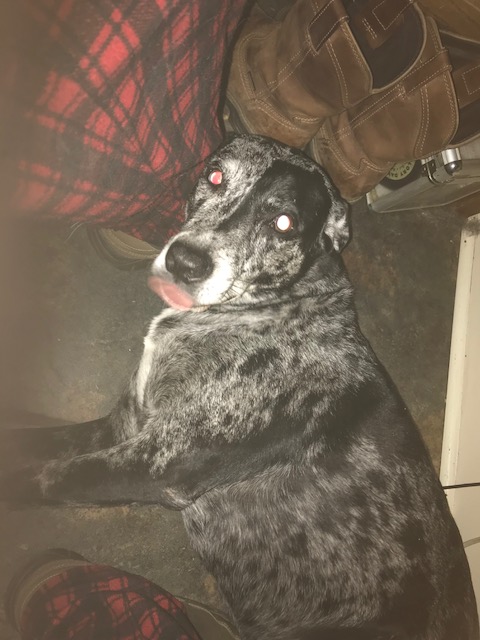
Cookie -
I Mustn’t be Late! The Horoscope for 1 July

What, wrong one? So this one is last minute because of two things: work has begun ramping up into the five weeks of transferring operations between the two labs which means new and exciting incompatiblities (of every conceivable type) being discovered, and also the freeware software I use to generate my star charts borked out. Hey, don’t blame me for being Jewish Scottish Miserly Frugal economically minded. The geocentric stuff is easy to find substitutes for, but it took a while to get some heliocentric views.
And I’m glad I did, because this week is a doozy:
Yeah, he really is We’ve got a construction that takes in five of the seven planets, with neither arm being major to the other: Sol-Mercury-Venus and Mercury-Earth-Mars in mutual opposition. That first bit is a sign of good gossip, but when it’s in opposition with the second it means that there is going to be a major blowup on the homefront caused by news of someone’s love life. Now, the one bit of consolation if it happens to be YOUR love life news that is at issue is that one of these conflagrations, is that Saturn is not part of this construction. So, the relationship will not be ending. Actually, since Saturn is currently retrograde right now, adding it to the construction would give signs of a Medea situation, but it’s not so it’s not.
So, on to the conjunctive news:

You’ve got three more weeks of this joke to come. This is the first full week of the Sun in Cancer, so be sure to wear at least SPF45 and get any suspicious spots checked for melanoma. You don’t want to end up like John McCain do you? Actually, this is one of those uncomfortable situations astrology-wise. For people identified with (born in) Cancer, having the sun there is good. But with Cancer being a water sign and the sun being about as fiery an object as there is, the juxtaposition makes the rest of the sky kind of grumpy and on edge. Enjoy your July!
Leo is getting some love, and it’s not even its turn in the sun yet. This week it’s got a conjunction of Mercury with Venus, so Gryffindors can expect good news, good lovin’, and their cats will only excrete into their litterboxes.
You know what? Unless I tell you otherwise just assume that Jupiter retrograde is in Scorpio and Saturn retrograde is in Capricorn. Got it? Cool.
In sports news, this week’s World Cup matches will feature an upset, as the moon moves into Aquarius along with Mars. Wel, I’m reading it as an upset. Technically it’s just “disorder/chaos/change” so riots or a flash flood would also be appropriate.
-
Beyond the Pale
Not long ago I saw an article that amused me. It was a bunch of eggheads puzzling over the mystery of how humans were able to domesticate dogs. I had to laugh. Clearly none of those guys had ever domesticated a wild animal. Any mammal that lives in social groups, and some birds, domesticate easily. Don’t hit them with a stick and give them food. I dare you to try and get rid of them after that. I have rescued and raised cottontails, raccoon, and red squirrel. I know people who have had pet flying squirrels, grey squirrels, foxes, and I once dated a girl who raised a whitetail doe. The damned thing lived in the house and slept in the bed with her every night. Don’t ask.

Anyway, the real question is not how did we domesticate dogs, but why. My wife jokes that we did not domesticate dogs, they domesticated us–or as she says dogmesticated. I think it is closer to enslavement. Hold on while I check my grocery list. I think they need more chews and treats, maybe even a bag of food that runs around $50….
I’m back. The answer, of course, is simple. Having a pack of wolves hanging around your paleolithic camp at night is a good idea when you live in a world where all manner of beast and man are trying to eat you. It is nearly impossible to sneak up on a camp of sleeping people without sounding the alarm by waking the wolves. They were the original burglar alarm. In that world, people didn’t move around all that much. Wander outside your tribe’s territory and you were likely going to be put on a spit. Contemporary primitive cultures live within strict boundaries. Many people I have met in the more backward parts of the world live out their whole lives never traveling more than a few miles from the spot where they were born. I once tried to explain to a Bolivian who wanted to know where I was from by telling him how long it would take to get there by canoe. “Two years that way,” and I pointed north. That made sense to him.
Beyond the pale. Ever wonder what that means or where it came from? Europeans didn’t have the extinct Eurasian wolf to domesticate, so they would build a fence around their village that was bristling with sharpened sticks or thorns. That was called the pale. Try to get past it and you were likely to be impaled. It was often whitewashed, which is why we use the word ‘pale’ to describe a color. At night, if someone got inside the pale, their silhouette could be seen more easily against the white background. The expression ‘beyond the pale’ refers to going outside the safe zone or going too far.
I am saying that there was never a golden age of gamboling about the fields and dales. Throughout all of human history, people lived within strict boundaries. Go outside those boundaries and some dude named Trog was going to bring your nutsack home to his wife so that she could tan it and make a little purse out of it. Travel has always been restricted. In fact, I would contend that people have more freedom of movement today than at any time in history.
I have heard people blame travel restriction on the rise of nation states and the modern idea of borders. Human history is mostly a chronicle of ethnic or cultural groups invading their neighbors. Travel restrictions were always there; nation states arose from the need for greater security. Borders were not drawn arbitrarily. They mark the edges of cultural territories. Restricting who may or may not cross those borders was and is a matter of life or death.
 The open borders advocates around here have gotten me on the fence once or twice, but looking at contemporary events around the world got my feet back on the ground. I agree that freedom of movement is an inalienable right. One has freedom of movement so long as they do not trespass. If one believes in self-ownership, that every person’s mind, body, and conscience are their own property and no one else’s, then by logical extension they must accept that the fruit of one’s labor is their own property also. I decide who is welcome to set foot on my property and who is restricted from doing so. If a group of like minded people own property collectively, then they decide who may or may not set foot on it. I have no problem with the principle or practice of a nation preventing trespass so long as they do not restrict movement out of those borders or prevent one of the collective owners from re-entering.
There are other factors at play besides security, of course–the welfare state being the largest of those. Ideology is a concern of mine, as well. I am not a multiculturist. All cultures are not equal and the spectrum is quite wide. Flooding our country with people who do not accept the principle of inalienable rights or private ownership is worse than a bad idea. There are many individuals despite being from inferior cultures that would be a great credit to our country, and we should allow them in, even encourage them. Allowing just anyone based solely on their culture or ethnicity on the other hand is…unwise. A merit based system really is the only sensible policy in my mind.
I know this is one of the more contentious subjects around here, so y’all have at it. I’ll make popcorn.
-
Tails of the the Teufelhund, Part 5 – Anniversary!
I got Bella on 3/4/17. My oldest granddaughter wanted a puppy, and we were looking for a new dog anyway, so I saw this:

And I got one. And now she’s about 14 months old. So this is our anniversary. On to Destruction!
A few shirts:t


She is much better about what she chews, but she is That Which Chews. So I buy $5 worth of rope a week for us to play with, and for her to tear up.

Here’s my hardwood ukulele stand that I found in my bed one morning:

I wake at 5 AM and she wakes at 5:15, ready to play, and if I don’t play, she flips out and starts throwing her toys about and hilarity ensues. I end up doing some hardcore upper body exercise that I certainly don’t need, but I guess she does. My dog follows my every move. She watches me. She knows when I’m going to work, and hides out ’til I get back. She greets me with great fanfare, yet waits until I have all my work shit off before she comes for love. And she gets lots!
She knows she can clear the porch wall and do anything she wants, but she sits and waits for my signal. That’s a good pup, IMO.
Bella is finishing out at about 30 pounds, a mid-weight cruiser dog, and damn, what a good dog!
She loves porter and a good stout and meat! Just like a good hum–I mean dog does….
Am I hopelessly in love with my dog? You betcha!

Music both you and your dog can appreciate:
And:
Pet your dog. Give ’em a treat. Bella says, “Arf!”
Kittah says, “ROUNNN! Leave me be!”