Author: UnCivilServant

  • UnCivil Learns From Glibs

    After the previous article from Leap regarding putting a handle on a knife blank, and some ongoing discussions in the comments, I wondered if it was within my capacity to do likewise. I asked a lot of questions of the Glibertariat, trying to harvest knowledge for the project. The first big problem I saw was that the example from the original article was a single-edged hidden tang blade. Since I have heaps of utility knives, I am making something for a more artistic goal. Aesthetically, I like the shape of a double-edged blade. Structurally, I prefer a fully tang – which is where the shape of the handle and the shape of the metal within the handle are identical. Unfortunately, the unsharpened knife blank I found had a tang of a shape I didn’t like and would be too small to be comfortable in my oversized mitts.

    So, I sank a lot of disposable income into buying tools and parts. In terms of cash outlay, it would have been cheaper to buy a knife. But part of that was because my toolbox was geared towards the problems I’ve had to deal with. But tools are a capital investment, and if I keep doing this as a hobby, the amortized costs would head towards negligable. But, that is neither here nor there. The question is, could I learn enough to make a decent piece?
    First off, I discarded the idea of making the blade myself. That was just way too far out of my skill reach at the moment. So I’ll be trying to put a handle on the blank. This process stretched out over a couple of days in the evening after the day job.

    Day 1 – The blank is here

    The first box

    While I technically started the project when I ordered the parts, but I couldn’t do anything until the parts arrived. The pieces that showed up in that first box were the blade blank proper, the handle scales and four Corby bolts. The blade blank is hardened high carbon steel, but not sharpened. This is good, because it’s easier to handle while working on it. Plus, without an edge, it’s not a dagger, it’s a letter opener. Thus this is not an elaborate confession to weapons possession. The handle scales are Resin Ivory, basically an imitation Ivory made of synthetic materials. So the only piece of hardware that might need elaboration are the Corboy bolts. Traditionally, handles would be held with solid pins. There are a lot of downsides to that, however. You either don’t have a mechanical lock, or you have to manually peen the ends. Corby bolts are one of several options that use threaded shafts to bridge two thicker ends. These provide a more secure connection, which is good for newbies like me. The trade-off is that the holes need to be coutnersunk. Luckily, I have a standing drill press, and know how to work with it.

    So, after excitedly telling the Glibertariat that the parts were here, I set about assembling the remaining materials. Because the tang is smaller than my intended handle, I need to fill in the rest of the space around the tang on the same layer. If I was masochistic, I could try to cut out spaces in the resin ivory to rest the tang in. I’m not. I’ll be adding some spacers in which it is easier to cut the shape. The material I decided to use was leather. I have stores of leather scrap from various crafting projects. I picked some brown oil-tanned scraps and a bright red suede split. The oil-tanned leather I never got around to using before, as it was stiffer than I’d expected. The red pigskin suede I’d used to line my toolbox. Only the harder oil-tanned leathers would be cut to shape around the tang. The suede was too thin and elastic, and is there for decorative purposes.

    Parts stacked and trimmed to size, I prepared to drill the holes. Since there were already holes in the tang, I decided to use that as my guide. Taped together to keep them from moving around, I brought the lot to my drill press. Resin ivory has an… interesting aroma when being worked. It wasn’t strong enough to drive me away, but something to note if you decide to use the material in one of your projects. On the plus side, it is easy to work. On the down side, it is easy to work. With one slip while drilling the last countersink, I suddenly had a three-sixteenths inch hole all the way through the scale instead of halfway through as intended. So, I was going to have a pin instead of a bolt holding that spot. Oh well, I’ll still have two bolts.

    Putting holes in things

    Holes drilled, it did my first test fit. It was a real pain to work corby bolts with one screwdriver. This is because they’re intended to be driven by two screwdrivers at once. Still, I got it together and it seemed to work. I chose not to do any more work that day, since it was getting late, and the only task I could do was trimming the oil-tanned leather.

    Day 2 – The Epoxy

    After I ordered the blank, I realized I’d ordered four Corby bolts for a blank with five holes. After some thought, I realized I didn’t want to have two countersinks on the holes by the base of the blade. That would seriously weaken the resin ivory. These holes are there for a bolster to be attached. I decided to pin them. I didn’t have copper pin stock, but that is easily rectified with a visit to the internet. My pin rod and epoxy arrived a day ahead of schedule, and one day after I started the project. So I set about getting ready to assemble. I trimmed the oil-tanned leather to shape with hobby knives I owned for other expensive passtimes *cough*Warhammer*cough*. Once I had these blanks, I did another test fit of the layers and tried to fit the pin rod through. Here I was reminded of the aforementioned elasticity of the suede. The drill bit didn’t punch a full eighth-inch hole through the material. So I got out my leather punch. It is basically a hole punch like those used for paper, only designed to put holes in leather. I punched out a set of larger holes in the suede to stop snagging things.

    Despite using the holes in the tang as a guide for drilling, the pins didn’t fit, even without the suede. I am tempted to blame mystery causes, but the truth is, it’s my fault. My countersinks were not perfectly centered on the holes, so the corby bolts shifted the scales ever so slightly off. If you remember yesterday, The resin ivory is easy to work. A round file of small enough diameter shaved off enough resin to fit the pin stock through. There was a lot of grumbling through this stage. But it was better to find out these problems before I started with the epoxy. I was still within my margin of error for never having done this before. It could still be brought together. However, the dry-fitting told be something very important – I wanted to make sure I was in clothing I could afford to lose when I started working with the resin. The lack of a table-mounted vice meant the operation of the Corby bolts was awkward, even with two little screwdrivers. So the odds were, I’d spill on myself.

    Having changed, cut two pins off the main pin stock, andassembled my stuff, I decided I hadn’t taken enough precautions. I grabbed a giant trash bag to use as a drop cloth, and a pair of resin-mixing gloves. Okay, they’re disposable nitrile kitchen gloves. Mixing up a quarter ounce each of resin and hardener, I began my assembly, spreading epoxy on before each layer was placed, and coating the pins. Suede is a very porous material, and soaked up epoxy into its structure. After hardening, it should be a composite material akin to fiberglass or carbon fiber rod, only with organic fibers. The oil-tanned leather is less porous, and didn’t soak in as much, but still absorbed enough to have a similar effect. When initially thinking about the process before any of the dry-fits, I wondered if I needed loc-tite, or similar thread glue. But the dry fits told me there was zero chance I wasn’t going to get epoxy in the threads of the Corby bolts. This is not an issue, since I want the handle as solid as I can get it.

    Pins set, layers epoxied, I noticed a problem. The countersink that went all the way through resulted in the end separating, as it didn’t have the mechanical pressure of the other two bolts, and the leather is… squishy. Fortunately, I picked half hour epoxy, so I had time to grab some scrap plastic and a set of clamps. Fitting three clamps about the handle, I got everything back to the proper shape. Clamped up, I left it to cure overnight.

    Sure the heaps of plastic look bad, but it’s better than getting epoxy all over the room.

    Day 3 – Daily Grind

    I get home from the day job, decide to remove the clamps and peel off the plastic. Luckily, the plastic didn’t adhere to the epoxy, but the last clamp was stubborn about letting go. At first I thought I’d ripped the plastic and epoxy had seeped through. Nope, once I detatched it, the plastic was intact. But there was this big round dent. I was mortified, thinking I’d overtightened the clamp and crushed my way into the resin ivory. Finishing the plastic removal I inspected the damage. It was not so dire as my fears. I had so much epoxy that had been pressed out of the middle of the handle that it had pooled around the clamp and shaped to the bevel of the pad. This was why it was so difficult to get the clamp off. Relieved, I set about getting ready to drind down the pins and take off the excess epoxy. For this, I definately wanted a face mask. I don’t care whether or not California thinks it causes cancer, I just don’t want to be breathing that stuff in when I reduce it to dust.

    Not structual Damage

    And it occurs to me at that moment that while I do own a belt grinder, it was still in the box. So I went and opened the Amazon box. Unsurprisingly, there was another box inside, unbranded. So after disentangling this box from the Amazon box, I open it – and find another box inside. They had sent me a Matroyshka Doll in box form. Eventually, I find not more cardboard, but styrafoam. Prying it off, I unveiled a lovely piece of hardware, which I didn’t have a place for. it ended up on top of my table saw. (Fortunately, the sawblade retracts below the level of the table). Finding a breath mask and ear protection, I set about cleaning up the pins and bolts.

    Grinder all set up, I learned a few things, some of which I already knew to some extent. First, when you abraid off material, what is left heats up. Second, copper is an excellent conductor of heat. So, if you were, for example, grinding down a copper Corby bolt and hand your finger on the other end, you’re going to feel it. Third, Resin Ivory grinds easily. Fourth, eoxy-impregnated leather does not. Fifth, a belt grinder is a versitile tool that can do wonders in the hands of a skilled user. Sixth, I am not skilled with a belt grinder. Seventh, grinding produces an epic crapload of dust. I was so glad I put on a respirator mask. My first grind was pretty rough.

    After the first grind

    I realized that the layout of one of the grinder components was preventing me from doing what I needed to in order to have the shape I was looking for. I needed to adjust the location of a guard behind the belt proper. Removing the operation interlock from the power switch I took the side of the machine off. There’s no one to flick the switch, but I was about to stick my hands inside it. I saw that this white enamelled metal piece was just being held in with a paur of bolts which an allen key could operate. After loosening one and accidentally tighening the other, I got both loose and started to lower the guard. At which point I found that it was not white. It was dark blue. There was just so much resin dust coating the surface that I could no longer tell.

    The guard lowered slightly, I got more shape into the handle. I noticed that the composite leather material was by far the harder one to grind. The resin ivory essentially disappeared when subjected to the belt, so all of the resistance preventing me from absolutely wrecking the handle came from that leather/epoxy core. So what had been intended as a decorative element became a key structural one. I’m okay with that. Especially since I’d been expecting the resin ivory to be stronger. After the second grind, it was pretty good. I did have a problem. The respirator mask so essential to not breathing in the particulates also impeded the airflow to my lungs. So, I had to step away from the room and take the mask off.

    Part of me went, that is a pretty good shape for a first ever attempt. But there was another opinion rattling around in my head. It said there were things I could fix, even with my skill level. Flaws that I could remove. So, I got back in there and went for a third grind. I cleaned up a lot of the protests I had, making more refined handle than I’d had. It was still clunky and crude, and I did some hand filing and sanding to deal with areas where the grinder would do more harm than good. I even tried to polish it with beeswax. Only to very quickly discover I had no idea what I was doing. I sanded the wax off and went back to refining it with abrasives.

    After the Third Grind

    Finally, I had something that felt good in my hand. It wouldn’t win any beauty contests, but the handle is in one piece, there are no massive faults, and it will hold up. There was just one problem. There is no edge on the thing.

    It will not cut.

    Click For full Image
  • Rite of Passage

    Author’s Note: This is a work of fiction, complete and unabridged. Don’t expect any deep insights, philosophising, or political priciples. It’s here for entertainment. So be entertained.

    It is set in the same world as the as yet unpublished “Prince of the North Tower”, but the characters and places that appear here are not mentioned there, beyond being within the “Five Kingdoms”.

    Yes, I get the irony of turning in such a run of the mill yarn shortly after opining on the mistakes writers make.

    Alvar Lev

    Alvar was sore. Every muscle burned. His arms ached from swinging a hammer. His ears rang from the strike of steel on steel. His legs throbbed from working the treadle on the grindstone. His eyes hurt from looking into fires and at minute details. His back complained from the nights spent sleeping on the bare stone of the forge floor. He’d lost track of how long he’d been in the forge. How many meals taken in the back corner. How many restless nights. How many discarded billets and flawed blades. Hinrik Jarn had watched over Alvar’s shoulder and uttered quiet words of advice the whole time. But, the master smith had not touched a single tool. The blade had to be Alvar’s work, and the boy refused to accept anything less than perfect.

    A churl’s son undergoing the rite of manhood could make do with anything that would cut or stab, but that would not do for Alvar. He was still annoyed at himself that he’d never managed to draw out the steel to a length suitable for a sword. Settling for a blade three times the length of his hand felt like giving up. But it was straight, and the edges parallel until the point. Half the length was double-edged, but Alvar’s legs had simply not been able to work the treadle on the grindstone any more. So he’d filed saw teeth into the lower half of the back edge. To remind himself which side had the full cutting edge, Alvar had added a D-guard to the grip. The simple piece of brass had been more difficult to work than he’d expected.

    Had he simply set out to make anything, the blade would have been something to be proud of. But, all Alvar could see was where he’d fallen short of every goal he’d set. The blade was too short, too narrow, and not fully edged on both sides. The guard was too plain, too unornamented. The grip was nothing but a piece of wood with a leather wrap. The pommel was a simple lug, and he’d bent the tang while peening it. But he was too tired and sore to start over. He could barely rise and carry the blade from the forge to the great hall. Kneeling beside the throne, the youth set the implement atop a wooden pedestal. Alvar’s auburn locks were matted with sweat and streaked with soot. His handsome, boyish features were no better off, as his fatigue showed plainly. The woolen shift he wore would never be white again.

    The great hall of Skogahaugr was a long, vaulted chamber in dark granite. Each arch had a false buttress in the form of a wooden post that appeared to prop up a decorative element near the ceiling. These posts were carved with a spiral of runes containing the saga of Alvar’s family. The verses spoke of how his ancestors had wrested the lands of Snaerveldi from the Kings of Neph and withstood the sieges to drive them back. The crown thus won had found its way to Alvar’s brow when he was but six. He prayed nightly to prove worthy of his lineage and knew he could not let himself accept ‘good enough’ from his endeavors.

    Though Alvar was King, Olaf ruled. The Regent was a big man, with arms like tree trunks, and a chest like a bear’s. His beard had been black when Alvar was crowned, but was now streaked with gray. It was starting to resemble the wolf’s pelt that lined Olaf’s cloak. By custom, a man of Snaerveldi could not wear the fur of a beast he had not slain himself. The shortage of fur in Olaf’s attire merely reminded Alvar of how little time his step-father spent in the woods. The rite of manhood was no place for women or children, so Alvar’s mother and half-siblings were nowhere near the hall. Even so, the sheer number of men who hung around the court seeking the favor of Olaf Gull meant the room was far from empty. Each one of them in turn would inspect the blade and opine on its fitness. All the while, Alvar was expected to kneel in silence upon the stone, aching from the ordeal of its forging.

    By virtue of his position, Olaf was first. Alvar had the urge to snatch the blade off the pedestal. before his step-father could pick it up. But, decorum and tradition stayed his hand. He merely clenched his jaw and gripped his knees to avoid improper acts or outbursts. Olaf gently lifted the implement from its perch and ran his gray eyes over the steel. Alvar knew the older man saw every flaw and blemish in the blade. However much the youth despised Olaf, he knew the regent was no fool. The former merchant had adroitly insinuated himself into the role of ruler so smoothly, little fuss had been raised. His silvered tongue had wooed the court and the widowed queen to the point that only Alvar protested the wedding. The king had been but a child, and the protests were ignored.

    “Fine work, my son,” Olaf said.

    Alvar rankled at every word. It wasn’t fine work, it was merely ‘good enough.’ And he was very much not Olaf’s son. The sycophantic murmurs of the men at court were easier to bear. The blade would serve its purpose in the latter half of the rite, so they took the opportunity to attempt to ingratiate themselves with their king. Alvar didn’t want flattery, he wanted honesty. However acerbic Henrik Jarn had been with his words, he’d been fair in his critiques. These hangers-on didn’t even point out the obviously bent pommel. The young king was grateful when the presentation of the blade was done, and he could finally rest in a real bed.

    * * *

    The wind blowing through the forest brought fresh flurries of snow falling from the laden boughs. Often Alvar would spot what he took for a track only to discover it was merely the mark of a clump off the branches above. So he pulled his cloak tighter about his shivering frame and kept going. The snow swallowed sound, meaning all that reached Alvar’s ears was the susurration of the breeze and the subtle creak of three limbs. Dark enough to look stark black against the snow, the trunks surrounded the youth, cutting short vision in every direction. There was plenty of space to move between them, and the snow was not deep. Alvar’s boots only sank to the ankles with each step. A trail appeared before him, but it was only that of a hare.

    For a churl, a hare was a fine catch, but if Alvar wanted to wrest his throne from Olaf’s clutches, he could not have a churlish omen. So he ignored the hare’s tracks. Puffing out mist, he continued on. Where his muscles had been sore from exertion, now they were all but numb. The first pangs of hunger twinged his gut. Alvar refused to let that distract him. The whole rite was supposed to be a test of cunning, endurance and determination. To hunt down and slay a beast of the forest with just your wits and a blade you forged yourself tested a great many qualities of a man. The type of beast taken was seen as a portent of the type of man you would be. So Alvar stepped over the fox tracks and kept going. Foxes were cunning, but duplicitous. That would not do. It was perfectly acceptable to craft additional implements once you were in the woods, like snares or spears, but Alvar was uncertain what he might need.

    Movement in the corner of his eye caught Alvar’s attention. He froze and looked. It was only a horse and rider. Olaf and several of his picked men were pacing him to ensure he didn’t cheat. Alvar found the implication galling. It was unthinkable to not do this the proper way. Another part of him wondered if the riders were scaring off the beasts. He scowled and motioned for the rider he saw to back away. The rider did not, but did sit still while Alvar gained a lead again. Grumbling and shivering, the youth nearly walked past the hoofprint. It was cloven, and it was big. The size of his palm, more or less. From the spacing relative to the other prints, he could immediately rule out swine and bovine. This was a deer, and a big one.

    To the men of Snaerveldi, a stag meant wisdom and strength, good qualities for a king. Alvar turned to follow the trail, wondering what he would do if it turned out to be a doe. That could wait until he laid eyes upon the creature. There was no way to tell how old the tracks were with any certainty, but they were still clear. It had been snowing earlier that morning, so it could not have been more than a few hours. How far could a deer walk in a few hours? Pretty far, Alvar realized as he tried to work the chill from his fingers. All he could imagine was finding the beast and being too cold and tired to strike. All the while, Olaf and his flunkies would laugh when the stag turned and gored Alvar with its antlers.

    The boy froze.

    Accidents were not unknown. With only Olaf and his chosen cadre as witnesses, who’s to say such a mishap would be at the hands of an animal? As a boy, Alvar was no threat to Olaf, indeed, he was the excuse for the older man’s post. Were Alvar to die during his rite of manhood, it would be a very small step for his step-father to take up the crown. The young king glanced suspiciously behind him, but did not see the riders. Regardless of his fears, Alvar still had a beast to take. Resuming the trail, his bright blue eyes flicked from track to woods to where he suspected the riders to be. Nothing. For all the world, it looked as though Alvar were alone with the trees.

    The sight of cleared snow heartened the youth. The deer had rooted through the accumulation to the plants underneath. Along the edges were marks that could have only been made by antlers. A smile came to Alvar’s face as he picked up the pace. He blinked against the wind and its frigid fingers scratching at his eyes. All that meant was he was downwind from the stag, and it would not pick up his scent on the approach. In an instant, all thoughts of cold, tiredness, and Olaf left his head. There, laying in a patch of cleared ground, was the stag. Patches of snow still dusted its dark brown coat, insulated from his heat by the dense fur. His antlers bore a myriad of points, and reached out wider than Alvar’s shoulders. Indeed, they were almost wide enough to span between the young man’s elbows with his arms outstretched.

    Crouching low and close to a tree, Alvar contemplated his approach. At the moment he had every advantage. The stag was upwind, at rest, and facing the other way. But, they were wary creatures, and the slightest stray noise would send him bounding off into the woods. Moving as silently as his numbed limbs could muster, Alvar stepped around his tree and advanced to the next one. Keeping his eye on the stag, his heart nearly froze when the wind stopped. The stag hadn’t noticed him, as the wind had simply died down rather than reversing. As Alvar contemplated starting forward again, he heard the breathing. It was a low, raspy growl practically over his right shoulder. At first, he thought one of the riders must have approached too close. As he turned, the young king realized the sound was nothing like a horse.

    A white blur leapt on Alvar in an angry snarl. The boy barely had time to interpose his arm between his throat and its teeth before being knocked from his feet. A massive feline with snow-white fur and a shaggy mane bowled him to the ground. As they hit, Alvar’s blade sank to the hilt in the lion’s torso. Claws raked at him as it tried to rip his arm off. Fear lanced through him as he expected his elbow to give way any second. Turning his face away from the enraged muzzle, Alvar twisted his blade in the wound. A torrent of hot blood poured over his hand as the cat’s clawing became spasmodic and flailing. His head reeled from a solid swat to the side of his face. Shoving the dying predator off himself, the youth tried to gain his feet. Falling to his knees, blood dripped from his blade and body.

    Forcing himself to his feet, Alvar snarled at the empty patch of ground where the stag had reposed just moments before. He kicked the dead lion out of frustration. Staggering forward, dripping and reeking of blood, the king made to follow the deer. He spat out a mouthful of red and blinked blood from his left eye as he appraised the tracks again. A horse interposed itself between him and the trail. “Out of my way,” Alvar snarled, motioning Olaf aside. Scarlet drops cast off his arm as he did so, and his mouth filled with iron.

    “Your hunt is over,” Olaf said.

    “I haven’t caught it yet.”

    “It doesn’t matter what you stalk, it matters what you first kill.” Olaf motioned behind Alvar at the dead lion. “Besides, you need to be stitched up before you bleed to death.”

    Spitting another mouthful of blood, Alvar looked at the tooth marks bit deep into his left forearm, and down at the rents elsewhere on his body. If not for the numbing cold, he’d have been paralyzed by agony. He wobbled unsteadily, his torn face dripping down his shirt even as it leaked into his mouth.

    Alvar crumpled backwards into the snow.

    * * *

    It was said that Alvar took the pain well. It helped that they’d sutured his face first and consequently immobilized his jaw to prevent him pulling out stitches. The worst injuries had been to the left side of his face, his left forearm and the front of his thighs. The claw marks across his torso had been long, but shallow. Unable to kneel, he sat on a stool beside the throne. Swaddled in bandages, the king set his bloodied blade on the pedestal. The Snow Lion lay upon the floor before the throne, looking for all the world as though it had lain down to take a nap. During their fight in the wild, Alvar hadn’t realized how big the cat actually was. He could have lain on its back easily. No wonder it had knocked him down so effortlessly. The great hall was cold, but Alvar welcomed the chill. The cold had saved his life in the forest, and it kept the pain down now.

    Though only the men of the court had attended the presentation of the blade, the king’s rite of manhood was of interest to any man of the kingdom. That Alvar had made his blade produced little interest in the common man. That he had slain a Snow Lion with it brought them in droves out of sheer curiosity. Few had ever seen the dangerous beasts, and many of those did not return to speak of it. So to even be able to see the remains of one brought them to the great hall of Skogahaugr. Olaf had to post guards at the door to control the crowds and to keep the women and children outside. It was not their place to attend the presentation of the kill and attest to the suitability of the beast. Women had their own rites, from which men were excluded. From both, children could only wait in futile frustration until their time came.

    It was not appropriate for Alvar to speak, so it was of little consequence that he could not. With that last bat to the head, the lion had dug its claws in deep. There was no way the king’s face would not bear scars from the wound. It was the last thing on Alvar’s mind. He was annoyed at the lion for having interrupted his hunt, and confused at Olaf’s behavior. To be rid of Alvar, and the last obstacle to fully claiming the crown, he had merely needed to act slow. The lion had done most of the work. Instead, he’d done everything to make sure the king lived. Now all the churls and thanes gawked at the dead lion and the wounds their king had sustained fighting it. Such a move would surely weaken Olaf’s hold on Snaerveldi. Alvar the boy was a useful tool. Alvar the man could dispose with his regent.

    It didn’t make sense the the young man.

    The king’s eyes went to where his step-father was observing the line of curiosity seekers pretending to be interested in the rite. He actually looked proud. Proud of what?

    Alvar didn’t understand.

  • Kitbash: The Wheels on the Wagon

    Now that we’ve assembled a passable Caisson, we can move on to the main body of the scratch build. To start with we need to make sure it can hold the weight of the model. While on the human scale, the main model is light, on the scale of the styrene we’re working with, it has a bit of heft. So the basic chassis is going to be a ladder frame of the thicker box tube. As I measure it out to fit the appropriate width of the model, I make a discovery – I cannot cut the box tube squarely. Every slice has a deviation from perpendicular, and there is a variation in length. Not huge, but enough that they will not all have that great of a contact surface on both ends if the ladder frame is assembled hollow. I found this out when the ladder frame fell apart. So Plan B – I take the ladder frame and assemble it on a sheet of plasticard, gluing it to the flat surface. Once glued down, I take a pair of scissors and cut the ladder framed section off the main card. The particular sheet I used was the same one I’d taken the Caisson parts from, so there was a notch already cut into the board. It was also thin enough to cut with regular scissors and not fail catastrophically. I then took little scraps of plasticard sheeting and reinforced the joints on the side facing away from the sheet.

    Hand crafted by trial and error

    The platform is now very sturdy and will serve as a proper base for the remainder of our work. But it’s ugly, you might say, and I’d agree with you. It is also the underside. People will not be getting a good look at the kludged face of it. They will be seeing the perfectly uniform sheet that we glued the box tubing to. The next step is to position the ‘bearings’. They’re not real bearings, they’re just short sections of box tubing through which the axles will run. But they do fill the important role of attaching the platform to the axles, and thus the wheels. When I first set about planning this, I realized that the slope would be defined by the front and rear wheels, and the middle wheels will be a bit tricky. So I positioned the bearings for the front and rear axles and began brainstorming. I’d initially envisioned short posts which would hold the middle bearings at the proper level below the plane of the platform. This idea got torpedoed by the inability to get precise lengths on the box tubing.

    After going through a couple of possible ideas in my head, I decided that the best move would be one which did not depend upon my precision to keep the middle wheels on the proper level. I was inspired by a leaf spring. With the flexibility of plasticard sheeting (or at least the flexibility of the thickness I was using), I could have the bearing for the middle wheels float, and the weight of the model would hold them against the surface underneath. I could have made independent suspensions for two bearings on the middle axle, but I was worried about the strength of such a structure. I had a panel of a good enough width, and a length of box tubing long enough to make a suitable bearing along that width, so I affixed one spring to the front end of the platform and under the front bearings, thus holding the middle axle at whatever height was appropriate for the surface the model rested upon.

    There was much rejoicing.

    Yay.

    Testing our new suspension

    The rejoicing stopped as I turned my attention to the question of keeping the wheels on the axles. Initially, I rejected the idea of gluing them in place. On the Caisson, I’d capped the axle with bitz large enough to prevent the wheels from sliding off. I had no more of them, so I started looking for alternatives. Inspiration struck as I spied by collection of skulls. Not real skulls, mind, but plastic ones for decorating miniatures in Grimdark. So far I’d only used one, and I’d paid good money for them. And the Ork skulls looked just the right size to act as hubcaps. So I started futzing about with the correct angle to trim the end of the axles to get enough plastic to plastic contact to make sure the skullcaps don’t fall off. When I realized I’d trimmed an axle too short, I asked myself why I was going to such trouble to avoid gluing the wheels in place.

    The answer was simple – I didn’t want to work with superglue.

    The alignment looks good.

    Whining aside, I realized that the simplest way to get the look I wanted was to glue the axle into the wheel and glue the skullcap on the hub. Then I could adjust alignment by simply nudging the skull while the glue was still wet. So, I got out my superglue, cut the axles to the proper length, and affixed the wheels and caps on one end of the axles. Then it was simply a matter of sliding the axles into the proper bearings and gluing the wheels on the other end. I waited until the wheels were dry before attaching the other set of skulls. That way I only needed to worry about lining them up, and not that I was going to dislodge the alignment of the wheel as I did. Why persist with the skullcaps when their purpose was no longer relevant. Two reasons – one, I had grown attached to the visual; two – I’d already cut them from the sprue and cleaned up the attachment points. I could have thrown them in the Bitz box, but there was scant little decoration on this wagon chassis as it was.

    Decorative touches

    Speaking of decoration, at some point I took the flag from the chariot kit, extended the flagpole, and attached it to the back of the chassis. I also attached a not-so-random towhook under the back end. This towhook is for the Caisson. While all of this was going on, I was also spray-priming the animals and the Caisson. It had gotten up to forty out, and I wanted to take advantage of the warm weather. The assembly of the main chassis took so long that the sun had set before I was spraying that component. Luckily, my spray area is indoors, and I had light to see by. Unluckily, I had an open window sending all my warm indoor air into the cold outdoor air.

  • Kitbash: Circus of Errors

    Well, the kit containing the animals arrived. It was made by the same folks who made the main model, but is an older kit for their fantasy line. It’s supposed to make a chariot that can be pulled by either horses or lions. Since our IFV model is far, far larger than the chariot, we’re going to use both horses and lions. They did recruit the aid of a traveling circus after all.

    Ragnmar: “Um, won’t the lions eat the horses?”
    Dorian: “We just put the horses in front. That way the lions motivate the horses and the horses motivate the lions.”
    Circus Lady: “I told you earlier, they’ve all been lobotomized, and had override chips implanted. The controller is built into the handle of my whip.”
    Dorian: “Sure, spoil the fun.”
    Ragnmar: “You’re a dick, Dorian.”

    Don’t Worry, They’ll be Fine

    The chariot kit also has a heap of bitz that will be perfect for adding character to other pieces. My army in the actual game has a lion’s head ensign, so it won’t be hard to find homes for the lion-themed decorations from the chariot. Lets clip all of the animals off the chariot sprue and assemble them. I specifically picked the chariot because the animal were posed to be pulling, and had an attachment point on their harnesses where a simple loop shackle could be fitted. We will eventually attach our chains to these shackles, but we’ve got to get them made first. The base model had the animals attached to a yoke, but has only one yoke in the set. To provide consistency, I want all four to be attached by a similar system.

    My first idea was to drill into the attachment point and fit these staples. The loops of the staples proved to be too wide for the model as built. I’d made the mistake of buying the staples before I had the chariot model, and guessed wrong. When I tried to squeeze it narrower to fit the model, I started to realize it was going to be a good deal of work to get it to fit. Not only that, but in the end, it was going to be rather ugly and not fit properly. Oh well, $1 lost. Not really, since the staples are still perfectly serviceable in their original function.

    An alternative came along when my first shipment of plasticard pieces arrived and it turned out I’d ordered the wrong size. I’d been buying axles for the main carriage, and these pieces of tubing are way too narrow for that role. But, if I can bend them into a hundred an eighty degree turn, they would fit almost perfectly as shackles for the chains to attach to.

    So now we get to our first piece on working with plasticard. What is plasticard? In short, it’s high density polystyrene. Yes, the same material they make styrafoam from, only without the foamy airspace. I have straight tubes of the stuff and I need to bend it. Best way to do that is to apply heat. We’ve ventured into something I’ve never actually done before, but I’m too far down the rabbit hole to stop now. So, the first source of heat I tried is hot water. I took my Japanese kettle, set it to boiling, filled a coffee cup with hot water and rested a plasticard tube in it. I got a gentle bend in the part of the tube in the water after quite a few minutes of waiting. This did not make me happy, as I needed a rather severe bend, and I’m an impatient sort. So I dumped the now cooled water into my brush-washing bin and went to get my hairdryer.

    My hairdryer has never been used on hair. I got it when I first needed to put plastic up to the windows on my house. It has only ever been used on plastic, and today would be no different. Now, if you do the math, there is probably more energy trapped in that cup of hot water than I’ll be getting out of the hair dryer. But the problem was, it wasn’t conducting into the polystyrene, but evaporating away with the steam. The hot air moving past it at high rate of speed will transfer more of its heat into the polystyrene than the water did. One thing to note with as thin a work piece as I’ve got here – the airflow out of your standard consumer hair dryer is not even in temperature. There are hot spots directly downwind of the heating elements. These hot spots are what we are looking for, as they will render the plasticard the most malleable. There may be some trial and error involved in finding these spots, but in the end, I got a loop. With the air of pliers and a mandrel, I was able to refine one of those bends into a shackle shape. Some trimming and cleanup later, and it glued neatly to the attachment point on the first horse. That’s a second benefit of switching from metal to plasticard – we can glue it and paint it using the same glue and paint as the rest of the model. The day is saved, we can now get our draft animals modeled. Sadly, as always happens, I get the technique perfected on the last shackle I need to make.

    A lot of frustrating time went into this.

    They will need a base, as they were not balanced to stand without being attached to the rest of their original kit. I can get some bases from the game store when I pick up sheet plasticard for something else I plan to do. Fast Forward a Week, and we have a plethora of plasticard options. Except there’s still a problem. I underestimated the diameter of the plasticard tube yet again. On the bright side, the new tubing is of the perfect diameter to serve as an axle for the wheels. So, I’m going to adjust my mental plan for the design. Not by much, mind you, but I had originally planned the MDF axles that came with the wheels and pinning them to the tubing, which would have required tubing wide enough for the axle to fit inside. Did I just say MDF? Yes. When wheels I got are Medium Density Fiberboard. While I can’t glue them to the polystyrene using plastic glue, I can paint them using the same paints.

    I’m going to be perfectly honest. Scratch-build is new ground for me. So I’m going to start with a proof of concept and put together a caisson. Since there are multiple definitions of ‘caisson’, lets be clear – I’m talking about the two-wheeled cart for hauling ammunition. The wheels came in packs of four, and I only needed six for the main build. So I have a pair free for this proof of concept. I also have in my bitz collection a great many ammo boxes and fuel cans. As such can build the caisson and heap it with appropriate cargo without any additional investment. Is this a part of the main kitbash? Well, yes, it’s simply going to be towed behind the vehicle.

    Ammo Boxes
  • So You Want To Write A Book

    I don’t know if it’s still common, but it used to be an oft-professed desire to write a book. How hard can it be? After all, you can read and write, and that’s all it takes, right? To get started, that is really all you need. Eventually you will turn out forty to a hundred thousand words if you just start cracking. The problem is, you don’t want to write A book, because your one book will suck. So if you want to write a good book, write that first book, chuck it, write a different one, chuck it and repeat. Eventually you will hone the secondary skills required. That of characterization, exposition, description and dialog. These all feed into storytelling. This, of course, assumed that you are writing fiction. Fiction is easier, you don’t actually have to know anything, you just have to string together an entertaining yarn.

    It turns out that a lot of those people who were expressing an interest in writing a book were not interested in the act of writing. What they wanted was to have written a book. Whether it is for the bragging rights or the passive income doesn’t matter, because they will never write a book. It’s simply because the amount of time it takes to sit down and puts tens of thousands or hundreds of thousands of words down on paper is a barrier to entry all its own. If you do not enjoy the act of writing for the sake of writing, the probability of finishing the volume drops to minute. In my case, I started writing stories back in high school. These stories were crap, but I wrote them to entertain myself. I needed to provide my own fiction, because the literature being foisted upon us public school students was specifically selected to make the students hate books.

    The first obstacle is scene flow. A novice writer will often have a vivid picture in their head, but the words on the page do not convey all of it. They will also know where everyone is going next but frequently fail to chain the scenes together in a manner that someone not privy to the contents of the author’s head could follow. It becomes a nightmare if they try their hand at non-linear storytelling, as you combine the problems above with a format that is inherently harder to follow. The pieces of the scene should be laid out in order and strung together in a coherent pattern. It seems obvious, but early on this requires a conscious effort. The frequent counterpoint to disjointed scenery is the ‘and then’ syndrome. Where a character does something, and then something else and then a third thing. A list of actions and events with no color or engagement. While it can be followed, it ends up boring.

    The second obstacle is description. The mistakes often fall into two categories – over-describing and under-describing. Under-describing is often from the same problem as the issues with flow. The picture is complete in their head, and they don’t fully put it on paper. If it’s not on the page, you don’t get credit for it. The opposite end of the spectrum would be trying to get every detail of the picture down on the paper, even when it doesn’t contribute to the reader’s understanding. This can come out spontaneously, or as an over-correction to a novice who had previously been bitten by not describing enough. Finding the balance is infuriating and ironically difficult to describe. Because there is no one good amount of description. Some things don’t need to be covered, while plot- and character-relevant components should be given sufficient attention.

    After the first two, novice authors become more individualistic in their flaws. Some are terrible at developing characters. Others can’t create a plot to save their stories. I have always been the latter. One of my early books started from a seed of “Twenty-five pages of nothing.” The characters were alive, the dialog entertaining, and the scenes well-set. The problem was, nothing happened. It was just a couple days in the life of a nineteenth century gentleman. Strangely, people were still entertained. My solution to break out of that rut was to focus on what I was good at. I let the characters run loose and develop the plot from their interactions. This required knowing them as people and understanding their motivations. It also tends to meander and generate a lot of banter. I’ve had to trim down otherwise entertaining banter for the sake of scene flow because it got in the way.

    For people who can write plots but not character… I got nothing.

    I never had that problem and have no advice beyond this – write more. Like all skills, storytelling and characterization improves the more it gets practiced. So the more works you churn out, the more you will learn from you mistakes. There is a point of diminishing returns, obviously, and there will be works that are not as good as those that preceded them. That is just how it goes. But it is a craft you can practice as long as your brain functions.

    I should probably address bragging and passive income. I do have passive income from my books. Last month it was $25. Most writers have to write as a sideline to a day job or other means of support. The sort of people whose writing generates sufficient passive income to live on are household names. Then there’s the matter of bragging rights. When I meet someone, I tend to say I work in IT. I’ll still talk about my writing with anyone who asks, but I’m usually not the first to bring it up. A lot of these people think they’ll go to cocktail parties and tell the local cosmos “I’m the author of…” But these people won’t ever be in that situation. They’re not the sort who’d spend their Sunday night tapping out 3,100 words in their active work, then turn around and write a thousand word article on writing for their local Libertarian preserve.

  • Kitbash: Drive Me Closer, I Want to Hit Them With My Sword

    Right now our Circus lady is curing, we’re waiting for parts for the animals and wheels, and we need to start getting the main body assembled. Since this is not a tutorial on assembling the kit, I am going to skip any steps that are just “follow the instructions”. So we will focus on deviations from the instructions. The first thing where we’re going to deviate on the main kit is with some magnets. Magnetizing components allows for rapidly changing them out, and is often applied to weapons options. We won’t be magnetizing the weapons. We will be using magnets however. The key to magnetizing is pre-planning. Where do we want to be able to attach and detach other components at will? Two places. We want to be able to swap bases between the diorama and a scratch built flying base. We also want to be able to attach and detach the Circus lady at will. So we need two sets of magnets.

    The first one is rather easy to place. Using the already magnetized base from the other model, I can hold the magnet in place until I affix it properly. How do you affix these internal magnets? There’s glue, but I had leftover Green Stuff, and with those channels in the floor, it will hold pretty darn well. Plus, being on the bottom of the model, it won’t be in as much danger of shifting due to gravity. So that one was the easy one. The other place we want to magnetize is the left headlight assembly. We want our Circus lady to be able to stand on the corner of the vehicle and motivate her beasts to haul. Initially I planned a line of three small magnets with the same polarity so we can have a few options as to where she stands. There was just one problem with this – when you get two magnets close to each other, they tend to act of their own accord. After a lot of frustrated fussing, I realized I wasn’t going to be able to do it at the present time. So I cut down to the two magnets on the ends, which were far enough apart that I was able to get them into the notches I cut in the back of the headlight assembly. Once I had glue in, I promptly entombed them in Green Stuff – I was not going to do that all over again.

    Some assembly required

    The magnets on the outside are there simply to help hold the inside magnets in place while the Green Stuff cures, and to remind me that there are magnets in there. Oh, and ensure polarity of the interior magnets. I know that once the interior magnets got entombed, there wasn’t much chance of them shifting, but I really don’t want to fight with the fiddly little magnets any more. So, we go back to textbook assembly until we get to the turret. Thankfully, I already decreed we were not magnetizing weapons, so that is out. So what am I doing to the turret? First off, I’m going to drill out the bore of the machine gun. No one will notice if you leave the bore the solid slug of plastic that it comes out of the box as, but that little added touch of detail helps. I don’t do it to every weapon, or even most weapons, but when I’m already going to all of this effort, I’m going to drill out the bore of the projectile weapons.

    The second point of deviation is that we’re going to leave the turret as three subassemblies. The gunner, the pintle mount and the turret proper. Why? Because there are a lot of tight corners in there and trying to prime, let alone paint, all of those nooks and crannies is asking for trouble. So we’re going to paint them separately and press-fit them together. This requires not gluing the layers to each other. The second thing we’re going to do is to swap out the arms on the gunner. We need a pose that says “Drive me closer, I want to hit them with my sword.” And to do that, we need to give the guy a sword. So it’s back to the Bitz Box. Swapping out weapons arms is easy, right? Well if all you want to do is make sure he’s holding the weapon, sure. But we want him posed properly for the meme-reference. So we need to take a saw to some arms. For the left arm, we have a chainsword that’s just a hand, so we can just find an arm pointed in the proper direction and take off whatever’s in its hand. Too many of the arms are posed to hold something close in to the torso, which is the opposite of what we want. For the right arm, the pistol I want to give him has the wrong type of shoulder pad, so I have to swap it to an arm that is compatible with the correct ones.

    So we apply a little saw to the arms and do some more part surgery. Why didn’t I use the saw before? Because the female parts were not as bulky, and wouldn’t deform as much from clippers where they were more than the knife could handle. The saw is slow, but it does less damage to the surrounding part and can cut through an arbitrarily thick block of plastic. Once cut apart, we reassemble the parts we want and we have one enthusiastic gunner who can’t wait to get into melee range. Nevermind the fact that he’s sitting behind a minigun…

    So what’s next? Well, we need some parts to be delivered, and we need to look at what’s wrong with our Circus Lady’s backside.

    That didn’t work out exactly as intended.

    So what happened was that gravity caused the green stuff to slump against the front loincloth. And the upper part is still a mess. So lets cover the rump with a pistol from the Bitz Box. Yes, the pistols are gratuitously oversized. But with ammo packs, the holster hides most of the worst errors. We also have to attach a magnet to the heel of that boot. So far I’ve been using thin plastic glue. (Thin being a measure of viscosity.) But plastic glue works by chemically reacting with the plastic to cause the pieces to fuse to each other. It does not work so well with metal. So as I cut a notch from the heel of the foot to fit the magnet, I had to find the cyanoacrylate, more commonly called Superglue. I hate superglue. It sticks to anything but itself. So I end up having to hold the pieces in place for far too long before it sets and pray I didn’t get any on my fingers. If I did, I would get glued to the piece while waiting. This is more than a little annoying.

    We’ve got a ways to go.

    Almost as annoying as getting glued to the piece is realizing I don’t have magnets small enough to hide in the foot. So what am I going to do about this oversized lump of metal in her heel? I’m still thinking about that. So what is there to do now? We need to wait for the pieces I ordered online, but that doesn’t mean work has to stop. What can I do while waiting? I can paint. My preference is for spray primers and to paint light on dark. There are a few simple techniques to ensure a good primer coat that doesn’t wipe out details. First off is to remember that you can always add more primer, but taking it off will be difficult to impossible. Especially around the fine details. So short bursts in gentle sweeps will do well. You need about sixteen to twenty inches of separation from the spray nozzle to the piece in order to have the best dispersal of pigment. Don’t try to get the whole piece in one pass. Coast from one direction, so you have a dry face for the model to rest on. Let that layer dry and spray the other side. Repeat from as many directions as needed to remove pale spots and get a uniform coat. A bright penlight will help provide alternative lighting to check whether or not a given pale spot is the underlying plastic or reflections.

    Oh, and whatever you do, make sure you spray prime in a well-ventilated area. Most sprays use hydrocarbon-based accelerants that will cause issues if you breathe too much. Plus the pigment, which you don’t want in your sinuses. No matter where you work, there will be droplets of pigment that float long enough to dry and form colored dust. You will begin to notice this if you use the same spot long enough. It can be wiped up, unlike a direct spay that will stick to whatever it hits. Last tip, put a backdrop behind the piece to catch as much of that loose pigment as you can. A simple cardboard box will suffice, provided it’s big enough.

    Wherein we apply the base coat.

    Right now we’re priming in eight pieces, three layers of the turret, the Circus lady, three weapons mounts, and the main chassis. This will allow the structure to have more posability, and allow us to paint it properly. If you notice the walker in the back, the one on the left, it’s not just there to look pretty, it’s a color reference for the vehicle. So we start with some base coats. The primer counts as our first base coat, because there are large areas of the model that will stay black. On our Circus Lady and the gunner, we have one model that has a lot of exposed skin and one completely encased in armor. His coat will be more uniform, mostly dark red. The base coat for the skin and hair will be leather brown, and while we’re painting it, we’ll paint the holster and ammo pouches. We need to be careful not to paint over her shirt. That one gets based in dark purple, the loincloth in pale gray and the metal in a lead hue.

    A time-consuming, but vital step

    While I could leave that as her skin tone, I’m not going to. These intermediate layers do two things – one they reduce the number of layers required to cover a pure black base, and it subtly influences the character of the final color layered on top. Most of the brown will be covered up, except for the holster and ammo pouches. Though the red is the final color of the gunner’s armor. Since I’m basing the Circus Lady’s armor, I’ll hit the metallic parts of the main chassis and weapons. Because there are so many “metal” components across my collection, this particular silver hue is one of my most commonly used pigments. There are two painting techniques I have to discuss when applying these patches. First is what is typically thought of when mentioning ‘painting’. That is evenly applying pigment to coat the area. This is used for things like gun barrels and antennae. The second is drybrushing. Drybrushing is the use of a limited amount of pigment (the ‘dry’ brush) to scrape over the prominent details of the model. This gets useful for grates, vents and simulating wear on mechanical components.

    There are some people who would advise diluting your pigment. I have only once ran into a time when I needed to add water to paint – after a pot had all but dried out and needed to be restored to working order. This is because I find diluted pigment doesn’t cover well, and refuses to stay where I put it. You will typically get this bad advice online when you gloop it on. More appropriate advice would be to use less paint. As with primer, you can always put more on, but taking it off is not so easy.

    So we start layering on other colors. With a few details, the “very undone” look of freshly primed pops to something looking closer to completed. For this reason, I try to pick primers that represent as much of the base color as I can. This is not always practical, and for individual characters I will just suck it up and paint it all, such as with the Circus Lady miniature here.

    All gussied up and painted
  • Kitbash: For Want of a Sprue

    This story starts with a Christmas sale at the friendly neighborhood gaming store. While browsing, I managed to talk myself into spending money on the newfangled infantry fighting vehicle model for the latest dose of plastic crack from my favorite dealer. This was not the best purchase, because I was none too excited when I got home. But I’d bought it, so I took the shrink wrap off the box, opened it up and got out the instructions. Skimming through them, I found a spot where there were no part numbers. Mistaking this for a misprint, I went searching through the sprues for parts of the right shape to be the pieces involved in the operation in question.

    That’s when I started to suspect something was wrong. None of the sprues in the box had the right parts, and the missing pieces were rather important. To be specific, they formed the stand that allowed the model to appear to hover (if you ignore the fact that you can still see the stand). Box art showed these pieces to be clear, and online unboxing videos showed a sprue of clear plastic with the two parts I did not have. Now I was a bit miffed. This wasn’t like some optional component I could choose to omit, so I needed to find a solution. Well, my first thought were the bitz merchants online who routinely part out kits. Then I realized, “This is a manufacturer’s mistake, I should start with customer service.”

    I sent them an e-mail, then sent them another one when an auto-reply said I should provide more information (like the model number). Then a few days later I get a message telling me a replacement had been dispatched. I thought, “Great, I’ll have my stand, and I’ll be back in business.” A few details began to creep into my consciousness. First was fairly innocuous, the $0 order put in my account history linked back to the full kit. Well, that could be explained by the website not having product pages for individual sprues. Then there was the FedEx shipping weight – two pounds. And box dimensions too big for the tiny clear sprue I was expecting. I began to suspect they had not sent me a replacement sprue, but a replacement kit.

    And I was proven right when the box arrived. A whole, still shrink-wrapped kit. My initial reaction was “Why would they do that? All I needed was a sprue.” But some logic began to tell me why it happened this way. Let’s look at it from a business process perspective. You are a company that produces plastic model kits on injection-molded sprues. You have hundreds of products, each product contains anywhere from one to a dozen sprues. Are you going to maintain a warehouse of every possible replacement sprue you might need to send out? Not if your quality control is any good. You’d be paying for warehousing and staff while hanging on to a lot of unsold inventory ‘just in case’. What about grabbing a sprue from the factory? Well, not all of the products are actively being pressed at any given time. There might not be any for that replacement part lying around. Plus you’d disrupt the finely tuned processes. And forget retooling a machine to mold a one-off. That would just be absurdly expensive. But, you do have a worldwide distribution network which is already tuned to pick and ship completed kit boxes on-demand. The marginal cost drops to the box plus shipping. That is far lower than the alternatives, and faster as it is not a deviation from routine for the supply chain.

    The Sprue

    Long story short, I got a complete kit from customer service to replace my incomplete kit, and they don’t want the incomplete kit back. So what am I to do with the incomplete kit? It’s almost the whole thing, just missing a stand. I could be boring and rig up a stand, it’s going to be obscured by the vehicle body anyway.

    But then I’d be living down to my Glib reputation.

    Instead I decided to be funny. We have this oversized, high-tech IFV for power-armored super soldiers. What does it do when the lift systems break down on a low-tech backwater? A conversation between the fictitious driver and the resident mechanic came to mind.

    Ragnmar: “The Grav systems won’t grav and the turbines won’t turb.”
    Dorian: “That’s not technically-”
    Ragnmar: “I don’t need to be technically accurate, I need to be moving towards the front. I’m stuck in this circus!” *gestures wildly at the tents around them*
    Dorian: “While it may be a colorful local encampment-”
    Ragnmar: “No, it literally is a circus. They have trained lions and everything.”
    Dorian: “Normally I’d get a transport in here and put you back in reserve. But our ships left the system to-”
    Ragnmar: “Skip to what you’re actually going to do.”
    Dorian: “Do you need to be back at full capacity, or just moving again?”
    Ragnmar: “Just get me moving again.”
    Dorian: “Excuse me, circus lady, I’m going to need your help…”

    And so I thought of the super-advanced grav-IFV up on wheels being pulled into combat by circus animals. That, of course, is not something the kit is designed to do. So now we’re firmly into what is affectionately known as “Kitbashing”. To give a dry definition, at its most basic, kitbashing is the act of customizing the appearance of a model by using parts from outside the kit from which it is normally made. Sometimes, this is as simple as swapping out heads on infantry. Other times, it gets complicated to the point where the original model is unrecognizable. We’re aiming for in between, with an amusing scene that is still somewhat complicated in terms of the customizations, but still recognizable as the original model.

    So, what do we need?

    We have the unassembled base kit without stand. We need wheels, circus animals, some thing to attach them to the main body, and the circus lady. I’ve also decided that I want this scene to be modular, that is, if I want to deploy the model to the tabletop, I can detach it from the scenery, drop it on a jury-rigged stand and run it alongside the complete version. So, the wheels should be attached to a chassis, but not the vehicle’s chassis proper. This frame is one more thing for the list.

    Now to accomplish this we need to look for parts. The chassis to hold the wheels is going to be new construction. New construction? Yes, there is a material commonly called ‘plasticard’. It is the not the same plastic as the average model, but sold in sheets, bars, tubes, etc. It is one of the vital tools in the arsenal of anyone looking to do more than just swap parts. Being plastic, you don’t need any special paints or tools to work with it versus the normal kits, and it supplements the more expensive detailed moldings. For something like a chassis between some wheels, tube and beam plasticard is ideal. It spends most of its time unseen, and even if seen, will look the part it’s trying to play.

    An easy way to attach the animals to the vehicle is by using actual chain. Craft store chains in ‘hematite’ color are easy to come by and of the right scale to fit in with the model. They’re metal, but we don’t need to paint them or anything, since they’re already in the right color. We will need to cut them to length, so I’ll have to make a note to find my wire cutters. So, now we need to source some animals. Preferably ones that are posed like they’re pulling something. I spent a lot of time on this one. And I found the perfect solution. It’s an older kit, but it’s a fantasy chariot that is supplied with both horses and lions as options for draft animals. I’m not sure yet if I want to use the wheels from the chariot kit, they’re kind of small. The wheels are important given their juxtaposition to the high-tech main body. They also need to look like they’d be able to hold the weight. After a while, I decided to order some from the internet and save the chariot wheels for another day.

    Now we come to our Circus Lady. There are two things this part must do. First, it must not look like I just grabbed a basic soldier and gave it a whip. Second, it must still look like it belongs to the same faction. The whip is vital, as the stagecoach driver, she’ll be using it to direct the animals pulling the whole thing. But all the whips I have belong to a different faction. We’ll call them BDSM Elves, since that’s a non-trademark infringing way of getting the point across. I can’t use a whole model from the BDSM Elves because, well, that wouldn’t be able to pass for the faction the IFV belongs to.

    I’m somewhat surprised that I got fifteen hundred words into an article about kitbashing before I mention the concept of the Bitz Box. It’s really as simple as it sounds. Most kits have more options than can be used on any given model, so there are bits left over. These get thrown into a box in case they can be used later. The base model for our Circus Lady will be built around the sorceress body that came with a dragon rider kit. She was the option I didn’t use when assembling it. However, she does have a whip arm and is built to the same scale and proportions as the models of a sect within my main faction. Since I have a lot of bitz not used to make these other girls, I can mix and match until the Circus Lady fits in with the proper faction.

    My Bitz Box

    Picking through my Bitz Box for these silent sister pieces, I find a minor problem. The whip hand is a left hand – and so are all of the good hands for the silent sisters. A ‘bad’ hand in this case is a hand gripping something I don’t want in the finished piece. I do have some pointy silent sister hands, and a right handlebar hand from… lets call it ‘cyborg cavalry’. That’s close enough. While this right hand on the handlebar is not a perfect fit aesthetically, it is to the correct scale, and more importantly, it is easy to make the whip fit. We just need to conduct a little part surgery and we can make a right arm. Joining the whip to handle is the easy part. Next we need to take one of the ‘bad’ hands and separate the forearm so we can graft that forearm onto the cyborg cavalry hand. Shaving of the right slivers of plastic, and we can hide the fact that the hand doesn’t fit.

    Since the sorceress model was designed to be seated, we need to adjust the legs. In fact, lets take this armored leg with a loincloth and use that to make her stand. In a nice bit of fortuitousness, the curve of the waist chain on the sorceress matched the curve of the top of the armor on the loincloth leg. So it was easy to trim down the torso and glue it in place. The sculpt almost looked like it was meant to be. Fitting in the right leg was less cooperative. I grabbed the completed version of the kit (the one that gets to have its stand) to use as a measuring device for her pose. Now, you may have noticed that some of these pieces are black and the rest are gray. This is not because they were molded from black plastic. No, this was because the sorceress is an old model. One I bought when I still primed on the sprue. This technique did not work out so well, because it resulted in weak joints and models that broke more often than I liked. To glue these pieces into the kitbash, I have been carefully shaving off the primer to expose a clean plastic surface that the plastic glue can react with.

    Making a Lady

    Since I only have two sorceress torsos and multiple silent sister heads, I do the more drastic trimming to the head and give it a profile more like the one made for this torso. While the sorceress as delivered had a backside to make HM happy, it doesn’t take much to notice that our Circus lady doesn’t have a backside to speak of. And so we come to Green Stuff? What is Green Stuff? It is… green. Actually it is two-party epoxy putty that very often comes with one component tinged blue and one yellow. This gives an easy indicator of when they’ve been properly mixed because it turns green. It is also sold in other colors, but “Green Stuff” is widely recognized as the generic term for the material. While still freshly mixed it is somewhat adhesive and quite malleable. It is used both to fill gaps and to sculpt components. After about a day or so, it will have hardened up and can be sanded, cut or painted. My thought was we should sculpt ourselves a back half to the loincloth. I overestimated my skill as a sculptor. Still, I filled the gap, and have something hanging down there. We’ll let it cure and see what there is to work with.

    Gluteoplasty Not included.

    Next step – we start assembly on the main vehicle.

  • UnCivil Cooks – Phaildelphia Cheese Steak

    UnCivil Cooks – Phaildelphia Cheese Steak

    I’ve heard a rumor that there was something sportsball related that happened in Philadelphia. I think the Phillies won Fifa or something. So to celebrate, I’ll be bastardizing their one claim to culinary fame – tossing beef, cheese and aromatic veggies on a roll. I’m just not in the mood for bread, so the first change will be to replace the roll with an absurdist substitution. Okay, maybe not as absurd as I could have, but we’re going with portabello mushrooms. Since mushroom caps don’t fold too well, they’ll be more in the role of trenchers for the goop.

    Being within the limits of the culinary talents of the residents of Philadelphia, it is a fairly straightforward process. We need to start by greasing a cooking surface. You could use butter, but I decided to go a different way. While collecting ingredients, I spotted salt pork on the grocery shelf. I figured I could use it in much the same was as bacon. I did make one oversight, I didn’t realize they sold salt pork with the skin still attached. This is mainly an inconvenience that made cubing it a bit more of a hassle than it otherwise would have been. I should have got bacon, it’d be easier. But, once chopped up, I tossed it into the pan and started rendering out the pork fat.

    Not the prettiest pig.

    This part is simple, don’t let the pork stick to the pan, and keep it on medium heat until it lets the lard out. Once it does that and you have a nice, sizzling puddle of grease, it’s time to add the onions. Sliced or diced, doesn’t matter, we’re not being faithful to the original, but we need the onions browned or even caramelized for flavor. Even though you can probably guess what onions in a pan look like, I still took a picture anyway.

    Aromatic veggies.

    I’m too impatient to wait for the onions to caramelize, so I got out the shaved beef. They claim it’s shaved steak, but the consistency is more like that of a brisket. Doesn’t matter, it’s a brick of beef that has been frozen and fed through a deli slicer. I start piling this in with the onions.

    The beef joins the piggy party.

    Now, beef this thin cooks really fast, I mean it was less than half a minute between the time I put it in and this next picture.

    Some people would call this ‘done’

    So I needed to prep my trenchers, and I realized I had far too much beef for the amount of mushroom I had. So I needed plates. When I think of sportsball, I think of food slopped onto cheapass paper plates, so I dropped the ugly mushroom tops onto some of the cheapest I had at my disposal while the beef finished cooking. It was a suitably cheapass looking sight.

    It looks so sad.

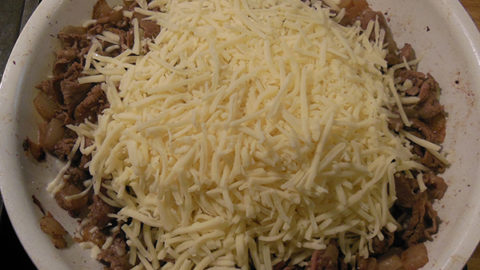
    Now the key thing with the choice of cheese is how easily it melts. Since everything else is completely cooked at this point (except the mushrooms, which won’t be cooked at all), we want something that melts readily. I went with Monterrey Jack, because it will melt if you look at it harshly. I just heaped it on there…

    Most things can be improved with cheese.

    And stirred it in. Before you know it, we get the goop we’re looking for.

    Ready to plate.

    We scoop the goop onto our fungal trenchers and… we get something that looks like a Philly street after a sportsball game…

    “Splat”

    Perhaps I should go and look for inspiration somewhere with a better culinary track record.