Hello GlibFitters, apologies for the crap article today! My laptop decided to corrupt the OS randomly, and I haven’t had time to fix it. This week, I’m phoning it in!
This week is the week of suck for those of you that have been dutifully improving your fitness since the start of the challenge. Week 2 is the low point of the whole process. Week 3 sucks less, and you should be over the hump by week 4.
Just remember that all this hard work will pay off in the near future, and the suck will subside.
Worst case, give yourself a break for ten minutes and grab a hamburger.
As for me, this has been an up and down week. I’ve had catered lunches to account for and Valentine’s day was a complete fitness failure, but I’m maintaining weight and have hopped right back on the horse. A bad meal or a bad day aren’t enough to kill my momentum anymore.
I thought about titling this “Hey Hihn, how’s this for deep libertarian thought?”, but I’m not that spiteful. This article is based upon an idea I’ve been tossing around in my head for a while. It usually comes back to the forefront whenever we’re talking about transfolk or open marriages. As with all of my articles, I make no representation that I’m not unknowingly ripping off some philosopher or, even worse, walking into some trap.
There seem to be two types of libertarians… really more of a spectrum with clustering near the edges. On one end is what I’ll call the Deferentialists. The Deferentialists work from the premise that when an individual makes a decision, it is the right decision for them. Deferentialists’ motto is “live and let live.” They’re deferential to the individual’s decision making.
On the other end is what I’ll call the Restraintists. The Restraintists work from the premise that when an individual makes a decision, it is their decision to make, whether or not it is the right decision. Restraintists’ motto is “who am I to tell you what to do?” They restrain their own sense of morality to avoid overstepping their authority.
The oddest image that came up for “authority”
I’ve written in the past about my authority-based view of rights. To sum it up, your mom had the authority to wash your mouth out with soap when you cussed as a kid, but a politician doesn’t have the authority to punish you for your speech. This places me firmly in the Restraintist camp, and I think that all libertarians who care about being effective should join me.
The Ineffectiveness of Deferentialism
When viewed from a simplistic and static point of view, Deferentialism and Restraintism achieve the same thing. Should the government implement a law implementing some social goal? Deferentialism says no because the social goal may be right for some people, but it may also be wrong for some people. Restraintism says no because even if the social goal is good, the government overstep of its authority is evil, and the ends don’t justify the means.
However, Deferentialism is ineffective in two ways. First, people, even Deferentialists, tend to have a line drawn in the sand where they shift from relativistic deference to the individual to a more absolutist stance. For example, Cosmotarians tend to be Deferentialists up to the point where their particular identity politics ox is gored. Second, Deferentialism gives no answer to Cultural Marxism. Deferentialists are either forced to kowtow to the virulent left, or they end up drifting authoritarian.
This image seemed oddly appropriate.
In contrast, Restraintism handles both of these issues differently. Restraintists have absolutist stances for everything, so there is no line drawing to be done. Any failure to properly act libertarian on a certain issue is a failure of moral restraint, not a philosophical deficiency. Similarly, Restraintism isn’t hampered when facing off against Cultural Marxism. While Restraintists would never strip away the rights of Marxists, they’re free to criticize, ostracize, and attempt to curtail the creeping growth of Cultural Marxism.
Congratulations you motley crew of fitness fools! You’ve made it through one week of the fitness challenge. Some of you have already fallen off the wagon, and we’re here to shame you into slinking back on. You’re not gonna give up already, are you??
Just admit that you fucked up and start week 2 anew. We won’t judge you more harshly than you judge yourself, we promise.
Week one of a new routine is always hard. Motivating yourself to do stuff really sucks. The good news is that if you made it through the first week, you have evidence that you won’t die from the changes you made. The bad news is that weeks 2 and 3 are gonna suck worse before it gets better. But you want to be healthy and strong, right?
Oh geez, maybe I should add a carrot to balance out that giant Hillary sized stick I just dropped in this article.
For myself, I had an okay week. Superbowl weekend was a 48 hour glut, but I ate well otherwise. I only got one day of physical activity in, which is 1/4 of what I wanted. It’s going to be hard to find the time to do physical activity. How about y’all?
Hello GlibFit friends! The time has finally come for our first fitness challenge. The purpose of this challenge is to each push ourselves to make and meet fitness goals with shared accountability among our community. Please recognize the fact that, given the nature of fitness challenges, it’s not going to be easy for most folks. Keeping that in mind, don’t be an asshole.
Here’s how it works. The challenge is ten weeks long, starting today and ending Friday April 13th. Every Friday, we’re going to have a GlibFit thread for discussing progress and as a general fitness open thread. For ease of access during the week, all the GlibFit posts will live in their own category index in the website footer.
At the end of the 10 weeks, we take a look back at what we’ve accomplished. Then, if people are still into it, we start again in May with a second session.
It’s not too late to join in, and it’s not too late to revise your goal for this session. We’re not keeping track of your goals, so it’s up to you to keep track of your goal and your progress. As mentioned before, the best goals are quantifiable and achievable. Something like “spend 30 minutes 3x per week on the treadmill and run a 5k on April 3rd in 25:00” is a great goal. “Eat less carbs and turn the TV off” is harder to hold yourself accountable to.
Part of fitness accountability sometimes includes tracking your food and exercise on a daily basis on your phone. At the very least, I try to track my weight daily. The most commonly used app for that is My Fitness Pal. If you have a MFP account, join our group and become friends with your fellow Glibs. If there are other apps that people are using, please share in the comments.
After barely surviving the immediate fallout of the government shutdown, Baby Trshmnstr and I braved the post-apocalyptic wasteland to see if the Starbucks gift cards still worked. On the way, we passed by ground zero, one of the hardest hit places in the world by this tragedy… a National Park. Specifically, Manassas Battlefield National Park.
Blood stained these grounds a century and a half ago, and we honor the loss, but this park will now have new historic meaning as the Bull Run ran red with the life essence of the millions who have died because of the government shutdown.
I originally thought that I had captured an image of a valiant National Park Officer shielding the gawkers and rubberneckers from the unimaginable horror that lies beyond the main entrance. Upon further inspection, it was an evil libertarian trying to pillage the piled up bodies for gold and for survivors to put to work in their salt mines. Thank God for the gate blocking their way! Some heroic government employee must have put it in place prior to dying from lack of funding.
The evil libertarians are at the gate!!! They’ve failed to get in, but they’ve succeeded at blocking my picture of the gate!!
We trudged on: me, the less than loyal dog, and the only-partially-aware baby. Oh, to view this horror from the eyes of a babe! What a punishment! A sentence worse than death: to grow up and live a shell of a life surrounded by death and rot! And all because the damn Republicans shut down the government!
We continued to what was once the field hospital, where the wounded were once brought to be hacked up or to be released into the sweetness of death. However, through the wanton cruelty of the Trump, the casualties of today’s Civil War weren’t even given a chance. Only a few straggling survivors were able to make it to the field hospital to revive the building to its most glorified use. The well that once was polluted with the severed appendages and disfigured tissue of battlefield casualties is quietly empty today, the few survivors too disoriented and delirious from the mass gore and violence of the GOP assault.
Oh, the poor survivors! Nowhere to go, no civilization to return to! They’re left, like the beasts of the plains, to die nameless and without dignity in this new dystopian reality!!
We finally passed by what was once a gathering place for schoolchildren and other lovers of learning to gaily frolic from historical monument to historical monument. Horses would gallop by and athletes would perfect their fitness in a small utopia built up on government land. Now, all that is left at this alternate entrance to the park is a bevy of burnt out automobiles, husks left from a happier time.
As we drove past this monument to unspeakable violence, choking back tears and vomit, it struck me how this park would look in a far away future, once this turmoil has passed. Much like the neatly lined cannons and artillery pieces that adorn Henry Hill not more than half a mile from this place, a future monument to this oh so frivolous act of hatred will show these destroyed cars lined in neat rows, scorched by the hatred of this nation’s Hitler.
Why is there sometimes a perverse beauty in violent death? What draws the eye to such destruction?
I part with a single thought. As I gaze into the cruel face of government shutdown, I see that the struggle is finished. I love Big Brother.
“3 out of 4 Americans believe that killing animals for meat is immoral, according to a MSNBC-MediaMatters-PETA poll. Based on this information, Congress is debating new rules put forth by the FDA to tax meat production at a higher rate than vegetables.”
The infant mortality rate is nearly double in Mississippi and Alabama than it is in New York and California!!!! Oh wait, It is 0.4% in NY and CA and 0.8% in MS and AL. And wait, there’s more! There’s a longstanding and well-known correlation between poverty and higher infant mortality. CA and NY are 2 of the richest states and MS and AL are 2 of the poorest states. What, exactly, is the point of this article except to poor shame the south?
Every media outlet has published a metric ton of articles that start just like this. It’s lazy writing, but it’s also the platinum standard for crafting a narrative. See, people are social animals that are primed to go with the crowd. When that subconscious impulse is manipulated through polling, people’s behavior becomes malleable. When you have some basic understanding about the strata of voters and their belief systems, you can get them to do your bidding without them even knowing.
Three basic concepts make public opinion polling an irresistible tool used to bias an audience: herd behavior, identity politics, and aura of authority. The formula is simple, using a favorable polling result, generalize the findings so that it is implied that a majority of an identity group believe a certain way, relying on herd behavior to solidify support of the belief within the identity group.
The ironic part is that none of what makes public opinion polling such a strong tool is based in reality. The herd behavior is based on an illusion. By and large, support for a politically controversial position sits somewhere between 40% and 60%, meaning that nearly half of people oppose said controversial position. Further, polling doesn’t allow for enough nuance to differentiate between being opposed to legalizing machine guns and being for the repeal of the 2nd Amendment. Identity politics, as well, is subtle. Take, for example, the approval/disapproval ratings of prominent politicians. If identity politics were the primary driver of public opinion, the surges and drops in approval ratings would be quite attenuated.
However, the illusion of universal agreement is very powerful.
Social Science is Modern Day Astrology
The holy grail of science is replicability. If you can produce an effect in one study, you should be able to replicate the conditions and achieve the same effect in a successive study. In physics or chemistry, this is usually fairly straight forward. Barring some unknown environmental variable affecting the experiment, the bowling ball and the feather land on the ground at the same time in a vacuum. The sodium and the water create a highly exothermic reaction when combined.
Social science is much squishier, both in methodology and in result. When you’re working with people, they don’t behave like molecules in a vacuum. They lie, they are affected by minor biases in your methodology, they are subject to many weird psychological effects like the placebo effect, and they don’t take kindly to being locked in a laboratory for 15 years for a longitudinal study.
Resultantly, more social science is done by “poll” than by “experiment.” Not that the experimental method is any better. I experienced the infamous psychological experiment where they flash pictures of different races of people and then time how fast you click on the good word or the bad word.
This has led many skeptics to put scare quotes around social “science”, which more and more resembles phrenology than physics. Adding more fuel to the fire is the “replicability crisis.” The replicability crisis affects both experimental and poll based studies. Essentially, social science can’t find the same effect two times in a row. Not only that, but they can make a study say that any effect exists (such as, listening to songs about old people makes you younger).
However, in a world that fucking loves science and decides social policy by sound byte, the internal crisis in social science becomes a very public issue. As discussed in Part 1, science journalism is a farce. When an ethically compromised journalism industry interacts with an ethically compromised social science industry, you get science journalism that is slave to the agenda of the media. We live in a world where science is subservient to the state. If you publish something that aligns with the state’s goals, you get media coverage and additional grant funding. If you try to publish something that goes against the state’s goals, you get undermined at every step.
Manipulating the Results: Bias in the Experiment
People are quite malleable as I’ve already said, and this is evident in the results of studies. Wording is very important. Want an anti-abortion poll result, mention “mother” and “convenience.” Want a pro-abortion poll result, mention “choice” and “woman”. I’ll let the next example speak for itself.
An example of a wording difference that had a significant impact on responses comes from a January 2003 Pew Research Center survey. When people were asked whether they would “favor or oppose taking military action in Iraq to end Saddam Hussein’s rule,” 68% said they favored military action while 25% said they opposed military action. However, when asked whether they would “favor or oppose taking military action in Iraq to end Saddam Hussein’s rule even if it meant that U.S. forces might suffer thousands of casualties,” responses were dramatically different; only 43% said they favored military action, while 48% said they opposed it. The introduction of U.S. casualties altered the context of the question and influenced whether people favored or opposed military action in Iraq.
There are quite a few known phenomena that influence studies, as well.
Acquiescence Bias – Making a statement and asking the poll taker to agree or disagree. Usually folks with lower education will agree disproportionately with the statement in comparison to when the same issue is asked in a question format.
Social Desirability Bias – We saw a bunch of this last election cycle. People tend not to like to tell others about their illegal or unpopular opinions, so they’ll simply lie to make the poll giver like them.
Question Order Bias (“Priming the Pump”) – Ask a question that will likely get a positive or negative reaction, then follow it with a question you want to influence in that positive or negative way. For example, if I were to ask y’all whether you like the current spending levels of the federal government and then followed it up with a question of whether you like deep dish pizza, the pizza question will be skewed negative.
Interviewer Effect – Related to the Social Desirability Bias. The poll taker changes their responses based on characteristics of the poll giver. For example, if a woman is giving a poll on equal pay, the poll taker may respond more favorably than if a man gives the poll.
Observer Effect – The poll taker is subtly affected by the poll giver’s unconscious cues, resulting in their responses being biased toward the poll giver’s expectations. For example, if the poll giver expects that black people will answer a question a certain way, they may change their inflection when asking the question in a way that influences a black poll taker to answer in that way.
This still ignores the cognitive biases that we have talked about in Parts 1 and 2.
How do you sort through all this crap and get to a real, measurable effect? You design a good experiment. How do you design a good experiment when taking a survey? You don’t.
Manipulating the Results: Playing with the Data
Okay, so we have highly questionable data from a shit survey, but at least we’re now in the realm of math. Nothing can go wrong here!
A core requirement of legitimate polling is “randomization.” Taking a random sample of the group you’re trying to study is what allows you to generalize the results to the group as a whole. If you do something to disrupt the random sample, you weaken the ability to generalize the results to the group as a whole.
How do people screw with the random sample?
Weighting – Let’s say you’ve done a 1,000 person survey, but you’re concerned that your relatively small (but random) sample isn’t actually representative of the world. See, you’re a savvy poll taker and you know that a recent poll showed that there are 41% Democrats, 37% Republicans, and 22% Independents in the locality of your poll, and your poll has 39% Democrats, 40% Republicans, and 21% Independents. We’ll just inflate the results of the Democrats in the poll to reflect 41%, deflate the result of Republicans to reflect 37% and mildly inflate the results of the Independents to 22%, and we’ll do our further analysis based on this massaged data. Of course, this assumes that the pollster’s understanding of reality is correct, and it screws with the randomization of the data, resulting in a strong danger that the data no longer reflects reality.
Margin of Error – You survey 1,000 people, and 44% love Trump and 46% hate him. Therefore, Trump is unpopular on the net. Well, except for the margin of error. For a 1,000 person survey in a country of ~300 million, the results are roughly correct. Roughly correct means that your poll (and others designed in the same way) is within 3% of the reality 95% of the time. This, of course, assumes a representative (read random) sample.
Data dredging – Let’s do a huge survey asking a zillion questions. Then let’s go fishing for correlation between variables. We’ll just ignore that correlation does not imply causation, because who actually believes in that. It actually makes for some amusing reading.
Fudging the data – How about we do 15 runs of the survey, pick the 3 that most support my hypothesis, and publish a paper with the results of those 3 data runs?
A more technical issue is highlighted in Anscombe’s quartet. Four completely different sets of data that are statistically identical. Why? Let me tell a story from Poli Sci 300-something, Statistics for Political Science. One of the main statistical analyses performed by Poli Sci statisticians is linear regression. Linear regression (which you may remember from 5th grade math) is trying to fit data to a straight line (technically you can fit it to another curve). However, the problem is that you have to predetermine the type of curve you’re fitting it to. It doesn’t self-tailor. If you have an exponential relationship between being libertarianism and small government views, it won’t fit well to the straight line regression. It struck me, sitting in that class, how much statistical analysis was an art, not a science. If you don’t understand the math and conceptual understanding behind the numbers (as most social science students don’t), you’re going to come to somewhat worthless results when doing statistical analysis.
The Results are Garbage In the First Place: The Telephone Problem
Garbage in, garbage out. It’s pretty much my motto. It’s especially true with public opinion polling. Let’s quickly mention two issues so you get a sense for the type of garbage being used in modern public opinion polls. No need to linger on this issue.
1) Self-selection bias – This has always been there. Who is likely to answer a telephone poll? Is there some inbuilt bias caused by some declining to participate? Is there a destruction of the randomness of the sample if it takes 3,000 phone calls to get 1,000 poll takers?
2) The shift away from landlines – This is new. Currently, less than 50% of people still have landlines. Cell phones really screw up some of the assumptions behind the methodology of telephone polling. For example, if a pollster wanted to survey people in central Indiana about some local issue, it’s possible that I would get a phone call. I don’t live in central Indiana, and haven’t for over 5 years. What does it mean for the poll that I’m not in the expected cohort? Nothing good. However, it’s easy enough to ask where I live at the beginning. What about the other way around. A pollster is trying to survey northern Virginians about some local issue. I’m essentially disenfranchised by that poll because my area codes is central Indiana. Further, cell phones make it really easy to block unknown numbers, resulting in even fewer “hits” for each phone call.
Knowing the Public: What Motivates Voting Behavior?
Now that I’ve thoroughly shattered your trust in the public opinion poll, let me shatter your trust in the people being polled. Let’s talk about a truly experimental social science study looking at beliefs and voting patterns.
The interesting result of this experimental study of people’s beliefs and voting habits is this:
There are 5 different types of voters:
Ideological – Able to abstract their issue positions into larger conceptualizations (principles) and set those conceptualizations relative to other ideologies.
Near Ideological – Have awareness of an ideological spectrum, but their positions don’t particularly rely on an ideology.
Group Interest – Good ol’ identity politics. I’m black therefore I vote Democrat.
Nature of the Times – Something bad happened in the world when Republicans were in power so I’m voting Democrat.
No Issue Content – I vote because…well… argle bargle, incoherent rambling, no making sense. Seriously, this is the category where the pollster couldn’t make any sense of their motivations for their beliefs.
There must be a bunch of people in groups 1 and 2, a ton in 3, and a smaller amount in groups 4 and 5, right? That would be the sort of society I want to live in.
Sorry to disappoint.
Group 1 (Ideologues) – 2.5%
Group 2 (Near Ideologues) – 9%
Group 3 (Identititarians) – 42%
Group 4 (Idiots who can rationalize their opinons) – 24%
Group 5 (Idiots who can’t even coherently explain the reason for their opinions to a pollster) – 22.5%
This was taken in the early 1960s. Wanna bet it’s even worse today? Identity politics wins because that’s how a plurality of people think. Principals over principles is a thing because 42% of people care about principals and 11.5% (generously) care about principles.
The sickening part is that group 4 and 5 vote. (Table 1 of the study shows the percentages for the study as a whole and for likely voters, with only marginal changes to the percentages).
I could type more about the horrifying prospects of society based on this study, but I think it’s more impactful to let the data sink in. 89% of people base their worldview/politics/beliefs on something other than a set of principles/ethics/morals. Almost 50% have blatantly idiotic reasons for holding their opinions.
As a final note, 35% of respondents randomly varied across opposing positions for issues in successive interviews. There wasn’t a trend in these changes, which made the pollster come to the conclusion that these people weren’t able to come to the same opinion two interviews in a row.
Quick Takeaways from the series of articles
The media is untrustworthy, and not just in the obviously biased ways
Gell-Mann amnesia is real
Science journalism is neither about science nor is it good journalism
Any conclusion drawn from social science should be viewed with great skepticism
Anything being pushed based on majoritarian or poll-tested bases is probably shit
By thinking in terms of principles, you’ve elevated yourself into rarified air. Most people struggle to even rationalize their opinions.
Aight! We’ve talked about Computer Science and we’ve talked about some design features used in blockchain. Now let’s put it all together and cap this series off.
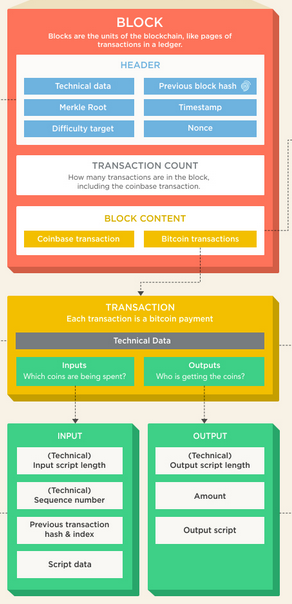
What is blockchain? It is a linked list of data structures that uses cryptographic hashing to sign each data structure, thus including it in the canonical chain. Here’s the block used by Bitcoin (most other cryptos will have mostly the same components).
You can see the transactions in the Block Content section, and you can see info (such as the hash of the previous block) in the Header section. Let’s relate this all together and draw a true picture of a blockchain (specifically Bitcoin) block. To do so, we’re gonna be dealing with a whole bunch of cryptographic hashes.
Hashing: A Redux
If you want the nitty gritty detail, you can go here. However, since we’re not writing a mining algorithm or a storefront, I’ll spare you the minutae. If you want an awesome video that explains exactly what I’m about to talk about, but in visual form? Here ya go! Want to learn more about blockchain than you ever wanted to know, but all at a layperson level? You’re welcome!
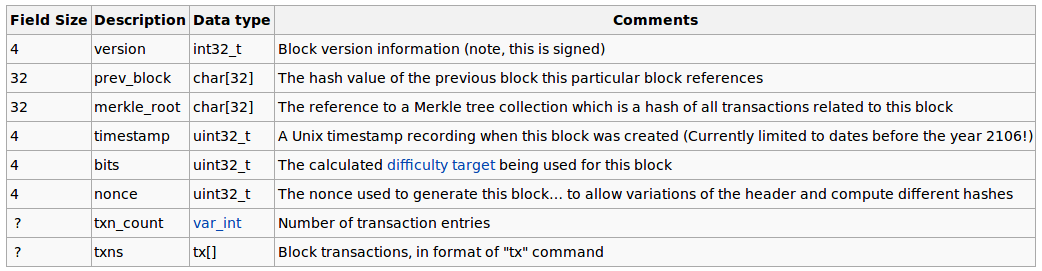
Here’s a Bitcoin block:
Let’s work from the bottom up.
txns
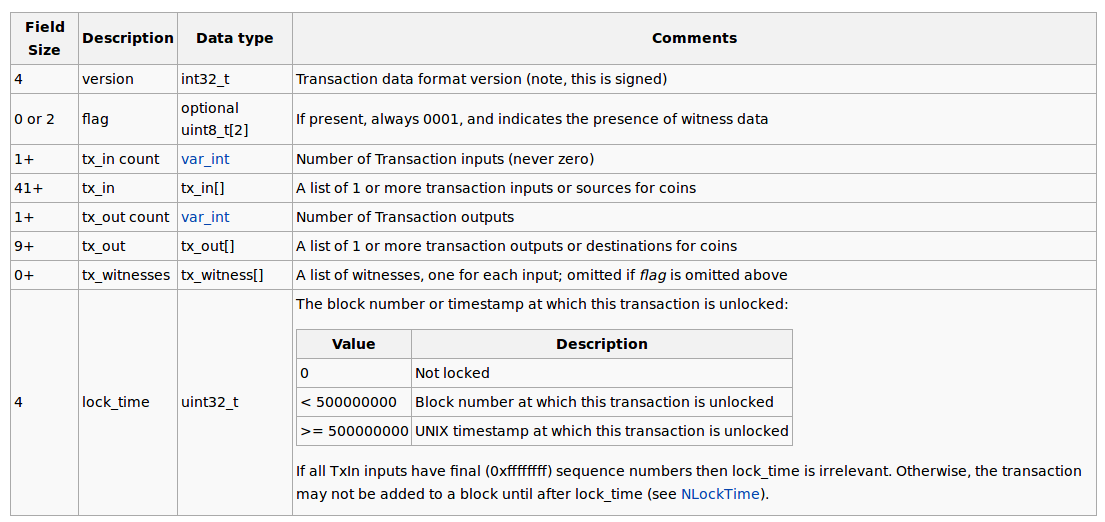
The payload of a Bitcoin block is an array of transactions. Each transaction looks like this:
I show the transaction mainly to show you that it contains two things: tx_in and tx_out. This is how it works, you combine a certain number of prior transactions in the blockchain (inputs) and then dole out the coins contained in those transactions in the outputs. If the inputs go over how much you’re paying the other person, you add an output to pay yourself back the overage. It’s much like cash. Just like handing bills to the cashier and receiving change back, you hand over inputs, and receive back an output for the overage.
Let’s do a quick example. Oscar wants to pay ZARDOZ for the Gift of the Gun, and he wants to pay $150. Oscar has previously received money from Office Manager Mohammed for “Jihad related expenses” for the amount of $110. Oscar has also previously received money from Preet Bahahahaha for “Woodchipping services” in the amount of $65. In order to pay ZARDOZ, Oscar sets up the transaction by including the previous Jihad and Woodchipping transactions as inputs, and creates two outputs: one to ZARDOZ for $150, and one back to Oscar for the remainder ($25). Then those Jihad and Woodchipping transactions are marked as fulfilled, meaning that they can’t be used again as inputs.
txn_count
This is fairly self explanatory. This contains the number of transactions in the block.
nonce
From here on up in the block, everything is contained in the header. Remember that the hash of the block is really the hash of the header. The txn and txn_count parts of the block are not used in calculating the hash. However, we’ll find out really soon why the transactions are still reflected in the block hash.
Nonce is related to mining. I’ve alluded to the way that blocks are created, and I’ll discuss it more in the next section, but suffice it to say that the nonce is a random number and has no purpose besides in calculating the hash. The way that a block is added to the blockchain is that the block’s hash must be below a certain number. How do you get the hash below a certain number? You adjust the source data used to make the hash. Since the hash comes from the header and the nonce is in the header, you can change the nonce until the hash is below a certain number. Notice that simply changing the nonce to a lower number doesn’t guarantee that the hash is a lower number. This is where luck and random chance come into play. We’ll talk more in the next section about this.
bits
Bits goes with the nonce. It is the “certain number” mentioned above that the hash needs to go below for the block to be accepted.
timestamp
Timestamp is self explanatory. It’s the time when the block was created.
Merkle Root
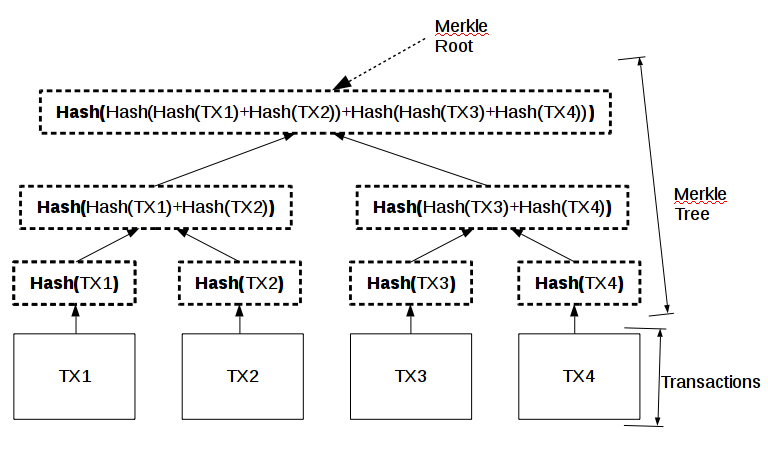
We’ve discussed the Merkle root before, but haven’t really nailed it down. Let’s do that now. The 10,000 foot view is that the Merkle root is the hash of all of the transactions. The hash of the block (which is actually the hash of the block header) takes the Merkle root into account when calculated.
The Merkle tree is a binary tree (each parent node has two children) that hashes from the bottom up. The bottom row of the Merkle tree contains the hashes of each transaction. The middle row hashes adjacent bottom row hashes (it’s a hash of a hash). The top row is a hash of a hash of a hash and contains information from all of the transactions. Notice what it would take to modify or replace a transaction. If STEVE SMITH tries to replace TX4 with FAKE_TX4, he has to recalculate three different hashes, as well (all of the hashes that include TX4 in them).
Prev Hash
This has been discussed at length in the prior two parts. This is the hash of the prior block, the link between the current block and the prior block.
Version
The version of the blockchain tells everybody what rules this block has been assembled under. This makes it possible to improve a blockchain without having to toss out all of the old blocks.
Mining
We’ve hinted at what mining is already, but now we can put all the pieces together. When transactions are posted to the blockchain network (all of the computers mining and transacting on that blockchain), they are packaged up into a block to be added to the end of the blockchain. How this happens is technical and a bit beyond this overview. Once a block is packaged up, the mining process begins. The block, sans block hash and nonce, is sent out to the network for mining. Computers that are set up as miners begin to calculate the block hash. Remember that the block hash is calculated from data that includes the Merkle root, the previous block’s hash, and the nonce. All of those pieces of data are constant except for the nonce. Therefore, miners, upon calculating the block hash, adjust the nonce to try to get the block hash to be less than the current difficulty number (represented by the bits field).
Once a miner has calculated a block hash below the current difficulty number, they submit the hashed block to the network. If they’re the first to do so, they “win”. They end up getting a small payment of cryptocurrency for their efforts. The payment is based on an algorithm that reduces the amount of currency created for a successful mine until an end date when no more currency will be created for that coin. At that time, miners will only be compensated by transaction fees (which are currently in the tenths of a percent range).
As you can imagine, it’s not easy to do this. Bitcoin, for example, is designed so that, on average, the winner mines the block in about 10 minutes. Given the vast amount of processing power dedicated to Bitcoin mining across the world, the chance of a single desktop computer winning even once a month is slim. In some other cryptocurrencies, it is easier, but even a second tier crypto like Monero would average one or two wins a month for a standard desktop computer. At that point, you’re probably not making enough to pay for the electricity you used.
That’s where mining pools come in. It’s a fairly simple concept. Take a bunch of computers, let them mine as a cohesive unit, and split the winnings across members based on a pre-defined formula.
The Big Picture of Blockchain and Different Applications
We’ve talked about blockchain in the context of cryptos, but there are a ton of different potential applications for blockchain. The main “hot topic” for blockchain use is reputation analysis. Rather than having to go through a reputation broker (Uber, AirBnB, Yelp) to find out whether the person driving that car or renting that room or cooking that meal is trustworthy, you can reach out to the decentralized blockchain to find their reputation.
This is a fairly simplistic application of reputation analysis, but the reason folks are excited is the application of such a thing to automation technology. What if, for example, you didn’t have to put in a reservation to get a hotel room? If your reputation is high enough and the room is available, the lockbox automatically opens and gives you the key to the room. All you have to do is tell the system how long you plan on staying there, and you’re set.
Another application is identity management. Does the cashier really need to see your name, address, and other personal info to know that you’re old enough to buy alcohol? There’s a whole bunch of identity leakage that sets each and every one of us up for identity theft. One proposed use of blockchain is to provide customized identity services. The cashier can query the blockchain as to whether you’re old enough to buy alcohol, but can’t access your address. Amazon can get your address, but can’t get your social security number. Starbucks can get your first name, but not your last name.
What about securing your finances? This isn’t entirely separate from cryptocurrencies, but what if every transaction you made was from a different account? Instead of giving your bank account info or your credit card number to merchants, you give the equivalent of a Visa gift card with the exact amount of the transaction on it. If Target gets breached and your info is leaked to malevolent actors, it’s not an issue, because it points to an empty one-time account.
Finally, the application that I think would be the most interesting. Traffic management via blockchain. As automated cars become a more likely reality, most of the traffic management interaction methods that have been designed to be centralized or distributed in nature. A decentralized traffic management system would reduce the efficacy of government meddling and the potential for an enforced monopoly a la internet service provider.
Cryptocurrencies
I’m not going to list out all the cryptocurrencies in detail. I trust y’all to DDG it yourselves. Let me just point out a few of the big ones in passing.
Bitcoin – The original and most famous. There is relatively little anonymity in using Bitcoin, as shown by the Silk Road FBI takedown. It’s also relatively slow to get new blocks integrated, at an average of 10 minutes per block.
Bitcoin Cash – A fork of Bitcoin meant to scale to more users a bit easier by making the blocks bigger.
LiteCoin – Billed as “silver to Bitcoin’s gold”. It generates blocks 4x faster (2.5 minutes per block), will generate more coins than BitCoin, and some different internal algorithms.
Ethereum – Ethereum is much more than a cryptocurrency. It creates smart contracts that can take advantage of automation. Want to unlock your guestroom when somebody has enough reputation points? Ethereum is probably the best blockchain to start from to do this sort of thing.
Monero – Billed as the “secure cryptocurrency,” it is designed slightly differently from BitCoin so that bad actors (like the FBI) can’t trace one transaction back and see your entire transaction history. Secure is a relative term, because, as seen in the Silk Road incident, there are weaknesses wherever you have to give personal info (shipping, currency conversion)
Drawbacks and Limitations
This could be an article in and of itself, but I’ll just hit a few that are top of mind.
Blockchain length – The immense size of the Bitcoin (and other large cryptos’) blockchain means that you either need to rely on somebody else’s node to get plugged in (by using an exchange) or you need to wait a few days for all of the blocks to be downloaded.
Block acceptance time – In Bitcoin, it takes an average of 10 minutes for your transaction to be included in an accepted block, and due to forks (when two different blocks are accepted in two different parts of the network), folks recommend waiting an hour before declaring the transaction “completed.” That obviously doesn’t work for somebody trying to walk out the checkout line at the supermarket.
Scalability – This is kinda wrapped up in the last two, but the number of transactions in a block are limited by a maximum size. Therefore, as more and more transactions occur, the chance of your transaction making the first block goes down substantially. Then, you have to wait not only 10 minutes for your block to be mined, but you have to wait an unknown amount of time until your transaction is included in a mined block. This is where transaction fees come into play. When there are 50,000 transactions, which ones are you going to try to make into a block as a miner? The ones that pay the best, of course.
Security – We’ve discussed some security concerns already, but blockchain doesn’t resolve the single biggest threat in online transactions: the other party in the transaction retaining and ultimately misappropriating your personal information.
I hope this series was helpful to y’all! I’ve certainly learned a ton!
We’re gonna try some participation from the peanut gallery for this one. I’m bringing an idea over from another online community. The idea is fairly simple. You sign up for one or more self-created fitness related goals in this thread. Then, starting February 1st and extending through April 15th, you do your best to meet your fitness goals. Each Friday, in the weekly GlibFit thread, we talk about how the week went, whether we met our goals, and whether we’re seeing progress.
There’s nothing beyond that. The point is some moral support and some third-party accountability in a digestible 10-week time segment. Your goal can be anything health and fitness related. It can be dietary, exercise related, or whatever else you want. From experience, having something quantifiable is more motivating than having some vague, subjective goal.
Here’s my goal:
4 days per week of physical activity
5 days per week of low-carb diet
If you’re a My Fitness Pal user, join our group here.


 There seem to be two types of libertarians… really more of a spectrum with clustering near the edges. On one end is what I’ll call the Deferentialists. The Deferentialists work from the premise that when an individual makes a decision, it is the right decision for them. Deferentialists’ motto is “live and let live.” They’re deferential to the individual’s decision making.






 Social science is much squishier, both in methodology and in result. When you’re working with people, they don’t behave like molecules in a vacuum. They lie, they are affected by minor biases in your methodology, they are subject to many weird psychological effects like the placebo effect, and they don’t take kindly to being locked in a laboratory for 15 years for a longitudinal study.
 Acquiescence Bias – Making a statement and asking the poll taker to agree or disagree. Usually folks with lower education will agree disproportionately with the statement in comparison to when the same issue is asked in a question format.
 1) Self-selection bias – This has always been there. Who is likely to answer a telephone poll? Is there some inbuilt bias caused by some declining to participate? Is there a destruction of the randomness of the sample if it takes