Author: Glib Staff

  • Jumping Off A Bridge With The Rest Of You – The Bum Beer Challenge

    Swiss Servator

    I believe it was Brett who warned mexican sharpshooter sometime back about his beer reviews, something to the effect of not letting the commenters goad you into joining them should they jump off a bridge. Well, ms did at least fall off a small pedestrian bridge at the commentariats urging…reviewing “Earthquake“.

    Well, never learning from other’s mistakes…I saw a bit of banter in the comments of one of ms’ fine beer reviews:

    Almost immediately my brain’s higher functions shut down and I started pestering ms “hey, lets do a bum beer challenge! I can do a couple and you can do a couple!” Now the good messican resisted at first, but I whinged enough to get him to relent.

    I decided to open with a classic – Olde English 800. It got me to thinking…you know what else Olde and English we had at least 800 of around? Yeah….the common law. Not everything we brought over from England was worth casting aside, like tea over coffee or boiled beef. The common law was a keeper. In fact, when various States set up their Constitutions, they would often explicitly keep such. Virginia for example;

      “That the common law of England, and all statutes, or acts of parliament made in aid of the common law, prior to the fourth year, of James the first, which are of a general nature not local to that kingdom, together with the several acts of the colony then in force, so far as the same may consist with the several ordinances, declarations, and resolutions of the general convention, shall be considered as in full force, until the same shall be altered by the legislative power of the commonwealth.”

    So, was Olde English 800 one of these Colonial legacies? Hardly. It is a product of the Miller Brewing Company and joined us in 1964. It has been a staple of bums, highschoolers and college kids looking for a cheap drunk ever since. It has a bit of an evil reputation – receiving less than flattering reviews from those that care to do such.

    Up first…


    A sniff was a bit alarming. It reminded me of the stale beer you would smell in leftover plastic cups from a college kegger…the next morning when you were trying to remember if you had 13 or 14 beers, and really didn’t want to smell the leftover Natty Light in cups strewn about the living room and front porch.

    Taste – like corn syrup and despair, mixed and chilled. Then came the slightly to moderately unpleasant aftertaste. Some subsequent slugs of it didn’t help. I decided to pour the rest of the bottle out, in memory of departed comrades (but not the really cool ones, just the meh ones). RATING: 1 out of 5 dumpsters.

    Next up, I had planned to do King Cobra Malt Liquor – Anheuser-Busch’s answer to Olde English 800. I am disappointed that I was unable to find it around anywhere. Oh, not because I expected it to be any less vile than OE 800….but I had teed up some funny:

    Sorry, Commander. Maybe next time.

    and some interesting:

    Queen’s Cobras Regiment, Royal Thai Army

    But the story of the Queen’s Cobras, serving in Vietnam, will have to wait for another time.

    Instead, I drew forth the local Wal-Mart’s latest bum beer – Rockdale Light. Fortunately, it came in bum cans (24 oz) too (I suspected one can would be enough for this lifetime). Unlike OE, the Rockdale seems to have a bit more of a moderate set of opinions.

    Yes, Rockdale LIGHT…I am watching my Glibfit calories.

    Slipping the tallboy into its paper sack, I cracker ‘er open. Could it be that the craft beer revolution had come to bum beers? I tried a sniff and got…nothing. Huh. I mean, zero. Odd that…. OK, on to taste. Hmmmm. Similar. It was the Oakland of beers – No there, there. A little bit of an aftertaste of something resembling beer. 24 oz of 4ish % ABV….nothing. Not high enough alcohol content for a true bum beer, but by God, I can see cases of this being drained by thirsty undergrads, furtive highschoolers and others on a budget/not desiring taste, merely effect. I mean, $1.29 for a 24 oz can isn’t bank breaking. Dump a couple in a cheap plastic pitcher and here you go! Gets the job done, maybe a bit slower and you may end up a bit bloated by the sheer volume you would have to consume…but a success for the category. RATING: 3 out of 5 dumpsters.

    Later today, in Part 2, mexican sharpshooter suffers because of my enthusiasm.

  • What Are We Reading – May 2018

    Old Man With Candy

    After a conversation with Warty, I remembered perhaps my favorite scientific biography ever, Oliver Heaviside: The Life, Work, and Times of an Electrical Genius of the Victorian Age by Paul Nahin, and have been giving it a reread. Heaviside is only vaguely known among people in the physical sciences (I only knew the name because of the Heaviside step function in math), but ought to be far better known; for example, what physicists and engineers think of as the Maxwell equations (the foundations of electromagnetic theory) are actually the Heaviside equations. Maxwell’s formulation was clumsy and complex- Heaviside reworked them into a simple but comprehensive set of partial differential equations, the ones familiar to contemporary students and practitioners. His operational calculus laid the groundwork for Laplace transform methods routinely used in circuit analysis. His work solved the massive problems of the nascent telegraphy and telephony technologies and brought us into the 20th century.

    But that’s what makes him interesting specifically to geeks. What makes him interesting overall is the sociology associated with him. Unlike most prominent British scientists of the era. Heaviside was a true outsider, born into poverty, and completely self-taught. Moreover, he was an odd personality, and if he were alive today, we’d put him somewhere on the autism spectrum. He had almost no social interactions beyond his immediate family, refused to adopt the manners and mores of the gentlemanly scientists with whom he interacted in scholarly journals, and larded his papers and books with thinly veiled invective and humorous insights (“It is wonderful how little work there is when you know how to do it.” “It is as unfair to call a vector a quaternion as to call a man a quadruped.”). Of course, establishment figures fought to keep this outsider outside, but the sheer power of his intellect swept that aside. Trigger warning: to understand what Heaviside did, some equations will inevitably present themselves. If you’re on the other side of CP Snow’s two worlds, you can skip over them and take my word that what he did was brilliant, significant, and vastly influential. This book is fascinating, a study in sociology and psychology as much as it is about physics, an absolute delight.

    SugarFree

    I had been meaning to read Annihilation by Jeff VanderMeer since it won the 2014 Nebula for Best Novel, but it wasn’t until the announcement of the Netflix adaptation that I finally got around to it. It involves a scientific expedition into Area X, a portion of the southern United States coast that has been inexplicably quarantined by an invisible and deadly barrier with a single, deliberate opening to allow people to explore. Inside, mutant animals and an inexplicable structure beg to be explored. Almost everyone that goes dies or disappears or comes back insane, with amnesia or riddled with strange cancers.

    I really have to say, I don’t understand the hype around this book. It wasn’t bad, but it wasn’t really anything groundbreaking or even exciting. It is written in a limited viewpoint from an unnamed and probably unreliable narrator in a journal. In fact, none of the characters have names and are just referred to by their job or functions on the expedition, The Biologist, the Linguist, The Psychologist, etc. In an experiment to find the optimum psychological conditions for an expedition that can both survive and return with some sort of coherent information about the conditions inside the barrier, all the members on this trip are women.

    Like much modern music, it seems like VanderMeer took a dozen or so better works, threw them into a blender, and hoped the reader wouldn’t find too many recognizable chunks floating around in the slurry. But I’m good at spotting chunks: There are bit and pieces of Solaris, Roadside PicnicRogue Moon and–for the first two–their cinematic adaptations, as well as all the movies and books derived from them (Event Horizon, Cube, et.al,) countless “found” memoirs of the inexplicable, the mind-flaying horrors of Lovecraft and even a solid piece of gristle from Poe’s The Narrative of Arthur Gordon Pym of Nantucket.

    The movie is a pretty disappointing follow-up to the excellent Ex Machina by Alex Garland. It takes a few things from the novel, but otherwise pretty much ignores it to create a strange mash-up of “The Colour Out of Space” and The Crystal World by J. G. Ballard (minus all of Ballard’s Heart of Darkness overtones.)

    Riven

    I finally passed my exam and have been celebrating by reading exactly nothing–except the dialogue in Persona 5. That said, Mr. Riven and I listen to some podcasts when we’re lifting or traveling. Last week we traveled to Missoula for the USPSA Area 1 Championship. Mr. Riven has been especially delighted with his recent find of the Myths and Legends podcast. It dovetails nicely with his current game of choice–God of War. The writer and host covers a wide variety of, well, myths and legends with a good deal of fairly dry humor and a flair for entertaining. Besides the Norse lore that’s so apropos for God of War, they also cover Slavic fairytales, epic Viking tales, and all of the standard classics: Greek and Roman mythology, King Arthur’s court, mythological beasts, etc. There’s plenty more besides what I’ve listed here, and we greatly enjoyed a lot of the Slavic tales on our trip. Fans of John Wick might also appreciate the stories that include Baba Yaga, who is seems to be equal parts hilarious and terrifying (just like an ancient boogeyman should be).

    mexican sharpshooter

    It came to my attention that my younger brother was not a prog, but is still in college, so I decided to pick up a few books he might benefit given his environment.  I got through this one pretty quickly, given Bastiat is pretty straightforward and concise.  I also picked up The Road to Serfdom.  This one is taking me longer.

    I also bought The Federalist Papers since I never read them.  I have to admit, I don’t like Hamilton.  I can deal with his arguments droning on, taking several pages and multiple essays to convey–I’ve read boring stuff before.  I simply find a lot of them ineffective, and he does not always adequately explain why something regulated by a state might be bad but it is totally okay for the federal government to do it.  It might be my biases as a former federal employee, and seeing ineffective, incompetent implementation of seemingly simple tasks for several years.  I do realize I should try to decouple that when reading a historical document.  I found myself flipping through Hamilton’s essays and finding the next one Madison wrote as his seem better thought out.  In all, it leaves me wondering if the natural born clause in the Constitution was intentionally written to keep certain assholes from being president, a certain asshole named Hamilton.

    Web Dominatrix

    I just started (and then finished in swift order) To Sell Is Human by Dan Pink. As a business owner I have to spend time selling, and I’ve hated it for years, which is why I was so delighted to discover this book which explains how to sell without feeling like a sleezeball backed up with case studies.

    I am now reading The Power of Habit by Charles Duhigg as my habits need some major work. There are habits I have that are good, others that are bad, and others that just simply aren’t serving me in the best way.

    Tulip

    I would like to recommend three short story collections. First is American Housewife by Helen Ellis. These are great little vignettes. My two favorites are “The Wainscoting War” and “My Novel Is Brought to You by the Good People at Tampax.”

    The second is Let Me Tell You by Shirley Jackson. I love her short stories. She is probably familiar to most as the author of The Lottery. She also wrote The Haunting of Hill House. I read that in one sitting when I was fifteen. It was a hot, August day and when I finished, I was in a cold sweat. I’m still not sure why, but that book creeped me out like no other.

    The last is Beyond the Woods: Fairy Tales Retold by various authors. Most are based on old tales, but with a modern twist. They are dark, creepy and sometimes funny.

    SP

    I’ve just started reading Bad Things Happen (David Loogan Book 1) by Harry Dolan. I’m enjoying it very much so far. It’s a noir-ish mystery, which I love in books and film. If it stays true to the promising beginning chapters, I’ll most likely pick up the rest in the series.

    Also reading several vegetarian and vegan cookbooks. I’m getting a little tired of the same old plain stuff I’ve been eating during my 60 day 100% plant-based window (in which I’m trying to cement the practice), and need to mix it up some. Highly recommended: The Complete Vegetarian Cookbook: A Fresh Guide to Eating Well With 700 Foolproof Recipes from America’s Test Kitchen. 250 or so of these recipes are vegan. I’ve cooked from this before and everything just works. I’m thinking about putting a post together with brief reviews of several others, if there is any interest.

    And, last, but certainly not least, a quick read through Year-Round Indoor Salad Gardening: How to Grow Nutrient-Dense, Soil-Sprouted Greens in Less Than 10 days by Peter Burke has inspired me to begin growing soil-raised sprouts in the house. I love that I’ll be able to do so next winter!

    Brett L

    I finished Mark Lawrence’s latest, Grey Sister. Its probably his least best work, and still better than almost anything out there in the SF/F genre right now. It definitely ends on an Empire Strikes Back note, so I expect the third one to really kick ass. I read John Conroe’s latest collection The Demon Accords Compendium, Vol. 1. I give it a B. I think that universe has mostly run its course. And then Exam Ref 70-532 Developing Microsoft Azure Solutions because this Azure shit is hot and I need to keep my LinkedIn profile popular. Azure is fun and I wish I was 23 and single and could spend 2 or 3 nights a week messing around in it for 3-5 hours at a time.

    STEVE SMITH

    STEVE SMITH READ ABOMINABLE BY HOOMAN WRITER DAN SIMMONS. ABOMINABLE LONG BOOK BUT SHORT ON HOT YETI ACTION; STORY ALL MOUNTAIN CLIMBING AND NAZIS! STEVE SMITH FIND HOOMAN SIMMONS AND STEVE SMITH SHOW HIM WHAT ABOMINABLE REALLY MEANS!

    jesse.in.mb

    AWOL on the Appalachian Trail: I have a confession to make. Travelogues make me bitter; I was miserable thinking about how little I’d traveled while watching The Secret Life of Walter Mitty…on a flight to spend a week in Berlin and Prague on my own for New Years, and was bitter *both* times I saw Under the Tuscan Sun (some of you are too young to remember when airlines just played one movie at a time)…while flying back from a month in Rome with side trips through the Tuscan countryside. So I reaaaally shouldn’t have read this delightful travelogue about hiking the AT because his motivations felt familiar and the adventure sounds absolutely awful, but doable.

    Happy Dreams: This novel, about a peasant who moves to the city to be a trash picker, was a constant aggravation and a struggle to read, but I’m glad I kept chipping away at it. Toward the end of the novel I ended up caring about the characters even if their behavior still grated deeply. The author’s afterward really should’ve been the intro. Once I understood where he was coming from the entire story came together as beautiful in its grind.

    Macbeth: A Novel: Audible had it on sale, and it was read by Alan Cumming. I’d never read it or seen the play (unless you count THRONE OF BLOOD), and I figured Cumming reading Macbeth would be awesome…except it’s not Shakespeare’s Macbeth, it’s Macbeth: A Novel. I kept thinking it didn’t *seem* very Shakespearean, and then looked into a it a bit and was annoyed.

  • What Are We Reading – April 2018

    SP

    Reading two very different books at the moment, but that’s really not unusual for me as I generally read constantly.

    First, I’m dipping into Waking Up by Sam Harris. I’ve practiced meditation on and off for most of my adult life; currently in “off” mode. However, I’ve long acknowledged that during “on” periods, I seem to be much more resilient regarding the regular buffeting that life hands me. I simply lack the discipline necessary to always maintain a practice. Various things crop up that derail the habit, and it takes me a while to get back to it. I’m hoping that this book gives me a nudge to begin again. One day will simply lead to the next, and so on, and I’ll be back to a better practice and, perhaps, sort out some things that have been on my mind lately.

    I’ve also begun Data and Goliath: The Hidden Battles to Collect Your Data and Control Your World by Bruce Schneier. If you weren’t already paranoid – and you’re here at Glibertarians.com so I’m betting you are to some extent – this book will push you over the edge. I’m also looking forward to Bruce’s new book Click Here to Kill Everybody: Security and Survival in a Hyper-connected World due out in September.

    Web Dominatrix

    I’m currently reading two books as well, also very different from each other.

    The first is When: The Science of Perfect Timing by Daniel Pink. This is very much as is described in the title: all about why the timing of something matters as much — and sometimes more — than the thing itself. Pink discusses how people’s biorhythms make them more prone to mistakes at different parts of the day, and how it’s important to align the task you’re doing with your own natural rhythm. The book starts off with the suggestion that maybe the Lusitania sunk because it was early afternoon — typically a time when most people make mistakes — and the Captain made a series of bad judgement calls. I find this book very interesting.

    I’ve also just tucked into We The Corporations by Adam Winkler. It’s too soon to form an opinion.

    SugarFree

    I had been meaning to read The Three-Body Problem by Liu Cixin for a while now, intrigued by the idea of the most popular Chinese-language science fiction novel of all time and when it won the 2015 Hugo Award (in translation by Ken Liu.) But with the announcement that Amazon was prepared to commit a billion dollars to adapt the trilogy for Prime TV, I decided to move it up in my long reading backlog.

    The first book in the trilogy isn’t perfect, seemingly to only half-heartedly commit to its attempt to blend the history of Red China’s SETI program, the Cultural Revolution and a modern-day mystery of wide-spread suicides among physicists which are somehow connected to an underground VR game called The Three-Body Problem. The early parts of the book, set around the Cultural Revolution and the SETI program are very engaging, but the long sequences of the main character playing the VR game–with its grounding in higher mathematics and Chinese historio-mythologue–is less so. And when the reveal comes to tie it all together, it creates severe fictional whiplash.

    I was left with a real sense of “Where the hell does he go after this?” And after Liu showed me in the sequel, The Dark Forest, I was left asking “Where the hell does he go after this?” And after Liu showed me in the final book, Death’s End, all I could think was “How in the hell are they going to make this in a TV show?”

    There are few science fiction books that surprise me, and even fewer that don’t turn that surprise into disappointment. Liu Cixin didn’t disappoint me but these books are not an easy read.

    Riven

    The bad news is: I did not pass the exam on April 3rd. The good news is: I get to take it again on May 7th. … Yay. So, I’ve still been reading this lovely book, taking practice exams, etc. It’s been a very exciting few months. I’m looking forward to reading literally anything else after this is all over. … But mostly I’m looking forward to quality time with Persona 5, which Mr. Riven purchased for me for my birthday based on how much I loved Catherine. Since I can’t recommend you pick up the book I’m buried in, I will recommend you purchase either of these fine video games, instead.

    jesse.in.mb

    Al Qaeda’s Super Secret Weapon – a VERY tongue in cheek take on the end of DADT in short graphic novel form. I laughed until my sides ached. There’s an almost poignent discussion of the IDF and why threesomes seem like a good idea but aren’t somewhere in the middle, and a pointed criticism of the Dallas airport. ¯\_(ツ)_/¯

    An Irish Country Cookbook, Patrick Taylor – I didn’t realize when I picked it up that it was a tie-in to a book series. I’ve queued up a few of the recipes and the short stories interwoven into the book almost make me want to start reading Taylor’s Irish Country Doctor series.

    I’ve completely failed to put down Jia Pingwa’s Happy Dreams, which is both fascinating and infuriating, which is why I’m light on the reading this month.

    Old Man With Candy

    Two fun books, with a couple from SugarFree queued up for next month. First a reread of something I picked up a couple years ago and loved the hell out of, Bad Science: The Short Life and Weird Times of Cold Fusion, detailing what (to me) was the most interesting scientific fiasco of my lifetime. I may be somewhat biased because I know (or knew) about three quarters of the people talked about in the book, but it really is a delightful look at the use and abuse of science, the wonderful self-correcting nature of the process, the socio-religious tensions in the Salt Lake City-Provo axis, and the carnivorous world of academia. It does make me grateful that I’ve made a science career in industry instead…

    The polar opposite is an intimidatingly thick romance novel, The Proviso: Director’s Cut, by the Glibertarians’ own Moriah Jovan (mojeaux). I’m not much on the romance novel genre, but couldn’t resist this one. It’s set in a corporate cut-throat environment, and brings together fatal attraction, ultra-violence, Mormonism (I’m sensing a theme in my books this month), sex, and libertarian sensibilities. The personalities of the characters are very three dimensional and the storyline is compelling. I’m halfway through and greatly enjoying this exploration outside of my reading comfort zone. The scene in the prosecutor’s office will sound disturbingly familiar:

    “We don’t help people here. We find excuses to put them in jail and take their stuff… That means we’re the bad guys. Power hungry, abusive of the office, contemptuous of the law, in bed with all the wrong people, completely uninterested in justice,and to top it off, we’re a bunch of thieving bastards… And if you think any other prosecutor’s office is any different, think again.”

    JW

    I haven’t been eating at home much recently, so I’ve run out of cereal boxes to read. But the really cool thing is that at my favorite restaurant, they have special placemats! So instead of me telling you about what I’ve been reading, I’ll show you!

    It’s cool because it’s interactive.

    SP’s Dog

    Swiss came to visit me. Swiss brought me a whole pizza. Just for me. I didn’t share. I love Swiss. Swiss is my favorite forever. Bacon Magic didn’t bring me pizza. I bark and growl at Bacon Magic.

    Swiss inspired my reading. My Pizza. American Pie. The Pizza Bible.

    I love Swiss. Forever. Woof!

    Brett L

    I am reading the latest Mark Lawrence book, Grey Sister, second installment in his newest series. Honestly, I’ll probably take a break and re-read the first one as I can’t track the characters.

    I also read The Great Passage, a surprisingly entertaining book (set in Japan and translated from the original Japanese) about a young, uh, “focused” man who becomes the center of a fifteen year effort to create a new dictionary. I really don’t know how to describe it beyond that. But a really good novel about a couple of awkward people who fall in love with dictionaries and lexicography from a passionate desire to communicate better.

    I also read the Riyria Revelations trilogy since last I made a WAWR post. A fun “let’s go overthrow the empire” adventure by two thieves who turn out to be principled killers instead of just thugs. Fast-paced, entertaining, good plot twists. A little too reliant on deus ex machina but a good sword-and-sorcery yarn that doesn’t take itself too seriously.

  • What Are We Reading? – March 2018

    Hello fellow Glibertarians! We’ve been reading, or in jesse’s case listening…or in JW’s case looking vacantly at pictures on the back of a Lucky Charm’s box and wanted to share our experiences with you! Gather round and share your latest reads in the comments (like we could stop you).

    SugarFree

    Nothing but British Apocalypse this month, starting with a tenth or twelfth re-read of John Wyndham‘s The Day of the Triffids (1952), easily the best killer-plants-eat-middle-class-England novel. Despite my commitment to cut down on re-reading to focus on material I always wanted to read but never have managed to get around to, Triffids was an overlap of my book-to-film read/watch project. After reading it again, I watched the 1962 film adaptation, as well as the 1981 and 2009 BBC TV miniseries.

    Triffids is an oddly refreshing apocalypse to read in retrospect, relying on neither the dreary analogue politics of nuclear annihilation or the current vogue of climate change. Wyndham makes two changes to a familiar post-WWII England and lets the plot unwind: There are the huge plants called Triffids–poisonous, mobile and fecund–that everyone tolerates because they produce a valuable oil and manageable because in non-industrial settings their stinger can be docked and a comet that produces a cosmic light-show that blinds anyone who watches it. The protagonist, a worker on a triffid farm, wakes up in a hospital, eyes bandaged from an attack by the vicious vegetables that almost blinded him. (If all this sounds familiar, it is because the premise was taken in bits in pieces for the set-up for The Night of the Comet (1984), and the intros for both 28 Days Later (2002) and The Walking Dead (comic and TV show.) The protagonist stumbles around in London, avoiding packs of blind people who grow more violent in their desperation, finds himself a beautiful sighted girlfriend (who missed being blinded because she was sleeping off a massive hangover) and the struggle to survive begins. Slavers, plague, clueless goody-two-shoes and separation all afflict our lovers long before the killer plants become too much of a problem. A foster daughter and a couple of the friendly sort of blind folks later, they build themselves a comfortable if hardscrabble life on a lovely country estate, flamethrowers ever at the ready. (The last part led Brian Aldiss to dismiss this entire genre as “cozy catastrophes.”)

    The 1962 movie is pretty garbage, discarding most of the plot for rubber Triffid suits and wooden acting. The 1981 miniseries the most accurate to the spirit and letter of the book, lifting dialogue straight from certain sections. The Triffids are fairly well done; modeled on pitcher plants and oddly pretty (you understand why people would have a deadly walking plant in their gardens.) The 2009 miniseries is pretty crap, using only the broadest outlines of the book (and stealing a plot point from 28 Days Later in a sly twist.)

    Old Man With Candy and I both read The Death of Grass (US title: No Blade of Grass), 1956, a savage little exercise in doing what it takes to survive from John Christopher, best known as an author of children’s fantasy and science fiction novels. A virus attacks all the grasses of the world, wiping out more of the ready carbs and leading to worldwide famine. However, OMWC smartly declined to put himself through the terrible 1970 film adaptation, which changes the virus-famine to a namby-pamby environment horror story (think horrible folk guitar over stock footage of industrial waste and oil spill birds) that misses the point of the book.

    I finished off the spree with J. G. Ballard‘s apocalypse tetralogy: The Wind From Nowhere (1961), The Drowned World (1962), The Burning World 1964; variant title: The Drought), and The Crystal World (1966). Ballard takes the four medieval elements (air, water, fire, and earth) and sets about gleefully destroying the world. They were a bit much to read back-to-back. Wind and Burning are fairly skippable, and Drowned tries to work in far too much Heart of Darkness. Drowned and Crystal incorporates the sort of nightmare logic that informs his later and more accomplished work and the writing is superb, full of lush prose about awful things–but all of them are flawed in their own way, and you would be better off reading Crash or High-Rise to experience Ballard.

    jesse.in.mb

    Oliver Pötzsch – The Hangman’s Daughter. Pötzsch digs into his own family history to write a detective novel set in an inter-war period (1660, so not *that* inter-war) Bavaria. The story focuses on Jakob Kuisl the town hangman, and the town physician. The title is a bit misleading because even though she’s in the story and has all of the hallmarks of a strong heroine (clever, headstrong, agile), she’s a relatively minor character. The setting and the story are fun and the presentation (Kindle In Motion) was something I hadn’t experienced before. It made me feel a bit like I was reading a children’s book, but the art was solid.

    Randall Munroe – What If?: Serious Scientific Answers to Absurd Hypothetical Questions. As a fan of XKCD for about as long as XKCD has been a thing, I was excited to finally take a crack at What If?, and it was breezy and delightful. The audio edition was narrated by Wil Wheaton, which probably should’ve annoyed me but his tone augmented the nerdy whimsy of it quite nicely.

    John Scalzi – The Dispatcher. I have limited exposure to Scalzi’s early works (Old Man’s War has been near the top of my to-read list for a solid five years, but never quite gets there), and have heard his later stuff isn’t that great, but I enjoyed The Dispatcher as a thought experiment of a violent place (Chicago, natch) where violence has changed: when you’re murdered you feel it, but you return home unscathed after death. Much of the novella is presented as a conversation between a dispatcher (a licensed killer) and a CPD detective who are trying to find another dispatcher who has been violently abducted. Zachary Quinto brings a warm affability to the dispatcher which gives the moral discussions an interesting dimension.

    Heroic Mulatto

    Timothy Zhan – Thrawn. Because Thrawn.

    Riven

    Well… I’m testing on the material presented in this book on April 3rd, then I can start reading other books again. (Y’know, provided I pass…) I’m looking forward to finishing up the copy of the Kama Sutra that Swiss got me for Christmas. What, your friends wouldn’t get you a book like that? Get better friends. Mr. Riven and I also recently visited his parents and listened to about half of Jordan Peterson’s 12 Rules for Life on the drive there and back again over ~8 hours.  We still have the last half to listen to, but what we did hear was some pretty solid advice with a good bit of dry humor. Much to my delight, Peterson is the narrator of his own audiobook, and I’m looking forward to the next road trip across the state so we can finish it.

    SP

    My extended road trip to visit OMWC’s Mom resulted in varied reading. I read a couple issues of The Jewish Journal (Palm Beach), which is really pretty informative, but not as informative as my MIL’s canasta ladies. I read many of those inserts that pharmacists include with medications. I read through and sorted out all my MIL’s tax documents. And, as indicated previously on this website, I read many, many, MANY wine bottle labels.

    I downloaded The Complete Father Brown Mysteries for my Kindle app. Although there is some controversy of the “completeness” or lack thereof among the reviewers of this edition, for what I needed… mindless relaxation I could fit into small blocks of free time… this filled the bill nicely. Especially for $.99. In the 40 years since I last read them, I’d forgotten how gentle and charmingly written these short stories are. Perfect.


    Swiss Servator

    Beer labels, and lots and lots of contracts.

  • Links, Afternoon. 1 serving.

    Enjoy a happy hour beer, citizen!


    Good news, citizens!  the Links ration has been increased from 4 to 3! Now you will enjoy a bounty of links, three of them to be exact. It the commenting goes really well, and the quota is overfilled, there may be a sharing out of a taste of Victory Gin!

    Celebrate the taste of INGSOC!


    Your links ration:

    1. Remember, Big Brother is watching.
    2. Rebellion will be punished.
    3. We have always been in favor of the spending bill.


    …read the Links.
  • What we did with the money…so far.

    Now that we are a year into The Glibertarian Age, the POWERS THAT BE decided to hold a meeting. Our…organization… took in some money this year (from your donations and a bit from the sales of Glibs merch). We have set aside some to keep the site up and running (with SP’s patience being tried every once and while). So, what to do with the remainder? As the POWERS THAT BE had agreed earlier, two particular organizations would receive a donation.

    The first donation was $600 to the Institute for Justice.

    This is a group that is truly fighting the good fight. They wade in and fight on four main issues: Educational Choice, Economic Liberty, First Amendment and Private Property. As much as we can disagree and dispute (from things as serious as abortion to as fun as pizza) – I think we can all cheer on the IJ.

    One of the most difficult aspects of fighting the constant encroachments on liberty, is the money to engage in litigation can be scarce for the little guy. This is where the IJ steps in. They send in the lawyers who will walk in and say “not so fast”. They will fight cases all the way to the end. Once they start to help, there is no running the abused party out of money or time.


    The second donation was $300 to the Foundation for Individual Rights in Education.


    This group has been useful in shining a light on the administrations of various schools/colleges/universities attempts to rid themselves of those pesky rights of speech, due process and the like. They will also get in there and assist with the defense of individual faculty and students.


    FIRE’s mission …

    The mission of FIRE is to defend and sustain individual rights at America’s colleges and universities. These rights include freedom of speech, legal equality, due process, religious liberty, and sanctity of conscience—the essential qualities of individual liberty and dignity. FIRE’s core mission is to protect the unprotected and to educate the public and communities of concerned Americans about the threats to these rights on our campuses and about the means to preserve them.


    This support for liberty has been made possible by YOU, the Glibertariat. YOUR donations, and purchases have helped defend liberty. Raise a glass to yourselves, or pat yourself on the back. You deserve it.


    UPDATE: We also should point out the link on the right side of the page…

    GLIBS ON KIVA.ORG

    Microfinance lending. A hand up, not a handout.

  • World War G – continued

    WORLD WAR G…RESUME!


    Truce time is done… resume combat in this open thread.  Time to go find some pizza. Which type, we will not say.

  • What Are We Reading – February 2018

    jesse.in.mb

    Don Winslow – The Force. Is the story of a cop who thought himself good and spent his entire career methodically crossing line after line until he was really a villain. Maybe. Winslow seems unsure if this is going to be elegy or indictment and I found the damn thing an infuriating listen. There’s some unironic patter about his first duty is to get home to his family. Seriously.

    James S. A. Corey – Leviathan Wakes (The Expanse Book 1). It was fun dipping my toe back in hard sci-fi. I wish I’d read this before watching the first season of the show as the show was a fairly faithful retelling of the book with some alterations so that you saw more of Earth’s politics from the beginning, primarily from the view point of Chrisjen Avasarala (Shoreh Aghdashloo), who does not appear in the first book. It cannot be stated enough that I would listen to Shohreh Aghdashloo read an intro to chemistry text book for all eternity and be content.

    Richard Phillips – Mark of Fire (The Endarian Prophecy Book 1). Fantasy, a little on the generic side, but well paced. The magical system was a fun departure from most of what I’ve read, and while not exactly unique, it was well fleshed out. The second book just came out in January and the third on 02/20, so I may just continue on with the series.

    SP

    I’ve been driving around the country helping elderly relatives with various health stuff this month. (Pro tip: Don’t be the oldest-female-child-and-only-child-with-medical-training in a huge family.)

    Not one of SP's elderly relatives, or OMWC would have married SP for her money But, hey, I don’t mind driving. And I love my elderly relatives. Interstates, however, get on my nerves. Yes, I’d prefer to take the “blue highways” but time hasn’t allowed.

    What to do? Listen to an audiobook, of course!

    On this last drive, I started listening to the somewhat lengthy Shooting Victoria. The length – 19 hrs and 54 mins – would normally be off-putting for me, but when one has endless, mind-numbingly-boring hours to fill…feature, not bug.

    Shooting Victoria tells the stories of the eight(!) failed attempts to assasinate Great Britain’s Queen Victoria over the course of the 19th century. Although perhaps a bit dry for some, it’s quite interesting to me from a social history standpoint. I’m only 8 hours in or so and we’ve already had much discussion of Bedlam, Chartism, the state of the judiciary, the plight of the Spitalfields silk weavers, and the Irish Potato Famine. Also fascinating-yet-not-surprising are the machinations of the political figures and those within the Queen’s household.

    I am enjoying the book and will likely finish it on my next driving trip. Webdominatrix and I are headed to Florida soon to check in on OMWC’s elderly relative, with stops to visit Brett & his family and SugarFree & his bourbon (not a euphemism) along the way. Nothing good can come from this. No, there will not be pics.

    Old Man With Candy

    For sheer thrills and excitement, there’s nothing to match C.D. Motchenbacher, and I managed to score a copy of an older edition of Low Noise Electronic Design, sent to me as a gift from one of my favorite technical authors. It may be old, but so am I, and the basic physics that are discussed are still valid. It’s comprehensive and readable, everything a technical book should be.

    For fun, I realized that it had been years since I picked up my copy of The Annotated Alice, the Lewis Carroll classics thoroughly annotated in a witty and scholarly style by the late polymath Martin Gardner. The fact that the author may well have been a closeted pedophile wasn’t the main attraction, I swear. I’m not a poetry kinda guy, but The Walrus and the Carpenter and Jabberwocky still speak to me in a way nothing else has, other than the works of Don Marquis. As someone whose professional career has been tied to molecular physics, I am particularly delighted by the insights of Through the Looking Glass and Gardner’s commentary. Everyone should own this.

    Riven

    All of my reading time since last month has still been dedicated to this sole book. The good news is that I should be testing on it in a few weeks. The bad news is that, until then, it’s going to be the only book I’m reading and I will continue to be scarce.

    Brett L

    I read The Shadow of What was Lost by James Islington, which Amazon’s AI has been pushing on me for a long time and reviewers compare to Robert Jordan. I like Mr.Islington’s writing, but the plot is very reminiscent of Jordan, which is to say that there probably is one but I can’t discern it. The plot of the book — two young men who are destined to be magic users are set on a quest. Along the way they meet a 3rd young man who may be a mass murder as well as a wizard who is probably a mass murderer, but the men he killed were probably going to kill one of the original two young men. These 4 men meet a princess who turns out to be the 2nd young man’s cousin. Eventually an army is defeated, much wrong is righted, the young mass murderer turns out to be The Highlander — an immortal with a super-sword who has killed more people than dysentery.

    Oh, and a shit-ton of Microsoft Azure and DevOps training. DevOps sounds cool if I ever work on a team of more than 1 or have clients who actually can be arsed to test what I write.

    SugarFree

    I have read so much. So bigly of the reading. Yuge reading.

    Read The Iron Druid series. I liked it quite a bit, unlike some [cough]Brett L[cough]jesse[cough]. Basically Dresden Files Lite crossed with American Gods. Druids and shit. A talking dog. Hot redhead bartenders. The ultimate in “don’t stick it in crazy Death Goddess” sex. Will say… I thought the series was finished or I would have avoided it until it was. Between Planetary and GRRM, I have literary battered wife syndrome: I never want to get into that sort of abusive situation again. The final book of the series is supposed to be out in April. I’ll believe when I see it and not before, mofo.

    I have this urge to read the book before I see the movie, and over the years I have built up a large backlog of movies I’ve been waiting to see. My project for the next few months is to finally do something about it. So far I’ve read/watched The Other by Tom Tryon, The Fury by John Farris, The Stepford Wives by Ira Levin and I’m working on reading The Devil Rides Out by Dennis Wheatley.

    The Other was a bit of a bust since the movie hews so closely to the novel. Kind of pointless if you’ve read the novel. But the novel was very good. The whole thing goes down like a fever dream.

    De Palma’s film of The Fury is better than the book, honestly. The novel introduces better characterization and motives but is so disjointed it feels like maybe the copy you are reading had some chapters torn out at random. Time shifts back and forth, plot threads weave and unweave at random, and whole character arcs will have the important middle bit excited. Also, filming the novel as written would have had De Palma up on child porn charges.

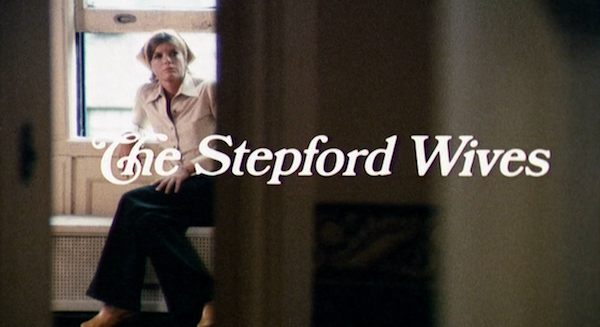
    I had already seen The Stepford Wives a couple of times, so it was a bit of cheat. In this case, both the novel and the film are worth it. The plot doesn’t make much sense–if you can make realistic sexbots, just sell the sexbots, make a ton of cash and buy young hot wives; lather, rinse and repeat every ten years or so President Donald style. But the feminist paranoia of the piece is so palpable and so–for the lack of a better term–hysterical, it creates excellent tension. And I’m pretty sure there’s not a single scene of Katherine Ross or Paula Prentiss wearing a bra for the first 3/5ths of the movie. It was the 70s, man. Can you dig it?

    And that font. I’m not a font nerd or anything, but could that font be more 70s?

    JW

    So I was reading the milk carton at breakfast, and discovered something interesting. Besides it providing me with the minimum daily adult requirement of Vitamin D, it turns out that Mary Margaret Cameron, age 9, is missing. She was last seen on October 13, 2007 in the company of her noncustodial father, and they had a cool picture of what she looked like with age progression. She’s developed well, and I’m sure he’s a proud daddy.

    Sloopy

    The only thing anyone here needs to be reading is the TUNNELL ESTATE AUCTION SALE DAY CATALOG.

    Disclaimer: Contributions not necessarily actually by the author whose name appears above them.

    Web Dominatrix

    I have had a slow reading month. I too have been enjoying Shooting Victoria at SP’s recommendation. I am currently reading Salt: A World History and I find this far more fascinating than I expected. It is, as you might have guessed, the tale of how salt has shaped civilisation.

    I am also reading/listening to (Thanks, Amazon, for allowing me to switch between Kindle and Audible!) Uncertainty about Heisenberg’s principle.