Author: The Bearded Hobbit

  • You’re Doing It Wrong – #3

    [et_pb_section bb_built=”1″][et_pb_row][et_pb_column type=”4_4″][et_pb_text admin_label=”Intro Text” _builder_version=”3.10.1″]

    Find out what you were doing wrong previously. And the time after that.

    A while back there was a post where someone referenced the Digital Time that was proposed by the French Revolution. Well, arguments about our calendar are really useless.

    Or are they.

    [/et_pb_text][et_pb_divider _builder_version=”3.10.1″ color=”#ffffff” height=”6px” /][/et_pb_column][/et_pb_row][et_pb_row _builder_version=”3.10.1″][et_pb_column type=”1_2″][et_pb_text admin_label=”start of day” _builder_version=”3.10.1″]

    Your calendar: The changeover of the day occurs at midnight.  The changeover of the year occurs on 1 January.

    Status: WRONG

    This one is similar to the seasons example.  Looking at the daylight as a sine wave (negative light? work with me here), starting the day at the peak of the negative is the same as starting winter on the day of the Winter Solstice.  Again, looking at history, day used to begin at daybreak.1 

    Make 6AM the start of the new day.  While we’re at it, start the hour count at that time.  Noon is 0600, nominal sunset it 1200 and midnight (“middle of the night”) is 1800.  Suddenly makes much more sense.


    [/et_pb_text][/et_pb_column][et_pb_column type=”1_2″][et_pb_text admin_label=”image” _builder_version=”3.13.1″]

    [/et_pb_text][/et_pb_column][/et_pb_row][et_pb_row][et_pb_column type=”4_4″][et_pb_divider _builder_version=”3.10.1″ color=”#ffffff” height=”6px” /][/et_pb_column][/et_pb_row][et_pb_row _builder_version=”3.10.1″][et_pb_column type=”1_2″][et_pb_text admin_label=”image” _builder_version=”3.13.1″]

    [/et_pb_text][/et_pb_column][et_pb_column type=”1_2″][et_pb_text admin_label=”24hour” _builder_version=”3.10.1″]

    Oh, yeah. Notice the 24-hour clock notation in there? Who decided that we need to reset the clock again in the middle of the day? Why are there two 8 o’clocks every day? If you’re going to have 24 hours in a day, count them all, dammit!2

    [/et_pb_text][/et_pb_column][/et_pb_row][et_pb_row][et_pb_column type=”4_4″][et_pb_divider _builder_version=”3.10.1″ color=”#ffffff” height=”6px” /][/et_pb_column][/et_pb_row][et_pb_row _builder_version=”3.10.1″][et_pb_column type=”1_2″][et_pb_text admin_label=”Start of year” _builder_version=”3.10.1″]

    By the same token, the year starts at perihelion? Our time, human time, is based upon the days of the season rather than some arbitrary orbital milestone. Again, looking at the previous post’s graph (reproduced at right), the logical start of the new year is the Spring Equinox, the positive-going zero-crossing. Interesting that this date was used as the start of a new Presidential term in the early days of the Republic. The Romans (among others) used that date to start their year.

    So again, there is a historical precedent.3

    [/et_pb_text][/et_pb_column][et_pb_column type=”1_2″][et_pb_text admin_label=”seasons graph” _builder_version=”3.10.1″]

    [/et_pb_text][/et_pb_column][/et_pb_row][et_pb_row][et_pb_column type=”4_4″][et_pb_divider _builder_version=”3.10.1″ color=”#ffffff” height=”6px” /][et_pb_text admin_label=”Closing text” _builder_version=”3.10.1″]

    I can’t help but to be an engineer whose job is to “fix things.” Here’s a fix for something that you never knew was broken.

    Now get off my lawn.

    [/et_pb_text][et_pb_divider _builder_version=”3.10.1″ color=”#ffffff” height=”6px” /][et_pb_text admin_label=”Footnotes” _builder_version=”3.10.1″]

    1. I think the Romans used this. No citiation.
    2. Of all of my crackpot ideas, this would be the easiest to implement and the most certain to get the most screams; i.e.“Military Time!!” (the elimination of the BC/AD would be a very close second)
    3. Well, I’ve gotten this far without a citation so you’re on your own.

    [/et_pb_text][/et_pb_column][/et_pb_row][/et_pb_section]

  • You’re Doing it Wrong – #2

    [et_pb_section bb_built=”1″][et_pb_row][et_pb_column type=”4_4″][et_pb_text admin_label=”Intro Text” _builder_version=”3.10.1″]

    Find out what you were doing wrong previously

    A while back there was a post where someone referenced the Digital Time that was proposed by the French Revolution. Well, arguments about our calendar are really useless.

    Or are they.

    [/et_pb_text][et_pb_divider _builder_version=”3.10.1″ color=”#ffffff” height=”6px” /][/et_pb_column][/et_pb_row][et_pb_row _builder_version=”3.10.1″][et_pb_column type=”1_2″][et_pb_text admin_label=”AD1″ _builder_version=”3.10.1″]

    Your calendar: Year One is the Year of Our Lord and all years previous are Before the Year of Our Lord

    Status: WRONG

    This has bugged me since I can remember. BC? AD? BCE? WTF? Herod1 died before he was born?

    It was one thing that really interferred with my understanding of history. “Third Centruy BC”. Was that the 300’s? The 200’s?

    Then I stumbled upon the Holocene Calendar. And the whole thing started to make much more sense.

    The Holocene marks the latest inter-glacial after the Pleistocene and is dated at starting roughly 11,700 years ago. After the african migration of 60, 000 years ago it marks the dividing point of the Neo-Litic (New Stone Age) and the Paleo-Litic (Old Stone Age). Human agriculture which lead to permanent cities and “civilization” is usually dated to this period. Why not start the calendar at this time?

    [/et_pb_text][/et_pb_column][et_pb_column type=”1_2″][et_pb_text admin_label=”wheat image” _builder_version=”3.10.1″]

    [/et_pb_text][/et_pb_column][/et_pb_row][et_pb_row][et_pb_column type=”4_4″][et_pb_divider _builder_version=”3.10.1″ color=”#ffffff” height=”6px” /][/et_pb_column][/et_pb_row][et_pb_row _builder_version=”3.10.1″][et_pb_column type=”1_2″][et_pb_text admin_label=”Gregory XIII image” _builder_version=”3.10.1″]

    [/et_pb_text][/et_pb_column][et_pb_column type=”1_2″][et_pb_text admin_label=”AD2″ _builder_version=”3.10.1″]

    All of human civilization has occurred in the past 12,000 years, much of it in half that time. Outside of astronomical events, every single human historical event that can be traced to a specific date2 falls into that period. As a user of the Gregorian Calendar I am a bit prejudiced but it seems that we could eliminate all of this BC-negative year stuff by starting the date accounting of Mankind at the beginning of the Holocene, call it 12,018 years ago. Simply add 10,000 to the current year.

    Suddenly, there is no more BC/AD adjustment. There is theoretically a Year Zero but it doesn’t matter since nothing is dated before. According to modern research, no one dates the first birthday of Jesus to 1AD; consensus seems to be that He was born around 4BC or born before He was born. So, born in 9997 and died in 10030. Does that take away from the basic message?

    [/et_pb_text][/et_pb_column][/et_pb_row][et_pb_row][et_pb_column type=”4_4″][et_pb_divider _builder_version=”3.10.1″ color=”#ffffff” height=”6px” /][/et_pb_column][/et_pb_row][et_pb_row _builder_version=”3.10.1″][et_pb_column type=”1_2″][et_pb_text admin_label=”AD3″ _builder_version=”3.10.1″]

    The Copper Age begins around 4000HE. Things start to come into position. Four thousand years from cultivated crops to refined metals, marking the end of the Neo-Lithic, the end of the Stone Age.

    The Bronze Age begins around 6700HE

    The first pyramid was finished in 7390HE

    The Iron Age began about 9200HE

    The Roman Empire was from 9974 until 10476. I think my four year-old granddaughter could even subtract those numbers.

    All of history can be represented by a continous number line. Later events are represented by a larger number. Years between dates are a simple arithmetic operation. We’re living in the CXXIst Century (121st). How cool is that?

    [/et_pb_text][/et_pb_column][et_pb_column type=”1_2″][et_pb_text admin_label=”giza image” _builder_version=”3.10.1″]

    [/et_pb_text][/et_pb_column][/et_pb_row][et_pb_row][et_pb_column type=”4_4″][et_pb_divider _builder_version=”3.10.1″ color=”#ffffff” height=”6px” /][/et_pb_column][/et_pb_row][et_pb_row _builder_version=”3.10.1″][et_pb_column type=”1_2″][et_pb_text admin_label=”eclipse image” _builder_version=”3.10.1″]

    [/et_pb_text][/et_pb_column][et_pb_column type=”1_2″][et_pb_text admin_label=”AD4″ _builder_version=”3.10.1″]

    Other calendar systems could be adjusted because the date of the start of the Holocene is rather arbitrary. This year is 5778 in the Jewish calendar. Adding 10,000 years pushes the start date of the calendar back another 3760 years. Or the date in the Arabic calendar is 1439 so, again, adding 10k years pushes Year Zero up 579 years. Same for other calendars.

    The one monkey wrench in this is astronomical dates. There are known dates of some events such as eclipses that would have to me mapped to the new calendar but -5,000HE is not that much different from 15,000BC/BCE. The addition of a Year Zero helps in calculations.

    [/et_pb_text][/et_pb_column][/et_pb_row][et_pb_row][et_pb_column type=”4_4″][et_pb_divider _builder_version=”3.10.1″ color=”#ffffff” height=”6px” /][et_pb_text admin_label=”Closing text” _builder_version=”3.10.1″]

    I can’t help but to be an engineer whose job is to “fix things.” Here’s a fix for something that you never knew was broken.

    Now get off my lawn.

    [/et_pb_text][et_pb_divider _builder_version=”3.10.1″ color=”#ffffff” height=”6px” /][et_pb_text admin_label=”Footnotes” _builder_version=”3.10.1″]

    1. Nothing special about him. Pick any other person born BC died AD.
    2. Like April 2, 2842 BC or something.

    [/et_pb_text][/et_pb_column][/et_pb_row][/et_pb_section]

  • You’re Doing it Wrong – #1

    [et_pb_section bb_built=”1″][et_pb_row][et_pb_column type=”4_4″][et_pb_text admin_label=”Intro Text” _builder_version=”3.10.1″]

    A while back there was a post where someone referenced the Digital Time that was proposed by the French Revolution. Well, arguments about our calendar are really useless.

    Or are they.

    [/et_pb_text][et_pb_divider _builder_version=”3.10.1″ color=”#ffffff” height=”6px” /][/et_pb_column][/et_pb_row][et_pb_row _builder_version=”3.10.1″][et_pb_column type=”1_2″][et_pb_text admin_label=”Trad Seasons” _builder_version=”3.10.1″]

    Your calendar: Summer (the season) begins on June 21st.

    Status: You’re doing it wrong.

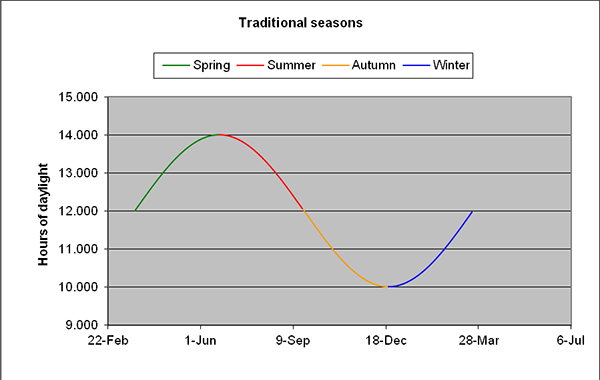
    I can’t believe the resistance that I get about this topic. It seems pretty simple to me. Why is June 22nd a summer day but June 20th belongs to spring? Chasing that question down led me to some surprising results.

    If you plot the deviation of daylight hours over the year it looks like a sine wave.

    But this looks weird. The days of summer don’t start until the longest day of the year?

    And, I had always wondered about Ground Hog Day. What was its significance? Wasn’t the first day of spring always fixed at 6 weeks after GHD? Spring is delayed until March 21st? Duh!

    It turns out that the dates of the seasons are fairly arbitrary.
    In fact, I cannot find where the dates were set to the current observation1. The “usual” observance doesn’t seem to have much of a tradition behind it other than it being the system in use.

    [/et_pb_text][/et_pb_column][et_pb_column type=”1_2″][et_pb_text admin_label=”Trad seasons image” _builder_version=”3.10.1″]

    [/et_pb_text][/et_pb_column][/et_pb_row][et_pb_row][et_pb_column type=”4_4″][et_pb_divider _builder_version=”3.10.1″ color=”#ffffff” height=”6px” /][/et_pb_column][/et_pb_row][et_pb_row][et_pb_column type=”1_2″][et_pb_text admin_label=”Adj Seasons image” _builder_version=”3.10.1″]

    [/et_pb_text][/et_pb_column][et_pb_column type=”1_2″][et_pb_text admin_label=”Adj Seasons” _builder_version=”3.10.1″]

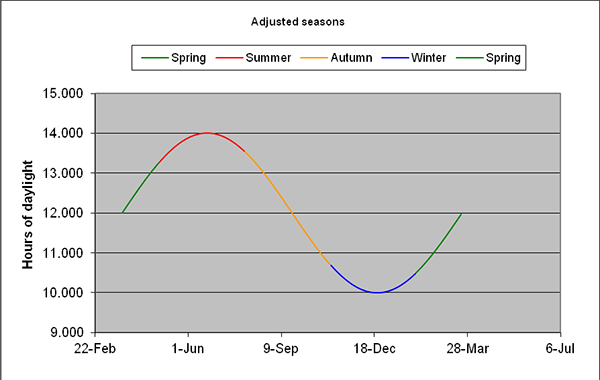
    So, what would be a logical definition of the seasons? It seems to me that the best layout would be based upon the duration of the solar day. To me, the Summer Solstice would not be the beginning of summer but rather the midpoint.

    Well, what do you know; this has been the standard recogntion for hundreds of years!

    Suddenly the Ground Hog Day tradition makes sense. Spring starts on Feb 2 (halfway between the Solstice and the Equinox) but rodent-shadow “Spring” starts on the Equinox instead as an abberation. May Day never made sense to me (other than the Soviet orgasm) but now it was simple: It’s the first day of Summer. Hallowe’en, the first day of Winter. Autumn begins on August 1st.

    [/et_pb_text][/et_pb_column][/et_pb_row][et_pb_row][et_pb_column type=”4_4″][et_pb_divider _builder_version=”3.10.1″ color=”#ffffff” height=”6px” /][/et_pb_column][/et_pb_row][et_pb_row][et_pb_column type=”1_2″][et_pb_text admin_label=”Adj Corr Seasons” _builder_version=”3.10.1″]

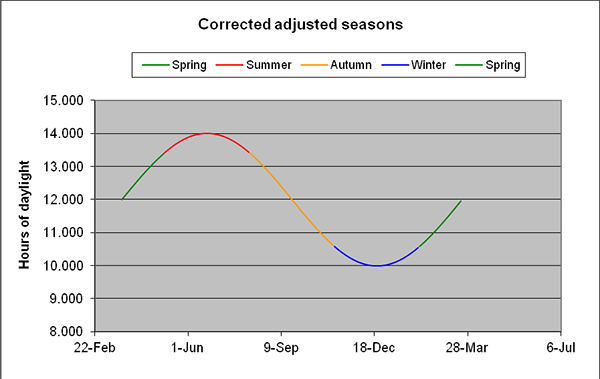
    The earth has changed orientation over time and the alignment of the seasons has changed as well. If we were to do a strict reckoning then we would use the last graph, summer starting about May 6th and the other seasons following every 91.25 days. To choose the traditional dates (May 1st, August 1st, October 31st, February 2nd) seems to me to be a reasonable compromise, bringing matters back to traditional observations while being closer to the solar midpoints.

    I’m trying to keep weather out of this discussion, but for my region, November is a winter month. I could argue spring and fall, but May is a summer month here, as well. The USWS is off of my schedule slightly as they say that summer begins on June 1st (all others follow). It seems to me to be a rather arbitrary choice based more upon weather than anything else. It is their setpoint, not mine2. But basing the reckoning of seasons upon the weather makes little sense in places like Hawai’i. My friend spent some time there and mentioned that there is no weather segment on the local news. Every day had basically the same high and low temperatures year around. If there was something else (“Typhoon On The Way”) then it was news, not weather.

    [/et_pb_text][/et_pb_column][et_pb_column type=”1_2″][et_pb_text admin_label=”Adj Corr image” _builder_version=”3.10.1″]

    [/et_pb_text][/et_pb_column][/et_pb_row][et_pb_row][et_pb_column type=”4_4″][et_pb_divider _builder_version=”3.10.1″ color=”#ffffff” height=”6px” /][et_pb_text admin_label=”Closing text” _builder_version=”3.10.1″]

    I can’t help but to be an engineer whose job is to “fix things.” Here’s a fix for something that you never knew was broken.

    Now get off my lawn.

    [/et_pb_text][et_pb_divider _builder_version=”3.10.1″ color=”#ffffff” height=”6px” /][et_pb_text admin_label=”Footnotes” _builder_version=”3.10.1″]

    1. I haven’t looked very hard

    2. They are the “Weather Service” after all

    [/et_pb_text][/et_pb_column][/et_pb_row][/et_pb_section]

  • delta Vee

    I was trying to sleep off my hangover when the long-range radar annunciator went off. I had been dreaming of Crystal and was trying to hold onto the wisps of the dream as I groped for the tether. It wasn’t clipped to my belt. Then I saw it, floating gently, just out of reach a half a meter to my left in the weightlessness of the cabin.

    This was frustrating. I have been a spacer for almost ten years now and had fallen for the most basic groundhog mistake. I hadn’t checked my tether before falling asleep. Now I was at the mercy of those pesky three laws from Newton.

    On my second lift from Phobos we had a new recruit who had made the same mistake. He had flailed the air in a panic, slowing rotating while the rest of the off-duty crew laughed at his antics. Eventually someone took pity and snagged him. Now I knew how that recruit felt. Thinking of him I managed to quell my own panic.

    Except that I was painfully alone since Crystal stormed out at our last stop three days ago. I was going to have to get out of this by myself. The air circulation system would eventually give me some delta Vee toward the bulkhead; it was designed to do so. But I didn’t want to wait for it. And the beeper from the radar was starting to get really annoying.

    I tried to grab the tether, even though I knew it was out of reach. My legs reflexively kicked but there was nothing there to kick against and I again felt the rush of panic. “This is stupid,” I said aloud.

    To settle myself, I took a look around to assess the situation.

    Somewhere along the line I had picked up a little roll roughly along the line from head to toe and I could see the entire interior of my ship every couple of minutes.

    I was in the sleeping area at the rear of the habitat and could see the control room at the front down the length of the ship. The light was flashing on the radar controller in tune with the beeper. I could be heading toward a collision. I had to get out of this and see what was going on.

    The bulkhead opposite the tether was close but still just out of arms reach. If I could get turned around then I might be able to get close enough to get a little push with my feet.

    It wasn’t any good. I could twist around and create rotation but I couldn’t move myself to a position where I could touch the inside of the ship. All of the twisting had me huffing and puffing and the pounding in my head was so loud that I had to stop for a few minutes to get my pulse rate down. Breathe in, breathe out. I closed my eyes to try to relax.

    Wrong idea.

    Closing my eyes increased the swirling in my head and my nausea instantly took over. I quickly opened my eyes and began swallowing saliva to quell the rising gorge. I’ve seen space sickness and its disgusting results and I knew that I did not want to spend the next several hours chasing down little balls of vomit. That sick little part of my brain, however, pointed out that the delta Vee of the outgoing projectile puke might be enough to enable me to reach the wall. It was not a convincing argument.

    I had no choice but to wait for the air currents to push me to a place where I could get a handhold, a toehold, an anythinghold. Once I could get something to push against I could generate some delta Vee and get going the direction I needed to.

    In the meantime that damn buzzer was just about to blow the top of my head off.

    It seemed to take forever but eventually the nearer bulkhead rotated into the correct location. I pushed downward and felt a comforting resistance at the end with my toes. I slowly floated over to the other side of the bulkhead. Finally! I grabbed a handhold and launched myself forward toward the control room.

    Living on a spaceship is a little bit like living underwater because you’re always giving yourself a little push and floating toward your destination. Spacers can make it the length of the ship with a single pull. The groundhogs use the handholds and crawl from section to section, their legs flopping uselessly behind them.

    I killed the beeper and checked the screen as I grabbed the handrail around the control room to check my momentum. Proximity alarm. I had set the deep space radar at maximum when I had cleared the traffic around Ceres Base days ago and had promptly forgotten it after my row with Crystal. I pulled myself down into the seat, tightening the straps so that I wouldn’t drift away from the controls.

    Something was in my neighborhood and I adjusted the radar screen to see what it was. The object was definitely metallic; its radar signature glowed brightly on the screen. I did a scan of the common frequencies. If it was another scout ship or some other traveler through the belt then it would show up on the EM bands. Nothing and, significantly, no markers. This rock was totally quiet across the spectrum. I started to get excited. If it was an undiscovered metallic asteroid then I could be rich.

    I fired up the Doppler radar to get a fix on the object. After a few moments its bearing and location came in and I transferred the information to the astrogation computer then ran the location through to database. I was in luck; nothing matched my new neighbor’s location. I had to get closer. In order to file a claim with Ceres I would have to affix a marker beacon and provide accurate location data. I was grinning and my headache was forgotten as I updated my heading.

    Nothing happens very fast in space. After I punched the course correction into the computer there was not much more I could do. It would be almost seven hours before interception. I pushed the console away and stretched. Fingertip to fingertip, I could almost reach the switches on opposite sides of the control room.

    It’s not much of a control room. When I was an apprentice I got a chance to see the control room of one of the big space liners that ferry rich fat cats around the Colonies. It was larger by far than my whole ship, now. The whole habitable space of my ship is only about ten meters long by four meters in diameter and the inhabitants have to stash everything needed to live on in this volume. The control room on the liner had consoles for more than 25 people, ringed around a huge holoscreen in the middle. My ship was designed for two people, provided those two people didn’t mind being a little cramped. Still, it was a marvel of design with everything needed to be self-sufficient. And it had an amenity missing from the control room on the space liner; I had four portholes. It was a minor victory, however. There was nothing to look at except billions of stars.

    I felt the gentle bump of the thrusters as the new course came into effect. The delta Vee always seemed out of place after long periods of weightlessness. I waited until the seat cushions stopped pushing back, and then unbuckled my straps. Grabbing the handrail, I pulled myself out of the seat and went back to the galley to fix some coffee and breakfast.

    A few hours later I strapped back into the control seat and took another look at my target. I frowned as I sipped some coffee out of the bulb. It was small. So much for my dreams of fortune. As an independent contractor my share would be limited. It would take a big chunk of rock to pay off my ship and have enough left over to live on for a while and this couldn’t have been more than a few tens of meters in diameter.

    Most people think that there are chunks of rock everywhere in the asteroid belt. I guess that’s true in a way, but space is vast and everything is relative.

    All of the big objects are well known and active mining is taking place on many of them. You can sign up for a five-year contract with one of the companies to dig rock and return to Terra at the end with a fair chunk of money in your pocket if you can avoid the temptations of Nuevo Las Vegas during the layover at Mars.

    Or you can complete that Degree in Mining so that you can sign a lifetime contract. Lifers have it pretty good and there are always a few of them on one of the space liners, ordering the staff around like they were back at the mines. At least that’s where I met them. They were the closest thing to aristocracy in the relative lawlessness of the belt.

    Then there are the folks like Crystal and me, prospectors drifting through the belt looking for ore-rich rocks that are normally too small to be detected. Once located, we survey and analyze the find, set a beacon and send a claim back to Ceres Base for recording. Then we head off in another direction, hoping to bump into another rock.

    If one of the companies buys our claim then we get to buy some more consumables and travel a bit longer. It’s boring, lonely work, which is why most prospectors are two-person teams. Crystal and I had put up everything that we had for this prospector ship and supplies.

    We met on one of the satellite runs when I was apprenticed to the control room. Looking to stretch my legs, I wandered the various compartments of the ship ending up in one of the gardens. Crystal was there working on the watering systems and she caught my eye. Tall and slender, she had her dark hair cut into a bob to make it manageable in weightlessness. She was kind of tech smart and I was kind of geek smart and in a few days we were lovers. We had a good time and parted when we arrived at Ganymede. She was scheduled for the next leg of the journey and my contract had run out.

    When she found me on Mars I needed help and she was looking for a change. We’d talked before of what we could do and it turned out that we had both thought about scouting the belt. With her savings and chits and cashing in her leave we had enough to live on while we searched for a decent scout ship. All of that hard work and I had blown it in my fight with her.

    * * *

    A few hours later I was back in the control seat trying to figure out my new neighbor. The radar still showed a bright spot and I used the coordinates to line up the optical telescope. I was close enough, now, to make out the shape of a ship, probably an ore freighter. Normally, though, there would be running lights and a purple glow aft from the ion pulse engines. This object produced no light.

    Curiously, too, there was no radar signal from them. I was hitting them with both the distancing and the Doppler radar and I would have expected the same from them, at least to warn against collisions.

    I sent a couple of hailing transmissions that went unanswered. I frowned and drummed my fingers on the console as I tried to think of what to do.

    There were several reasons why a ship would show no lights and answer no hail and most of those were bad. Worst was a radiation leak from the ion propulsion units. Usually, though, those have a way of curing themselves by turning the engines (and all matter within a kilometer or so) into a brief flash of nuclear energy. Even at this range I would be too close for comfort. Fortunately, at least for now, the radiation sensors showed only the usual background counts. I reminded myself to keep an eye on them as I got closer.

    It was also completely possible that this ship could have been attacked by an unlicensed ship. These modern-day pirates with well-armed crews have been known to hijack ore freighters and steal the cargo. The attackers usually leave the crew unharmed as long as they don’t put up a fight, disabling the radio so that no call for help can be sent. Even if an SOS could be transmitted, no help could be dispatched before the raiders slipped away to hide in the belt.

    As I approached the ship it showed no sign of life. This didn’t look like pirates. The ship appeared to be intact with the exception of the forward empennage which appeared to have had some considerable damage. I was close enough now to see more details and I was getting more questions than answers.

    Often objects under thrust use a roll along the longitudinal axis to maintain stability. But in addition to a light roll this object had a very slow rotation around its lateral axis. It was going to be tricky to come along side. I would have to pull up parallel to the other craft, and then try to match its tumble. When I would get all of that down I would then have to match its roll by establishing a lateral orbit. I ran the figures thru the flight computer and frowned at the answer. This was going to cost me a lot of fuel, seven or eight months worth. This derelict was becoming more and more costly to me and it had better pay off.

    Anxious as I was for answers, I had to direct my attention to the approach maneuver. Because of the extra speed I had added I would have used too much fuel in my forward thrusters to slow my approach. So, I had to rotate my ship around and use a long burn on the ion thrusters to match speed with the other ship. It really didn’t matter what my orientation was when I arrived as I was going to have to make several maneuvers anyway. What was frustrating was that during that time my telescope would be annoying pointed in the wrong direction.

    Soon I felt the push of the thruster against my back as the ion engines flared to maximum. It wouldn’t be long now.

    I had dozed off during the deceleration and woke up with a start when the matching radar alarm went off.

    * * *

    After the braking maneuver was competed I rotated my ship so that I could see the derelict from the forward instruments. By this time I was close enough that I could make out considerable detail with just my field glasses. My hangover was a distant memory thanks to the nap and, now, the excitement of this find.

    The rotation was slow enough that I could make out the extensive damage to the flight deck. They must have hit something full-on. Even if it only destroyed the control room the rest of the crew would have been doomed by the sudden absence of air and would have succumbed very quickly. Why hadn’t their radar picked it up? A ship of that size would have had a dedicated radar crew but, rare as they are, collisions do happen.

    The cargo bay looked intact, however, and that is where my interest lay. Spacers seldom have time to worry about other spacers. We know the deal when we sign the papers, the weak and unlucky don’t make it and the rest have the chance of a lifetime. Even this chance is solidly against the average Joe. For every 1,000 spacers seeking pay rock only one will find it, on average. Some of them lose themselves in the vastness of the Asteroid Belt and get swallowed up by infinity, never to return. Most of them will spend every credit that they can lay their hands on for fuel, air, water and grub and spend a few fruitless years chasing ghosts until they limp back to Ceres to try to sell their ship for a ticket back to Terra. And some of these two-man crews go insane and many a salvage collector has recovered a scout craft with two corpses inside locked in a mutual death grip.

    But still they come; the latest version of the pioneers who had worked their way west seeking a new life in the Americas so many years ago. Crystal and I had been caught up in that dream.

    The blowup should never have happened.

    While at Ceres Base we made a stop at the trading dome of Mr. Gower. He had built some converters that were connected to the solar wind accumulators and used this to supply fuel to the traders. He didn’t have enough capacity to open a full-scale recharge outfit but was content to offer departing scout ships a few Megajoules in exchange for buying his wares, and was known to buy certain gadgets that might pass through. It was a well-trusted relationship around the belt and we needed more outfits like his if we wanted a chance for a permanent colony. Right now we had Ceres Base pretty much running the spacing and mining operations, and primary supplier of equipment and supplies. But no matter how well The Organization tried, there were always things missing. Folks like Mr. Gower and his mercantile provided those missing things. Most were legal, some not quite as such.

    Crystal had begged off, wishing to pick up some last-minute items. My afternoon with Mr. Gower had started off innocently enough. He and I caught up on old times while we sampled his various potents and smokems. Then he broke out the whiskey.

    He then told me of one of his latest projects, a distillery. Spacers are nothing if not drunkards, (as my own history had shown,) and he could count on a substantial addition to his income by offering it to the crews passing through.

    This was tempting. I had not tasted whiskey for two years and was sure that I could have a sample with no trouble. I had kicked the habit once; no problem if I had to do it again. I was strong enough to control myself. Except that I wasn’t.

    I had a shot. And then I had another. After that I lost track as we continued to toast each other’s health. Before I left I bought two bottles.
    I was quite pleasantly buzzed returning to the ship with my booty under arm. Crystal was waiting, angry and anxious at the same time.

    “Where were you?” When I told her, she growled, “Are you drinking again?”

    It went downhill from there.

    My drinking had gotten me kicked off of the liners and I had run into Crystal again when I was trashed on Mars. When I bottomed out at Marsport she took pity on me and sobered me up. I stayed at her place and washed dishes by night while working on the scout ship that we had rescued from Salvage in the off time. We had been working hard for two years and it finally paid off with our launch outward to the belt and Ceres Base. I had stayed sober mostly because I couldn’t afford the cost of booze at Marsport but also because I was growing true feelings for this girl who saw more in me than I saw myself. The time was good for me and I felt better than I had for a long time.

    When she saw that I intended to bring the liquor on board, she shook her head. “I thought that you had cleaned up your act,” she said. “First chance you get and you’re back to your old ways. Am I supposed to spend the next year locked up with a drunkard?”

    Drunk and stupid, I stood my ground. We were going to be gone for a long time, I said, and who knows what adversity we might find.

    “When I found you at Marsport I wanted to help you because I thought that you were worth helping,” she said. “It seems to me, now, that you have no regrets for your past. Until you face that and say that you are sorry to those whom you have hurt, you are going to repeat it.”

    She touched me on the cheek with her hand. “Besides, my oh-so-serious bunkmate, you are worth saving even though you don’t have a clue as to why.”

    She said she’d be staying with a friend and I stayed on board. Several hours later the ship lifted with a drunken me at the controls. I roamed a bit, and then began punching random course settings to the up-beat of ribald songs of my own making. It would have been a horrible thing to watch. I kept it up for a couple of days and had a great old time until the booze ran out. Then I passed out without connecting my sleeping tether.

    * * *

    The matching maneuver was going to be about the toughest that I had ever come up with. I had to match the tumble of the derelict about the longitudinal axis and also had to match the slow roll of the ship in order to pass a lanyard. It was this last procedure that had me stumped. I would have to circle that ship at a Vee that would not allow a stable orbit; our masses were too small. Every approach that I programmed became unstable after a few tries. This was frustrating! A potential fortune was a stone’s-throw away and I couldn’t mate up with it!

    If I pulled in close then my angular velocity would throw me out. If I stayed at the limit of my tether then I would have to apply thrusters frequently to keep me aligned.

    In the end I chose a compromise between the two options, far enough out that I could hold an orbit with minimal fuel expenditure yet close enough to allow the tether to give or take slack as needed. It meant the two ships would be chasing around each other side by side like a couple of movie theatre hot dogs in a warming shelf, only taking the same shelf and rolling it down a set of stairs long ways. After a couple of hours of sweat I finally was within reach of my destination. I was going to burn a lot of fuel per hour but I figured that I was going to spend minimal time around this ship, hopefully about half an hour or so.

    I had to go through the EVA procedures carefully as I was alone. While very routine for two-man crews, I had to be extra cautious without someone to back me up. I had brought my craft to within ten or so meters of the derelict but it was still going to be a tricky transfer. In my mind, though, was only the thought of the contents aboard the spacecraft just outside my window. My headache and hangover were becoming a distant memory in my excitement.

    I ran through the checklist as I donned my suit, acutely aware that I didn’t have a backup person as procedures required. I took longer than normal, double-checking the seals to make sure of my suit integrity but my heart was still pounding as I cycled the airlock. The magnetic boots were clumsy after months of free-fall and my legs struggled to make each step.

    When the door opened I could see the derelict so close it seemed that I could touch it. When the tether was ready I aimed at the ship and fired. The cable shot across the separation until it contacted the other ship. The magnetic latch connected and the retraction wheel took up the slack as I attached it to my ship. Time to check out my find.

    I connected the carabiner to the cable and prepared to launch myself across the void. “Piece o’ cake,” I told myself. I grabbed the cable and timed a pull to my jump to clear the reluctance of my magnetic boots.

    As I watched the cable stream through the carabiner I though of how much depended upon those two pieces of metal, each less than a centimeter in diameter. I should have added a second carabiner for safety since I wasn’t using a thruster pack and didn’t have a backup watching me. Scout ships like mine (ours!) only have limited room for storage and thrusters were notorious fuel hogs which meant even more space for fuel. We carried the required emergency packs with a single fuel load each but we never thought about using them. Our task was to mark likely rocks with beacons from the cozy safety of the control room. EVAs were always risky and I was pushing my luck with this one.

    In less than a minute my magnetic boots clumped to the surface of the derelict ship.

    It took me a moment to find my balance. I had landed on my feet forward of amidships, with the control room forward to my left and the cold engines a hundred meters aft to my right. That was when it really sunk in how big this ship was. Even if the holds were empty I could sell the hulk for enough to keep me going in the dives of Marsport and Venusburg for a very long time. Depending upon how damaged this ship was, we could sell our scout ship to pay for the repairs and run our own freighter to the inner system. Why, hell, with no payment we’d be clearing maximum haul each direction. In no time at all we could have our own fleet traveling the Great Circle to the planets and satellites and Crystal and I could. . .

    Oh, right. Crystal. . .

    I unclipped the carabiner and turned left to clomp my way to the control room.

    * * *

    Before I could stick my salvage marker on the ship I had to ensure that there was no one left alive on board. Because of the rotation I had fastened my tether as close as I could to the center of mass and I was going to have to work my way forward to inspect the control room. It was bad enough that I was having to re-learn walking in the mag-boots and as I made my way I could feel the forces pushing on me. The increasing angular velocity was causing a spin on my inner ear that was only making my hangover rear its ugly head again. I had to force myself to not think about it; space sickness in a space suit is something to be avoided at all costs.

    In addition I was increasingly feeling the centripetal forces making me feel more and more like I was going to fall forward onto my knees. I had to be careful of this as my only tie to the ship was the magnets in my boots. Once again I keenly felt the lack of a booster pack and a safety observer. There were no handholds at this part of the ship and I finally reached the point where I had to turn and back my way to the front of the ship. I stopped every few meters to note my progress and as I proceeded I began to see the damage that had disabled it.

    When I felt I could go no further I got into a comfortable position and took a good look. These poor bastards had taken a boulder to the main control deck and had quickly lost their atmosphere. The same chunk of rock had caused the rotation that was making it difficult to hold my place. Why didn’t they see it coming? By a blind stroke of bad luck it must have come from an angle that is in one of the radar blind spots. I wanted to take a look at the forward radar but I didn’t feel that I could move another millimeter more forward. I had seen enough and it was time to scramble my way back aft.

    The damage that I had seen was enough to convince me that there was no one left alive. The ship was mine! This in itself meant a small fortune. I wanted to look inside the hold to see if my small fortune was a large one, instead.

    Walking was easier as I moved towards amidships and I soon arrived back at the tether. There was still a little bit of play in the take-up reel so I figured my course-correction software was working okay. A glance at my watch showed that I was doing well on time; my trip forward had taken less than ten minutes. I untied the marker beacon from my belt, twisted it to activate it and placed it on the hull of the derelict. Then I stood up and hooted and hollered and punched the space around me in joyous glee. I was rich! I had hit the triple sevens, the number on the wheel, the prize behind Door Number Three. All trace of the hangover had disappeared. This was shaping up to be a great day after all.

    The outside controls for the hold access were around the waist of the ship where I stood next to the tether. I was going to have to walk about 20 meters or so up-spin which meant that Coriolis was going to pull me to the left and I was going to have to lean right to compensate. I concentrated on where I thought the control panel was and, when the panel rolled into sight I looked toward it. I had to concentrate on the fixed spot on the surface; if I tried to watch the stars I would soon be on my hands and knees suffering from extreme vertigo. It had to get the trajectory straight in my head (a tumbling rifled bullet) and match it to my own (start rollin’? or tumblin’?). I’m pretty sure that I saw Jupiter rise about three times from three different horizons.

    Finally I came to the external control panel for the forward hold. This is what I needed. Freighters generally loaded their aft holds first for stability against the thrust and for protection from the radiation of the engines. If the forward hold was full then I needed to look no further; the ship was full. If the forward hold was empty it offered an interior way for me to check the aft hold. I was still uneasy with the mag-boots and was uncomfortably aware of how easily I could come off of the surface.

    The controls were straight-forward and I quickly punched in the responses to the safeties and twisted the lever.

    There was a shudder as dozens of dogs were forcibly removed from their latches and levers strained to release. Suddenly the last catch gave way and as the door jumped open several meters I saw ice crystals quickly form from the air suddenly released. The ship gave a sudden lurch forward and I reflexively fell on my knees to keep balance. The hold had air pressure! The interlocks on the controls normally would have kept me from being able to perform the sudden decompression but the emergency bypass had allowed me to do it.

    The force of the out-gassing air was going to alter the delta Vee of the ship and my preset program was not going to be able to keep up. As soon as I realized this I stood up and began clomping back toward the tether point as fast as I could.

    I could tell I wasn’t going to make it. I had twenty meters to close while wearing these dammed magnetic boots. Already I could see the tether stiffen with the new stresses. Only a few more meters to go, a couple of more seconds. I could see the tether straighten, tension, and then, horror of horrors, I saw the magnetic foot detach and spring away under the tension of the cable. I was running now, desperate to grab that cable. Five meters to go, three meters to go. It was near the level of my head. I straightened out my legs to push against the magnets in my boots and timed the last few steps, closer to leaps. Two, one NOW and I strained to reach the cable. I could feel the sensation of the cable brushing against the surface of my gloves but my desperate snatches could not make home. I found myself in a slow lateral revolution between the two ships and without any apparent means of approaching either one. And drifting slowly away.

    * * *

    It is probably best to not print the exclamations that I emitted in the next few moments. Let’s just say that I was frustrated, panicked and extremely angry at myself. At that exact instant I did not know where the ships were, much less the direction to the cable that would take me to at least one of them.

    I forced myself to calm. I was still breathing hard from the exertion to reach the cable. I tried to settle my breathing.

    I knew what had happened and I tried to assess the situation. I knew that I had missed the cable by a matter of centimeters, millimeters really, so I just had to get back to where I came from. I was probably less than a meter away and our Vee was in mostly the same direction. I probably only needed to cover the couple of centimeters to put me within reach of the cable.

    I wiggled around to give myself some lateral rotation so that I could see where I was. The derelict was a few meters under my feet; my ship a seemingly impossible distance away and the tether, the tantalizing, tempting tether, less than a meter away.

    I needed delta Vee. With sudden clarity I knew what I had to do. I needed a jet and I had but one way to generate it. Before I could talk myself out of it I reached over with my right hand and unscrewed my left glove. I could feel the atmosphere running down my arm and out my sleeve as I pointed my arm in the direction that I figured was opposite of the tether.

    Several things happened at once. My ears instantly clogged with the change in pressure, and I instinctively swallowed to try to clear them. I felt an intense cold on my left hand that grew worse, the pain becoming intense. I suddenly had an alarm in my ear that I hadn’t had before, screaming about a pressure loss. And I was moving.

    I knew that I had been rotating by seeing the stars out of the corner of my eye. The sudden rush of pressure out of my left sleeve was giving me the push that I needed, but was it giving it in the right direction? My question was answered almost instantly as I felt the tether rub against the back of my suit. I grabbed the cable, tucked it under my arm, and then fumbled to replace my glove.

    I had a problem. The pressure under my skin swelled my hand so much that I couldn’t get my glove back on. The sound of the air rushing by was decreasing as I fought with it. I was letting air out of my lungs to match the pressure loss in my suit and pretty soon it wouldn’t matter; I was seconds away from blacking out. The air bottles could not maintain a breathable pressure with the arm hole open. I fumbled with it for a moment then gave up. There was no way that glove was going to fit over that monstrosity my hand had become. I noticed, however, that the swelling of the hand had just about sealed off the air leak and I was able to pull my arm against the cuff. In addition the insulation from my sleeve was clogging the air leak. This slowed the air loss enough that the bottles could keep up, giving me enough pressure to maintain consciousness. I’d deal with the hand later. Wrapping my arms around the tether I gave a mighty jerk and launched myself towards my ship.

    The out-gassing from my sleeve was whirling me around as I held onto the tether for dear life.

    The few seconds to travel to my ship seemed like hours. In order to get the door closed the tether had to be rewound and I gritted my teeth in pain and impatience as the cable retracted. As the airlock pressurized the stress and excitement caught up with me. I removed my helmet; the inside was already dotted with flecks of blood from my nose and ears. First I vomited, then I passed out.

    I was only out for a moment, though, as the pain on my left arm brought me back awake. The agony was now up to the shoulder. The flesh was purple but much of the swelling had gone down under the air pressure of the ship. I slowly peeled my suit off as best as I could one-handed. I had a moment of worry that I wouldn’t be able to get the pressure suit past my wrist. I kneaded the battered flesh and was able to slowly slide my wounded hand through the ring at the end of the sleeve.

    At last I made it to the medical station and injected myself with pain-killers. The hand looked pretty bad but I could painfully flex my fingers so I didn’t think that I would lose it. Now that I no longer needed to save fuel for prospecting I could shoot a direct course to the medical facilities at Ceres Base at maximum thrust.

    In spite of the pain I had a grin on my face that would have been tough to wipe off. I had claimed a salvage ship with cargo and, more importantly, I had pulled myself out of a situation that should have killed me. I thought of Crystal and I wished she could have been a part of this special moment. No, part wasn’t enough; I knew how badly I needed her.

    I had looked death in the face and knew how close I had come. I knew there and then the hurt that I had caused the person that I loved the most. My life was no longer a rambling search of existence; I now knew the value of sharing the best and the worst of life with someone who enjoyed it with me. I had hurt the person whom I loved the most very badly and I had to repair that damage. My drinking had caused every problem in my life. I had quit once before and I was now determined that I would control my own life. It was going to be a long haul but I was ready.

    I sent two messages to Ceres Base. The second was the location and frequency of my marker beacon, along with the details of my salvage application. The first was a personal to a certain lady staying at Gower’s Landing. It was much simpler. All that it said was, “I’m sorry.”

  • Forty Years Later – Chapter 4

    Catch up on the earlier Chapters: 1, 2, 3

    (click to enlarge images)

    Day 5

    The next morning I discovered the last indignity from the motel. There was no hot water. Not even a drop. I had to settle for washing my pits and crotch and using clean clothes to face decent society.

    Having seen the results of the dinner buffet, I wasn’t expecting much for the breakfast buffet and my pessimism was correct. Same bored guy behind the counter took my breakfast order. I took the opportunity to re-check the board for the cavern tours and was pleased to discover that I had mis-read it; the $50 tour was for another area and the standard tour was only $20, and I even got a discount for AAA when I bought the ticket. The cavern tour made up for all of the hassles that I had endured with the motel and restaurant. It was simply magnificent.

    I was almost solo with my attractive tour guide but at the last minute a family from somewhere in Eastern Europe joined us. I can usually pick out a language (even though I cannot speak it) from its sounds and a few vocabulary words that I can recognize. I never knew for sure but they sounded Slavic to me.

    Like Carlsbad Caverns the entrance to the cave was not the original entrance. An elevator took us down (and back up), followed by a walk of a mile or so. It is a “dry” cave (unlike Carlsbad) and therefore has a different sort of cave formations. The walk also took us by the old Civil Defense fallout shelter and a hotel room located 250 feet below the surface. Our guide said that she had spent her honeymoon there and the total darkness and total silence was actually too much to take! They had to turn on a nightlight in order to remain the night!

    I finished the tour around mid-morning and resumed my trip on US-66. Someone, I’m guessing the Tourist Bureau from the Seligman area, has sponsored a series of signs along the road, similar to the Burma Shave signs of the past. I thought that this was a clever way to promote the historic road. There is a lot of interest nowadays for the promotion of US-66 of bygone days, as my trip was discovering. I think that Americans are missing a lot of their heritage by blasting by on the limited-access Interstate Highway. A forgotten America still exists on the back roads that is not part of the Interstate Exit conglomeration of chain motels and fast food restaurants.

    At Seligman I climbed back on the freeway to deal with the truck traffic.

    I took the exit to drive through Ash Fork, as the road had diverted in the past. I had not remembered the Ash Fork was famous for its stone quarries, particularly shale and flagstone. Most of the houses in town were made of stone and many of them looked to be quite old.

    I wanted to see the statue that Winslow had erected of the guy “standing on a corner in Winslow Arizona” and missed it on the westbound trip so I exited the freeway and drove through the town in the other direction
    I recall hearing the refrain, “Spend the night in a wigwam!” ever since I was a child. One of the few remaining authentic Wigwam Motel ™ franchises was located in Holbrook Arizona and, since I was committed to doing the “tourist thing,” I reserved a wigwam. I am so glad that I did.

    The original design was from the 1930’s and the park in Holbrook is one of three remaining in the country. The layout is quite clever with a surprisingly large bedroom and a bathroom with shower at the rear. The park has numerous old cars parked at nearly every room, adding to the nostalgic flavor of the place.

    As I sat in the lengthening shadows of my last night on the road I used my cell phone to call my buddies who were gathered for our weekly poker game. A bit later I was finally got to visit with some neighbors who were having a little party in the parking lot. We chatted for a few minutes, then they moved on to a party downtown and I moved on to my bed in the wigwam.

    Day 6

    I had breakfast where the locals eat, Joe & Aggie’s Place. All that one could ask for, large helpings of terrific food and a bottomless pot of coffee.

    In the parking lot there was a family of foreign tourists apparently taken by my motorcycle. When I walked up in my leather chaps and vest they were enthralled. The husband asked if I would pose with their children and I suggested putting the son on my bike for the photo. It looked like the daughter wanted her picture taken, too, (and I would have been glad to oblige) but I think that the parents felt that they were putting me out by the photo op. Hell, I didn’t care, it was fun being thought of as “an American biker.” I got an extra internal kick from knowing that my Harley-riding friends would be in distress by the foreigners being impressed with a biker on a Japanese bike.

    After my encounter with Stogie I looked for other motorcyclists to ride with. On the way back I caught up with a fellow on a Honda 350. I held with him for a few miles, but he was traveling much slower than I wanted to so I said, “See ya” and went on. At Continental Divide I stopped at the Stuckeys for fuel and, upon leaving, encountered my friend on the Honda. We stopped for a few minutes to chat and then I went on.

    To avoid the truck traffic on I-40 and to bypass Albuquerque I planned my trip across the reservation from Gallup through Crownpoint to Cuba. Again, wonderful scenery on a two-lane blacktop with no traffic. The road meanders from small town to town as it winds toward Cuba.

    I was only a few miles away and had the lunch from El Bruno’s on my mind as I followed the Rio Puerco into town. Suddenly my reverie was interrupted by the impact of an insect on my exposed neck and the instant application of pain. I had run into the business end of a bee and the sting was rapidly swelling. I’m pretty sure that I’m not allergic to bee stings but I was still worried that the swelling might cause my windpipe to close. Fortunately the pain and swelling subsided in a bit and I was able to enjoy my lunch.

    After spending the night again with Bruce I headed east toward home. The trip back was uneventful until I arrived back on my home turf in Albuquerque. I hit the freeway at the peak of rush hour. I had heard horror stories about the horrible traffic jams in Los Angeles, yet the worst traffic that I encountered was right in my home town!

    I pulled into home right at dinner time. The family came out to greet me and hugs were liberally spread around. As I had been riding the hard saddle of the dirtbike almost non-stop my first words upon arrival were, “My butt hurts!”

    I was home.

    The last leg of the trip was in sight. A while back my uncle sent me a copy of a column from a motorcycle magazine where the author gave tips about road trips. One of the tips was a reminder that the last day of the trip is still part of the trip and one should not hurry the finish. A suggestion was to stop at the local bar on the way home and savor the trip just before it is over. I stopped at Los Ojos for a beer and found some folks to listen to my tales before heading up the hill for the last 20 miles.

    I was home.

  • Forty Years Later – Chapter 3

    Catch up on the earlier Chapters: 1, 2

    Day 3

    Yesterday’s winds were gone, the air was clear and cool, and I was looking forward to a nice day of riding. Traffic was light and I could spend time looking for landmarks that I could remember. There were not many of them as the whole area has built up over the years.

    I was in awe as I followed I-10 to I-5. I had never seen such roads! At Claremont there was a triple flyover; four levels of road in one place! I had never seen such sights!

    I had also never seen grooved pavement and the wiggles gave me a bit of worry as I tried to get used to it.

    On the way to the exit that I needed I passed one for “Olive St.” Later that trip I would encounter the sign for “Roscoe St.,” exits with the names of my paternal grandparents.

    The low fuel light had come on sometime back and, as it didn’t look like I was going to make it to the Sunland Blvd exit, I pulled off the freeway and promptly got lost. I refueled and figured my way back to the freeway.

    In an apparent effort to discourage gasoline use, California has a new type of nozzle on gas pumps and they do not work well with motorcycles, shutting off too early and not allowing any further fill. The entire time I was in the state I was always about a gallon short of a full tank after gas stops.

    At last! Sunland Boulevard, and many memories of the area came rushing back, such the gas station on the corner at the exit. As I made my way up the road I could see many familiar sights. Often the only difference was that the area has grown up over the years. The Viennese-styled restaurant is still there and the Von’s supermarket is in the same place, even though it’s now called “Ralph’s”.

    The intersection at Mt. Gleason St. was unchanged, right down to the convenience store on the corner and the restaurant across the street. Hill was a couple of 4-way stops away and there I was at 7743. I’d made it.

    Lynn had given me directions to get there and I followed them right to the house. 7743, that was the address. I pulled into the driveway and shut off the engine. I’d made it.

    * * *

    I parked across the street from the former von Groff house and rested while I took some pictures and lit a mini-cigar in celebration. Sadly, no one was home and I had to be content with photos of the outside.

    When I knocked on the door Lynn’s mom, Mona, answered. “Lynn’s still is school,” she informed me, “She’s got one week left.”

    I was flabbergasted. In my worldview, school had already gotten out. All schools had already gotten out. I had not considered the possibility that hers had not.

    While Mona went back to her vacuuming, I tried to decide what to do.

    I was now officially halfway through my trip and had made my primary goal. I had a nice ride up Big Tujunga Canyon ahead of me but first I wanted to get some lunch. I had passed the Jack-In-The-Box where Lynn and I shared our first kiss so I decided to eat there.

    I didn’t know what to do. I had planned on spending only a few days with Lynn, then on to Frisco. I had arrived on Monday so I decided to spend the week there and play the trip back by ear. Again, I had planned to camp out, but the von Groffs graciously allowed me to sleep on their couch.

    While Lynn finished her semester I spent the next few days riding around the Los Angeles area, taking in the sights. One day I took the Universal Studios tour, another I worked with Lynn’s dad, Jim, at his mechanic’s shop.

    Afternoons and evenings there was Lynn, adorable, lovable, Lynn. One of the first days I helped her practice for her track meet on the upcoming Saturday. We’d ride the San Fernando Valley, stopping in at Jack or Shakey’s Pizza for something to eat, with kisses in the parking lot.

    That weekend the family attended the track meet where both of the daughters were participating. Here was taken the only photograph of the entire trip, with me, Lynn, Mona, and Lynn’s sister Cheryl. Lynn was quite the runner. While in high school she set the state record for the 440 yard run for high school girls.

    The von Groffs had a bathtub instead of a shower and I was so shy that I declined to bathe the entire time that I was there. I must have had some pretty good BO by the time the weekend rolled around!

    Saturday evening there came a phone call. Jim’s old friend, Al, was calling to see if there was an extra boy hanging around. Jim handed the phone to me and Dad explained that Mom was worried about me and, wasn’t it about time that I came home? I meekly protested that I hadn’t gone to Frisco yet but Dad convinced me to head back. I started back the next day, returning over the same route.

    The last time that I had ridden a motorcycle up Big Tujunga Canyon I managed to run out of gas and Mona had to rescue me. This time I fueled up before the ride but had a different worry. Severe forest fires had devastated the national forest the year before and many roads in the area were closed. Checking the web I could find no specifics and, starting up the canyon, I didn’t know if the road went through to Palmdale or not.

    Much of the ride was familiar as the road climbs from the canyon bottom. The road quickly climbs up the steep sides, several times crossing impressive bridges spanning deep ravines. Lots of curves and very light traffic enhanced the pleasure of the ride.

    Evidence of the fire was everywhere. I had recalled a pine/juniper forest but most of the landscape was barren, testimony of the intensity of the conflagration. To me, though, the scenery was reminiscent of the desert and held a stark beauty of its own.

    And the road was mine. I only saw a few cars on the entire trip. I felt a bit of sadness when the curves came to an end and I encountered the traffic of the Antelope Valley. After a bit of traffic I entered I-15 to Barstow and my hotel for the night.

    When traveling I like to eat well and avoid the “greasy spoon” type of places. Criss-crossing the west as I have over the years, I have started a running joke; someone will mention some out-of-the-way place and I’ll pipe up, “Dell, Montana? I know a good place to eat, there!” Well, Barstow has one of the best steakhouses in the west.

    I returned to the motel and once again sat outside sipping a drink and smoking a cigar. No one came by so I turned in for the evening.

    Day 4

    Another disappointing breakfast at the Days Inn, but I had read about a place in Amboy that was semi-famous so I figured I could grab an early lunch there. No such luck. The grille was shut down, as I guess it was past tourist season. I had my choice of candy bars and soda. I chose a bottle of water and went on my way.

    As I mentioned, I prefer to take loop trips, this year, however, I wanted to ride the original routes. I-40 ended at Newberry Springs in 1970 and picked back up at the mountain pass above Needles. After topping off fuel I exited the freeway onto Historic Route 66.

    Of the four trips that I made between New Mexico and California in 1972-73 only the last was over the newly-completed freeway from Barstow to Seligman. One was over the 89A/I-10 route and the other two were over old 66 in California and Arizona. The biggest frustration was the traffic behind trucks on the two-lane and traveling at night was iffy because of the lack of 24-hour gas stations at the time. When crossing the newly-completed I-40 in the early summer of 1973 the traffic was so light that I was able to stop on the middle of the road in the middle of the night to take a leak.

    Almost immediately I ran into trouble. The macadam of the road had deteriorated and was badly in need of repair. Many tire-sized cracks were in the road and I continuously had to watch for gaps that could break a sidewall or bend a rim. I decided that if the road was this bad past Ludlow then I would have to abandon this portion of the trip by necessity and return to the freeway. To my great relief, the road conditions improved greatly at Ludlow.

    In the ghost town of Bagdad I found another Whiting Brothers station surrounded by a fence and junkyard dogs. It was in pretty poor shape and the demise of Bagdad was one more example of a small town vanishing.

    Back in 1970 I had first noticed the displays beside the road. The white sand of the flat desert of the dry lakes along the road had messages laid out in the black volcanic rock from elsewhere. In later years I’d seen the same thing in the salt flats along US-50. Most were of the “John loves Mary” variety although there were a few political messages (“End war now”) and even an enigmatic “RP fuck it”. I thought of leaving my own statement but I didn’t collect any rocks from elsewhere and I didn’t want to disturb any of the other messages. Some were obviously old, some were shrines with cairns and crosses but most were made of local rock. Surprisingly many were obviously made of stones from elsewhere, brought a large distance to make a statement.

    It was on this stretch of road that I realized that I was in the perfection of enjoyment. I could see the road before me, going over the hill twenty miles hence. I was stopped in the middle of the highway and not a single soul was coming or going. “I like this,” I decided. I want to do more.

    The road connected back with Interstate 40 at the top of the hill above Needles. I was low on gas and had planned on fueling there but as I approached I decided that I could make Arizona handily and could avoid one final encounter with the worthless California gasoline nozzles.

    I had to backtrack slightly to get to the turnoff to old 66. The road from the freeway was a winding track, over hilltops and across arroyos towards Oatman.

    Another great ride! Turns and dips through the arroyos and no traffic! Oatman is known for the wild burros that inhabit the town and there were several burros (and considerable burro-droppings) in the center of town. I had looked forward to a cold beer in the local version of Los Ojos but the intense density of tourists dampened my thirst. I pushed on.

    Tight turns around ridges and ravines, with spectacular vistas all the way. When researching the road I learned that travelers in the 1930s would often hire a local to drive their car down the road, as the hard turns and drop-offs were too intimidating. Today, even on a motorcycle, one has to be totally aware of the road as the turns are frequent and the drop-offs are steep.

    Too soon I reached the end of the mountains and crossed the valley towards Kingman. Taking the back way into Kingman I was reminded that I-40 bypassed one of the prettiest little canyons in the area. Old 66 wound through the valley next to the train tracks and into the original downtown. A few of the buildings looked familiar as I turned onto Andy Devine Blvd, following the original route.

    The traffic was light heading up the valley and I could take time to enjoy the view. The area was growing and it was easy to see why; clean air, mild climate and glorious vistas.

    Every time that I had driven the US-66 loop I passed by the Grand Canyon Caverns and each time I told myself, “I’m going to stop one of these days.” Well, this trip was the excuse that I needed and I booked a night at the local motel. The ads on the Internet looked promising, the motel featuring a bar and cable TV, and the local restaurant advertised buffets for dinner and breakfast along with a full menu to choose from.

    I pulled into the motel parking lot under a banner that proclaimed “Bar Open.” At the front desk I told the girl, “You’ve got my two favorite words on your sign outside!” She looked uncomfortable and replied, “Well, the bar is only open on Fridays and Saturdays.” Disappointing, but she did have some package beers available so I could wash the down the dirt from the road.

    Got into the room and discovered surprise #2. Not only did they not have cable TV, the local channels were barely viewable. Not a big problem, I had plenty of music on my computer to listen to for the evening’s entertainment.

    By now it was dinnertime and I was ready for some good grub. The restaurant was at the top of the entrance to the caverns a mile or so from the motel. On the road there were signs proclaiming, “Steaks!” I was looking forward to a large piece of dead animal flesh.

    I knew that things were not as I had been led to believe when I entered the dining room and saw their advertised buffet totally empty. In fact, the whole place was mostly empty except for the bored guy behind the counter.

    “What’ll ya have?”
    “A steak and a beer?”
    “Well, the only steak that we’ve got is a chicken-fried steak.”
    “I’ll take a burger. You got the beer, right?”
    “Yeah, that we’ve got.”

    While waiting for dinner I looked over the place and saw the board with the prices for the cavern tour. The number that I saw was $49.95. Fifty bucks for an hour’s walk? I reconsidered my plans as I munched my dinner.

    Again I sat outside of my room smoking a little cigar, waiting to visit with my neighbors. As this was off-season, I had no neighbors and I went inside to bed.

  • Forty Years Later – Chapter 2

    Catch up on the first Chapter: 1

    Day 2

    As I mentioned, I was still operating on Mountain Time and had to wait for the breakfast from the lobby. I managed to dump coffee all over my shirt so had to rinse it out in the bathroom sink. It didn’t take too long to dry the shirt on the back of my bike. This actually made me smile as I thought of a similar circumstance on the previous trip, washing my clothes in the bathroom sink of the motel.

    After topping off the fuel I started one of the most pleasant motorcycle tours I’ve ever taken.

    US 89-A used to be the primary road south of Flagstaff toward Phoenix but was bypassed in the late 1970s by Interstate 17. The old road is still the most scenic way to Sedona and the primary route to Prescott and beyond. And one of the bonuses (at least to gypsy motorcyclists) is the ride down Oak Creek Canyon. The canyon rivals Zion National Park for its dramatic colors and spectacular scenery. At the bottom I am sure that I had the same feeling this year as 40 years ago; “I want to do that again!”

    I had chosen a non-weekend day for my ride and was rewarded with light traffic. It really didn’t matter as I was in no hurry and was enjoying the ride. A couple of times I let people go around while I rubbernecked.

    At the base of the canyon I discovered that a building that had been an important part in the earlier trip was still intact. In 1970 it was a Texaco gas station that had an air hose that I needed to fix my flat tire. Today it is a thriving deli and general store. The original Texaco oval sign now was painted for the new business.

    The flat tire on the rear caught me by surprise on my return trip. I had the tools to repair the tire and, fortunately, a Texaco station was right there with an air hose.

    The problem was that then, as now, I have the mechanical ability of a bonobo. Every time that I would try to mount the repaired tire, I would pinch the tube causing a new leak. It was well past dark and the owner said, “I’ve got to close and I need to shut off my air compressor!” I was still fighting myself and begged him to leave the air hose. I finally convinced him that I would push the air hose thru the hole in the building when I was finished. After multiple attempts I was finally able to get the tire to hold air and headed on to my last night in Flagstaff.

    The last time that I had passed through Sedona I had caught it at rush hour and was trapped in traffic. Today I had the road to myself and was able to enjoy the beautiful setting of the city. Riding in through the red bluffs reminded me of our own red rocks at Jemez Pueblo.

    The town of Jerome is perched upon the hillside and the road matches the destination as a narrow, two-lane road. It was there that I discovered a fundamental fact about some humans.

    I was behind two cars on a road with no passing zones. As I was going nowhere, I put some distance between myself and the car ahead. I was going the exact same speed as the cars in front of me, merely at a distance where I would not have to worry about sudden maneuvers. This drove the guy behind me completely batshit insane. On a short stretch of road ahead he passed me across double yellow so that he could follow the two cars ahead of me the remainder of the way with me still following behind.

    Lynn and I have stopped at Jerome in the past and toured the tourist spots. This is one of the places that I could retire to. I could totally see myself operating a hamburger stand there. Unfortunately for me, it was 9:30 AM local and no place was open for lunch.

    The ride to Jerome is only the beginning of the curves and slopes of 89-A. For a motorcyclist, this was heaven, tight curves and little traffic. I took my time, enjoying the scenery.

    A few miles on the other side of Jerome I encountered some minor road construction and I found myself at the end of the traffic behind the pilot car. I was in no hurry and kept back in the pack, looking for a place to take some photos of the highway curves. Finally I came to a spot where I could photograph the road and the valley below from the highway. Because of the traffic control I knew that I had plenty of time so I stopped the bike, leaned it on the kickstand and pulled out the camera.

    A few photos later I was ready to move on. After putting the camera away I readied to raise the bike off of the kickstand. And discovered that I was unable to do so.

    The place that I had chosen was on a curve and I was on the slope, leaning downward. Probably the deal-breaker was my bag on the back, its extra weight just enough to keep me from getting upright to where I could balance the bike. Regardless how I pushed, I could not get the motorcycle vertical enough to raise the kickstand.

    This was ridiculous. Although I wasn’t in immediate hazard I knew that it was only a matter of time until the next wave of cars was released by the flagman. I couldn’t get my short legs to push enough off of the pavement below to get the bike into an upright position where I could balance it.

    At last I dismounted and held the bike up from the downhill side. I was able to start it and, holding the clutch in with my left hand, engage first gear with my right and walk the bike to the shoulder. There I could mount my motorcycle and continue on the road. It was easy to laugh about it afterward but I was in a bit of a fix for a bit, there!

    The city of Prescott is one of the nicest towns in all of Arizona. Set high in the mountains it is surrounded by pine covered hills and miles and miles of open space. As I was thinking how pleasant the town of Prescott was I crossed Pleasant Street! Coincidence?

    89 continued with more curves and light traffic.

    By this time I was getting very hungry and resolved to stop at the next place that I saw for some lunch. Driving through Yarnell I spotted a restaurant, the only one that I had seen. The criteria that my brother had established (the more cars around a place, the better it is) was appropriate as the parking lot was full and I stopped for a well-deserved break.

    Walking in I instantly felt a sensation of déjà-vu; I knew that I had been here before.

    In 2002 Lynn and I had traveled to our niece’s graduation in California and had done a loop trip that included 89-A. At dinner time we were still a long way away from our hotel in Prescott so we stopped at a roadside diner for dinner. Yep, same place. To top it off, as they advertised being in business since 1948, it is entirely possible (yet totally unremembered) that I stopped at this very place for lunch in 1970.

    I still had a few more miles of curves ahead to be enjoyed. The road at one point became so steep that the uphill and downhill lanes were separated. This removed the hazard of uphill traffic and allowed me to enjoy the view without worry of traffic.

    At one point there was a vista point which showed the industry of the Congress valley below. At last it was warm enough so I took off my leather jacket and stuffed it into my saddlebags. In hindsight it was here that I made a major tactical mistake by not buying and downing serious amounts of water. It was soon going to manifest itself as a potentially life-threatening situation. One of the most enjoyable mornings of riding was going to be followed by one of the most miserable afternoons that I’ve ever had.

    The winds had been blowing all day but the trees of the forest had kept most of the pressure off. Now that I arrived at the desert they returned with renewed vigor. The wind that had been a nuisance was now a major force. Passing through Salome on Highway 60 I saw a dust devil that was more of a tornado. I watched its progress so that I would not be caught up in it, awed by its impressiveness as it soared thousands of feet above. Still, the winds! Pounding, unrelentless and sucking the very moisture out of my body. Now that I was out of the mountains I felt that I could open up the bike and cover the remaining miles. I didn’t count on the effect that the heat, dryness and winds would have on me.

    I carried a water bottle on the inside of my windshield where I could get at it easily. But the constant pressure of the winds plus the traffic, particularly the trucks, meant that I generally felt uncomfortable taking my hands off of the handlebars so I failed to keep drinking fluids. And what happens when one becomes water-deprived? They lose common sense, including the incentive to drink water!

    I was lucky to gas up in Congress as it was the last gas for many a mile down the road. I’m not sure that I would have made it from Prescott to the next gas station. The pleasure of the two-lane road was offset by the horrendous winds and the terrific heat. I’ve lived in New Mexico most of my life and am used to 100 degree days but this heat was at least ten to fifteen degrees above that and I was in gale-force winds and staring directly into the setting sun. Things didn’t get any better when I joined the truck traffic on Interstate 10. I was lightheaded trying to find gasoline in Blythe and drove around much of the town in a daze.

    I pushed onward. I only had about 100 miles to go and I figured that I could endure whatever was necessary. That endurance proved to be a test of my mortal abilities.

    My destination was Indio. I had forgotten how desolate this portion of the desert was. Scores of miles passed by with no sign of civilization. Exits were for roads through the desert and there were no services to be had. I pushed on, dodging the trucks and fighting the unrelenting wind.

    The wind also sucked the very moisture out of me and I suddenly felt an intense burning in my right eye. The hot, dry wind irritated it and I could provide temporary relief by closing the eye. After a few minutes my vision in that eye turned totally white and I was blind in that side.

    At the time I concluded that I had sunburn on the eye. Although I was wearing UV-protective sunglasses my thoughts were of people who watched arc-welding and the subsequent first-degree sunburn that it caused.

    I pulled off at the first exit and splashed water from by water bottle into my eye. The cool water cleared my vision for a few moments but the wind quickly dehydrated it once more.

    I had to assess my options, and they were pretty few. There was no other town until Indio, another 50 miles away, where I had a motel reservation. I could sit at the exit until my vision cleared or I could push on one-eyed. Daylight was slowly fading and monocular driving could only be worse at night. I had no choice. I closed my eye and returned to the highway.

    I felt pretty pathetic by the time I got to the Motel 6 and had to make a decision to take a downstairs room or a room with wifi. I chose the latter and had to haul my bag upstairs to the room that was diagonally across from the top of the stairs, the farthest room away.

    Finally I was able to soak a washcloth to put across my eyes and lay down on the bed in the darkness. After dozing for half an hour or so I discovered, to my relief, that my sight had returned. The nap had restored my energy and I was ready to find some dinner.

    As I washed my face I could see the dead skin of second-degree sunburn on my cheeks. Although I had used sun blocker it was obviously not near enough for the intense sun. Fortunately I had picked up some aloe lotion in Flagstaff and applied it liberally to my face.

    I was finally ready for dinner.

    As a general rule I avoid Mexican food outside of New Mexico but the neighborhood where I was staying looked an awful lot like the South Valley of Albuquerque and if I wanted to eat, it was going to be Mexican.

    I discovered, to my joy, that the offerings looked a lot more like home than the usual sour cream and guacamole encrusted glop of most Californian “Mexican food.” I ordered a beer and water. And water. And more water. I guess after a while the waitress figured from my face what was going on and brought me a pitcher.

    Not knowing their chili I went with the fajitas. The flavor of the carnitas took me back to the steaks that Dad had cooked years ago. I don’t know what they used that was the same.

    On the way back to my room I noticed that the motel next door bore a strong resemblance to the one that I had stayed in on my original trip. The location was about right and the layout was as I had remembered with a separate building in front and a strip of rooms to the right. If it was, indeed, the same place (now named “Economy Inn”) then it was quite a coincidence being right next door to where I was staying!

    Originally my trip was to have been two days out, a couple of days in Tujunga and then a return home via San Francisco. Quite the trip for a sixteen-year-old on a dirtbike! My plans got changed for me by a sandstorm while crossing the desert and I was forced to make an unscheduled stop in Indio.

    I checked into a motel next to the highway. The room cost $8, one tenth of my entire traveling funds. In addition, the TV required a dime for each half hour of viewing. I bought a buck’s worth of dimes from the office and rolled the bike into the room to get it out of the gale.

    I was a bit concerned about what that dust was doing to the innards of the bike so, in between washing my clothes in the bathroom sink and feeding dimes into the TV, I tore down and rebuilt the carburetors. When I checked out the next morning I left a good-sized gas/oil stain on the rug.

    I really didn’t feel up to visiting with the locals and the remoteness of my room meant that there wasn’t anybody strolling by, anyway. I hit the bed early.

    To be continued.

  • Forty Years Later – Chapter 1

    Introduction

    In 1970 I was 16 years old and caused a minor family scandal by driving from New Mexico to California to see my girlfriend on my 250cc dirtbike.

    I had forsaken all local females (for reasons that are best left unstated) and sent letters to two out-of-state daughters of family friends, resolving to visit whichever one answered first. Fortunately for me the one from Pennsylvania never replied and I carried on a correspondence with Lynn from California. I planned my visit to see her for the week that summer vacation started (between my junior and senior years in high school).

    I’ve always loved motorcycles and grew up in a family of two-wheel enthusiasts. Dad had a variety of bikes when I was growing up and our uncles sold my brother and me our first motorcycles. Dirtbikes were natural transportation for us growing up in the mountains. Somewhere along the way I picked up a Yamaha Big Bear Scrambler that was big enough for me to ride back and forth to school. And fast! This 250cc two-stroke was one of the quickest bikes off of the line in its time and I routinely beat 350cc Hondas from light to light. But, being two-stroke, I had to keep tabs on the level of oil in the auto lubrication system. Generally, though, the usage was about a quart for every couple of tanks of gas.

    I prepped the bike by changing the sprockets to gear the bike for a road trip and added some highway pegs before I left. The latter were actually quite useful. Sitting in the same position for hours gets to be uncomfortable and tiring. I often drop one or both legs back hooking the heel of my boot on the passenger pegs. The highway bar was a section of pipe that I bolted onto the frame in front of the engine to give an additional position to select.

    I knew that there was no way that Mom and Dad would let me go on a trip across three states so I told them that I was going to go camping in Colorado for a week. I didn’t know it at the time, but Dad had pretty much figured out where I was going to go, although he never said anything. I actually intended upon camping during this trip and had a sleeping bag and cooking gear along with me. Flagstaff was the designated midpoint for both going and coming and there were some good campsites in the area.

    At the time of my previous trip, Interstate 40 (US-66) was fairly complete between towns but would divert traffic through each municipality that was along the way. Some of the towns weren’t too bad: Winslow; Grants; Gallup. Some of the gaps were significant, such as the stretch from Seligman to Kingman in Arizona and from Essex to Ludlow in California. It was the latter two stretches that induced me to take US-66 to Flagstaff, then AZ-89A to Prescott, connecting to Interstate 10 near Blythe, California. From there I followed Interstates 10 and 5 to Tujunga, where the von Groffs lived. I returned by the same route.

    By the way, I wound up marrying the girl.

    Forty years later I’m still married to the same lady and still riding, now a Kawasaki Vulcan cruiser instead of the two-stroke. I had been looking for a trip to take and it occurred to me to repeat the 1970 trip including the diversions through the towns, and see how things have changed.

    I joined the US Air Force in 1971 and, by some berserk malfunction of the normal tendency of the military to assign someone on the opposite side of the globe from where they request, I was assigned to March AFB, 80 miles away from my sweetie. During this time Lynn and I made several trips from California to my parent’s place in Cedar Crest and also during this time many of the towns were bypassed by completing the freeway around them, although we still made trips over “old” US-66.

    While I covered the same ground going and coming in 1970, today I prefer to do loop trips, outbound and inbound on different routes. Hence I resolved to duplicate the 1970 trip from Cedar Crest to Tujunga and then to follow historic Highway 66 on much of the return trip.

    Day 0

    I now live in the Jemez Mountains, 150 miles from my original beginning in Cedar Crest. A search on the Internet turned up a bed and breakfast that is, remarkably, less than a quarter mile away from the folks’ house (as the crow flies, at least). I made a reservation and planned to start the trip from there.

    Part of the purpose of this trip was to observe and comment upon the changes to my old “stomping grounds” so I drove by many of my old haunts. I knew that the area was going to grow; it’s a prime place to live and raise a family. But, wow! Some places, then large fields, now were large subdivisions. I tried to find the road back into an area where we used to hunt and drive dirtbikes. Wall to wall homes now.

    The summer that I first got my drivers license I drove all over the area including a near-daily ride to Sandia Crest. I couldn’t pass up the opportunity to repeat the ride. The road winds up the east side of the mountain, rising from piñon and juniper through pine then into spruce and fir forests. Many curves and light traffic; a rider’s dream. I had to limit my time at the top of the mountain as a thunderstorm was threatening and there weren’t many things taller than me on the mountain!

    The folks’ house looked the same and the ride up the road gave me a momentary rush of nostalgia. It was the same, but different. An arroyo where I used to ride my dirtbike is now full.

    I still had some time before dinner and I took the road north to San Pedro then turned east on 344. Family friends had lived in San Pedro back in the 1920s when it was a booming mining town. By the 1960s there was nothing left but the concrete foundations of some of the buildings. Today it was difficult to find even those.

    This road loops around the Lone Mountain through Cedar Grove to Edgewood. There was no traffic and the light rain only reassured me that I was self-contained and ready for anything. My bike was running perfectly and I was comfortable in seating and control. My motorcycle was ready for this. I was ready for this.

    At the B&B, I visited with a couple of my fellow lodgers. I was curious what had led people to stay overnight a stone’s-throw from where I grew up. In both cases the Internet had led them here, outside of Albuquerque yet near to all of the attractions that the city had to offer.

    One fellow was a bit older than me, probably in his mid-60s. He had made a successful career in engineering and, now that he was retired, he was looking for a more creative outlet. In his case he was learning to play the bass guitar.

    I mentioned that his story had many similarities to mine. I, too, have had a career in engineering and am now trying to develop my own creativity, writing in my case. Oh, and when I was a teenager I played the bass guitar.

    Day 1

    After breakfast I packed up and followed the road to Highway 14. My trip had begun.

    North 14 (I still call it North 14 although it is just Highway 14, now. Hell, I remember when it was North 10!) is now a 4-lane road serving the entire East Mountain area. The freeway wasn’t there in 1970 so I followed old 66 through Tijeras canyon.

    I don’t have any direct memories of leaving that morning in May of 1970. I probably would have grabbed some breakfast then left early to avoid embarrassing questions from the family. My duffel bag was strapped on back and I followed the dirt road to the highway. The trip down North 14 and 66 would have been familiar as I rode it each day to school. The freeway through Albuquerque was complete and old-66 connected at Carnuel. I crossed town to the West Mesa where the freeway ended and the four-lane began.

    The freeway through Albuquerque had been completed in 1970 and now as then I entered at the Carnuel interchange.

    Despite the giant casino, the bridge over the crossing of the Rio Puerco on the frontage road was still there. They removed a similar girder-style bride over the Rio Grande when they built the upgraded road at Otowi and I always thought that was mistake.

    Over the years I’ve driven past the pull-out for Laguna Pueblo and never stopped. Well, I finally stopped and took a couple of photos. It seems we’re so busy nowadays that we never stop to look around at what we’re passing.

    The lava flows near Grants are always interesting. At the first exit the freeway would have ended so I turned to drive through town.

    I remember driving past the lava outside of Grants. Grants was the first diversion from the freeway and I drove down main street.

    About this time I encountered a fellow motorcycle traveler. He introduced himself as simply “Stogie” and he was riding a Honda 160 that had seen better days. We were headed the same direction and resolved to ride together.

    Grants today is depressing to drive through. Many old buildings are still standing, the land not worth their destruction. Some of this can be blamed on the collapse of the uranium mining, but many of these buildings would have been standing when I passed by forty years ago.

    Part of what I was looking for on this trip was the heart of Old 66 and deep in that heart were the Whiting Brothers. They ran a series of gas stations and hotels along the highway and the secret of their success was name recognition. For example, few autos of the 40s and 50s had air conditioners. The Whiting Brothers rented window-mounted units that provided cool air via evaporation of water when traveling at highway speeds. The driver would return the air conditioner to the Whiting Brothers station at the other end of the desert for a return of deposit. They placed their businesses in well thought-out locations and I photographed an abandoned gas station and hotel at Continental Divide. Big trucks were light on power at the time and it made sense to approach the highest part of the road with empty tanks for the least amount of weight.

    As near as I can remember I had never been west of Bluewater on I-40 with the folks, so I probably had a rush of excitement as I passed that point. Uncharted Territory! Here be monsters!

    Gallup was a completely different world than Grants. Very few abandoned buildings, many businesses. Most old service stations closed in the 70s and 80s but the buildings continue on as florists, pottery shops and even auto repair mechanics.

    In Grants Stogie made a phone call while I topped off the gas and checked the oil. “Good news,” he said as he returned. “I got us lunch!”

    We rode our bikes up the hill into Rich Folks Land. Stogie knew this guy from college and they were great pals. I kept quiet and admired the kitchen while Stogie and young Mr. Kennedy chatted up. Then it was time to push on.

    After lunch I re-entered the freeway and headed toward Holbrook. I had to laugh just as I was leaving New Mexico. Chief Yellowhorse’s tourist spot is still in the same place on the border and doesn’t look like it’s changed a single bit in 40 years.

    From the count of the mile markers, it appears that the knife-edge of the bluff over Chief Yellowhorse’s place is the state line and indeed it is quite close to there.

    Just inside the border, traffic is diverted through an official looking building. I knew that I was “clean” and had all of my required paperwork (although I didn’t know at the time that I could have been held as a “minor in flight”). I asked Stogie what was going on. “It’s just an agriculture inspection station. They’re looking for contaminated fruit. You got any contaminated fruit?” I assured him that I didn’t and we were whisked through with the minimal amount of hassle.

    I was quite surprised to see how many people live in the villages off the freeway through the Navajo lands. More people in the world and they’ve got to live somewhere.

    The freeways are fast and the miles roll by and as I approach Holbrook I recall the flat tire 40 years ago.

    I had been losing air in the front tire for some time but had been able to keep it going with a fresh fill at each gas stop. This time, though, the distance and, probably, the heat seemed to speed up the process so I finally pulled over at one of the washes with a flat. I had tire tools with me and a little tiny air pump that could fill a football before the first quarter was over, but a bit slower with a tire. “Take the whole wheel off,” Stogie said, “And I’ll take it to the truck stop in Holbrook.” I unbolted it and he threw it on the back of his bike and took off. Wasn’t but a short time later that I began thinking things like, “I don’t know this guy, I don’t know his real name or where he’s from.” My bike was totally disabled almost 200 miles from home. I had only a vague idea of where I was and no one else who cared for me knew even that. My fears disappeared when I saw Stogie a while later crossing the median with my tire in his lap. I quickly remounted the tire and we drove on to Holbrook.

    I wanted to thank Stogie for running the tire but I wasn’t old enough to buy him a drink like in the movies so we settled for a coke in a diner. There he broke the news to me that he was stopping his ride here. His engine was using a lot of oil and making some noise so he didn’t figure it would make it across the desert. His plan was to go to the truck stop and find some trucker who had room for him and his bike to haul to LA.

    I thought of Stogie as I came into Holbrook. It was easy to spot the diner where we parted; it’s even still a diner. There was a bulletin board at the SUB at UNM where people could advertise or try to connect with other students. I left a couple of messages there when I attended a couple of years later but never heard back from him. Makes you wonder sometimes about people who just drop into your life at the right time to help you out of a jam then disappear forever.

    Holbrook looks hale and hearty, lots of small businesses, very few closed buildings. Saw some buildings that would have had to have been here 40 years ago but I didn’t remember directly, aside from the diner.

    Over all, most of the places that I visited on this trip were much better off in 2010 than in 1970. Recessions come and go but the country continues to grow.

    The wind had been getting steadily stronger, coming at me just to the left of head-on, and the electronic highway signs gave warning of high wind alerts ahead. My windshield cut a lot of the force but some of the gusts felt like they were going to rip the helmet off of my head. It was hitting in massive gusts, pounding me as I went.

    When one rides a motorcycle the bike leans to turn. With the pressure of the wind I would lean to the left to counter its force simply to go forward. Suddenly the wind would stop and instead of countering the force I would be turning to the left such that I had to lean to the right to recover the correct direction. Then the wind would strike again and, leaned to the right, I would feel like I was going to go down on that side. I would then have to balance my propagation down the road to the pressure of the wind on the side and lean back to the left into the wind. Repeat constantly. A very tiring process, to say the least, and not exactly safe as the pounding of the gusts reduced the control of the bike considerably.

    The effort with the flat tire used up much of my daylight and I rode westward into a setting sun. Winslow was off the freeway but was a divided road so that I could keep ahead of slower traffic. However, the climb into Flagstaff was in the dark and pushing a bit of a headwind. I discovered that I could find a respite in the wake of the trucks and spent as much time as I could there until they slowed for the hills and I went around. The truckers seemed to be cool with that and I kind of felt like they were looking out for me.

    I got my first true feeling of nostalgia when pulling into Winslow off of the freeway. There was a park there to welcome travelers and it had not changed very much in 40 years. I recognized a couple of former gas stations that I had fueled up in the past.

    Back into the wind and onto the freeway.

    I passed Two Guns and Twin Arrows, gas stations and curio shops that, even in 1970, were closed.

    Two Guns and Twin Arrows are relics of the Old 66, spots on the highway to get some gas, some water for the radiator and maybe buy a bit of Indian jewelry. From the style of gas pumps at Twin Arrows it must have made a renaissance in the 80s but it’s nothing but an abandoned building covered in political graffiti today.

    I took an early exit in Flagstaff showing Historic 66 and it was a relief to get out of the wind.

    The ride through the town was uneventful and I checked into my motel.

    Although I had intended to camp I arrived in Flagstaff well after dark. I had a chum from high school, Bruce, who had moved to Flagstaff so I gave him a call, begging a place to sleep. He said “No problem” and gave me directions to his house.

    Most of the memories of my stays with Bruce, both going and coming, are lost. I do recall the evening of my outbound trip.

    Bruce was playing in a garage band and they had rehearsal that night. They were jamming without their singer and invited me to take place. I, of course, jumped at the chance. I didn’t know the words of a lot of songs and would do occasional improvisations as necessary. They played the Cream song “Spoonful” and, as I thought that the lyrics were obscure references to drug culture (they probably were), I made up my lyrics to reflect this. I was asked to tone it down (the parents were listening).

    Part of the intent of this trip was to converse with my fellow travelers to get their insights of the road. After dinner I set a chair up outside of my room, poured myself a drink, lit a cigar and sat down to interface my fellow man. No one showed up. There was a Harley across the parking lot but I never saw its rider. Quite a bit later on a fellow showed up who was highly agitated and probably quite drunk. I decided that my interaction resolution didn’t include agitated drunks and I kept my distance from him.

    I looked at the bike as I sat there and noticed something interesting. When I was a teenaged motorcycle enthusiast I often encountered parents and relatives of my friends who were glad to tell their motorcycle tales. One guy talked about the day he had ridden all day in a crosswind and when he got to where he was going he saw that the front tire of his bike was so worn that it was showing threads on one side. At the time I took it as another “tall tale.” But I had put a new tire on the front of my bike in preparation for this trip and the right side of the tire still had the nubs. The right side and not the left as the nubs on the left were completely worn down. I had been fighting the wind from the left all day and I now had a new appreciation of old motorcyclists and their “tall tales.”

    When the drink was gone and the cigar was cold, I went back inside.

    To be continued.